
Ownership Types for Object Encapsulation Barbara Liskov Chandrasekhar
Ownership Types for Object Encapsulation Barbara Liskov Chandrasekhar Boyapati Liuba Shrira Laboratory for Computer Science Massachusetts Institute of Technology {liskov, chandra, liuba}@lcs. mit. edu

Outline l Object Encapsulation l Ownership Types l Upgrades in Persistent Object Stores
Modular Reasoning l Goal is local reasoning about correctness Ø Prove a class meets its specification, using only specifications but not code of other classes l Crucial when dealing with large programs l Requires no interference from code outside the class Ø Objects must be encapsulated
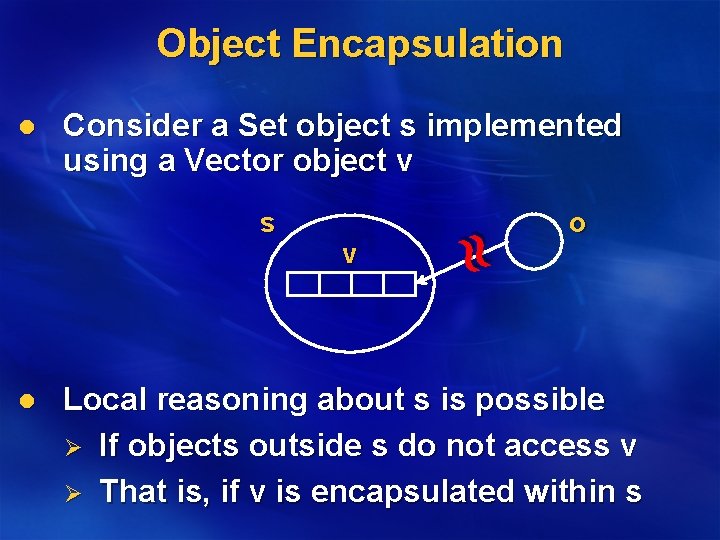
Object Encapsulation Consider a Set object s implemented using a Vector object v s l v ~~ l o Local reasoning about s is possible Ø If objects outside s do not access v Ø That is, if v is encapsulated within s
Encapsulation l In general, all objects that s depends on must be encapsulated within s l s depends on x if mutations of x affect behavior of s Ø Ø Leino, Nelson (SCR ’ 00) Detlefs, Leino, Nelson (SRC ’ 98)
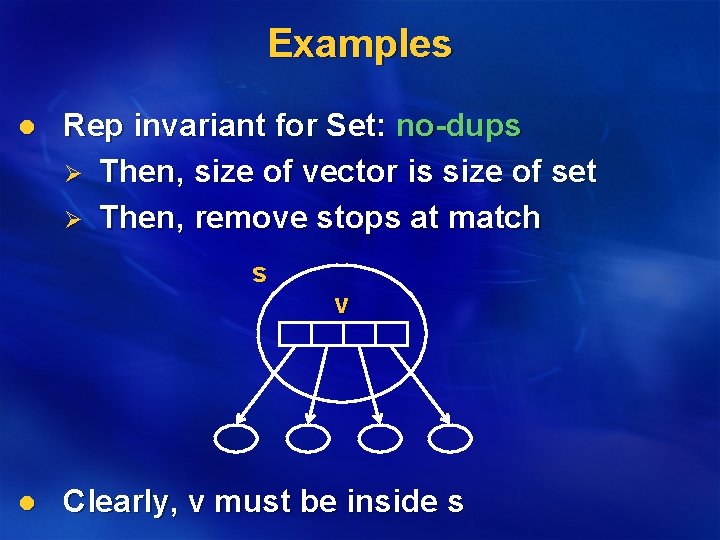
Examples l Rep invariant for Set: no-dups Ø Then, size of vector is size of set Ø Then, remove stops at match s l v Clearly, v must be inside s
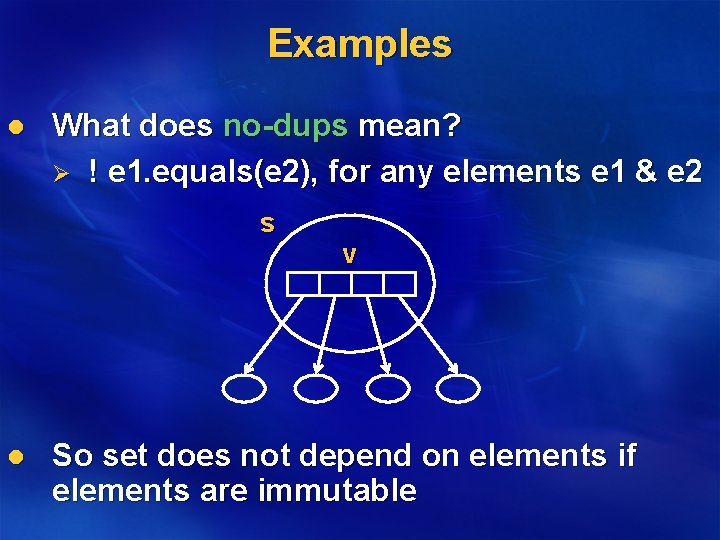
Examples l What does no-dups mean? Ø ! e 1. equals(e 2), for any elements e 1 & e 2 s l v So set does not depend on elements if elements are immutable
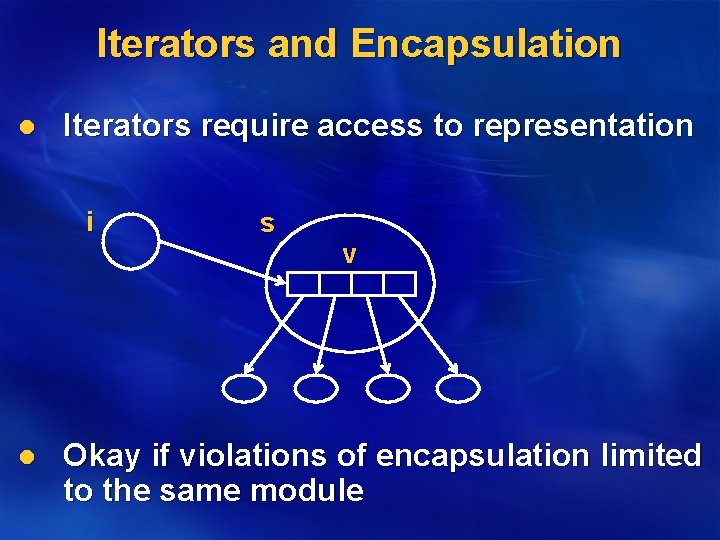
Iterators and Encapsulation l Iterators require access to representation i l s v Okay if violations of encapsulation limited to the same module
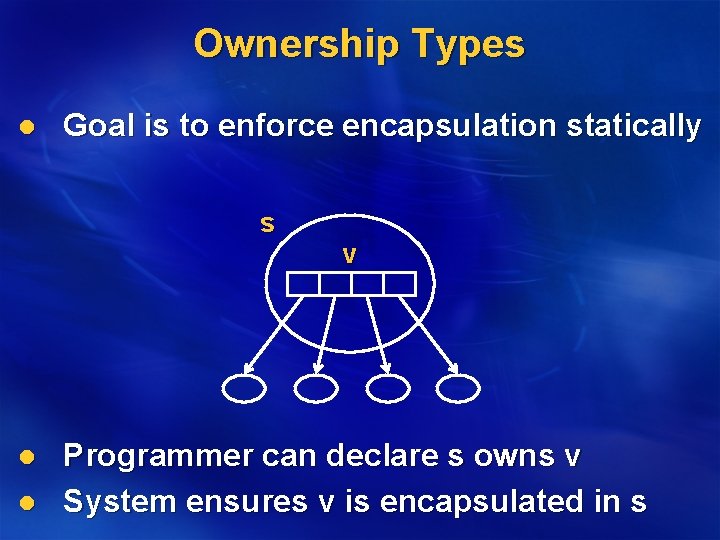
Ownership Types l Goal is to enforce encapsulation statically s l l v Programmer can declare s owns v System ensures v is encapsulated in s
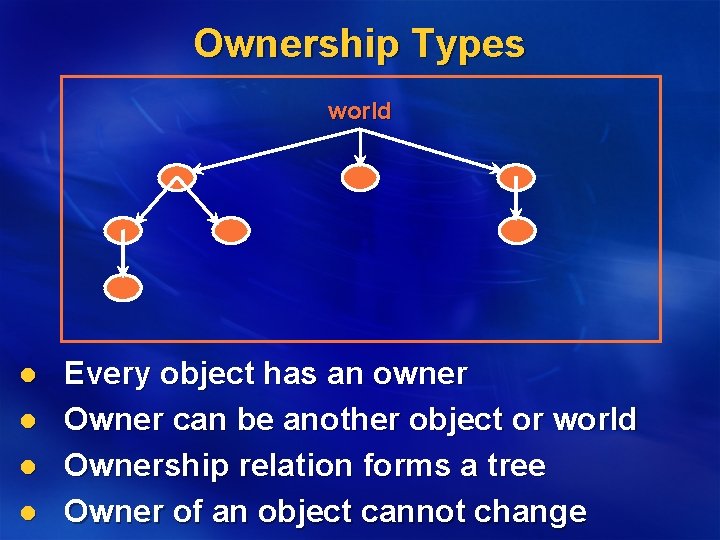
Ownership Types world l l Every object has an owner Owner can be another object or world Ownership relation forms a tree Owner of an object cannot change
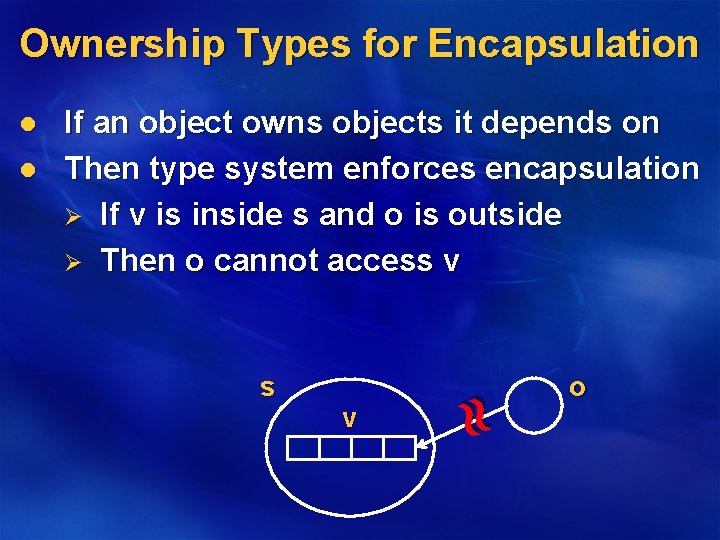
Ownership Types for Encapsulation l If an object owns objects it depends on Then type system enforces encapsulation Ø If v is inside s and o is outside Ø Then o cannot access v ~~ l o
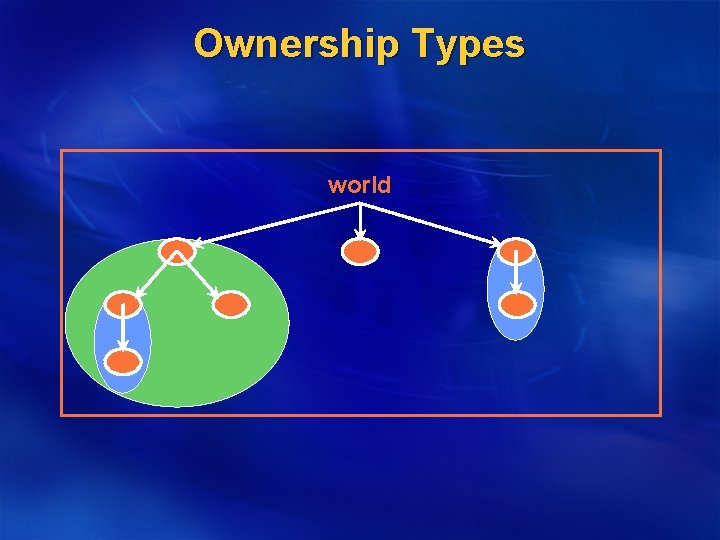
Ownership Types world
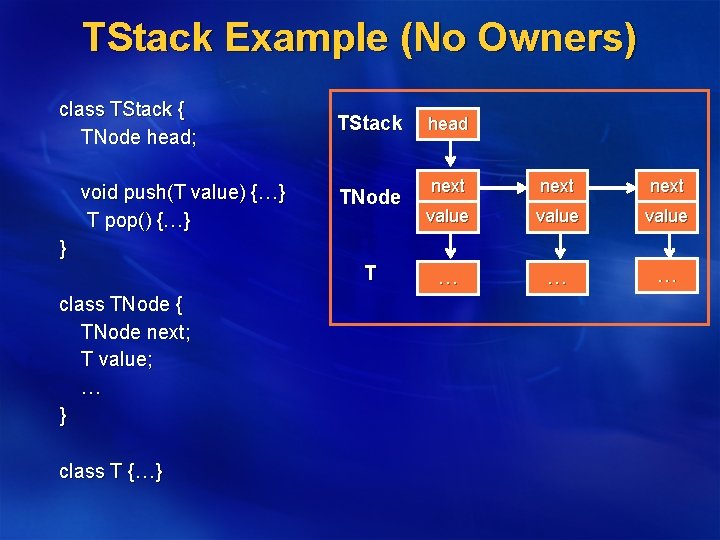
TStack Example (No Owners) class TStack { TNode head; void push(T value) {…} T pop() {…} TStack TNode head next value … … … } T class TNode { TNode next; T value; … } class T {…}
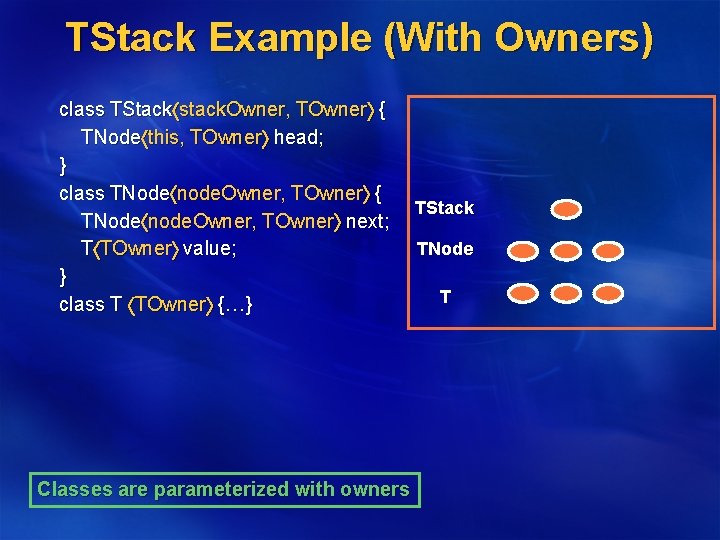
TStack Example (With Owners) class TStack stack. Owner, TOwner { TNode this, TOwner head; } class TNode node. Owner, TOwner { TNode node. Owner, TOwner next; T TOwner value; } class T TOwner {…} Classes are parameterized with owners TStack TNode T
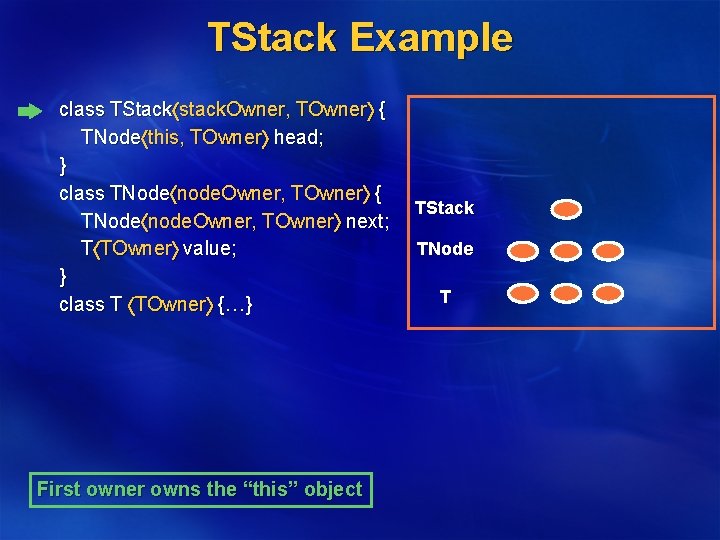
TStack Example class TStack stack. Owner, TOwner { TNode this, TOwner head; } class TNode node. Owner, TOwner { TNode node. Owner, TOwner next; T TOwner value; } class T TOwner {…} First owner owns the “this” object TStack TNode T
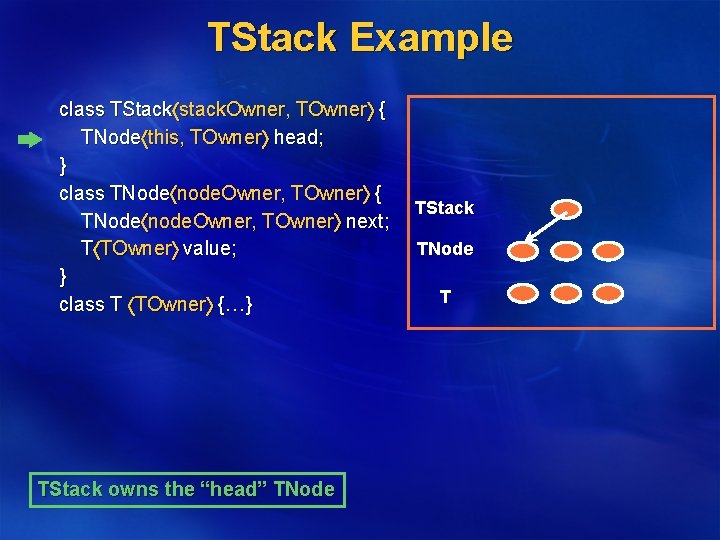
TStack Example class TStack stack. Owner, TOwner { TNode this, TOwner head; } class TNode node. Owner, TOwner { TNode node. Owner, TOwner next; T TOwner value; } class T TOwner {…} TStack owns the “head” TNode TStack TNode T
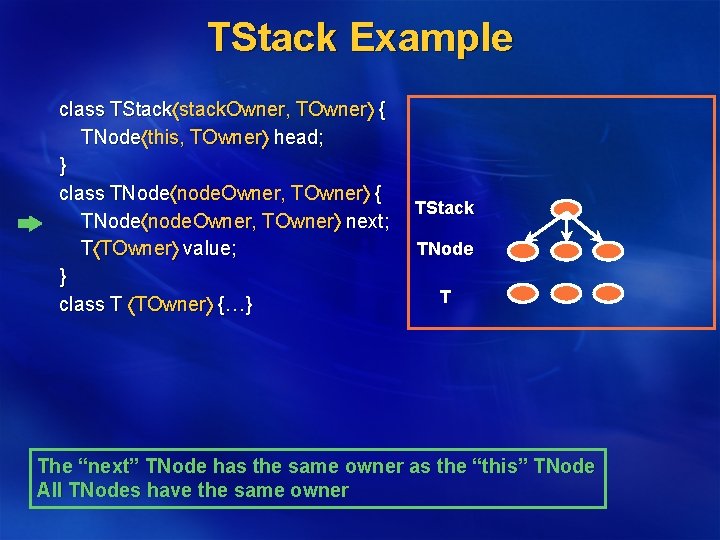
TStack Example class TStack stack. Owner, TOwner { TNode this, TOwner head; } class TNode node. Owner, TOwner { TNode node. Owner, TOwner next; T TOwner value; } class T TOwner {…} TStack TNode T The “next” TNode has the same owner as the “this” TNode All TNodes have the same owner
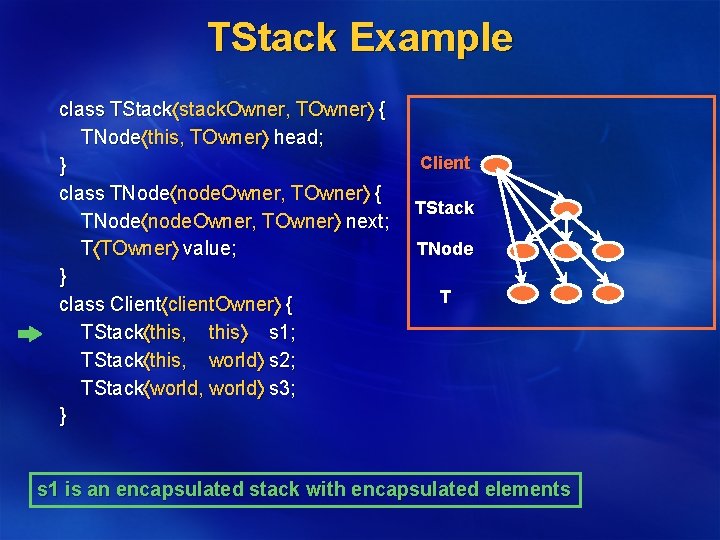
TStack Example class TStack stack. Owner, TOwner { TNode this, TOwner head; } class TNode node. Owner, TOwner { TNode node. Owner, TOwner next; T TOwner value; } class Client client. Owner { TStack this, this s 1; TStack this, world s 2; TStack world, world s 3; } Client TStack TNode T s 1 is an encapsulated stack with encapsulated elements
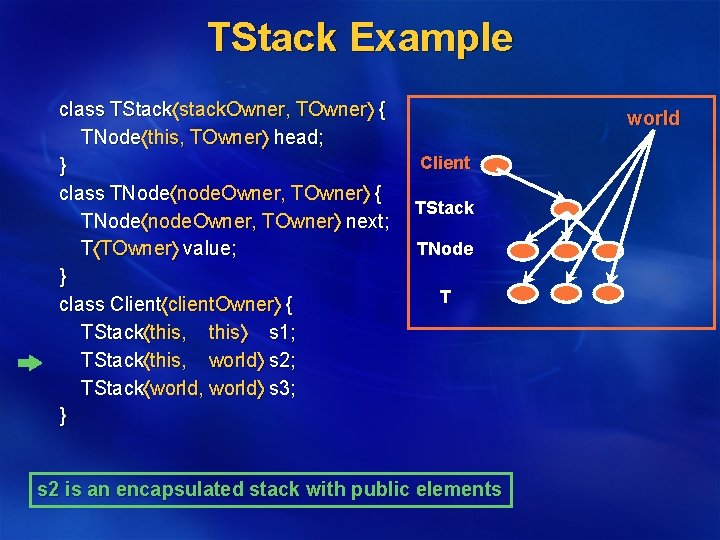
TStack Example class TStack stack. Owner, TOwner { TNode this, TOwner head; } class TNode node. Owner, TOwner { TNode node. Owner, TOwner next; T TOwner value; } class Client client. Owner { TStack this, this s 1; TStack this, world s 2; TStack world, world s 3; } world Client TStack TNode T s 2 is an encapsulated stack with public elements
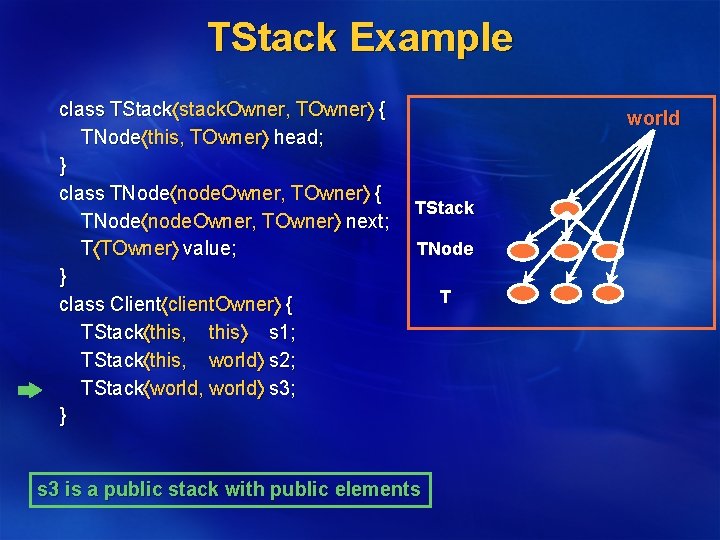
TStack Example class TStack stack. Owner, TOwner { TNode this, TOwner head; } class TNode node. Owner, TOwner { TNode node. Owner, TOwner next; T TOwner value; } class Client client. Owner { TStack this, this s 1; TStack this, world s 2; TStack world, world s 3; } world TStack TNode s 3 is a public stack with public elements T
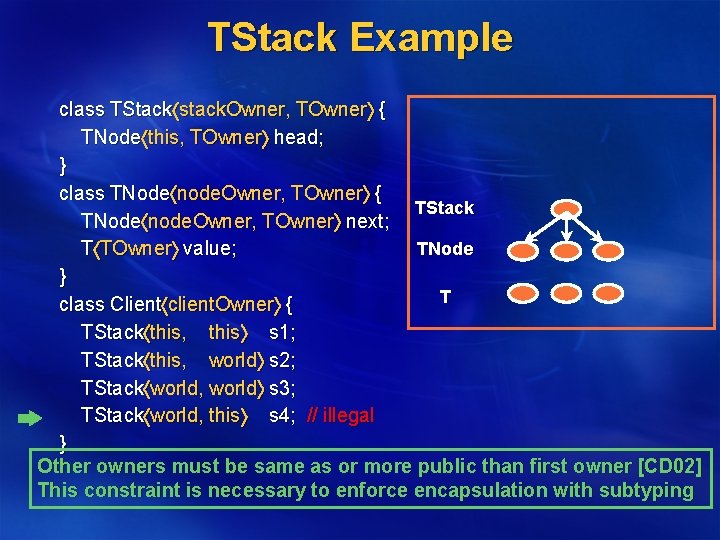
TStack Example class TStack stack. Owner, TOwner { TNode this, TOwner head; } class TNode node. Owner, TOwner { TStack TNode node. Owner, TOwner next; TNode T TOwner value; } T class Client client. Owner { TStack this, this s 1; TStack this, world s 2; TStack world, world s 3; TStack world, this s 4; // illegal } Other owners must be same as or more public than first owner [CD 02] This constraint is necessary to enforce encapsulation with subtyping
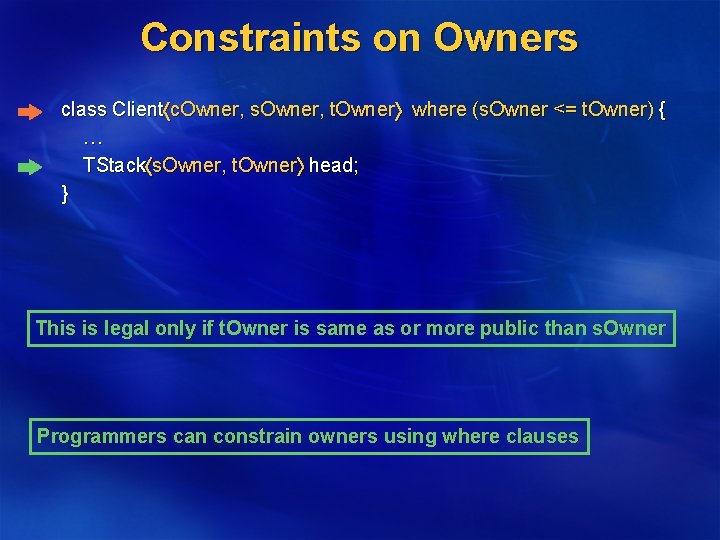
Constraints on Owners class Client c. Owner, s. Owner, t. Owner where (s. Owner <= t. Owner) { … TStack s. Owner, t. Owner head; } This is legal only if t. Owner is same as or more public than s. Owner Programmers can constrain owners using where clauses
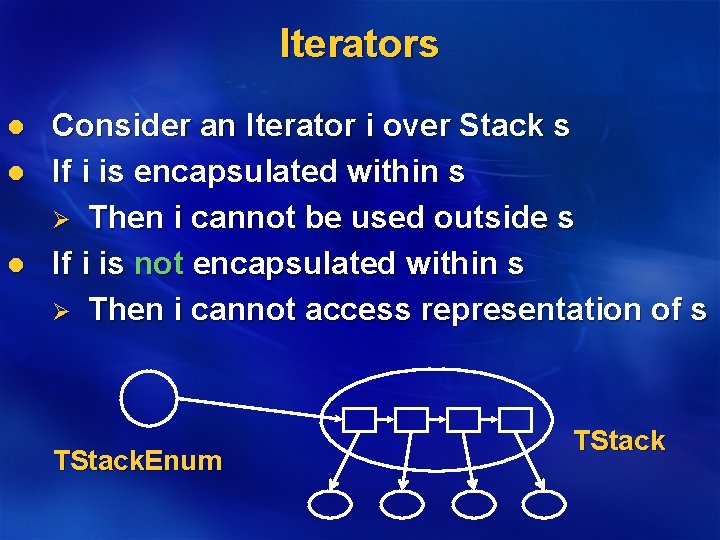
Iterators l l l Consider an Iterator i over Stack s If i is encapsulated within s Ø Then i cannot be used outside s If i is not encapsulated within s Ø Then i cannot access representation of s TStack. Enum TStack
Solution l Use inner classes l Gives desired access to representation Yet, satisfies our modularity goal l
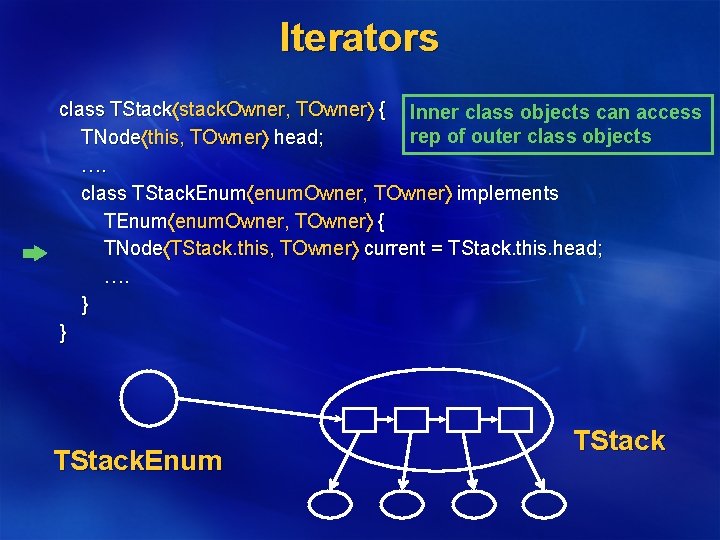
Iterators class TStack stack. Owner, TOwner { Inner class objects can access rep of outer class objects TNode this, TOwner head; …. class TStack. Enum enum. Owner, TOwner implements TEnum enum. Owner, TOwner { TNode TStack. this, TOwner current = TStack. this. head; …. } } TStack. Enum TStack
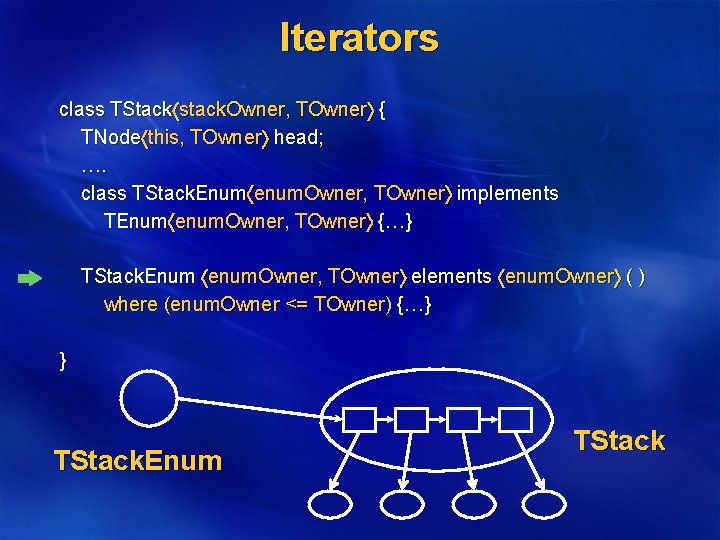
Iterators class TStack stack. Owner, TOwner { TNode this, TOwner head; …. class TStack. Enum enum. Owner, TOwner implements TEnum enum. Owner, TOwner {…} TStack. Enum enum. Owner, TOwner elements enum. Owner ( ) where (enum. Owner <= TOwner) {…} } TStack. Enum TStack
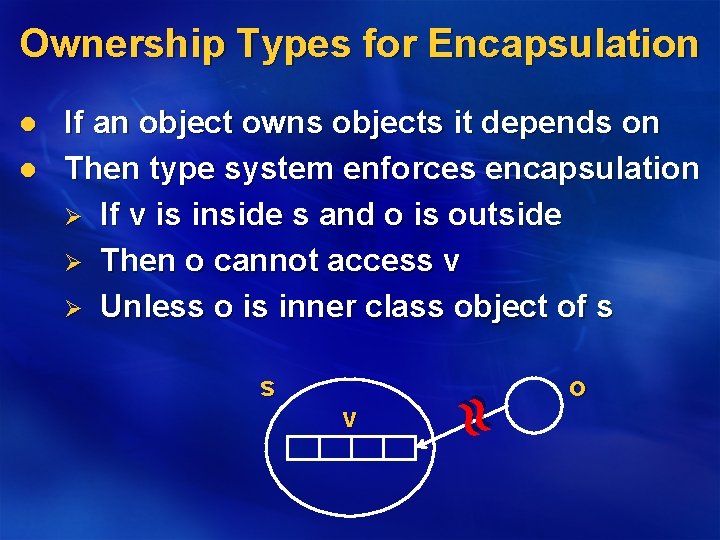
Ownership Types for Encapsulation l If an object owns objects it depends on Then type system enforces encapsulation Ø If v is inside s and o is outside Ø Then o cannot access v Ø Unless o is inner class object of s s v ~~ l o
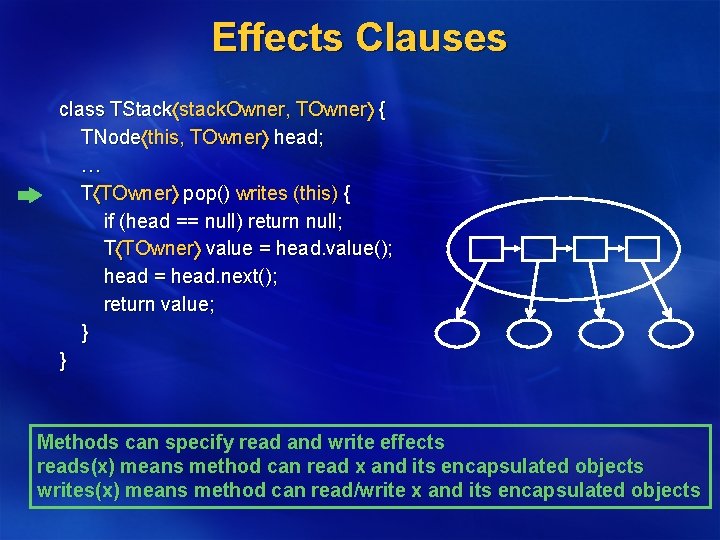
Effects Clauses class TStack stack. Owner, TOwner { TNode this, TOwner head; … T TOwner pop() writes (this) { if (head == null) return null; T TOwner value = head. value(); head = head. next(); return value; } } Methods can specify read and write effects reads(x) means method can read x and its encapsulated objects writes(x) means method can read/write x and its encapsulated objects
Related Work l Types augmented with owners Ø l Support for subtyping Ø l Clarke, Potter, Noble (OOPSLA ’ 98) Clarke, Drossopoulou (OOPSLA ’ 02) Owners combined with effects clauses Ø Boyapati, Rinard (OOPSLA ’ 01)
Summary l Ownership types capture dependencies l Extension for inner class objects allows iterators and wrappers Approach provides expressive power, yet ensures modular reasoning l l Effects clauses enhance modular reasoning
Applications l Safe upgrades in persistent object stores l Preventing data races and deadlocks Ø l Safe region-based memory management Ø l Boyapati, Lee, Rinard (OOPSLA ’ 01) (OOPSLA ’ 02) Boyapati, Salcianu, Beebee, Rinard (MIT ’ 02) Program understanding Ø Aldrich, Kostadinov, Chambers (OOPSLA ’ 02)
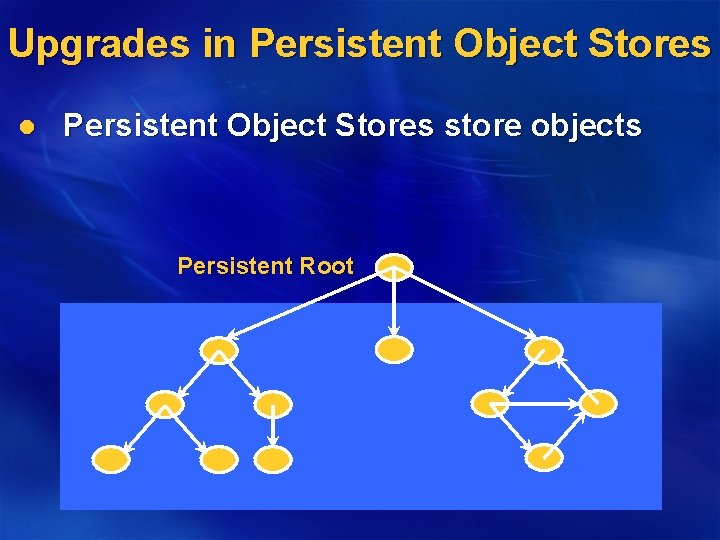
Upgrades in Persistent Object Stores l Persistent Object Stores store objects Persistent Root
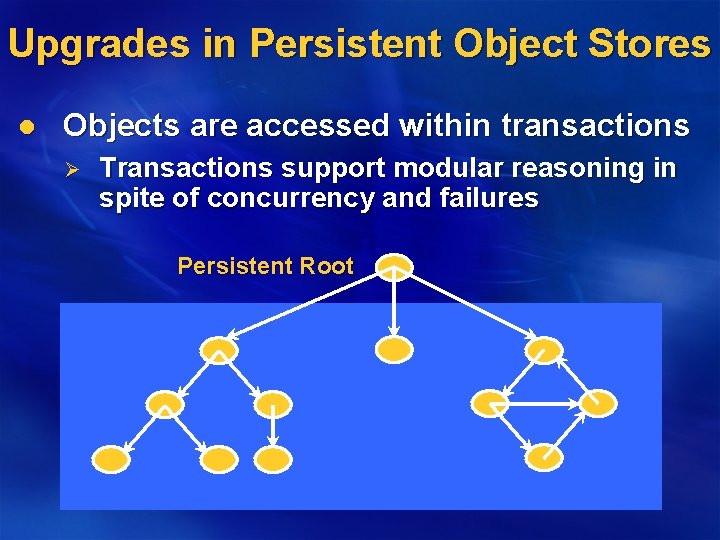
Upgrades in Persistent Object Stores l Objects are accessed within transactions Ø Transactions support modular reasoning in spite of concurrency and failures Persistent Root
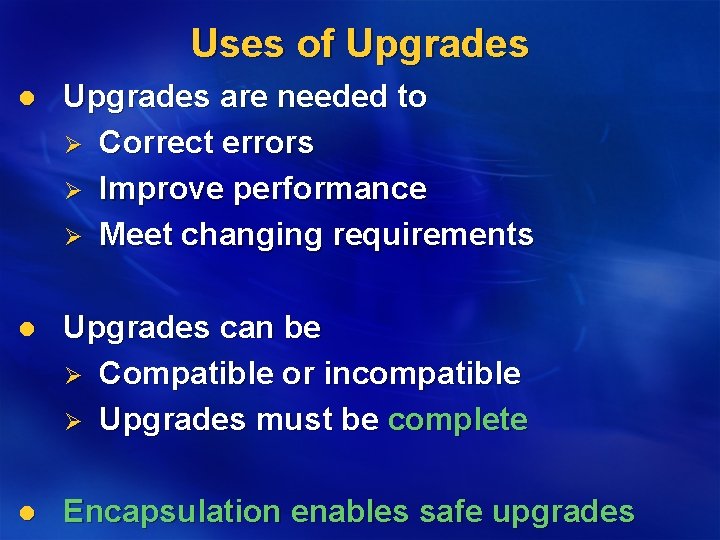
Uses of Upgrades l Upgrades are needed to Ø Correct errors Ø Improve performance Ø Meet changing requirements l Upgrades can be Ø Compatible or incompatible Ø Upgrades must be complete l Encapsulation enables safe upgrades
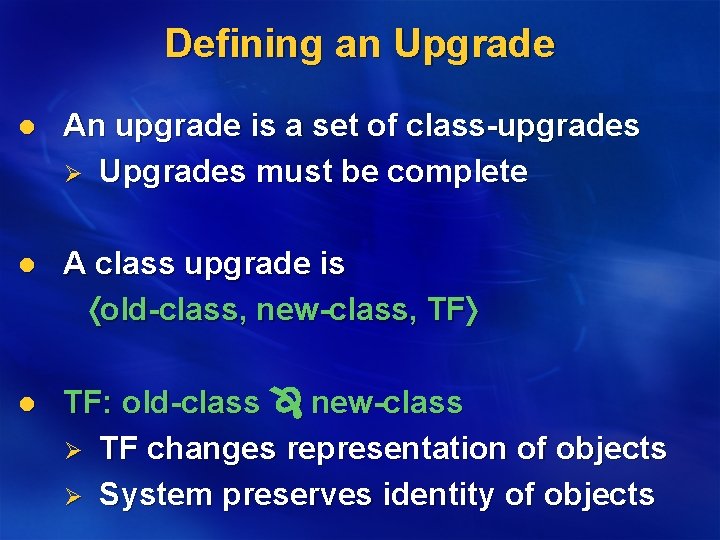
Defining an Upgrade l An upgrade is a set of class-upgrades Ø Upgrades must be complete l A class upgrade is old-class, new-class, TF l TF: old-class new-class Ø TF changes representation of objects Ø System preserves identity of objects
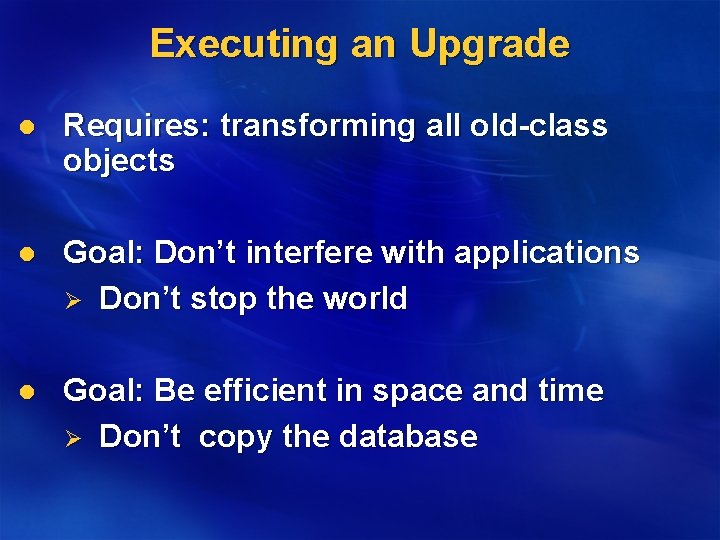
Executing an Upgrade l Requires: transforming all old-class objects l Goal: Don’t interfere with applications Ø Don’t stop the world l Goal: Be efficient in space and time Ø Don’t copy the database
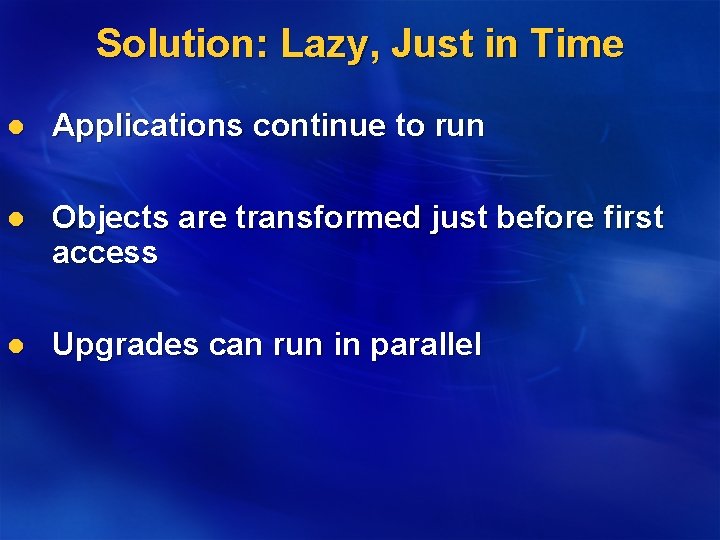
Solution: Lazy, Just in Time l Applications continue to run l Objects are transformed just before first access l Upgrades can run in parallel
Desired Semantics l Upgrades appear to run when installed Ø Serialized before all later application transactions l Upgrades appear to run in upgrade order l Within an upgrade, transforms run as if each were the first to run
Related Work l l l PJama: Atkinson, Dmitriev, Hamilton (POS ’ 00) Orion: Banerjee, Kim, Korth (Sigmod ’ 87) O 2: Deux et al (IEEE TKDE ’ 90) OTGen: Lerner, Habermann (OOPSLA ’ 90) Gemstone: Penney, Stein (OOPSLA ’ 87)
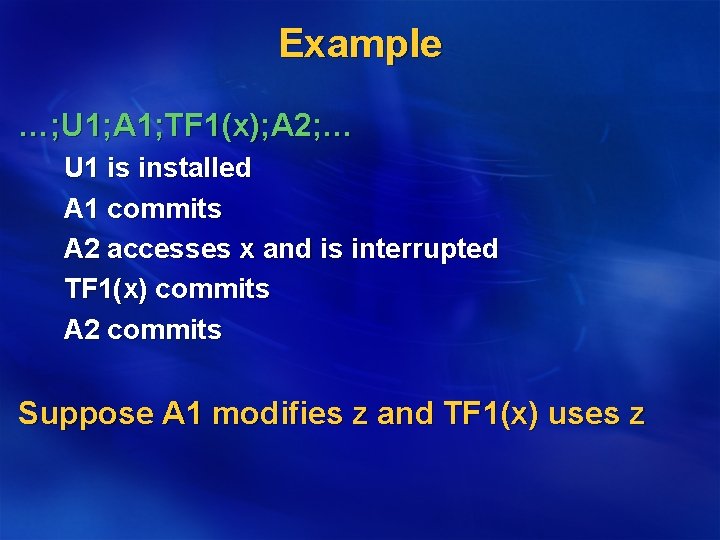
How System Works l l l Objects are transformed just before first access Ø Interrupt the application Ø Run earliest pending transform Ø Transform runs in its owns transaction Application continues after transform commits Transforms can be interrupted too
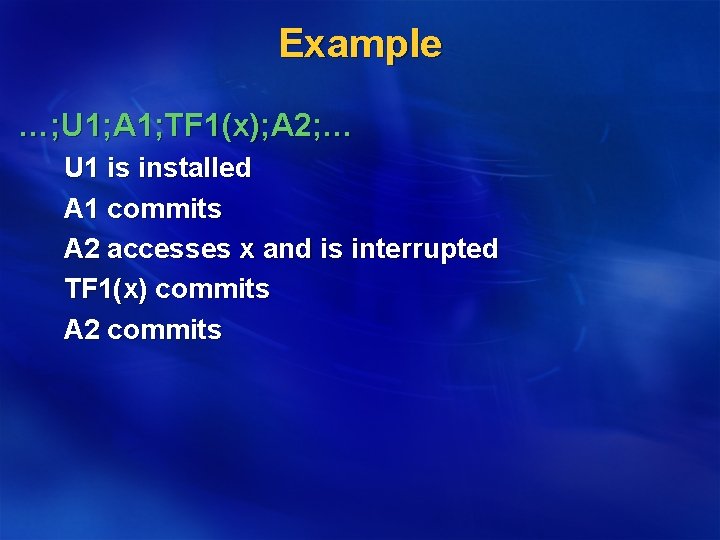
Example …; U 1; A 1; TF 1(x); A 2; … U 1 is installed A 1 commits A 2 accesses x and is interrupted TF 1(x) commits A 2 commits
Example …; U 1; A 1; TF 1(x); A 2; … U 1 is installed A 1 commits A 2 accesses x and is interrupted TF 1(x) commits A 2 commits Suppose A 1 modifies z and TF 1(x) uses z
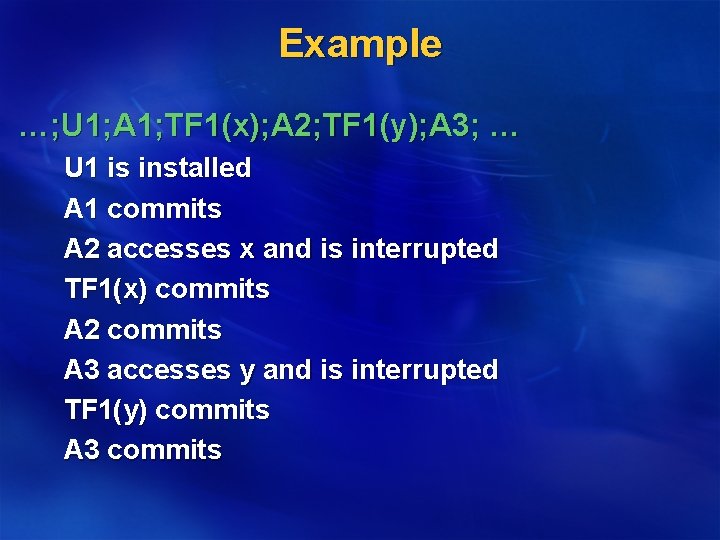
Example …; U 1; A 1; TF 1(x); A 2; TF 1(y); A 3; … U 1 is installed A 1 commits A 2 accesses x and is interrupted TF 1(x) commits A 2 commits A 3 accesses y and is interrupted TF 1(y) commits A 3 commits
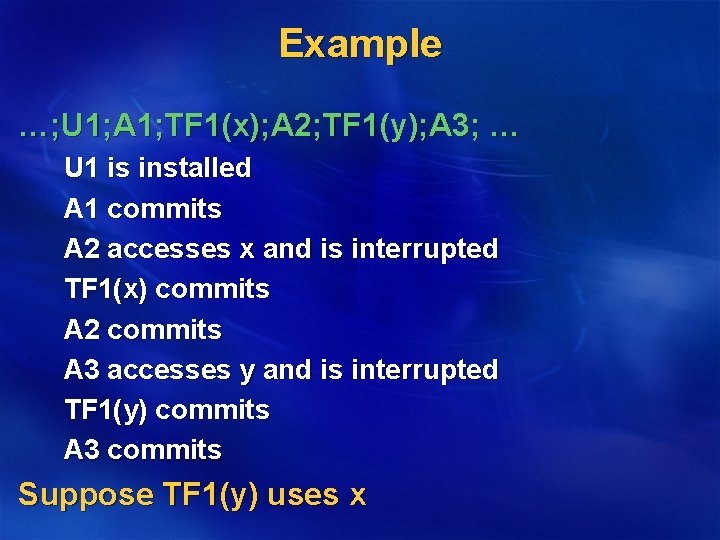
Example …; U 1; A 1; TF 1(x); A 2; TF 1(y); A 3; … U 1 is installed A 1 commits A 2 accesses x and is interrupted TF 1(x) commits A 2 commits A 3 accesses y and is interrupted TF 1(y) commits A 3 commits Suppose TF 1(y) uses x
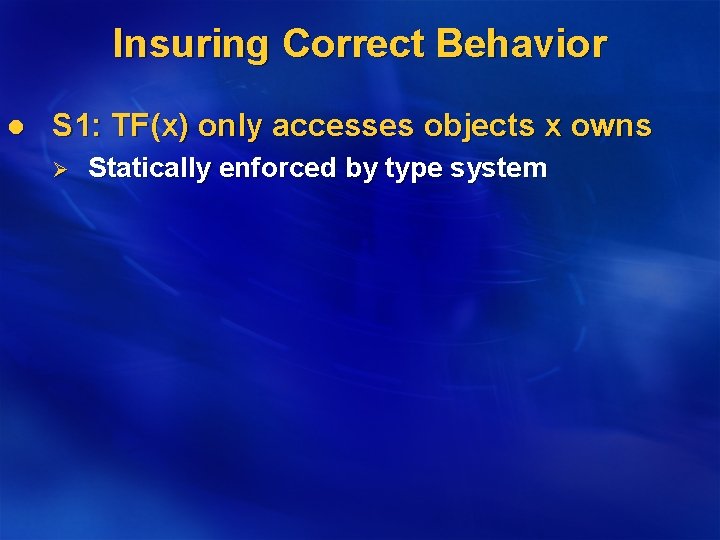
Insuring Correct Behavior l S 1: TF(x) only accesses objects x owns Ø Statically enforced by type system
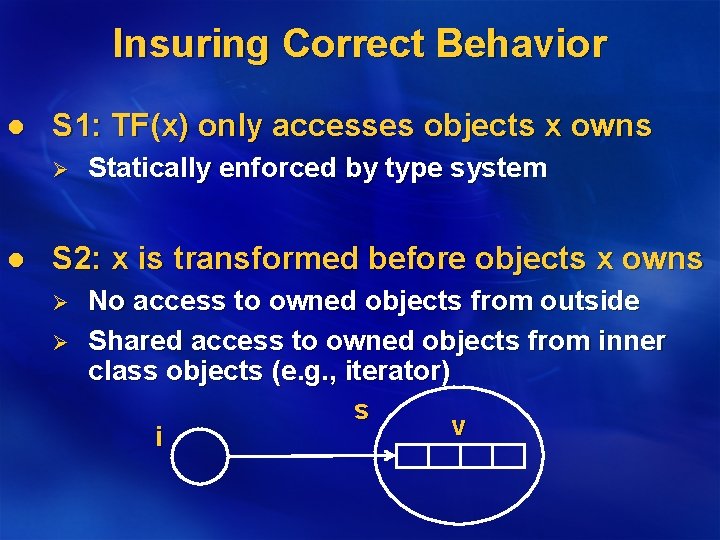
Insuring Correct Behavior l S 1: TF(x) only accesses objects x owns Ø l Statically enforced by type system S 2: x is transformed before objects x owns Ø Ø No access to owned objects from outside Shared access to owned objects from inner class objects (e. g. , iterator) s v i
Insuring Correct Behavior l l l S 1: TF(x) only accesses objects x owns S 2: x is transformed before objects x owns Plus basic lazy scheme Ø Ø Ø Applications don’t interfere with transforms Transforms of unrelated objects don’t interfere Transforms of related objects run in proper order (owner before owned)
Modular Reasoning l l S 1: TF(x) only accesses objects x owns S 2: x is transformed before objects x owns Plus basic lazy scheme Ensures modular reasoning: can reason about TF(x) as an extra method of x’s class
Conclusions l Modular reasoning is key l Ownership types support modular reasoning l Software upgrades benefit too
Ownership Types for Object Encapsulation Barbara Liskov Chandrasekhar Boyapati Liuba Shrira Laboratory for Computer Science Massachusetts Institute of Technology {liskov, chandra, liuba}@lcs. mit. edu
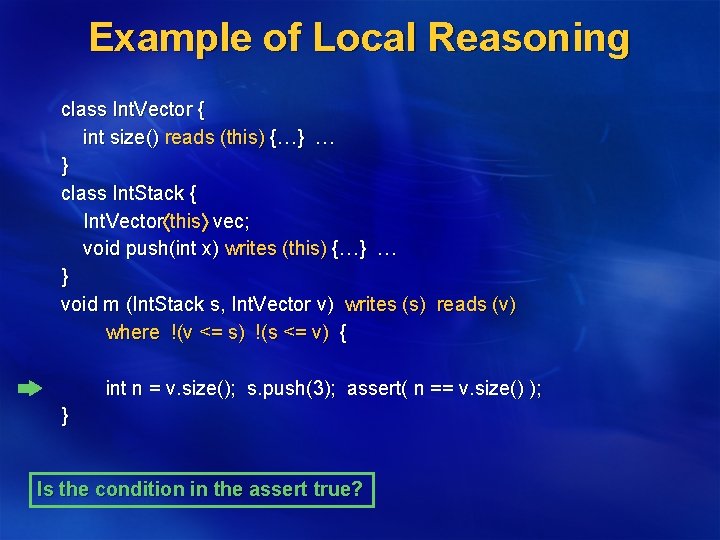
Example of Local Reasoning class Int. Vector { int size() reads (this) {…} … } class Int. Stack { Int. Vector this vec; void push(int x) writes (this) {…} … } void m (Int. Stack s, Int. Vector v) writes (s) reads (v) where !(v <= s) !(s <= v) { int n = v. size(); s. push(3); assert( n == v. size() ); } Is the condition in the assert true?
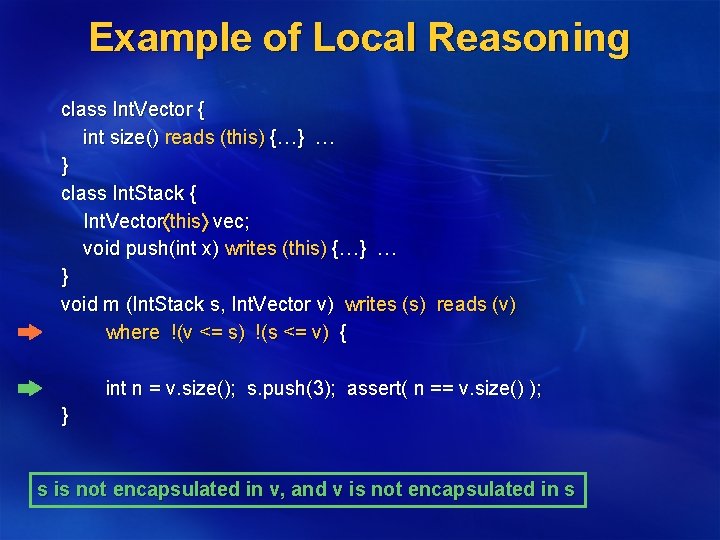
Example of Local Reasoning class Int. Vector { int size() reads (this) {…} … } class Int. Stack { Int. Vector this vec; void push(int x) writes (this) {…} … } void m (Int. Stack s, Int. Vector v) writes (s) reads (v) where !(v <= s) !(s <= v) { int n = v. size(); s. push(3); assert( n == v. size() ); } s is not encapsulated in v, and v is not encapsulated in s
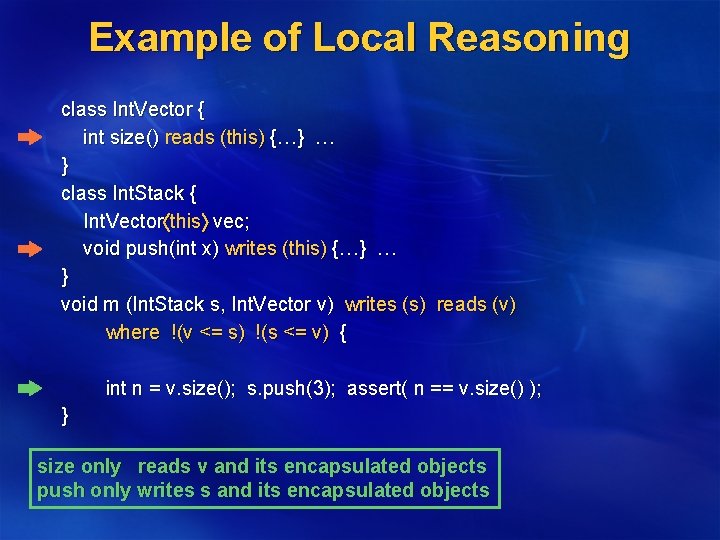
Example of Local Reasoning class Int. Vector { int size() reads (this) {…} … } class Int. Stack { Int. Vector this vec; void push(int x) writes (this) {…} … } void m (Int. Stack s, Int. Vector v) writes (s) reads (v) where !(v <= s) !(s <= v) { int n = v. size(); s. push(3); assert( n == v. size() ); } size only reads v and its encapsulated objects push only writes s and its encapsulated objects
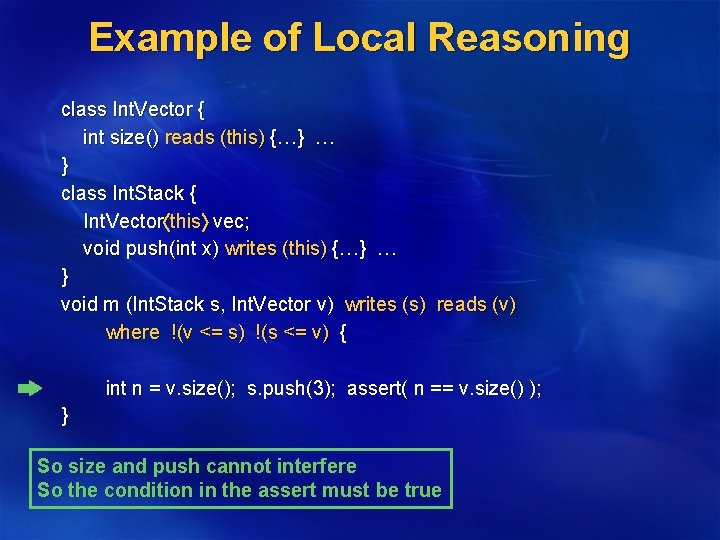
Example of Local Reasoning class Int. Vector { int size() reads (this) {…} … } class Int. Stack { Int. Vector this vec; void push(int x) writes (this) {…} … } void m (Int. Stack s, Int. Vector v) writes (s) reads (v) where !(v <= s) !(s <= v) { int n = v. size(); s. push(3); assert( n == v. size() ); } So size and push cannot interfere So the condition in the assert must be true
- Slides: 54