
OWASP Project Automated Threats to Web Applications Colin
OWASP Project: Automated Threats to Web Applications Colin Watson OWASP Newcastle, 27 th March 2018
• What is the Automated Threats project? • How to use the ontology • What’s new in versions 1. 1 and 1. 2? • Automated threats explained • Countermeasures explained Post Pizza AGENDA
OWASP Automated Threats to Web Applications WHAT IS THIS PROJECT ABOUT?
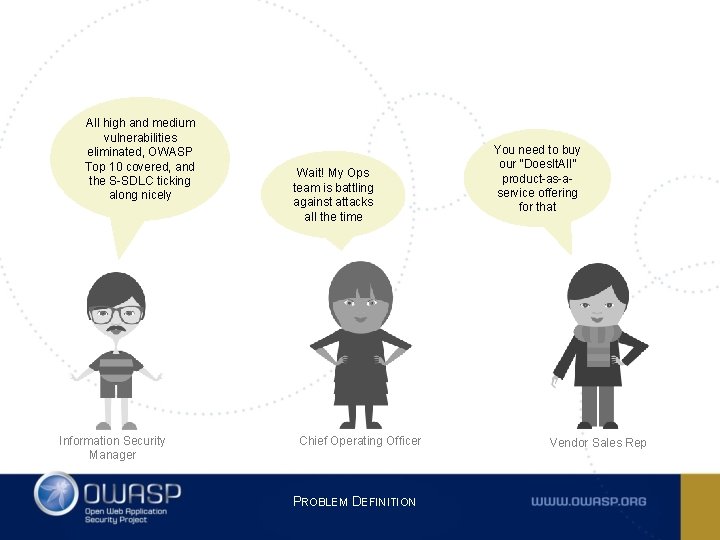
All high and medium vulnerabilities eliminated, OWASP Top 10 covered, and the S-SDLC ticking along nicely Information Security Manager Wait! My Ops team is battling against attacks all the time Chief Operating Officer PROBLEM DEFINITION You need to buy our “Does. It. All” product-as-aservice offering for that Vendor Sales Rep
• Automated threats Chief Operating Officer APPSENSOR DETECTION POINTS
• Continuous application security • Automated static analysis • Security testing automation • Vulnerability scanning • Application instrumentation • Attack detection & automated response • App. Sec dashboards • Threat indicator sharing • etc. Dev. Ops Lead GOOD AUTOMATION
• Account enumeration • Aggregation • Click fraud • Comment spam • Content scraping • etc. Malicious Automation BAD AUTOMATION
• Definition • Vocabulary • Guidance on detection and mitigation Vendor Sales Rep REQUIREMENT AND OBJECTIVES
• Threat events to web applications undertaken using automated actions • Abuse of functionality - misuse of inherent functionality and related design flaws, some of which are also referred to as business logic flaws • No coverage of implementation bugs • All the threats must require the web to exist for the threat to be materialised; thus attacks that can be achieved without the web are out of scope. Malicious Automation SCOPE
• The threat events are scenarios which are seen commonly by real operating web applications, and are multi-step and/or highly iterative and/or multiple weaknesses involved, and not primarily about events that relate to the tool-based exploitation of single-issue vulnerabilities of individual web applications. • Essentially the ontology needs to be a list of concise answers to the operational question “what is happening right now? ”. CEO AUTOMATED THREAT EVENT ONTOLOGY
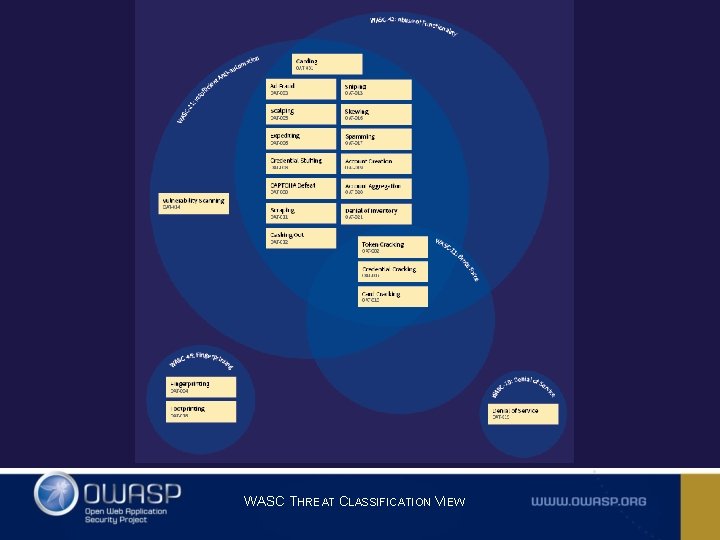
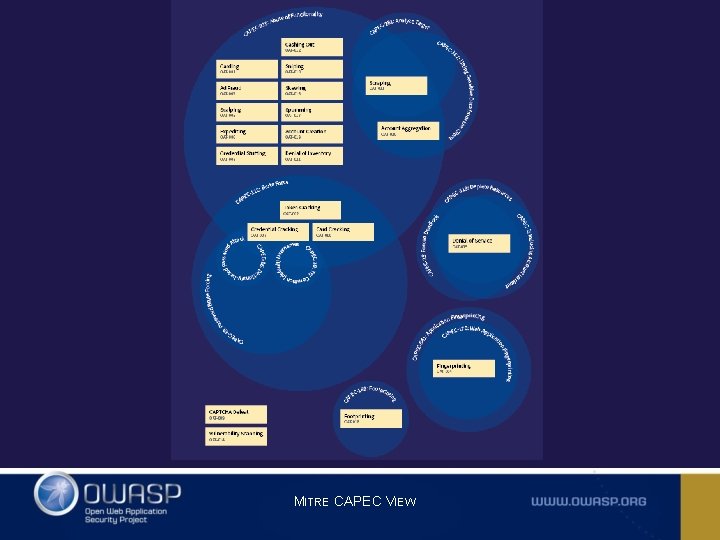
• Mitre Common Attack Pattern Enumeration and Classification (CAPEC) • Mitre Common Weakness Enumeration (CWE) • Web Application Security Consortium (WASC) Threat Classification • OWASP Top 10 [risks|controls|mobile|. . . ] • Lists of attack methods • etc. Malicious Automation OTHER LISTS
• Literature review – https: //www. owasp. org/index. php/OWASP_Automated_Threats_to_Web_A pplications#tab=Bibliography • Analysis • Comparison with other lists & taxonomies • Peer review – – – Professional colleagues Web application owners Web application developers Delegates at App. Sec EU 2015 via an online and printed survey form One-to-one interviews with participants of the OWASP Project Summit 2015 in Amsterdam – Others who found the project by search, or from coverage relating to a presentation to be given at App. Sec USA in San Francisco in September 2015. • Version 1, App. Sec USA 2015 Malicious Automation MANUAL PROCESS
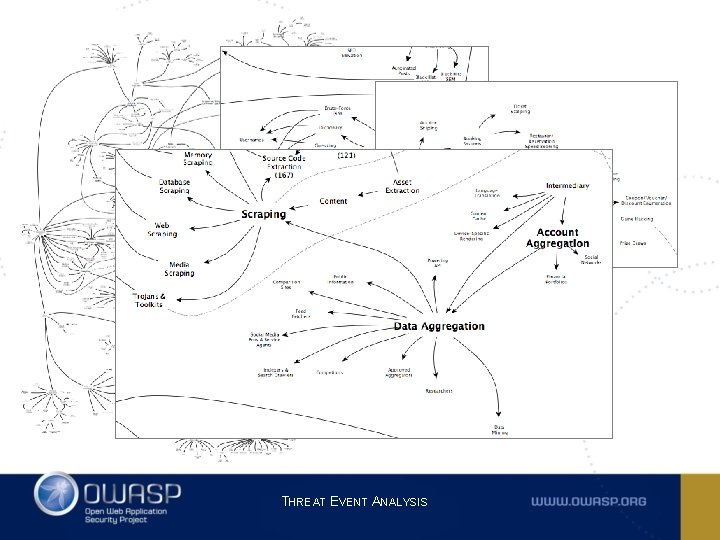
THREAT EVENT ANALYSIS
• Free PDF, print at cost hard copy from Lulu. com ISBN 978 -1 -329 -42709 -9, and wiki summary • Creative Commons Attribution-Share. Alike 3. 0 license
• Colin Watson – Founder and Co-leader • Tin Zaw – Co-leader • Other contributors – Jason Chan – Mark Hall – Andrew van der Stock – Roland Weber – Sumit Agarwal – Omri Iluz • Project sponsors – Distil Networks – Verizon Digital Media Services Paperclip+ AUTHORS, CONTRIBUTORS AND SPONSORS
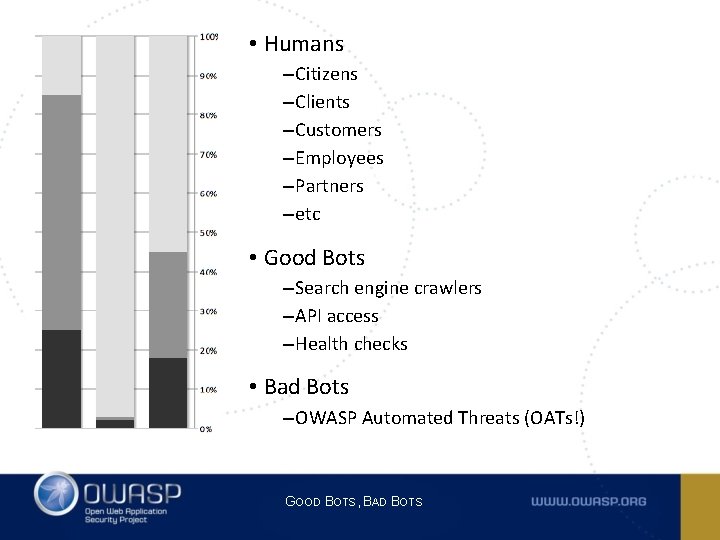
• Humans – Citizens – Clients – Customers – Employees – Partners – etc • Good Bots – Search engine crawlers – API access – Health checks • Bad Bots – OWASP Automated Threats (OATs!) GOOD BOTS, BAD BOTS
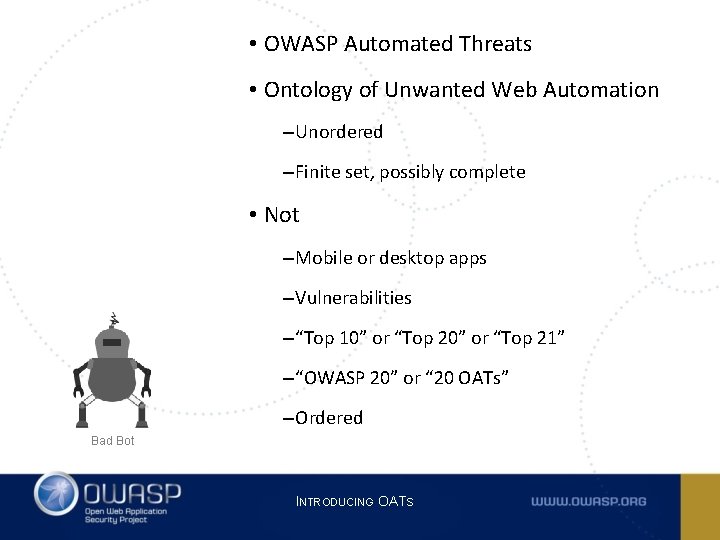
• OWASP Automated Threats • Ontology of Unwanted Web Automation – Unordered – Finite set, possibly complete • Not – Mobile or desktop apps – Vulnerabilities – “Top 10” or “Top 21” – “OWASP 20” or “ 20 OATs” – Ordered Bad Bot INTRODUCING OATS
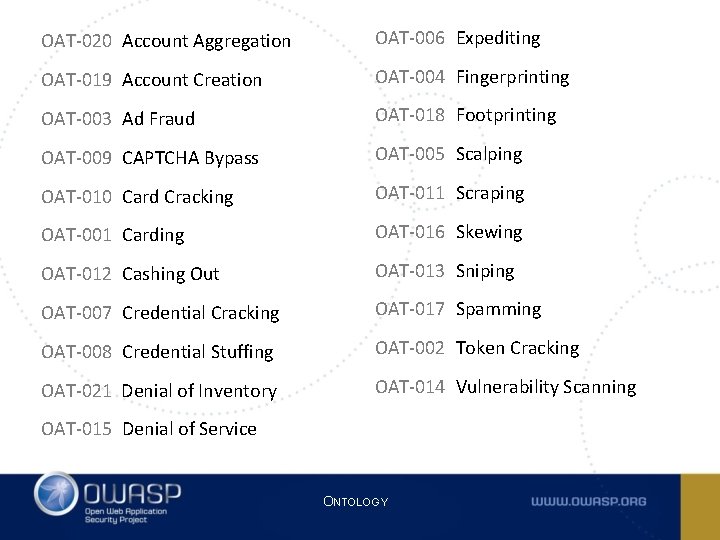
OAT-020 Account Aggregation OAT-006 Expediting OAT-019 Account Creation OAT-004 Fingerprinting OAT-003 Ad Fraud OAT-018 Footprinting OAT-009 CAPTCHA Bypass OAT-005 Scalping OAT-010 Card Cracking OAT-011 Scraping OAT-001 Carding OAT-016 Skewing OAT-012 Cashing Out OAT-013 Sniping OAT-007 Credential Cracking OAT-017 Spamming OAT-008 Credential Stuffing OAT-002 Token Cracking OAT-021 Denial of Inventory OAT-014 Vulnerability Scanning OAT-015 Denial of Service ONTOLOGY
Use Case Scenarios GREAT! HOW DO I USE IT?
1. Defining application development security requirements Information Security Manager USE CASE SCENARIO 1
2. Sharing intelligence within a sector CISO USE CASE SCENARIO 2
3. Exchanging threat data between CERTs Analyst USE CASE SCENARIO 3
4. Enhancing application penetration test findings Penetration Test Lead USE CASE SCENARIO 4
5. Specifying service acquisition needs Purchasing Manager USE CASE SCENARIO 5
6. Characterising vendor services Vendor Sales Rep USE CASE SCENARIO 6
As of March 2018 SO, WHAT’S NEW?
• v 1. 1 November 2016 • Introduction of 14 countermeasure classes • Application of generic countermeasures to specific threats • More threat specific symptoms Analyst WHAT’S NEW IN V 1. 1?
• v 1. 2 February 2018 • Changes to OWASP Automated Threats – OAT-021 Denial of Inventory (new!) – OAT-009 CAPTCHA Bypass -> CAPTCHA Defeat • Refining Countermeasures • Better matching Threats and Countermeasures • Fixing typos and layout errors Other Thingies WHAT’S NEW IN V 1. 2?
• Type of Project: – Documentation • Purpose of Review: – Incubator to Lab • Overall Status: – On Track: Project is progressing quite well • Reviewers: – Matt Tesauro, Igor Andriushchenko, and Gabriel Mendez Justiniano • Reviewed Nov 2016, promoted to Labs status Sep 2017 PROJECT REVIEW 2016
OWASP Automated Threats WALK THROUGH OF SOME EXAMPLES
• Business problem – Attacker takes over accounts of legitimate users, customer complaints, reduced customer service performance, data changed without consent, lost product/service • Technical threats – OAT-007 Credential Cracking – OAT-008 Credential Stuffing EXAMPLE: ACCOUNT TAKEOVER
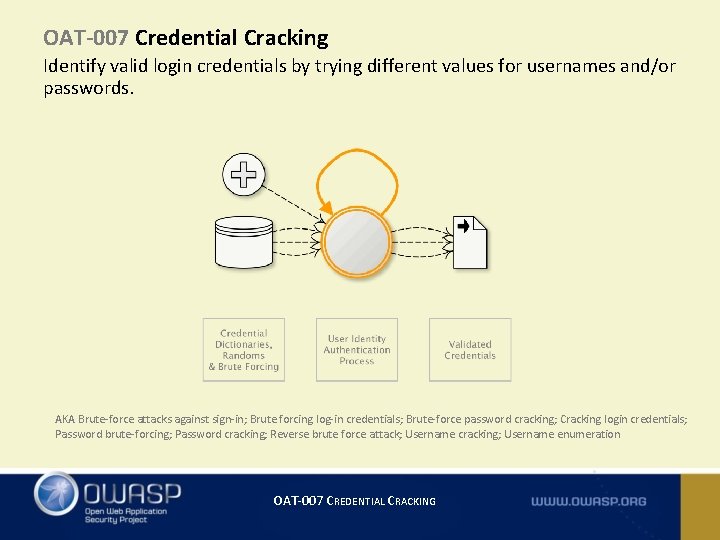
OAT-007 Credential Cracking Identify valid login credentials by trying different values for usernames and/or passwords. AKA Brute-force attacks against sign-in; Brute forcing log-in credentials; Brute-force password cracking; Cracking login credentials; Password brute-forcing; Password cracking; Reverse brute force attack; Username cracking; Username enumeration OAT-007 CREDENTIAL CRACKING
OAT-008 Credential Stuffing Mass log in attempts used to verify the validity of stolen username/password pairs. AKA Account checker attack; Account checking; Account takeover attack; Login Stuffing; Password list attack; Password re-use; Stolen credentials; Use of stolen credentials OAT-008 CREDENTIAL STUFFING
• Business problem – High card chargeback rates and transaction costs • Technical threats – OAT-001 Carding – OAT-010 Card Cracking – OAT-012 Cashing Out EXAMPLE: CREDIT CARD ABUSE
OAT-001 Carding Multiple payment authorisation attempts used to verify the validity of bulk stolen payment card data. AKA Card stuffing; Credit card stuffing; Card verification OAT-001 CARDING
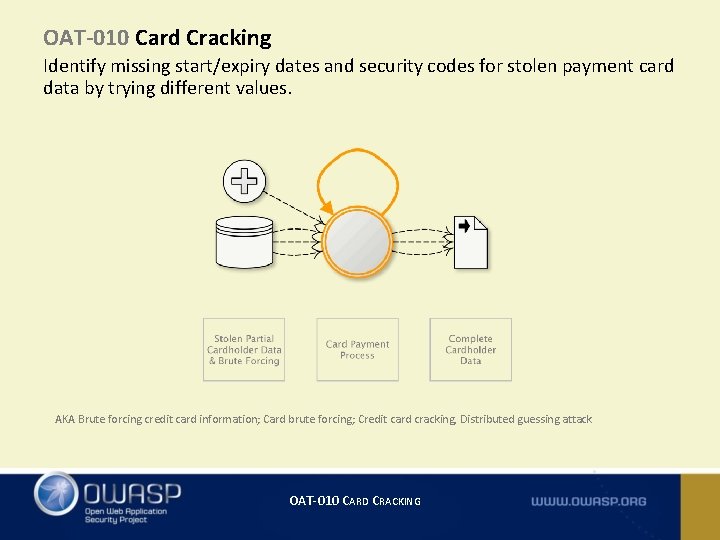
OAT-010 Card Cracking Identify missing start/expiry dates and security codes for stolen payment card data by trying different values. AKA Brute forcing credit card information; Card brute forcing; Credit card cracking, Distributed guessing attack OAT-010 CARD CRACKING
OAT-012 Cashing Out Buy goods or obtain cash utilising validated stolen payment card or other user account data. AKA Deetsing, Money laundering; Online credit card fraud; Online payment card fraud; Refund fraud; Stolen identity refund fraud (SIRF) OAT-012 CASHING OUT
• Business problem – E-commerce stats must be skewed – click to purchase ratio is way off compared to historic data • Technical threats – OAT-003 Ad Fraud – OAT-016 Skewing EXAMPLE: MEANINGLESS MANAGEMENT STATS
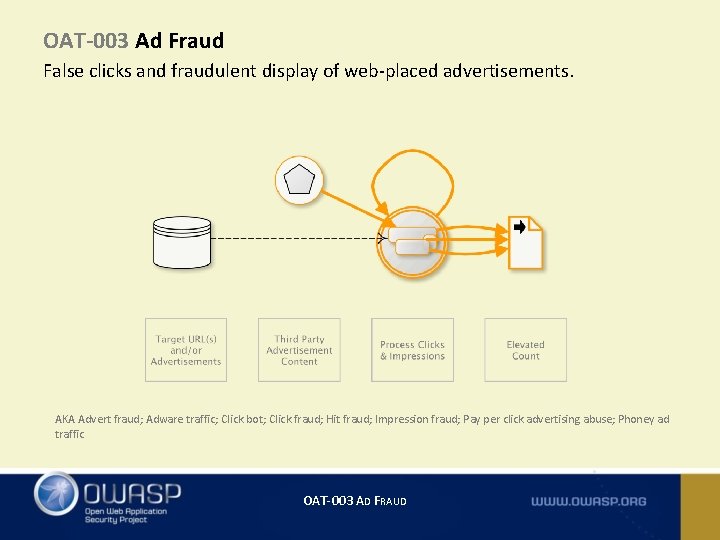
OAT-003 Ad Fraud False clicks and fraudulent display of web-placed advertisements. AKA Advert fraud; Adware traffic; Click bot; Click fraud; Hit fraud; Impression fraud; Pay per click advertising abuse; Phoney ad traffic OAT-003 AD FRAUD
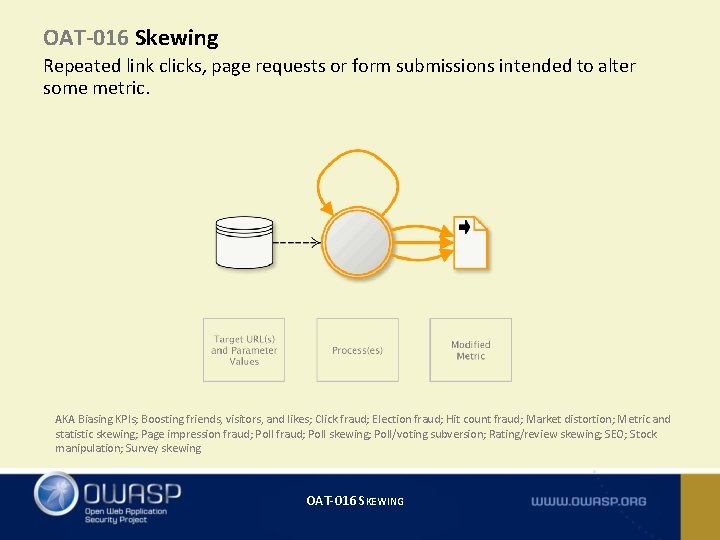
OAT-016 Skewing Repeated link clicks, page requests or form submissions intended to alter some metric. AKA Biasing KPIs; Boosting friends, visitors, and likes; Click fraud; Election fraud; Hit count fraud; Market distortion; Metric and statistic skewing; Page impression fraud; Poll skewing; Poll/voting subversion; Rating/review skewing; SEO; Stock manipulation; Survey skewing OAT-016 SKEWING
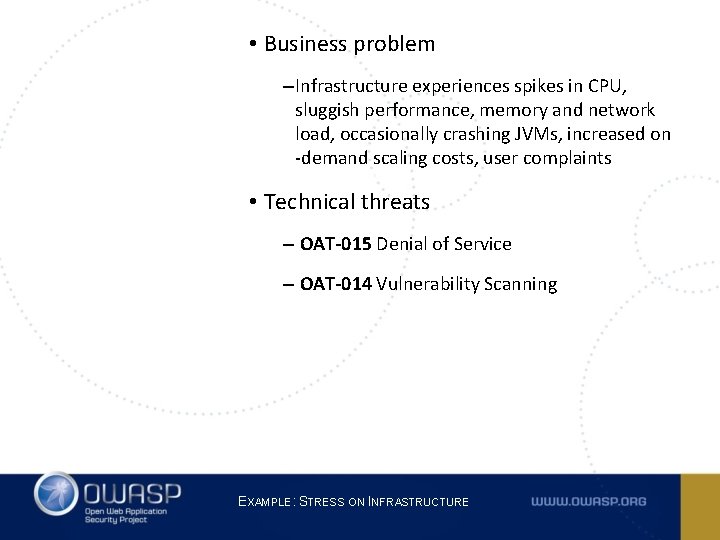
• Business problem – Infrastructure experiences spikes in CPU, sluggish performance, memory and network load, occasionally crashing JVMs, increased on -demand scaling costs, user complaints • Technical threats – OAT-015 Denial of Service – OAT-014 Vulnerability Scanning EXAMPLE: STRESS ON INFRASTRUCTURE
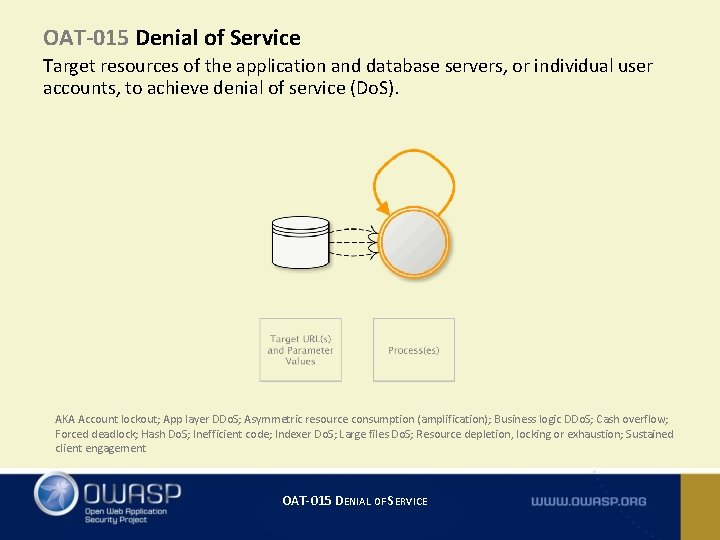
OAT-015 Denial of Service Target resources of the application and database servers, or individual user accounts, to achieve denial of service (Do. S). AKA Account lockout; App layer DDo. S; Asymmetric resource consumption (amplification); Business logic DDo. S; Cash overflow; Forced deadlock; Hash Do. S; Inefficient code; Indexer Do. S; Large files Do. S; Resource depletion, locking or exhaustion; Sustained client engagement OAT-015 DENIAL OF SERVICE
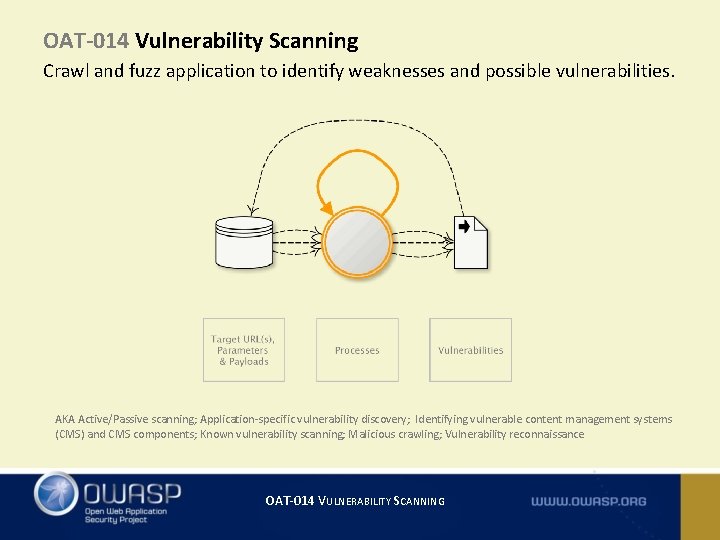
OAT-014 Vulnerability Scanning Crawl and fuzz application to identify weaknesses and possible vulnerabilities. AKA Active/Passive scanning; Application-specific vulnerability discovery; Identifying vulnerable content management systems (CMS) and CMS components; Known vulnerability scanning; Malicious crawling; Vulnerability reconnaissance OAT-014 VULNERABILITY SCANNING
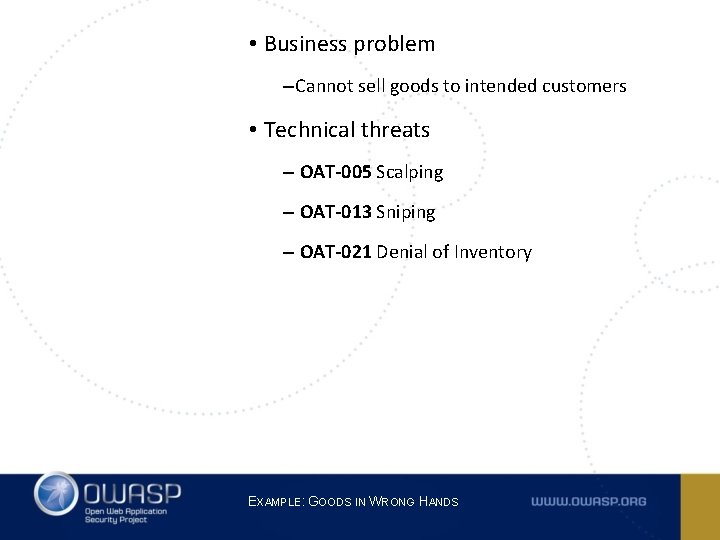
• Business problem – Cannot sell goods to intended customers • Technical threats – OAT-005 Scalping – OAT-013 Sniping – OAT-021 Denial of Inventory EXAMPLE: GOODS IN WRONG HANDS
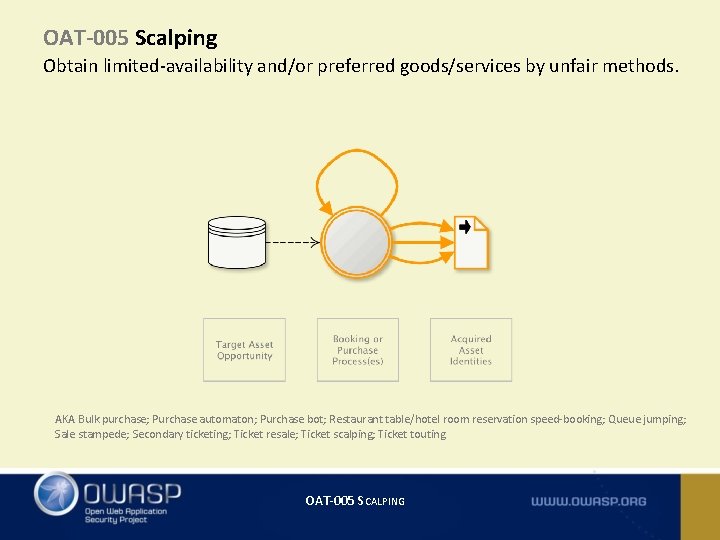
OAT-005 Scalping Obtain limited-availability and/or preferred goods/services by unfair methods. AKA Bulk purchase; Purchase automaton; Purchase bot; Restaurant table/hotel room reservation speed-booking; Queue jumping; Sale stampede; Secondary ticketing; Ticket resale; Ticket scalping; Ticket touting OAT-005 SCALPING
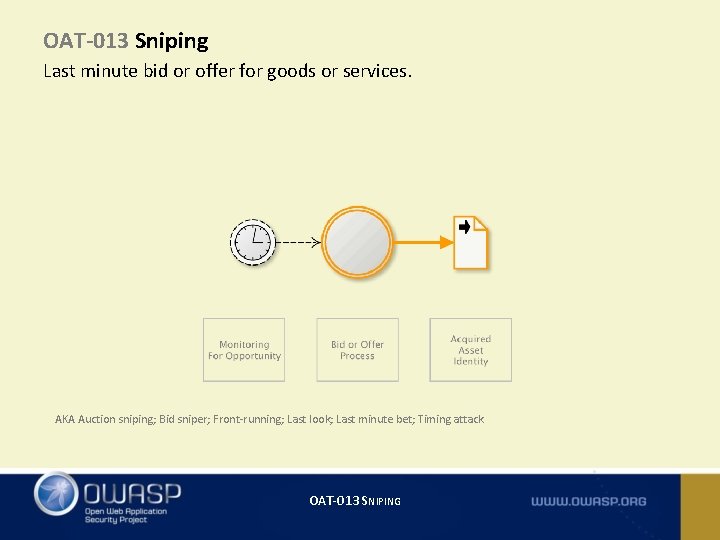
OAT-013 Sniping Last minute bid or offer for goods or services. AKA Auction sniping; Bid sniper; Front-running; Last look; Last minute bet; Timing attack OAT-013 SNIPING
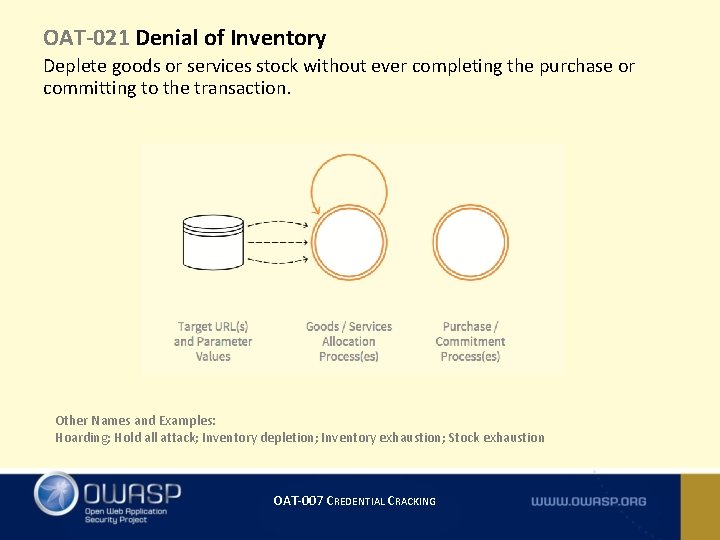
OAT-021 Denial of Inventory Deplete goods or services stock without ever completing the purchase or committing to the transaction. Other Names and Examples: Hoarding; Hold all attack; Inventory depletion; Inventory exhaustion; Stock exhaustion OAT-007 CREDENTIAL CRACKING
OWASP Automated Threats COMBINED EXAMPLES
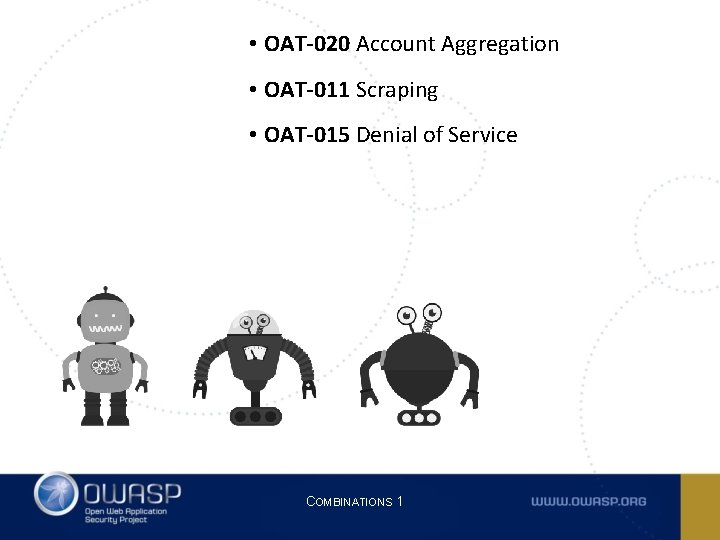
• OAT-020 Account Aggregation • OAT-011 Scraping • OAT-015 Denial of Service COMBINATIONS 1
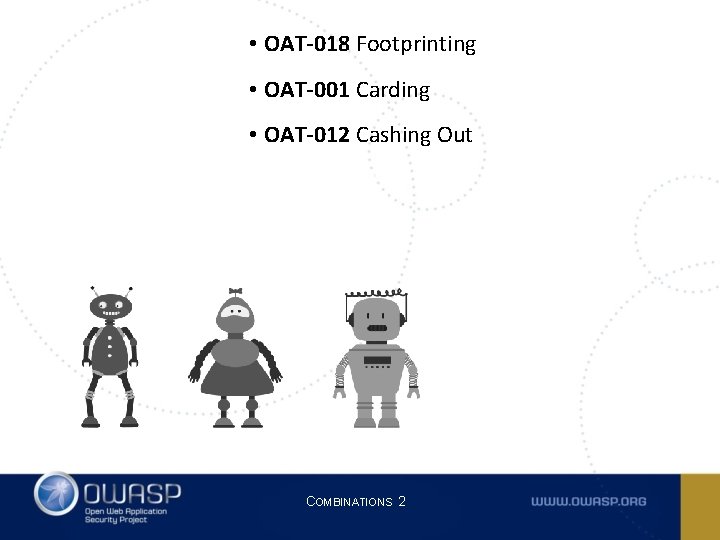
• OAT-018 Footprinting • OAT-001 Carding • OAT-012 Cashing Out COMBINATIONS 2
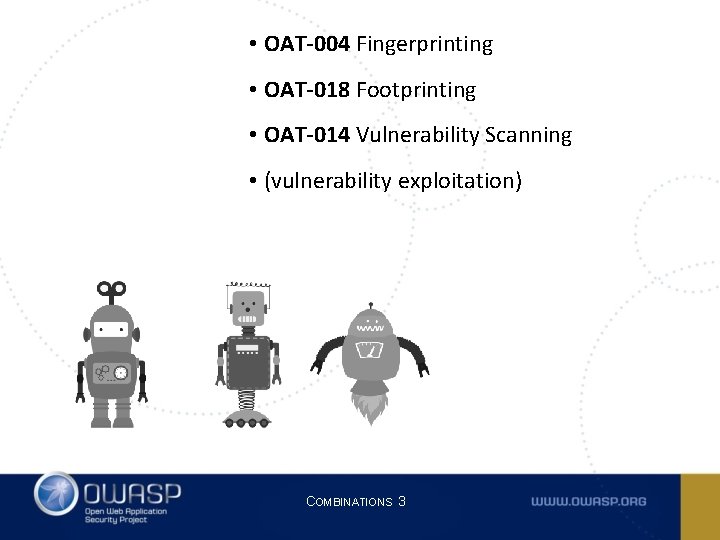
• OAT-004 Fingerprinting • OAT-018 Footprinting • OAT-014 Vulnerability Scanning • (vulnerability exploitation) COMBINATIONS 3
New in Version 1. 1 COUNTERMEASURES
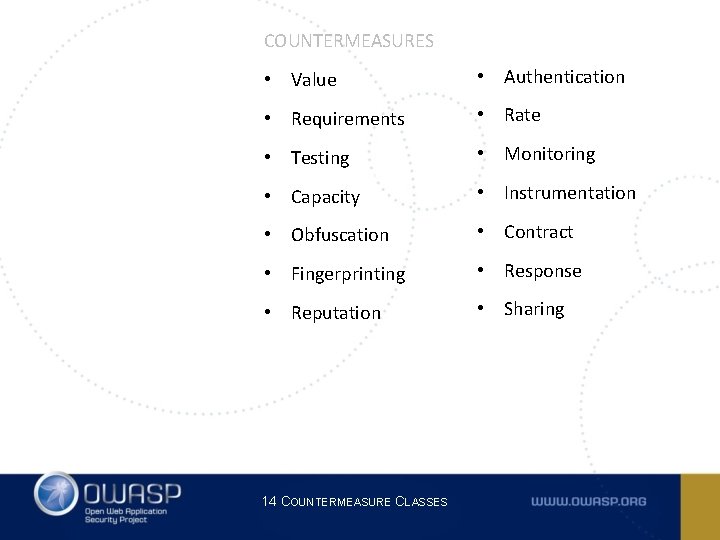
COUNTERMEASURES • Value • Authentication • Requirements • Rate • Testing • Monitoring • Capacity • Instrumentation • Obfuscation • Contract • Fingerprinting • Response • Reputation • Sharing 14 COUNTERMEASURE CLASSES
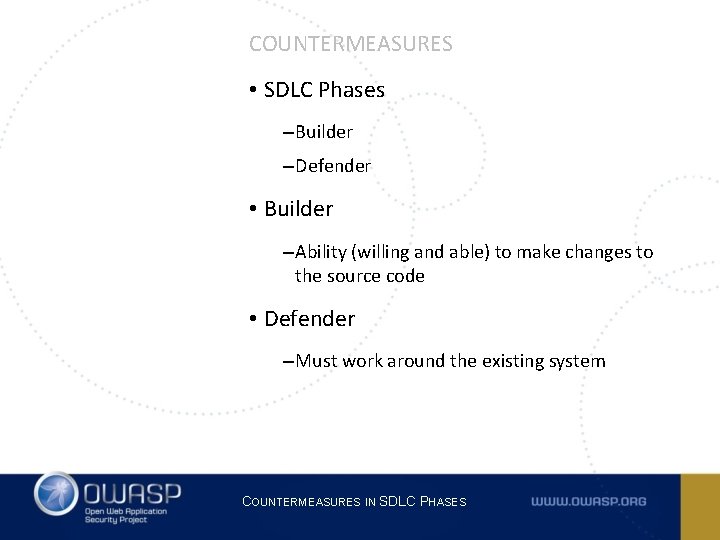
COUNTERMEASURES • SDLC Phases – Builder – Defender • Builder – Ability (willing and able) to make changes to the source code • Defender – Must work around the existing system COUNTERMEASURES IN SDLC PHASES
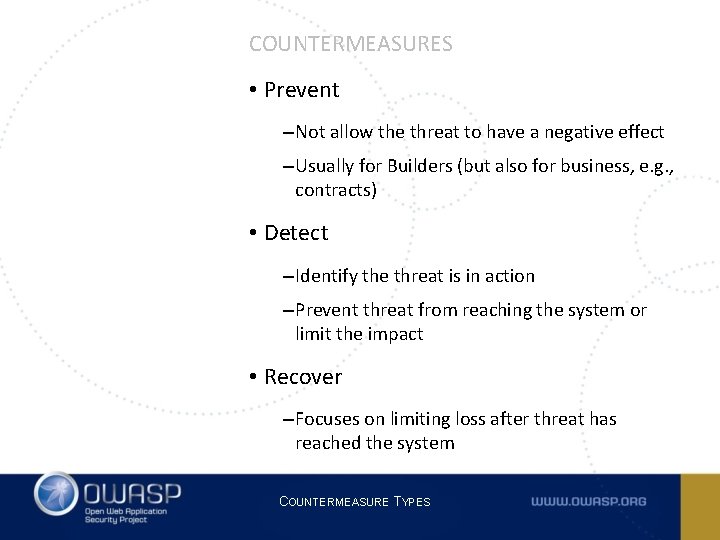
COUNTERMEASURES • Prevent – Not allow the threat to have a negative effect – Usually for Builders (but also for business, e. g. , contracts) • Detect – Identify the threat is in action – Prevent threat from reaching the system or limit the impact • Recover – Focuses on limiting loss after threat has reached the system COUNTERMEASURE TYPES
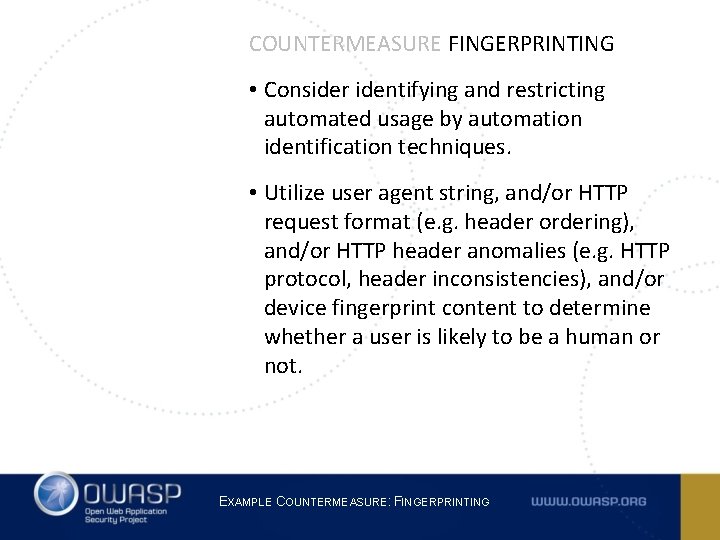
COUNTERMEASURE FINGERPRINTING • Consider identifying and restricting automated usage by automation identification techniques. • Utilize user agent string, and/or HTTP request format (e. g. header ordering), and/or HTTP header anomalies (e. g. HTTP protocol, header inconsistencies), and/or device fingerprint content to determine whether a user is likely to be a human or not. EXAMPLE COUNTERMEASURE: FINGERPRINTING
COUNTERMEASURE RATE • Set upper and/or lower and/or trend thresholds, and limit number and/or rate of usage per user, per group of users, per IP address/range, per device id/fingerprint, etc. • Also limitation of value per event/transaction. • Also includes use of queuing systems, user -prioritization functionality, and randomization of asset allocation. EXAMPLE COUNTERMEASURE: RATE
COUNTERMEASURE CAPACITY • Build adequate capacity so that any permitted and possible unwanted automated usage do not affect normal usage/performance. EXAMPLE COUNTERMEASURE: CAPACITY
COUNTERMEASURE CONTRACT • Require users not to undertake automated attacks against the application through terms & conditions, contracts, and guidance. • Understand contractual restrictions imposed by other parties on the application (e. g. service level agreements, financial credit). Example Specific Notes for OAT-005 Scalping Define T&Cs to explicitly define acceptable use of the application and permissible re-sale/re-use of the good/service by another party. Use employment contracts to ban staff from leaking information about availability and other properties of upcoming goods/service releases. EXAMPLE COUNTERMEASURE: CONTRACT
COUNTERMEASURE SHARING • Share information about automated attacks with others in same sector, with trade organizations, OWASP community, and with national CERTs. EXAMPLE COUNTERMEASURE: SHARING
Bot Apocalypse THE END IS NIGH
• But is it “security”? – Confidentiality – Availability – Integrity Info. Sec Purist SECURITY
WASC THREAT CLASSIFICATION VIEW
MITRE CAPEC VIEW
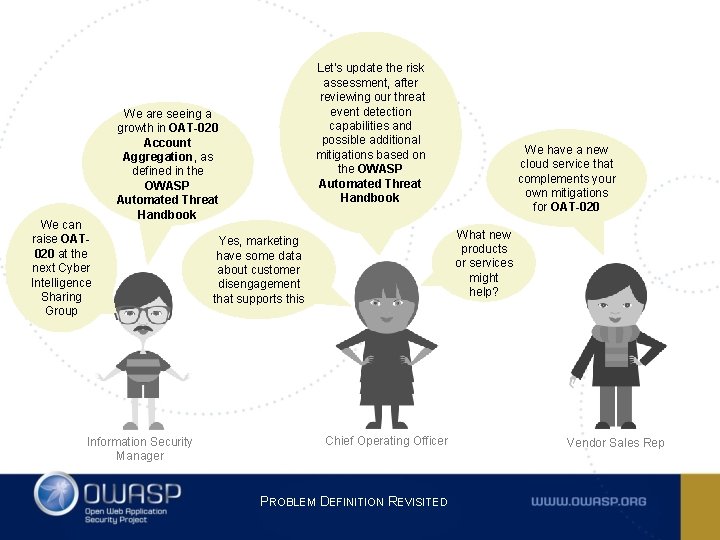
We can raise OAT 020 at the next Cyber Intelligence Sharing Group Let’s update the risk assessment, after reviewing our threat event detection capabilities and possible additional mitigations based on the OWASP Automated Threat Handbook We are seeing a growth in OAT-020 Account Aggregation, as defined in the OWASP Automated Threat Handbook Information Security Manager We have a new cloud service that complements your own mitigations for OAT-020 What new products or services might help? Yes, marketing have some data about customer disengagement that supports this Chief Operating Officer PROBLEM DEFINITION REVISITED Vendor Sales Rep
• Questions and contributions – Now – colin. watson@owasp. org – Project mailing list https: //lists. owasp. org/mailman/listinfo/automated_threats_to_web_applications Colin Watson QUESTIONS
- Slides: 66