
Overview Yield Prediction Based on design and the

Overview + Yield Prediction + Based on design and the process + Assumes a model for yield loss + Yield loss (for a particular design) + Random defects in the process + sub-optimal process (called “systematic yield loss”) + Why yield prediction? + Used to determine which process needs improvement + Modify designs suitably, if process cannot be improved + Stop working on a process/design, if the maximum possible yield is achieved! 06 -Dec-20 + And start on maintaining ‘cleaner’ fab for increasing yield 2
Index + Defectivity and Yield Prediction + size distribution + density distribution + Yield models + Defectivity, Fail Rate + Defect identification + electrical, optical, FA + Concept of critical area 06 -Dec-20 3
Index + Test Data (Yield) Analysis + SOF, COF analysis + overlay (inline, e-test, yield, bin) + classification of defects, kill ratio + correlation + Equipment (lot history) + Memory + Repair, redundancy, effect on yield 06 -Dec-20 4
Defect + Defect Size Distribution (metal, poly. . . ) + less number of Larger defects + Model Parameters (Do, P, Xo) + Outliers, Excursions + Concept of Critical Area + Assume uniform defect density distribution + Point Defects of identical size (Contact, via) + Defect Density distribution (uniform, normal, other models) + Not the same as Defect Size Distribution + Fail Rate 06 -Dec-20 5
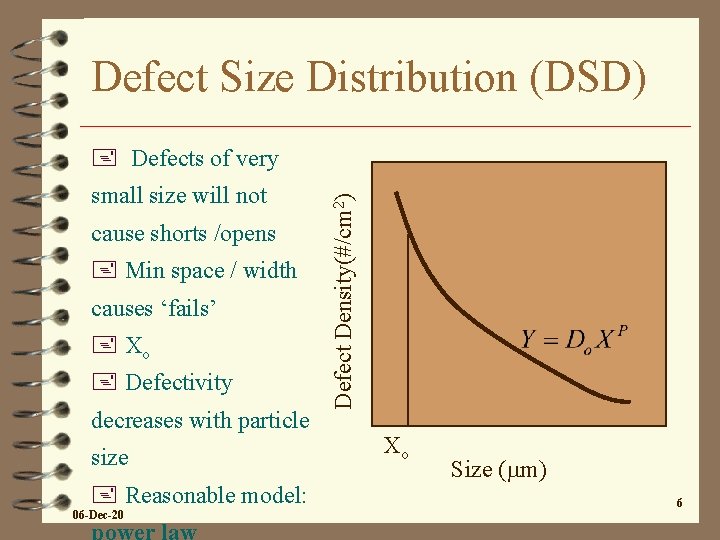
Defect Size Distribution (DSD) small size will not cause shorts /opens + Min space / width causes ‘fails’ + Xo + Defectivity decreases with particle size + Reasonable model: 06 -Dec-20 Defect Density(#/cm 2) + Defects of very Xo Size (mm) 6
Defect Size Distribution + Values of Do and P + ‘health’ of the fab + Typically p=3 + Typical Do should be 0. 5 for a very good fab + why? + Outliers have to be considered separately 06 -Dec-20 7
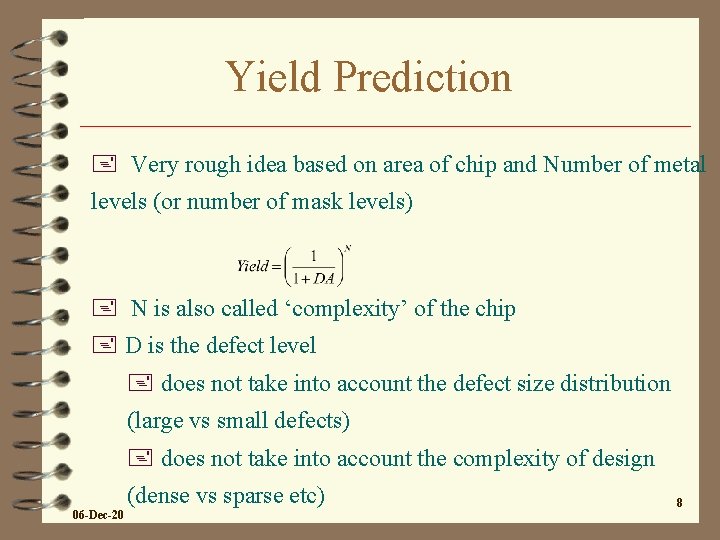
Yield Prediction + Very rough idea based on area of chip and Number of metal levels (or number of mask levels) + N is also called ‘complexity’ of the chip + D is the defect level + does not take into account the defect size distribution (large vs small defects) + does not take into account the complexity of design (dense vs sparse etc) 06 -Dec-20 8
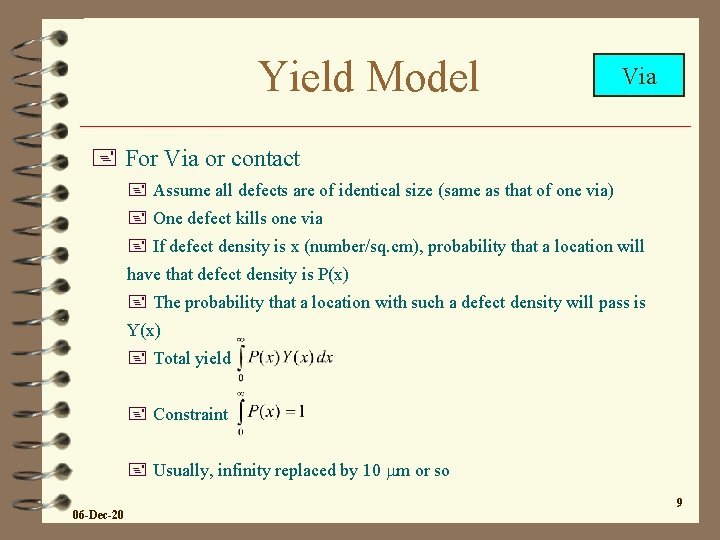
Yield Model Via + For Via or contact + Assume all defects are of identical size (same as that of one via) + One defect kills one via + If defect density is x (number/sq. cm), probability that a location will have that defect density is P(x) + The probability that a location with such a defect density will pass is Y(x) + Total yield + Constraint + Usually, infinity replaced by 10 mm or so 06 -Dec-20 9
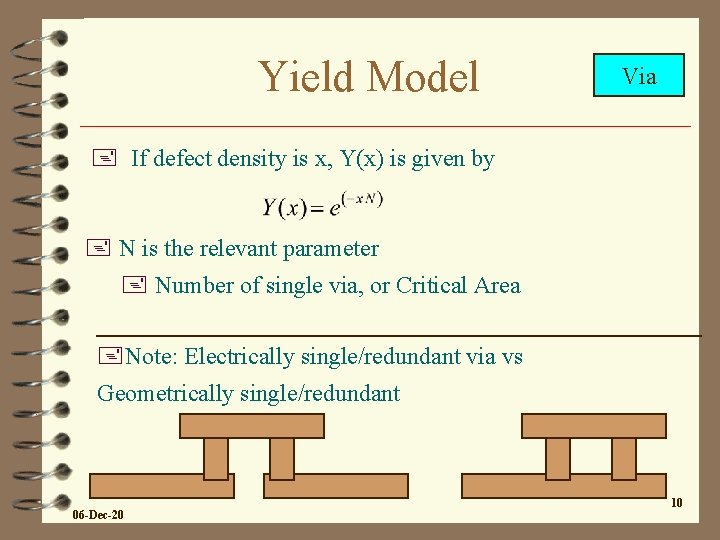
Yield Model Via + If defect density is x, Y(x) is given by + N is the relevant parameter + Number of single via, or Critical Area +Note: Electrically single/redundant via vs Geometrically single/redundant 06 -Dec-20 10
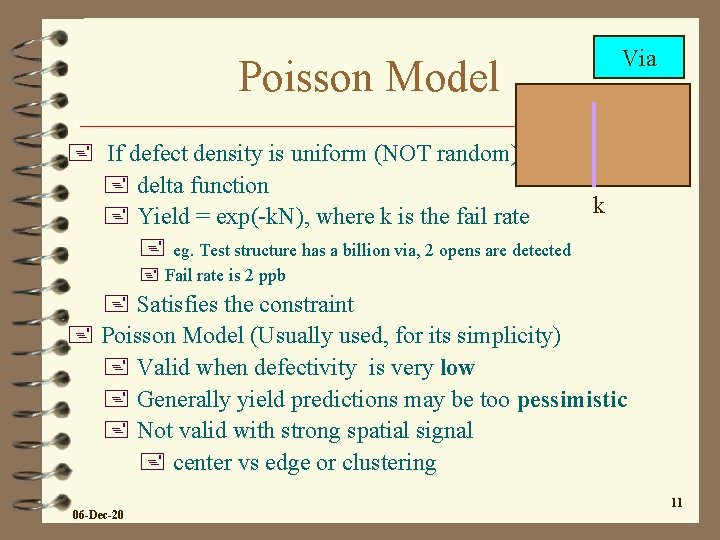
Poisson Model Via + If defect density is uniform (NOT random) + delta function k + Yield = exp(-k. N), where k is the fail rate + eg. Test structure has a billion via, 2 opens are detected + Fail rate is 2 ppb + Satisfies the constraint + Poisson Model (Usually used, for its simplicity) + Valid when defectivity is very low + Generally yield predictions may be too pessimistic + Not valid with strong spatial signal + center vs edge or clustering 06 -Dec-20 11

SEEDS Model Via + Defect density decreases exponentially + (NOT defect size). All defects are point defects + P(x) = 1/k*exp(-x/k) + 1/k is needed for normalization 1/k + Yield = 1/(1+k. N) + In general, yield predictions are very optimistic + More accurate, if there are lot of clusters 06 -Dec-20 12
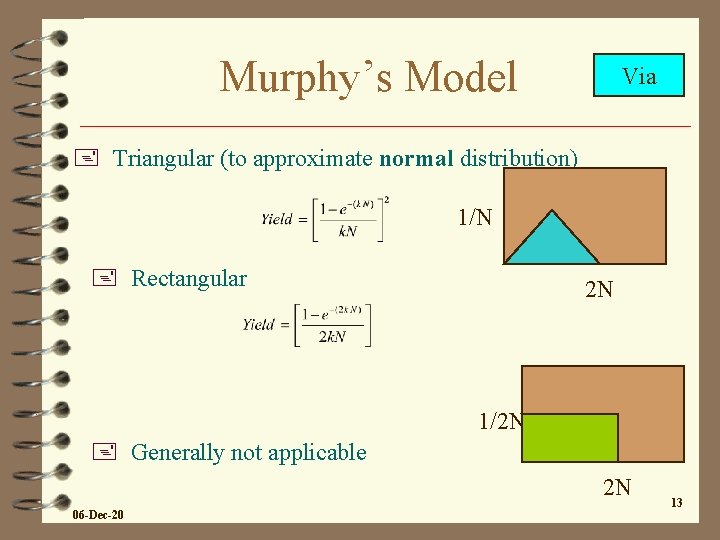
Murphy’s Model Via + Triangular (to approximate normal distribution) 1/N + Rectangular 2 N 1/2 N + Generally not applicable 2 N 06 -Dec-20 13
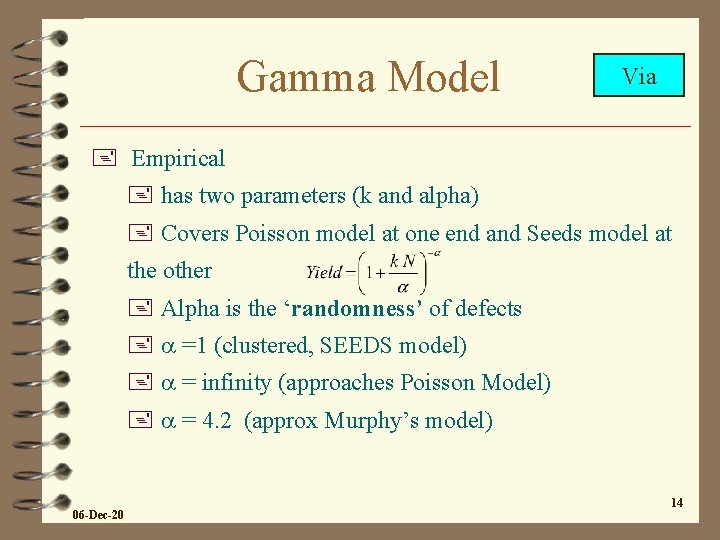
Gamma Model Via + Empirical + has two parameters (k and alpha) + Covers Poisson model at one end and Seeds model at the other + Alpha is the ‘randomness’ of defects + a =1 (clustered, SEEDS model) + a = infinity (approaches Poisson Model) + a = 4. 2 (approx Murphy’s model) 06 -Dec-20 14
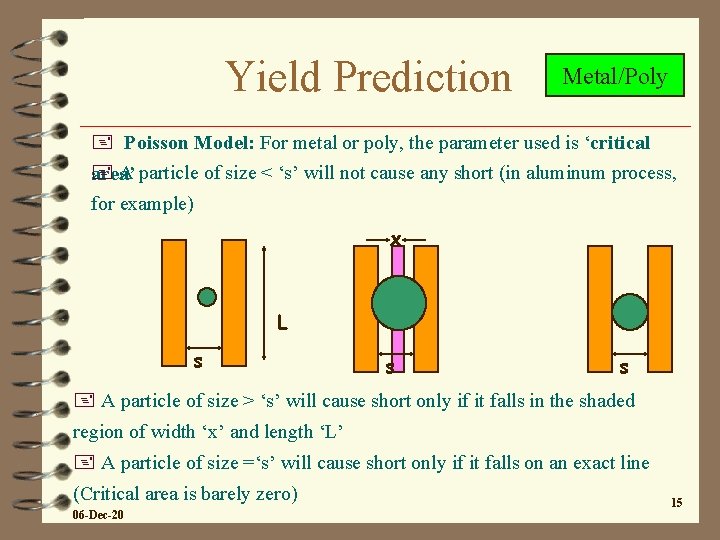
Yield Prediction Metal/Poly + Poisson Model: For metal or poly, the parameter used is ‘critical + A particle of size < ‘s’ will not cause any short (in aluminum process, area’ for example) x L s s s + A particle of size > ‘s’ will cause short only if it falls in the shaded region of width ‘x’ and length ‘L’ + A particle of size =‘s’ will cause short only if it falls on an exact line (Critical area is barely zero) 06 -Dec-20 15
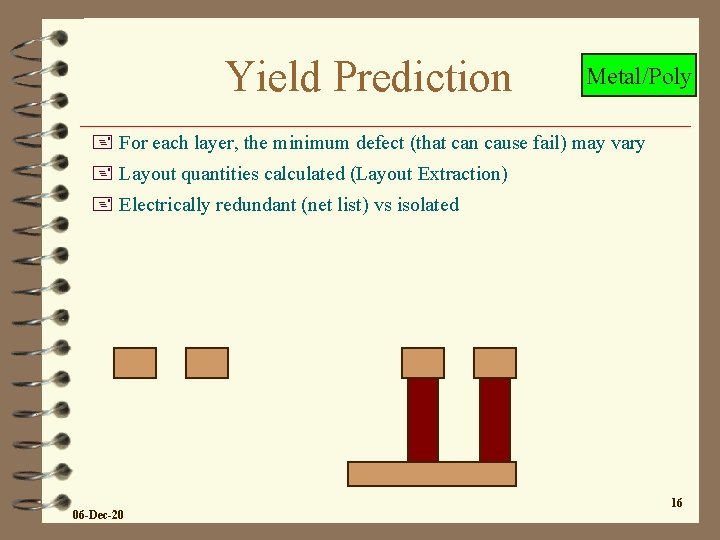
Yield Prediction Metal/Poly + For each layer, the minimum defect (that can cause fail) may vary + Layout quantities calculated (Layout Extraction) + Electrically redundant (net list) vs isolated 06 -Dec-20 16
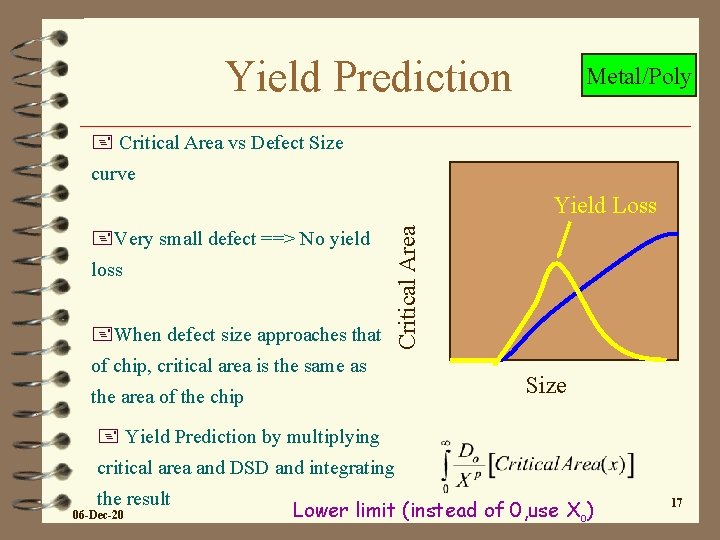
Yield Prediction Metal/Poly + Critical Area vs Defect Size curve +Very small defect ==> No yield loss +When defect size approaches that Critical Area Yield Loss of chip, critical area is the same as the area of the chip Size + Yield Prediction by multiplying critical area and DSD and integrating the result 06 -Dec-20 Lower limit (instead of 0, use Xo) 17
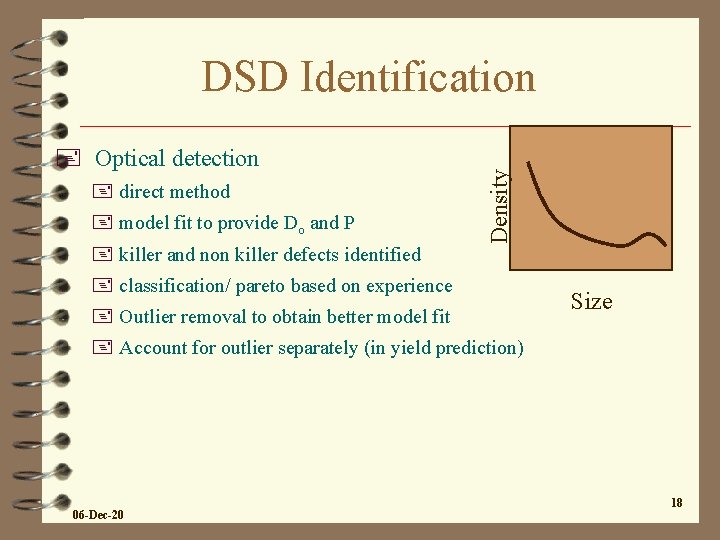
+ Optical detection + direct method + model fit to provide Do and P + killer and non killer defects identified Density DSD Identification + classification/ pareto based on experience + Outlier removal to obtain better model fit Size + Account for outlier separately (in yield prediction) 06 -Dec-20 18
DSD Identification + Electrical Detection + Done on test chips (using yield of test structures) + Better for identifying killer defects + overlay with optical (KLA) provides correlation + KLA done on test chip and Product chip + Not all areas ‘scanned’ optically + Calculation to obtain Do and P (assumes a yield model like Poissson Model) + Min Resolution depends on the space/width of structures + Accuracy depends on the total structures + more structures per die, more wafers. . . 06 -Dec-20 + Use of nest to enhance resolution 19
Defect Identification + Failure Analysis + Not practical for obtaining defect size distribution + Very useful for determining failure mechanism and in defect classification + Typically Voltage contrast test, FIB (Focussed Ion Beam) 06 -Dec-20 20
Review + Understanding of Modules + Basics of Testing (to detect defects, process issues and to determine if the product is passing/failing) + Defect distribution Models + Yield Models + Defect detection techniques (basics) + and fit to the model + Missing yet. . . + How to predict the yield of a chip + and compare with ‘real’ results + and decide on next step (if the prediction is correct vs incorrect) 06 -Dec-20 21
Yield Prediction + Analyze the whole chip yield + easy + vs process split, by wafer, by lot and so on + Analyze by blocks (sub units) of the chip + Random defect should be the same for all the blocks in a chip + Any deviation must come from different sensitivity of the blocks to various processes 06 -Dec-20 22
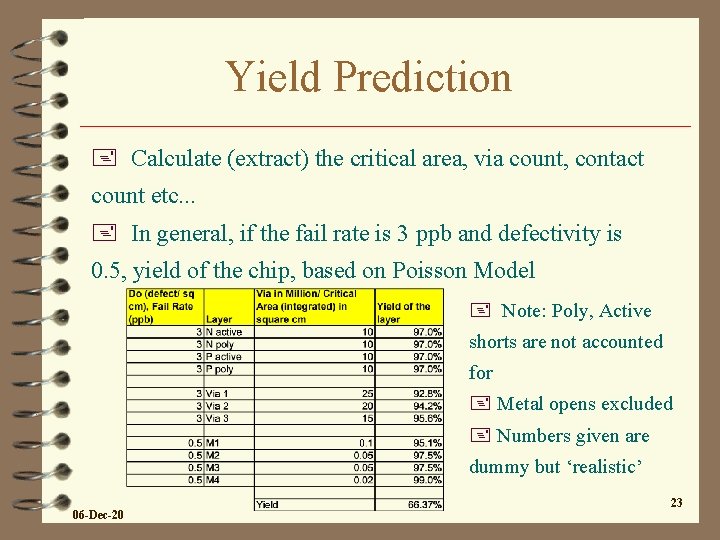
Yield Prediction + Calculate (extract) the critical area, via count, contact count etc. . . + In general, if the fail rate is 3 ppb and defectivity is 0. 5, yield of the chip, based on Poisson Model + Note: Poly, Active shorts are not accounted for + Metal opens excluded + Numbers given are dummy but ‘realistic’ 06 -Dec-20 23
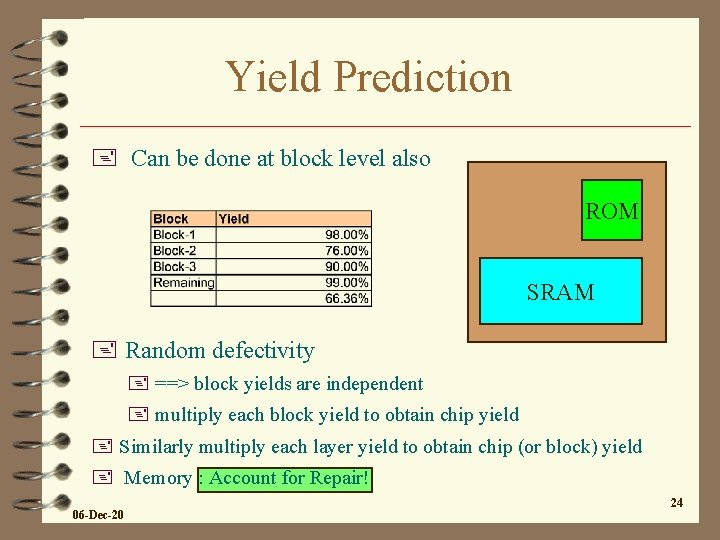
Yield Prediction + Can be done at block level also ROM SRAM + Random defectivity + ==> block yields are independent + multiply each block yield to obtain chip yield + Similarly multiply each layer yield to obtain chip (or block) yield + Memory : Account for Repair! 06 -Dec-20 24
Yield Data Analysis + Usually SOF test data + Check if ‘random’ model applied + account for known trends (center edge etc) + ‘convert’ to COF data + Isolate block which does not follow trend + Compare with other data + scribe line, inline, optical defect, thickness measurement. . . + Look for other modes of fail (for layout extractions not accounted for yet) 06 -Dec-20 25
Yield Data Analysis + Plot wafermap + do the fails look random? + (are the fails caused by random defectivity)? + Any trend (cluster, first wafer effect. . . ) + Extracting ‘COF’ data from ‘SOF’ data + example 06 -Dec-20 26
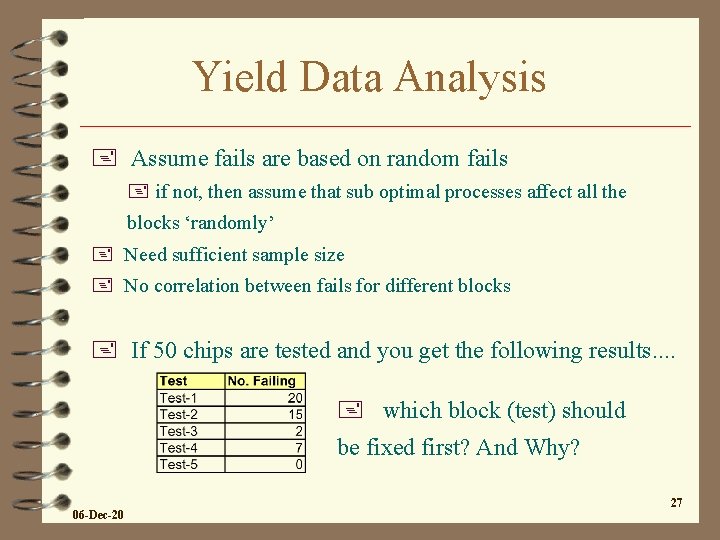
Yield Data Analysis + Assume fails are based on random fails + if not, then assume that sub optimal processes affect all the blocks ‘randomly’ + Need sufficient sample size + No correlation between fails for different blocks + If 50 chips are tested and you get the following results. . + which block (test) should be fixed first? And Why? 06 -Dec-20 27
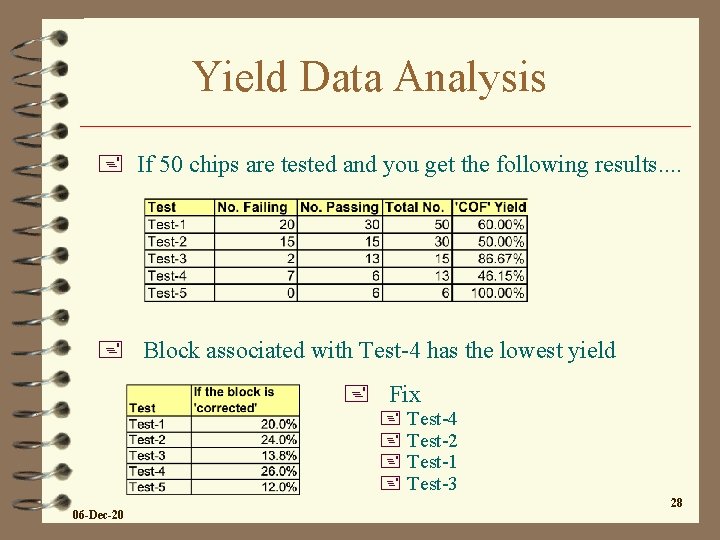
Yield Data Analysis + If 50 chips are tested and you get the following results. . + Block associated with Test-4 has the lowest yield + Fix + Test-4 + Test-2 + Test-1 + Test-3 06 -Dec-20 28
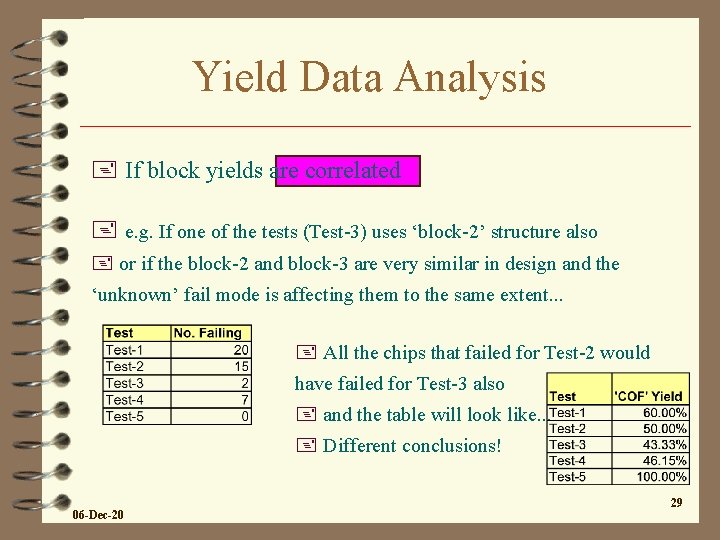
Yield Data Analysis + If block yields are correlated + e. g. If one of the tests (Test-3) uses ‘block-2’ structure also + or if the block-2 and block-3 are very similar in design and the ‘unknown’ fail mode is affecting them to the same extent. . . + All the chips that failed for Test-2 would have failed for Test-3 also + and the table will look like. . . + Different conclusions! 06 -Dec-20 29
Yield Data Analysis + To identify block yield correlations + COF for some wafers + Re-order test to ‘estimate’ correlations + More sample size to obtain accuracy + ‘COF like’ data extraction has to be done at wafer level, or lot level + Not at die level! + Compare ‘predicted’ vs ‘real’ ‘COF’ yield for blocks 06 -Dec-20 30
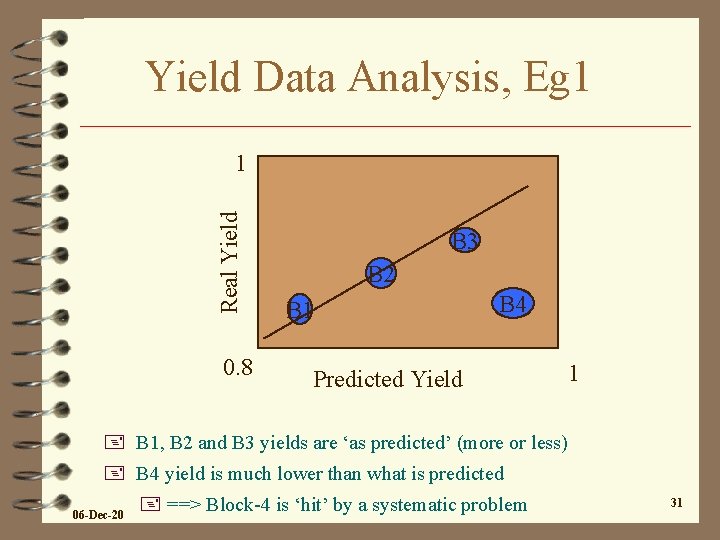
Yield Data Analysis, Eg 1 Real Yield 1 0. 8 B 3 B 2 B 1 B 4 Predicted Yield 1 + B 1, B 2 and B 3 yields are ‘as predicted’ (more or less) + B 4 yield is much lower than what is predicted 06 -Dec-20 + ==> Block-4 is ‘hit’ by a systematic problem 31
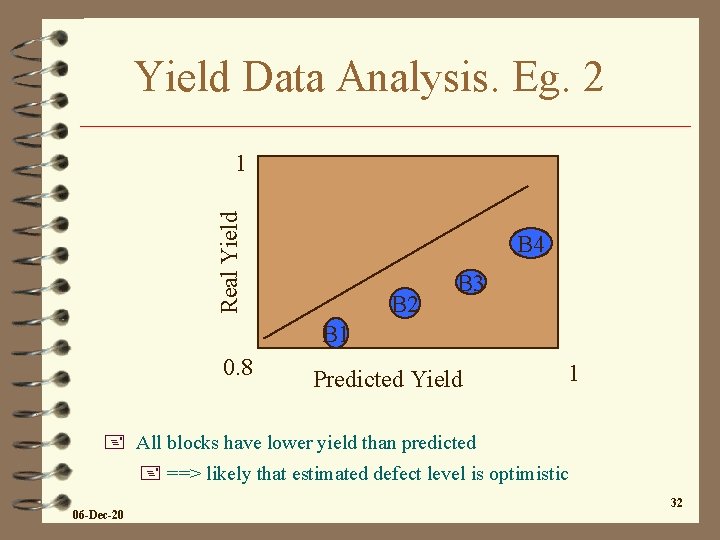
Yield Data Analysis. Eg. 2 Real Yield 1 B 4 B 2 B 3 B 1 0. 8 Predicted Yield 1 + All blocks have lower yield than predicted + ==> likely that estimated defect level is optimistic 06 -Dec-20 32
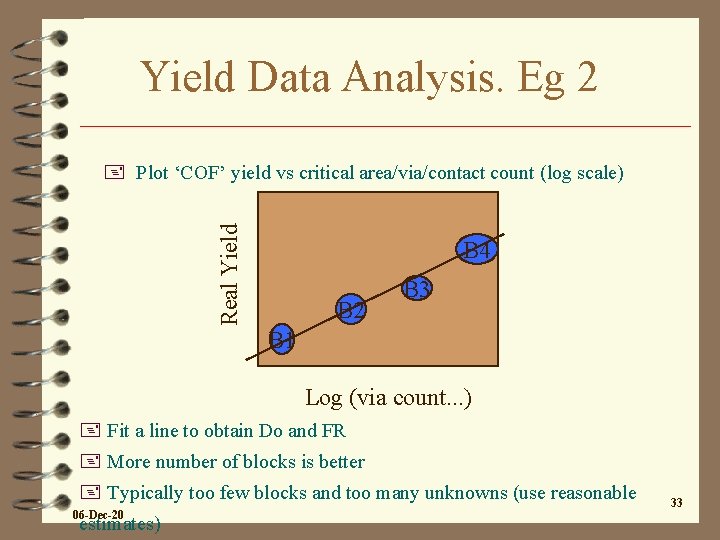
Yield Data Analysis. Eg 2 Real Yield + Plot ‘COF’ yield vs critical area/via/contact count (log scale) B 4 B 2 B 3 B 1 Log (via count. . . ) + Fit a line to obtain Do and FR + More number of blocks is better + Typically too few blocks and too many unknowns (use reasonable 06 -Dec-20 estimates) 33
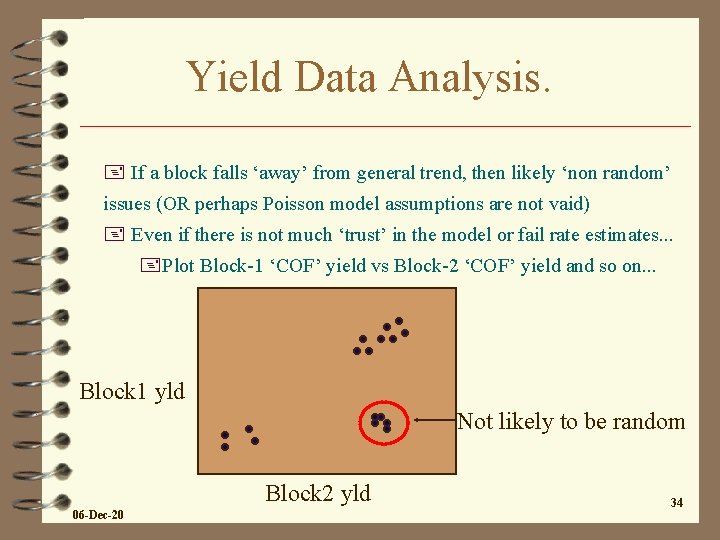
Yield Data Analysis. + If a block falls ‘away’ from general trend, then likely ‘non random’ issues (OR perhaps Poisson model assumptions are not vaid) + Even if there is not much ‘trust’ in the model or fail rate estimates. . . +Plot Block-1 ‘COF’ yield vs Block-2 ‘COF’ yield and so on. . . Block 1 yld Not likely to be random Block 2 yld 06 -Dec-20 34
Yield Data Analysis. + If a block has systematic yield loss + or if there are reasons to believe that the whole chip hit by systematic loss. . . + Need to determine the mode of fail and which module is causing the problem + To obtain better idea + Equipment Commonality (equipment related) + Do all wafers show the issue? Only some wafers? + Inline CD (top/bottom SEM) (process related) + Inline thickness measurement (process related) + scribe line data correlation (mode of fail) + Field Analysis (by shot) 06 -Dec-20 35
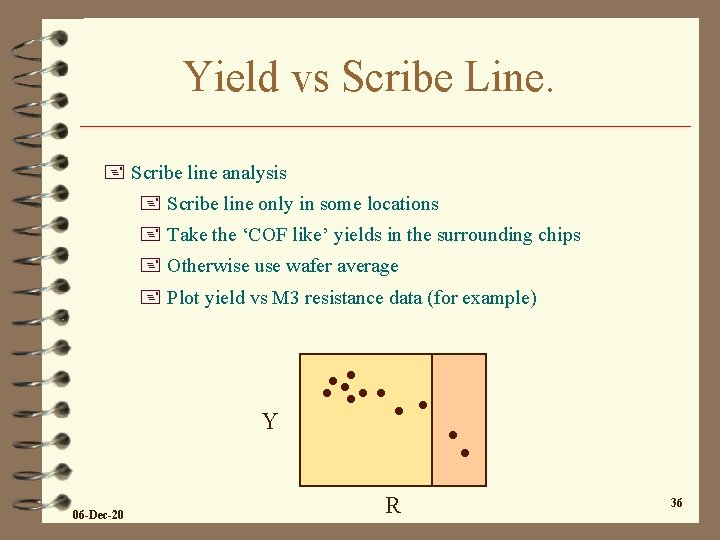
Yield vs Scribe Line. + Scribe line analysis + Scribe line only in some locations + Take the ‘COF like’ yields in the surrounding chips + Otherwise use wafer average + Plot yield vs M 3 resistance data (for example) Y 06 -Dec-20 R 36
Yield vs Scribe Line + Scribe line structures are small + ==> small variations/increase in scribe line is likely to represent a larger variation/increase in the product chip + ==> increased M 3 resistance or M 3 opens a possible issue + If scribe line shows severe opens or shorts, chip will be dead +Example: A chip has 10 million via 12 and scribe line has 1000 via 12 + For a FR of 10 ppb, chip via 12 yield is 91%. Scribe line yield is 99. 99% + Very few scribe lines tested vs all chips tested + ==> not likely to see full blown opens/shorts in scribe lines 06 -Dec-20 37
Yield vs Inline + Similar analysis for Inline data + thickness, CD + SEM CD measurements typically taken in scribe line + usually post etch, sometimes pre etch + can compare with electrical CD + between different products in the same fab + Sometimes there will be (deliberate) difference in the CD, because of difference in target + Thickness by 4 point probe, optical + Note: SEM and Steppers may be linked. Look for commonality + As much as possible, use the dies next to the ‘measurement location’ to calculate ‘COF like’ yield 06 -Dec-20 38
Yield vs Inline Defectivity + Compare with Inline Defectivity + Overlay defect vs yield map + Classified (pareto) vs yield + ADC (automatic defect classification) + sensitivity, observable defect size. . 06 -Dec-20 39
- Slides: 39