
Overview What is a PLAAFP How does the





- Slides: 37
Overview • What is a PLAAFP? • How does the PLAAFP fit into the IEP process? • How is a PLAAFP Determined? • What is included in a PLAAFP? • What are Common Core State Standards? • Writing IEP Goals & Objectives based on Common Core State Standards
Present Levels of Academic Achievement and Functional Performance (PLAAFP) • Identifies the student’s strengths and needs related to the general curriculum & programs, as well as other educational needs • The remainder of the IEP delineates the special education program, services, accommodations, modifications, goals, and objectives to address the needs delineated in the PLAAFP
What is the PLAAFP? • Part of the IEP • Objective, measurable description of the student and their needs • Moves from a general to specific • Meets stranger test • Observable behavior without judgment – uses verbs rather than adjectives • Directly links to IEP goals and objectives
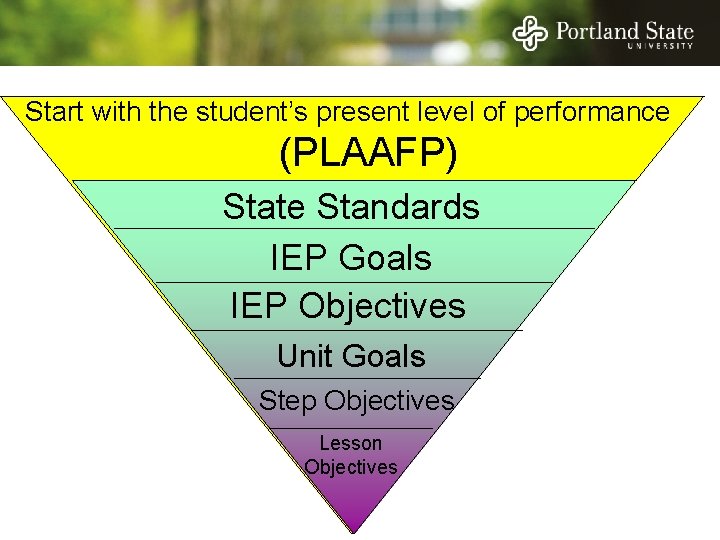
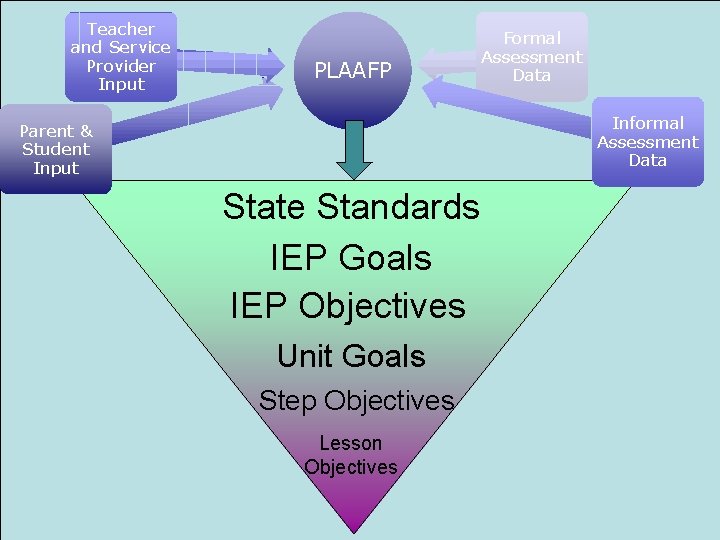
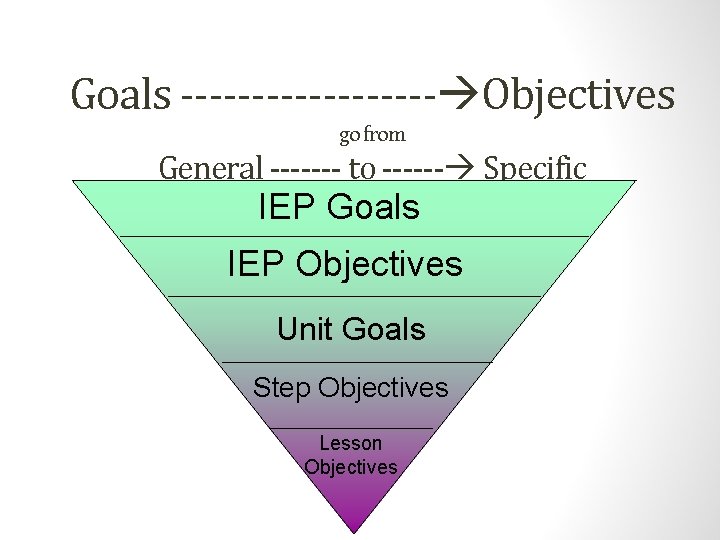
Start with the student’s present level of performance (PLAAFP) State Standards IEP Goals IEP Objectives Unit Goals Step Objectives Lesson Objectives
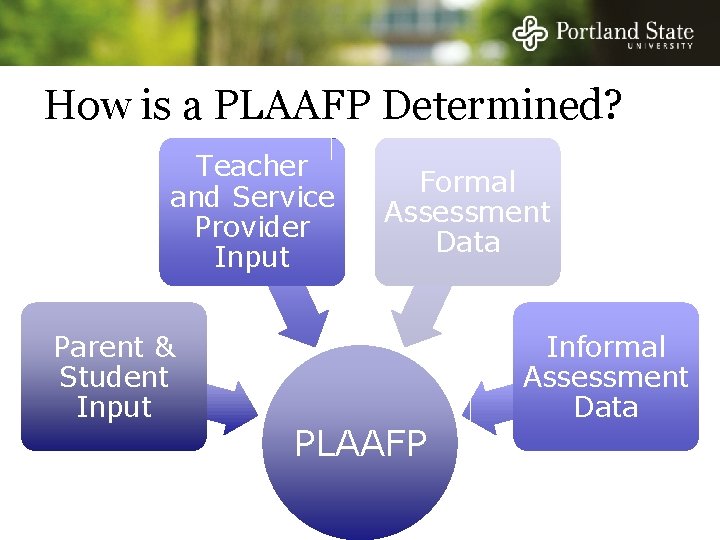
How is a PLAAFP Determined? Teacher and Service Provider Input Parent & Student Input Formal Assessment Data PLAAFP Informal Assessment Data
How is a PLAAFP determined? • Recent assessment data to determine the student’s present level of performance: -Formal • Standardized Norm-referenced tests (e. g. WJ-III, WISC) • State assessments -Informal • Student/parental input • Screening • Curriculum-based measurement • Ecological assessments, observations
Teacher and Service Provider Input PLAAFP Formal Assessment Data Informal Assessment Data Parent & Student Input State Standards IEP Goals IEP Objectives Unit Goals Step Objectives Lesson Objectives
What does a PLAAFP include? • Introduction/description of the student • Strengths of the student • Student preferences, needs and interests • Concerns of the Parent • How disability affects the student’s progress in the general curriculum • Performance in each goal area • http: //www. ode. state. or. us/search/pag e/? =1163
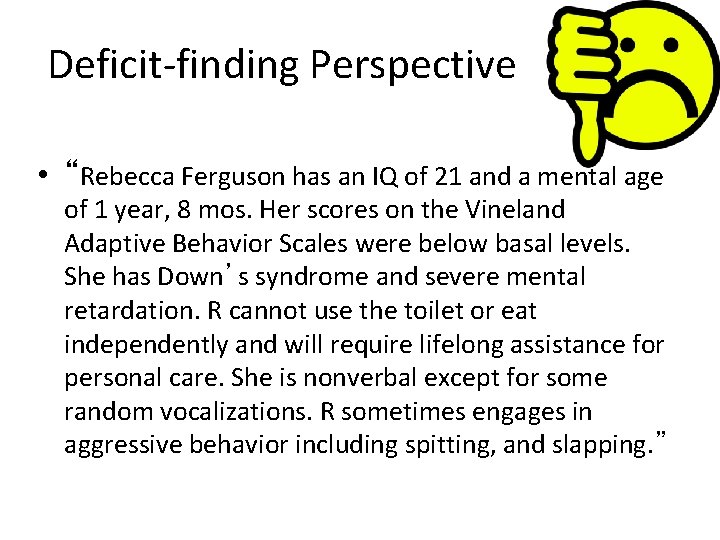
Deficit-finding Perspective • “Rebecca Ferguson has an IQ of 21 and a mental age of 1 year, 8 mos. Her scores on the Vineland Adaptive Behavior Scales were below basal levels. She has Down’s syndrome and severe mental retardation. R cannot use the toilet or eat independently and will require lifelong assistance for personal care. She is nonverbal except for some random vocalizations. R sometimes engages in aggressive behavior including spitting, and slapping. ”
Capacity-building perspective • “Rebecca is a 16 -year old girl with brown eyes and black hair who has been medically classified with Down’s syndrome. Her scores below basal levels on the Vineland the Weschler Intelligence Scale support her ongoing eligibility for special education services. R is highly social and greets others using eye contact, smiles, a wave, and an occasional hug. She makes her needs known by moving to an area or obtaining materials (e. g, her bathing suit to go swimming). She can sign “eat” to request food. She has strong preferences is assertive….
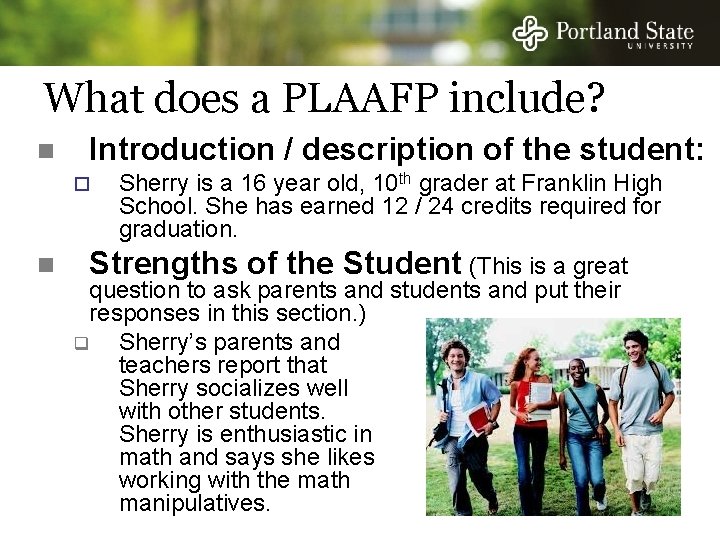
What does a PLAAFP include? n Introduction / description of the student: ¨ n Sherry is a 16 year old, 10 th grader at Franklin High School. She has earned 12 / 24 credits required for graduation. Strengths of the Student (This is a great question to ask parents and students and put their responses in this section. ) q Sherry’s parents and teachers report that Sherry socializes well with other students. Sherry is enthusiastic in math and says she likes working with the math manipulatives.
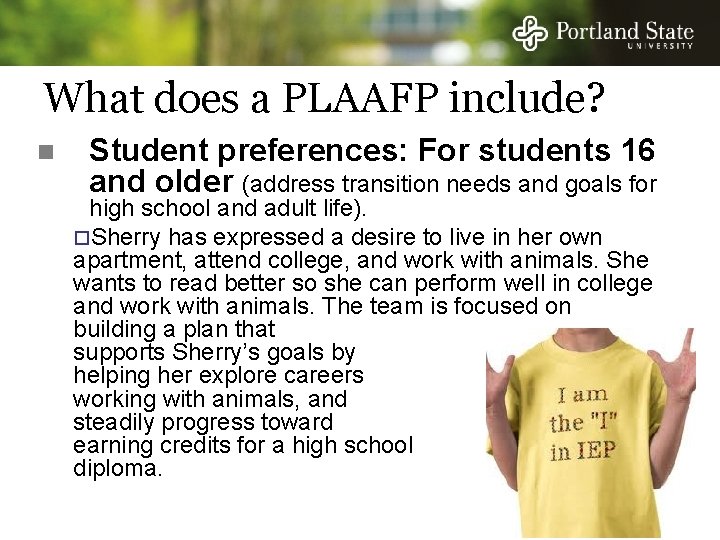
What does a PLAAFP include? n Student preferences: For students 16 and older (address transition needs and goals for high school and adult life). ¨Sherry has expressed a desire to live in her own apartment, attend college, and work with animals. She wants to read better so she can perform well in college and work with animals. The team is focused on building a plan that supports Sherry’s goals by helping her explore careers working with animals, and steadily progress toward earning credits for a high school diploma.
What does a PLAAFP include? n Concerns of the parent: Parents’ goals for the student ¨ Parents’ desired supports for the student n Sherry’s parents are concerned that she has not learned to organize materials and often misplaces and / or does not turn in assignments. They also want to see her reading continue to improve. They would like the school team to directly address these skills as Sherry will need to improve in these areas in order to graduate high school and pursue a career. ¨
What does a PLAAFP include? How the disability affects the student’s progress in the general curriculum. n ¨ ¨ Include the student’s current eligibility category for special education Weaknesses should be written in a cohesive, integrated paragraph. They must consider the whole child including academic, cognitive, social, adaptive, and communication strengths as they relate to progress in the general education curriculum and grade. Support needs that impede involvement in the general education: n n List any supports and modifications required to meet her goals in the general education curriculum.
What does a PLAAFP Include? Performance in each goal area Label the goal areas of the IEP • • Reading Writing Social behavior Communication… etc. Include in EACH section: • Results of recent assessments • Whether the student will take alternative assessment (OAKS or extended assessment) • Educational needs (sometimes referred to as “weaknesses”, we prefer educational needs) Note: THERE SHOULD BE A DIRECT LINK BETWEEN ASSESSMENT RESULTS AND THE GOAL
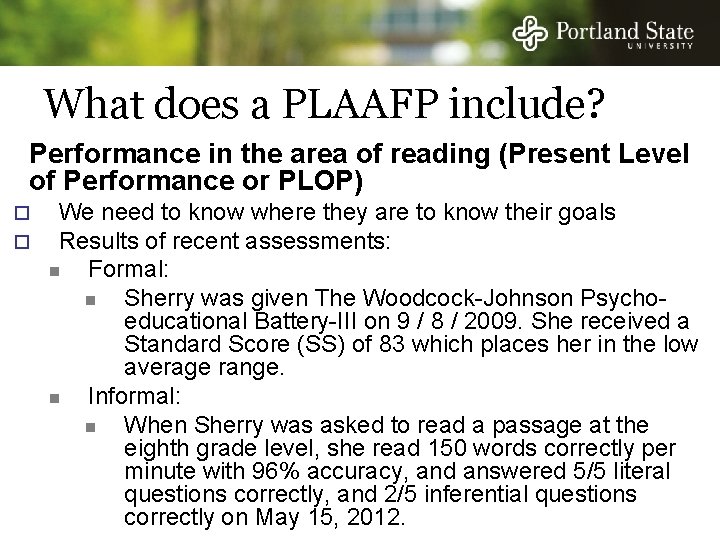
What does a PLAAFP include? Performance in the area of reading (Present Level of Performance or PLOP) ¨ ¨ We need to know where they are to know their goals Results of recent assessments: n Formal: n Sherry was given The Woodcock-Johnson Psychoeducational Battery-III on 9 / 8 / 2009. She received a Standard Score (SS) of 83 which places her in the low average range. n Informal: n When Sherry was asked to read a passage at the eighth grade level, she read 150 words correctly per minute with 96% accuracy, and answered 5/5 literal questions correctly, and 2/5 inferential questions correctly on May 15, 2012.
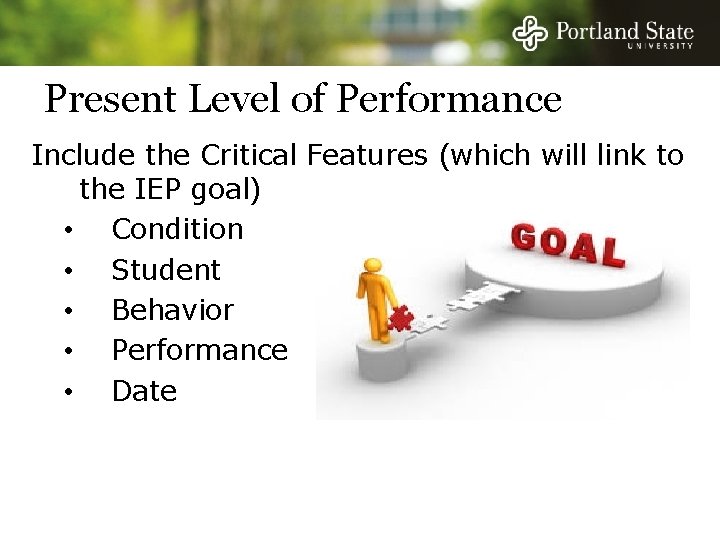
Present Level of Performance Include the Critical Features (which will link to the IEP goal) • Condition • Student • Behavior • Performance • Date
Writing IEP Goals & Objectives based on PLAAFP
Common Core State Standards (CCSS) State education chiefs and governors in 48 states came together to develop the Common Core, a set of clear college- and career-ready standards for kindergarten through 12 th grade in English language arts/literacy and mathematics. http: //www. corestandards. org/
App on i. Tunes for Common Core Standards https: //itunes. apple. com/us/app/commoncore-standards/id 439424555? mt=8
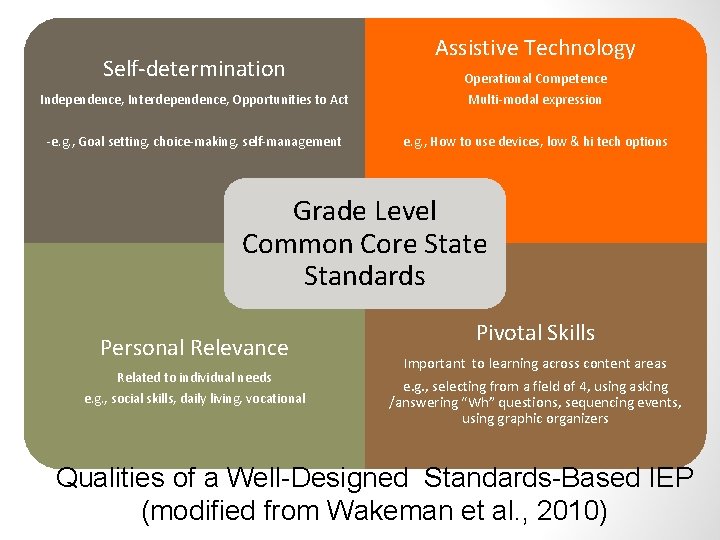
Self-determination Assistive Technology Independence, Interdependence, Opportunities to Act Operational Competence Multi-modal expression -e. g. , Goal setting, choice-making, self-management e. g. , How to use devices, low & hi tech options Grade Level Common Core State Standards Personal Relevance Related to individual needs e. g. , social skills, daily living, vocational Pivotal Skills Important to learning across content areas e. g. , selecting from a field of 4, using asking /answering “Wh” questions, sequencing events, using graphic organizers Qualities of a Well-Designed Standards-Based IEP (modified from Wakeman et al. , 2010)
Goals --------- Objectives go from General ------- to ------ Specific IEP Goals IEP Objectives Unit Goals Step Objectives Lesson Objectives
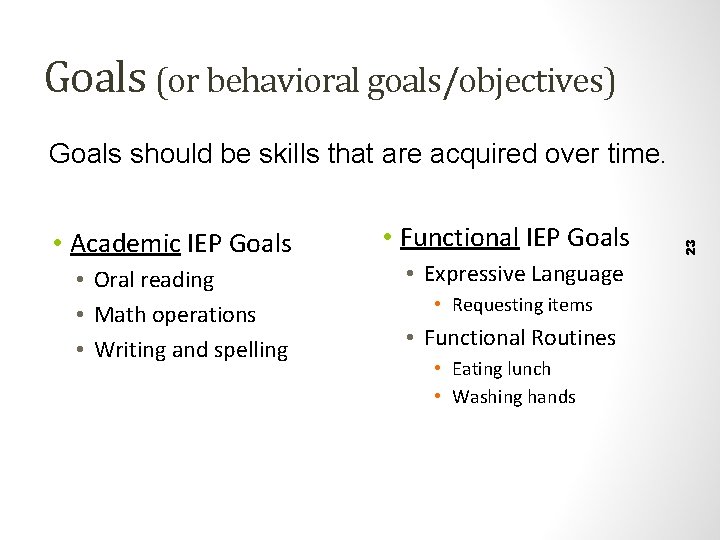
Goals (or behavioral goals/objectives) • Academic IEP Goals • Oral reading • Math operations • Writing and spelling • Functional IEP Goals • Expressive Language • Requesting items • Functional Routines • Eating lunch • Washing hands 23 Goals should be skills that are acquired over time.
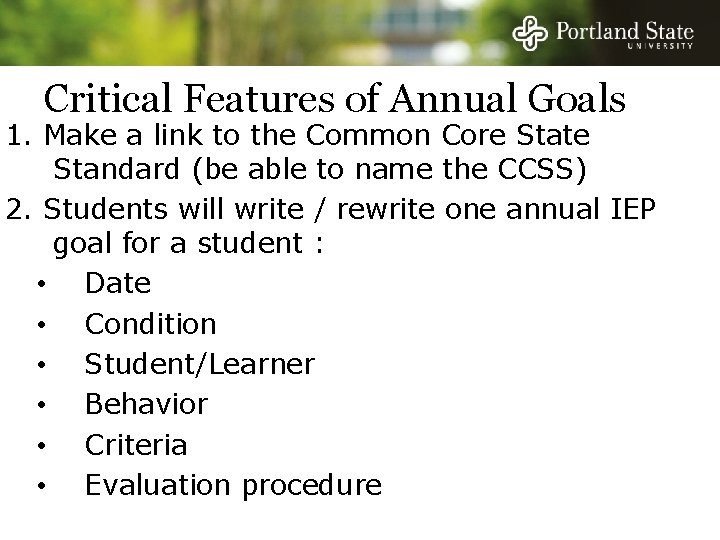
Critical Features of Annual Goals 1. Make a link to the Common Core State Standard (be able to name the CCSS) 2. Students will write / rewrite one annual IEP goal for a student : • Date • Condition • Student/Learner • Behavior • Criteria • Evaluation procedure
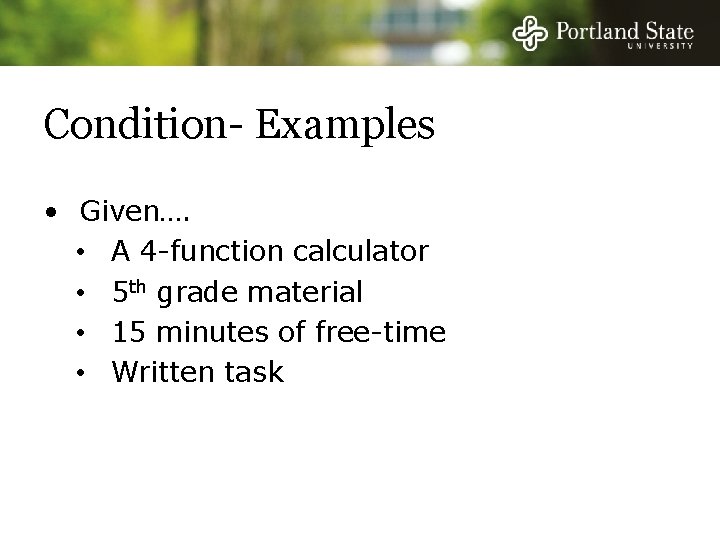
Condition- Examples • Given…. • A 4 -function calculator • 5 th grade material • 15 minutes of free-time • Written task
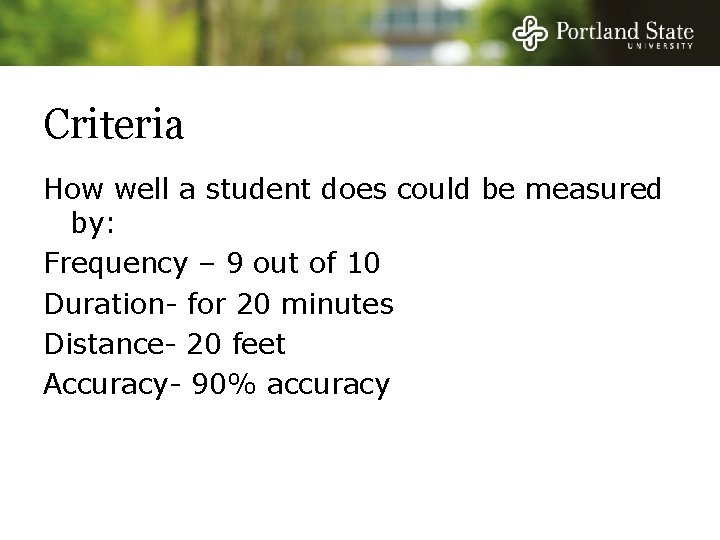
Criteria How well a student does could be measured by: Frequency – 9 out of 10 Duration- for 20 minutes Distance- 20 feet Accuracy- 90% accuracy
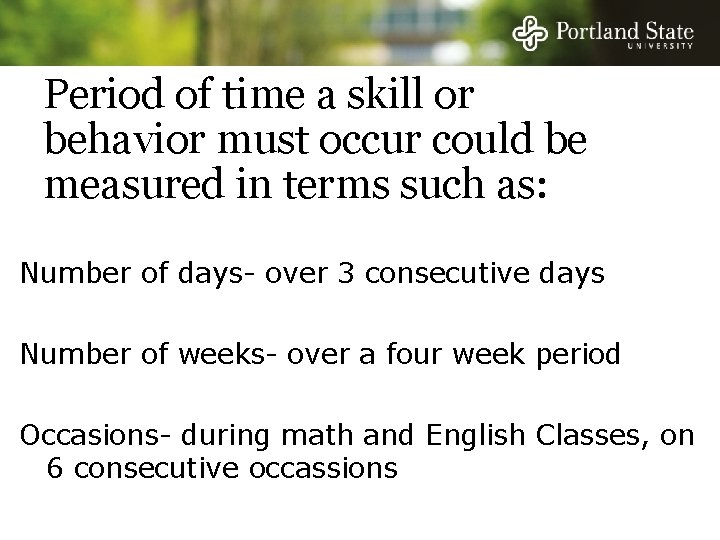
Period of time a skill or behavior must occur could be measured in terms such as: Number of days- over 3 consecutive days Number of weeks- over a four week period Occasions- during math and English Classes, on 6 consecutive occassions
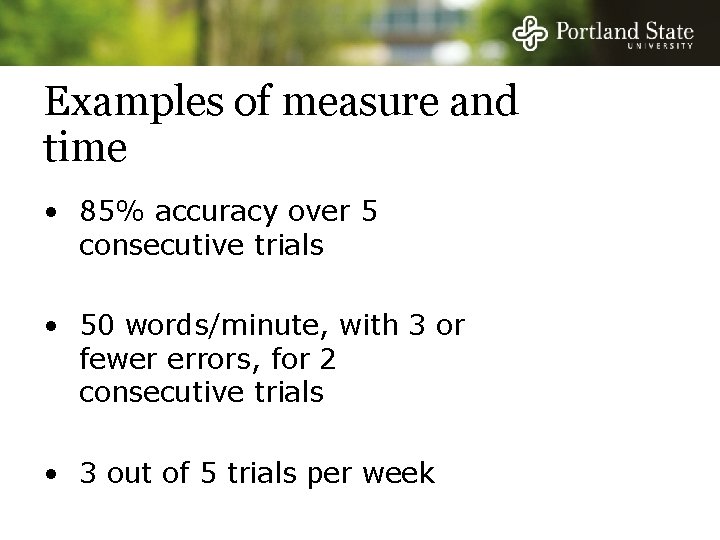
Examples of measure and time • 85% accuracy over 5 consecutive trials • 50 words/minute, with 3 or fewer errors, for 2 consecutive trials • 3 out of 5 trials per week
Evaluation Procedures Identify the method that will be used to measure progress & determine if the student has met the benchmark. An evaluation procedure must provide an objective method in which the student’s behavior will be measured or observed.
Evaluation Procedure Examples: • Structured observations of targeted behavior in class • Student self-monitoring checklist • Written tests • Audio-visual recordings • Behavior charting • Work samples
Example: IEP Goal By June 2015, Given narrative or informational texts written at the fourth grade instructional level, Jane will accurately write the answers to at least 8 out of 10 literal and inferential comprehension questions about the text for 3 consecutive weeks as measured by classroom weekly reading probes.
Link to Common Core State Standards (CCSS) College & Career Readiness (CCR) Standard for Reading: Key Ideas and Details 1. Read closely to determine what the text says explicitly and to make logical inferences from it; cite specific textual evidence when writing or speaking to support conclusions drawn from the text.
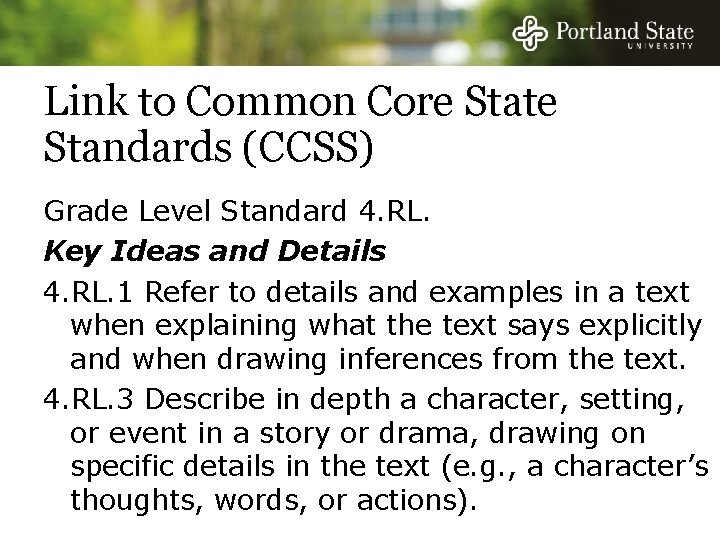
Link to Common Core State Standards (CCSS) Grade Level Standard 4. RL. Key Ideas and Details 4. RL. 1 Refer to details and examples in a text when explaining what the text says explicitly and when drawing inferences from the text. 4. RL. 3 Describe in depth a character, setting, or event in a story or drama, drawing on specific details in the text (e. g. , a character’s thoughts, words, or actions).
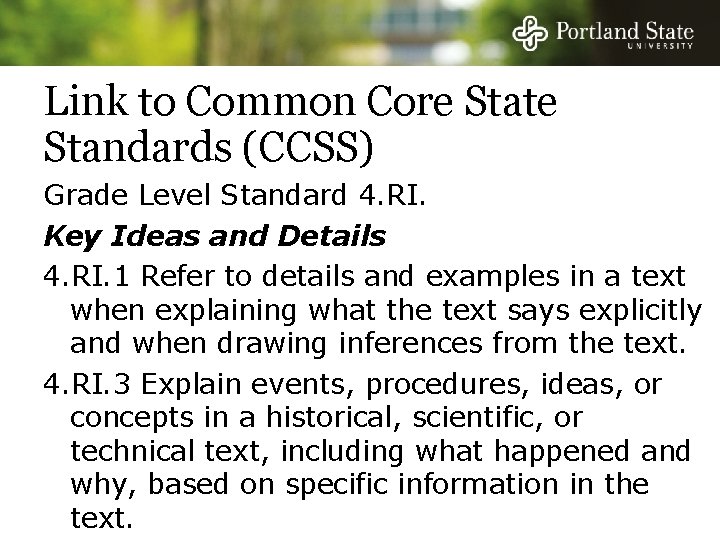
Link to Common Core State Standards (CCSS) Grade Level Standard 4. RI. Key Ideas and Details 4. RI. 1 Refer to details and examples in a text when explaining what the text says explicitly and when drawing inferences from the text. 4. RI. 3 Explain events, procedures, ideas, or concepts in a historical, scientific, or technical text, including what happened and why, based on specific information in the text.
Writing Goals: Linking to the common core • See Functional Work Sample Wiki • http: //functionalworksample. pbworks. com/ w/page/49912525/Writing%20 IEP%20 Goal s%20%20 Objectives
Website/App Students are Using for Linking Goals to CCSS https: //goalbookapp. com/