
OVERVIEW TO KNOWLEDGE MANAGEMENT AND LEARNING ORGANIZATION Contents

- Slides: 14
OVERVIEW TO KNOWLEDGE MANAGEMENT AND LEARNING ORGANIZATION.
Contents Introduction Modules Knowledge Management Learning Organizations Why knowledge management Knowledge Organization Short Case Conclusions
Introduction We live in the world that changes in a minute. Change often moves organizations and advances peoples intellect. For change to be effective, the organization as well as the people must change. As Philip Kotler said “every company should work hard to obsolete its own line before its competitors do”. To face such challenges companies make: Use of human experiences and intelligence, They must provide a sharing environment, Empower people with tools & Create a climate for learning
Cont. . With these challenges knowledge management is growing rapidly. The task here is how do we apply knowledge for value-added and conceptual advantage? How to we convert information into knowledge? Knowledge and intellectual capital represent our corporate and national wealth. Thus knowledge management is a newly emerging, interdisciplinary business model that has knowledge within the framework of an organization as its focus.
Modules 1. The paradigm of learning organization 2. Techniques of creative problem solving 3. Building a learning organization 4. Issues, themes and the role of information technology on learning organizations. 5. Techniques methods and approaches to learning organizations. 6. Knowledge management system
Knowledge Management Knowledge is an understanding gained through experience or study. KM is the management of the organization towards the continuous renewal of the organizational knowledge base. This means: Creation of supportive organizational structures Facilitation of organizations members, Putting IT instruments with emphasis on team work and diffusion of knowledge into place. KM is the process of capturing and making use of a firms collective expertise anywhere in the business - on paper, in documents, in databases or in people’s head.
Integral parts of KM Using accessible knowledge from outside sources Embedding and storing knowledge in business processes, products and services. Representing knowledge in databases and documents Promoting knowledge growth through the organization’s culture and incentives Transferring and sharing knowledge throughout the organization Assessing the value of knowledge assets and impact on a regular basis.
Learning Organization The change and uncertainty in today's have given rise to an emphasis on creating organizations. A learning organization continuously changes and improves, using the lessons of experience. Such organization are successful because they are uniquely capable of improving themselves by learning from experience.
Why knowledge management Knowledge management underlines a growing structure of ideas, techniques and technologies. Fortune 500 companies loose close to 12 billion dollars annually due to poorly managed KM. Thus survival and success of businesses in the ever increasing competitive marketplace depends significantly on the quality of knowledge, which those organizations apply to their business processes.
Cont. . This century is witnessing new business models emerging out of restructuring, redefining, reinventing the business, systems and processes. The single most important driver of this radical change is ICT. This century is termed as the HR: Knowledge Economy. This economy is driven by the knowledge, the information and the people the organization have.
Other aspects which make KM inevitable Increasingly competitive marketplace and the speed of innovation. Employees lay-offs create a need to change informal knowledge with formal knowledge. Time availability to acquire knowledge has diminished. Premature retirements and increasing mobility of the work force leads to loss of knowledge. Change in strategic direction of companies may result in the loss of knowledge in specific areas. The need for continuous learning is an inevitable reality.
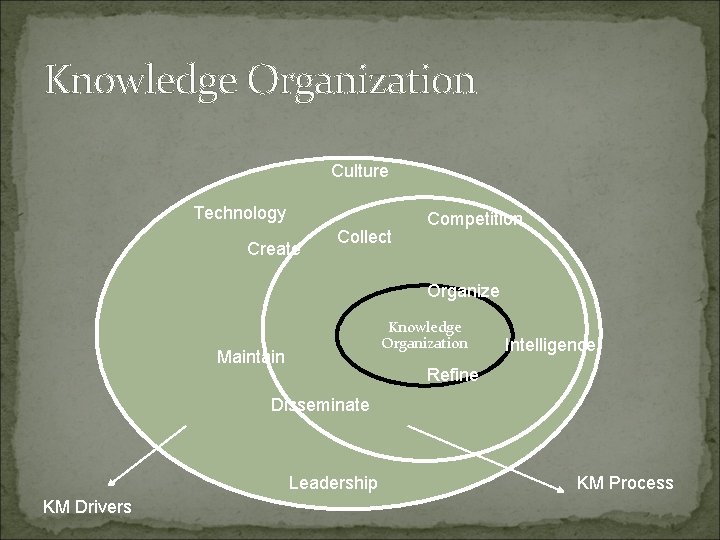
Knowledge Organization Culture Technology Create Collect Competition Organize Knowledge Organization Maintain Intelligence Refine Disseminate Leadership KM Drivers KM Process
Cont… An ideal knowledge organization is one where people exchange knowledge across the functional areas of business by using technology and established process. Knowledge is also internalized and adopted within the culture of the organization. All knowledge workers are in an environment where they can freely exchange and produce knowledge assets by using various technologies. This process influences the company as a whole in a positive way.
Conclusion To summarize, knowledge and information have become the areas which business problems occur. As a result managing knowledge characterizes the primary prospects for achieving considerable savings, vital improvements in human performance and competitive advantage.