
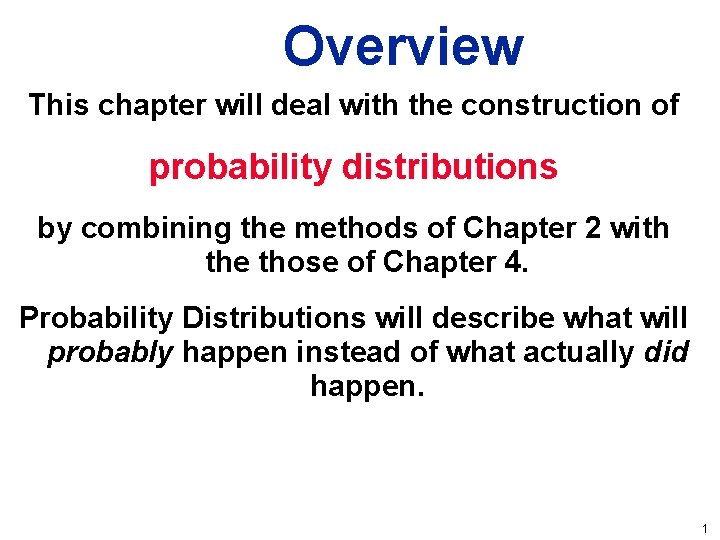
Overview This chapter will deal with the construction
![Mean, Variance and Standard Deviation of a Probability Distribution µ = [x • P(x)]](https://slidetodoc.com/presentation_image/1c98cc0a8e1dbc79502deacf39ba4ea4/image-8.jpg "Mean, Variance and Standard Deviation of a Probability Distribution µ = [x • P(x)]")
![Definition Expected Value The average value of outcomes E = [x • P(x)] 10](https://slidetodoc.com/presentation_image/1c98cc0a8e1dbc79502deacf39ba4ea4/image-10.jpg "Definition Expected Value The average value of outcomes E = [x • P(x)] 10")
![E = [x • P(x)] Event x P(x) x • P(x) Win $499 0.](https://slidetodoc.com/presentation_image/1c98cc0a8e1dbc79502deacf39ba4ea4/image-11.jpg "E = [x • P(x)] Event x P(x) x • P(x) Win $499 0.")


- Slides: 24
Overview This chapter will deal with the construction of probability distributions by combining the methods of Chapter 2 with the those of Chapter 4. Probability Distributions will describe what will probably happen instead of what actually did happen. 1
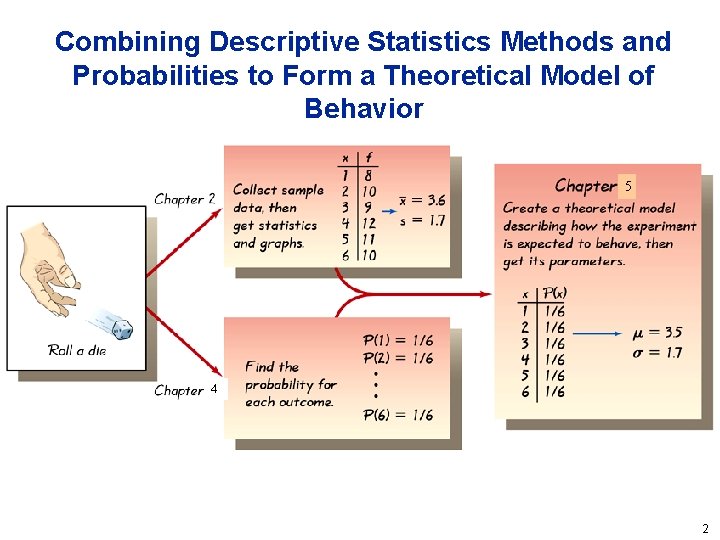
Combining Descriptive Statistics Methods and Probabilities to Form a Theoretical Model of Behavior 5 4 2
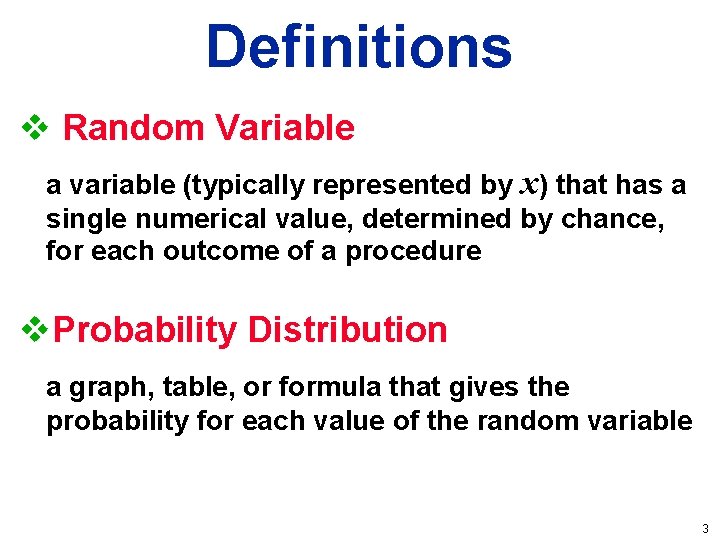
Definitions v Random Variable a variable (typically represented by x) that has a single numerical value, determined by chance, for each outcome of a procedure v. Probability Distribution a graph, table, or formula that gives the probability for each value of the random variable 3
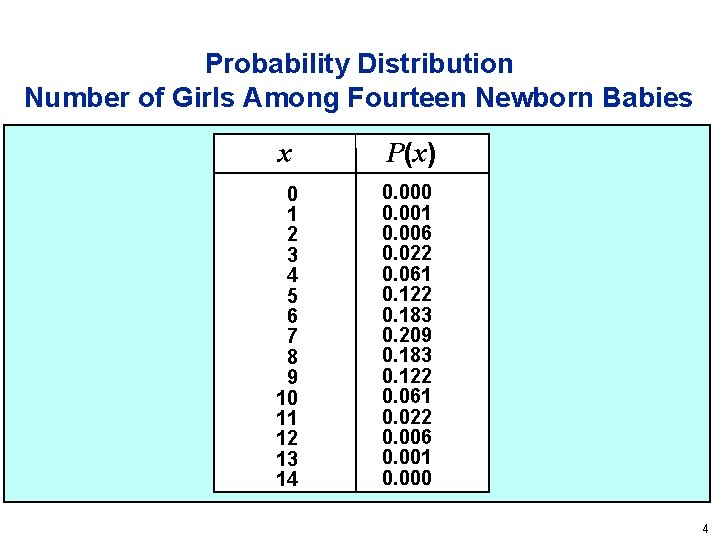
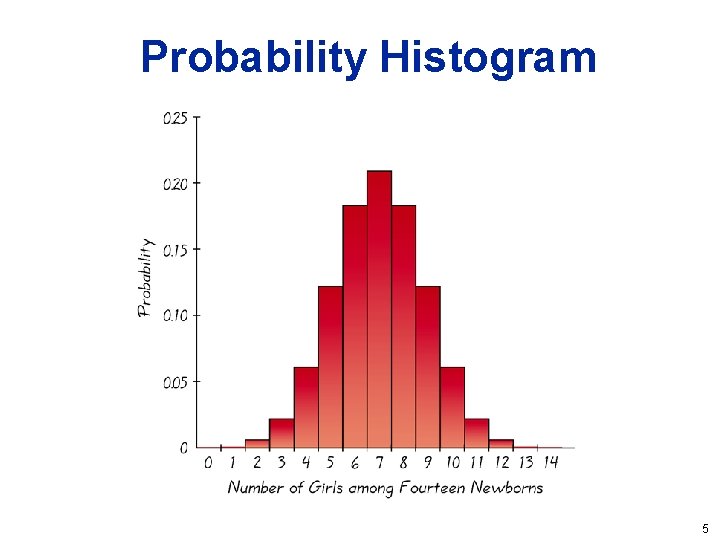
Probability Distribution Number of Girls Among Fourteen Newborn Babies x P(x) 0 1 2 3 4 5 6 7 8 9 10 11 12 13 14 0. 000 0. 001 0. 006 0. 022 0. 061 0. 122 0. 183 0. 209 0. 183 0. 122 0. 061 0. 022 0. 006 0. 001 0. 000 4
Probability Histogram 5
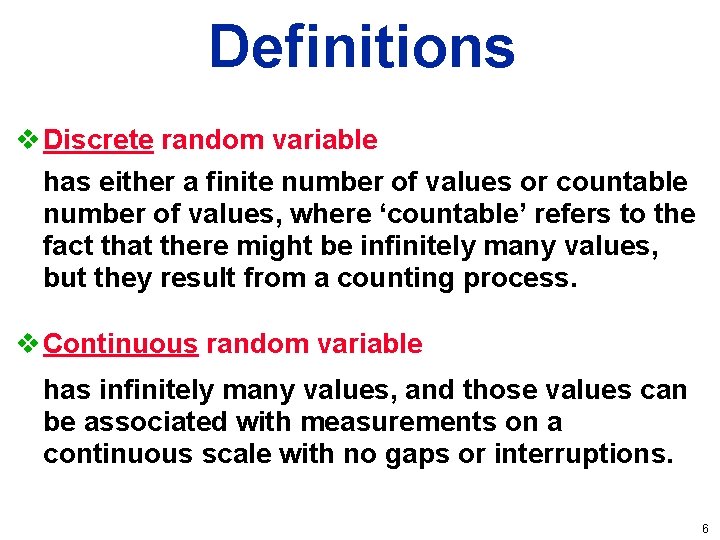
Definitions v Discrete random variable has either a finite number of values or countable number of values, where ‘countable’ refers to the fact that there might be infinitely many values, but they result from a counting process. v Continuous random variable has infinitely many values, and those values can be associated with measurements on a continuous scale with no gaps or interruptions. 6
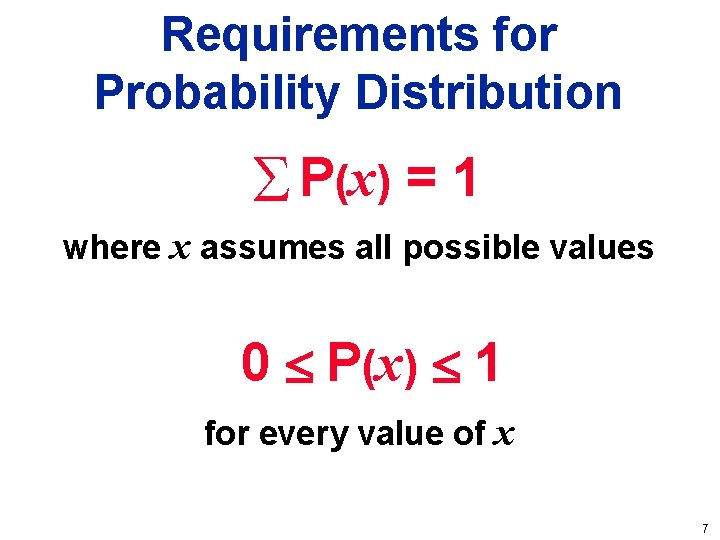
Requirements for Probability Distribution P(x) = 1 where x assumes all possible values 0 P(x) 1 for every value of x 7
Mean, Variance and Standard Deviation of a Probability Distribution µ = [x • P(x)] 2 = [(x - µ) • P(x)] 2 = [ x • P(x)] - µ 2 2 = [ x 2 • P(x)] - µ 2 2 (shortcut) 8
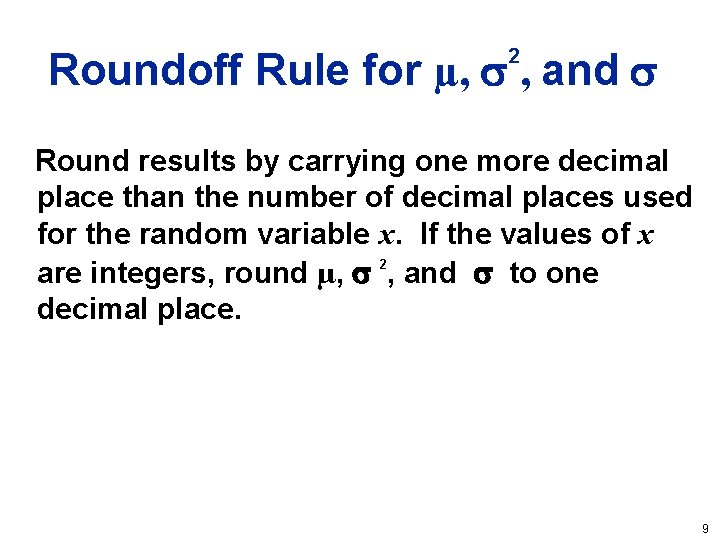
Roundoff Rule for µ, , and 2 Round results by carrying one more decimal place than the number of decimal places used for the random variable x. If the values of x are integers, round µ, 2, and to one decimal place. 9
Definition Expected Value The average value of outcomes E = [x • P(x)] 10
E = [x • P(x)] Event x P(x) x • P(x) Win $499 0. 001 0. 499 Lose - $1 0. 999 - 0. 999 E = -$. 50 11
12
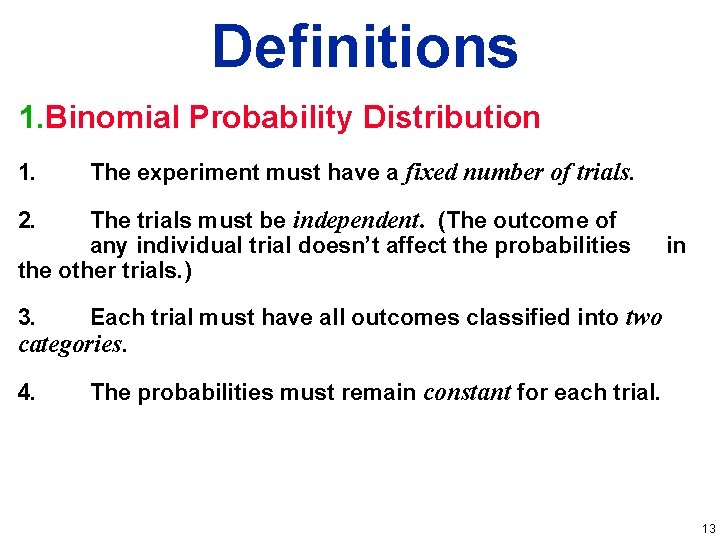
Definitions 1. Binomial Probability Distribution 1. The experiment must have a fixed number of trials. The trials must be independent. (The outcome of any individual trial doesn’t affect the probabilities the other trials. ) 2. in Each trial must have all outcomes classified into two categories. 3. 4. The probabilities must remain constant for each trial. 13
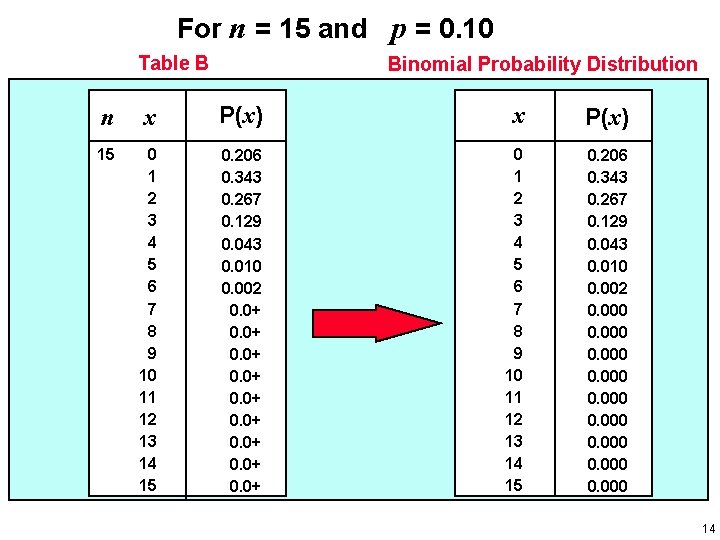
For n = 15 and p = 0. 10 Table B Binomial Probability Distribution n x P(x) 15 0 1 2 3 4 5 6 7 8 9 10 11 12 13 14 15 0. 206 0. 343 0. 267 0. 129 0. 043 0. 010 0. 002 0. 0+ 0 1 2 3 4 5 6 7 8 9 10 11 12 13 14 15 0. 206 0. 343 0. 267 0. 129 0. 043 0. 010 0. 002 0. 000 0. 000 14
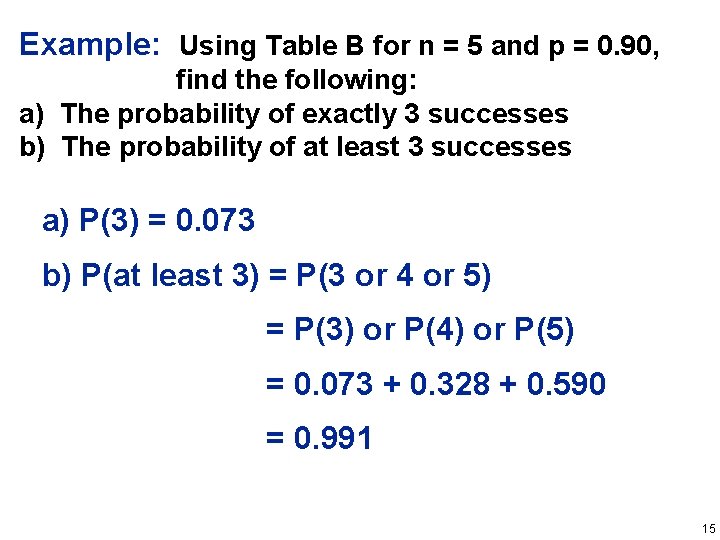
Example: Using Table B for n = 5 and p = 0. 90, find the following: a) The probability of exactly 3 successes b) The probability of at least 3 successes a) P(3) = 0. 073 b) P(at least 3) = P(3 or 4 or 5) = P(3) or P(4) or P(5) = 0. 073 + 0. 328 + 0. 590 = 0. 991 15
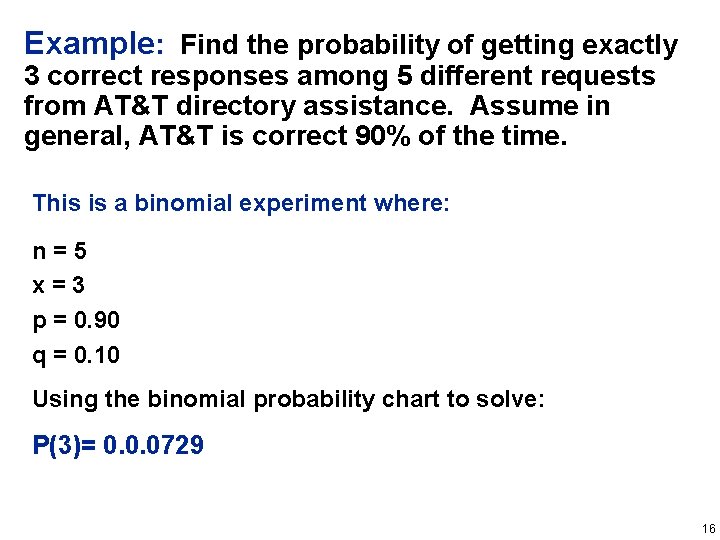
Example: Find the probability of getting exactly 3 correct responses among 5 different requests from AT&T directory assistance. Assume in general, AT&T is correct 90% of the time. This is a binomial experiment where: n=5 x=3 p = 0. 90 q = 0. 10 Using the binomial probability chart to solve: P(3)= 0. 0. 0729 16
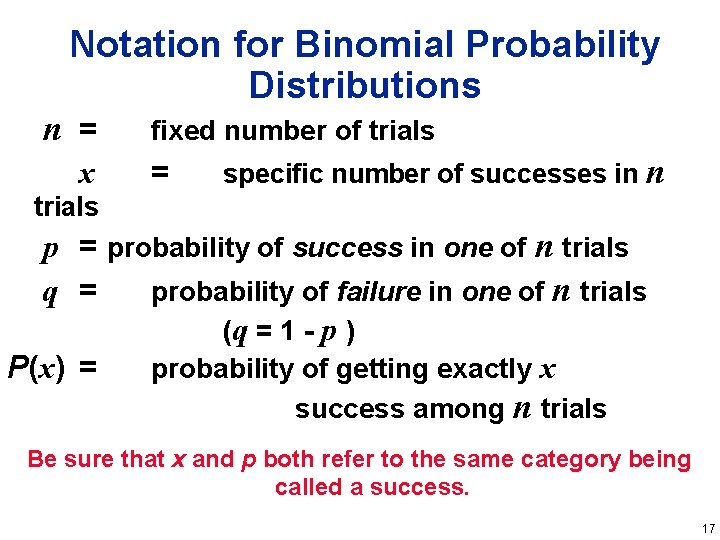
Notation for Binomial Probability Distributions n = x fixed number of trials = specific number of successes in n trials p = probability of success in one of n trials q = probability of failure in one of n trials (q = 1 - p ) P(x) = probability of getting exactly x success among n trials Be sure that x and p both refer to the same category being called a success. 17
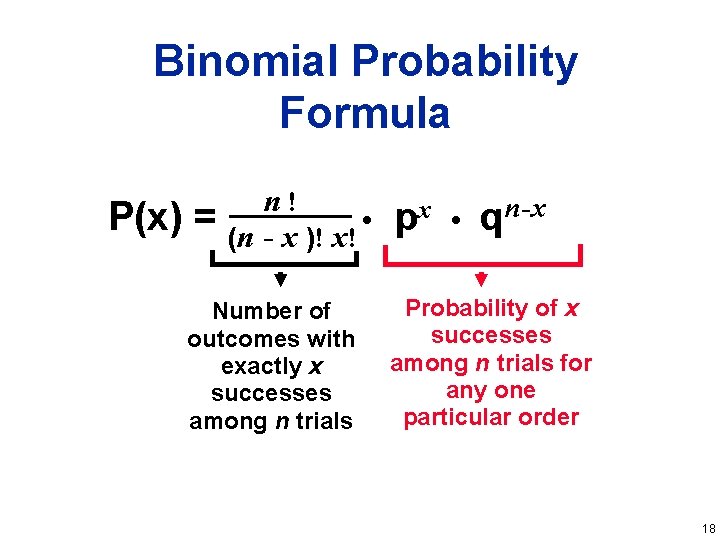
Binomial Probability Formula P(x) = n! • (n - x )! x! Number of outcomes with exactly x successes among n trials px • qn-x Probability of x successes among n trials for any one particular order 18
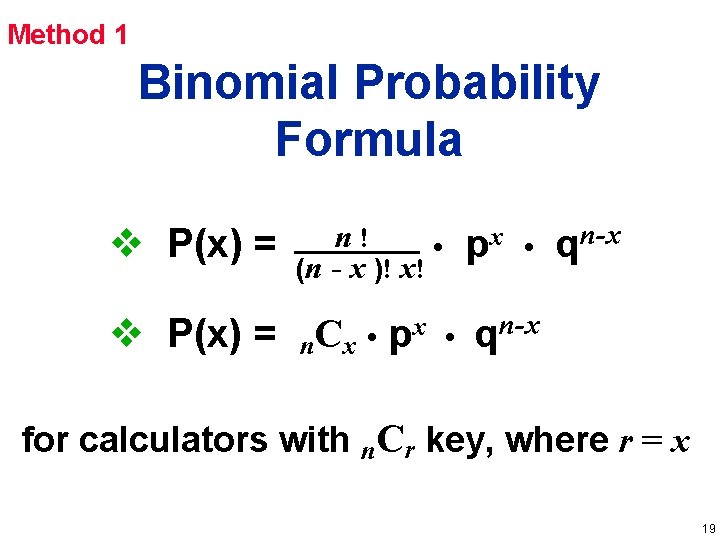
Method 1 Binomial Probability Formula v P(x) = n! • (n - x )! x! v P(x) = n. Cx • px px • • n-x q qn-x for calculators with n. Cr key, where r = x 19
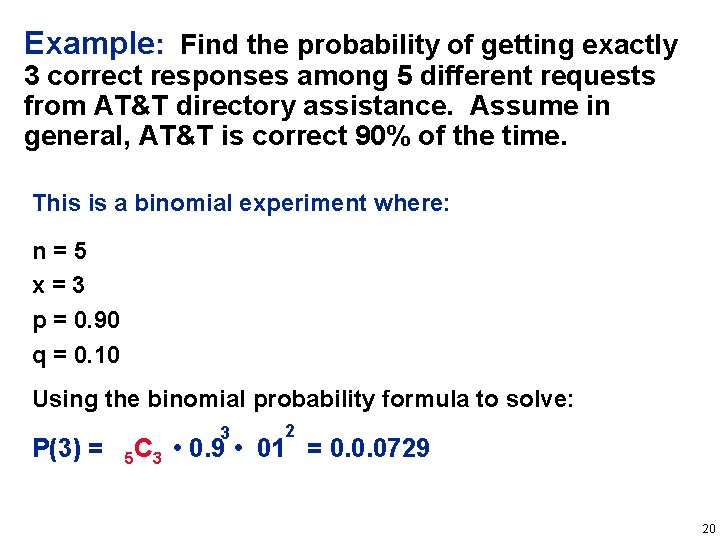
Example: Find the probability of getting exactly 3 correct responses among 5 different requests from AT&T directory assistance. Assume in general, AT&T is correct 90% of the time. This is a binomial experiment where: n=5 x=3 p = 0. 90 q = 0. 10 Using the binomial probability formula to solve: P(3) = 5 C 3 3 2 • 0. 9 • 01 = 0. 0. 0729 20
21
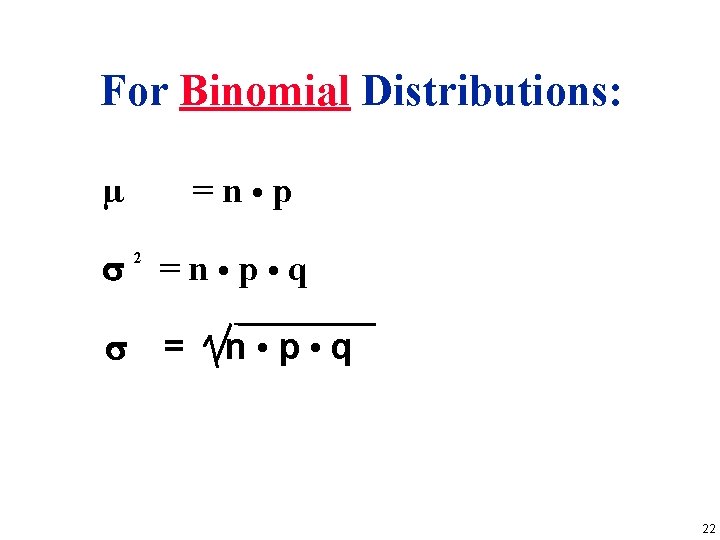
For Binomial Distributions: µ =n • p = n • p • q 22
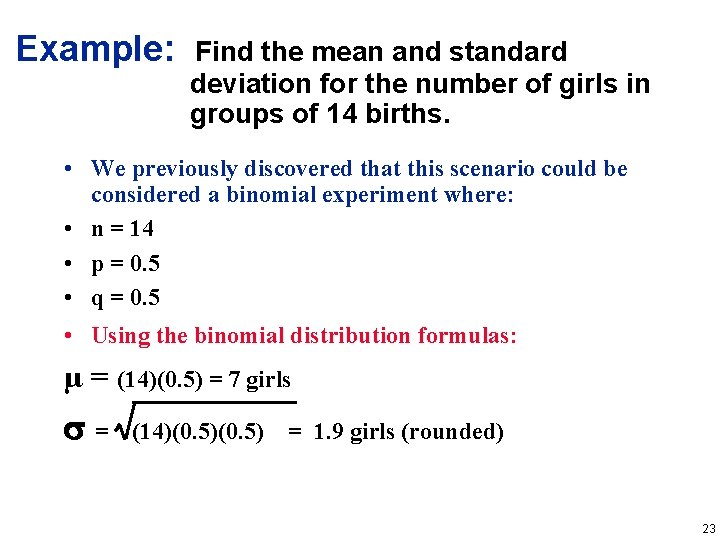
Example: Find the mean and standard deviation for the number of girls in groups of 14 births. • We previously discovered that this scenario could be considered a binomial experiment where: • n = 14 • p = 0. 5 • q = 0. 5 • Using the binomial distribution formulas: µ = (14)(0. 5) = 7 girls = (14)(0. 5) = 1. 9 girls (rounded) 23
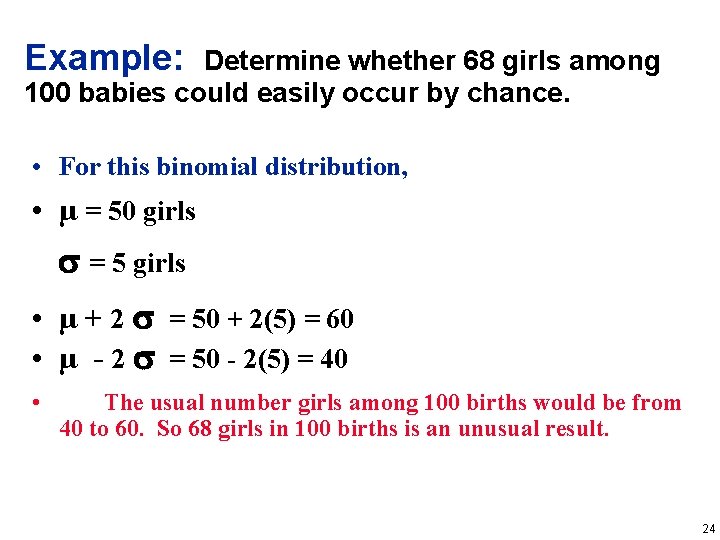
Example: Determine whether 68 girls among 100 babies could easily occur by chance. • For this binomial distribution, • µ = 50 girls = 5 girls • µ + 2 = 50 + 2(5) = 60 • µ - 2 = 50 - 2(5) = 40 • The usual number girls among 100 births would be from 40 to 60. So 68 girls in 100 births is an unusual result. 24