
Overview The Process That Feeds the Biosphere Photosynthesis
Overview: The Process That Feeds the Biosphere • Photosynthesis is the process that converts solar energy into chemical energy • Directly or indirectly, photosynthesis nourishes almost the entire living world Copyright © 2005 Pearson Education, Inc. publishing as Benjamin Cummings
• Autotrophs sustain themselves without eating anything derived from other organisms • Autotrophs are the producers of the biosphere, producing organic molecules from CO 2 and other inorganic molecules • Almost all plants are photoautotrophs, using the energy of sunlight to make organic molecules from water and carbon dioxide Copyright © 2005 Pearson Education, Inc. publishing as Benjamin Cummings
• Photosynthesis occurs in plants, algae, certain other protists, and some prokaryotes • These organisms feed not only themselves but also the entire living world Copyright © 2005 Pearson Education, Inc. publishing as Benjamin Cummings
• Heterotrophs obtain their organic material from other organisms • Heterotrophs are the consumers of the biosphere • Almost all heterotrophs, including humans, depend on photoautotrophs for food and oxygen Copyright © 2005 Pearson Education, Inc. publishing as Benjamin Cummings
Concept 10. 1: Photosynthesis converts light energy to the chemical energy of food • Chloroplasts are organelles that are responsible for feeding the vast majority of organisms • Chloroplasts are present in a variety of photosynthesizing organisms Copyright © 2005 Pearson Education, Inc. publishing as Benjamin Cummings
Chloroplasts: The Sites of Photosynthesis in Plants • Leaves are the major locations of photosynthesis • Their green color is from chlorophyll, the green pigment within chloroplasts • Light energy absorbed by chlorophyll drives the synthesis of organic molecules in the chloroplast • Through microscopic pores called stomata, CO 2 enters the leaf and O 2 exits Copyright © 2005 Pearson Education, Inc. publishing as Benjamin Cummings
• Chloroplasts are found mainly in cells of the mesophyll, the interior tissue of the leaf • A typical mesophyll cell has 30 -40 chloroplasts • The chlorophyll is in the membranes of thylakoids (connected sacs in the chloroplast); thylakoids may be stacked in columns called grana • Chloroplasts also contain stroma, a dense fluid Copyright © 2005 Pearson Education, Inc. publishing as Benjamin Cummings
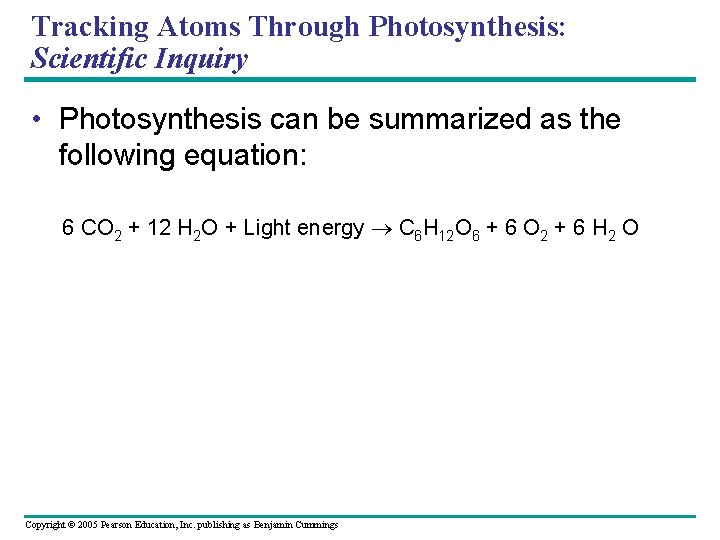
Tracking Atoms Through Photosynthesis: Scientific Inquiry • Photosynthesis can be summarized as the following equation: 6 CO 2 + 12 H 2 O + Light energy C 6 H 12 O 6 + 6 O 2 + 6 H 2 O Copyright © 2005 Pearson Education, Inc. publishing as Benjamin Cummings
The Splitting of Water • Chloroplasts split water into hydrogen and oxygen, incorporating the electrons of hydrogen into sugar molecules Copyright © 2005 Pearson Education, Inc. publishing as Benjamin Cummings
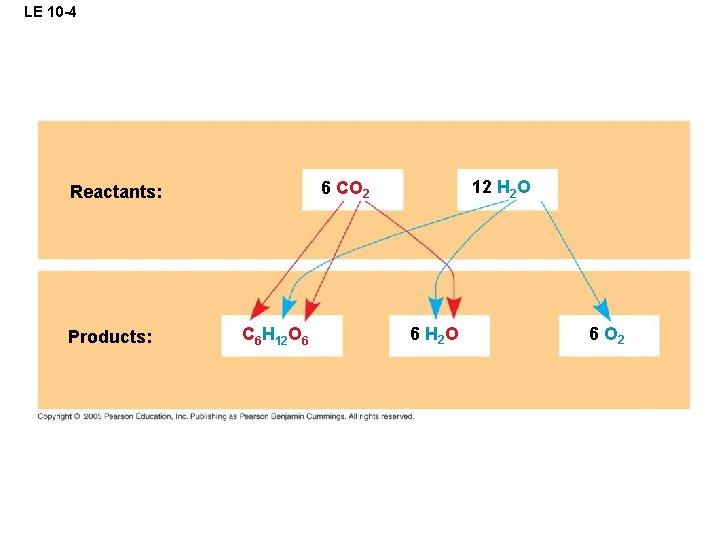
LE 10 -4 Products: 12 H 2 O 6 CO 2 Reactants: C 6 H 12 O 6 6 H 2 O 6 O 2
Photosynthesis as a Redox Process • Photosynthesis is a redox process in which water is oxidized and carbon dioxide is reduced Copyright © 2005 Pearson Education, Inc. publishing as Benjamin Cummings
The Two Stages of Photosynthesis: A Preview • Photosynthesis consists of the light reactions (the photo part) and Calvin cycle (the synthesis part) • The light reactions (in the thylakoids) split water, release O 2, produce ATP, and form NADPH • The Calvin cycle (in the stroma) forms sugar from CO 2, using ATP and NADPH • The Calvin cycle begins with carbon fixation, incorporating CO 2 into organic molecules Copyright © 2005 Pearson Education, Inc. publishing as Benjamin Cummings
Concept 10. 2: The light reactions convert solar energy to the chemical energy of ATP and NADPH • Chloroplasts are solar-powered chemical factories • Their thylakoids transform light energy into the chemical energy of ATP and NADPH Copyright © 2005 Pearson Education, Inc. publishing as Benjamin Cummings
The Nature of Sunlight • Light is a form of electromagnetic energy, also called electromagnetic radiation • Like other electromagnetic energy, light travels in rhythmic waves • Wavelength = distance between crests of waves • Wavelength determines the type of electromagnetic energy • Light also behaves as though it consists of discrete particles, called photons Copyright © 2005 Pearson Education, Inc. publishing as Benjamin Cummings
• The electromagnetic spectrum is the entire range of electromagnetic energy, or radiation • Visible light consists of colors we can see, including wavelengths that drive photosynthesis Copyright © 2005 Pearson Education, Inc. publishing as Benjamin Cummings
Photosynthetic Pigments: The Light Receptors • Pigments are substances that absorb visible light • Different pigments absorb different wavelengths • Wavelengths that are not absorbed are reflected or transmitted • Leaves appear green because chlorophyll reflects and transmits green light Animation: Light and Pigments Copyright © 2005 Pearson Education, Inc. publishing as Benjamin Cummings
• A spectrophotometer measures a pigment’s ability to absorb various wavelengths • This machine sends light through pigments and measures the fraction of light transmitted at each wavelength Copyright © 2005 Pearson Education, Inc. publishing as Benjamin Cummings
• An absorption spectrum is a graph plotting a pigment’s light absorption versus wavelength • The absorption spectrum of chlorophyll a suggests that violet-blue and red light work best for photosynthesis • An action spectrum profiles the relative effectiveness of different wavelengths of radiation in driving a process Copyright © 2005 Pearson Education, Inc. publishing as Benjamin Cummings
Excitation of Chlorophyll by Light • When a pigment absorbs light, it goes from a ground state to an excited state, which is unstable • When excited electrons fall back to the ground state, photons are given off, an afterglow called fluorescence • If illuminated, an isolated solution of chlorophyll will fluoresce, giving off light and heat Copyright © 2005 Pearson Education, Inc. publishing as Benjamin Cummings
A Photosystem: A Reaction Center Associated with Light-Harvesting Complexes • A photosystem consists of a reaction center surrounded by light-harvesting complexes • The light-harvesting complexes (pigment molecules bound to proteins) funnel the energy of photons to the reaction center Copyright © 2005 Pearson Education, Inc. publishing as Benjamin Cummings
• A primary electron acceptor in the reaction center accepts an excited electron from chlorophyll a • Solar-powered transfer of an electron from a chlorophyll a molecule to the primary electron acceptor is the first step of the light reactions Copyright © 2005 Pearson Education, Inc. publishing as Benjamin Cummings
• There are two types of photosystems in the thylakoid membrane • Photosystem II functions first (the numbers reflect order of discovery) and is best at absorbing a wavelength of 680 nm • Photosystem I is best at absorbing a wavelength of 700 nm • The two photosystems work together to use light energy to generate ATP and NADPH Copyright © 2005 Pearson Education, Inc. publishing as Benjamin Cummings
Noncyclic Electron Flow • During the light reactions, there are two possible routes for electron flow: cyclic and noncyclic • Noncyclic electron flow, the primary pathway, involves both photosystems and produces ATP and NADPH Copyright © 2005 Pearson Education, Inc. publishing as Benjamin Cummings
Cyclic Electron Flow • Cyclic electron flow uses only photosystem I and produces only ATP • Cyclic electron flow generates surplus ATP, satisfying the higher demand in the Calvin cycle Copyright © 2005 Pearson Education, Inc. publishing as Benjamin Cummings
A Comparison of Chemiosmosis in Chloroplasts and Mitochondria • Chloroplasts and mitochondria generate ATP by chemiosmosis, but use different sources of energy • Mitochondria transfer chemical energy from food to ATP; chloroplasts transform light energy into the chemical energy of ATP • The spatial organization of chemiosmosis differs in chloroplasts and mitochondria Copyright © 2005 Pearson Education, Inc. publishing as Benjamin Cummings
• The current model for the thylakoid membrane is based on studies in several laboratories • Water is split by photosystem II on the side of the membrane facing the thylakoid space • The diffusion of H+ from the thylakoid space back to the stroma powers ATP synthase • ATP and NADPH are produced on the side facing the stroma, where the Calvin cycle takes place Animation: Calvin Cycle Copyright © 2005 Pearson Education, Inc. publishing as Benjamin Cummings
Concept 10. 3: The Calvin cycle uses ATP and NADPH to convert CO 2 to sugar • The Calvin cycle, like the citric acid cycle, regenerates its starting material after molecules enter and leave the cycle • The cycle builds sugar from smaller molecules by using ATP and the reducing power of electrons carried by NADPH • Carbon enters the cycle as CO 2 and leaves as a sugar named glyceraldehyde-3 -phospate (G 3 P) • For net synthesis of one G 3 P, the cycle must take place three times, fixing three molecules of CO 2 Copyright © 2005 Pearson Education, Inc. publishing as Benjamin Cummings
• The Calvin cycle has three phases: – Carbon fixation (catalyzed by rubisco) – Reduction – Regeneration of the CO 2 acceptor (Ru. BP) Play Copyright © 2005 Pearson Education, Inc. publishing as Benjamin Cummings
Concept 10. 4: Alternative mechanisms of carbon fixation have evolved in hot, arid climates • Dehydration is a problem for plants, sometimes requiring tradeoffs with other metabolic processes, especially photosynthesis • On hot, dry days, plants close stomata, which conserves water but also limits photosynthesis • The closing of stomata reduces access to CO 2 and causes O 2 to build up • These conditions favor a seemingly wasteful process called photorespiration Copyright © 2005 Pearson Education, Inc. publishing as Benjamin Cummings
Photorespiration: An Evolutionary Relic? • In most plants (C 3 plants), initial fixation of CO 2, via rubisco, forms a three-carbon compound • In photorespiration, rubisco adds O 2 to the Calvin cycle instead of CO 2 • Photorespiration consumes O 2 and organic fuel and releases CO 2 without producing ATP or sugar Copyright © 2005 Pearson Education, Inc. publishing as Benjamin Cummings
• Photorespiration may be an evolutionary relic because rubisco first evolved at a time when the atmosphere had far less O 2 and more CO 2 • In many plants, photorespiration is a problem because on a hot, dry day it can drain as much as 50% of the carbon fixed by the Calvin cycle Copyright © 2005 Pearson Education, Inc. publishing as Benjamin Cummings
C 4 Plants • C 4 plants minimize the cost of photorespiration by incorporating CO 2 into four-carbon compounds in mesophyll cells • These four-carbon compounds are exported to bundle-sheath cells, where they release CO 2 that is then used in the Calvin cycle Copyright © 2005 Pearson Education, Inc. publishing as Benjamin Cummings
CAM Plants • CAM plants open their stomata at night, incorporating CO 2 into organic acids • Stomata close during the day, and CO 2 is released from organic acids and used in the Calvin cycle Copyright © 2005 Pearson Education, Inc. publishing as Benjamin Cummings
The Importance of Photosynthesis: A Review • The energy entering chloroplasts as sunlight gets stored as chemical energy in organic compounds • Sugar made in the chloroplasts supplies chemical energy and carbon skeletons to synthesize the organic molecules of cells • In addition to food production, photosynthesis produces the oxygen in our atmosphere Copyright © 2005 Pearson Education, Inc. publishing as Benjamin Cummings
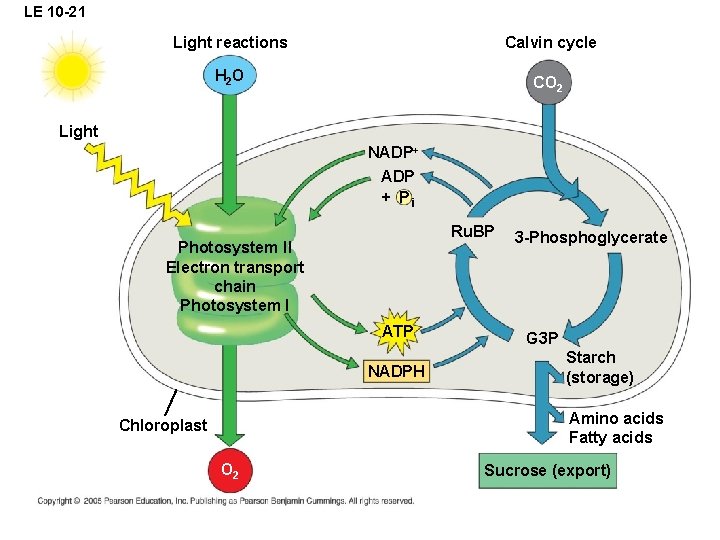
LE 10 -21 Light reactions Calvin cycle H 2 O CO 2 Light NADP+ ADP + Pi Ru. BP Photosystem II Electron transport chain Photosystem I ATP NADPH 3 -Phosphoglycerate G 3 P Starch (storage) Amino acids Fatty acids Chloroplast O 2 Sucrose (export)
- Slides: 35