
Overview The Molecules of Life All living things
- Slides: 38
Overview: The Molecules of Life • All living things are made up of four classes of large biological molecules: carbohydrates, lipids, proteins, and nucleic acids • Within cells, small organic molecules are joined together to form larger molecules • Macromolecules are large molecules composed of thousands of covalently connected atoms • Molecular structure and function are inseparable Copyright © 2008 Pearson Education, Inc. , publishing as Pearson Benjamin Cummings
Concept 5. 1: Macromolecules are polymers, built from monomers • A polymer is a long molecule consisting of many similar building blocks • These small building-block molecules are called monomers • Three of the four classes of life’s organic molecules are polymers: – Carbohydrates – Proteins – Nucleic acids Copyright © 2008 Pearson Education, Inc. , publishing as Pearson Benjamin Cummings
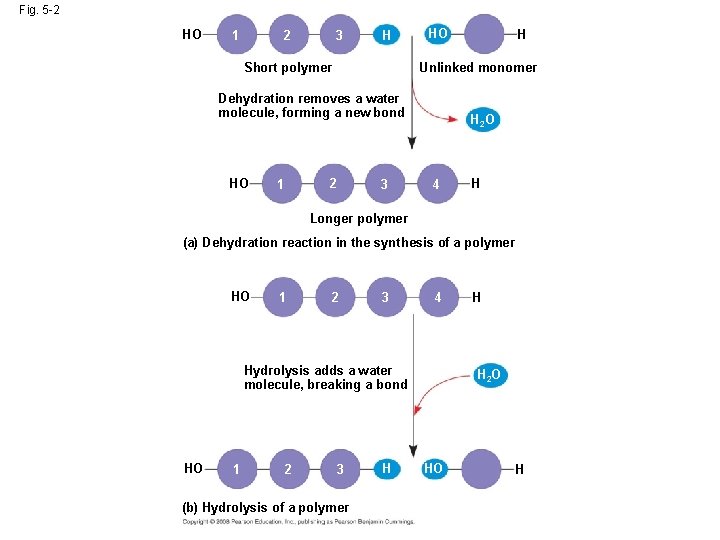
The Synthesis and Breakdown of Polymers • A condensation reaction or more specifically a dehydration reaction occurs when two monomers bond together through the loss of a water molecule • Enzymes are macromolecules that speed up the dehydration process • Polymers are disassembled to monomers by hydrolysis, a reaction that is essentially the reverse of the dehydration reaction Animation: Polymers Copyright © 2008 Pearson Education, Inc. , publishing as Pearson Benjamin Cummings
Fig. 5 -2 HO 1 2 3 H Short polymer HO Unlinked monomer Dehydration removes a water molecule, forming a new bond HO 2 1 H 3 H 2 O 4 H Longer polymer (a) Dehydration reaction in the synthesis of a polymer HO 1 2 3 4 Hydrolysis adds a water molecule, breaking a bond HO 1 2 3 (b) Hydrolysis of a polymer H H H 2 O HO H
The Diversity of Polymers • Each cell has thousands of different kinds of macromolecules 2 3 H HO • Macromolecules vary among cells of an organism, vary more within a species, and vary even more between species • An immense variety of polymers can be built from a small set of monomers Copyright © 2008 Pearson Education, Inc. , publishing as Pearson Benjamin Cummings
Concept 5. 2: Carbohydrates serve as fuel and building material • Carbohydrates include sugars and the polymers of sugars • The simplest carbohydrates are monosaccharides, or single sugars • Carbohydrate macromolecules are polysaccharides, polymers composed of many sugar building blocks Copyright © 2008 Pearson Education, Inc. , publishing as Pearson Benjamin Cummings
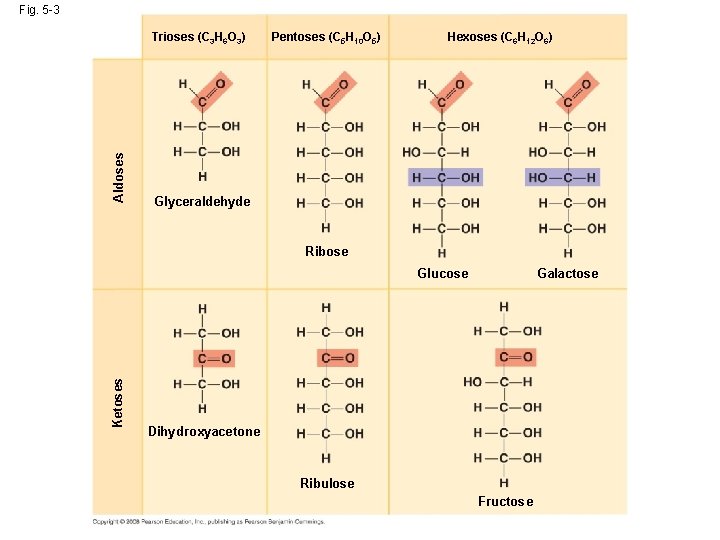
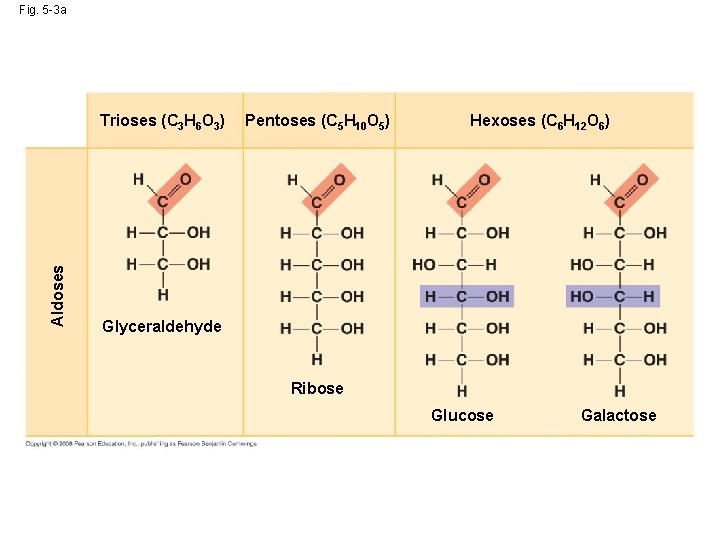
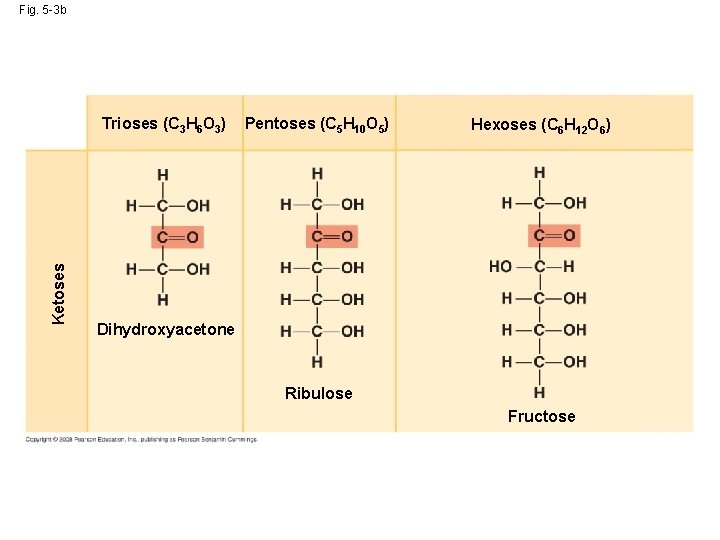
Sugars • Monosaccharides have molecular formulas that are usually multiples of CH 2 O • Glucose (C 6 H 12 O 6) is the most common monosaccharide • Monosaccharides are classified by – The location of the carbonyl group (as aldose or ketose) – The number of carbons in the carbon skeleton Copyright © 2008 Pearson Education, Inc. , publishing as Pearson Benjamin Cummings
Fig. 5 -3 Aldoses Trioses (C 3 H 6 O 3) Pentoses (C 5 H 10 O 5) Hexoses (C 6 H 12 O 6) Glyceraldehyde Ribose Ketoses Glucose Galactose Dihydroxyacetone Ribulose Fructose
Fig. 5 -3 a Aldoses Trioses (C 3 H 6 O 3) Pentoses (C 5 H 10 O 5) Hexoses (C 6 H 12 O 6) Glyceraldehyde Ribose Glucose Galactose
Fig. 5 -3 b Ketoses Trioses (C 3 H 6 O 3) Pentoses (C 5 H 10 O 5) Hexoses (C 6 H 12 O 6) Dihydroxyacetone Ribulose Fructose
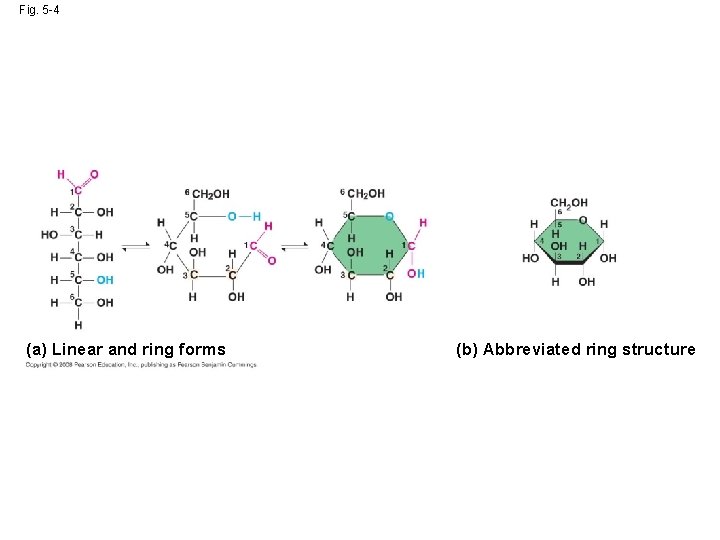
• Though often drawn as linear skeletons, in aqueous solutions many sugars form rings • Monosaccharides serve as a major fuel for cells and as raw material for building molecules Copyright © 2008 Pearson Education, Inc. , publishing as Pearson Benjamin Cummings
Fig. 5 -4 (a) Linear and ring forms (b) Abbreviated ring structure
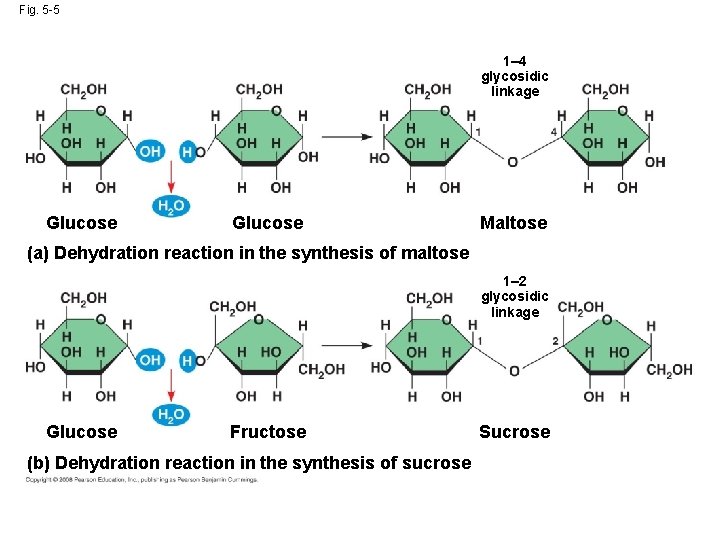
• A disaccharide is formed when a dehydration reaction joins two monosaccharides • This covalent bond is called a glycosidic linkage Animation: Disaccharides Copyright © 2008 Pearson Education, Inc. , publishing as Pearson Benjamin Cummings
Fig. 5 -5 1– 4 glycosidic linkage Glucose Maltose (a) Dehydration reaction in the synthesis of maltose 1– 2 glycosidic linkage Glucose Fructose (b) Dehydration reaction in the synthesis of sucrose Sucrose
Polysaccharides • Polysaccharides, the polymers of sugars, have storage and structural roles • The structure and function of a polysaccharide are determined by its sugar monomers and the positions of glycosidic linkages Copyright © 2008 Pearson Education, Inc. , publishing as Pearson Benjamin Cummings
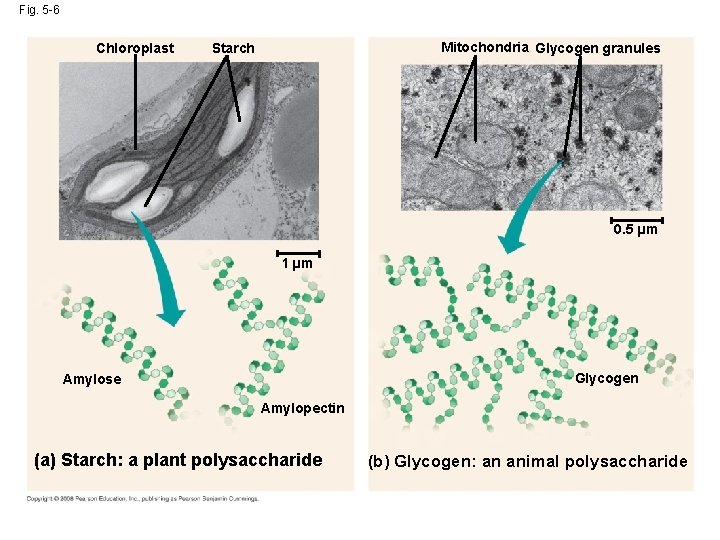
Storage Polysaccharides • Starch, a storage polysaccharide of plants, consists entirely of glucose monomers • Plants store surplus starch as granules within chloroplasts and other plastids Copyright © 2008 Pearson Education, Inc. , publishing as Pearson Benjamin Cummings
Fig. 5 -6 Chloroplast Mitochondria Glycogen granules Starch 0. 5 µm 1 µm Glycogen Amylose Amylopectin (a) Starch: a plant polysaccharide (b) Glycogen: an animal polysaccharide
• Glycogen is a storage polysaccharide in animals • Humans and other vertebrates store glycogen mainly in liver and muscle cells Copyright © 2008 Pearson Education, Inc. , publishing as Pearson Benjamin Cummings
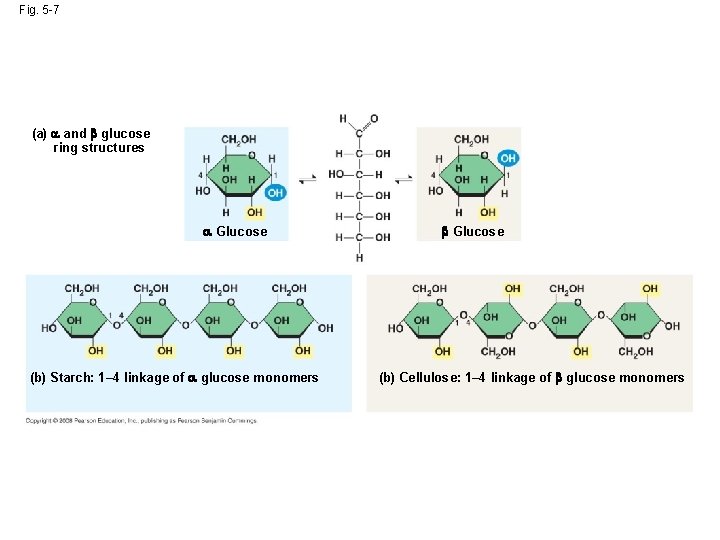
Structural Polysaccharides • The polysaccharide cellulose is a major component of the tough wall of plant cells • Like starch, cellulose is a polymer of glucose, but the glycosidic linkages differ • The difference is based on two ring forms for glucose: alpha ( ) and beta ( ) Animation: Polysaccharides Copyright © 2008 Pearson Education, Inc. , publishing as Pearson Benjamin Cummings
Fig. 5 -7 (a) and glucose ring structures Glucose (b) Starch: 1– 4 linkage of glucose monomers Glucose (b) Cellulose: 1– 4 linkage of glucose monomers
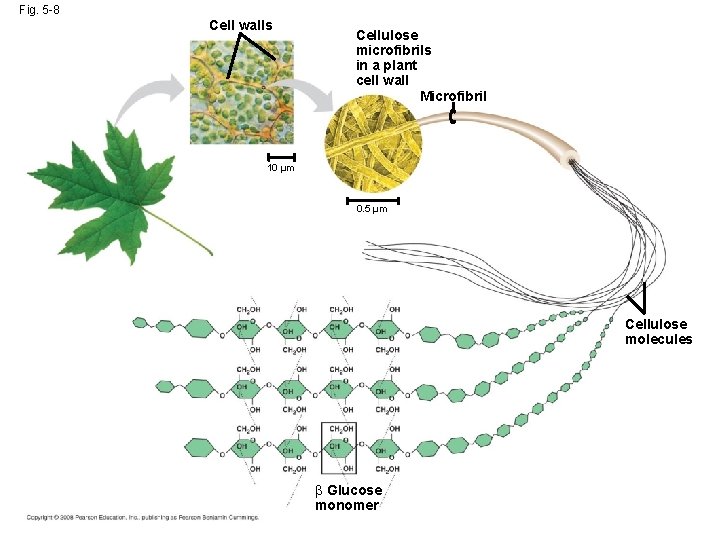
• Polymers with glucose are helical • Polymers with glucose are straight • In straight structures, H atoms on one strand can bond with OH groups on other strands • Parallel cellulose molecules held together this way are grouped into microfibrils, which form strong building materials for plants Copyright © 2008 Pearson Education, Inc. , publishing as Pearson Benjamin Cummings
Fig. 5 -8 Cell walls Cellulose microfibrils in a plant cell wall Microfibril 10 µm 0. 5 µm Cellulose molecules Glucose monomer
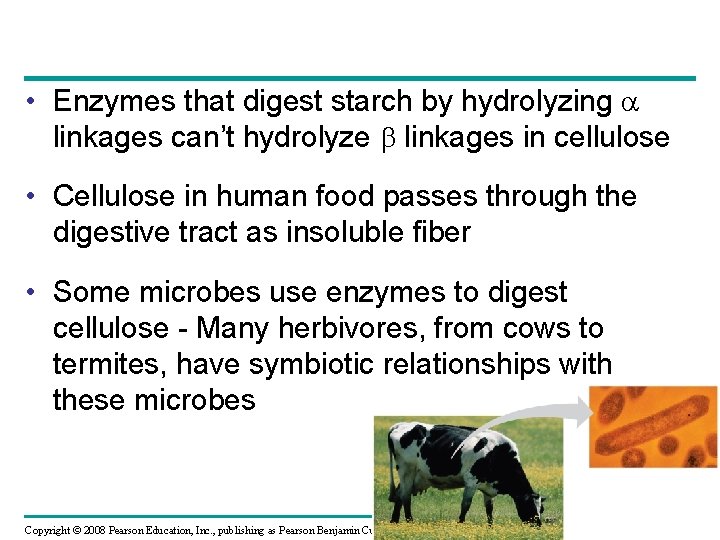
• Enzymes that digest starch by hydrolyzing linkages can’t hydrolyze linkages in cellulose • Cellulose in human food passes through the digestive tract as insoluble fiber • Some microbes use enzymes to digest cellulose - Many herbivores, from cows to termites, have symbiotic relationships with these microbes Copyright © 2008 Pearson Education, Inc. , publishing as Pearson Benjamin Cummings
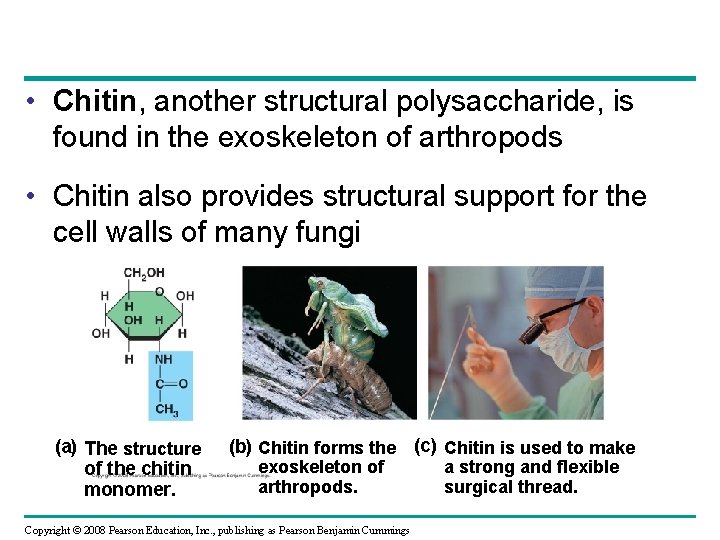
• Chitin, another structural polysaccharide, is found in the exoskeleton of arthropods • Chitin also provides structural support for the cell walls of many fungi (a) The structure of the chitin monomer. (b) Chitin forms the (c) Chitin is used to make exoskeleton of arthropods. Copyright © 2008 Pearson Education, Inc. , publishing as Pearson Benjamin Cummings a strong and flexible surgical thread.
Concept 5. 3: Lipids are a diverse group of hydrophobic molecules • Lipids are the one class of large biological molecules that do not form polymers • The unifying feature of lipids is having little or no affinity for water • Lipids are hydrophobic because they consist mostly of hydrocarbons, which form nonpolar covalent bonds • The most biologically important lipids are fats, phospholipids, and steroids Copyright © 2008 Pearson Education, Inc. , publishing as Pearson Benjamin Cummings
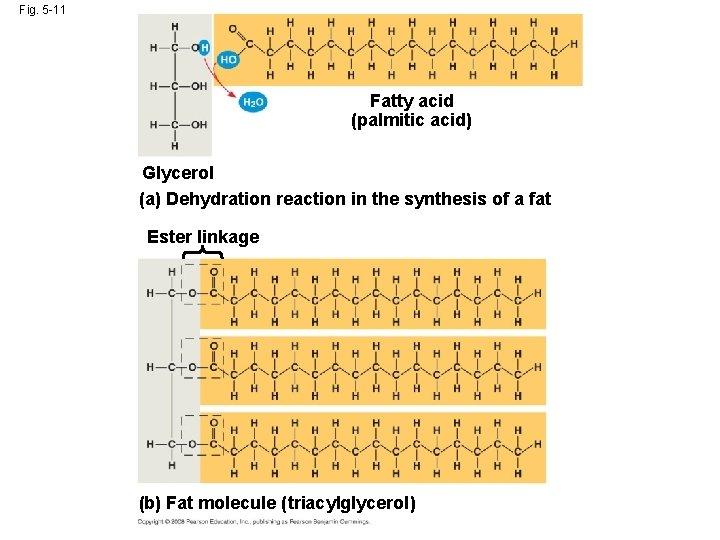
Fats • Fats are constructed from two types of smaller molecules: glycerol and fatty acids • Glycerol is a three-carbon alcohol with a hydroxyl group attached to each carbon • A fatty acid consists of a carboxyl group attached to a long carbon skeleton Copyright © 2008 Pearson Education, Inc. , publishing as Pearson Benjamin Cummings
Fig. 5 -11 Fatty acid (palmitic acid) Glycerol (a) Dehydration reaction in the synthesis of a fat Ester linkage (b) Fat molecule (triacylglycerol)
• Fats separate from water because water molecules form hydrogen bonds with each other and exclude the fats • In a fat, three fatty acids are joined to glycerol by an ester linkage, creating a triacylglycerol, or triglyceride Copyright © 2008 Pearson Education, Inc. , publishing as Pearson Benjamin Cummings
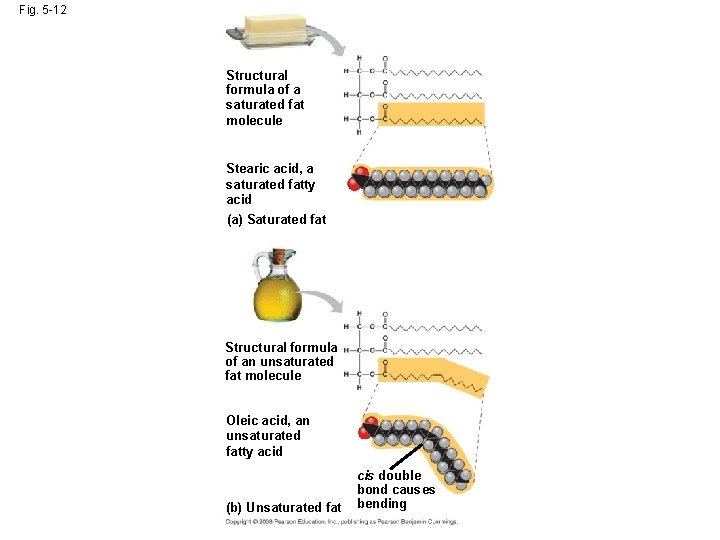
• Fatty acids vary in length (number of carbons) and in the number and locations of double bonds • Saturated fatty acids have the maximum number of hydrogen atoms possible and no double bonds • Unsaturated fatty acids have one or more double bonds Animation: Fats Copyright © 2008 Pearson Education, Inc. , publishing as Pearson Benjamin Cummings
Fig. 5 -12 Structural formula of a saturated fat molecule Stearic acid, a saturated fatty acid (a) Saturated fat Structural formula of an unsaturated fat molecule Oleic acid, an unsaturated fatty acid (b) Unsaturated fat cis double bond causes bending
• Fats made from saturated fatty acids are called saturated fats, and are solid at room temperature • Most animal fats are saturated • Fats made from unsaturated fatty acids are called unsaturated fats or oils, and are liquid at room temperature • Plant fats and fish fats are usually unsaturated Copyright © 2008 Pearson Education, Inc. , publishing as Pearson Benjamin Cummings
• A diet rich in saturated fats may contribute to cardiovascular disease through plaque deposits • Hydrogenation is the process of converting unsaturated fats to saturated fats by adding hydrogen • Hydrogenating vegetable oils also creates unsaturated fats with trans double bonds • These trans fats may contribute more than saturated fats to cardiovascular disease Copyright © 2008 Pearson Education, Inc. , publishing as Pearson Benjamin Cummings
• The major function of fats is energy storage • Humans and other mammals store their fat in adipose cells • Adipose tissue also cushions vital organs and insulates the body Copyright © 2008 Pearson Education, Inc. , publishing as Pearson Benjamin Cummings
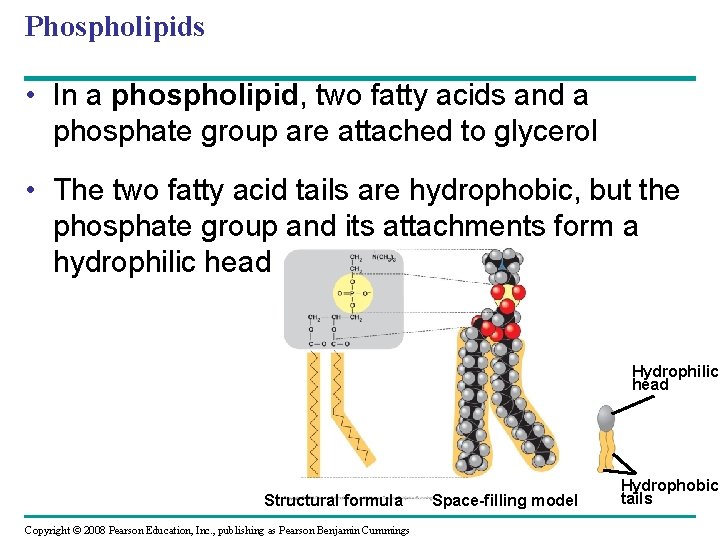
Phospholipids • In a phospholipid, two fatty acids and a phosphate group are attached to glycerol • The two fatty acid tails are hydrophobic, but the phosphate group and its attachments form a hydrophilic head Hydrophilic head Structural formula Copyright © 2008 Pearson Education, Inc. , publishing as Pearson Benjamin Cummings Space-filling model Hydrophobic tails
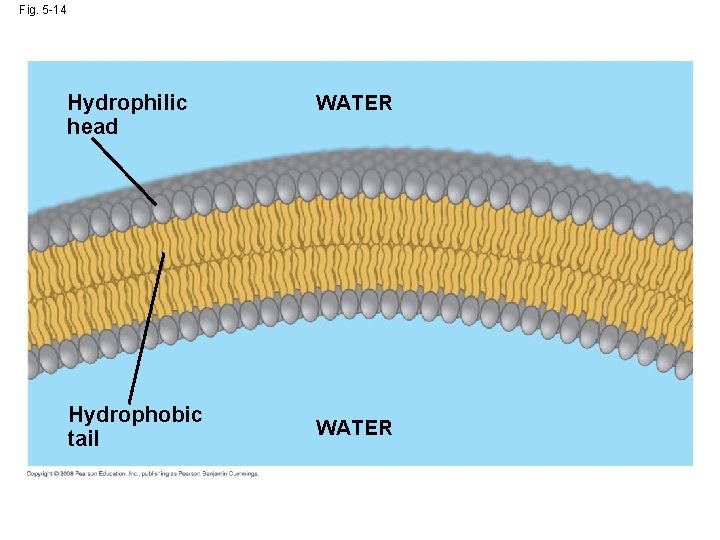
• When phospholipids are added to water, they self-assemble into a bilayer, with the hydrophobic tails pointing toward the interior • The structure of phospholipids results in a bilayer arrangement found in cell membranes • Phospholipids are the major component of all cell membranes Copyright © 2008 Pearson Education, Inc. , publishing as Pearson Benjamin Cummings
Fig. 5 -14 Hydrophilic head Hydrophobic tail WATER
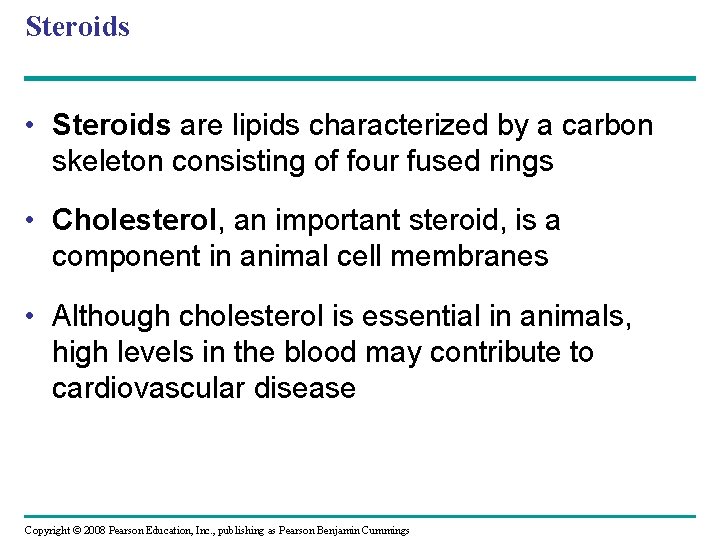
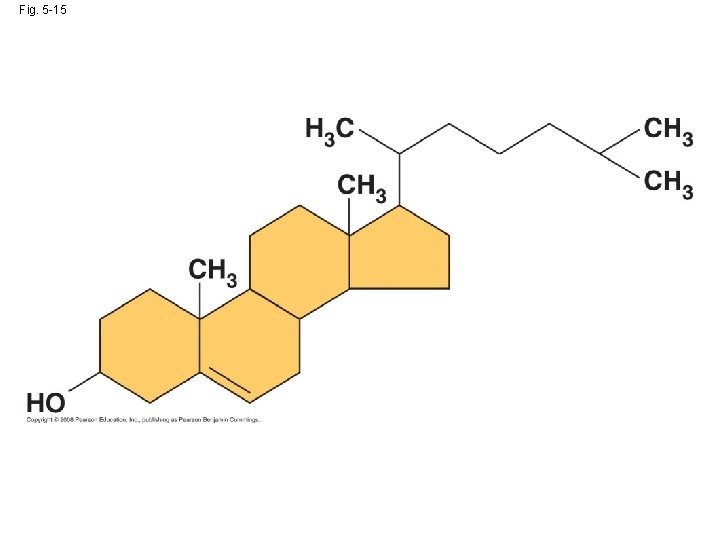
Steroids • Steroids are lipids characterized by a carbon skeleton consisting of four fused rings • Cholesterol, an important steroid, is a component in animal cell membranes • Although cholesterol is essential in animals, high levels in the blood may contribute to cardiovascular disease Copyright © 2008 Pearson Education, Inc. , publishing as Pearson Benjamin Cummings
Fig. 5 -15