
Overview SLA Credibility in the ISP Market Applying

Overview § SLA Credibility in the ISP Market § Applying SLAs to Inter-ISP Interconnect & Peering § Xchange. Point’s Interconnect Service Platform § Xchange. Point’s Approach to SLAs § Inter-ISP SLA Issues and Futures © Xchange. Point 2001

SLA Credibility in the ISP Market © Xchange. Point 2001

© Xchange. Point 2001
Are ISP SLAs taken seriously ? § There seems to be a cultural gulf in applying SLAs § engineering types don’t like getting involved in contractual details § commercial end-users have trouble understanding technically complex service parameters § There are different attitudes to SLAs amongst customers § some see them as essential supplier due diligence § others believe they are worthless pieces of paper which will be cynically ignored © Xchange. Point 2001
SLA Measurability and Credibility § § § There is little point in having SLA commitments in a contract unless: § all applicable the service parameters are measured § reports on conformance levels with the targets are easily available to both customer and supplier § the parameters are well understood by both customer and supplier § the supplier takes meeting the targets seriously Abuse of the above principles has been a cause of SLA cynicism in the ISP marketplace Better to have a small number of well-understood parameters which meet the above criteria than a long list which only do so partially © Xchange. Point 2001
Carrier Service Quality in a Bear Market § Market contraction is causing widespread § § § § deterioration in users’ service perception Reduced help desk staff Inflexible and over-zealous credit checking Excessive lead times Services being withdrawn Contact points in state of flux Which company is my invoice from this month ? Uncertainty about financial stability of providers © Xchange. Point 2001
Carrier Service Quality in a Bear Market § My evidence is anecdotal, but does any of this sound § § § familiar ? Key to survival and success in current market conditions is to address users’ service requirements This does not need to be complex Important to focus on core subset of service parameters that are important to users, and uphold levels for these © Xchange. Point 2001
Applying SLAs to Inter-ISP Interconnect & Peering © Xchange. Point 2001
Internet Interconnect Architecture § § § Multiple ISPs locate backbone nodes in single building operated by co-location provider In-building connections § to shared interconnect fabric using ethernet LAN switching technology § over point-to-point private interconnections Routing information exchanged bi-laterally between ISPs using BGP Interconnect operator need not be same organisation as colocation provider Co. Lo will generally have other customers: § carriers, hosting, ASPs, content distributors © Xchange. Point 2001
IPP Advantages § Reduced bandwidth costs § Improved throughput and latency performance § Economies of scale § Single large pipes to one IPP more efficient than § § many small private interconnects to many ISPs Better resilience and availability Critical mass of ISPs in single location creates competitive market in provision of capacity, transit and services © Xchange. Point 2001
Peering and Transit § Peering: Two ISPs agree to provide access to each others’ customers § § commonly no money changes hands: “settlement free” barter of perceived equal value simple commercial agreements traditionally across public peering points, no SLA § Transit: One ISP agrees to give another’s customers access to the whole Internet § they always charge for this ! § usually volume and/or capacity based § typically across private interconnects, with SLA § Other models exist © Xchange. Point 2001
Types of Interconnect § Public Peering § Virtual Interconnect § § VPI - Virtual Private Interconnect VPX - Virtual Private e. Xchange VPH - Virtual Private Hub VPN - Virtual Private Network § Private Interconnect § WPI - WAN circuit (SDH/SONET) Private Interconnect § OPI - Optical Private Interconnect § PPI - Physical Private Interconnect © Xchange. Point 2001
The Importance of Cross-ISP end-to-end SLAs § § § Users will often need VPN or extranet requirements to be serviced by more than one ISP Clearly the interconnection path between the ISPs is as missioncritical as the ISP’s individual backbones The user will ideally want an end-to-end SLA for this, but most ISPs can only guarantee their SLA over their own infrastructure An SLA for the Internet as a whole is impossible, but user requirements can usually be met by back-to-backing SLAs through inter-ISP transit/peering contracts This requires SLA agreements to be contracted to by all parties along all paths between ISPs, including the transit/peering interconnect provider © Xchange. Point 2001
What SLA Parameters are Applicable in Peering/Transit Agreements § Availability § Packet Loss § Delay/Latency § Service installation lead time § Throughput § Jitter § Fault response and resolution paths and timescales § Service credits are only meaningful for paid (normally transit or settlement-based) arrangements © Xchange. Point 2001
Difficulties of Implementing SLAs in an Interconnect Point Environment § § § At present, only Xchange. Point in Europe, and a small number of operators in the USA even offer SLAs for their IPP services Hard to distinguish between failure of customer router equipment and failure of service to customer Hard to measure end-to-end packet loss and delay from middle when there is no access to customer router equipment at ends § almost no traffic terminates on IPP operator’s own network Many traditional IPPs have multiple parties responsible for different aspects of their operations § lack of ownership and demarcation of responsibilities Membership-owned traditional IPPs have tended to duck liability issues © Xchange. Point 2001
Xchange. Point’s Interconnect Service Platform © Xchange. Point 2001
Architecture Overview § Present at multiple co-location sites per city § Dark fibre metro ring connecting all sites in city § Ethernet switches at all sites § DWDM equipment at major sites § Gigabit Ethernet between switches and sites § 10 -Gigabit capable © Xchange. Point 2001
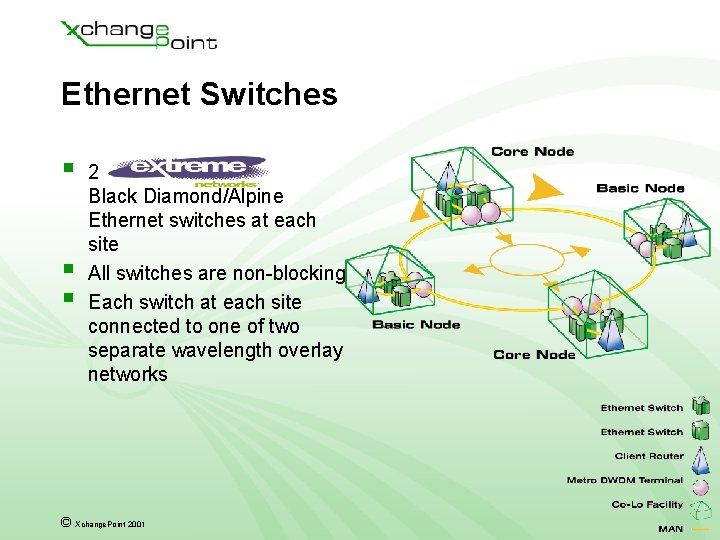
Ethernet Switches § § § 2 Black Diamond/Alpine Ethernet switches at each site All switches are non-blocking Each switch at each site connected to one of two separate wavelength overlay networks © Xchange. Point 2001
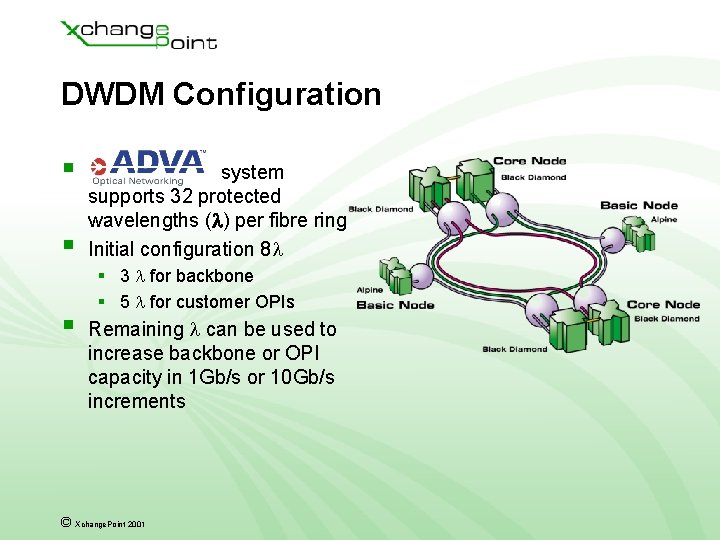
DWDM Configuration § § § system supports 32 protected wavelengths ( ) per fibre ring Initial configuration 8 § 3 for backbone § 5 for customer OPIs Remaining can be used to increase backbone or OPI capacity in 1 Gb/s or 10 Gb/s increments © Xchange. Point 2001
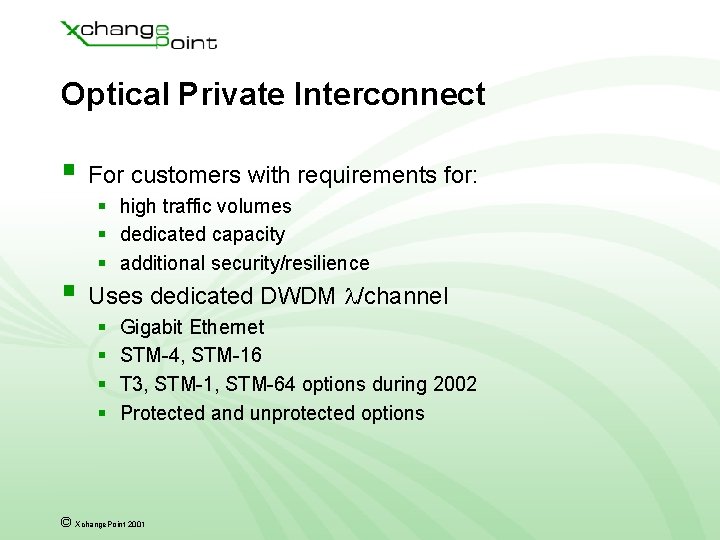
Optical Private Interconnect § For customers with requirements for: § high traffic volumes § dedicated capacity § additional security/resilience § Uses dedicated DWDM /channel § § Gigabit Ethernet STM-4, STM-16 T 3, STM-1, STM-64 options during 2002 Protected and unprotected options © Xchange. Point 2001
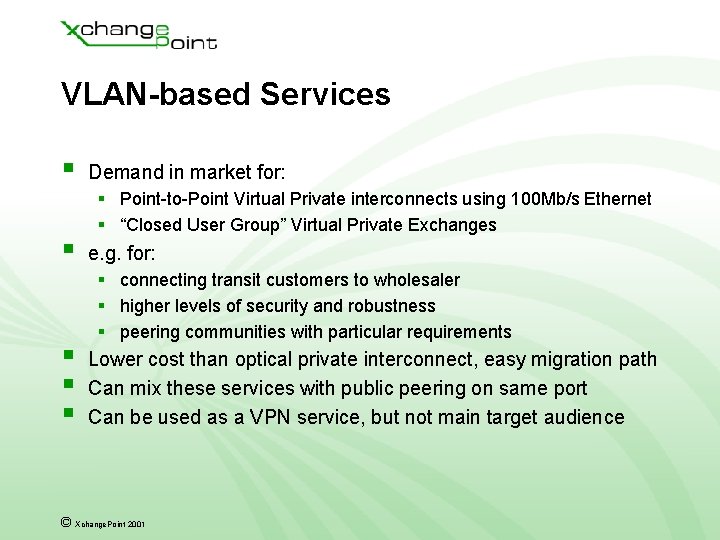
VLAN-based Services § § § Demand in market for: § Point-to-Point Virtual Private interconnects using 100 Mb/s Ethernet § “Closed User Group” Virtual Private Exchanges e. g. for: § connecting transit customers to wholesaler § higher levels of security and robustness § peering communities with particular requirements Lower cost than optical private interconnect, easy migration path Can mix these services with public peering on same port Can be used as a VPN service, but not main target audience © Xchange. Point 2001
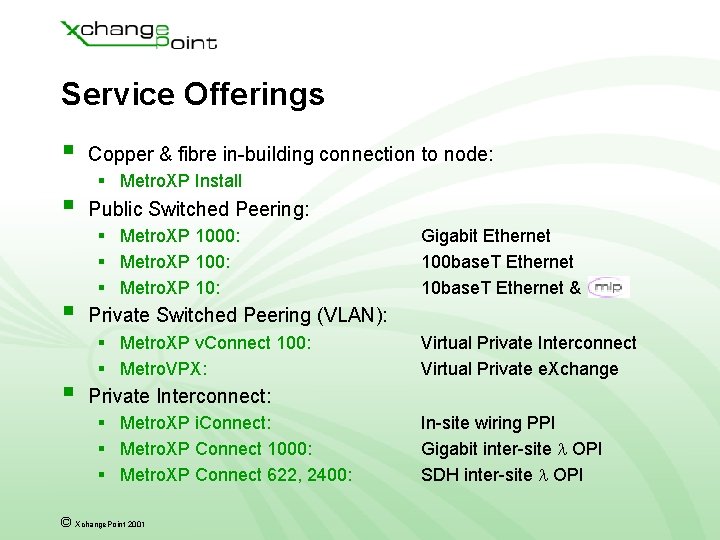
Service Offerings § § Copper & fibre in-building connection to node: § Metro. XP Install Public Switched Peering: § Metro. XP 1000: § Metro. XP 10: Gigabit Ethernet 100 base. T Ethernet 10 base. T Ethernet & Private Switched Peering (VLAN): § Metro. XP v. Connect 100: § Metro. VPX: Virtual Private Interconnect Virtual Private e. Xchange Private Interconnect: § Metro. XP i. Connect: § Metro. XP Connect 1000: § Metro. XP Connect 622, 2400: © Xchange. Point 2001 In-site wiring PPI Gigabit inter-site OPI SDH inter-site OPI
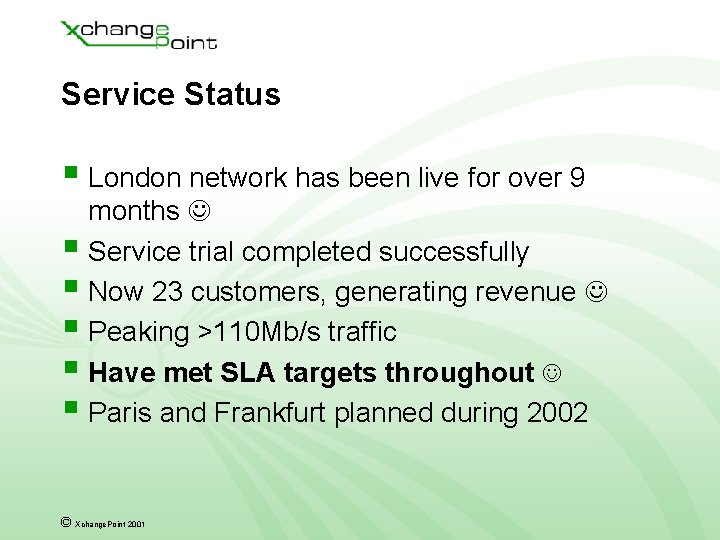
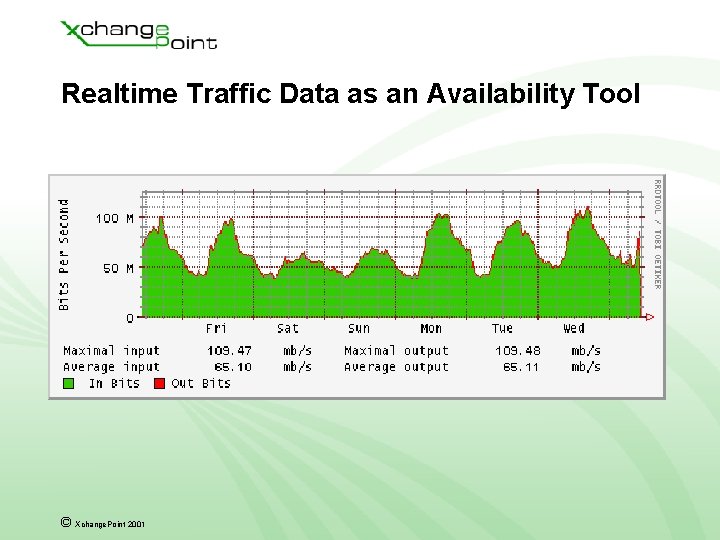
Service Status § London network has been live for over 9 months § Service trial completed successfully § Now 23 customers, generating revenue § Peaking >110 Mb/s traffic § Have met SLA targets throughout § Paris and Frankfurt planned during 2002 © Xchange. Point 2001
Xchange. Point's Approach to SLAs © Xchange. Point 2001
Keep it Simple, Measurable, Credible § § § Our background is from an ISP and IPP culture rather a carrier one - taking SLAs seriously has been slightly alien to us ! Today’s market conditions: § do not allow vast amounts of money to be piled into supersophisticated network management/monitoring systems § require that quality of service provision to the customer adheres to the highest competitive standards So our approach is one of: Have a small number of simple and well-understood parameters which we measure, report, commit to and exceed consistently § Our network architecture helps with this © Xchange. Point 2001
What we measure: Availability § § Measure availability of our equipment and network Infer service availability of service to customer from this § by “ping”ing customer router interface § by checking up/down state of switch port to router Meet 99. 9% on any single port to a customer Our network is highly resilient, but full service redundancy can only be achieved: § for switched services, if customer takes >1 port on >1 switch per site § for OPI service, if customer opts for optical protection option § these allow higher availability level of 99. 97% © Xchange. Point 2001
What we Measure: Responsiveness § § § These are mainly management process issues, not technical ones Service lead time within 10 days § very important in a market where lead times for traditional interconnect circuits in high demand metro areas can be 45 -90 days Customer support requests § § initial response within 5 minutes escalate after 4 hours resolve within 8 hours 24 x 7 NOC © Xchange. Point 2001
What we don't measure and why § § Throughput: our network is designed to be non-blocking, customer can utilise port at 65% capacity guaranteed Delay: § network is metro area only § round-trip times will only ever be a few milliseconds unless there is a more fundamental problem Jitter: see above Packet Loss: § § see above re Throughput we would like to be able to measure this better, however more sophisticated tools needed >1% packet loss is counted is availability failure meantime © Xchange. Point 2001
What we commit to and deliver § http: //www. xchangepoint. net/custinfo/SLA. html § Service provision within 10 days of order § Response to 24 x 7 customer support requests § Availability: 99. 97% § Packet loss: § 0% within single site § 0. 05% between sites § Rebates for failure to perform © Xchange. Point 2001
Realtime Traffic Data as an Availability Tool © Xchange. Point 2001
Realtime Traffic Data as an Availability Tool § § § Very simple principle: § publish traffic shipped through network in real-time MRTG is “industry-standard” tool for this § Multi Router Traffic Grapher § http: //www. ee. ethz. ch/~oetiker/webtools/mrtg. html Demonstrates not just traffic levels, but availability as well Good practice to put aggregate statistics in public domain § but keep per-customer statistics private to customer MRTG can record many network metrics, not just bits per second © Xchange. Point 2001
Acceptable Use Policy § § http: //www. xchangepoint. net/custinfo/AUP. html Designed to: § be minimally restrictive § protect customers and infrastructure from malice/accidents Main principles: § nature of traffic and commercial terms are purely bi-lateral matter for peers § don’t do anything that affects other customers adversely More constraints for public peering than private interconnect § e. g. AS number and PI address space needed for public peering © Xchange. Point 2001
Interaction Between an SLA and Acceptable Use Policy § § Use SLA as a way of encouraging customers to make best use of services e. g. If customer utilises port >65% and risks congestion, full SLA no longer guaranteed § incentive to upgrade service capacity Encourage multi-homing on >1 port for higher 99. 97% rather than 99. 9% availability level “Non-standard” traffic addressed in SLA rather than AUP § grey area between what is prohibited by AUP, and what services can be fully supported by SLA § gives customer flexibility while protecting network © Xchange. Point 2001
Future SLA challenges at Internet Peering Points § Multicast § how to measure packet loss when one packet goes to many destinations ? § Data gathered at peering points can be a very useful measure of network health, e. g. § Measurement boxes: unidirectional & round trip-times, packet loss § Routing Tables: route flap, average AS-path length § middle-to-middle rather than end-to-end, though § IPv 6, 10 Gb/s ethernet § no new challenges in principle, but tools will need updating © Xchange. Point 2001

Contact Details CTO: Web: E-mail: Phone: Keith Mitchell www. xchangepoint. net info@xchangepoint. net +44 20 7592 0370 Presentation: § http: //www. xchangepoint. net/info/Xchange-IIR-SLA. ppt © Xchange. Point 2001
- Slides: 35