
Overview Safety Question HRU Model TakeGrant Protection Model
- Slides: 41
Overview • • Safety Question HRU Model Take-Grant Protection Model SPM, ESPM – Multiparent joint creation • Expressive power • Typed Access Matrix Model April 8, 2004 ECS 235 1
What Is “Secure”? • Adding a generic right r where there was not one is “leaking” • If a system S, beginning in initial state s 0, cannot leak right r, it is safe with respect to the right r. April 8, 2004 ECS 235 2
Safety Question • Does there exist an algorithm for determining whether a protection system S with initial state s 0 is safe with respect to a generic right r? – Here, “safe” = “secure” for an abstract model April 8, 2004 ECS 235 3
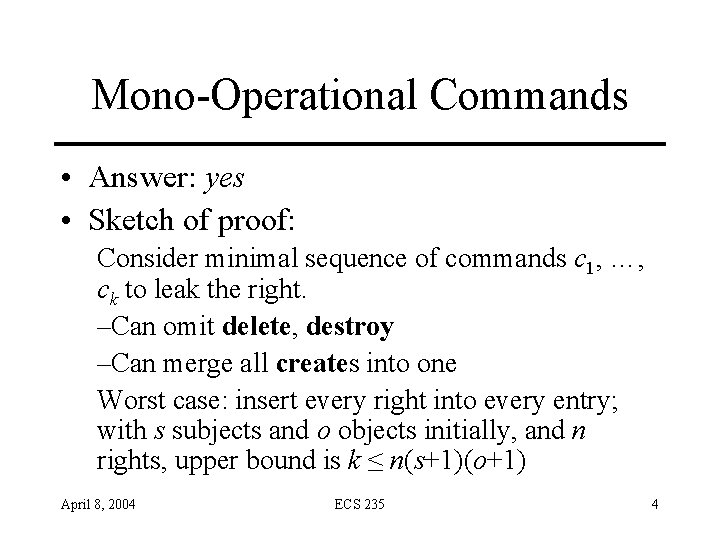
Mono-Operational Commands • Answer: yes • Sketch of proof: Consider minimal sequence of commands c 1, …, ck to leak the right. –Can omit delete, destroy –Can merge all creates into one Worst case: insert every right into every entry; with s subjects and o objects initially, and n rights, upper bound is k ≤ n(s+1)(o+1) April 8, 2004 ECS 235 4
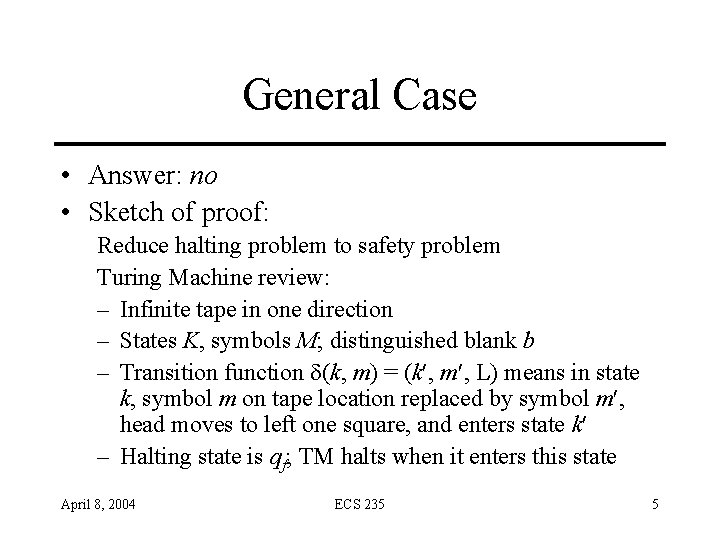
General Case • Answer: no • Sketch of proof: Reduce halting problem to safety problem Turing Machine review: – Infinite tape in one direction – States K, symbols M; distinguished blank b – Transition function d(k, m) = (k , m , L) means in state k, symbol m on tape location replaced by symbol m , head moves to left one square, and enters state k – Halting state is qf; TM halts when it enters this state April 8, 2004 ECS 235 5
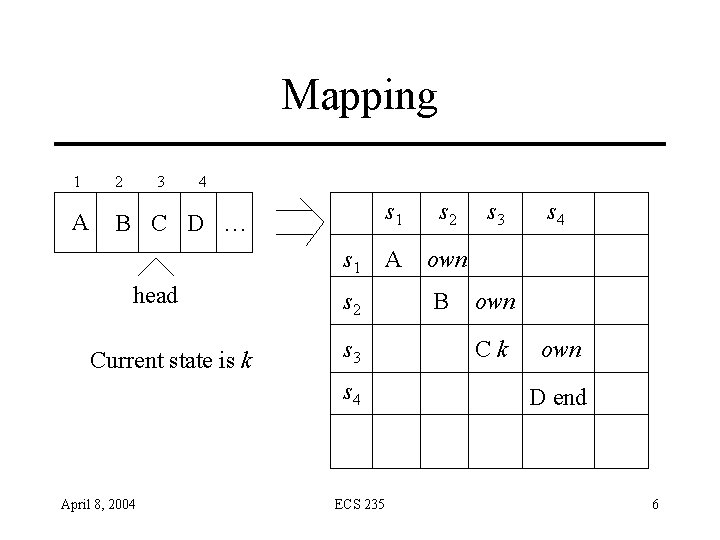
Mapping 1 2 3 4 A B C D … s 1 head Current state is k s 2 s 3 s 4 April 8, 2004 ECS 235 s 1 s 2 A own B s 3 s 4 own Ck own D end 6
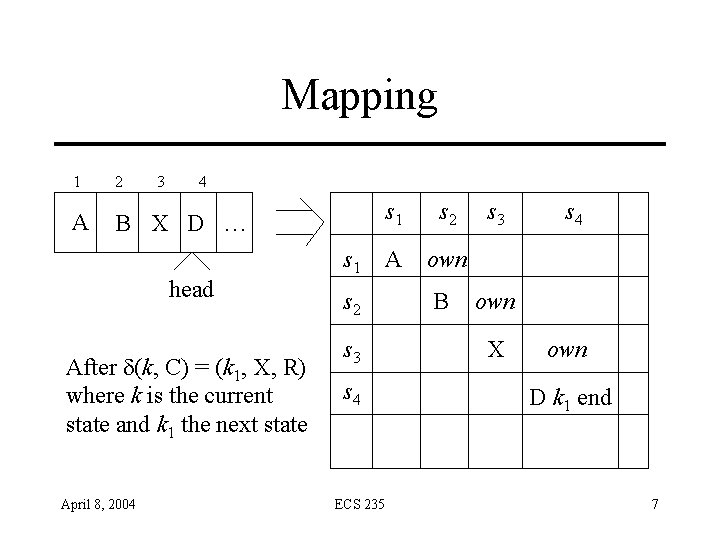
Mapping 1 2 3 4 A B X D … head After d(k, C) = (k 1, X, R) where k is the current state and k 1 the next state April 8, 2004 s 1 s 2 s 3 s 4 ECS 235 s 1 s 2 A own B s 3 s 4 own X own D k 1 end 7
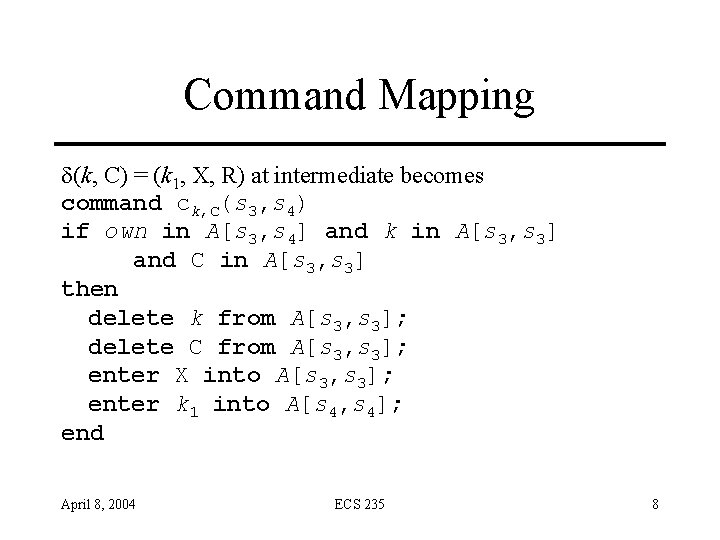
Command Mapping d(k, C) = (k 1, X, R) at intermediate becomes command ck, C(s 3, s 4) if own in A[s 3, s 4] and k in A[s 3, s 3] and C in A[s 3, s 3] then delete k from A[s 3, s 3]; delete C from A[s 3, s 3]; enter X into A[s 3, s 3]; enter k 1 into A[s 4, s 4]; end April 8, 2004 ECS 235 8
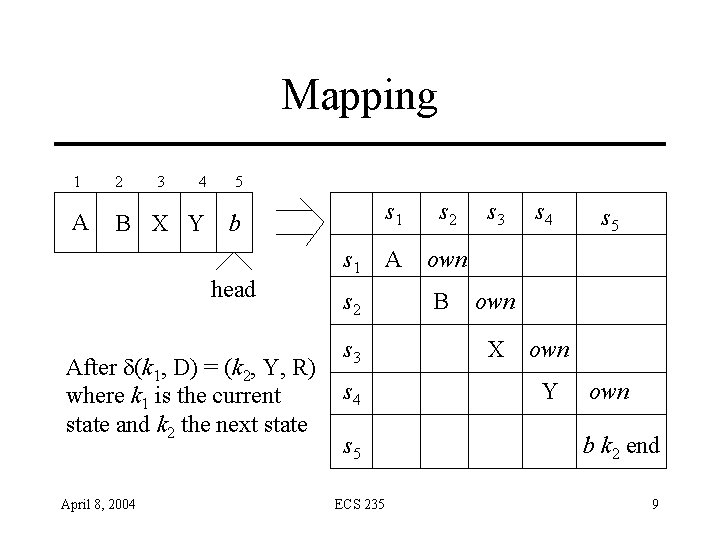
Mapping 1 2 3 4 5 A B X Y b head After d(k 1, D) = (k 2, Y, R) where k 1 is the current state and k 2 the next state April 8, 2004 s 1 s 2 s 3 s 4 s 5 ECS 235 s 1 s 2 A own B s 3 s 4 s 5 own X own Y own b k 2 end 9
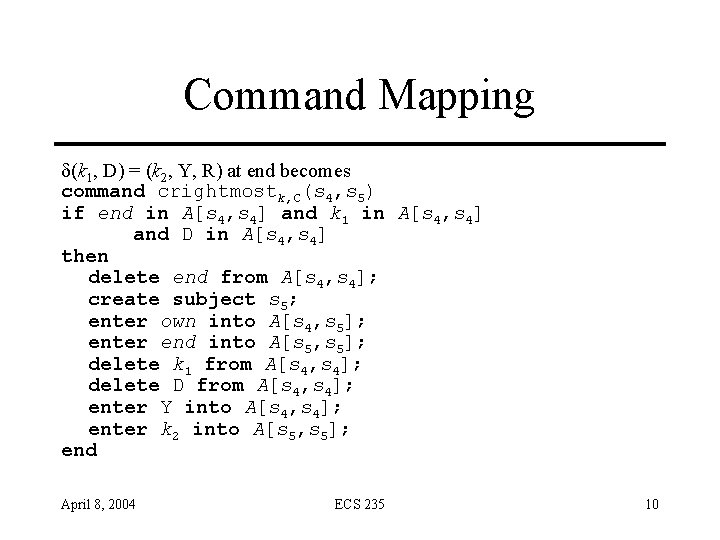
Command Mapping d(k 1, D) = (k 2, Y, R) at end becomes command crightmostk, C(s 4, s 5) if end in A[s 4, s 4] and k 1 in A[s 4, s 4] and D in A[s 4, s 4] then delete end from A[s 4, s 4]; create subject s 5; enter own into A[s 4, s 5]; enter end into A[s 5, s 5]; delete k 1 from A[s 4, s 4]; delete D from A[s 4, s 4]; enter Y into A[s 4, s 4]; enter k 2 into A[s 5, s 5]; end April 8, 2004 ECS 235 10
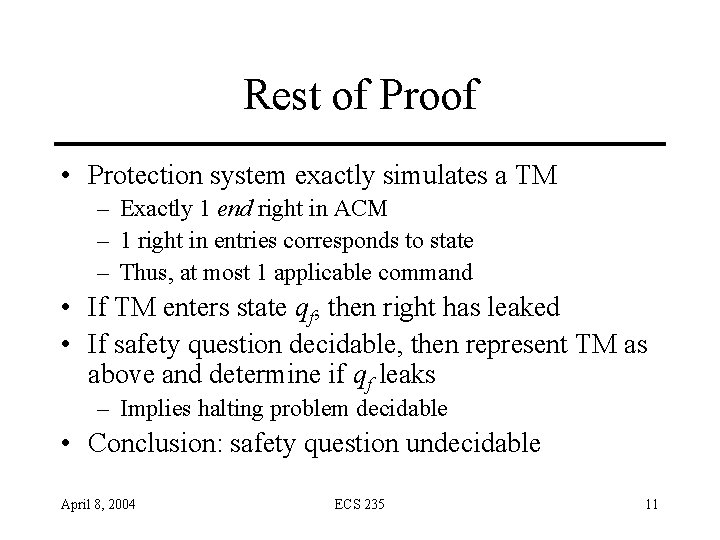
Rest of Proof • Protection system exactly simulates a TM – Exactly 1 end right in ACM – 1 right in entries corresponds to state – Thus, at most 1 applicable command • If TM enters state qf, then right has leaked • If safety question decidable, then represent TM as above and determine if qf leaks – Implies halting problem decidable • Conclusion: safety question undecidable April 8, 2004 ECS 235 11
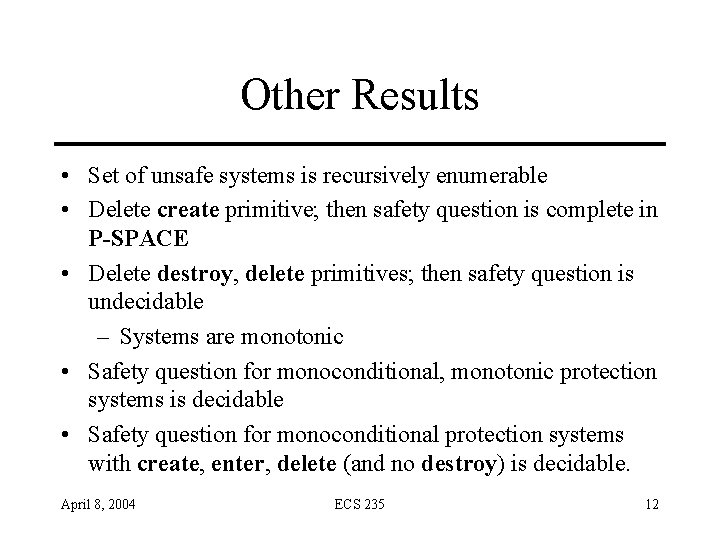
Other Results • Set of unsafe systems is recursively enumerable • Delete create primitive; then safety question is complete in P-SPACE • Delete destroy, delete primitives; then safety question is undecidable – Systems are monotonic • Safety question for monoconditional, monotonic protection systems is decidable • Safety question for monoconditional protection systems with create, enter, delete (and no destroy) is decidable. April 8, 2004 ECS 235 12
Take-Grant Protection Model • A specific (not generic) system – Set of rules for state transitions • Safety decidable, and in time linear with the size of the system • Goal: find conditions under which rights can be transferred from one entity to another in the system April 8, 2004 ECS 235 13
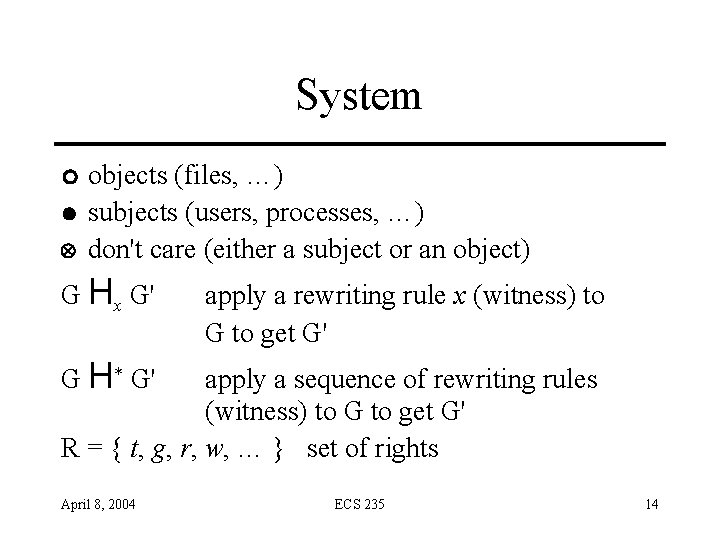
System ¡ l Ä objects (files, …) subjects (users, processes, …) don't care (either a subject or an object) G Hx G' apply a rewriting rule x (witness) to G to get G' G H* G' apply a sequence of rewriting rules (witness) to G to get G' R = { t, g, r, w, … } set of rights April 8, 2004 ECS 235 14
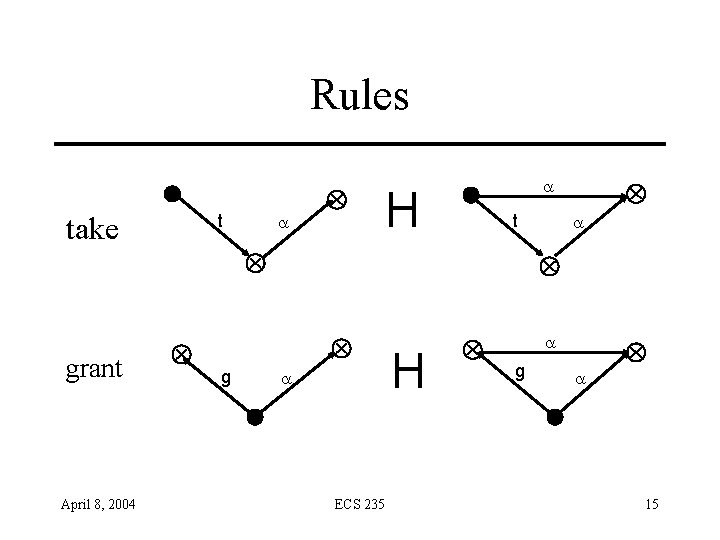
Rules l take grant a t Ä Ä a g Ä a t Ä l April 8, 2004 H l a H Ä a g a Ä l ECS 235 15
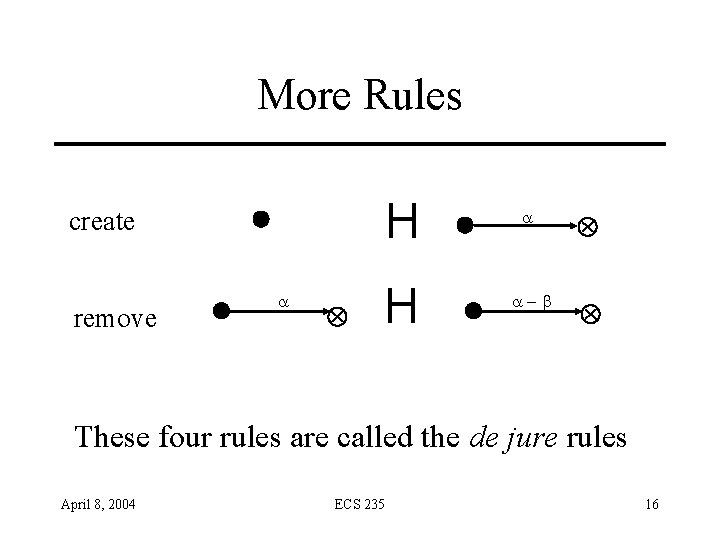
More Rules remove H l create l a Ä H l l a Ä a-b Ä These four rules are called the de jure rules April 8, 2004 ECS 235 16
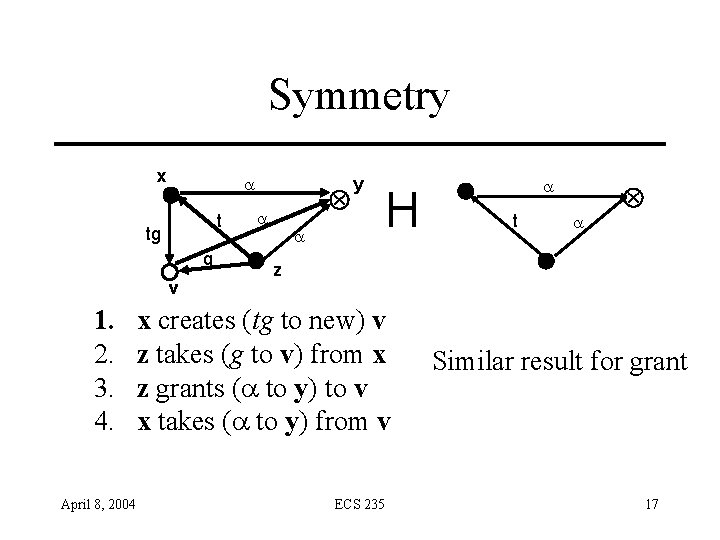
Symmetry x a l t tg ¡ v 1. 2. 3. 4. April 8, 2004 g a lz Ä y a H a l a t Ä l x creates (tg to new) v z takes (g to v) from x z grants (a to y) to v x takes (a to y) from v ECS 235 Similar result for grant 17
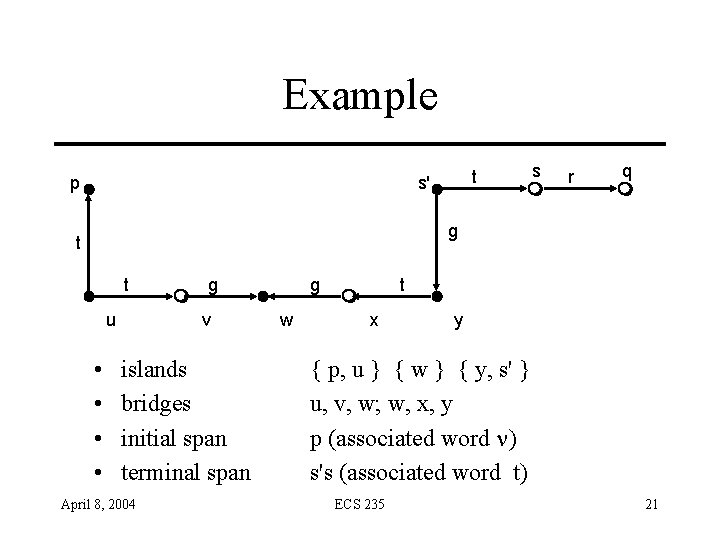
Islands • tg-path: path of distinct vertices connected by edges labeled t or g – Call them “tg-connected” • island: maximal tg-connected subject-only subgraph – Any right one vertex has can be shared with any other vertex April 8, 2004 ECS 235 18
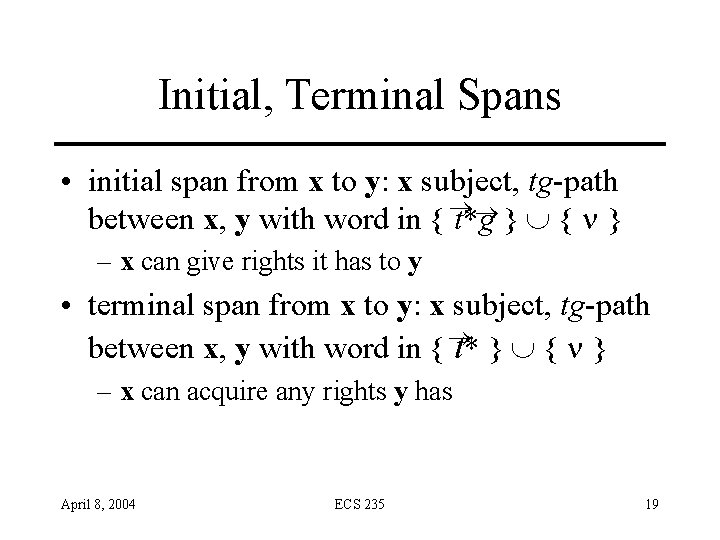
Initial, Terminal Spans • initial span from x to y: x subject, tg-path between x, y with word in { t*g } { n } – x can give rights it has to y • terminal span from x to y: x subject, tg-path between x, y with word in { t* } { n } – x can acquire any rights y has April 8, 2004 ECS 235 19
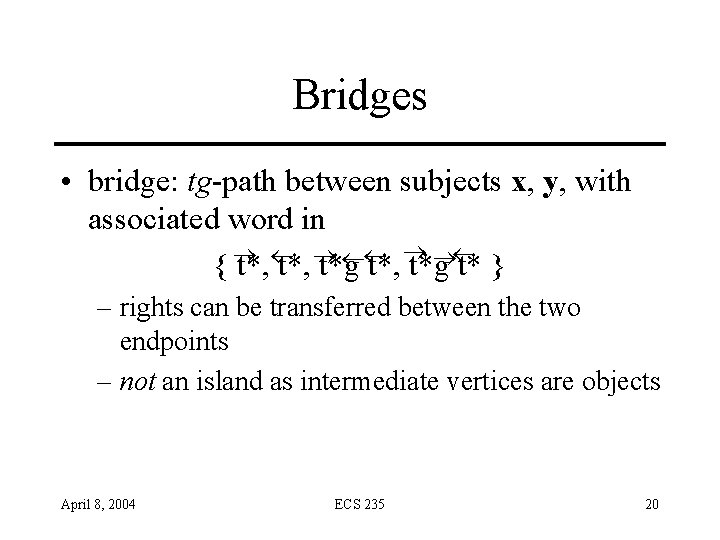
Bridges • bridge: tg-path between subjects x, y, with associated word in { t*, t*g t* } – rights can be transferred between the two endpoints – not an island as intermediate vertices are objects April 8, 2004 ECS 235 20
Example pl t s'l s m r q m g t t l u • • m g v islands bridges initial span terminal span April 8, 2004 g l w t m x l y { p, u } { w } { y, s' } u, v, w; w, x, y p (associated word n) s's (associated word t) ECS 235 21
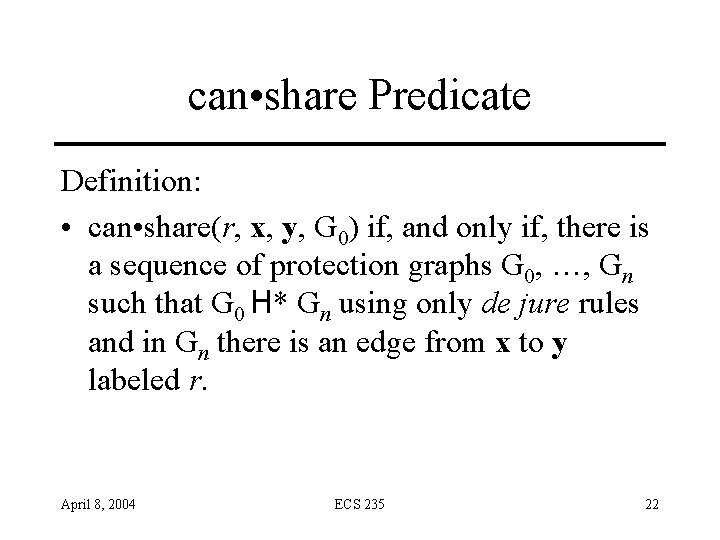
can • share Predicate Definition: • can • share(r, x, y, G 0) if, and only if, there is a sequence of protection graphs G 0, …, Gn such that G 0 H* Gn using only de jure rules and in Gn there is an edge from x to y labeled r. April 8, 2004 ECS 235 22
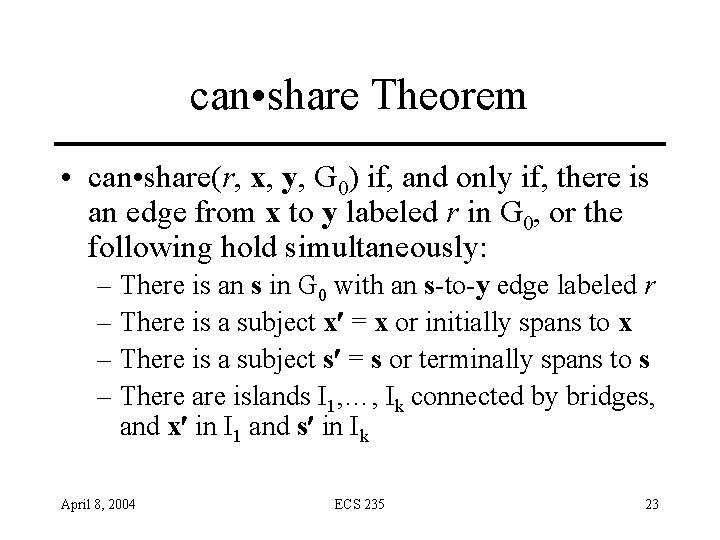
can • share Theorem • can • share(r, x, y, G 0) if, and only if, there is an edge from x to y labeled r in G 0, or the following hold simultaneously: – There is an s in G 0 with an s-to-y edge labeled r – There is a subject x = x or initially spans to x – There is a subject s = s or terminally spans to s – There are islands I 1, …, Ik connected by bridges, and x in I 1 and s in Ik April 8, 2004 ECS 235 23
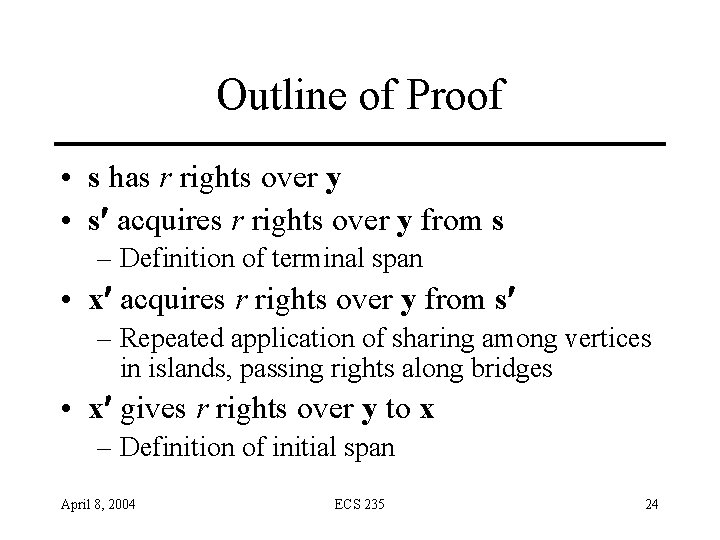
Outline of Proof • s has r rights over y • s acquires r rights over y from s – Definition of terminal span • x acquires r rights over y from s – Repeated application of sharing among vertices in islands, passing rights along bridges • x gives r rights over y to x – Definition of initial span April 8, 2004 ECS 235 24
Key Question • Characterize class of models for which safety is decidable – Existence: Take-Grant Protection Model is a member of such a class – Universality: In general, question undecidable, so for some models it is not decidable • What is the dividing line? April 8, 2004 ECS 235 25
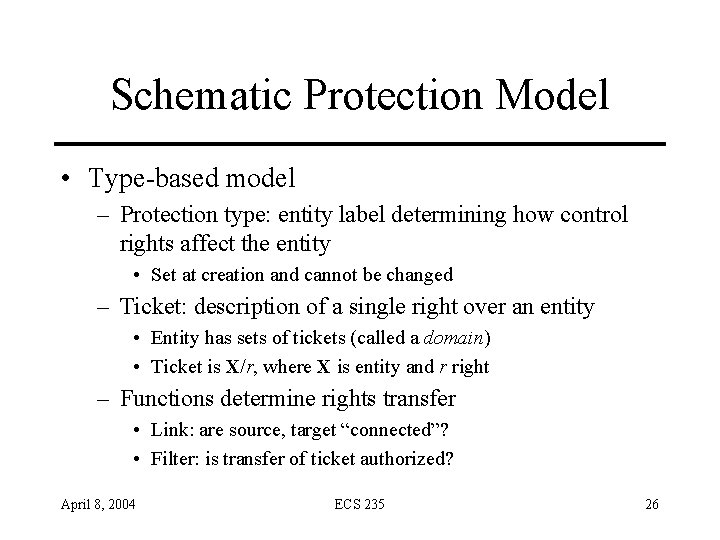
Schematic Protection Model • Type-based model – Protection type: entity label determining how control rights affect the entity • Set at creation and cannot be changed – Ticket: description of a single right over an entity • Entity has sets of tickets (called a domain) • Ticket is X/r, where X is entity and r right – Functions determine rights transfer • Link: are source, target “connected”? • Filter: is transfer of ticket authorized? April 8, 2004 ECS 235 26
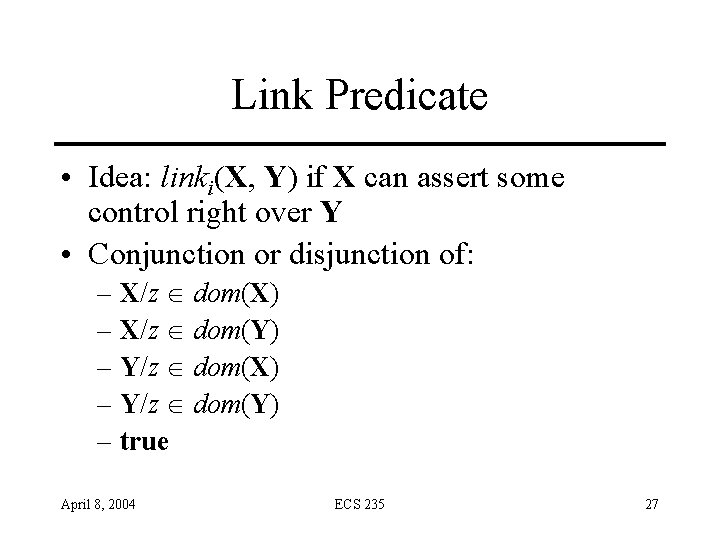
Link Predicate • Idea: linki(X, Y) if X can assert some control right over Y • Conjunction or disjunction of: – X/z dom(X) – X/z dom(Y) – Y/z dom(X) – Y/z dom(Y) – true April 8, 2004 ECS 235 27
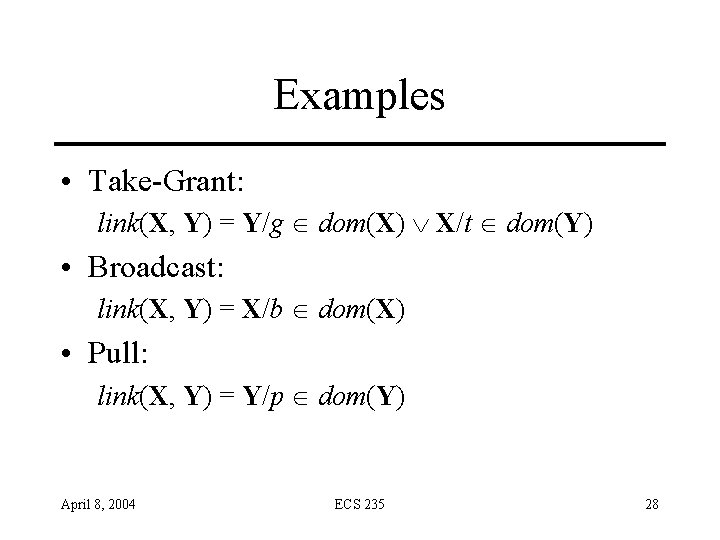
Examples • Take-Grant: link(X, Y) = Y/g dom(X) X/t dom(Y) • Broadcast: link(X, Y) = X/b dom(X) • Pull: link(X, Y) = Y/p dom(Y) April 8, 2004 ECS 235 28
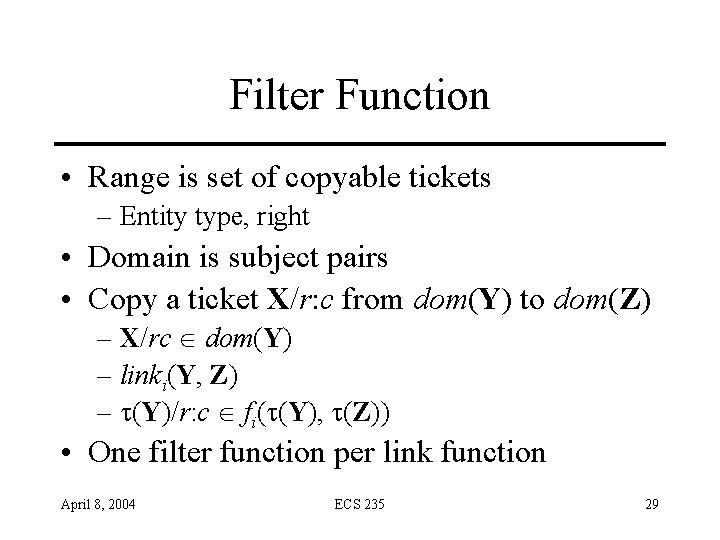
Filter Function • Range is set of copyable tickets – Entity type, right • Domain is subject pairs • Copy a ticket X/r: c from dom(Y) to dom(Z) – X/rc dom(Y) – linki(Y, Z) – (Y)/r: c fi( (Y), (Z)) • One filter function per link function April 8, 2004 ECS 235 29
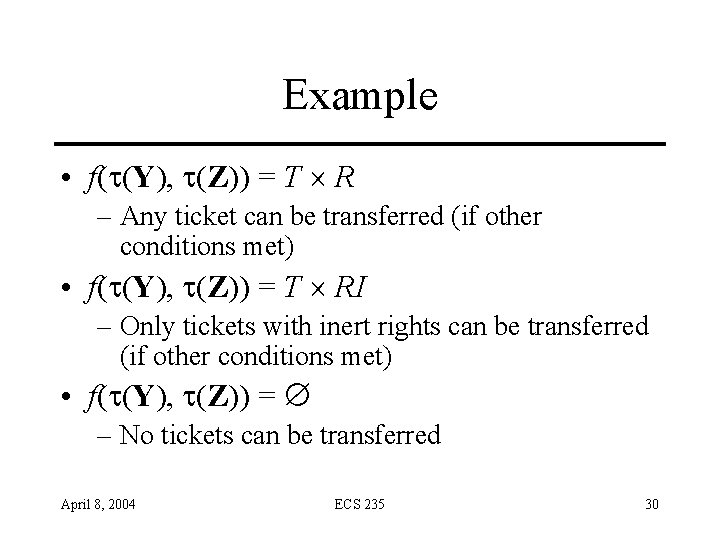
Example • f( (Y), (Z)) = T R – Any ticket can be transferred (if other conditions met) • f( (Y), (Z)) = T RI – Only tickets with inert rights can be transferred (if other conditions met) • f( (Y), (Z)) = – No tickets can be transferred April 8, 2004 ECS 235 30
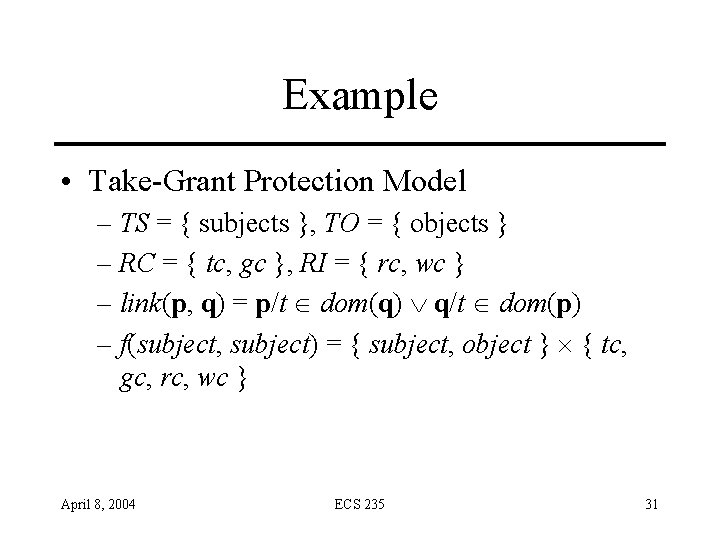
Example • Take-Grant Protection Model – TS = { subjects }, TO = { objects } – RC = { tc, gc }, RI = { rc, wc } – link(p, q) = p/t dom(q) q/t dom(p) – f(subject, subject) = { subject, object } { tc, gc, rc, wc } April 8, 2004 ECS 235 31
Create Operation • Must handle type, tickets of new entity • Relation can • create(a, b) – Subject of type a can create entity of type b • Rule of acyclic creates: April 8, 2004 ECS 235 32
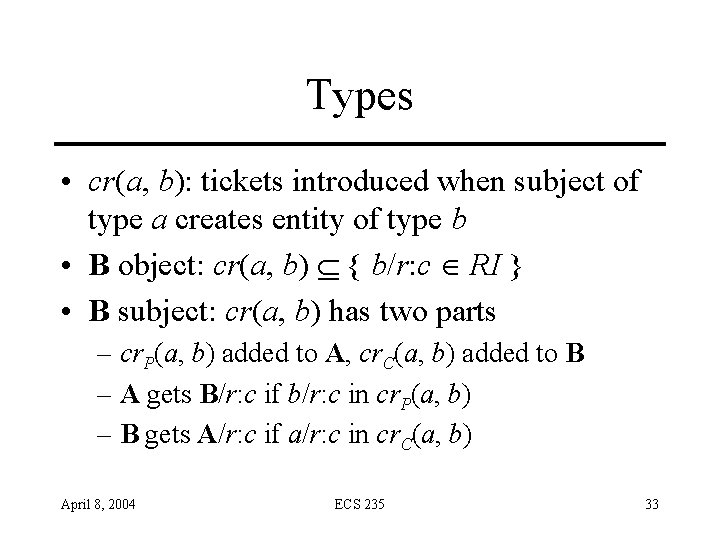
Types • cr(a, b): tickets introduced when subject of type a creates entity of type b • B object: cr(a, b) { b/r: c RI } • B subject: cr(a, b) has two parts – cr. P(a, b) added to A, cr. C(a, b) added to B – A gets B/r: c if b/r: c in cr. P(a, b) – B gets A/r: c if a/r: c in cr. C(a, b) April 8, 2004 ECS 235 33
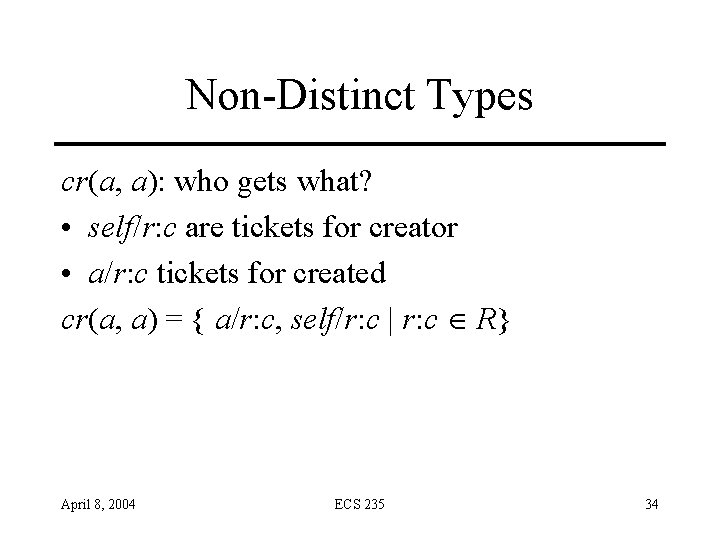
Non-Distinct Types cr(a, a): who gets what? • self/r: c are tickets for creator • a/r: c tickets for created cr(a, a) = { a/r: c, self/r: c | r: c R} April 8, 2004 ECS 235 34
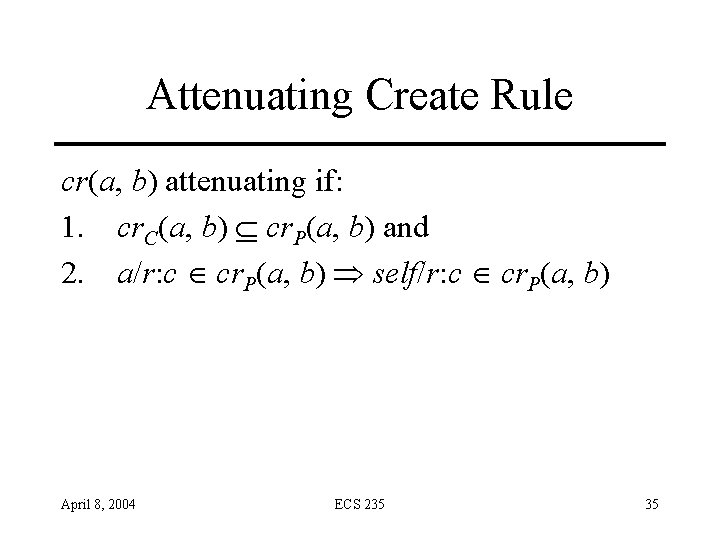
Attenuating Create Rule cr(a, b) attenuating if: 1. cr. C(a, b) cr. P(a, b) and 2. a/r: c cr. P(a, b) self/r: c cr. P(a, b) April 8, 2004 ECS 235 35
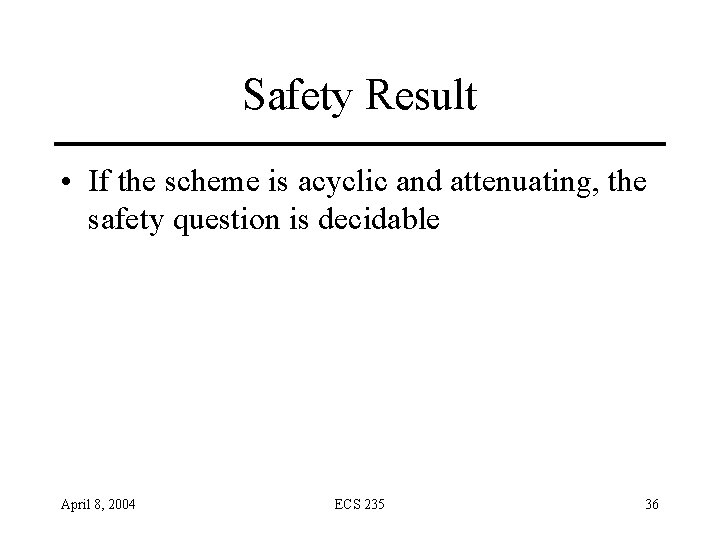
Safety Result • If the scheme is acyclic and attenuating, the safety question is decidable April 8, 2004 ECS 235 36
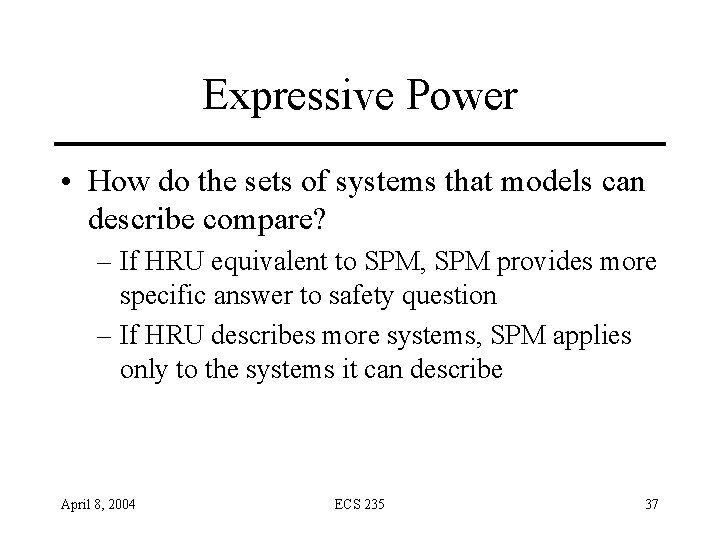
Expressive Power • How do the sets of systems that models can describe compare? – If HRU equivalent to SPM, SPM provides more specific answer to safety question – If HRU describes more systems, SPM applies only to the systems it can describe April 8, 2004 ECS 235 37
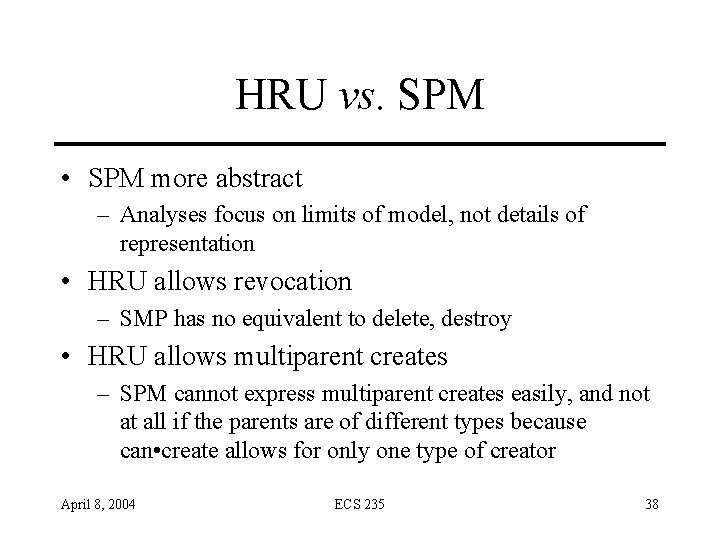
HRU vs. SPM • SPM more abstract – Analyses focus on limits of model, not details of representation • HRU allows revocation – SMP has no equivalent to delete, destroy • HRU allows multiparent creates – SPM cannot express multiparent creates easily, and not at all if the parents are of different types because can • create allows for only one type of creator April 8, 2004 ECS 235 38
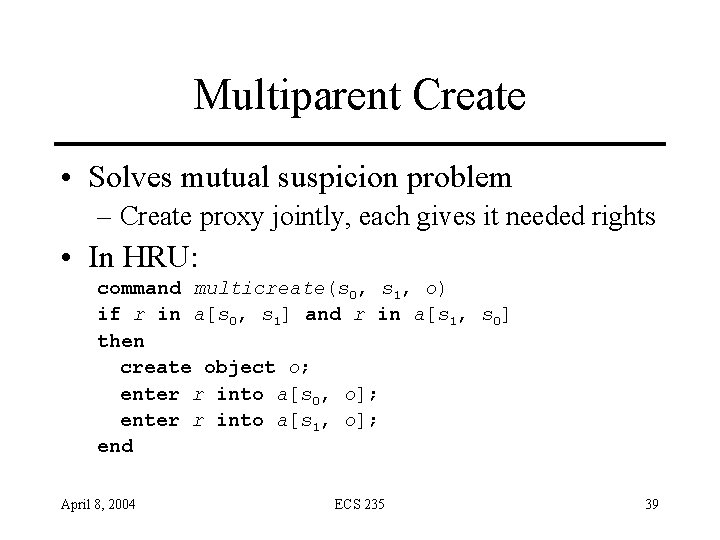
Multiparent Create • Solves mutual suspicion problem – Create proxy jointly, each gives it needed rights • In HRU: command multicreate(s 0, s 1, o) if r in a[s 0, s 1] and r in a[s 1, s 0] then create object o; enter r into a[s 0, o]; enter r into a[s 1, o]; end April 8, 2004 ECS 235 39
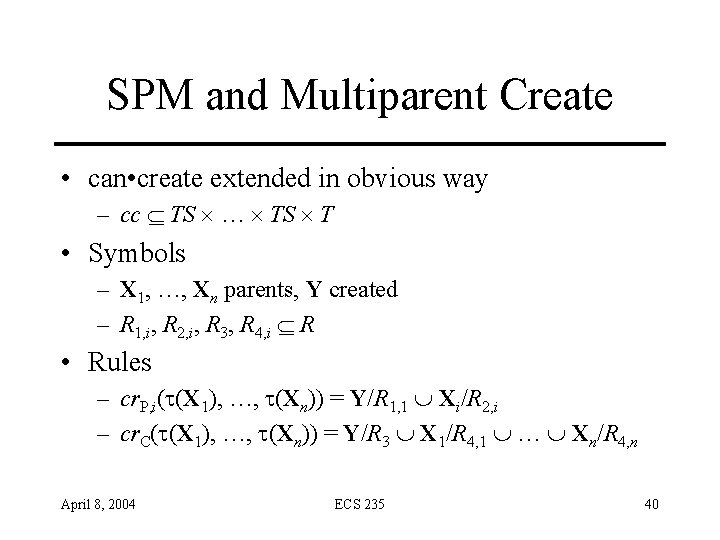
SPM and Multiparent Create • can • create extended in obvious way – cc TS … TS T • Symbols – X 1, …, Xn parents, Y created – R 1, i, R 2, i, R 3, R 4, i R • Rules – cr. P, i( (X 1), …, (Xn)) = Y/R 1, 1 Xi/R 2, i – cr. C( (X 1), …, (Xn)) = Y/R 3 X 1/R 4, 1 … Xn/R 4, n April 8, 2004 ECS 235 40
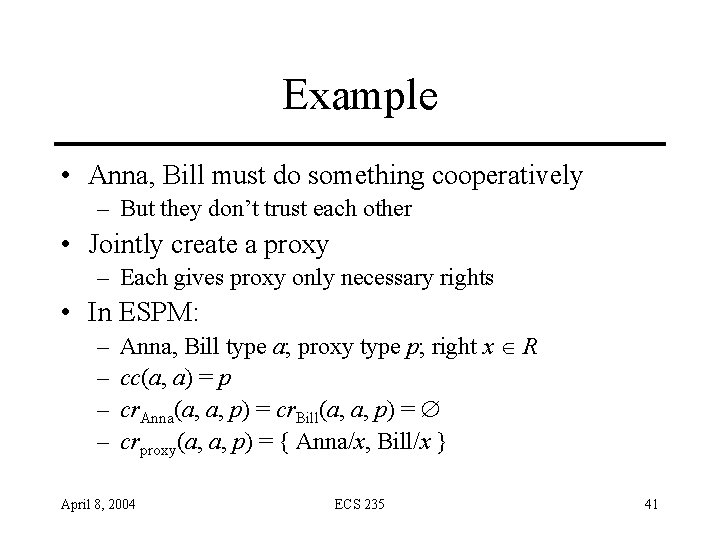
Example • Anna, Bill must do something cooperatively – But they don’t trust each other • Jointly create a proxy – Each gives proxy only necessary rights • In ESPM: – – Anna, Bill type a; proxy type p; right x R cc(a, a) = p cr. Anna(a, a, p) = cr. Bill(a, a, p) = crproxy(a, a, p) = { Anna/x, Bill/x } April 8, 2004 ECS 235 41