
Overview Reviewing dimensions used to distinguish types of



- Slides: 12
Overview • • • Reviewing dimensions used to distinguish types of Innovation These dimensions are not independent Technology trajectories → Used to represent technology’s rate of performance improvement – rate of adoption in the marketplaces → Described by S-curve patterns 4
Types of Innovation Product Innovation Vs Process Innovation - New products development versus new techniques that improve the effectiveness-efficiency of the production - Often occur in tandem – Interaction • Radical Vs Incremental Innovation - Totally new technology versus existing - Radicalness is the combination of newness and the degree of differentness • 5
Types of Innovation • Competence-Enhancing Innovation Vs Competence. Destroying Innovation - Building on existing technology versus rendering existing technology obsolete • Architectural Vs Component Innovation - Changing overall architecture versus changing individual components - A strictly architectural innovation may reconfigure the way that components interact 6
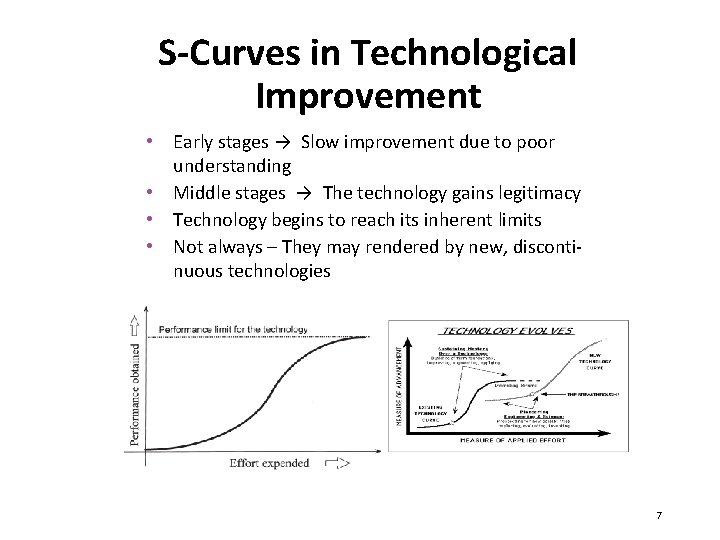
S-Curves in Technological Improvement • Early stages → Slow improvement due to poor understanding • Middle stages → The technology gains legitimacy • Technology begins to reach its inherent limits • Not always – They may rendered by new, discontinuous technologies 7
S-Curves in Technological Diffusion • Adoption is initially slow for an unfamiliar technology • It accelerates as the technology is better understood and utilized by the mass market • Many technologies become valuable only after a set of complementary resources are developed for them • Its , in part, related to technology improvement. 8
Cons & Limitations of S-curves • Its not safe to use s-curves as a prescriptive tool • The true limits of a technology are rarely known in advance • Several factors may influence the life cycle of a technology(p. e. market changes, firm’s development activities etc) • The benefit of switching to a new technology for a firm depends on a number of factors, as the offered advantages, the new technology’s fit with the firm, the expected rate of diffusion etc. 9
Technology cycles – Utterback & Abernathy model • Fluid phase: Uncertainty about both technology and its markets. Firms experiment with various factors until they reach the dominant design(stable architecture) • Specific phase: The firms focus to improve components within the architecture 10
Technology cycles – Anderson & Tushman model • Anderson and Tushman argue that: - A dominant design always rose to command the majority of market share, after the “Era of Ferment” - The dominant design was never in the same form as the original discontinuity • During the “Era of Incremental Change” firms focus on improving efficiency and existing components. Many firms cease to invest for alternative design architectures • This explains in part why incumbent firms may have difficulty recognizing and reacting to discontinuous technology 11