
Overview Restorative Practices in Schools By Dr Marian
Overview: Restorative Practices in Schools By Dr. Marian Fritzemeier, Ed. D. Restorative Practices Trainer Author, Speaker, Educator April 28, 2015 YFC Consortium Presentation

Modesto City Schools � When? � Who? August 2013 ◦ Marty Villa, MA, LMFT – 20 years facilitator for VORP (Victim Offender Reconciliation Program) ◦ Dr. Marian Fritzemeier, Ed. D. - Dissertation examined juveniles tried as adults; prevention restorative justice � Why? School-to-Prison Pipeline � What? Restorative Practices in Schools Training
Video Clip: Are our kids disposable? You-Tube by Health. Happens. Here, April 11, 2012. [36 sec. ]
3 Main Goals of Restorative Justice � Accountability ◦ Wrongdoers accountable to those they’ve harmed � Community Safety ◦ Need to create a safer community by building & restoring relationships ◦ Empowers community to take responsibility for well-being of its members � Competency Development ◦ Increase pro-social skills of all who have harmed others ◦ All stakeholders learn skills to make thing as right as possible Ashley, Jessica and Kimberly Burke. Implementing restorative justice: A guide for schools. ICJIA (Illinois Criminal Justice Information Authority). State of Illinois, [no date], p. 6. www. icjia. state. il. us/public/pdf/BARJ/SCHOOL. Accessed 11/21/2013.
How? Overview of Program Year 1 �Site Observation & Interview (2 hours) ◦ Select site teams 7 -9 staff � 3 Sessions (every two weeks) ◦ AM 3 ½ hours – Content presented by multimodality teaching methods ◦ PM 2 hours – Site team application activities �Follow-up consultation & implementation ◦ Up to 10 hours per site team
Seminar Goals � Introduce the concepts of Restorative Practices and its application in schools ◦ Be didactic rather than punitive ◦ Restore relationships � Offer new tools that can reduce the need for school exclusion and juvenile justice system involvement regarding school misconduct ◦ Keep students in school ◦ Significantly reduce suspensions and expulsions
Seminar Goals (cont. ) � Provide strategies to enhance the school environment, change the school culture, and restore relationships after conflict arises ◦ Decrease interruptions ◦ Increase school safety

Restorative Practices Pyramid: Tier 1, Tier , & Tier 3 Kiddle, Jon and Rita Alfred. Restorative Justice: A Working Guide for our Schools. Alameda County Health Care Services Agency, 2011, p. 10 healthyschoolsandcommunities. org/Docs/Restorative-Justice-Paper. pdf. Accessed 11/21/2013.
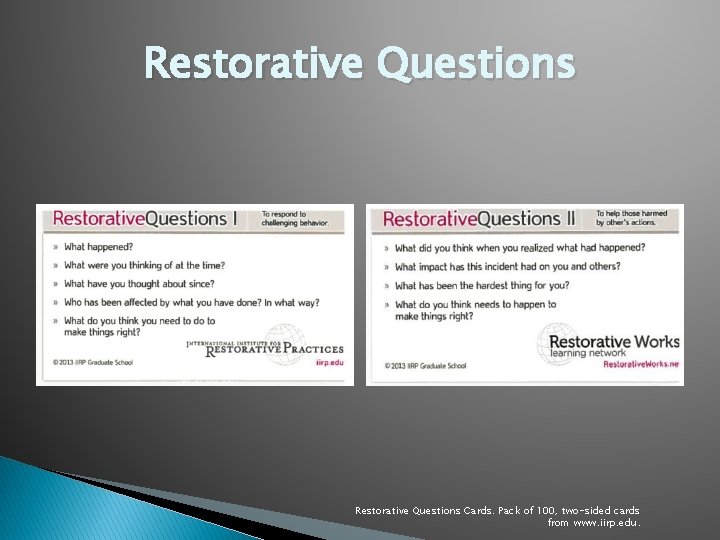
Restorative Questions Cards. Pack of 100, two-sided cards from www. iirp. edu.
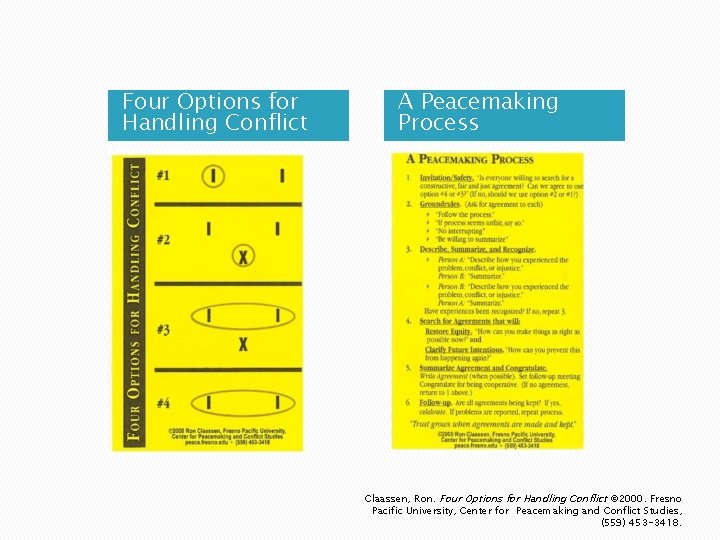
Four Options for Handling Conflict A Peacemaking Process Claassen, Ron. Four Options for Handling Conflict © 2000. Fresno Pacific University, Center for Peacemaking and Conflict Studies, (559) 453 -3418.
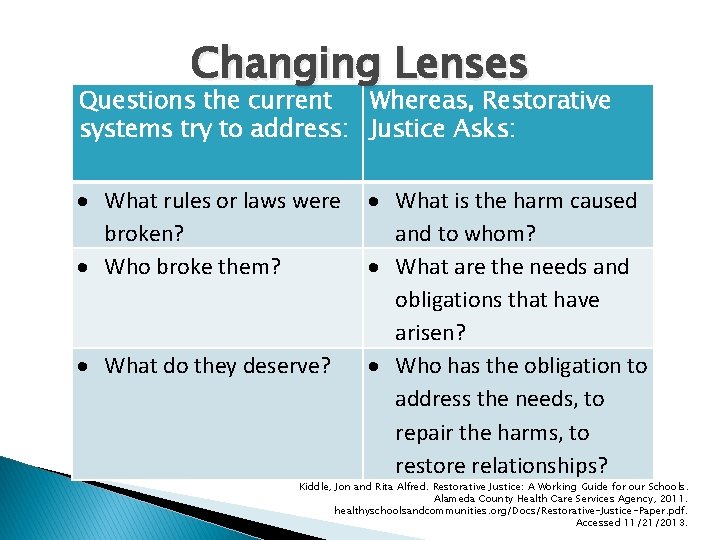
Changing Lenses Questions the current Whereas, Restorative systems try to address: Justice Asks: What rules or laws were broken? Who broke them? What do they deserve? What is the harm caused and to whom? What are the needs and obligations that have arisen? Who has the obligation to address the needs, to repair the harms, to restore relationships? Kiddle, Jon and Rita Alfred. Restorative Justice: A Working Guide for our Schools. Alameda County Health Care Services Agency, 2011. healthyschoolsandcommunities. org/Docs/Restorative-Justice-Paper. pdf. Accessed 11/21/2013.
Resources: Web Site � www. fromdiaperstodiamonds. com � Writing Tab; Resources ◦ Restorative Practices Books ◦ Restorative Practices Videos � Coming Soon: Restorative Practices Page
Contact Information � Dr. Marian Fritzemeier, Ed. D. � Restorative Practices in Schools Trainer � Author, Speaker, Educator � 918 Sierra Drive, Modesto, CA 95357 � Cell: (209) 765 -7016 � drmarian@fromdiaperstodiamonds. com � www. fromdiaperstodiamonds. com � https: //www. facebook. com/fromdiaperstodia monds
- Slides: 13