
Overview q q What is cryptography Classic cryptosystems
- Slides: 35
Overview q q What is cryptography? Classic cryptosystems o The Caesar cipher o Monoalphabetic replacement cipher o The one-time pad q Types of cryptosystems o Codes vs. ciphers o Symetric-key vs. assymetric-key (public key) o Hybrid cryptosystems Chapter 2 Classic Cryptography 1
What is Cryptography? Cryptology is the art and science of making and breaking “secret codes” q Cryptography is the making q Cryptanalysis is the breaking q Caesars cipher q o Replace every ‘A’ in the message with a ‘D’ o Replace every ‘B’ in the message with a ‘E’ o Replace every ‘C’ in the message with a ‘F’, etc. Chapter 2 Classic Cryptography 2
The Caesar Cipher Camouflage the message “ATTACK AT DAWN” by writing “DWWDFN DW GDZQ” q “ATTACK AT DAWN” is the plaintext q “DWWDFN DW GDZQ” is the ciphertext q Encryption: plaintext ciphertext q Decryption: ciphertext plaintext q Chapter 2 Classic Cryptography 3
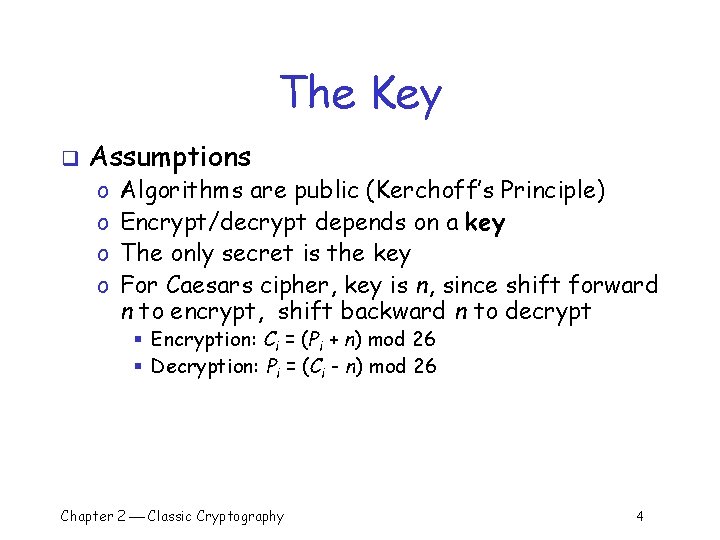
The Key q Assumptions o o Algorithms are public (Kerchoff’s Principle) Encrypt/decrypt depends on a key The only secret is the key For Caesars cipher, key is n, since shift forward n to encrypt, shift backward n to decrypt § Encryption: Ci = (Pi + n) mod 26 § Decryption: Pi = (Ci - n) mod 26 Chapter 2 Classic Cryptography 4
Keyspace for a Cryptosystem For the Caesar cipher, any value from the set {1, 2, …, 25} can be a key q The set of usable keys is referred to as a cryptosystem’s keyspace q Cryptosystems with a small keyspace are vulnerable to a brute-force search for the key (exhaustive key search) q Chapter 2 Classic Cryptography 5
What is Cryptanalysis? q Cryptanalysis is the science of attacking cryptosystems o Deduce the key and/or recover the plaintext q Assume adversary knows the ciphertext and encryption algorithm (maybe more) Chapter 2 Classic Cryptography 6
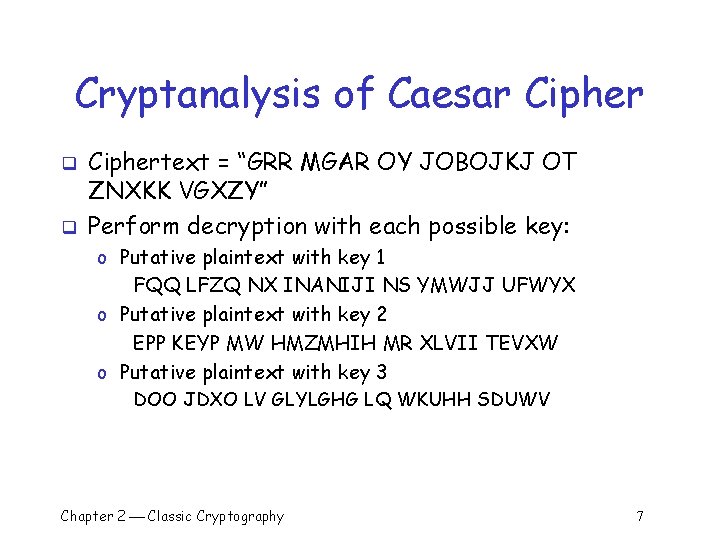
Cryptanalysis of Caesar Cipher q q Ciphertext = “GRR MGAR OY JOBOJKJ OT ZNXKK VGXZY” Perform decryption with each possible key: o Putative plaintext with key 1 FQQ LFZQ NX INANIJI NS YMWJJ UFWYX o Putative plaintext with key 2 EPP KEYP MW HMZMHIH MR XLVII TEVXW o Putative plaintext with key 3 DOO JDXO LV GLYLGHG LQ WKUHH SDUWV Chapter 2 Classic Cryptography 7
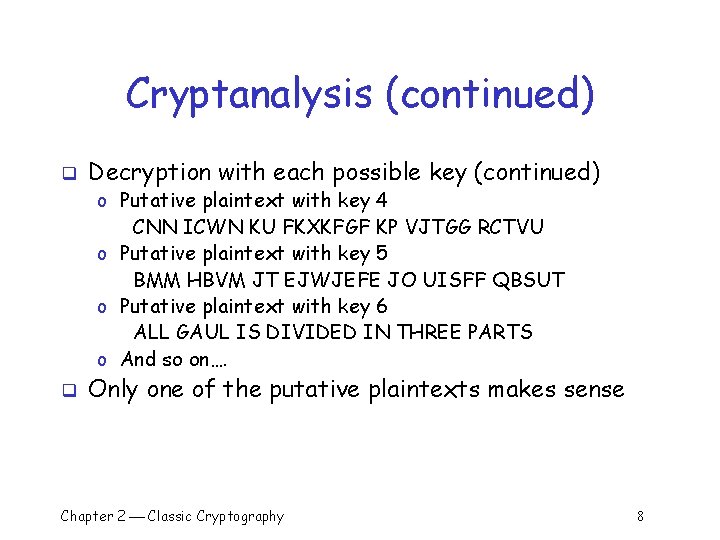
Cryptanalysis (continued) q Decryption with each possible key (continued) o Putative plaintext with key 4 CNN ICWN KU FKXKFGF KP VJTGG RCTVU o Putative plaintext with key 5 BMM HBVM JT EJWJEFE JO UISFF QBSUT o Putative plaintext with key 6 ALL GAUL IS DIVIDED IN THREE PARTS o And so on…. q Only one of the putative plaintexts makes sense Chapter 2 Classic Cryptography 8
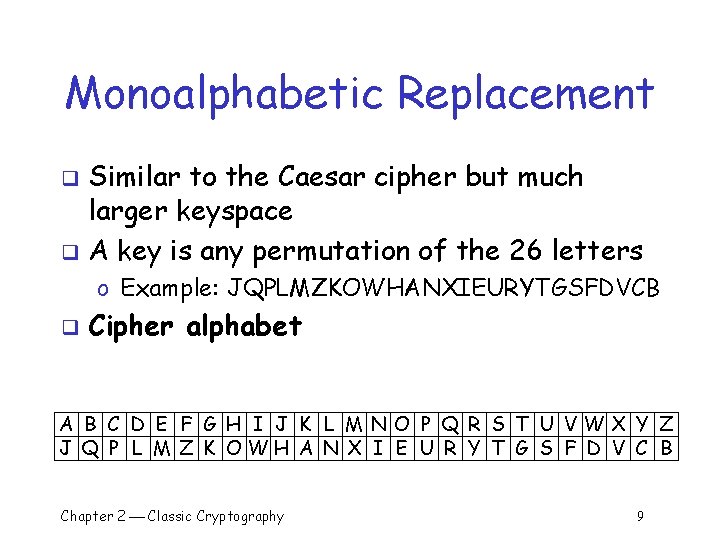
Monoalphabetic Replacement Similar to the Caesar cipher but much larger keyspace q A key is any permutation of the 26 letters q o Example: JQPLMZKOWHANXIEURYTGSFDVCB q Cipher alphabet A B C D E F G H I J K L MN O P Q R S T U VWX Y Z J Q P L M Z K OWH A N X I E U R Y T G S F D V C B Chapter 2 Classic Cryptography 9
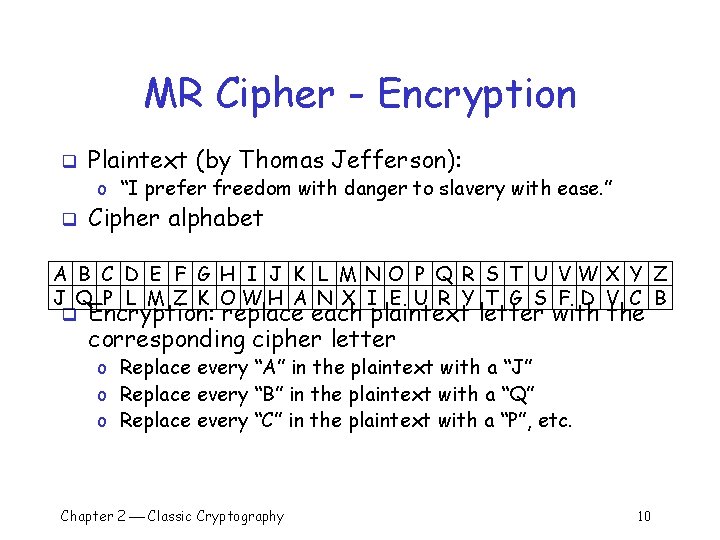
MR Cipher - Encryption q Plaintext (by Thomas Jefferson): o “I prefer freedom with danger to slavery with ease. ” q Cipher alphabet A B C D E F G H I J K L MN O P Q R S T U VWX Y Z J Q P L M Z K OWH A N X I E U R Y T G S F D V C B q Encryption: replace each plaintext letter with the corresponding cipher letter o Replace every “A” in the plaintext with a “J” o Replace every “B” in the plaintext with a “Q” o Replace every “C” in the plaintext with a “P”, etc. Chapter 2 Classic Cryptography 10
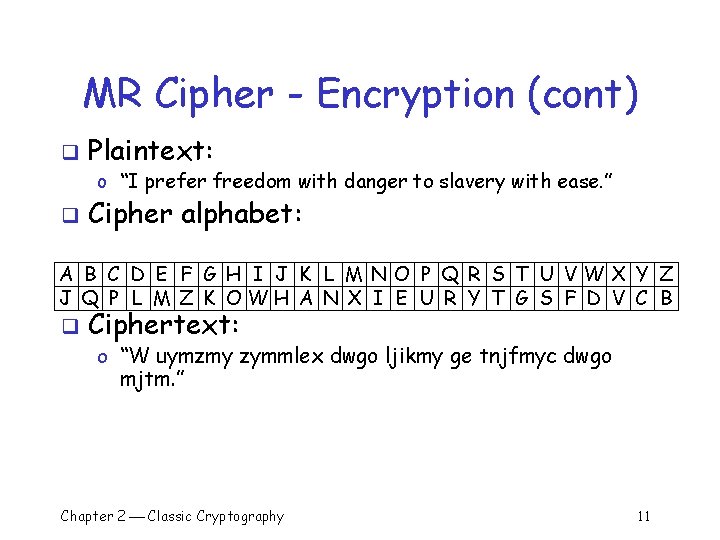
MR Cipher - Encryption (cont) q Plaintext: o “I prefer freedom with danger to slavery with ease. ” q Cipher alphabet: A B C D E F G H I J K L MN O P Q R S T U VWX Y Z J Q P L M Z K OWH A N X I E U R Y T G S F D V C B q Ciphertext: o “W uymzmy zymmlex dwgo ljikmy ge tnjfmyc dwgo mjtm. ” Chapter 2 Classic Cryptography 11
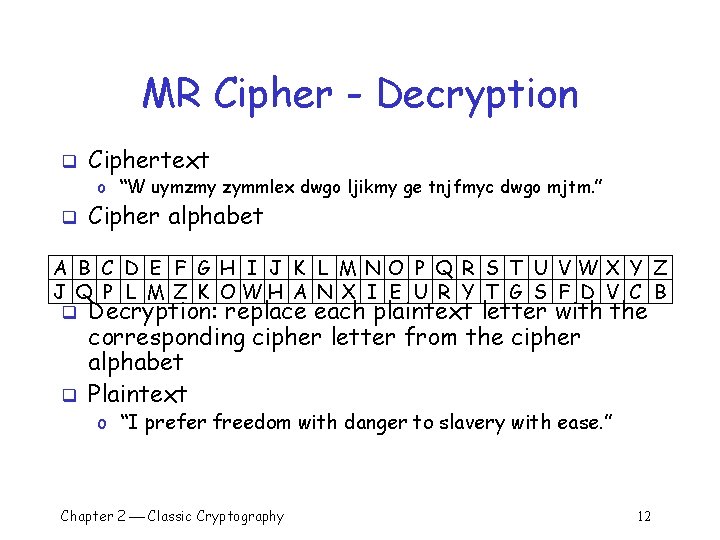
MR Cipher - Decryption q Ciphertext o “W uymzmy zymmlex dwgo ljikmy ge tnjfmyc dwgo mjtm. ” q Cipher alphabet A B C D E F G H I J K L MN O P Q R S T U VWX Y Z J Q P L M Z K OWH A N X I E U R Y T G S F D V C B q q Decryption: replace each plaintext letter with the corresponding cipher letter from the cipher alphabet Plaintext o “I prefer freedom with danger to slavery with ease. ” Chapter 2 Classic Cryptography 12
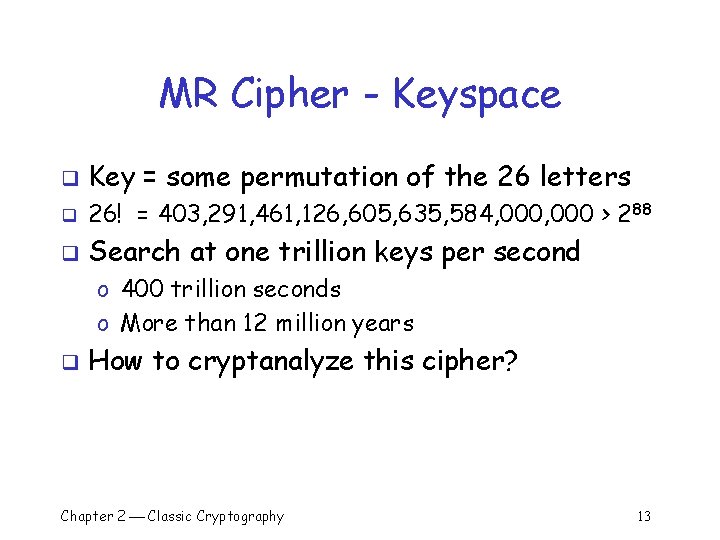
MR Cipher - Keyspace q Key = some permutation of the 26 letters q 26! = 403, 291, 461, 126, 605, 635, 584, 000 > 288 q Search at one trillion keys per second o 400 trillion seconds o More than 12 million years q How to cryptanalyze this cipher? Chapter 2 Classic Cryptography 13
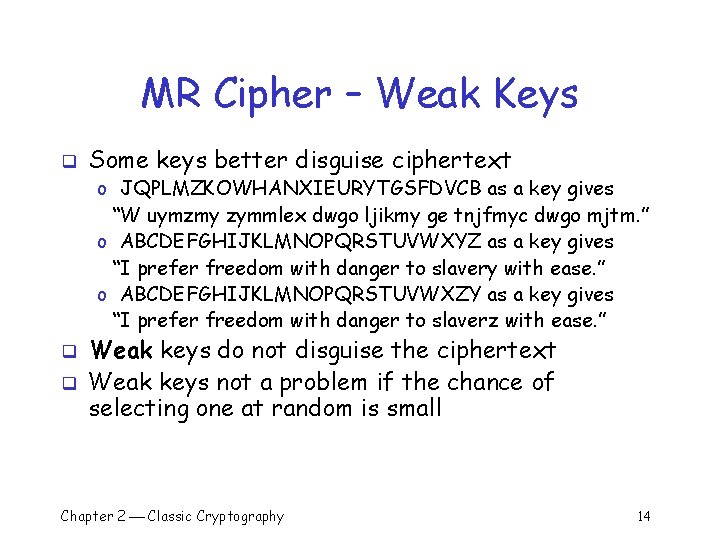
MR Cipher – Weak Keys q Some keys better disguise ciphertext o JQPLMZKOWHANXIEURYTGSFDVCB as a key gives “W uymzmy zymmlex dwgo ljikmy ge tnjfmyc dwgo mjtm. ” o ABCDEFGHIJKLMNOPQRSTUVWXYZ as a key gives “I prefer freedom with danger to slavery with ease. ” o ABCDEFGHIJKLMNOPQRSTUVWXZY as a key gives “I prefer freedom with danger to slaverz with ease. ” q q Weak keys do not disguise the ciphertext Weak keys not a problem if the chance of selecting one at random is small Chapter 2 Classic Cryptography 14
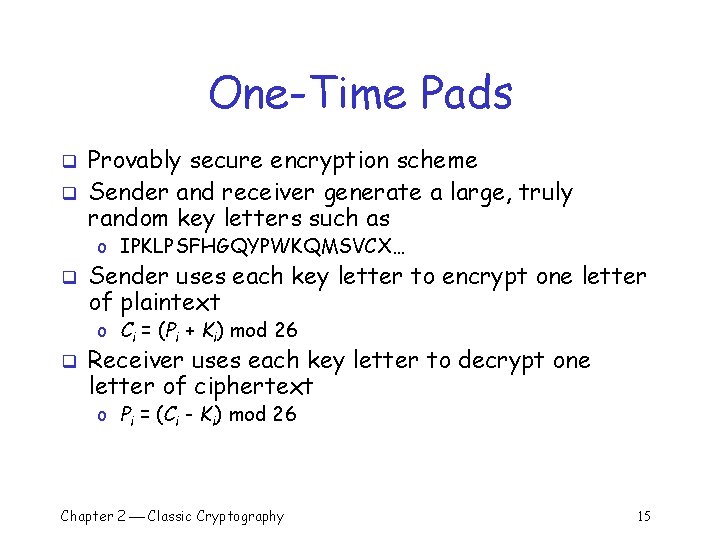
One-Time Pads q q Provably secure encryption scheme Sender and receiver generate a large, truly random key letters such as o IPKLPSFHGQYPWKQMSVCX… q Sender uses each key letter to encrypt one letter of plaintext o Ci = (Pi + Ki) mod 26 q Receiver uses each key letter to decrypt one letter of ciphertext o Pi = (Ci - Ki) mod 26 Chapter 2 Classic Cryptography 15
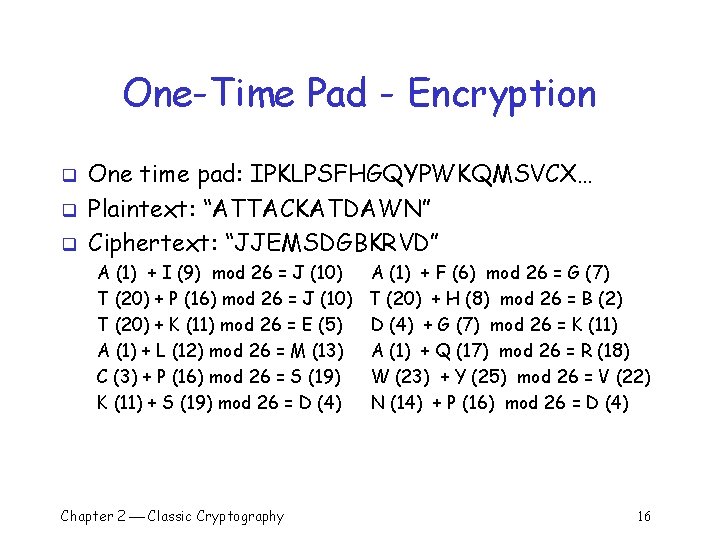
One-Time Pad - Encryption q q q One time pad: IPKLPSFHGQYPWKQMSVCX… Plaintext: “ATTACKATDAWN” Ciphertext: “JJEMSDGBKRVD” A (1) + I (9) mod 26 = J (10) A (1) + F (6) mod 26 = G (7) T (20) + P (16) mod 26 = J (10) T (20) + H (8) mod 26 = B (2) T (20) + K (11) mod 26 = E (5) D (4) + G (7) mod 26 = K (11) A (1) + L (12) mod 26 = M (13) A (1) + Q (17) mod 26 = R (18) C (3) + P (16) mod 26 = S (19) W (23) + Y (25) mod 26 = V (22) K (11) + S (19) mod 26 = D (4) N (14) + P (16) mod 26 = D (4) Chapter 2 Classic Cryptography 16
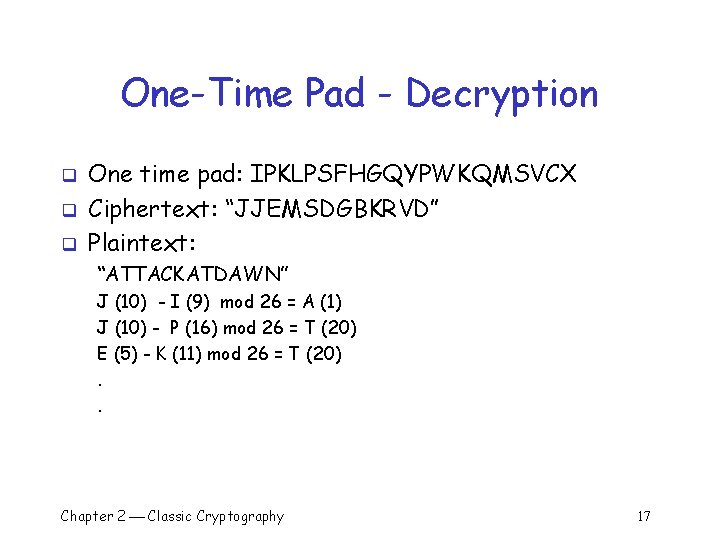
One-Time Pad - Decryption q q q One time pad: IPKLPSFHGQYPWKQMSVCX Ciphertext: “JJEMSDGBKRVD” Plaintext: “ATTACKATDAWN” J (10) - I (9) mod 26 = A (1) J (10) - P (16) mod 26 = T (20) E (5) - K (11) mod 26 = T (20). . Chapter 2 Classic Cryptography 17
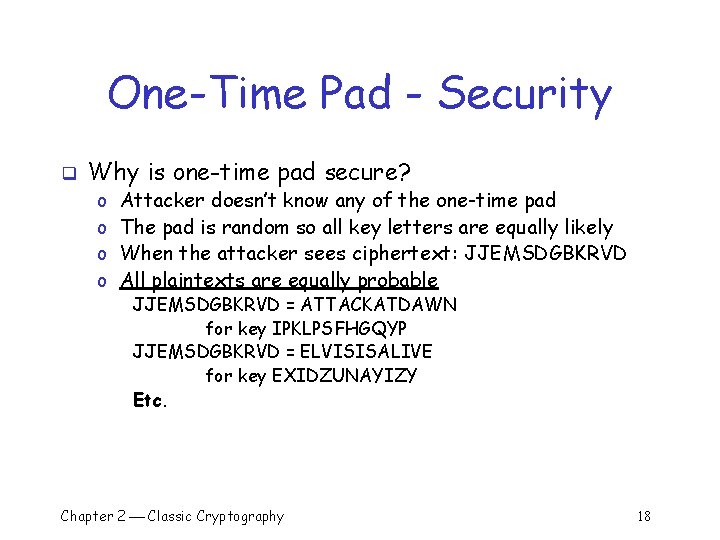
One-Time Pad - Security q Why is one-time pad secure? o o Attacker doesn’t know any of the one-time pad The pad is random so all key letters are equally likely When the attacker sees ciphertext: JJEMSDGBKRVD All plaintexts are equally probable JJEMSDGBKRVD = ATTACKATDAWN for key IPKLPSFHGQYP JJEMSDGBKRVD = ELVISISALIVE for key EXIDZUNAYIZY Etc. Chapter 2 Classic Cryptography 18
One-Time Pad (cont) Every plaintext message is equally possible q No way for adversary to know which is correct q A random key sequence added to nonrandom plaintext produces a random ciphertext q All messages of correct length are equally likely q Chapter 2 Classic Cryptography 19
One-Time Pads - Drawbacks q q Key must be as long as the message Security depends on adversary never obtaining a copy of the pad o o o Pad must be distributed securely to sender and receiver Pad must be destroyed immediately after use Must use the system properly Pad must be random (pseudo-random not good enough) Cannot reuse the pad Chapter 2 Classic Cryptography 20
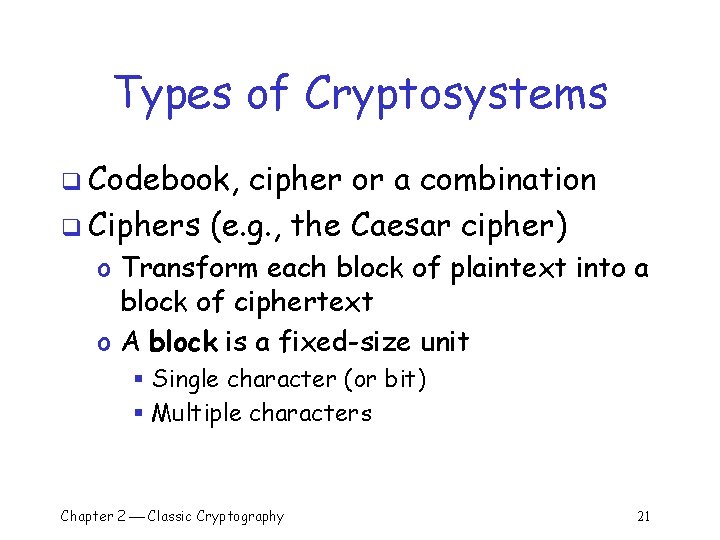
Types of Cryptosystems q Codebook, cipher or a combination q Ciphers (e. g. , the Caesar cipher) o Transform each block of plaintext into a block of ciphertext o A block is a fixed-size unit § Single character (or bit) § Multiple characters Chapter 2 Classic Cryptography 21
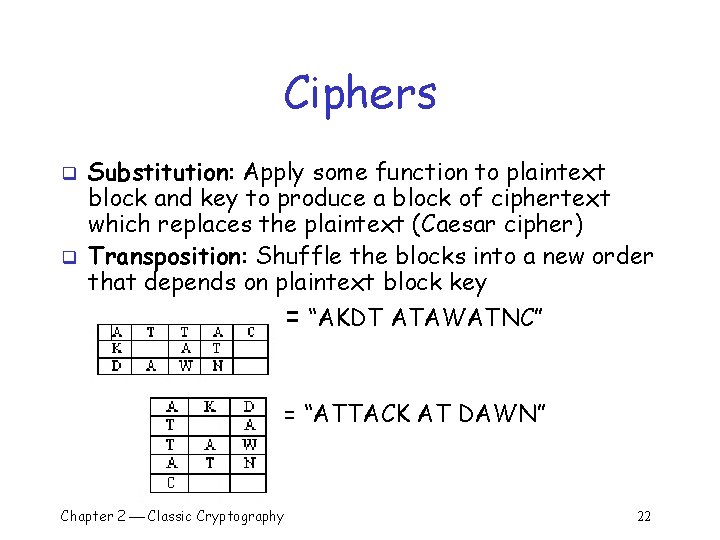
Ciphers q q Substitution: Apply some function to plaintext block and key to produce a block of ciphertext which replaces the plaintext (Caesar cipher) Transposition: Shuffle the blocks into a new order that depends on plaintext block key = “AKDT ATAWATNC” = “ATTACK AT DAWN” Chapter 2 Classic Cryptography 22
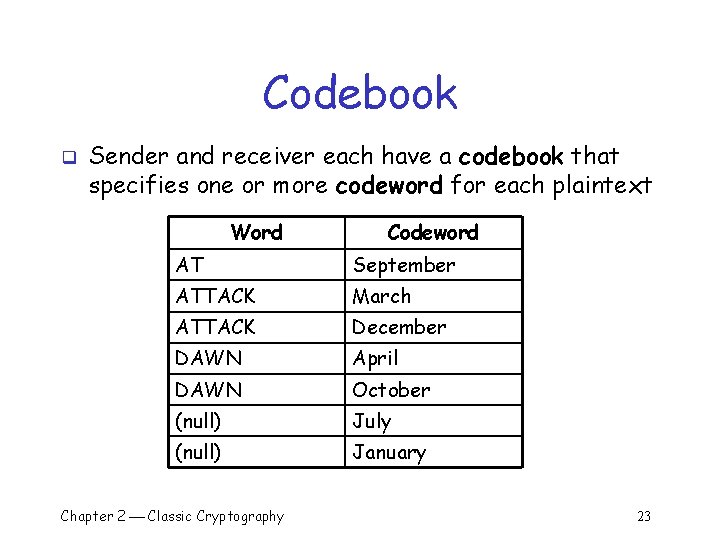
Codebook q Sender and receiver each have a codebook that specifies one or more codeword for each plaintext Word Codeword AT September ATTACK March ATTACK December DAWN April DAWN October (null) July (null) January Chapter 2 Classic Cryptography 23
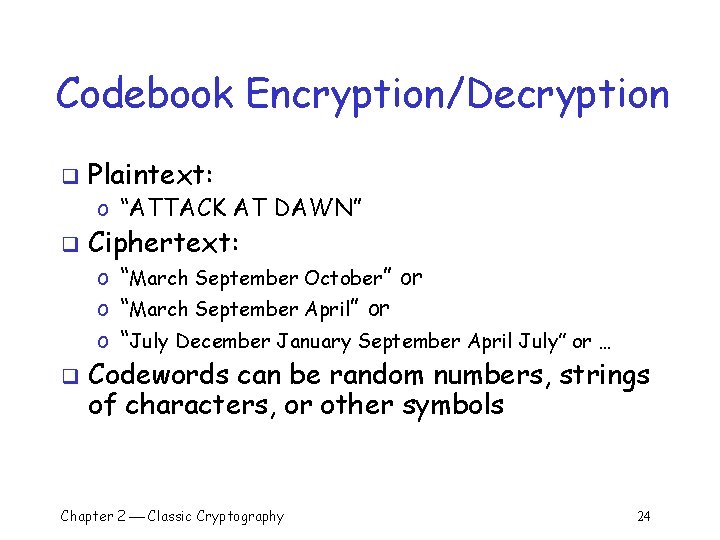
Codebook Encryption/Decryption q Plaintext: o “ATTACK AT DAWN” q Ciphertext: o “March September October” or o “March September April” or o “July December January September April July” or … q Codewords can be random numbers, strings of characters, or other symbols Chapter 2 Classic Cryptography 24
Types of Cryptosystems q Symmetric-key o Same key used for encryption and decryption o Typically used for bulk encryption q Asymmetric-key (or public-key) o Different key used for encryption and decryption o Usually not used for bulk encryption q Hybrid cryptosystems Chapter 2 Classic Cryptography 25
Symmetric-key Crypto q Use of a symmetric-key cryptosystem o Sender and receiver agree on a secret key § Must be done securely o Messages encrypted by sender with shared key and decrypted by the receiver with same key o Users need to establish shared secret key beforehand Chapter 2 Classic Cryptography 26
Public-Key Cryptosystems q Standard use of a public-key cryptosystem o Generate a public-key/private-key pair § Disseminate public key, keep private key secret o Anyone can encrypt a message to you with your public key o Only you can decrypt the message using your private key o Users do not need to have a established shared secret beforehand Chapter 2 Classic Cryptography 27
Public-Key Crypto (cont) q Another use of a public-key cryptosystem o Digital signatures - like nondigital (and then some) o User encrypts a document with his private key o Anybody can verify the digital signature with the signer’s public key § Only the private key can generate the signature (nonrepudiation) o Nothing comparable in symmetric key crypto Chapter 2 Classic Cryptography 28
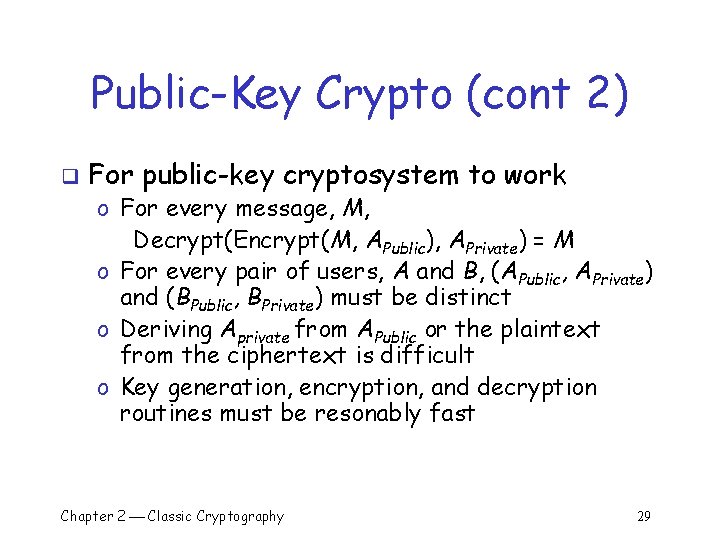
Public-Key Crypto (cont 2) q For public-key cryptosystem to work o For every message, M, Decrypt(Encrypt(M, APublic), APrivate) = M o For every pair of users, A and B, (APublic, APrivate) and (BPublic, BPrivate) must be distinct o Deriving Aprivate from APublic or the plaintext from the ciphertext is difficult o Key generation, encryption, and decryption routines must be resonably fast Chapter 2 Classic Cryptography 29
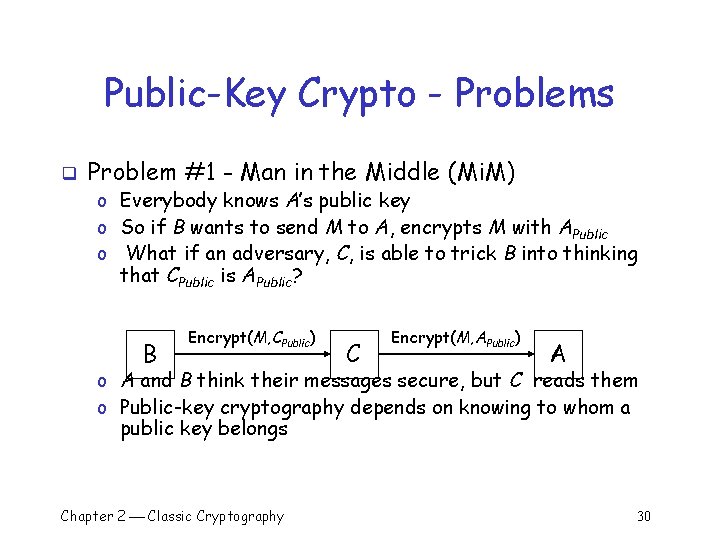
Public-Key Crypto - Problems q Problem #1 - Man in the Middle (Mi. M) o Everybody knows A’s public key o So if B wants to send M to A, encrypts M with APublic o What if an adversary, C, is able to trick B into thinking that CPublic is APublic? B Encrypt(M, CPublic) C Encrypt(M, APublic) A o A and B think their messages secure, but C reads them o Public-key cryptography depends on knowing to whom a public key belongs Chapter 2 Classic Cryptography 30
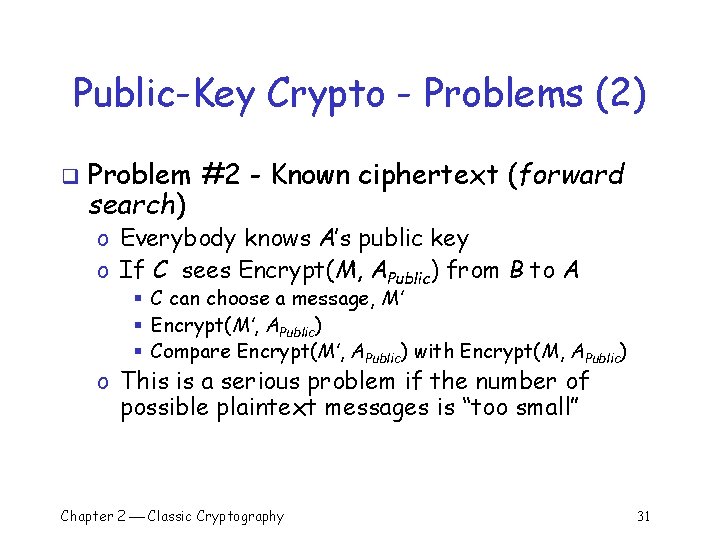
Public-Key Crypto - Problems (2) q Problem #2 - Known ciphertext (forward search) o Everybody knows A’s public key o If C sees Encrypt(M, APublic) from B to A § C can choose a message, M’ § Encrypt(M’, APublic) § Compare Encrypt(M’, APublic) with Encrypt(M, APublic) o This is a serious problem if the number of possible plaintext messages is “too small” Chapter 2 Classic Cryptography 31
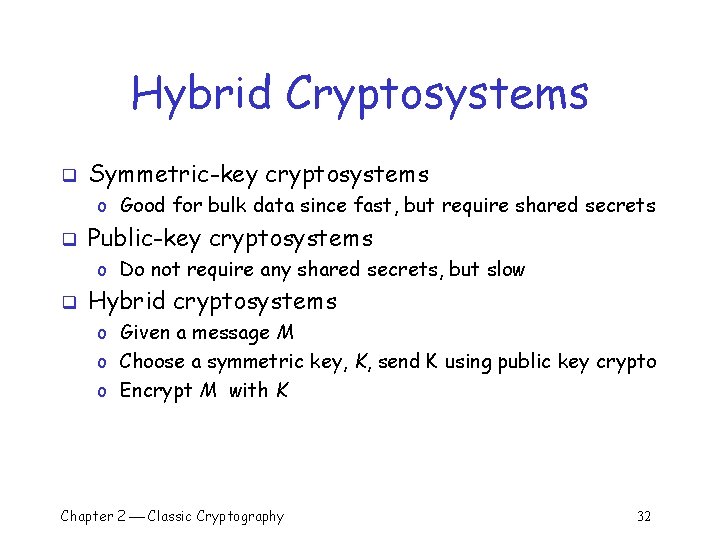
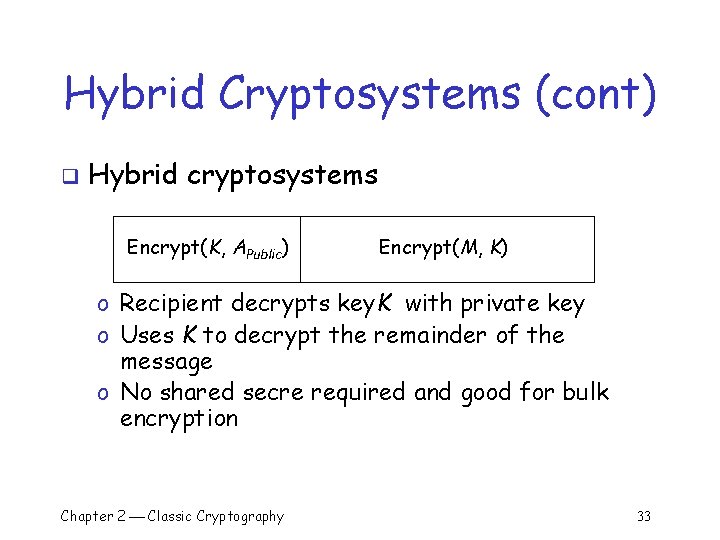
Hybrid Cryptosystems q Symmetric-key cryptosystems o Good for bulk data since fast, but require shared secrets q Public-key cryptosystems o Do not require any shared secrets, but slow q Hybrid cryptosystems o Given a message M o Choose a symmetric key, K, send K using public key crypto o Encrypt M with K Chapter 2 Classic Cryptography 32
Hybrid Cryptosystems (cont) q Hybrid cryptosystems Encrypt(K, APublic) Encrypt(M, K) o Recipient decrypts key. K with private key o Uses K to decrypt the remainder of the message o No shared secre required and good for bulk encryption Chapter 2 Classic Cryptography 33
Summary Cryptology is the art and science of making and breaking “secret codes” q Cryptography is the making q Cryptanalysis is the breaking q Classic cryptosystems include the Caesar cipher, monoalphabetic replacement cipher, one-time pad and many others q Chapter 2 Classic Cryptography 34
Summary (cont) Symetric-key cryptosystems are useful for bulk data encryption but require a shared secret q Public-key cryptosystems are much slower but do not require shared secrets and support digital signatures q Hybrid cryptosystems are good for bulk encryption and don’t require any shared secrets q Chapter 2 Classic Cryptography 35