
Overview Problem Solution Advantages Disadvantages Conclusion Problems Deep
Overview • Problem • Solution • Advantages • Disadvantages • Conclusion
Problems • Deep space exploration is difficult to initialize from Earth • Lack of excitement in today’s space program Problem * Solution * Advantages * Disadvantages * Conclusion
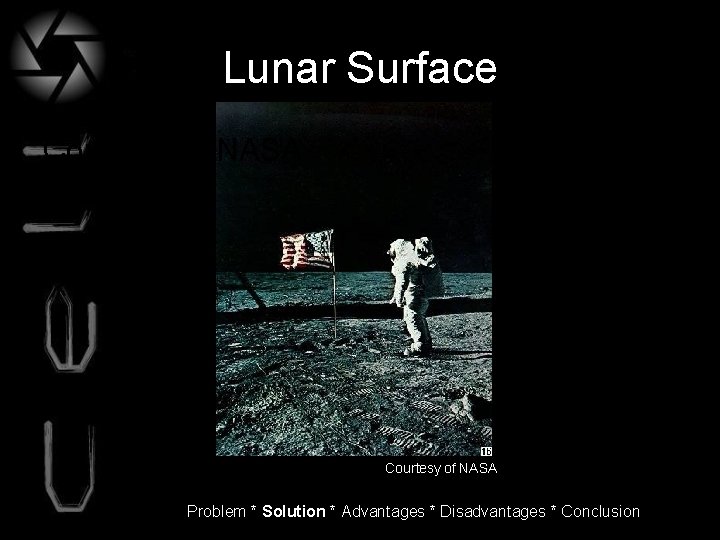
Lunar Surface Courtesy of NASA Problem * Solution * Advantages * Disadvantages * Conclusion
Lunar Surface – Past • Space Race • John F. Kennedy Speech: May 26, 19611 • Deadline: Within the decade • Accomplished in 1969 – Neil Armstrong and Buzz Aldrin Problem * Solution * Advantages * Disadvantages * Conclusion
Lunar Surface – Past • Mission Objectives: – Beat the Russians – Explore the Lunar Surface 2 • Surface Samples – Compositions, Resources, Minerals – 20 kg of Lunar Samples • Surveying • Habitation Problem * Solution * Advantages * Disadvantages * Conclusion
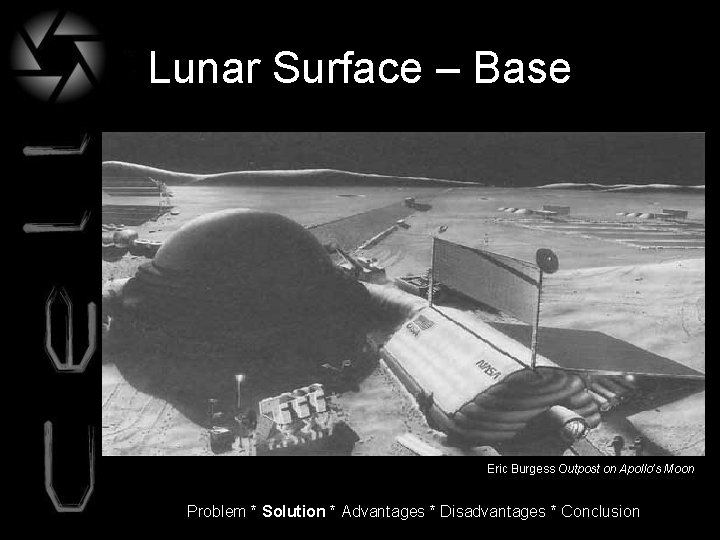
Lunar Surface – Base Eric Burgess Outpost on Apollo’s Moon Problem * Solution * Advantages * Disadvantages * Conclusion
Lunar Surface – Base • Establish a permanent base facility on the Lunar Surface – Central Command – Habitation Modules – Research Facility – Launch Facility – Mining Facility Problem * Solution * Advantages * Disadvantages * Conclusion
Lunar Surface – Base • Central Command – Facility controlling day-to-day base operations – Control of surface and L 1 launch facilities – Communication Station • Earth Inbound/Outbound • L 1 Station Problem * Solution * Advantages * Disadvantages * Conclusion
Lunar Surface – Base • Habitation Modules – Housing personnel – Water recycling – Provision Storage – Agriculture – Physical fitness facility – Equipment Storage – Waste Management – Energy – Solar Problem * Solution * Advantages * Disadvantages * Conclusion
Lunar Surface – Base • Research Facility – Low-gravity Laboratories – Biological Laboratories • Medical Facility – Surface-material testing Laboratories Problem * Solution * Advantages * Disadvantages * Conclusion
Lunar Surface – Base • Launch Facility – Lunar surface launch platform – Responsible for assembling and preparing launch vehicles for flight Problem * Solution * Advantages * Disadvantages * Conclusion
Lunar Surface - Base • Mining Facility – Bulk excavation of lunar resources for processing and utilization in base activities 2 • Base Maintenance and Repair • Study and Experimentation • Construction Problem * Solution * Advantages * Disadvantages * Conclusion
Lagrange Points – History • Collinear equilibrium points theorized by Leonard Euler • 1772 – Joseph Lagrange showed the existence of 5 equilibrium points in a two-body gravitational field • Lagrange further showed that the equilibrium points lie within the plane of rotation of the primary bodies • Collinear points found to be unstable while the other two points were found to be stable • The equilibrium points have come to be called Lagrange Points, or Libration Points Problem * Solution * Advantages * Disadvantages * Conclusion
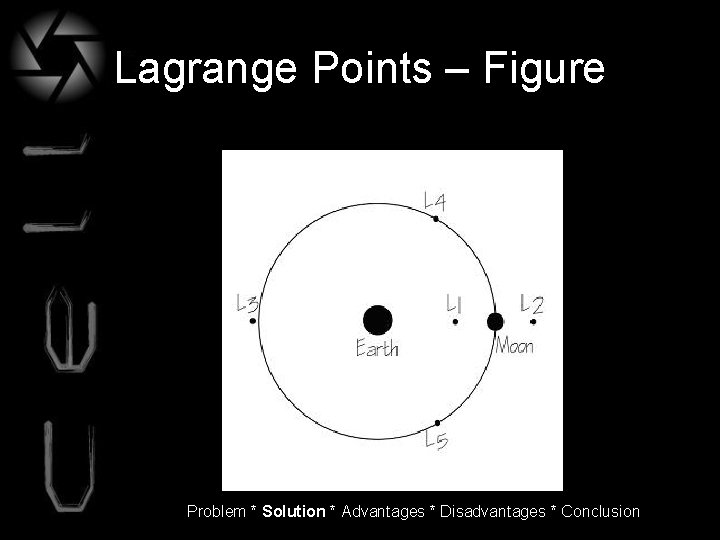
Lagrange Points – Figure Problem * Solution * Advantages * Disadvantages * Conclusion
Lagrange Points – Figure Bishop, R. H. Autonomous Navigation for Libration Point Formation Flying Missions Problem * Solution * Advantages * Disadvantages * Conclusion
Halo Orbits – History • An orbit by which an object may remain in close proximity to an equilibrium point • Suggested around 1950 by Arthur C. Clarke for communication purposes • Considered for use on Apollo 17 mission until the mission was altered Problem * Solution * Advantages * Disadvantages * Conclusion
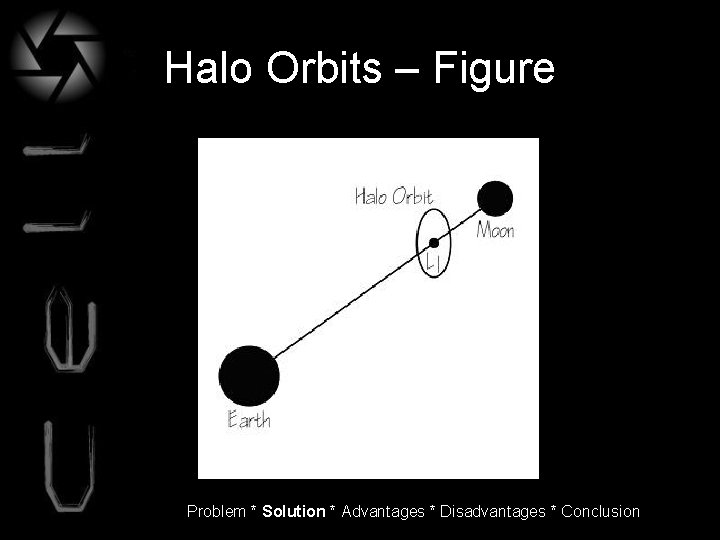
Halo Orbits – Figure Problem * Solution * Advantages * Disadvantages * Conclusion
L 1 Station • Configuration – Launch platform at L 1 – Construction yard in halo orbit about L 1 • Capabilities – Launch platform • Must be able to perform deep-space launches • Must be able to receive supplies from the Moon – Construction Yard • Must be capable of assembling deep-space vehicles • Must be capable of performing maintenance on L 1 station Problem * Solution * Advantages * Disadvantages * Conclusion
Transportation • Need for transportation – Form Earth to Lunar colony – In-between parts of colony • Types of vehicles Problem * Solution * Advantages * Disadvantages * Conclusion
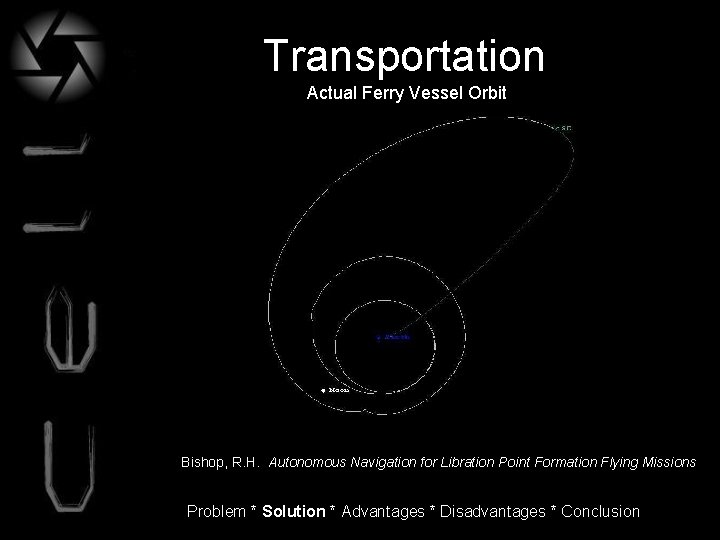
Transportation Actual Ferry Vessel Orbit Bishop, R. H. Autonomous Navigation for Libration Point Formation Flying Missions Problem * Solution * Advantages * Disadvantages * Conclusion
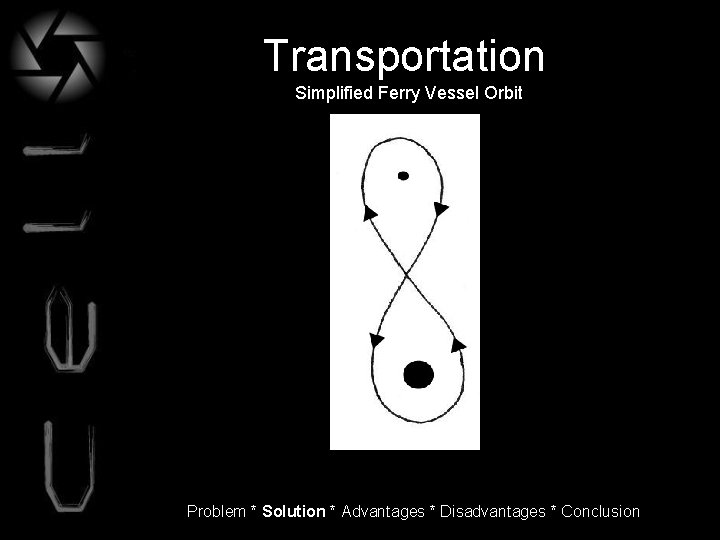
Transportation Simplified Ferry Vessel Orbit Problem * Solution * Advantages * Disadvantages * Conclusion
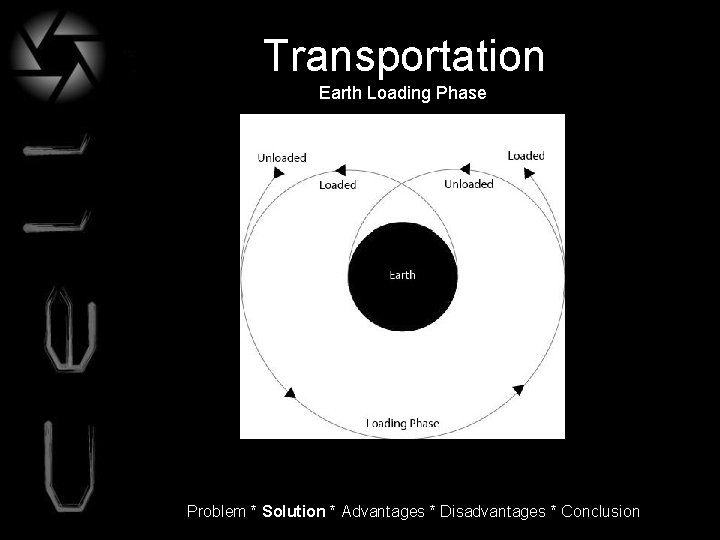
Transportation Earth Loading Phase Problem * Solution * Advantages * Disadvantages * Conclusion
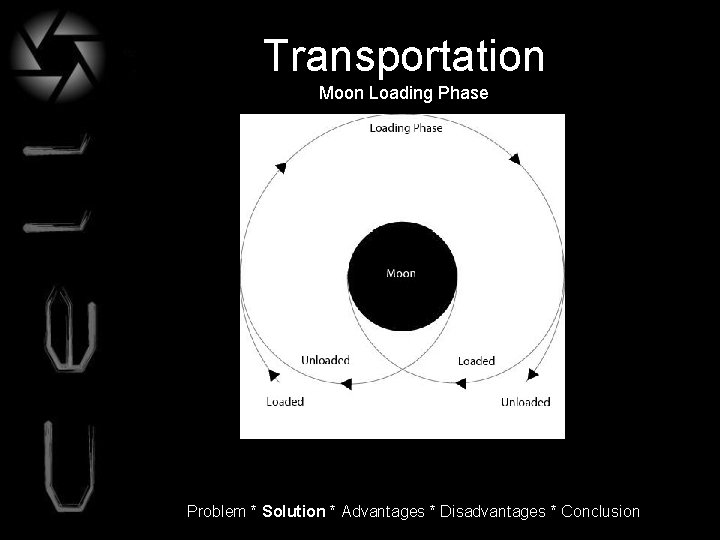
Transportation Moon Loading Phase Problem * Solution * Advantages * Disadvantages * Conclusion
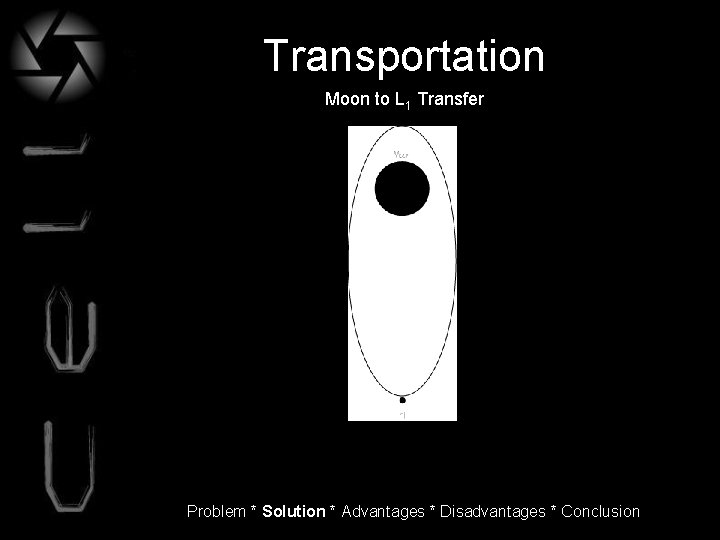
Transportation Moon to L 1 Transfer Problem * Solution * Advantages * Disadvantages * Conclusion
Transportation Summary • Ferry vessel – Transports materials back and forth between the Earth and Moon • Docking vessels – Located at both primary bodies – Dock with Ferry during the Ferry’s flyby with primaries – Loads/unloads the Ferry • Moon-to-L 1 vessel – Transports materials from Moon to L 1 Problem * Solution * Advantages * Disadvantages * Conclusion
Lunar Surface – Advantages • Permanent presence in space – further than LEO • Secondary perspective for interplanetary observations and measurements • Cost feasibility for interplanetary exploration (i. e. Mars)3 Problem * Solution * Advantages * Disadvantages * Conclusion
Lunar Surface – Advantages • Advance Technology • Lower long-term space expenditures • Revitalize space program – Promote manned interplanetary space exploration Problem * Solution * Advantages * Disadvantages * Conclusion
L 1 Advantages • “A manned station at L 1 could support an infrastructure expanding human presence beyond low-Earth orbit…” 3 • Proximity to bodies within the system 4 – Attractive for uses related to space missions – Well-suited for applications such as gateway stations for launching deeper exploratory missions Problem * Solution * Advantages * Disadvantages * Conclusion
Lunar Surface - Disadvantages • High Initial Cost 5 • Implementation Time • Hostile Environment Problem * Solution * Advantages * Disadvantages * Conclusion
L 1 Disadvantages • Unstable equilibrium position – Difficulty in controlling the station – Expense associated with fuel consumption • Takes time to reach L 1 from either of the primaries – Emergencies may not be quickly solved – Supplies may be delayed – Crew transfers will be lengthy Problem * Solution * Advantages * Disadvantages * Conclusion
Conclusion A lunar outpost should be built because: • Space exploration will expand since a spacecraft launched from the lunar outpost can have a greater payload, size, and range than a spacecraft launched from within the Earth’s atmosphere • The space program will be revitalized by giving future engineers something to look forward to • The advancements to technology that will be necessary to the development of a lunar colony will greatly benefit the rest of humanity Problem * Solution * Advantages * Disadvantages * Conclusion
References 1"Apollo Program, " Microsoft® Encarta® Online Encyclopedia 2003 http: //encarta. msn. com © 19972003 Microsoft Corporation. All Rights Reserved. 2 Burgess, 3 Bishop, Eric. Outpost on Apollo’s Moon, New York Columbia University Press, New York, 1993. R. H. , Huxel, P. J. , De. Mars, K. J. Autonomous Navigation for Libration Point Formation Flying Missions. NRA-03 -GSFC/AETD-01. Department of Aerospace Engineering and Engineering Mechanics, The University of Texas at Austin. August, 2003. 4 Condon, G. L. , Wilson, S. , and Ranieri, C. L. , “Performance Requirements and Kickstage Disposal Options For a Cislunar Gateway Station Transfer Vehicle, ” NASA Johnson Space Center, Houston, TX. 5 Dunham, D. W. , Farquhar, R. W. Libration Point Missions, 1978 -2002. Applied Physics Laboratory, Johns Hopkins University. 2002. 6 Mendell, Wendell W. (1996). “Lunar Base as a Precursor to Mars Exploration and Settlement, ” NASA Johnson Space Center, Houston, Texas. http: //ares. jsc. nasa. gov/Human. Explore/Exploration/EXLibrary/DOCS/EIC 040. HTML (6 October 2003). 7 Boles, Walter W. , Lunar Construction, University of Texas at Austin, Texas, 1990.
- Slides: 33