
Overview Problem CPU vs Memory performance imbalance Solution
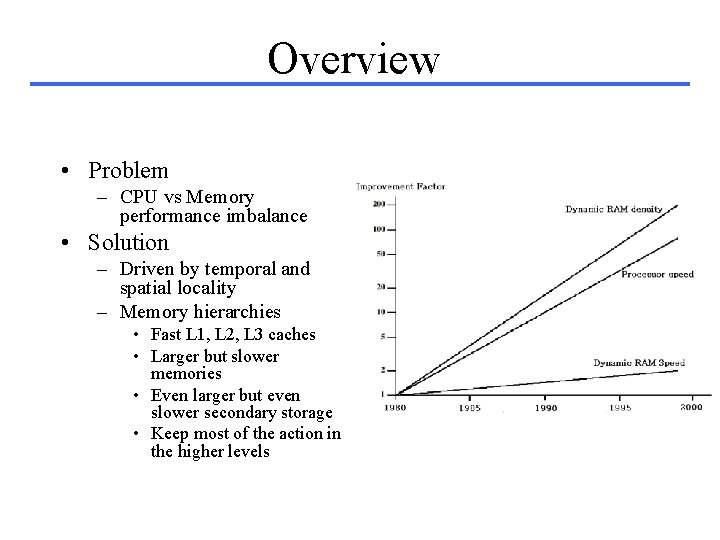
Overview • Problem – CPU vs Memory performance imbalance • Solution – Driven by temporal and spatial locality – Memory hierarchies • Fast L 1, L 2, L 3 caches • Larger but slower memories • Even larger but even slower secondary storage • Keep most of the action in the higher levels
Locality of Reference • Temporal and Spatial • Sequential access to memory • Unit-stride loop (cache lines = 256 bits) for (i = 1; i < 100000; i++) sum = sum + a[i]; • Non-unit stride loop (cache lines = 256 bits) for (i = 0; i <= 100000; i = i+8) sum = sum + a[i];
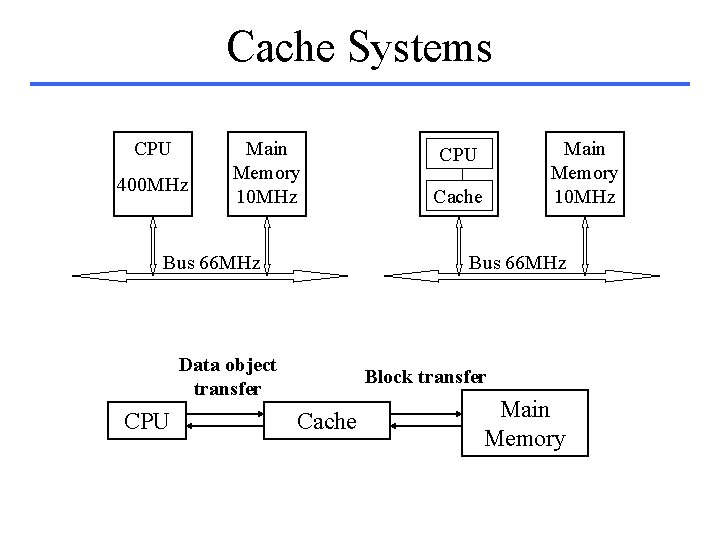
Cache Systems CPU 400 MHz Main Memory 10 MHz Bus 66 MHz Cache Bus 66 MHz Data object transfer CPU Main Memory 10 MHz CPU Block transfer Cache Main Memory
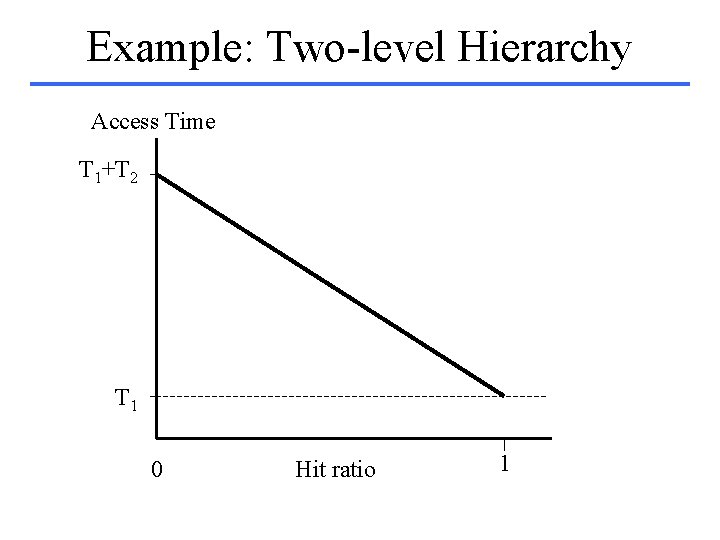
Example: Two-level Hierarchy Access Time T 1+T 2 T 1 0 Hit ratio 1
Basic Cache Read Operation • • CPU requests contents of memory location Check cache for this data If present, get from cache (fast) If not present, read required block from main memory to cache • Then deliver from cache to CPU • Cache includes tags to identify which block of main memory is in each cache slot
Elements of Cache Design • • Cache size Line (block) size Number of caches Mapping function – Block placement – Block identification • Replacement Algorithm • Write Policy
Cache Size • Cache size << main memory size • Small enough – Minimize cost – Speed up access (less gates to address the cache) – Keep cache on chip • Large enough – Minimize average access time • Optimum size depends on the workload • Practical size?
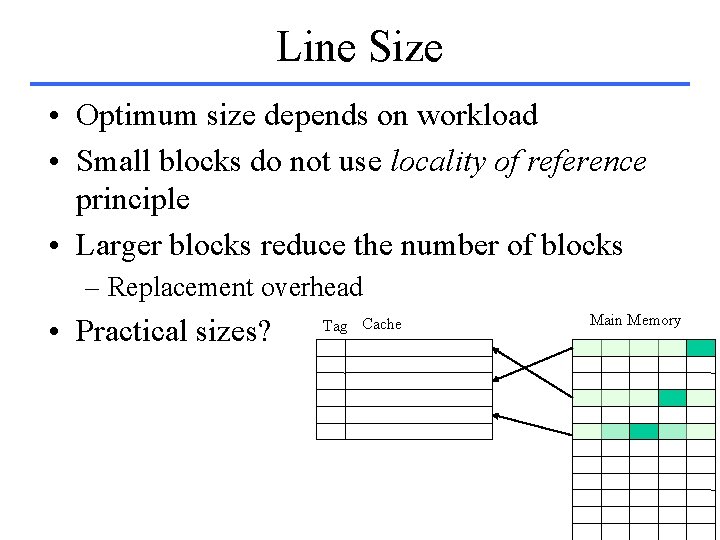
Line Size • Optimum size depends on workload • Small blocks do not use locality of reference principle • Larger blocks reduce the number of blocks – Replacement overhead • Practical sizes? Tag Cache Main Memory
Number of Caches • Increased logic density => on-chip cache – Internal cache: level 1 (L 1) – External cache: level 2 (L 2) • Unified cache – Balances the load between instruction and data fetches – Only one cache needs to be designed / implemented • Split caches (data and instruction) – Pipelined, parallel architectures
Mapping Function • Cache lines << main memory blocks • Direct mapping – Maps each block into only one possible line – (block address) MOD (number of lines) • Fully associative – Block can be placed anywhere in the cache • Set associative – Block can be placed in a restricted set of lines – (block address) MOD (number of sets in cache)
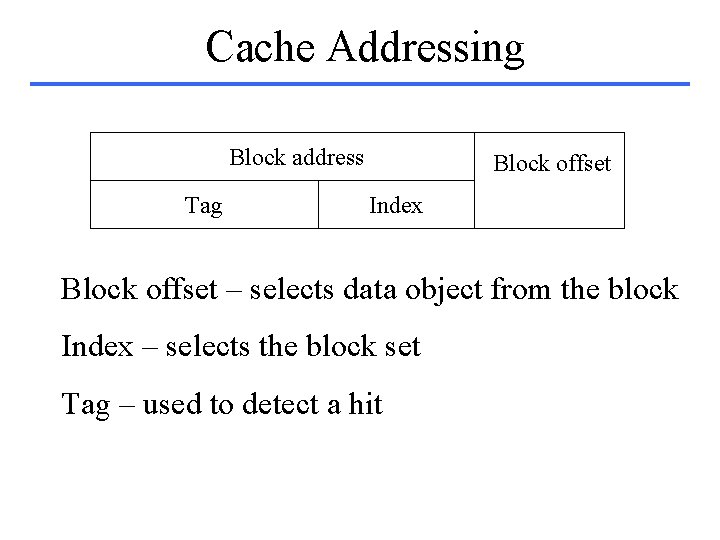
Cache Addressing Block address Tag Block offset Index Block offset – selects data object from the block Index – selects the block set Tag – used to detect a hit
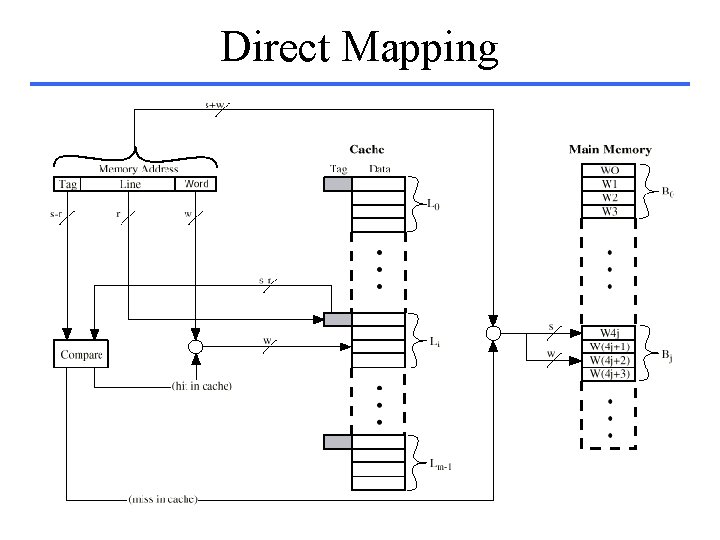
Direct Mapping
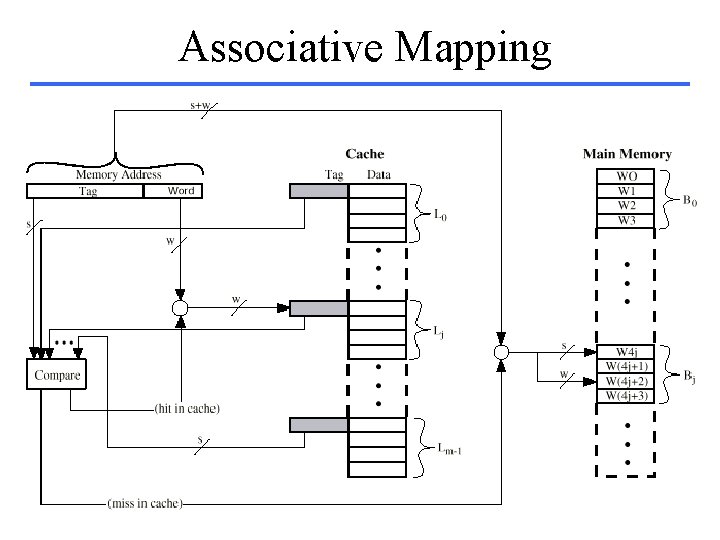
Associative Mapping
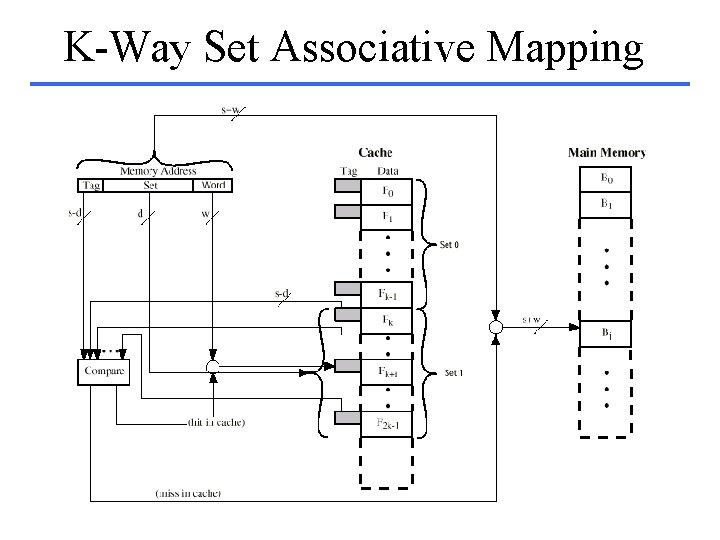
K-Way Set Associative Mapping
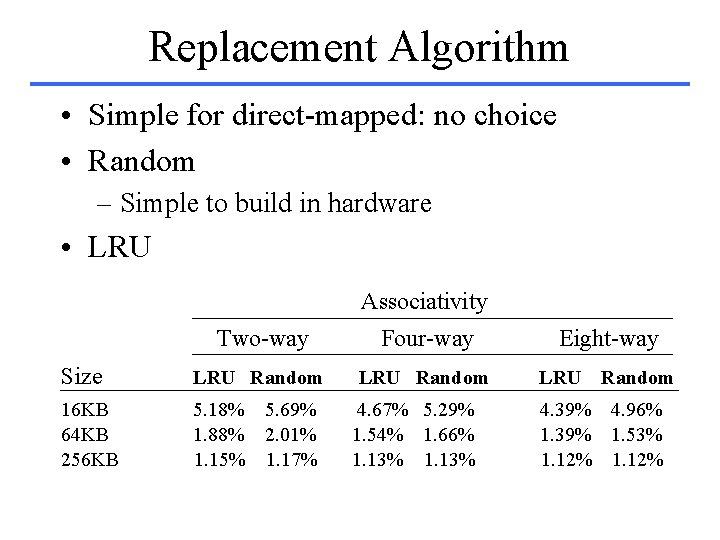
Replacement Algorithm • Simple for direct-mapped: no choice • Random – Simple to build in hardware • LRU Associativity Two-way Four-way Size LRU Random 16 KB 64 KB 256 KB 5. 18% 5. 69% 1. 88% 2. 01% 1. 15% 1. 17% 4. 67% 5. 29% 1. 54% 1. 66% 1. 13% Eight-way LRU Random 4. 39% 4. 96% 1. 39% 1. 53% 1. 12%
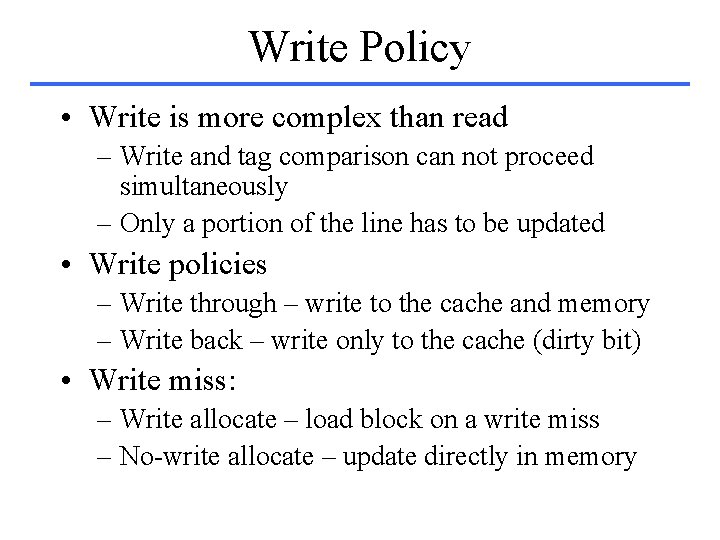
Write Policy • Write is more complex than read – Write and tag comparison can not proceed simultaneously – Only a portion of the line has to be updated • Write policies – Write through – write to the cache and memory – Write back – write only to the cache (dirty bit) • Write miss: – Write allocate – load block on a write miss – No-write allocate – update directly in memory
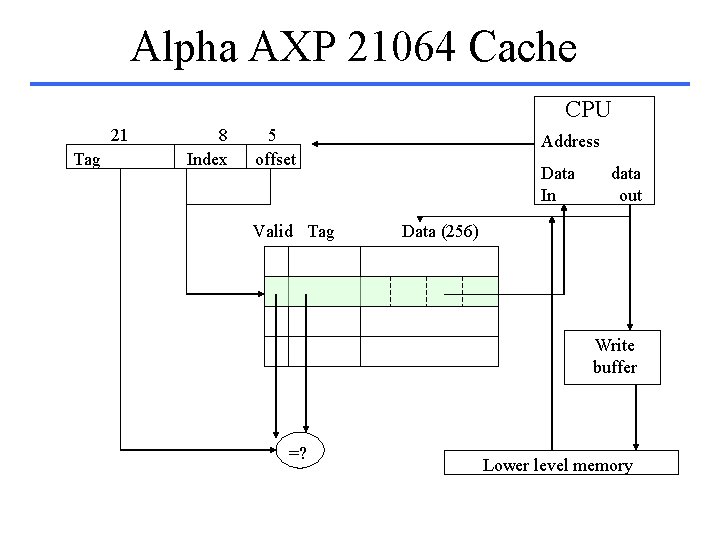
Alpha AXP 21064 Cache CPU 21 Tag 8 Index 5 offset Valid Tag Address Data In data out Data (256) Write buffer =? Lower level memory
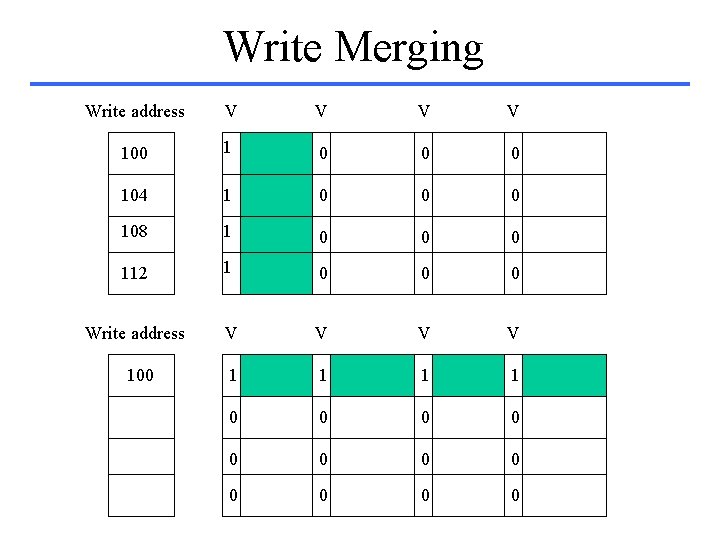
Write Merging Write address V V 100 1 0 0 0 104 1 0 0 0 108 1 0 0 0 112 1 0 0 0 Write address V V 1 1 0 0 0 100
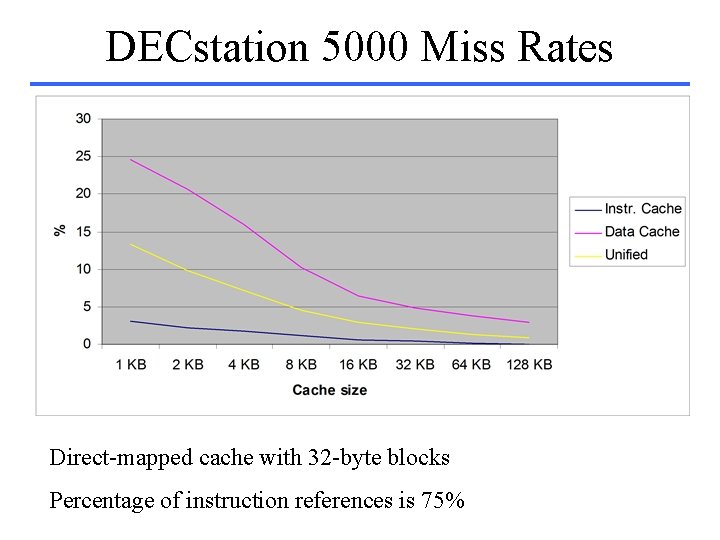
DECstation 5000 Miss Rates Direct-mapped cache with 32 -byte blocks Percentage of instruction references is 75%
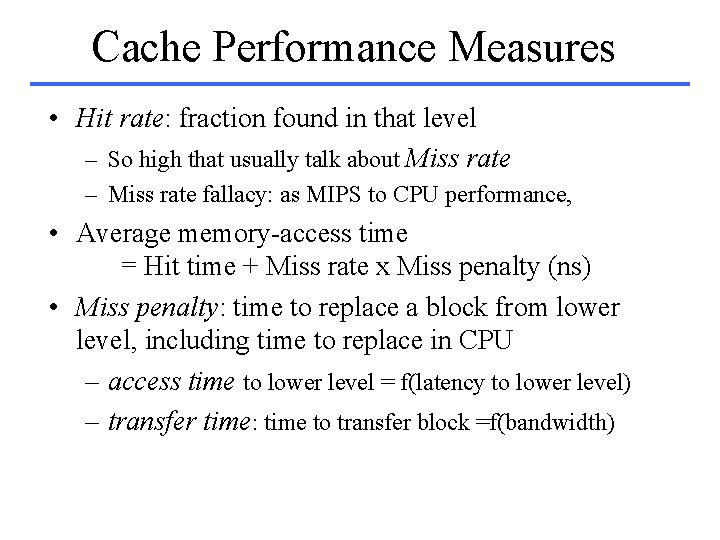
Cache Performance Measures • Hit rate: fraction found in that level – So high that usually talk about Miss rate – Miss rate fallacy: as MIPS to CPU performance, • Average memory-access time = Hit time + Miss rate x Miss penalty (ns) • Miss penalty: time to replace a block from lower level, including time to replace in CPU – access time to lower level = f(latency to lower level) – transfer time: time to transfer block =f(bandwidth)
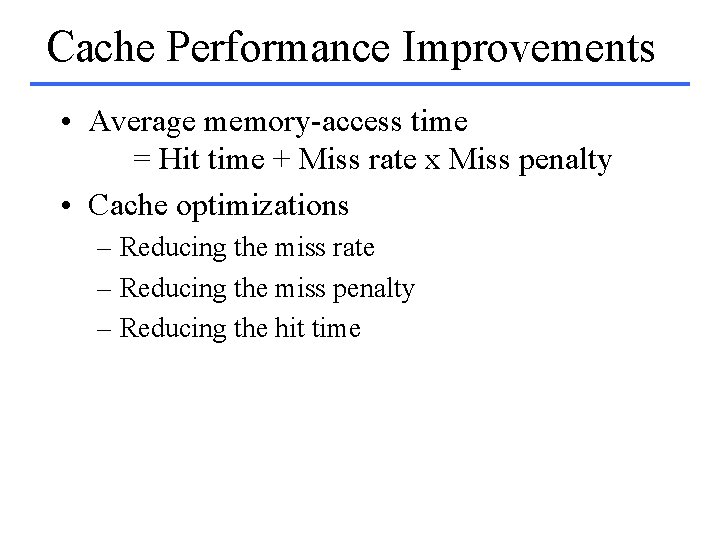
Cache Performance Improvements • Average memory-access time = Hit time + Miss rate x Miss penalty • Cache optimizations – Reducing the miss rate – Reducing the miss penalty – Reducing the hit time
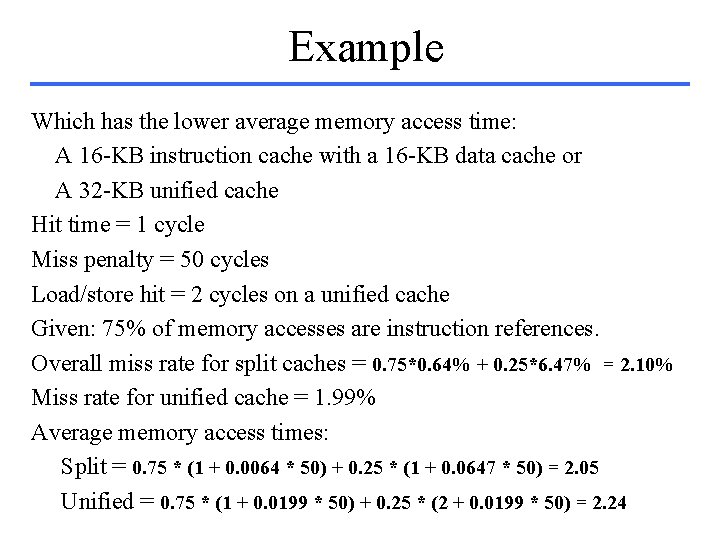
Example Which has the lower average memory access time: A 16 -KB instruction cache with a 16 -KB data cache or A 32 -KB unified cache Hit time = 1 cycle Miss penalty = 50 cycles Load/store hit = 2 cycles on a unified cache Given: 75% of memory accesses are instruction references. Overall miss rate for split caches = 0. 75*0. 64% + 0. 25*6. 47% = 2. 10% Miss rate for unified cache = 1. 99% Average memory access times: Split = 0. 75 * (1 + 0. 0064 * 50) + 0. 25 * (1 + 0. 0647 * 50) = 2. 05 Unified = 0. 75 * (1 + 0. 0199 * 50) + 0. 25 * (2 + 0. 0199 * 50) = 2. 24
- Slides: 22