
Overview Presentation What is Talk Boost KS 2
Overview Presentation

What is Talk Boost KS 2? Groups of 4 children box delayed Yr 3 Text - 5 with centredskills language description Text box description Targeted intervention Delivered by trained TA with centred three times per week for description 8 weeks © I CAN 2016 Talk Boost KS 2 TBKS 2 Tracker & Communication Text box with centred Notebook Detective Text box Manual Teacher with centred Whole class activities & description homework 2
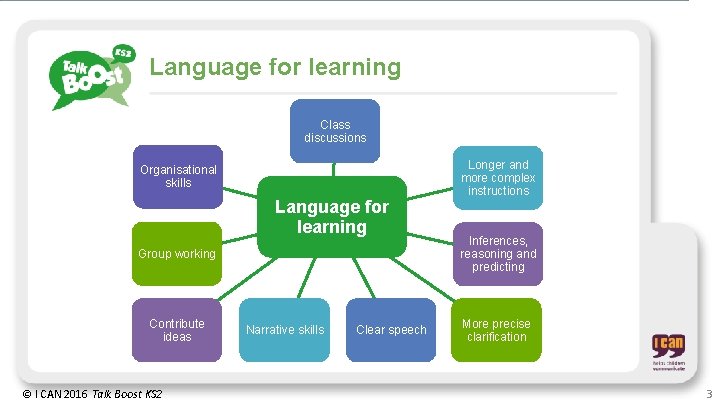
Language for learning Class discussions Organisational skills Language for learning Group working Contribute ideas © I CAN 2016 Talk Boost KS 2 Narrative skills Clear speech Longer and more complex instructions Inferences, reasoning and predicting More precise clarification 3
Talk Boost KS 2 – the need • Approximately 50% of children, particularly in areas of social deprivation, have language skills below the expected level for their age. • Without support, in areas of socioeconomic disadvantage language difficulties can remain until adolescence affecting relationships and learning. • Almost everything at school involves spoken language; it is the way most learning happens. It is crucial for development in primary school children. © I CAN 2016 Talk Boost KS 2 4
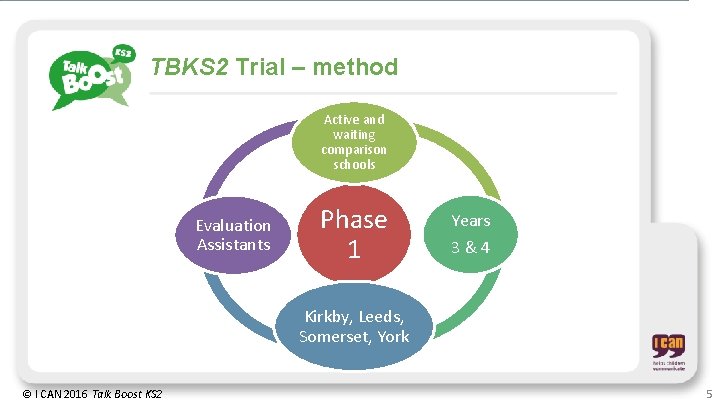
TBKS 2 Trial – method Active and waiting comparison schools Evaluation Assistants Phase 1 Years 3&4 Kirkby, Leeds, Somerset, York © I CAN 2016 Talk Boost KS 2 5
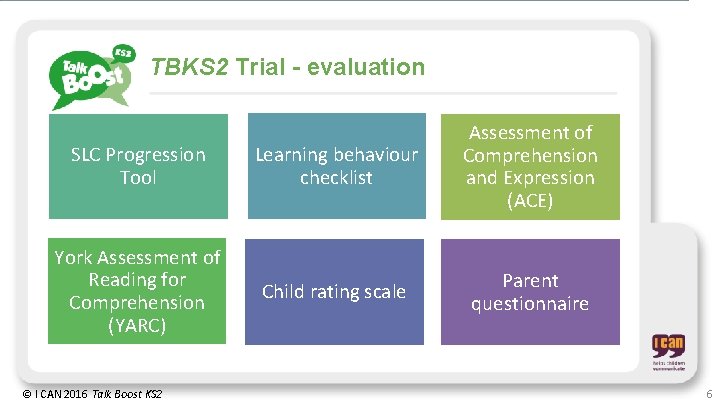
TBKS 2 Trial - evaluation SLC Progression Tool Learning behaviour checklist Assessment of Comprehension and Expression (ACE) York Assessment of Reading for Comprehension (YARC) Child rating scale Parent questionnaire © I CAN 2016 Talk Boost KS 2 6
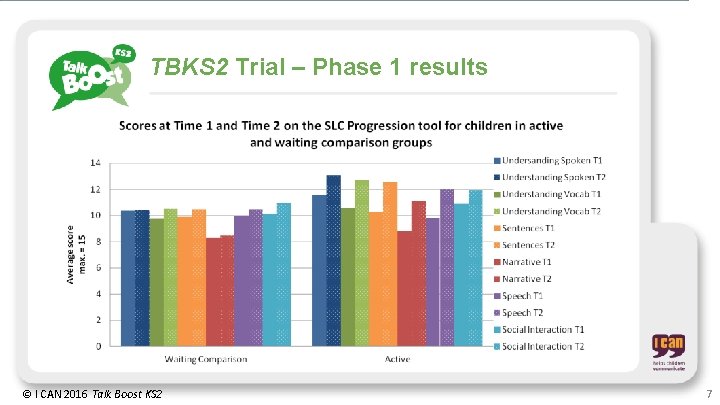
TBKS 2 Trial – Phase 1 results © I CAN 2016 Talk Boost KS 2 7
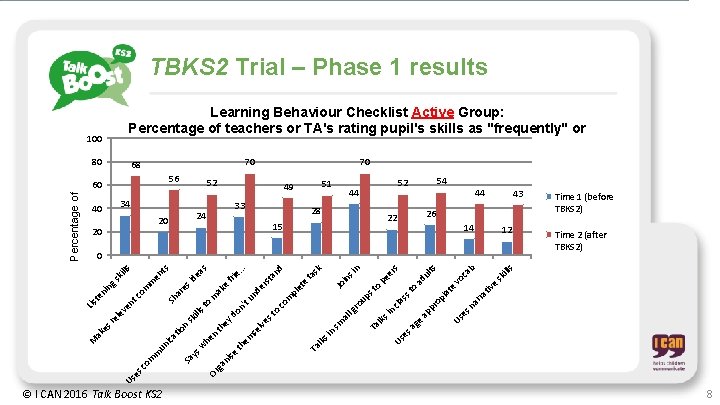
TBKS 2 Trial – Phase 1 results Learning Behaviour Checklist Active Group: Percentage of teachers or TA's rating pupil's skills as "frequently" or 100 80 70 68 56 52 34 40 20 51 49 33 24 20 54 52 44 28 43 26 22 15 44 14 12 ills sk ca tiv e vo e rra na pr ap Us es ag e es op i at to ss cla in lks Ta Us pe e o st up ro b ad ul ts rs n in Jo lg al sm in Time 2 (after TBKS 2) Ta lks Time 1 (before TBKS 2) Or ga ni se si sk ta e o st lve se th em n he w ys et m co tu n' do ey th n tio Sa pl nd e ak m sk ills to Sh ica un m m co Us es rs ta e. fri e id es ar om nt c ve le re es ak M © I CAN 2016 Talk Boost KS 2 nd s ea en ts m sk il in g en Lis t . . 0 ls Percentage of 60 70 8
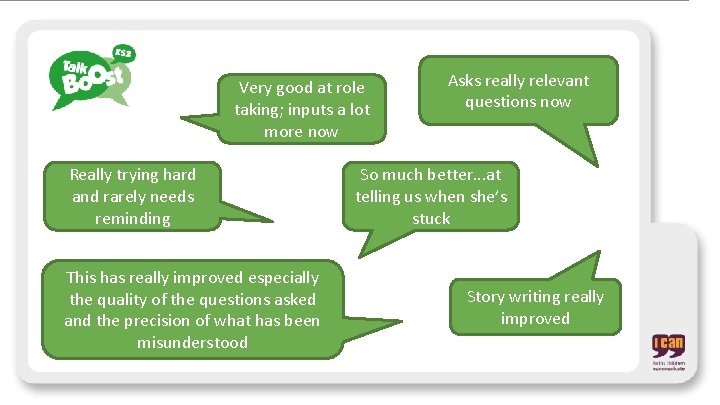
Very good at role taking; inputs a lot more now Really trying hard and rarely needs reminding This has really improved especially the quality of the questions asked and the precision of what has been misunderstood Asks really relevant questions now So much better. . . at telling us when she’s stuck Story writing really improved

Standardised test findings • ACE – both groups improved between T 1 and T 2 – no statistically significant difference between them • YARC – both groups got worse between T 1 and T 2 – no statistical difference between them 10

Child rating scale • Neither active nor comparison group’s scores changed much over time • This may reflect children’s growing self-awareness © I CAN 2016 Talk Boost KS 2 11
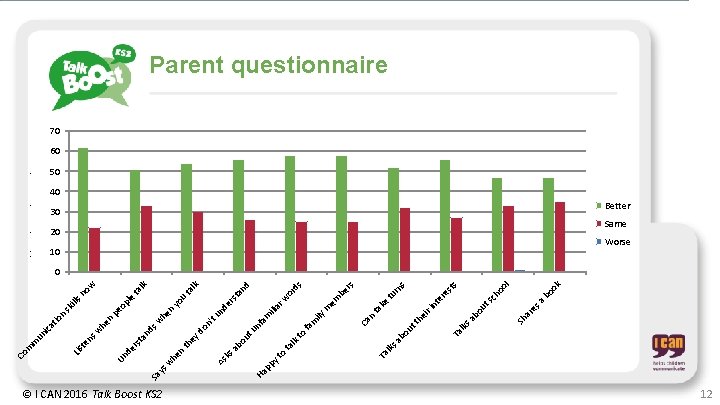
© I CAN 2016 Talk Boost KS 2 ey th ks es ar k oo ab oo l ch ts ou ab es ts er nt ri s rn rs be tu d lk ds or em ke ta he i Sh ks Ta l tt ou n Ca ta an st u rw m ilia ily m fa yo tu nd er n he lk ta w no op le ls sk il pe am nf n' do to ab lk ta n he n tio nd sw w ab ou tu Ta l o As ks n he w pp yt Ha ys Sa rs ta de Un ns ica un m te Lis m Co Number of parents Parent questionnaire 70 60 50 40 30 Better 20 Same 10 Worse 0 12
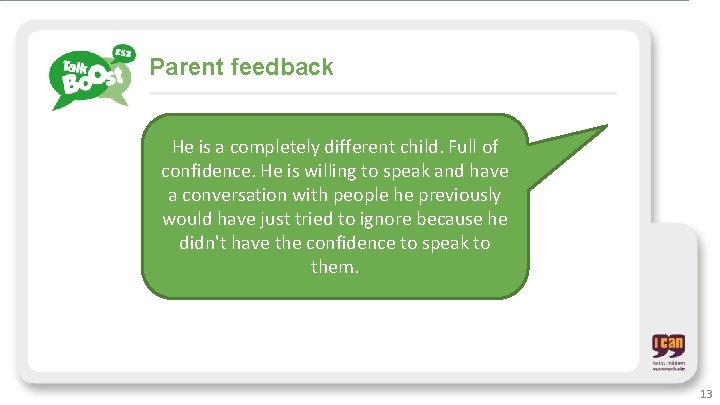
Parent feedback He is a completely different child. Full of confidence. He is willing to speak and have a conversation with people he previously would have just tried to ignore because he didn't have the confidence to speak to them. 13
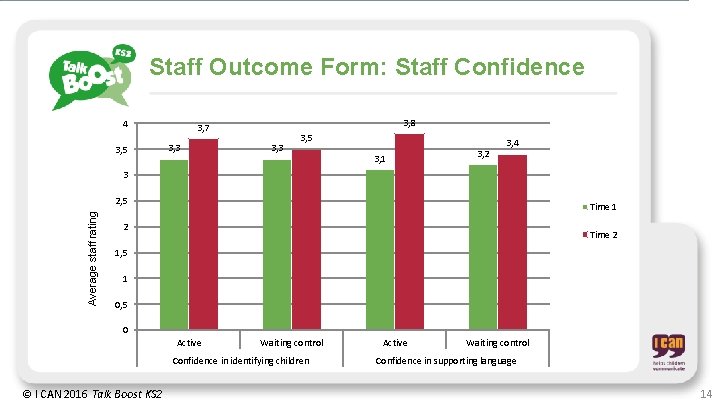
Staff Outcome Form: Staff Confidence 4 3, 5 3, 8 3, 7 3, 3 3, 5 3, 1 3, 2 3, 4 3 Average staff rating 2, 5 Time 1 2 Time 2 1, 5 1 0, 5 0 Active Waiting control Confidence in identifying children © I CAN 2016 Talk Boost KS 2 Active Waiting control Confidence in supporting language 14
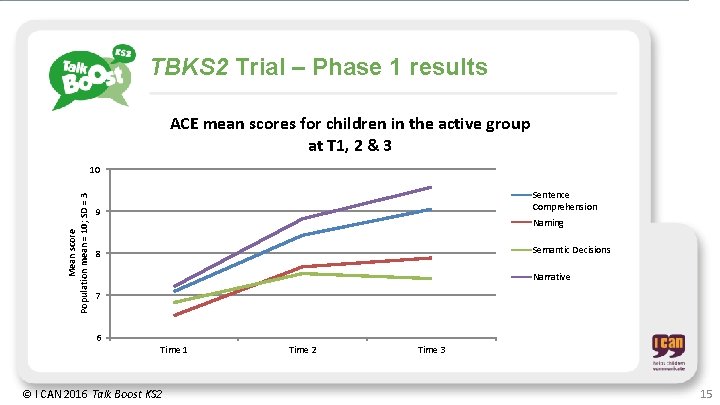
TBKS 2 Trial – Phase 1 results ACE mean scores for children in the active group at T 1, 2 & 3 Mean score Population mean = 10; SD = 3 10 9 Sentence Comprehension 8 Semantic Decisions Naming Narrative 7 6 Time 1 © I CAN 2016 Talk Boost KS 2 Time 3 15

TBKS 2 Trial – Phase 1 results Mean standard scores based on a population mean = 100; SD = 15 YARC mean standard scores for children in the active group at T 1, 2 & 3 99 97 95 Accuracy 93 Comprehension 91 89 87 Time 1 © I CAN 2016 Talk Boost KS 2 Time 3 16
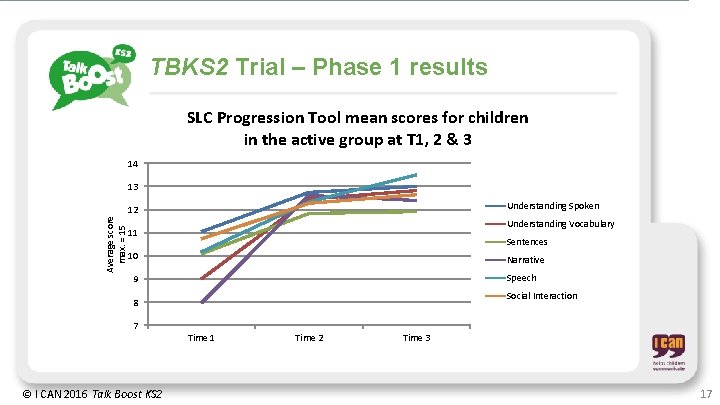
TBKS 2 Trial – Phase 1 results SLC Progression Tool mean scores for children in the active group at T 1, 2 & 3 14 13 Understanding Spoken Average score max. = 15 12 Understanding Vocabulary 11 Sentences 10 Narrative Speech 9 Social Interaction 8 7 Time 1 © I CAN 2016 Talk Boost KS 2 Time 3 17
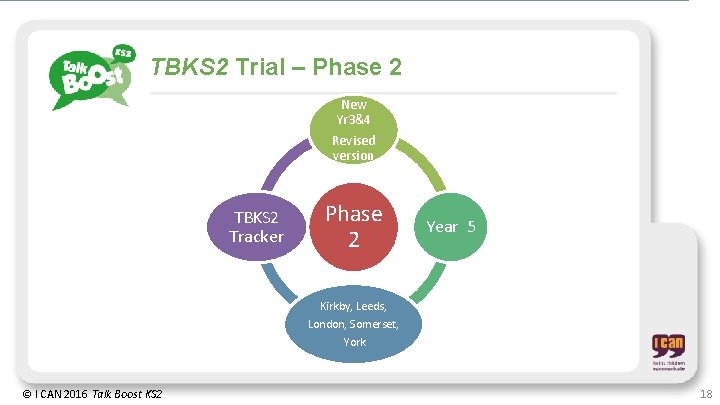
TBKS 2 Trial – Phase 2 New Yr 3&4 Revised version TBKS 2 Tracker Phase 2 Year 5 Kirkby, Leeds, London, Somerset, York © I CAN 2016 Talk Boost KS 2 18
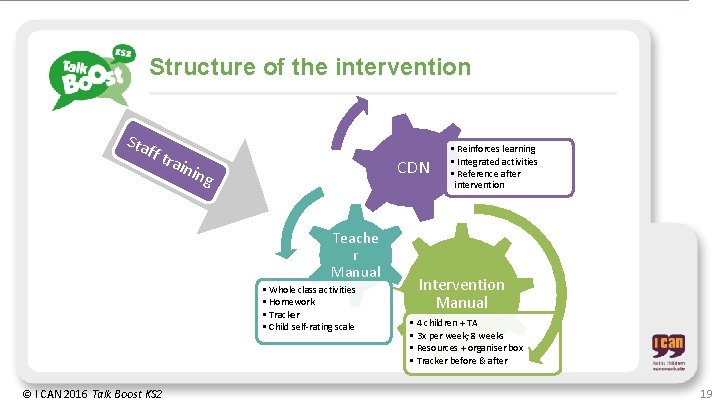
Structure of the intervention Sta ff t rain CDN ing Teache r Manual • Whole class activities • Homework • Tracker • Child self-rating scale © I CAN 2016 Talk Boost KS 2 • Reinforces learning • Integrated activities • Reference after intervention Intervention Manual • 4 children + TA • 3 x per week; 8 weeks • Resources + organiser box • Tracker before & after 19

Structure of the intervention (2) listening carefully working with others / making friends and having conversations - weeks 7 and 8 - week 1 and throughout Talk Boost KS 2 remembering & thinking - weeks 5 and 6 © I CAN 2016 Talk Boost KS 2 learning new words - weeks 2 and 3 • • Evidence informed Learning objectives Explicit feedback Meta-awareness telling stories and saying what happened - weeks 3 and 4 20
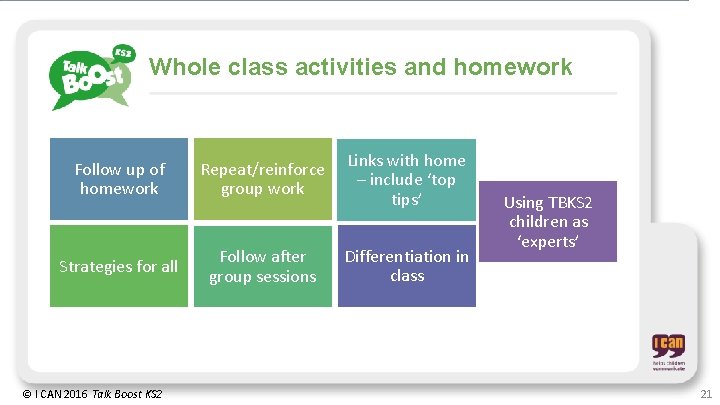
Whole class activities and homework Follow up of homework Repeat/reinforce group work Links with home – include ‘top tips’ Strategies for all Follow after group sessions Differentiation in class © I CAN 2016 Talk Boost KS 2 Using TBKS 2 children as ‘experts’ 21

Are you a communication detective? Groopy Caples • To make the grepes, sift the grap into a hep, boof a sig in the centre, chive an eck into it and flipper it, gradually adding the grap, hab, strezzel and serney. • Can you solve the mystery? 22
Any questions? 23
- Slides: 23