
Overview on regulating and inspection of agricultural products

- Slides: 32
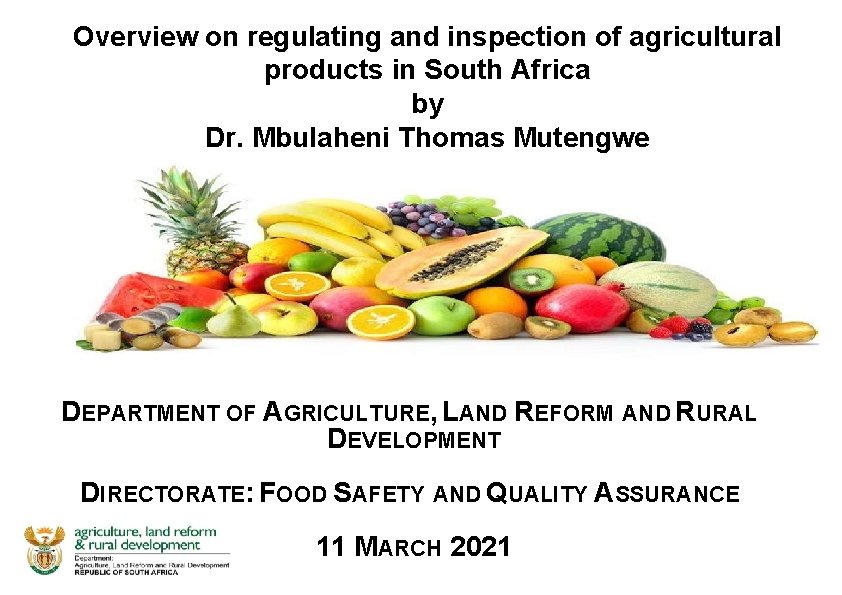
Overview on regulating and inspection of agricultural products in South Africa by Dr. Mbulaheni Thomas Mutengwe DEPARTMENT OF AGRICULTURE, LAND REFORM AND RURAL DEVELOPMENT DIRECTORATE: FOOD SAFETY AND QUALITY ASSURANCE 11 MARCH 2021
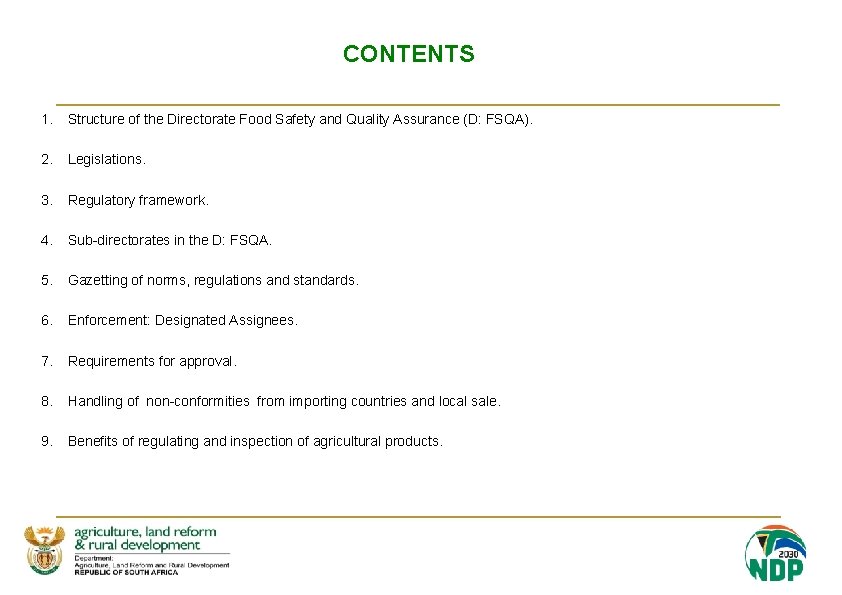
CONTENTS 1. Structure of the Directorate Food Safety and Quality Assurance (D: FSQA). 2. Legislations. 3. Regulatory framework. 4. Sub directorates in the D: FSQA. 5. Gazetting of norms, regulations and standards. 6. Enforcement: Designated Assignees. 7. Requirements for approval. 8. Handling of non conformities from importing countries and local sale. 9. Benefits of regulating and inspection of agricultural products.
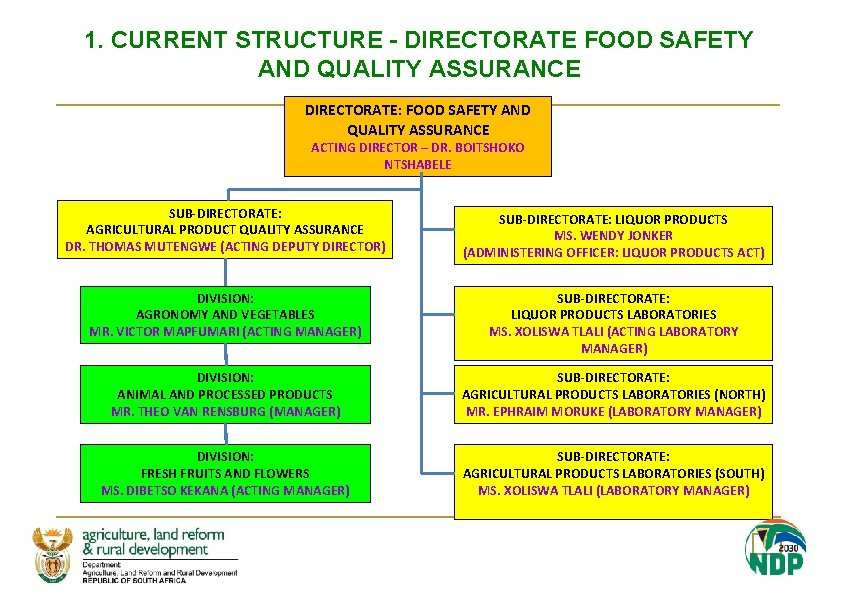
1. CURRENT STRUCTURE - DIRECTORATE FOOD SAFETY AND QUALITY ASSURANCE DIRECTORATE: FOOD SAFETY AND QUALITY ASSURANCE ACTING DIRECTOR – DR. BOITSHOKO NTSHABELE SUB-DIRECTORATE: AGRICULTURAL PRODUCT QUALITY ASSURANCE DR. THOMAS MUTENGWE (ACTING DEPUTY DIRECTOR) SUB-DIRECTORATE: LIQUOR PRODUCTS MS. WENDY JONKER (ADMINISTERING OFFICER: LIQUOR PRODUCTS ACT) DIVISION: AGRONOMY AND VEGETABLES MR. VICTOR MAPFUMARI (ACTING MANAGER) SUB-DIRECTORATE: LIQUOR PRODUCTS LABORATORIES MS. XOLISWA TLALI (ACTING LABORATORY MANAGER) DIVISION: ANIMAL AND PROCESSED PRODUCTS MR. THEO VAN RENSBURG (MANAGER) SUB-DIRECTORATE: AGRICULTURAL PRODUCTS LABORATORIES (NORTH) MR. EPHRAIM MORUKE (LABORATORY MANAGER) DIVISION: FRESH FRUITS AND FLOWERS MS. DIBETSO KEKANA (ACTING MANAGER) SUB-DIRECTORATE: AGRICULTURAL PRODUCTS LABORATORIES (SOUTH) MS. XOLISWA TLALI (LABORATORY MANAGER) 3
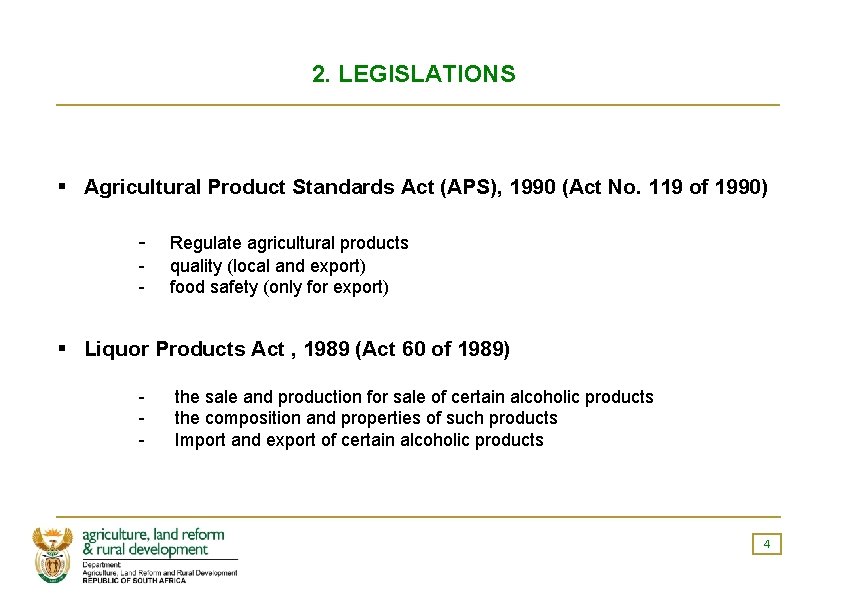
2. LEGISLATIONS § Agricultural Product Standards Act (APS), 1990 (Act No. 119 of 1990) Regulate agricultural products quality (local and export) food safety (only for export) § Liquor Products Act , 1989 (Act 60 of 1989) the sale and production for sale of certain alcoholic products the composition and properties of such products Import and export of certain alcoholic products 4
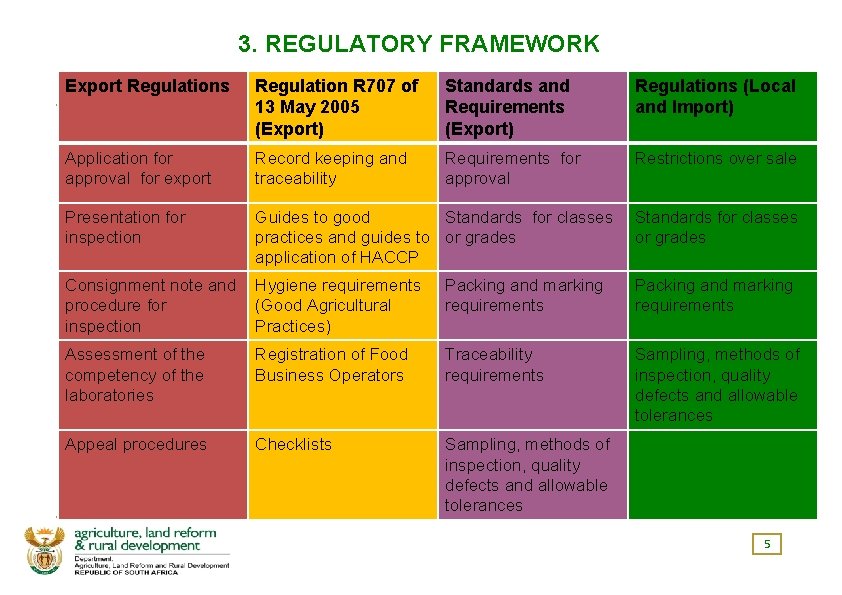
3. REGULATORY FRAMEWORK Export Regulations Regulation R 707 of 13 May 2005 (Export) Standards and Requirements (Export) Regulations (Local and Import) Application for approval for export Record keeping and traceability Requirements for approval Restrictions over sale Presentation for inspection Guides to good Standards for classes practices and guides to or grades application of HACCP Standards for classes or grades Consignment note and procedure for inspection Hygiene requirements (Good Agricultural Practices) Packing and marking requirements Assessment of the competency of the laboratories Registration of Food Business Operators Traceability requirements Sampling, methods of inspection, quality defects and allowable tolerances Appeal procedures Checklists Sampling, methods of inspection, quality defects and allowable tolerances 5
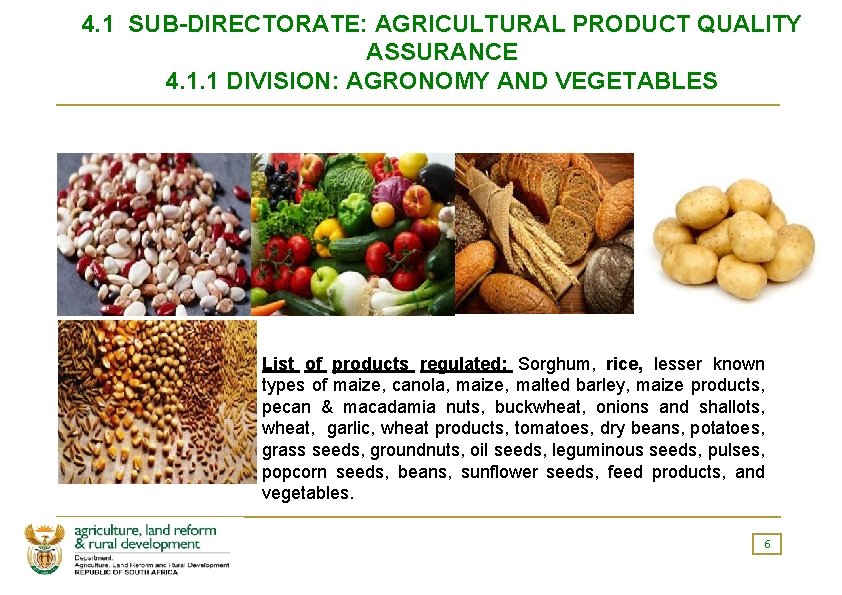
4. 1 SUB-DIRECTORATE: AGRICULTURAL PRODUCT QUALITY ASSURANCE 4. 1. 1 DIVISION: AGRONOMY AND VEGETABLES List of products regulated: Sorghum, rice, lesser known types of maize, canola, maize, malted barley, maize products, pecan & macadamia nuts, buckwheat, onions and shallots, wheat, garlic, wheat products, tomatoes, dry beans, potatoes, grass seeds, groundnuts, oil seeds, leguminous seeds, pulses, popcorn seeds, beans, sunflower seeds, feed products, and vegetables. 6
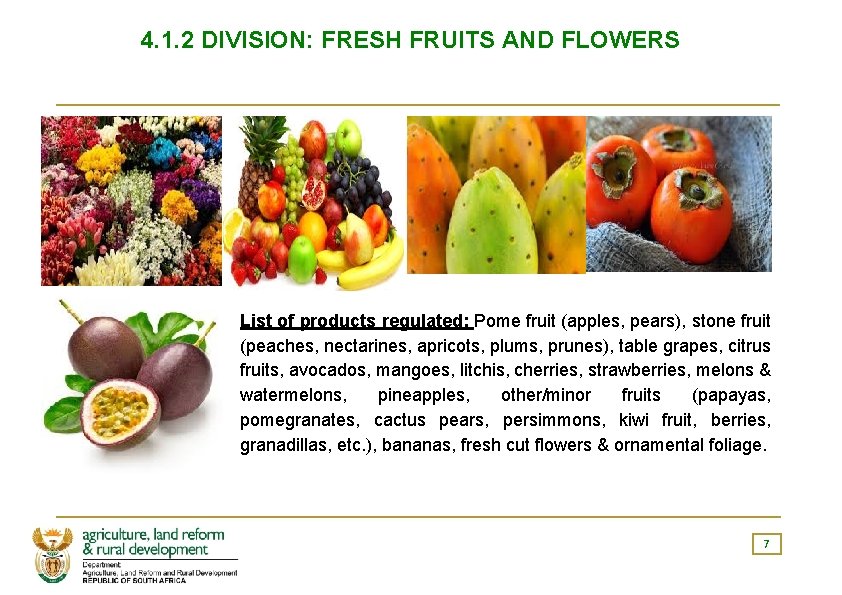
4. 1. 2 DIVISION: FRESH FRUITS AND FLOWERS List of products regulated: Pome fruit (apples, pears), stone fruit (peaches, nectarines, apricots, plums, prunes), table grapes, citrus fruits, avocados, mangoes, litchis, cherries, strawberries, melons & watermelons, pineapples, other/minor fruits (papayas, pomegranates, cactus pears, persimmons, kiwi fruit, berries, granadillas, etc. ), bananas, fresh cut flowers & ornamental foliage. 7
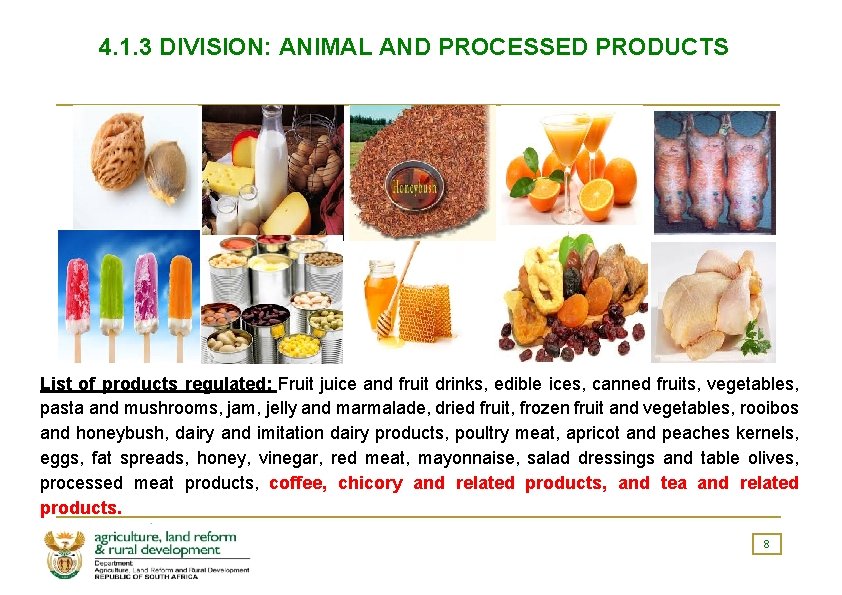
4. 1. 3 DIVISION: ANIMAL AND PROCESSED PRODUCTS List of products regulated: Fruit juice and fruit drinks, edible ices, canned fruits, vegetables, pasta and mushrooms, jam, jelly and marmalade, dried fruit, frozen fruit and vegetables, rooibos and honeybush, dairy and imitation dairy products, poultry meat, apricot and peaches kernels, eggs, fat spreads, honey, vinegar, red meat, mayonnaise, salad dressings and table olives, processed meat products, coffee, chicory and related products, and tea and related products. 8
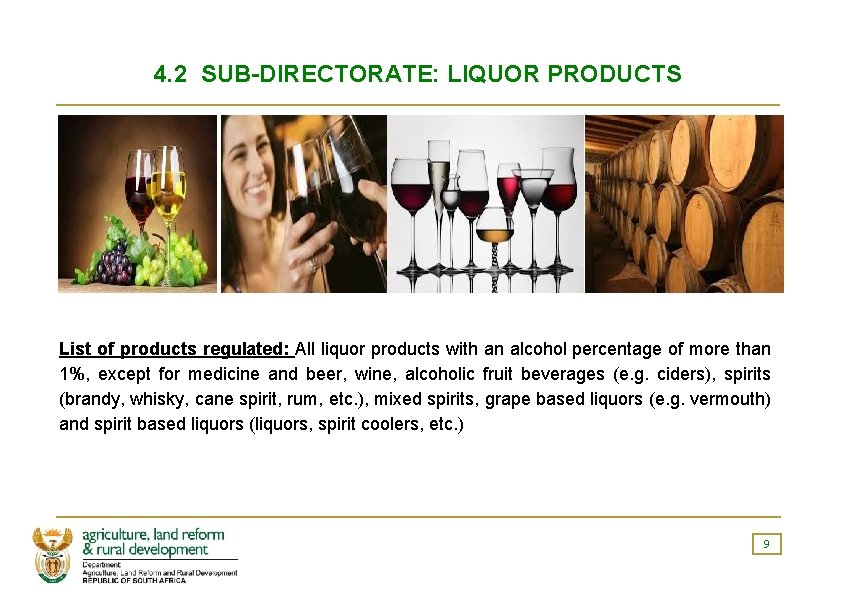
4. 2 SUB-DIRECTORATE: LIQUOR PRODUCTS List of products regulated: All liquor products with an alcohol percentage of more than 1%, except for medicine and beer, wine, alcoholic fruit beverages (e. g. ciders), spirits (brandy, whisky, cane spirit, rum, etc. ), mixed spirits, grape based liquors (e. g. vermouth) and spirit based liquors (liquors, spirit coolers, etc. ) 9
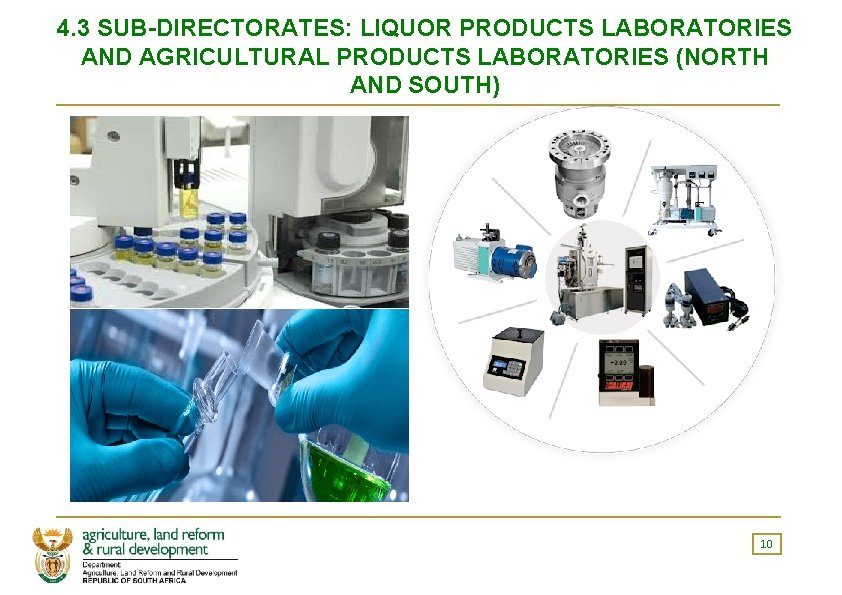
4. 3 SUB-DIRECTORATES: LIQUOR PRODUCTS LABORATORIES AND AGRICULTURAL PRODUCTS LABORATORIES (NORTH AND SOUTH) 10
5. GAZETTING OF NORMS, REGULATIONS AND EXPORT STANDARDS • Norms, regulations and standards are validated by publication in the government gazette under APS Act, 1990. • Based on specific needs of the SA market. • Harmonized with international standards such as: -The Organization for Economic Co operation and Development (OECD); The Codex Alimentarius Commission (CODEX); and United Nations Economic Commission for Europe (UN/ECE). 11
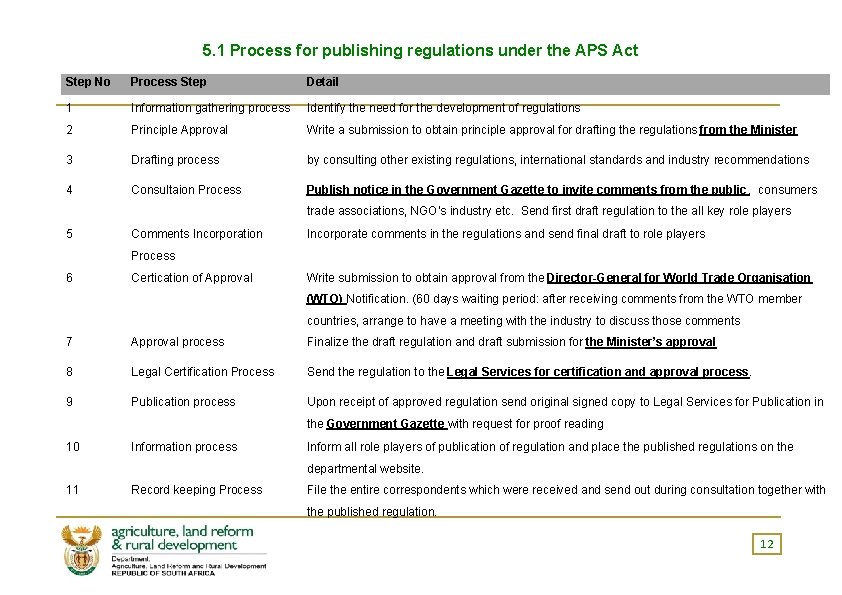
5. 1 Process for publishing regulations under the APS Act Step No Process Step Detail 1 Information gathering process Identify the need for the development of regulations 2 Principle Approval Write a submission to obtain principle approval for drafting the regulations from the Minister 3 Drafting process by consulting other existing regulations, international standards and industry recommendations 4 Consultaion Process Publish notice in the Government Gazette to invite comments from the public, consumers trade associations, NGO’s industry etc. Send first draft regulation to the all key role players 5 Comments Incorporation Incorporate comments in the regulations and send final draft to role players Process 6 Certication of Approval Write submission to obtain approval from the Director-General for World Trade Organisation (WTO) Notification. (60 days waiting period: after receiving comments from the WTO member countries, arrange to have a meeting with the industry to discuss those comments 7 Approval process Finalize the draft regulation and draft submission for the Minister’s approval 8 Legal Certification Process Send the regulation to the Legal Services for certification and approval process. 9 Publication process Upon receipt of approved regulation send original signed copy to Legal Services for Publication in the Government Gazette with request for proof reading 10 Information process Inform all role players of publication of regulation and place the published regulations on the departmental website. 11 Record keeping Process File the entire correspondents which were received and send out during consultation together with the published regulation. 12
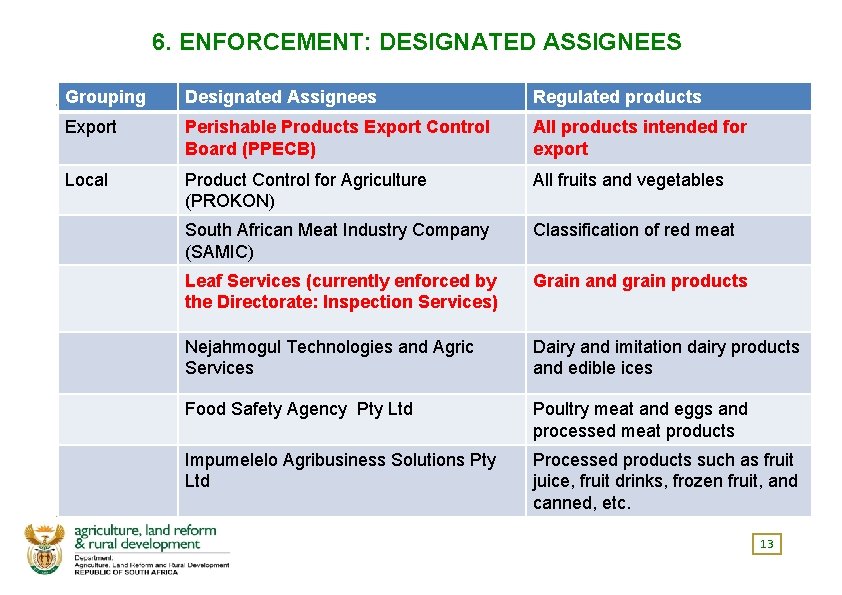
6. ENFORCEMENT: DESIGNATED ASSIGNEES Grouping Designated Assignees Regulated products Export Perishable Products Export Control Board (PPECB) All products intended for export Local Product Control for Agriculture (PROKON) All fruits and vegetables South African Meat Industry Company (SAMIC) Classification of red meat Leaf Services (currently enforced by the Directorate: Inspection Services) Grain and grain products Nejahmogul Technologies and Agric Services Dairy and imitation dairy products and edible ices Food Safety Agency Pty Ltd Poultry meat and eggs and processed meat products Impumelelo Agribusiness Solutions Pty Ltd Processed products such as fruit juice, fruit drinks, frozen fruit, and canned, etc. 13
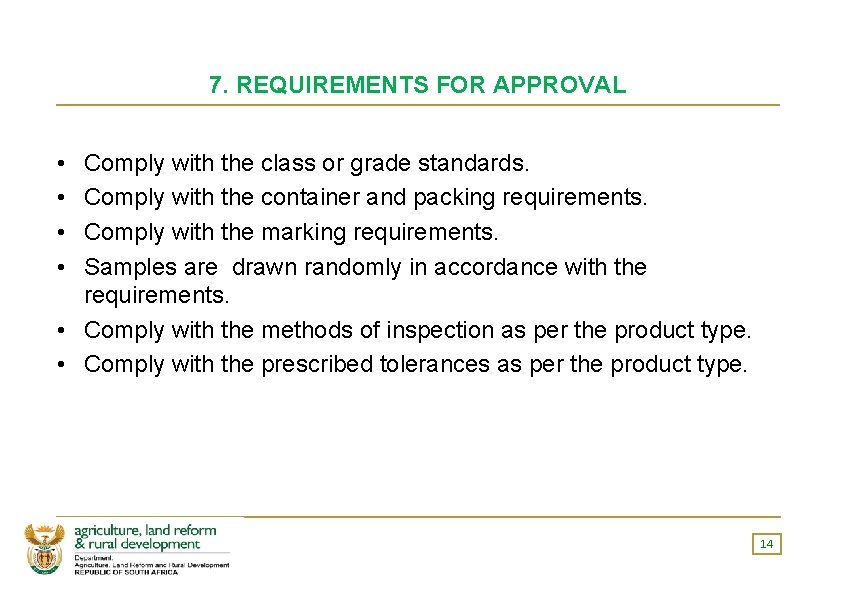
7. REQUIREMENTS FOR APPROVAL • • Comply with the class or grade standards. Comply with the container and packing requirements. Comply with the marking requirements. Samples are drawn randomly in accordance with the requirements. • Comply with the methods of inspection as per the product type. • Comply with the prescribed tolerances as per the product type. 14
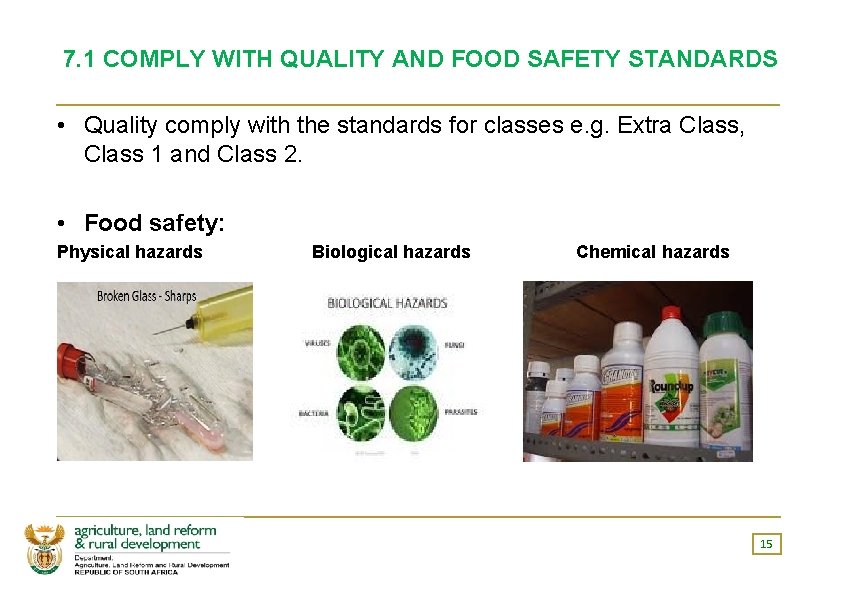
7. 1 COMPLY WITH QUALITY AND FOOD SAFETY STANDARDS • Quality comply with the standards for classes e. g. Extra Class, Class 1 and Class 2. • Food safety: Physical hazards Biological hazards Chemical hazards 15
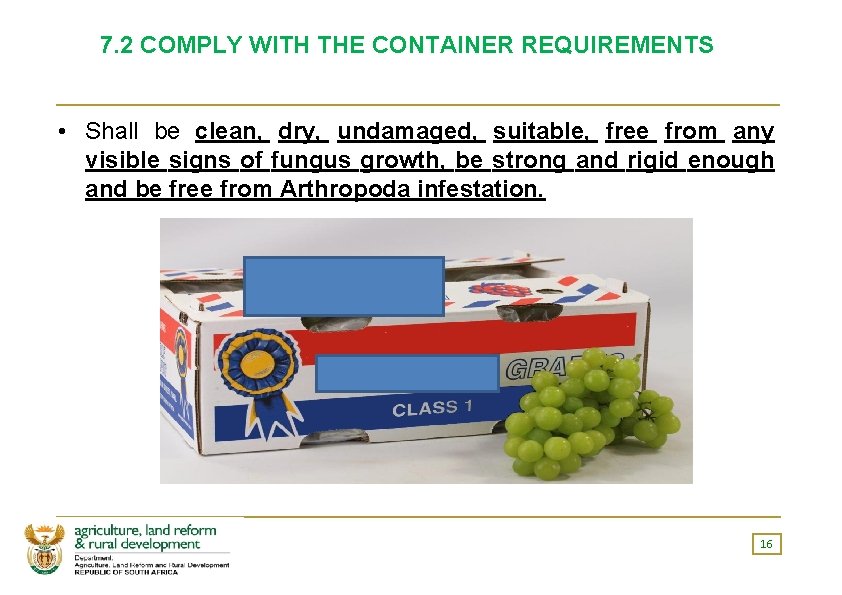
7. 2 COMPLY WITH THE CONTAINER REQUIREMENTS • Shall be clean, dry, undamaged, suitable, free from any visible signs of fungus growth, be strong and rigid enough and be free from Arthropoda infestation. 16
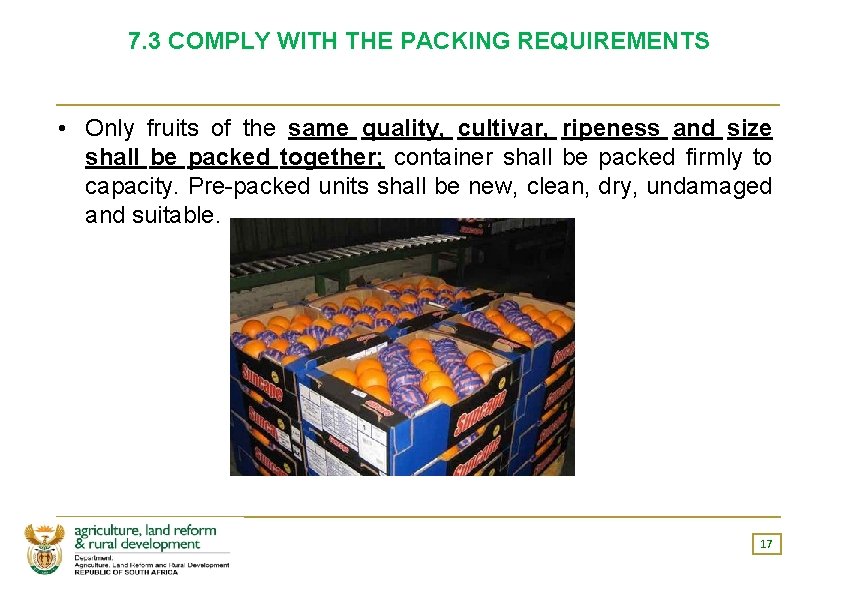
7. 3 COMPLY WITH THE PACKING REQUIREMENTS • Only fruits of the same quality, cultivar, ripeness and size shall be packed together; container shall be packed firmly to capacity. Pre packed units shall be new, clean, dry, undamaged and suitable. 17
7. 4 COMPLY WITH THE TRACEABILITY REQUIREMENTS • Traceability “is the ability to trace and follow a food product through all stages of production, packing, processing, packaging, handling and distribution. • SANS 22005: 2009 Traceability in the food and feed chain. General principles and basic requirements for system design and implementation • GS 1 standards – barcodes • Department of Health Policy Guidelines: National Food Safety Alerts And Official Food Product Recalls in South Africa • PUC /PHC Codes • Name and Address • Pallet Identification 18
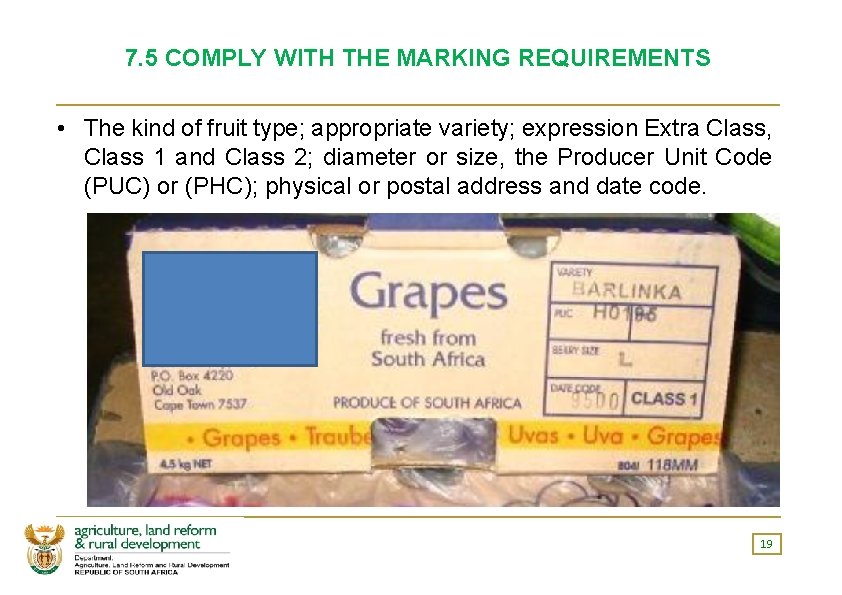
7. 5 COMPLY WITH THE MARKING REQUIREMENTS • The kind of fruit type; appropriate variety; expression Extra Class, Class 1 and Class 2; diameter or size, the Producer Unit Code (PUC) or (PHC); physical or postal address and date code. 19
7. 6 COMPLY WITH THE SAMPLING REQUIREMENTS Obtaining a sample of the consignment For the purpose of inspection, grading and sampling for quality control, an inspector shall take such samples of a product, material, substance or other article in question as he or she may deem necessary. 20
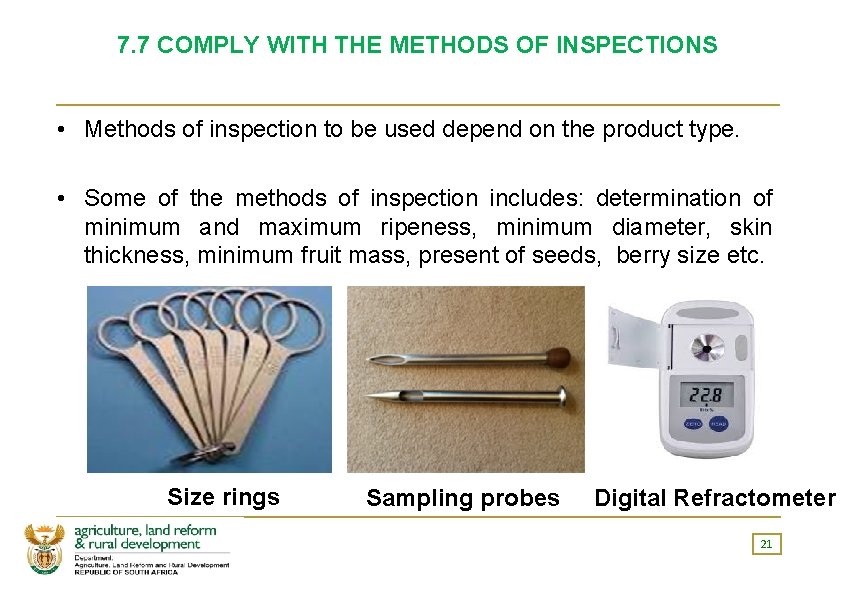
7. 7 COMPLY WITH THE METHODS OF INSPECTIONS • Methods of inspection to be used depend on the product type. • Some of the methods of inspection includes: determination of minimum and maximum ripeness, minimum diameter, skin thickness, minimum fruit mass, present of seeds, berry size etc. Size rings Sampling probes Digital Refractometer 21
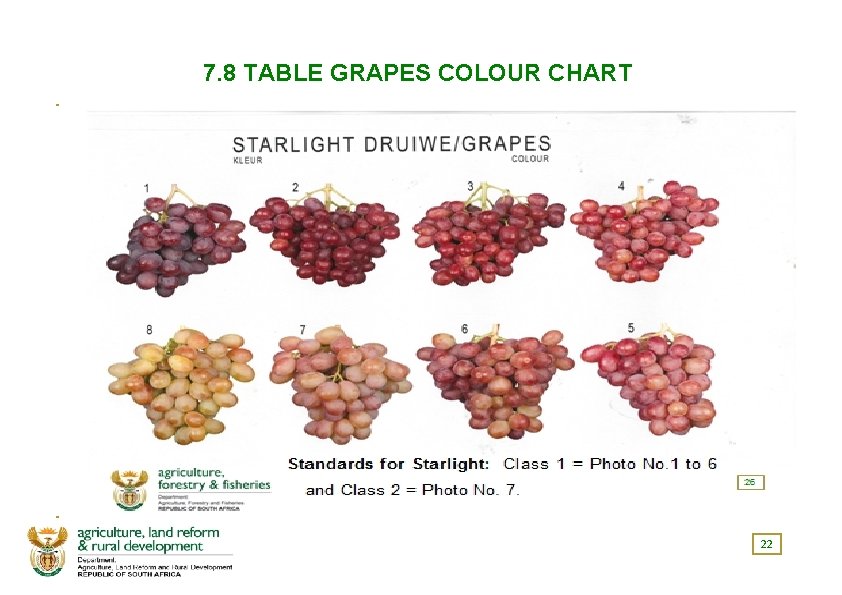
7. 8 TABLE GRAPES COLOUR CHART 22
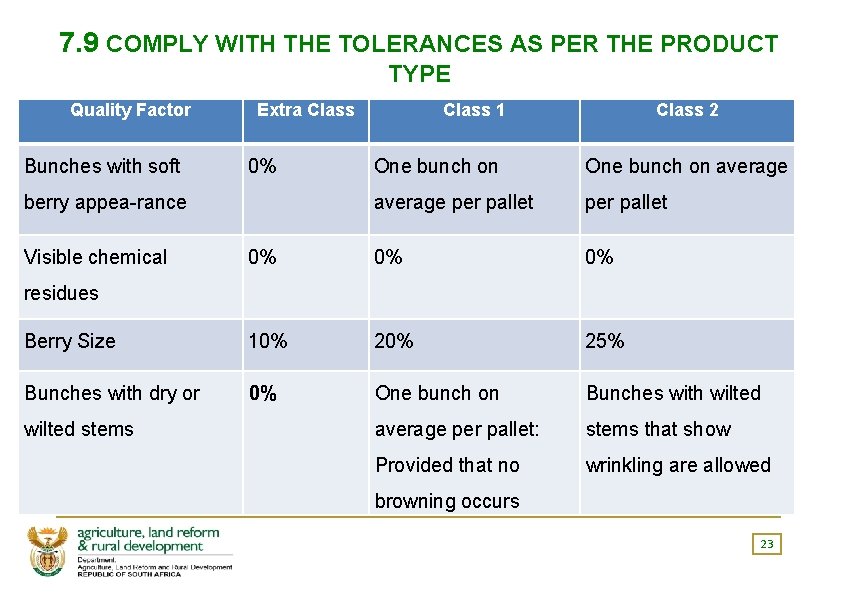
7. 9 COMPLY WITH THE TOLERANCES AS PER THE PRODUCT TYPE Quality Factor Bunches with soft Extra Class 0% Class 1 Class 2 One bunch on average per pallet 0% 0% 0% Berry Size 10% 25% Bunches with dry or 0% One bunch on Bunches with wilted average per pallet: stems that show Provided that no wrinkling are allowed berry appea rance Visible chemical residues wilted stems browning occurs 23
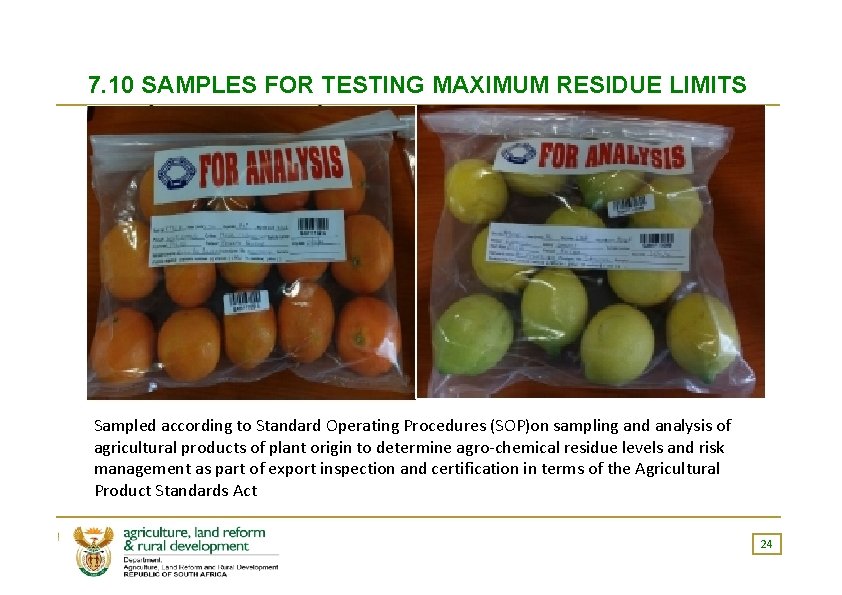
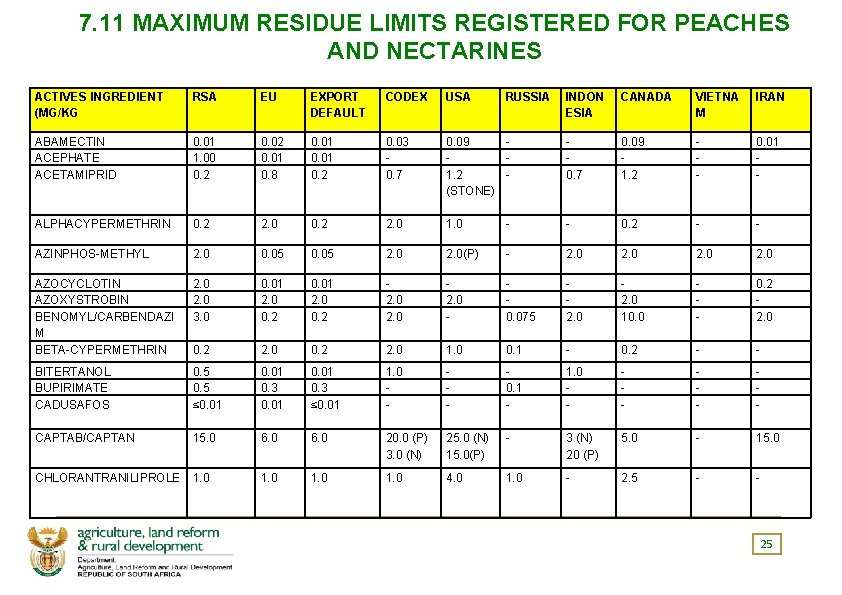
7. 10 SAMPLES FOR TESTING MAXIMUM RESIDUE LIMITS Sampled according to Standard Operating Procedures (SOP)on sampling and analysis of agricultural products of plant origin to determine agro-chemical residue levels and risk management as part of export inspection and certification in terms of the Agricultural Product Standards Act 24
7. 11 MAXIMUM RESIDUE LIMITS REGISTERED FOR PEACHES AND NECTARINES ACTIVES INGREDIENT (MG/KG RSA EU EXPORT DEFAULT CODEX USA ABAMECTIN ACEPHATE ACETAMIPRID 0. 01 1. 00 0. 2 0. 01 0. 8 0. 01 0. 2 0. 03 0. 7 ALPHACYPERMETHRIN 0. 2 2. 0 0. 2 AZINPHOS METHYL 2. 0 0. 05 AZOCYCLOTIN AZOXYSTROBIN BENOMYL/CARBENDAZI M BETA CYPERMETHRIN 2. 0 3. 0 RUSSIA INDON ESIA CANADA VIETNA M IRAN 0. 09 1. 2 (STONE) 0. 7 0. 09 1. 2 0. 01 2. 0 1. 0 0. 2 0. 05 2. 0(P) 2. 0 0. 01 2. 0 0. 2 2. 0 0. 075 2. 0 10. 0 0. 2 2. 0 0. 2 2. 0 1. 0 0. 1 0. 2 BITERTANOL BUPIRIMATE CADUSAFOS 0. 5 ≤ 0. 01 0. 3 ≤ 0. 01 1. 0 0. 1 1. 0 CAPTAB/CAPTAN 15. 0 6. 0 20. 0 (P) 3. 0 (N) 25. 0 (N) 15. 0(P) 3 (N) 20 (P) 5. 0 15. 0 CHLORANTRANILIPROLE 1. 0 4. 0 1. 0 2. 5 25
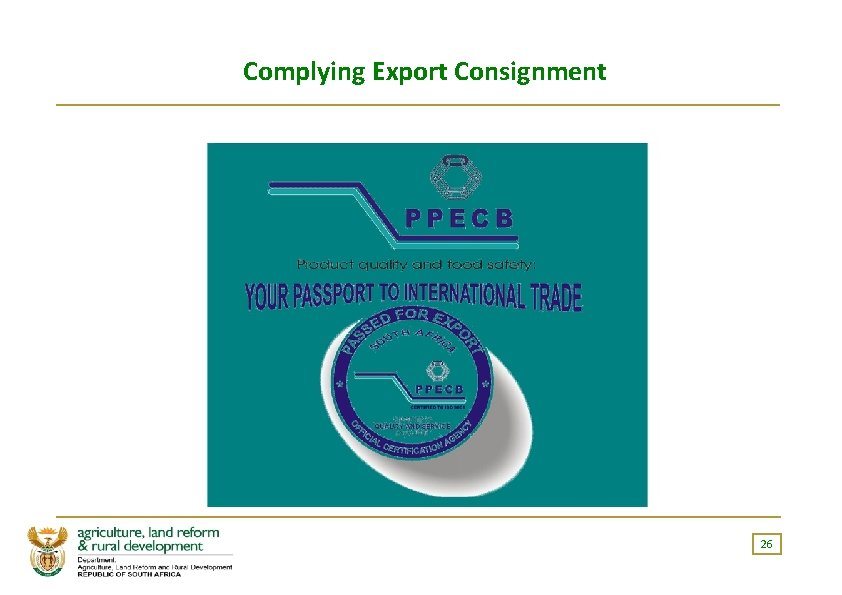
Complying Export Consignment 26
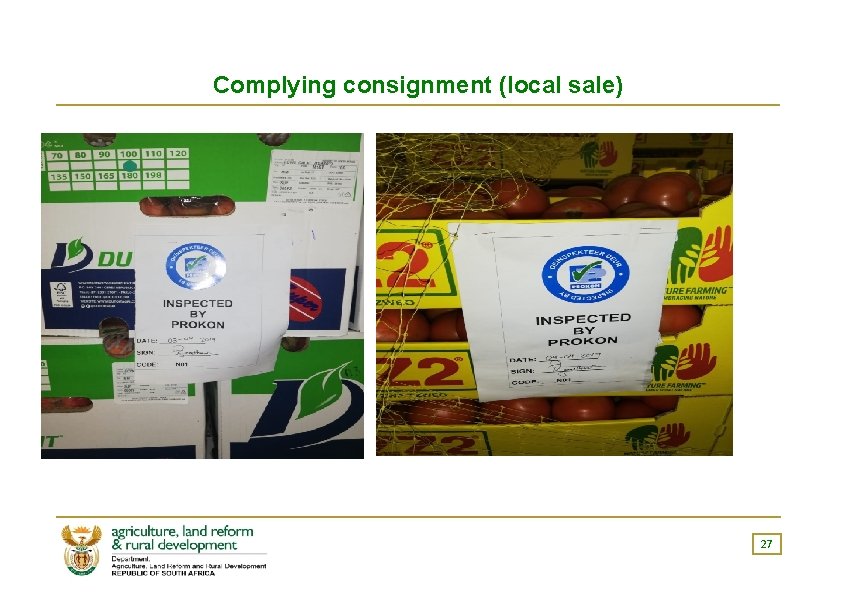
Complying consignment (local sale) 27
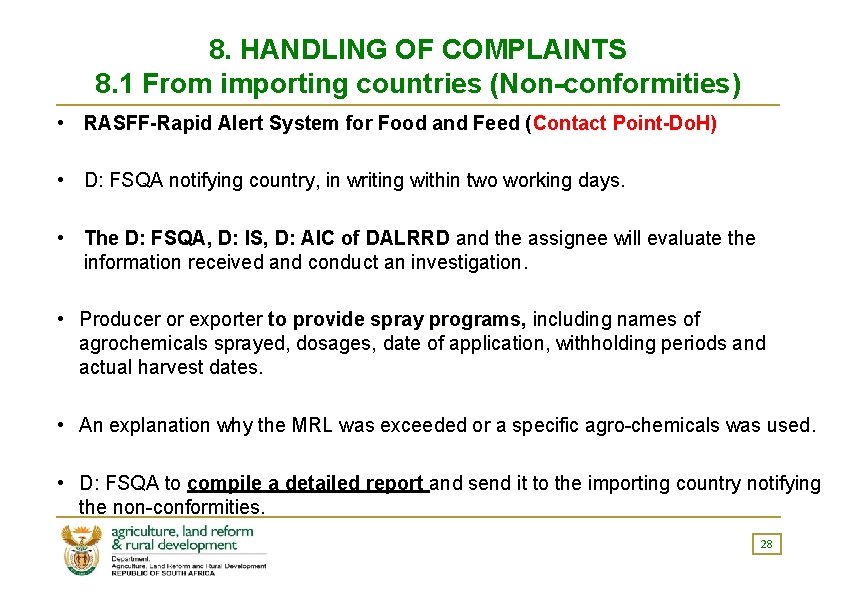
8. HANDLING OF COMPLAINTS 8. 1 From importing countries (Non-conformities) • RASFF-Rapid Alert System for Food and Feed (Contact Point-Do. H) • D: FSQA notifying country, in writing within two working days. • The D: FSQA, D: IS, D: AIC of DALRRD and the assignee will evaluate the information received and conduct an investigation. • Producer or exporter to provide spray programs, including names of agrochemicals sprayed, dosages, date of application, withholding periods and actual harvest dates. • An explanation why the MRL was exceeded or a specific agro chemicals was used. • D: FSQA to compile a detailed report and send it to the importing country notifying the non conformities. 28
8. 2 Local Non-conformities Designated Assignees • Issuing of a direction • Seizure 29
9. Benefits of regulating and inspection of agricultural products • Competing on an equal footing with other agricultural products from other countries. • Facilitate market access. • Provide the consumer with products of consistent quality and food safety compliance. • Job creation and increase foreign exchange. • Contribute to local food control. 30
Contact details: Dr Mbulaheni Thomas Mutengwe Tel No. +27 12 319 6121 Fax No. +27 12 319 6055 E-mail: Mbulaheni. M@dalrrd. gov. za. Website address: www. dalrrd. gov. za. 31
THANK YOU!