
Overview on Modernizing EIBenefits Delivery Modernization e Payroll
Overview on Modernizing EI…Benefits Delivery Modernization, e. Payroll and Hosted Contact Centre Solution Employer Forum November 1, 2018
Today, we will discuss… Purpose To provide an overview of the Benefits Delivery Modernization (BDM) Programme and updates on e. Payroll and Hosted Contact Centre Solution (HCCS). Content • BDM Strategic Context • Drivers for transforming ESDC’s benefits delivery model • The BDM Programme is how ESDC is building the foundation for modernizing social programmes • BDM will deliver many core capabilities, and consume other capabilities where they are available and meet BDM needs • BDM has learned lessons from other large-scale transformation projects • The BDM implementation strategy is phased, with no big bang projects • e. Payroll Update & Next Steps • HCCS Update & Next Steps 2
BDM Context Social programmes sustain our society, but the business rules to deliver them are complex • Social programmes support the most vulnerable Canadians by providing much needed income security; as a result social programmes are also highly visible and important. • ESDC, through its statutory income security programmes (i. e. EI, CPP and OAS) , provides more than $100 billion in benefits annually to support approximately eight million Canadians at all stages of their lives. This represent 6% of Canada’s GDP. • These programmes have evolved over a 50 year period resulting in a set of benefits governed by extremely complex legislation, regulations and policies. • Along with ESDC’s delivery networks, a broad range of partners (FPT) and organizations (e. g. employers, NGOs, insurance companies) interact with us to support benefits delivery every day. • All of this has resulted in business process, service delivery, and technology complexities. 3
There a number of drivers for why we need to transform ESDC’s benefits delivery model Since 2001, ESDC has implemented a series of tactical service improvements and efficiency initiatives to improve how income security programmes are delivered. Nevertheless, there a number of reasons why more substantive transformation is imperative: • Missing the mark on client experience*. Despite best efforts, we have an increasingly constrained ability to serve our clients the way they expect. For example, clients must provide the same information multiple times; it is difficult to understand their history of interactions; they are “new” to us every time they apply for a benefit. • Employers & Businesses: electronic ROE, Employer Contact Centre implementation and legislative changes (e. g. Reg. 19. 3 which amended deadlines for employers issuing electronic ROEs) have resulted in some efficiencies, however the underlying legislative reporting requirements remain complex and the ROE has been reported to be the number one source of burden for employers. • Staff are not equipped with modern processes, tools and technologies. Staff use multiple systems to serve a client or employer, bridge gaps inherent with current legacy systems through manual work-arounds, and may need multiple hand-offs to resolve an issue. • Risk of “rust‑out”**. Our core statutory programmes run on a large number of custom‑built business applications, siloed processes and aged legacy systems. Some applications are duplicative, some are more than 50 years old, and there is a high risk of technology “rust‑out”. • Limited agility and flexibility. The introduction of policy changes and incremental improvements is cumbersome, time consuming, and costly. Significant manual interventions are required to address overlays of policy changes and technology limitations. * Sources, e. g. : Service Quality Review, 2016, & OAG Report on Canada Pension Plan Disability Program, 2015 ** Source: 2010 Report of the Auditor General (Chapter 3) 4
The BDM Programme is how ESDC will build the foundation for modernized delivery of complex social programmes The BDM Programme will: ü Improve service experience for clients: o o o ü Reduce program reporting burden for clients and employers o o o ü Risk-based processing capability for benefits processing Integrity and quality by design Flexible/adjustable risk thresholds to address business continuity and fluctuating intake/inventories Integrated data set and single source of truth balanced with security and privacy Enable faster implementation of policy changes o ü Bundling of services (e. g. single registration for multiple services across ESDC and potentially OGD’s) Continue to champion for policy simplification to improve service, reduce reporting burden and enable e. Payroll Analyze the optimal sequencing and timelines to leverage a real-time source of earnings, HR and demographic data to administer EI and pensions, once implemented Introduce new operational capabilities: o o ü Use data to reduce wait times, streamline applications, and improve programme quality and integrity Enable a better understanding of clients via a digital, 360 degree view of their information and interactions Enable staff with modern processes, tools and technologies to better serve clients Changes can be implemented quicker due to limited customization, scenario-testing through analytic tools to assess impacts of policy changes and ability to adjust business rules independently and quickly. Reduce the risk of critical IT failure o Replace a suite of aging systems with modern, integrated capabilities across intake, processing and payments 5
BDM will deliver many core capabilities, and consume other capabilities where they are available and meet BDM needs Specifically, BDM will procure core capabilities for common benefits processing: • • • Client Relationship Management Benefits Case Management Workflow/Workload Management Business Rules Management Risk Analytics We need to confirm that other GC capabilities will be available when required and meet BDM needs: • • Client/Partner interaction solutions (including portal) Interoperability platform (departmental and GC bus) Additional capabilities will either be consumed or procured by ESDC to meet BDM requirements: • • • Identity, Credentials and Access Management Additional Channel services New or existing ESDC Enterprise Solutions (e. g. payment management, correspondence) Analytics solutions Data management Cloud-based infrastructure 6
BDM has learned lessons from other large-scale transformation projects Business Led • Balance enterprise with mandate requirements • Use modern, agile technologies • Properly define scope boundaries to define where change needs to occur, in order to achieve BDM objectives across multiple dimensions (People, Process, Service, Technology, Policy & Legislation). • Business Owners responsible for business change management Clients and Employees Co-Design • Treat change management as a priority (e. g. prepare employees and clients for process, policy and technology changes) • Engage end users and clients in the design process to ensure government is delivering what they want and need Phased deployment • Deadlines need to be realistic • Run new capabilities in parallel with legacy applications; support a roll-back strategy Agile Procurement • More flexibility with a collaborative multi-vendor (ecosystem) approach (no single vendor reliance) • Vendor must “show” as well as “tell” before locking in solutions. Industry Co-development • Better stakeholder engagement through Jurisdictional Research and panel discussions, Industry Day (e. g. Sept 2016 and April 2018), and partnering with industry to prototype, design and build solutions Future Proofing • Design for scale and replication • Build a modular architecture and balance innovation and risk • Incorporate new technologies and methods as they evolve and can make a business impact (new types of analytics, artificial intelligence, blockchain and others yet to be thought of) Program Management Model • Ensure strong governance and oversight • Alignment on priorities (e. g. GC Service Strategy, One. GC) • Partner with private sector (e. g. BDM Transformation Program Office) 7
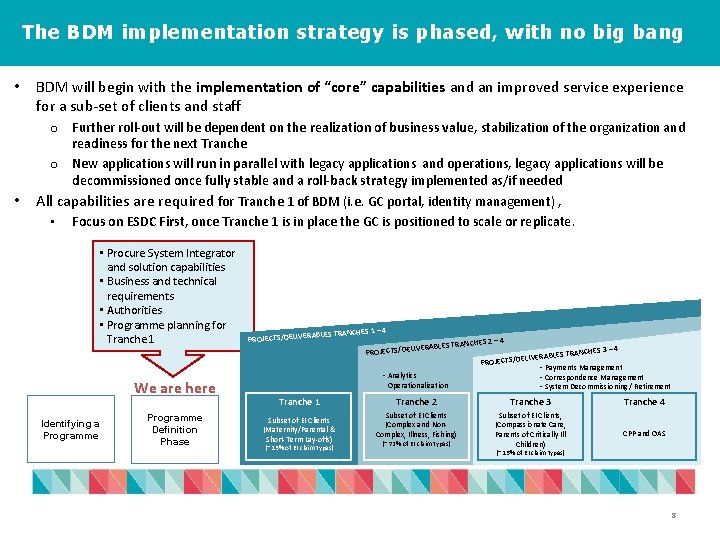
The BDM implementation strategy is phased, with no big bang • • BDM will begin with the implementation of “core” capabilities and an improved service experience for a sub-set of clients and staff o Further roll-out will be dependent on the realization of business value, stabilization of the organization and readiness for the next Tranche o New applications will run in parallel with legacy applications and operations, legacy applications will be decommissioned once fully stable and a roll-back strategy implemented as/if needed All capabilities are required for Tranche 1 of BDM (i. e. GC portal, identity management) , • Focus on ESDC First, once Tranche 1 is in place the GC is positioned to scale or replicate. • Procure System Integrator and solution capabilities • Business and technical requirements • Authorities • Programme planning for Tranche 1 We are here Identifying a Programme Definition Phase anches 1 – 4 iverables Tr Projects/Del RABLES TRANCHES PROJECTS/DELIVE 1– 4 • Analytics Operationalization Tranche 1 Subset of EI Clients (Maternity/Parental & Short-Term Lay-offs) (~ 13% of EI claim types) ANCHES 2 – 4 LIVERABLES TR PROJECTS/DE ELIV PROJECTS/D 4 ANCHES 3 – ERABLES TR • Payments Management • Correspondence Management • System Decommissioning / Retirement Tranche 2 Tranche 3 Subset of EI Clients (Complex and Non. Complex, Illness, Fishing) Subset of EI Clients, (Compassionate Care, Parents of Critically Ill Children) (~ 72% of EI claim types) Tranche 4 CPP and OAS (~ 15% of EI claim types) 8
e. Payroll Update Key activities (since the last Employer Forum): ü With the support of the EI commissioners for employers and workers, ESDC concluded a series of co-design sessions in June 2018 (to advance the e. Payroll concept) with representatives from the employer, labour and payroll community. Achievements: ü Confirmed that with policy changes, natural earnings, HR and demographic data provided directly by businesses could be used to administer the EI program, reducing burden for employers, clients, and the government; ü Co-designed a preliminary Service Model (for EI first) and preliminary prototypes; and ü Demonstrated the value proposition of e. Payroll and increased interest and support for e. Payroll among stakeholders and OGDs including Stats Can and CRA. 9
e. Payroll Next steps Strategic considerations for long-term success: ü Since the co-design activities began, in June 2017, the Government of Canada’s digital landscape has continued to evolve: o A new Minister of Digital Government has been appointed. o Government messaging of digital services continues to grow stronger. o Emerging role of Canadian Digital Services to accelerate digital change. o Department and Agencies beginning to align their efforts to the Government’s digital vision (i. e. One. GC). ü Engaging Central Agencies: o Timing is right to engage Finance Canada, the Treasury Board Secretariat and the Privy Council Office for discussions to position e. Payroll for long term success (i. e. , who should lead e. Payroll? ) o This includes engaging other partners such as the Canada Revenue Agency, Statistics Canada, and Innovation, Science, and Economic Development to further strengthen value proposition ü ESDC and BDM: o Advancing BDM to set the foundation to transform service delivery for the EI, CPP, and OAS. o Determine timelines and sequencing for BDM to consume e. Payroll services and the data, (namely real-time information) needed to administer EI and pensions 10
HCCS Update and Next Steps Background: ü HCCS will improve service delivery by replacing an outdated, end-of life telephony platform with a modern solution, that will offer new functionalities that ESDC can leverage to enhance the customer experience and support the department’s service delivery modernization agenda. ü The first wave of HCCS migrations consists of eight contact centres from three Departments: Shared Services Canada (SSC), Canada Revenue Agency (CRA), and ESDC. Engagement: ü ESDC met with employers at the Federal Government Relations Advisory Council (FGRAC) in April to provide an overview of HCCS. ü In June 2018, ESDC delivered multiple presentations to the Canadian Payroll Association (CPA) as part of the 36 th Annual Conference and Trade Show in Ottawa. ü Employers were engaged as part of moderated and unmoderated usability testing for the new Interactive Voice Response system design as part of HCCS. Achievements: ü There have been three migrations so far: SSC’s End User Service Desk (EUSD) on July 13 2018; ESDC’s National Service Desk (NSD) on August 17 2018; and ESDC’s Employer Contact Centre (ECC) on October 26. Next Steps: ü Continue planning, design, and service readiness activities for remaining ESDC specialized call centres including the EI Specialized Call Centre network. 11
- Slides: 11