
Overview on Methods on Quantitative Risk Management QMF

- Slides: 29
Overview on Methods on Quantitative Risk Management QMF 06, Sydney Gerhard Stahl, Ba. Fin Präsentationtitel | 15. 09. 2020 | Seite 1
Agenda 1. Market risk 2. Credit risk 3. Op. Risk 4. Banks and Insurances Präsentationtitel | 15. 09. 2020 | Seite 2
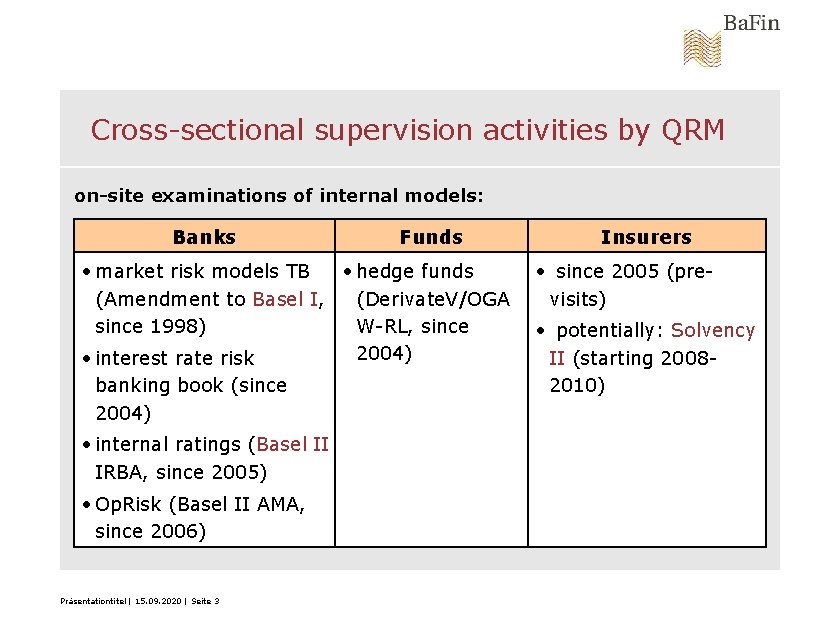
Cross-sectional supervision activities by QRM on-site examinations of internal models: Banks Funds • market risk models TB • hedge funds (Amendment to Basel I, (Derivate. V/OGA since 1998) W-RL, since 2004) • interest rate risk banking book (since 2004) • internal ratings (Basel II IRBA, since 2005) • Op. Risk (Basel II AMA, since 2006) Präsentationtitel | 15. 09. 2020 | Seite 3 Insurers • since 2005 (previsits) • potentially: Solvency II (starting 20082010)
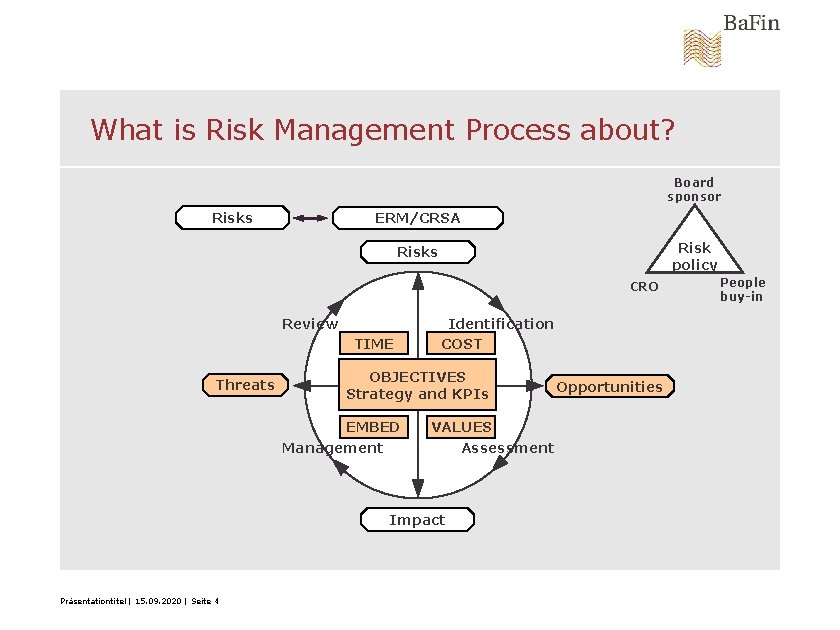
What is Risk Management Process about? Board sponsor Risks ERM/CRSA Risk policy Risks CRO Review TIME Threats Identification COST OBJECTIVES Strategy and KPIs EMBED Management VALUES Assessment Impact Präsentationtitel | 15. 09. 2020 | Seite 4 Opportunities People buy-in
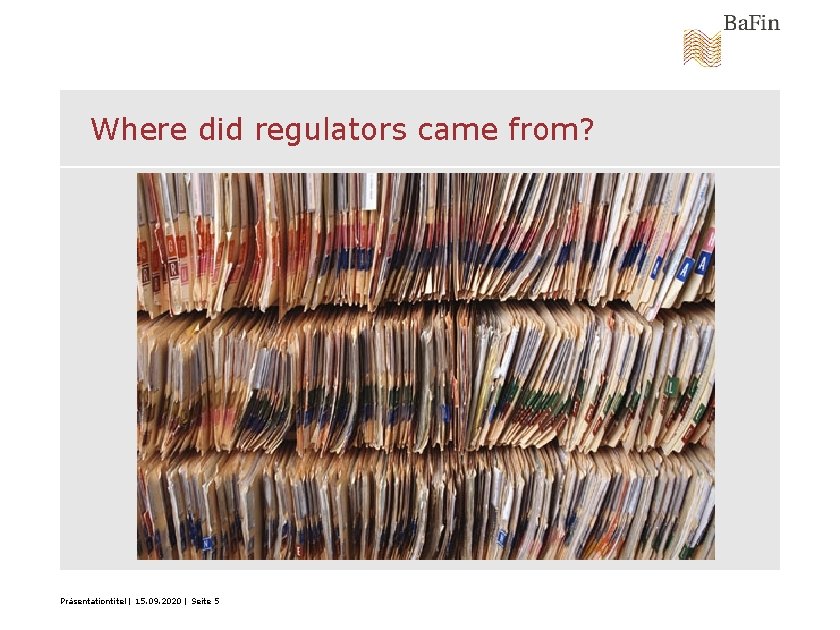
Where did regulators came from? Präsentationtitel | 15. 09. 2020 | Seite 5
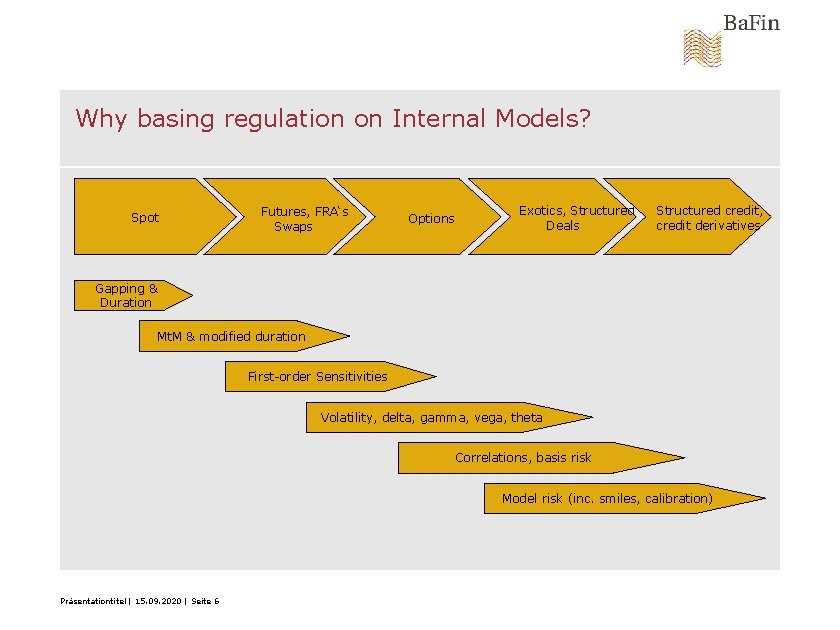
Why basing regulation on Internal Models? Spot Futures, FRA‘s Swaps Options Exotics, Structured Deals Structured credit, credit derivatives Gapping & Duration Mt. M & modified duration First-order Sensitivities Volatility, delta, gamma, vega, theta Correlations, basis risk Model risk (inc. smiles, calibration) Präsentationtitel | 15. 09. 2020 | Seite 6
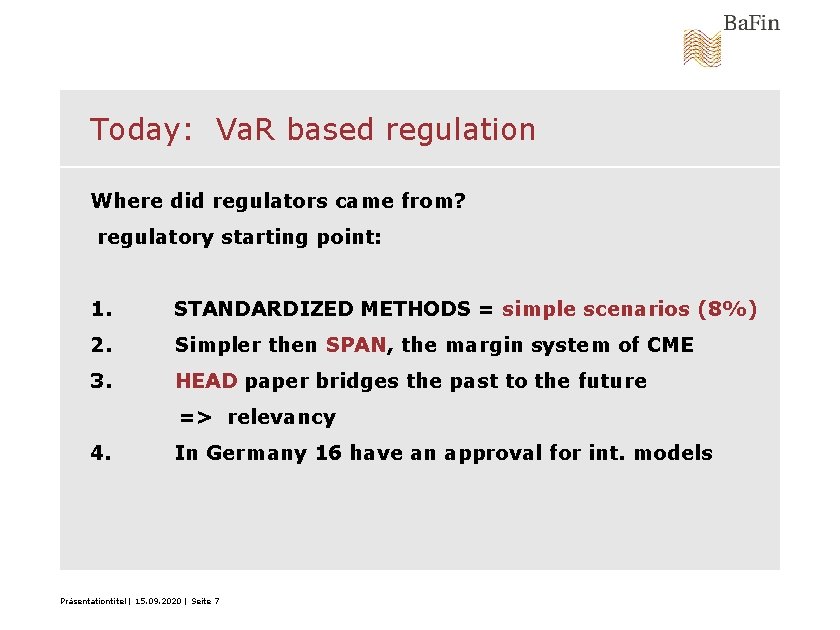
Today: Va. R based regulation Where did regulators came from? regulatory starting point: 1. STANDARDIZED METHODS = simple scenarios (8%) 2. Simpler then SPAN, the margin system of CME 3. HEAD paper bridges the past to the future => relevancy 4. In Germany 16 have an approval for int. models Präsentationtitel | 15. 09. 2020 | Seite 7
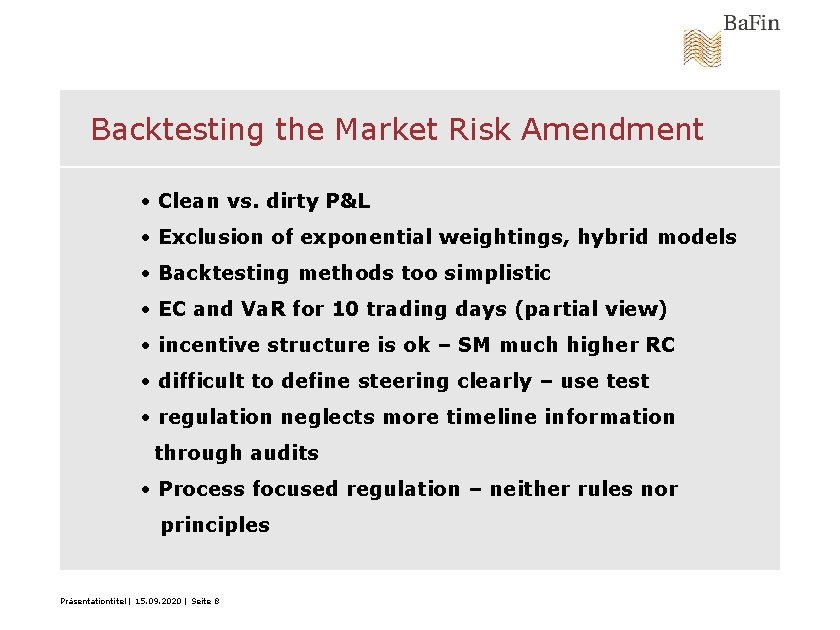
Backtesting the Market Risk Amendment • Clean vs. dirty P&L • Exclusion of exponential weightings, hybrid models • Backtesting methods too simplistic • EC and Va. R for 10 trading days (partial view) • incentive structure is ok – SM much higher RC • difficult to define steering clearly – use test • regulation neglects more timeline information through audits • Process focused regulation – neither rules nor principles Präsentationtitel | 15. 09. 2020 | Seite 8
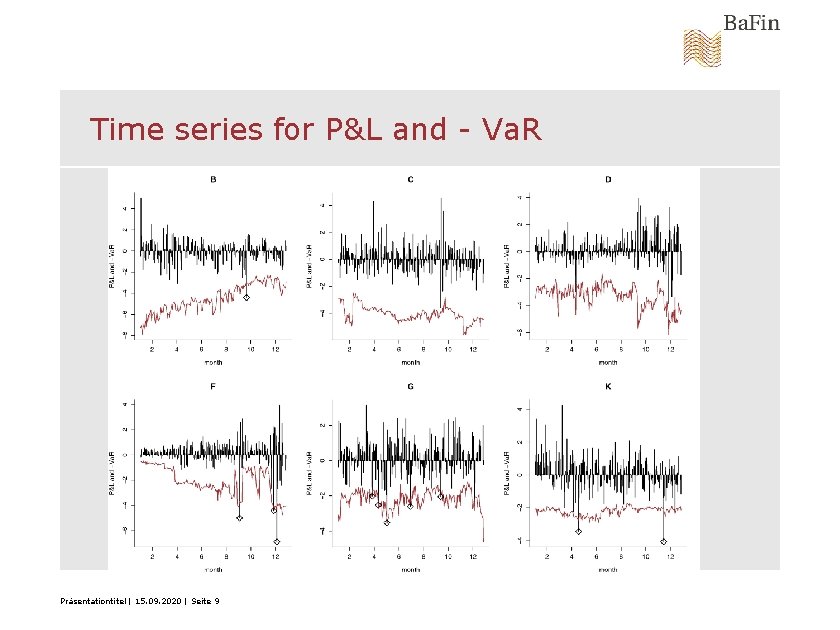
Time series for P&L and - Va. R Präsentationtitel | 15. 09. 2020 | Seite 9
Annotations to HEAD – what is a good risk measure? 1. SM are weakly coherent 2. Backtest-ability 3. Clear substantial meaning 4. Robustness 5. good scaling behavior (time, level of significance, portfolios, . . . ) - risk silos, different users 6. Valuation of assets is key (marked to market, marked to model, best estimate, …) There is no one size fits all measure of risk What is gained if instead of a PD an ES is determined? ? ? Präsentationtitel | 15. 09. 2020 | Seite 10
Which models are in place? 1. The Winner: Historical Simulation 2. Monte-Carlo-Simulation 3. Delta-Gamma Approaches (REAL TIME Va. R) Präsentationtitel | 15. 09. 2020 | Seite 11
Cont. 1. One period bottom-up models 2. Assumptions: 1. Square-root of time scaling 2. Aggregating silos by the assumption of uncorrelatedness 3. Mapping error, approximation error, estimation error, numerical errors 4. Market data of high quality 5. Marked-to-market (model) valuation 6. Often crude methods for pricing model errors 7. Stress tests depend on models Präsentationtitel | 15. 09. 2020 | Seite 12
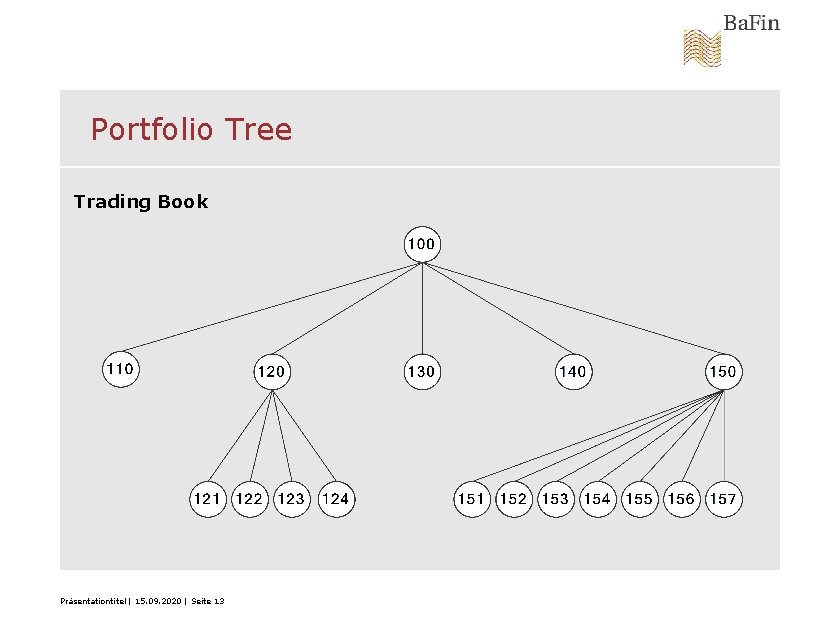
Portfolio Tree Trading Book Präsentationtitel | 15. 09. 2020 | Seite 13
Credit Risk • Credit risk is key for the business model of a universal bank • Hence, for core credit segments (retail, corporates, banks, …) rating models were established long before Basel II • Rating systems actually in place were not implemented from scratch • Typically, they are a hybrid models blending the existing ones with newer approaches (external data, KMV, Risk. Calc, statistical models) Präsentationtitel | 15. 09. 2020 | Seite 14
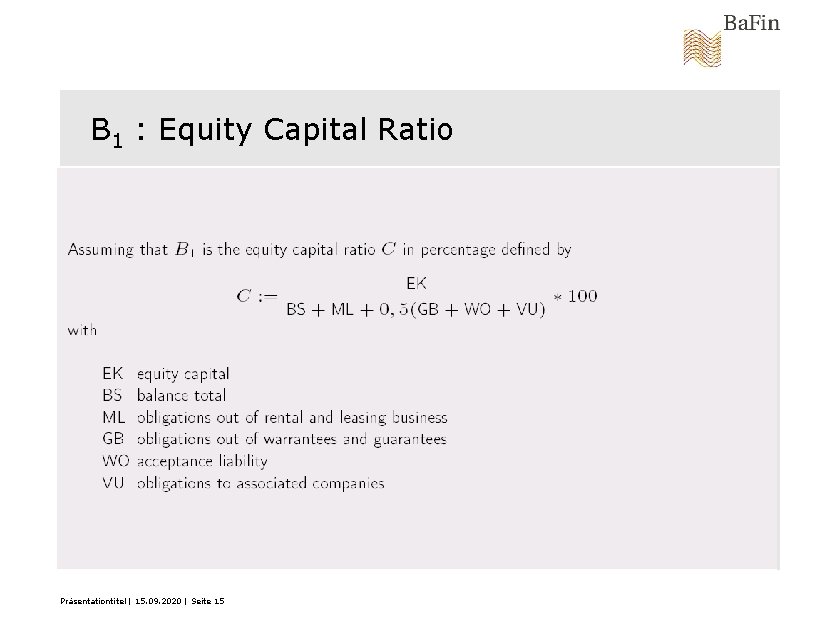
B 1 : Equity Capital Ratio Präsentationtitel | 15. 09. 2020 | Seite 15
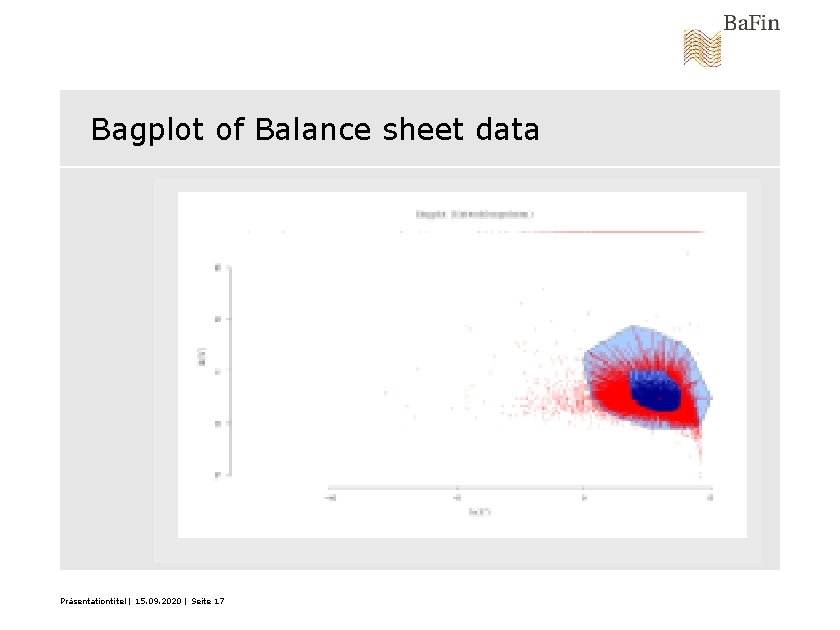
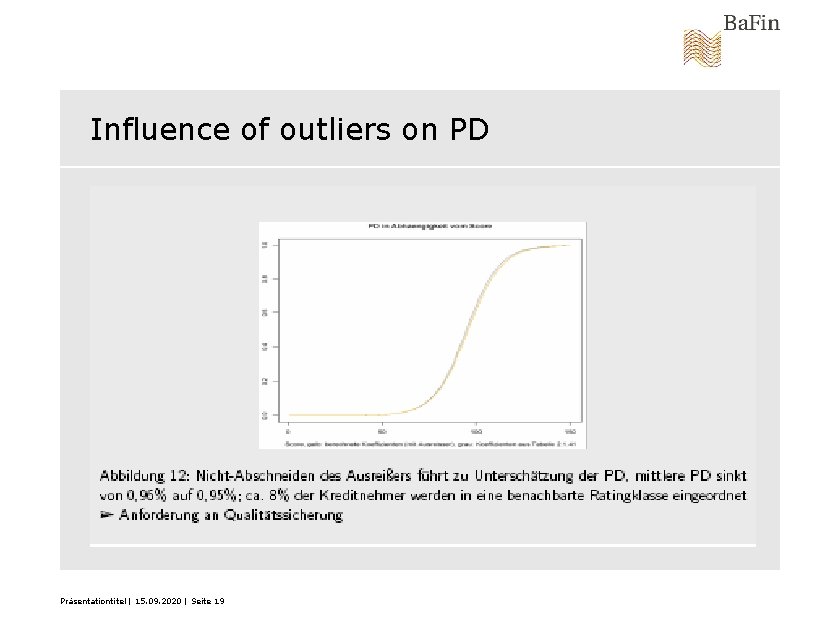
Data Quality poor data quality of ratios • ratios out of annual balance sheet are characterized by numerous and extreme outliers • in approx. 30% of all observations at least one ratio is outside of the 1% or 99% quantile • ratios of the qualitative section are in some cases significantly beyond the respective range • Only 20 -30% were complete an error free Präsentationtitel | 15. 09. 2020 | Seite 16
Bagplot of Balance sheet data Präsentationtitel | 15. 09. 2020 | Seite 17
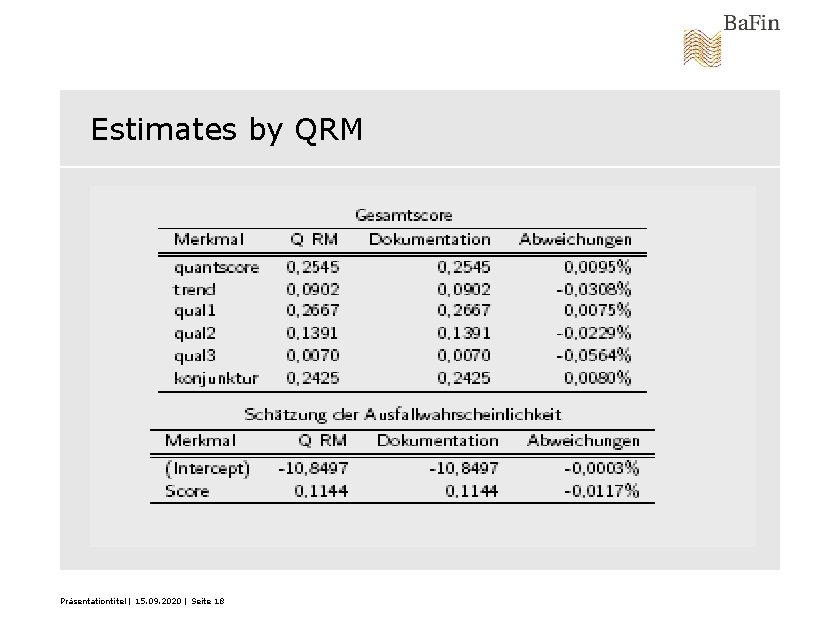
Estimates by QRM Präsentationtitel | 15. 09. 2020 | Seite 18
Influence of outliers on PD Präsentationtitel | 15. 09. 2020 | Seite 19
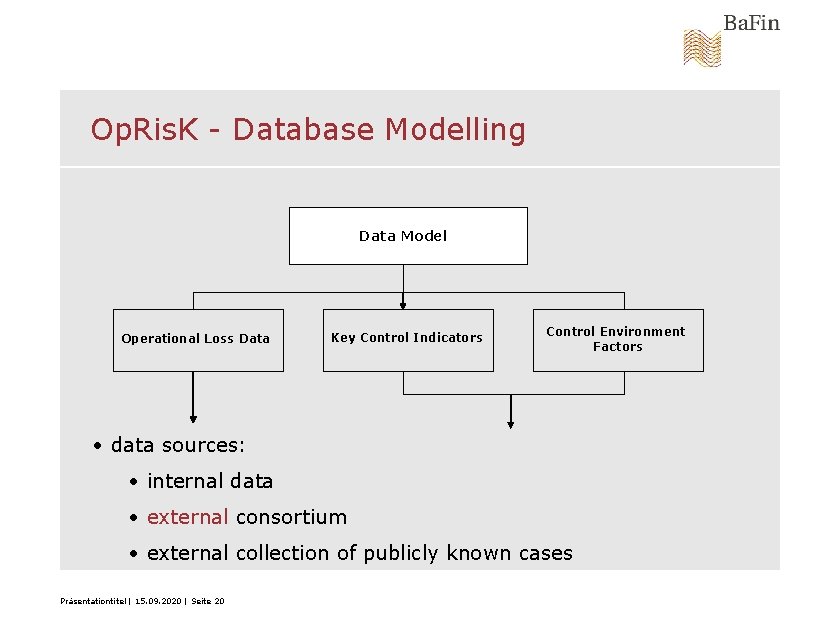
Op. Ris. K - Database Modelling Data Model Operational Loss Data Key Control Indicators Control Environment Factors • data sources: • internal data • external consortium • external collection of publicly known cases Präsentationtitel | 15. 09. 2020 | Seite 20
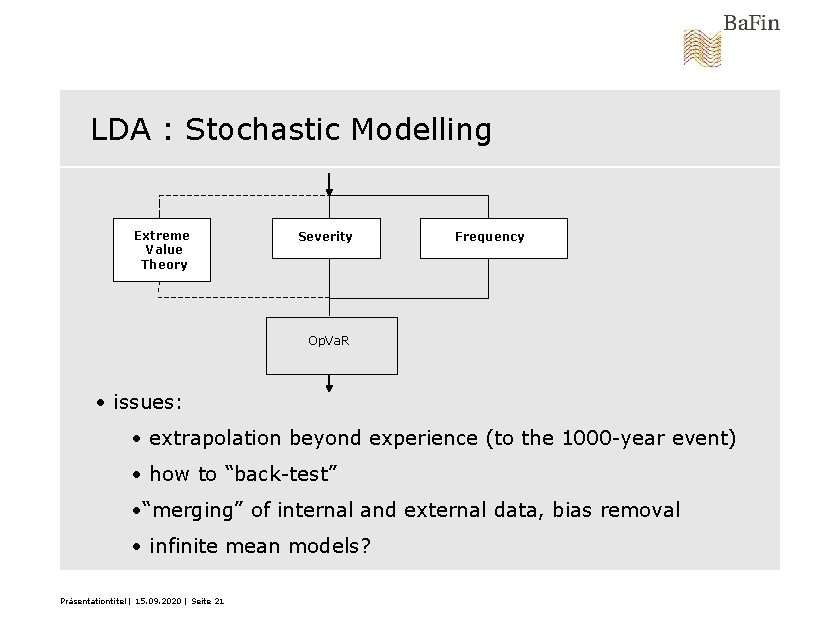
LDA : Stochastic Modelling Extreme Value Theory Severity Frequency Op. Va. R • issues: • extrapolation beyond experience (to the 1000 -year event) • how to “back-test” • “merging” of internal and external data, bias removal • infinite mean models? Präsentationtitel | 15. 09. 2020 | Seite 21
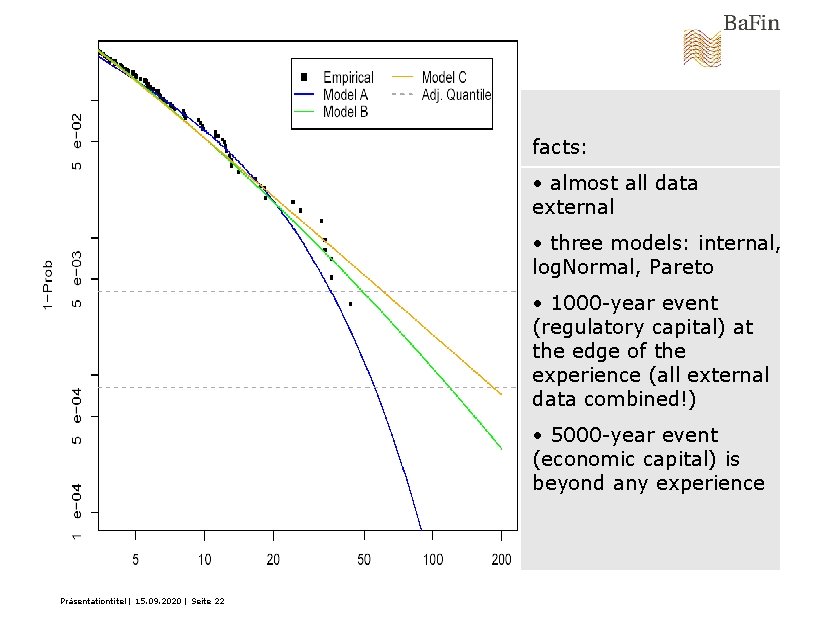
facts: • almost all data external • three models: internal, log. Normal, Pareto • 1000 -year event (regulatory capital) at the edge of the experience (all external data combined!) • 5000 -year event (economic capital) is beyond any experience Präsentationtitel | 15. 09. 2020 | Seite 22
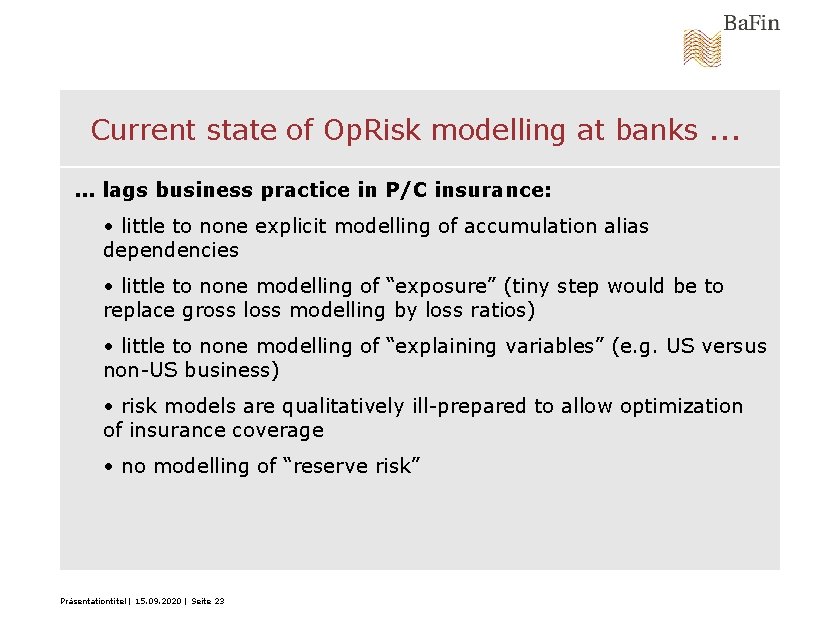
Current state of Op. Risk modelling at banks. . . lags business practice in P/C insurance: • little to none explicit modelling of accumulation alias dependencies • little to none modelling of “exposure” (tiny step would be to replace gross loss modelling by loss ratios) • little to none modelling of “explaining variables” (e. g. US versus non-US business) • risk models are qualitatively ill-prepared to allow optimization of insurance coverage • no modelling of “reserve risk” Präsentationtitel | 15. 09. 2020 | Seite 23
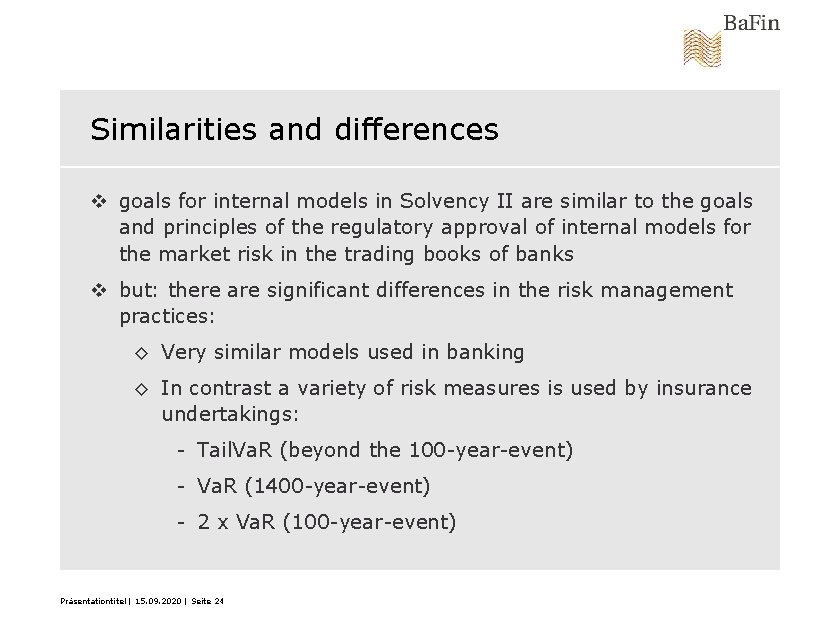
Similarities and differences v goals for internal models in Solvency II are similar to the goals and principles of the regulatory approval of internal models for the market risk in the trading books of banks v but: there are significant differences in the risk management practices: ◊ Very similar models used in banking ◊ In contrast a variety of risk measures is used by insurance undertakings: - Tail. Va. R (beyond the 100 -year-event) - Va. R (1400 -year-event) - 2 x Va. R (100 -year-event) Präsentationtitel | 15. 09. 2020 | Seite 24
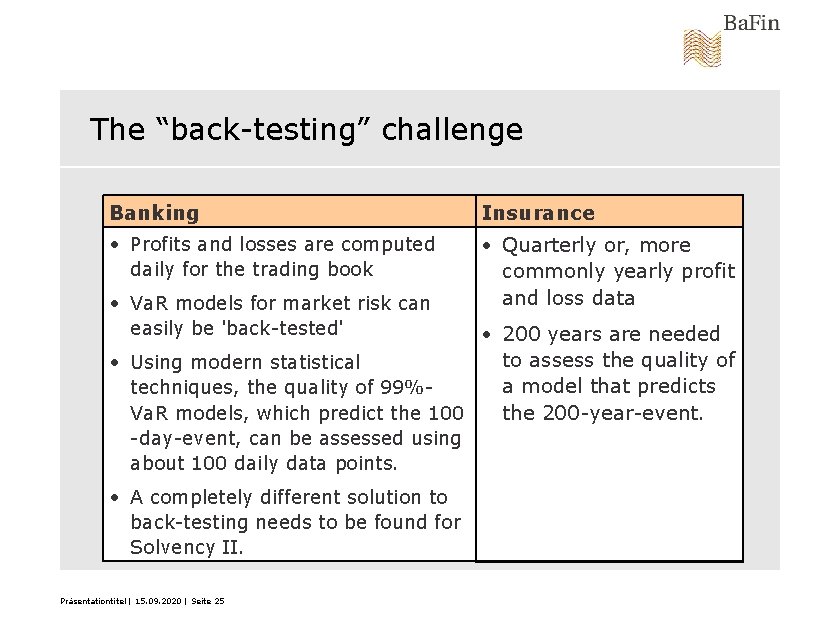
The “back-testing” challenge Banking Insurance • Profits and losses are computed daily for the trading book • Quarterly or, more commonly yearly profit and loss data • Va. R models for market risk can easily be 'back-tested' • 200 years are needed to assess the quality of • Using modern statistical a model that predicts techniques, the quality of 99%Va. R models, which predict the 100 the 200 -year-event. -day-event, can be assessed using about 100 daily data points. • A completely different solution to back-testing needs to be found for Solvency II. Präsentationtitel | 15. 09. 2020 | Seite 25
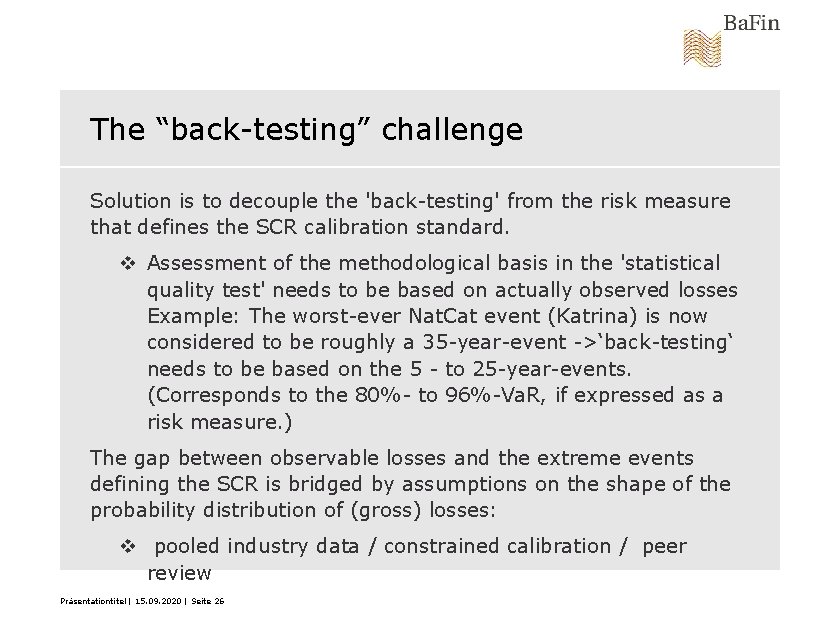
The “back-testing” challenge Solution is to decouple the 'back-testing' from the risk measure that defines the SCR calibration standard. v Assessment of the methodological basis in the 'statistical quality test' needs to be based on actually observed losses Example: The worst-ever Nat. Cat event (Katrina) is now considered to be roughly a 35 -year-event ->‘back-testing‘ needs to be based on the 5 - to 25 -year-events. (Corresponds to the 80%- to 96%-Va. R, if expressed as a risk measure. ) The gap between observable losses and the extreme events defining the SCR is bridged by assumptions on the shape of the probability distribution of (gross) losses: v pooled industry data / constrained calibration / peer review Präsentationtitel | 15. 09. 2020 | Seite 26
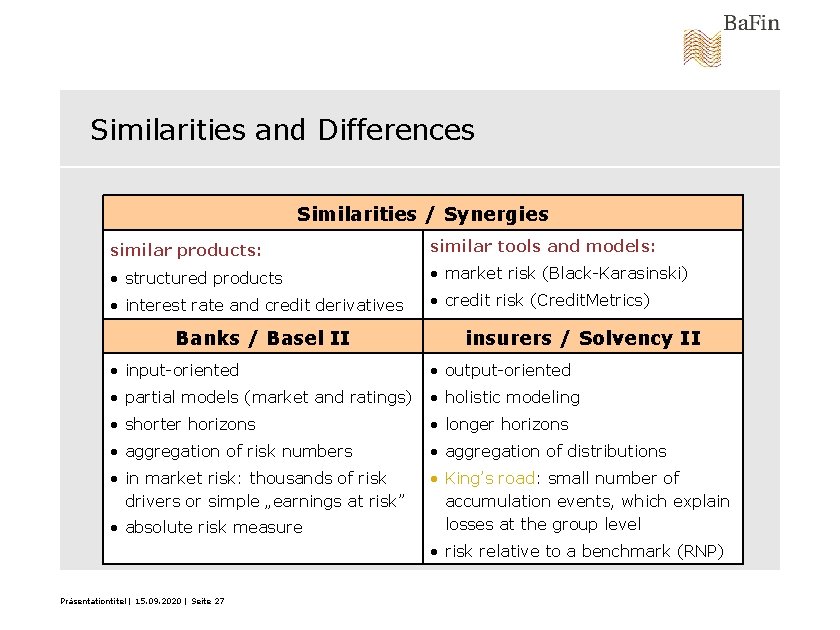
Similarities and Differences Similarities / Synergies similar products: similar tools and models: • structured products • market risk (Black-Karasinski) • interest rate and credit derivatives • credit risk (Credit. Metrics) Banks / Basel II insurers / Solvency II • input-oriented • output-oriented • partial models (market and ratings) • holistic modeling • shorter horizons • longer horizons • aggregation of risk numbers • aggregation of distributions • in market risk: thousands of risk drivers or simple „earnings at risk” • King’s road: small number of accumulation events, which explain losses at the group level • absolute risk measure • risk relative to a benchmark (RNP) Präsentationtitel | 15. 09. 2020 | Seite 27
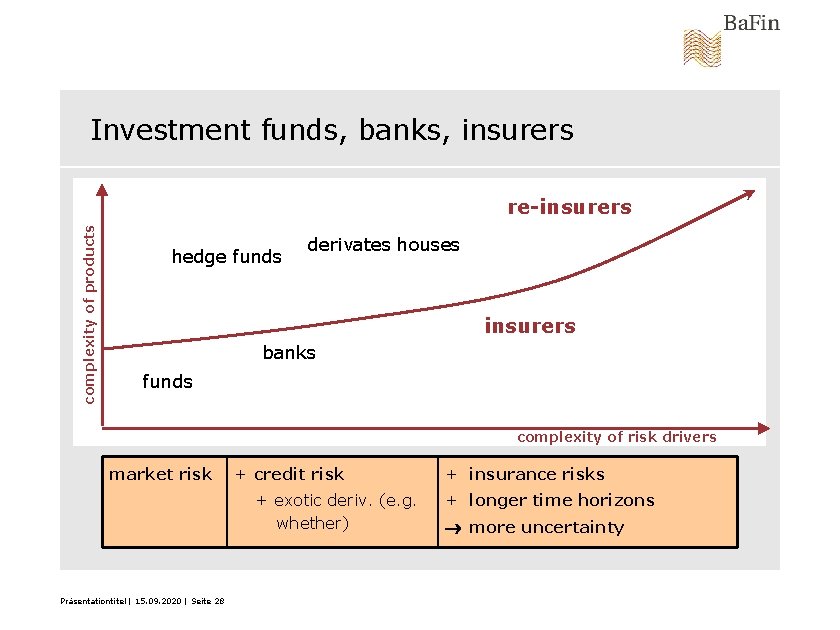
Investment funds, banks, insurers complexity of products re-insurers hedge funds derivates houses insurers banks funds complexity of risk drivers market risk + credit risk + exotic deriv. (e. g. whether) Präsentationtitel | 15. 09. 2020 | Seite 28 + insurance risks + longer time horizons more uncertainty
Präsentationtitel | 15. 09. 2020 | Seite 29