
Overview on CERN Test Beam Facilities and Plans
Overview on CERN Test Beam Facilities and Plans for Tests for Non-Collider Experiments Edda Gschwendtner, CERN
2 Overview • East Area Test Beam Facility • North Area Test Beam Facility • Test-Plans for Non-Collider Experiments • Summary E. Gschwendtner, CERN 13 Mai 2009
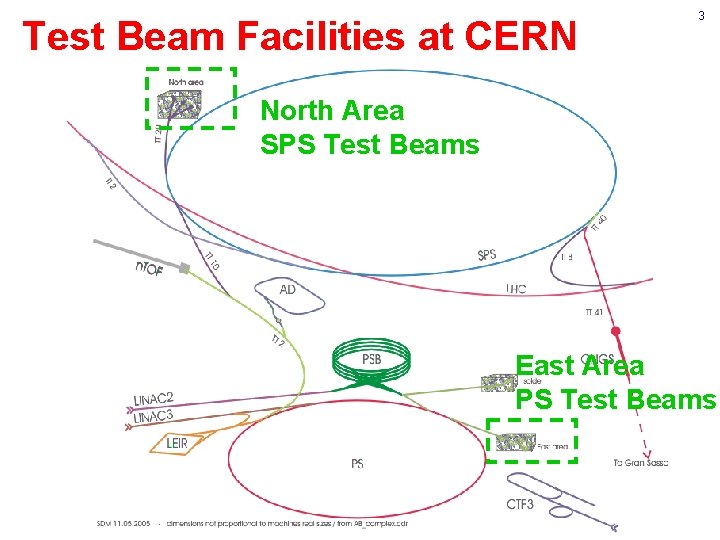
Test Beam Facilities at CERN 3 North Area SPS Test Beams East Area PS Test Beams E. Gschwendtner, CERN 13 Mai 2009

4 PS East Area 5 beam lines total length 300 m 300 scientists / year performing experiments and tests E. Gschwendtner, CERN 13 Mai 2009
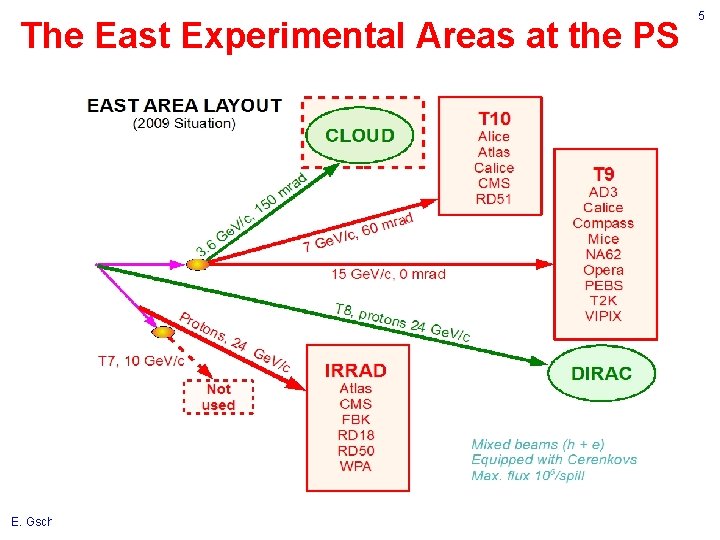
The East Experimental Areas at the PS E. Gschwendtner, CERN 13 Mai 2009 5
East Area Beam Characteristics • Momentum range – Secondary beam: 1 Ge. V/c – 15 Ge. V/c • Particle type and intensity – electrons, hadrons, muons – max. 1 -2*106 particles per spill typically 103 - 104 used • Spill structure from PS – 400 ms spill length – typically 1 spill every 33. 6 s, more on request E. Gschwendtner, CERN 13 Mai 2009 6
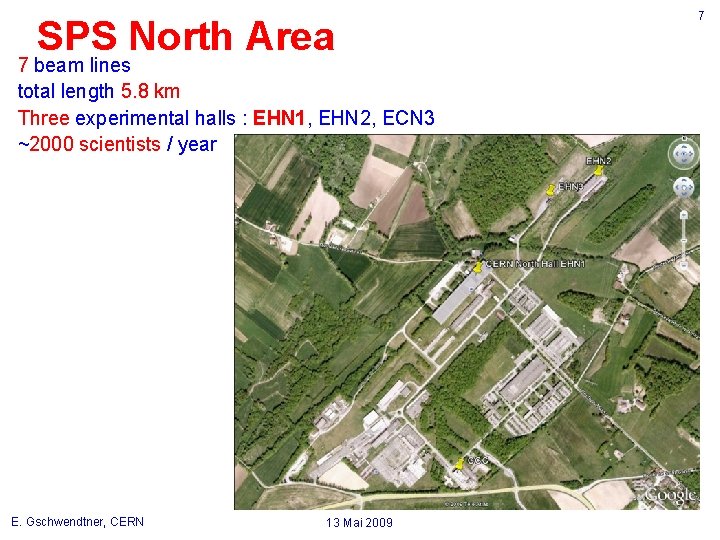
SPS North Area 7 beam lines total length 5. 8 km Three experimental halls : EHN 1, EHN 2, ECN 3 ~2000 scientists / year E. Gschwendtner, CERN 13 Mai 2009 7
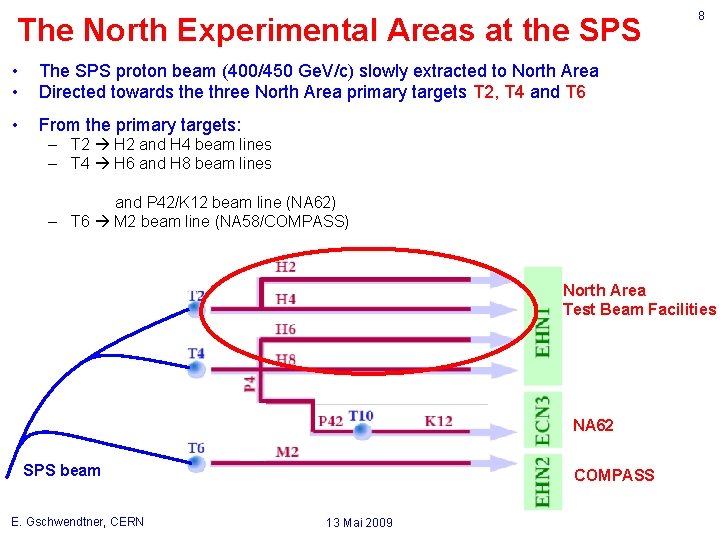
The North Experimental Areas at the SPS • • The SPS proton beam (400/450 Ge. V/c) slowly extracted to North Area Directed towards the three North Area primary targets T 2, T 4 and T 6 • From the primary targets: 8 – T 2 H 2 and H 4 beam lines – T 4 H 6 and H 8 beam lines and P 42/K 12 beam line (NA 62) – T 6 M 2 beam line (NA 58/COMPASS) North Area Test Beam Facilities NA 62 SPS beam E. Gschwendtner, CERN COMPASS 13 Mai 2009

North Area Test Beams NA 61 H 2 H 4 ATLAS, Eu. DET, SILC… H 6 H 8 Up to 4 user areas per beam line Possibility to take parasitic muons behind main user Some areas permanently occupied by LHC users (ATLAS, CMS, LHCb, TOTEM)
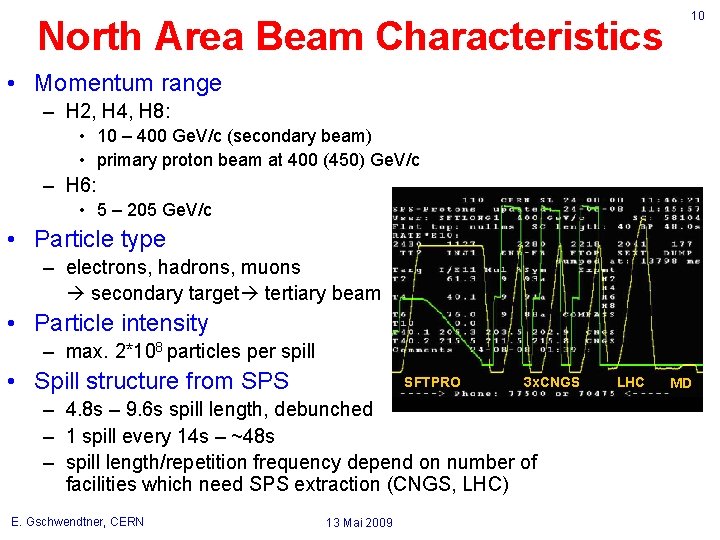
North Area Beam Characteristics 10 • Momentum range – H 2, H 4, H 8: • 10 – 400 Ge. V/c (secondary beam) • primary proton beam at 400 (450) Ge. V/c – H 6: • 5 – 205 Ge. V/c • Particle type – electrons, hadrons, muons secondary target tertiary beam • Particle intensity – max. 2*108 particles per spill • Spill structure from SPS SFTPRO 3 x. CNGS – 4. 8 s – 9. 6 s spill length, debunched – 1 spill every 14 s – ~48 s – spill length/repetition frequency depend on number of facilities which need SPS extraction (CNGS, LHC) E. Gschwendtner, CERN 13 Mai 2009 LHC MD
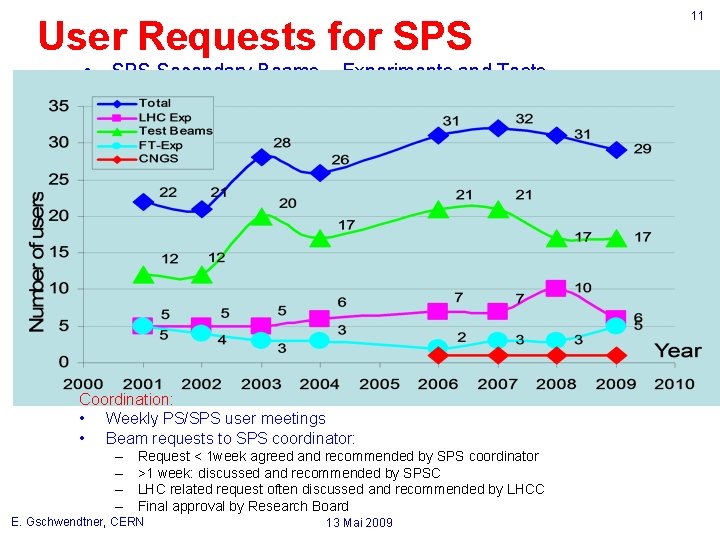
User Requests for SPS • SPS Secondary Beams – Experiments and Tests Coordination: • Weekly PS/SPS user meetings • Beam requests to SPS coordinator: – – Request < 1 week agreed and recommended by SPS coordinator >1 week: discussed and recommended by SPSC LHC related request often discussed and recommended by LHCC Final approval by Research Board E. Gschwendtner, CERN 13 Mai 2009 11
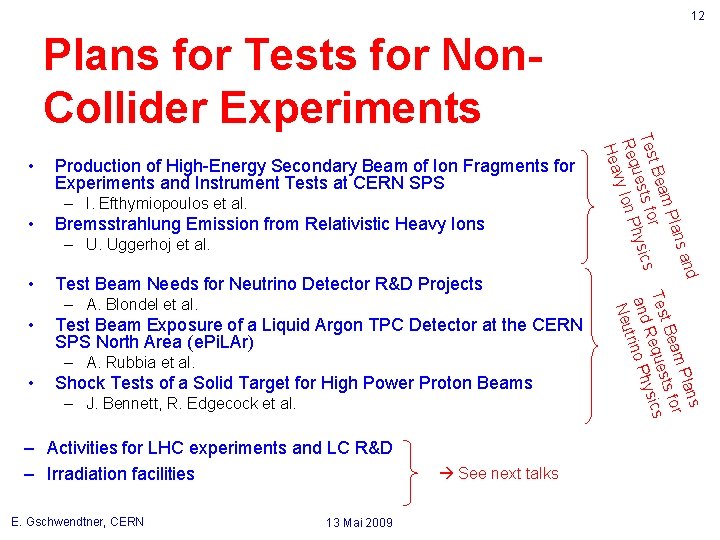
12 Plans for Tests for Non. Collider Experiments Production of High-Energy Secondary Beam of Ion Fragments for Experiments and Instrument Tests at CERN SPS – I. Efthymiopoulos et al. • Bremsstrahlung Emission from Relativistic Heavy Ions – U. Uggerhoj et al. • Test Beam Needs for Neutrino Detector R&D Projects – A. Blondel et al. • Test Beam Exposure of a Liquid Argon TPC Detector at the CERN SPS North Area (e. Pi. LAr) – A. Rubbia et al. • Shock Tests of a Solid Target for High Power Proton Beams – J. Bennett, R. Edgecock et al. – Activities for LHC experiments and LC R&D – Irradiation facilities E. Gschwendtner, CERN 13 Mai 2009 See next talks ns d a l s an m P r Plan Bea sts fo t am Tes que sics t Be e R s s for Tes c d n Phy a uest hysi trino Req y Ion P Neu v Hea •
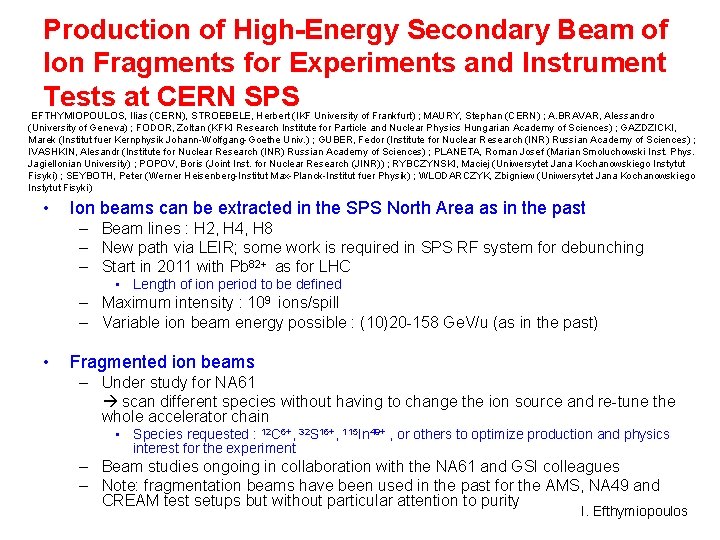
Production of High-Energy Secondary Beam of Ion Fragments for Experiments and Instrument Tests at CERN SPS EFTHYMIOPOULOS, Ilias (CERN), STROEBELE, Herbert (IKF University of Frankfurt) ; MAURY, Stephan (CERN) ; A. BRAVAR, Alessandro (University of Geneva) ; FODOR, Zoltan (KFKI Research Institute for Particle and Nuclear Physics Hungarian Academy of Sciences) ; GAZDZICKI, Marek (Institut fuer Kernphysik Johann-Wolfgang-Goethe Univ. ) ; GUBER, Fedor (Institute for Nuclear Research (INR) Russian Academy of Sciences) ; IVASHKIN, Alesandr (Institute for Nuclear Research (INR) Russian Academy of Sciences) ; PLANETA, Roman Josef (Marian Smoluchowski Inst. Phys. Jagiellonian University) ; POPOV, Boris (Joint Inst. for Nuclear Research (JINR)) ; RYBCZYNSKI, Maciej (Uniwersytet Jana Kochanowskiego Instytut Fisyki) ; SEYBOTH, Peter (Werner Heisenberg-Institut Max-Planck-Institut fuer Physik) ; WLODARCZYK, Zbigniew (Uniwersytet Jana Kochanowskiego Instytut Fisyki) • Ion beams can be extracted in the SPS North Area as in the past – Beam lines : H 2, H 4, H 8 – New path via LEIR; some work is required in SPS RF system for debunching – Start in 2011 with Pb 82+ as for LHC • Length of ion period to be defined – Maximum intensity : 109 ions/spill – Variable ion beam energy possible : (10)20 -158 Ge. V/u (as in the past) • Fragmented ion beams – Under study for NA 61 scan different species without having to change the ion source and re-tune the whole accelerator chain • Species requested : 12 C 6+, 32 S 16+, 115 In 49+ , or others to optimize production and physics interest for the experiment – Beam studies ongoing in collaboration with the NA 61 and GSI colleagues – Note: fragmentation beams have been used in the past for the AMS, NA 49 and CREAM test setups but without particular attention to purity I. Efthymiopoulos

Production of High-Energy Secondary Beam of Ion Fragments for Experiments and Instrument Tests at CERN SPS § Beam line: double spectrometer with 0. 04% resolution that helps to separate the ion fragments corresponding to a selected magnetic rigidity : Br § With optimized target and degrader, simulations show a selection rate of 2. 2× 10 -4 /incident Pb ion for the case of 32 P 15+ , i. e. ~2. 2× 10⁵ selected ions/spill for the maximum intensity of 109 Pb-ions. I. Efthymiopoulos
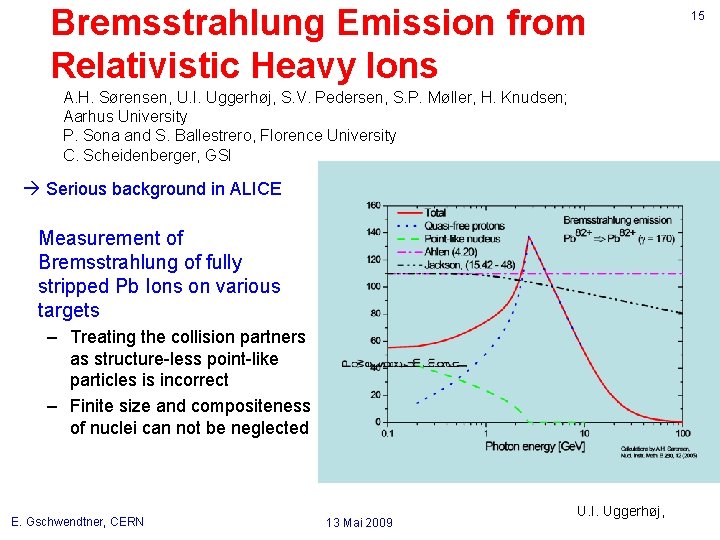
Bremsstrahlung Emission from Relativistic Heavy Ions A. H. Sørensen, U. I. Uggerhøj, S. V. Pedersen, S. P. Møller, H. Knudsen; Aarhus University P. Sona and S. Ballestrero, Florence University C. Scheidenberger, GSI Serious background in ALICE Measurement of Bremsstrahlung of fully stripped Pb Ions on various targets – Treating the collision partners as structure-less point-like particles is incorrect – Finite size and compositeness of nuclei can not be neglected E. Gschwendtner, CERN 13 Mai 2009 U. I. Uggerhøj, 15
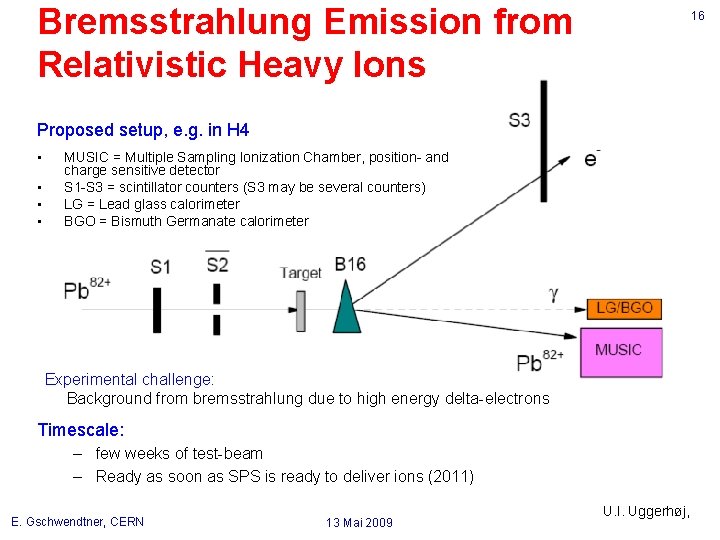
Bremsstrahlung Emission from Relativistic Heavy Ions 16 Proposed setup, e. g. in H 4 • • MUSIC = Multiple Sampling Ionization Chamber, position- and charge sensitive detector S 1 -S 3 = scintillator counters (S 3 may be several counters) LG = Lead glass calorimeter BGO = Bismuth Germanate calorimeter Experimental challenge: Background from bremsstrahlung due to high energy delta-electrons Timescale: – few weeks of test-beam – Ready as soon as SPS is ready to deliver ions (2011) E. Gschwendtner, CERN 13 Mai 2009 U. I. Uggerhøj,
Test Beam Needs for Neutrino Detector R&D Projects E. Gschwendtner, CERN 13 Mai 2009 17 A. Blondel
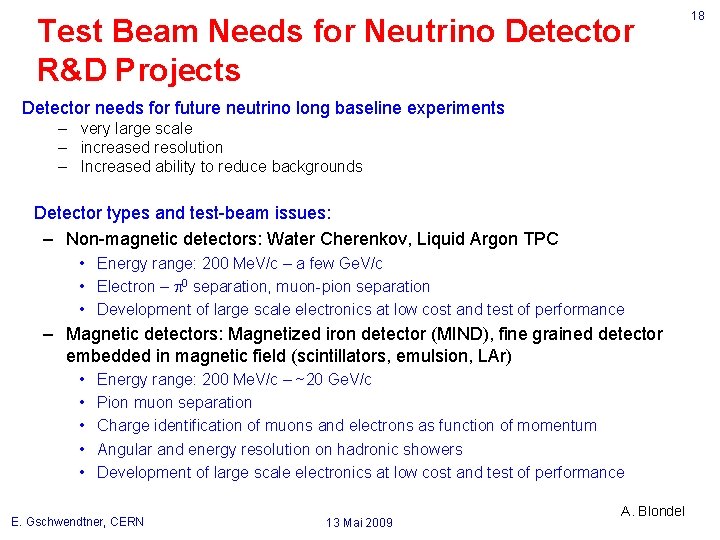
Test Beam Needs for Neutrino Detector R&D Projects Detector needs for future neutrino long baseline experiments – very large scale – increased resolution – Increased ability to reduce backgrounds Detector types and test-beam issues: – Non-magnetic detectors: Water Cherenkov, Liquid Argon TPC • Energy range: 200 Me. V/c – a few Ge. V/c • Electron – p 0 separation, muon-pion separation • Development of large scale electronics at low cost and test of performance – Magnetic detectors: Magnetized iron detector (MIND), fine grained detector embedded in magnetic field (scintillators, emulsion, LAr) • • • Energy range: 200 Me. V/c – ~20 Ge. V/c Pion muon separation Charge identification of muons and electrons as function of momentum Angular and energy resolution on hadronic showers Development of large scale electronics at low cost and test of performance E. Gschwendtner, CERN 13 Mai 2009 A. Blondel 18
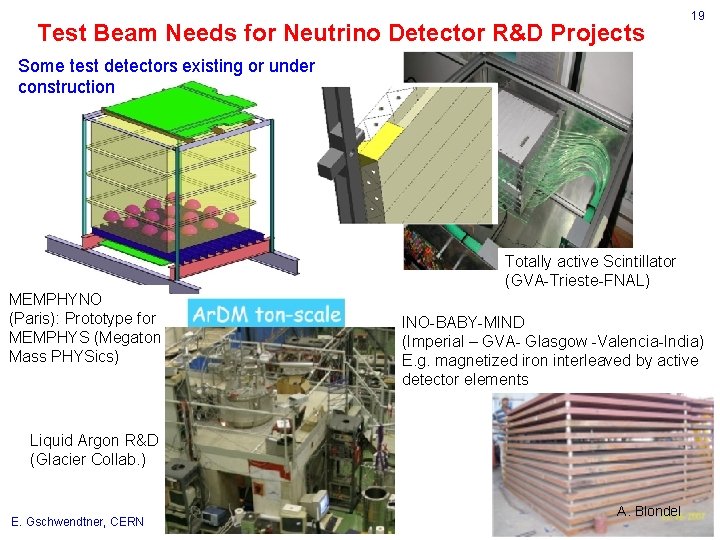
Test Beam Needs for Neutrino Detector R&D Projects 19 Some test detectors existing or under construction Totally active Scintillator (GVA-Trieste-FNAL) MEMPHYNO (Paris): Prototype for MEMPHYS (Megaton Mass PHYSics) INO-BABY-MIND (Imperial – GVA- Glasgow -Valencia-India) E. g. magnetized iron interleaved by active detector elements Liquid Argon R&D (Glacier Collab. ) E. Gschwendtner, CERN 13 Mai 2009 A. Blondel
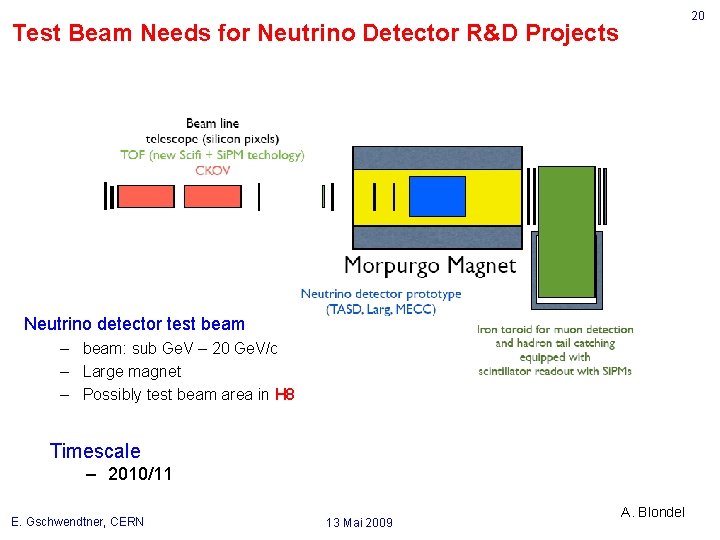
20 Test Beam Needs for Neutrino Detector R&D Projects Neutrino detector test beam – beam: sub Ge. V – 20 Ge. V/c – Large magnet – Possibly test beam area in H 8 Timescale – 2010/11 E. Gschwendtner, CERN 13 Mai 2009 A. Blondel
Test Beam Exposure of a Liquid Argon TPC Detector at the CERN SPS North Area (e. Pi. LAr) D. Autieroa, A. Badertscherb, G. Barkerc, Y. Declaisa, A. Ereditatod, S. Gninenkoe, T. Hasegawaf, S. Horikawab, J. Kisielg, T. Kobayashif, A. Marchionnib, T. Maruyamaf, V. Matveeve, A. Meregagliah, J. Marteaua, K. Nishikawaf, A. Rubbiab, N. Spooneri, M. Tanakaf, C. Touramanisj, D. Warkk, l, A. Zalewskam, M. Ziton (a) IPN Lyon (b) ETH Zurich (c) University of Warwick (d) Bern University (e) INR, Moscow (f) KEK/IPNS (g) University of Silesia (Katowice) (h) IPHC Strasbourg (i) University of Sheffield (j) University of Liverpool (k) Imperial College (l) RAL (m) IFJ-PAN, Krakow (n) CEA/SACLAY The realization of the ultimate LAr TPC that will compete with the planned third generation water Cerenkov detectors offers great promise and many challenges. The new concept « GLACIER » , scalable to a single detector unit of mass 100 kton, was proposed in 2003: it relies on a cryogenic storage tank developed by the petrochemical industry (LNG technology) and on a novel method of operation called the LAr LEM-TPC E. Gschwendtner, CERN 13 Mai 2009 A. Rubbia 21
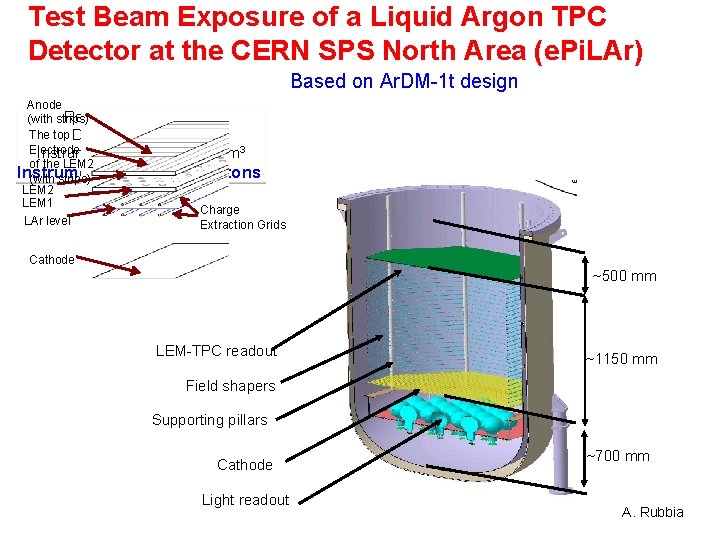
Test Beam Exposure of a Liquid Argon TPC Detector at the CERN SPS North Area (e. Pi. LAr) Based on Ar. DM-1 t design Anode Readout area: ≈ 2. 5 m 2 (with strips) The top Drift length: ≈ 1. 15 m Electrode Instrumented volume : ≈ 2. 8 m 3 of the LEM 2 Instrumented mass: ≈ 3. 9 tons (with strips) LEM 2 LEM 1 Charge LAr level Extraction Grids Cathode ~500 mm LEM-TPC readout ~1150 mm Field shapers Supporting pillars Cathode Light readout ~700 mm A. Rubbia
23 Test Beam Exposure of a Liquid Argon TPC Detector at the CERN SPS North Area (e. Pi. LAr) • Calorimetry: the 100% homogeneity and full sampling calorimetry with low energy particles (0. 5 -5 Ge. V/c e/mu/pi). To determine the ability to reconstruct neutrino events in the Ge. V-range. Hadronic secondary interactions: exclusive final state study of pion secondary interactions will be attempted. [+ purity tests in non-evacuated vessel, cold readout electronics, DAQ development, . . . ] • • • Test beam requirements – – 0. 5 -5 Ge. V/c e/mu/pi with well defined momenta Possibility to reach lower momenta (200, 400 Me. V/c) Low intensity of particles during spill (< 1 k. Hz) Liquid Argon infrastructure H 8 • Timescale – 2010 – duration of the tests: 2 to 3 years E. Gschwendtner, CERN 13 Mai 2009 A. Rubbia
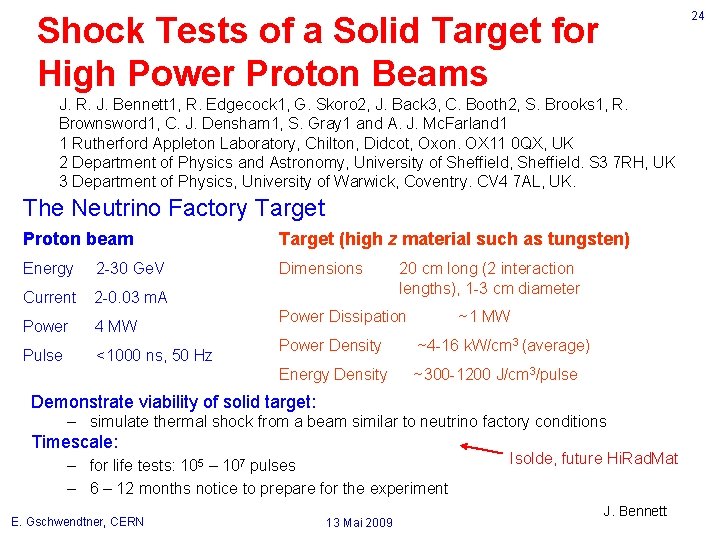
Shock Tests of a Solid Target for High Power Proton Beams J. R. J. Bennett 1, R. Edgecock 1, G. Skoro 2, J. Back 3, C. Booth 2, S. Brooks 1, R. Brownsword 1, C. J. Densham 1, S. Gray 1 and A. J. Mc. Farland 1 1 Rutherford Appleton Laboratory, Chilton, Didcot, Oxon. OX 11 0 QX, UK 2 Department of Physics and Astronomy, University of Sheffield, Sheffield. S 3 7 RH, UK 3 Department of Physics, University of Warwick, Coventry. CV 4 7 AL, UK. The Neutrino Factory Target Proton beam Target (high z material such as tungsten) Energy 2 -30 Ge. V Dimensions 20 cm long (2 interaction lengths), 1 -3 cm diameter Current 2 -0. 03 m. A Power 4 MW Pulse <1000 ns, 50 Hz Power Dissipation ~1 MW Power Density ~4 -16 k. W/cm 3 (average) Energy Density ~300 -1200 J/cm 3/pulse Demonstrate viability of solid target: – simulate thermal shock from a beam similar to neutrino factory conditions Timescale: – for life tests: 105 – 107 pulses – 6 – 12 months notice to prepare for the experiment E. Gschwendtner, CERN 13 Mai 2009 Isolde, future Hi. Rad. Mat J. Bennett 24
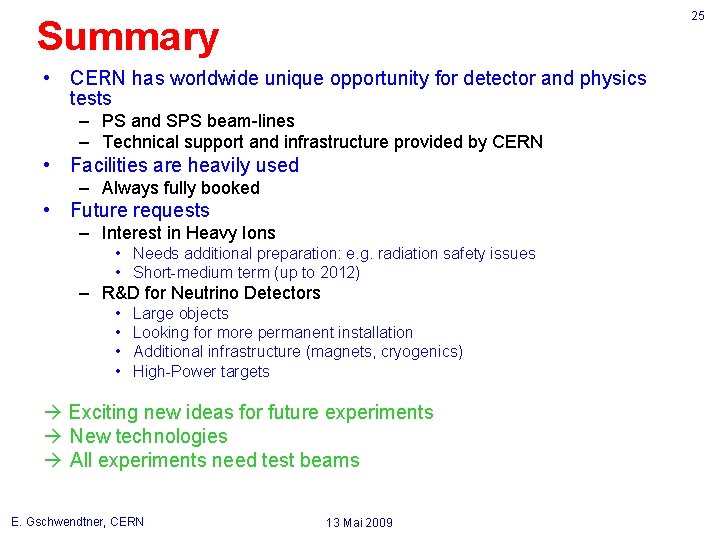
25 Summary • CERN has worldwide unique opportunity for detector and physics tests – PS and SPS beam-lines – Technical support and infrastructure provided by CERN • Facilities are heavily used – Always fully booked • Future requests – Interest in Heavy Ions • Needs additional preparation: e. g. radiation safety issues • Short-medium term (up to 2012) – R&D for Neutrino Detectors • • Large objects Looking for more permanent installation Additional infrastructure (magnets, cryogenics) High-Power targets Exciting new ideas for future experiments New technologies All experiments need test beams E. Gschwendtner, CERN 13 Mai 2009

Additional slides
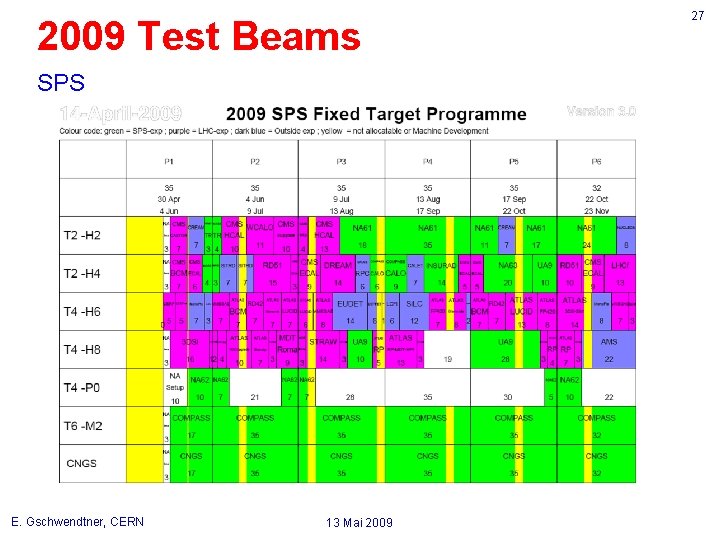
2009 Test Beams SPS E. Gschwendtner, CERN 13 Mai 2009 27
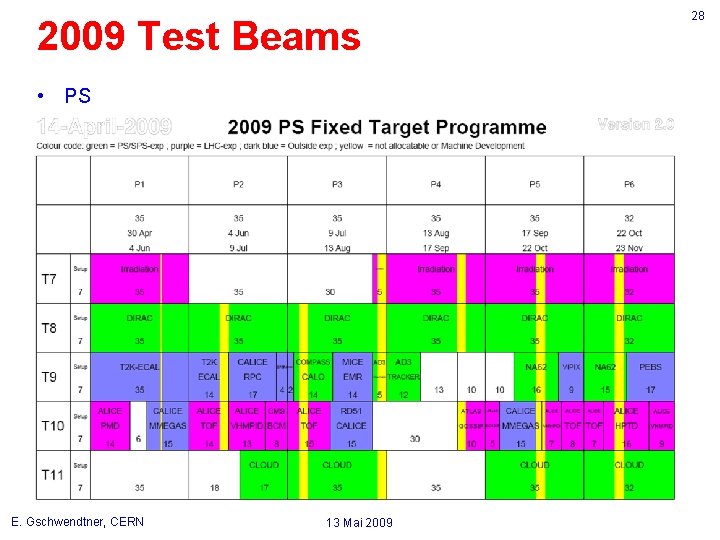
2009 Test Beams • PS E. Gschwendtner, CERN 13 Mai 2009 28
- Slides: 28