
Overview Offspring of S390 operating system Same reliability
Overview § Offspring of S/390 operating system • Same reliability, performance, scalability, and cost efficiency § OS/390 geared more towards e-business and client/server interaction • Allows greater flexibility • Allows companies to customize their system Ø Various elements that can be added to base OS
Customizing the System § BDT File –To-File- allows users from one OS/390 system to copy data from another OS/390 system § C/C++ with or without Debug Tool § IBM Communications Server Security Level 3 highest level of security for a TCP/IP network environment, supporting packet filtering, tunnels and NAT § OCFS Security Level 3 - working with Cryptographic services (base element), provides weak and strong software cryptographic services, along with various data libraries
Real World Use § 90% of the world’s largest corporations run OS/390 as central OS • Running on Hitachi, Fujitsu, IBM S/390 and Amdahl hardware § Close to 1, 400 Independent Software Vendors take advantage of OS/390 • People. Soft, Lotus Domino, SAP R/3
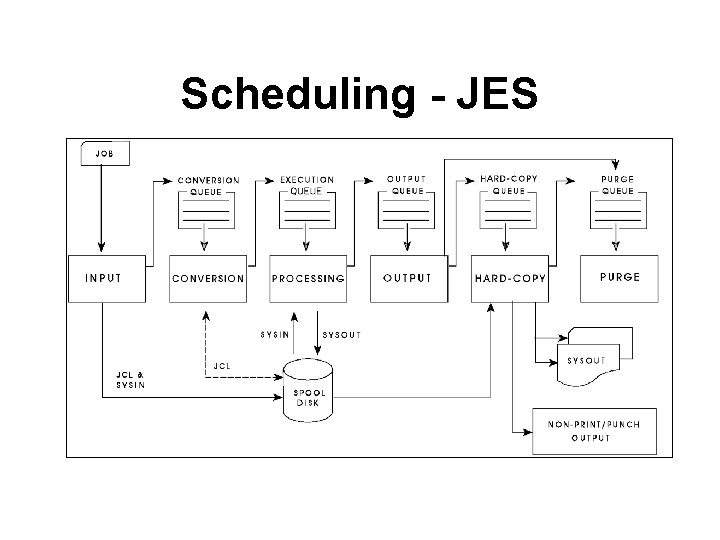
Scheduling § JES- Job Entry System • Before and after running the program § BAP- Base Control Program • During processing
Scheduling - JES § HASP- Houston Automatic Spooling Priority § JES 2 – Single processor § JES 3 – Multi processor § JCL – Job Control Language
Scheduling - JES
Software and Hardware § The OS/390 is intimately tied to its hardware § The hardware and the software often evolved in tandem § Any discussion of OS/390 processor modes inevitably becomes a discussion of S/390 processor configuration and availability
Processor Performance § Despite its limited market the OS/390 is relatively unchallenged in the area of highend mainframe number crunching • Size, power and security make it useful for mission -critical systems like finance-oriented transaction systems § Some supporters claim that up to 90% of all high-end business data is held on an S/390 system • Such a claim is questionable; IBM has seen a decline in S/390 revenue in the past ten years with the increase of “simpler and smaller” UNIX and Windows NT solutions
A Well-Endowed Machine 1. There is still no doubt that the S/390 systems offer serious high-end computing power. 2. Two kinds of processor upgrades: vertical and horizontal 1. Horizontal: replacing the current processor with a different one designed for that system 2. Vertical: adding new processors to the system 3. One measure of vertical growth efficiency is its “linear scalability. ” 4. S/390 systems have near-perfect linear scalability. 1. Ideal for multiprocessing

A Short Processor History § OS/390 evolved from first OS/360 system • First developed in 1964 by Gene Amdahl, Gerry Blaauw and Fred Brooks at IBM • Originally a uniprocessor, single-batch system § Some highlights: • 1968: first two-way SMP concurrent batch system ever • 1983: the 3084 system featured the first four-way SMP architecture. • 1999: the S/390 featured twelve-way SMP architecture with cryptographic coprocessor Ø Up to 32 may be clustered into a Sysplex • 2000: the v. Series 900 was released with 16 -way SMP and 64 -bit addressing
Interesting Processor Features § System can be divided into logical partitions using Processor Resource / System Manager (PR/SM) • Each partition can feature different installations and restrict user access § Double Operation Execution • Each operation is executed twice, in parallel • The results are compared and upon mismatch the operation is performed again § CPUs feature Cryptographic Facility • Special instructions that support identification and key management • Improves security by a factor of 19 when compared to software generation of 512 bit RSA keys
Memory Management § In the OS/390 there are three levels of memory managed by the operating system: • central storage • expanded storage • page data sets on disk
Memory Management § Central storage manages itself based on the most recently used algorithm and workload priority § The Real Storage Manager allocates storage on the basis of demand by assigning frames from an available frame queue, also known as AFQ
Memory Management § OS/390 implemented the idea of expanded storage to accommodate inactive pages § Expanded storage is addressable only as pages and is not accessible to the I/O subsystem or normal CPU instructions
Memory Management § Pages with low priority or not recently used are paged out to expanded memory. § Block Paging - Pages that need to be paged out are grouped together and written out as a block in one I/O. § More efficient than normal paging in its use of I/O
File Management § The OS/390 file management system uses a heirarchical approach § Features included in the system: • • • Directory support Current directory and home support Absolute and relative path names Hard links and symbolic links Extended attribute support Save and restore support
File Management § The OS/390 heirarchical file system views the entire file heirarchy as a collection of heirarchical file system data sets § The data set is the fundamental unit of data management in OS/390
Process Management § The job as a whole is usually thought of a as a single transaction with a single purpose. § There is a specific language for the definition of such jobs, namely Job Control Language.
Process Management § For every job submitted OS/390 needs to know: • Where to find the appropriate input • How to process that input • What to do with the resulting output
- Slides: 19