
Overview of Virginia K12 Funding Formulas and Formula
- Slides: 39
Overview of Virginia K-12 Funding Formulas and Formula Approaches to Recognize Student Need September 19, 2018 1
Presentation Overview • Provide an overview of the mechanics of state K-12 (Direct Aid) funding formulas, including key inputs used in the formulas • Present formula approaches to recognize student need 2
Presentation Topics • Key Input Variables Used in Direct Aid Funding Formulas • Direct Aid Funding Categories • State and Local Shares of Funding • Formula Approaches to Recognize Student Need • Appendices 3
Key Input Variables Used in Direct Aid Funding Formulas 4
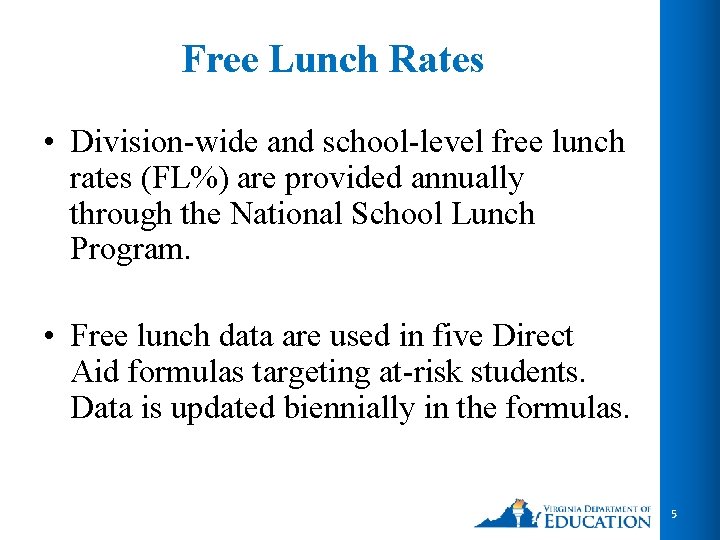
Free Lunch Rates • Division-wide and school-level free lunch rates (FL%) are provided annually through the National School Lunch Program. • Free lunch data are used in five Direct Aid formulas targeting at-risk students. Data is updated biennially in the formulas. 5
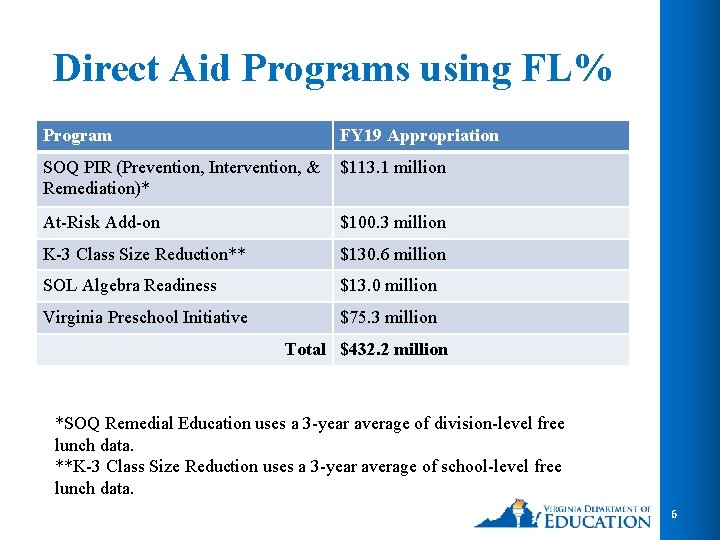
Direct Aid Programs using FL% Program FY 19 Appropriation SOQ PIR (Prevention, Intervention, & Remediation)* $113. 1 million At-Risk Add-on $100. 3 million K-3 Class Size Reduction** $130. 6 million SOL Algebra Readiness $13. 0 million Virginia Preschool Initiative $75. 3 million Total $432. 2 million *SOQ Remedial Education uses a 3 -year average of division-level free lunch data. **K-3 Class Size Reduction uses a 3 -year average of school-level free lunch data. 6
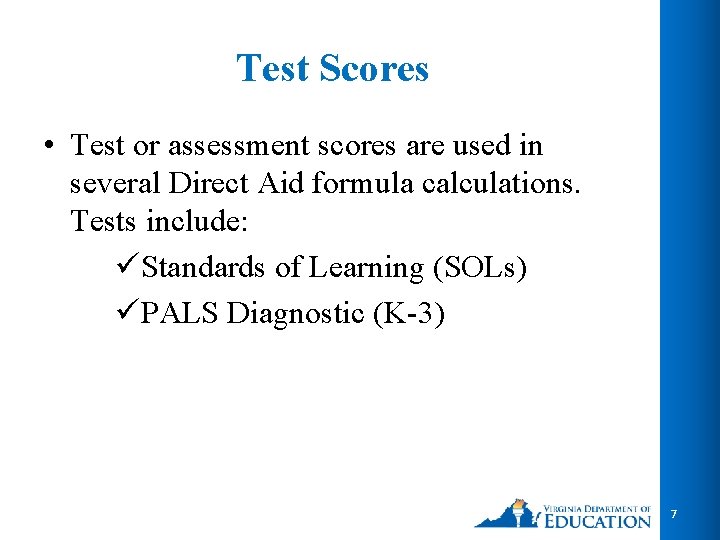
Test Scores • Test or assessment scores are used in several Direct Aid formula calculations. Tests include: üStandards of Learning (SOLs) üPALS Diagnostic (K-3) 7
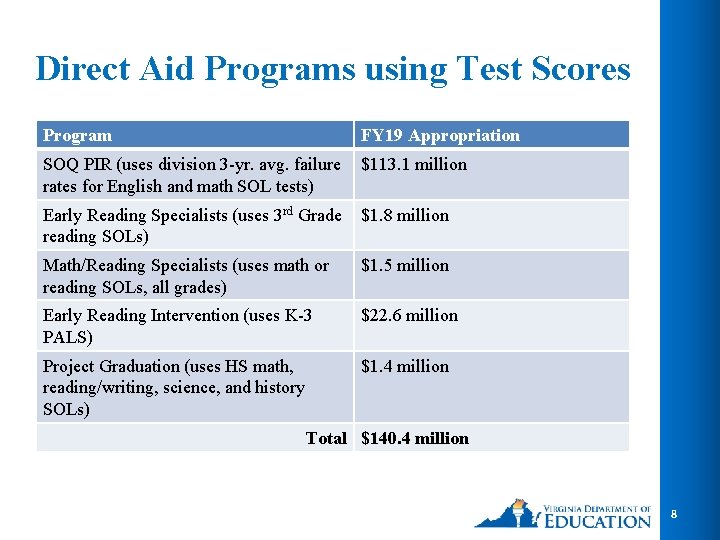
Direct Aid Programs using Test Scores Program FY 19 Appropriation SOQ PIR (uses division 3 -yr. avg. failure rates for English and math SOL tests) $113. 1 million Early Reading Specialists (uses 3 rd Grade reading SOLs) $1. 8 million Math/Reading Specialists (uses math or reading SOLs, all grades) $1. 5 million Early Reading Intervention (uses K-3 PALS) $22. 6 million Project Graduation (uses HS math, reading/writing, science, and history SOLs) $1. 4 million Total $140. 4 million 8
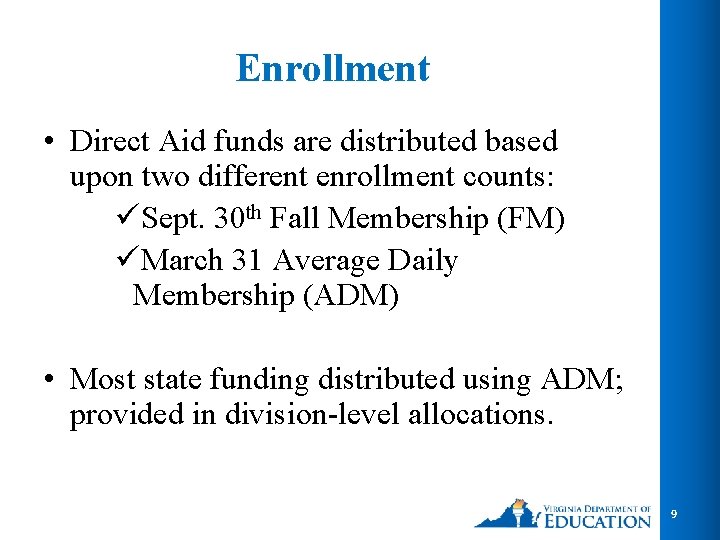
Enrollment • Direct Aid funds are distributed based upon two different enrollment counts: üSept. 30 th Fall Membership (FM) üMarch 31 Average Daily Membership (ADM) • Most state funding distributed using ADM; provided in division-level allocations. 9
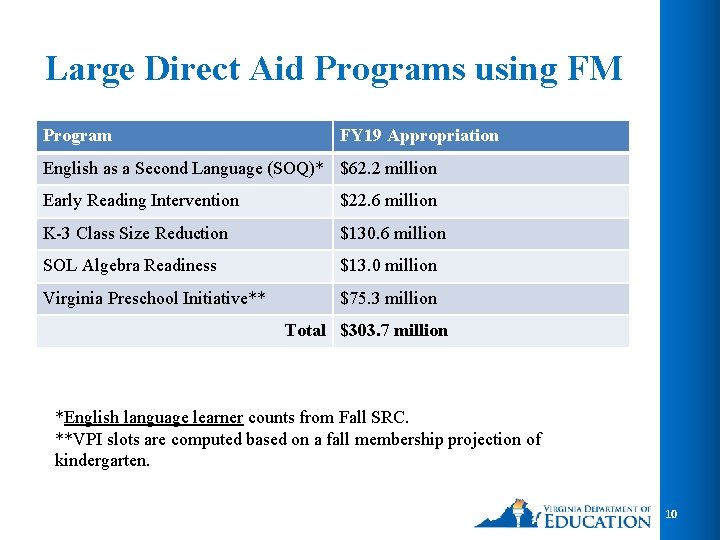
Large Direct Aid Programs using FM Program FY 19 Appropriation English as a Second Language (SOQ)* $62. 2 million Early Reading Intervention $22. 6 million K-3 Class Size Reduction $130. 6 million SOL Algebra Readiness $13. 0 million Virginia Preschool Initiative** $75. 3 million Total $303. 7 million *English language learner counts from Fall SRC. **VPI slots are computed based on a fall membership projection of kindergarten. 10
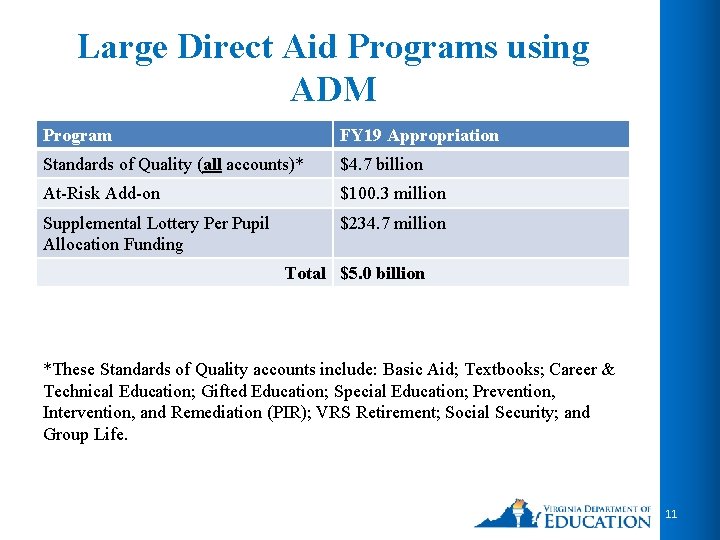
Large Direct Aid Programs using ADM Program FY 19 Appropriation Standards of Quality (all accounts)* $4. 7 billion At-Risk Add-on $100. 3 million Supplemental Lottery Per Pupil Allocation Funding $234. 7 million Total $5. 0 billion *These Standards of Quality accounts include: Basic Aid; Textbooks; Career & Technical Education; Gifted Education; Special Education; Prevention, Intervention, and Remediation (PIR); VRS Retirement; Social Security; and Group Life. 11
Direct Aid Funding Categories 12
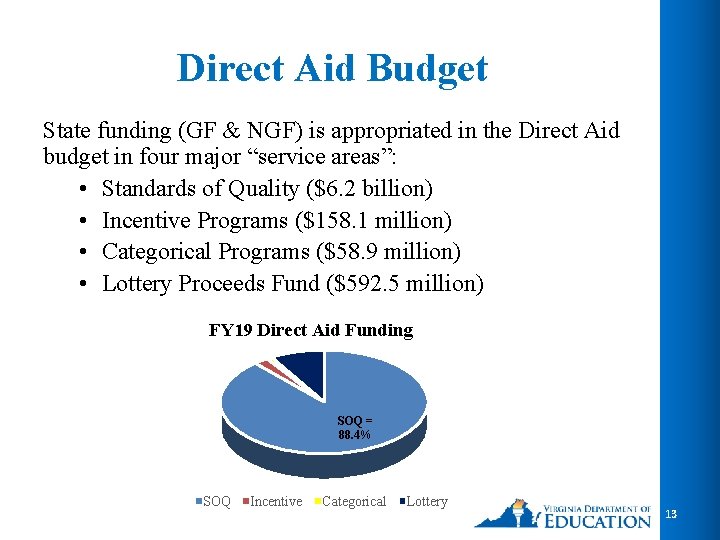
Direct Aid Budget State funding (GF & NGF) is appropriated in the Direct Aid budget in four major “service areas”: • Standards of Quality ($6. 2 billion) • Incentive Programs ($158. 1 million) • Categorical Programs ($58. 9 million) • Lottery Proceeds Fund ($592. 5 million) FY 19 Direct Aid Funding SOQ = 88. 4% SOQ Incentive Categorical Lottery 13
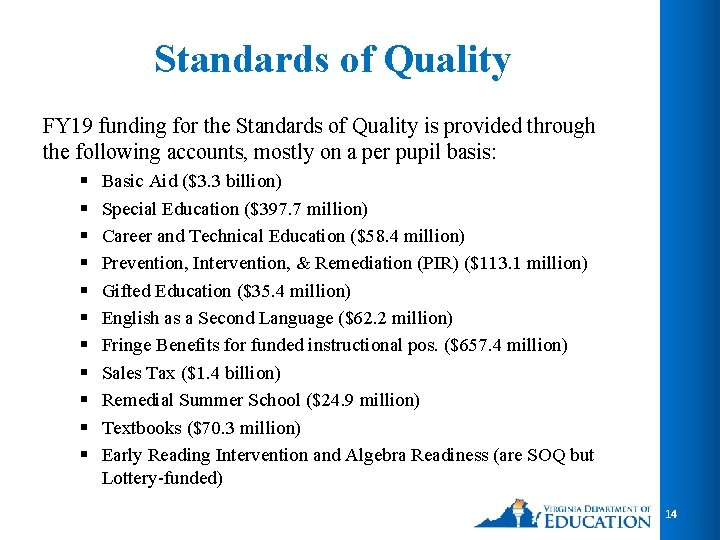
Standards of Quality FY 19 funding for the Standards of Quality is provided through the following accounts, mostly on a per pupil basis: § § § Basic Aid ($3. 3 billion) Special Education ($397. 7 million) Career and Technical Education ($58. 4 million) Prevention, Intervention, & Remediation (PIR) ($113. 1 million) Gifted Education ($35. 4 million) English as a Second Language ($62. 2 million) Fringe Benefits for funded instructional pos. ($657. 4 million) Sales Tax ($1. 4 billion) Remedial Summer School ($24. 9 million) Textbooks ($70. 3 million) Early Reading Intervention and Algebra Readiness (are SOQ but Lottery-funded) 14
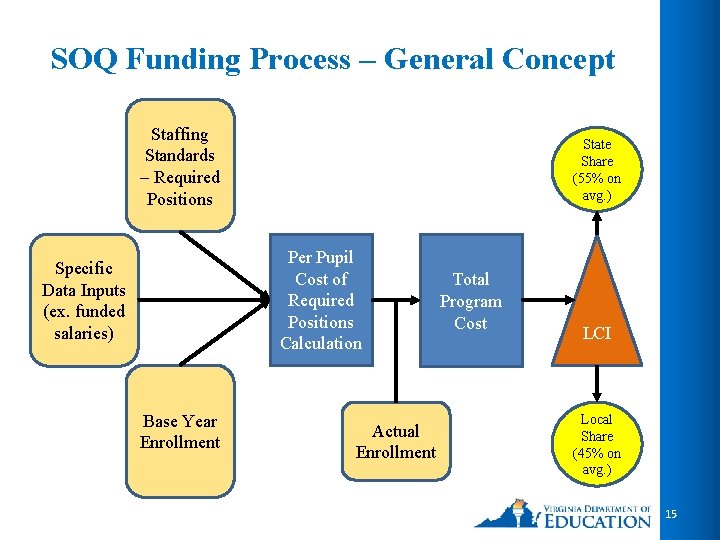
SOQ Funding Process – General Concept Staffing Standards – Required Positions State Share (55% on avg. ) Per Pupil Cost of Required Positions Calculation Specific Data Inputs (ex. funded salaries) Base Year Enrollment Actual Enrollment Total Program Cost LCI Local Share (45% on avg. ) 15
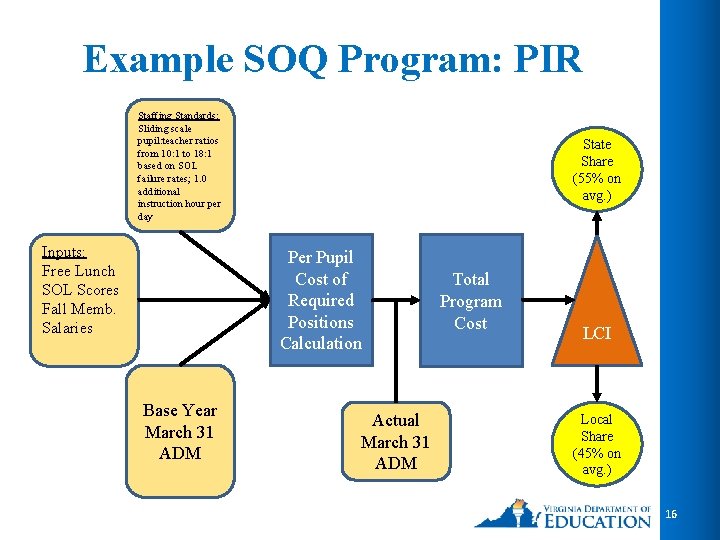
Example SOQ Program: PIR Staffing Standards: Sliding scale pupil: teacher ratios from 10: 1 to 18: 1 based on SOL failure rates; 1. 0 additional instruction hour per day Inputs: Free Lunch SOL Scores Fall Memb. Salaries State Share (55% on avg. ) Per Pupil Cost of Required Positions Calculation Base Year March 31 ADM Actual March 31 ADM Total Program Cost LCI Local Share (45% on avg. ) 16
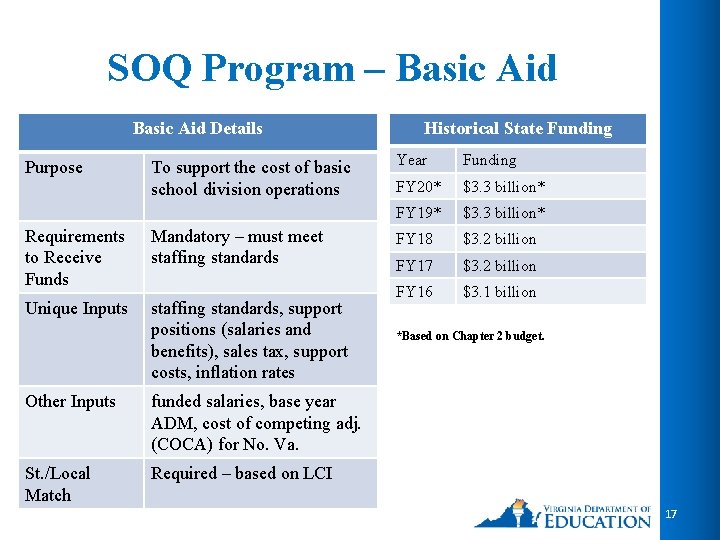
SOQ Program – Basic Aid Details Purpose To support the cost of basic school division operations Requirements to Receive Funds Mandatory – must meet staffing standards Unique Inputs staffing standards, support positions (salaries and benefits), sales tax, support costs, inflation rates Other Inputs funded salaries, base year ADM, cost of competing adj. (COCA) for No. Va. St. /Local Match Required – based on LCI Historical State Funding Year Funding FY 20* $3. 3 billion* FY 19* $3. 3 billion* FY 18 $3. 2 billion FY 17 $3. 2 billion FY 16 $3. 1 billion *Based on Chapter 2 budget. 17
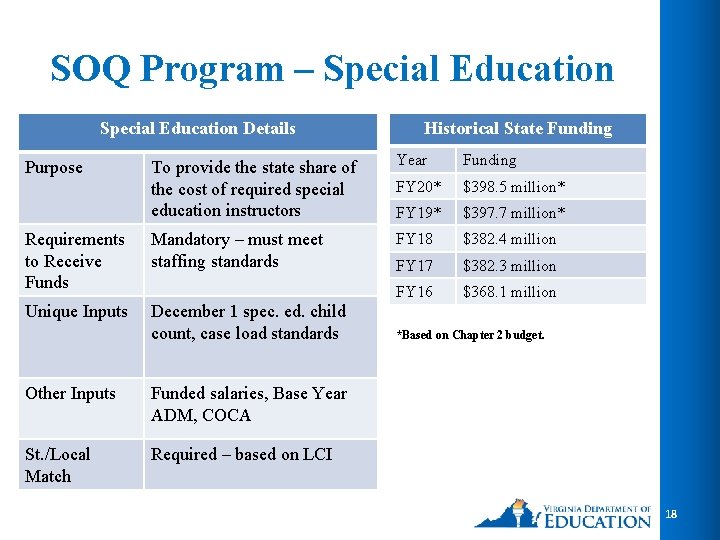
SOQ Program – Special Education Details Historical State Funding To provide the state share of the cost of required special education instructors Year Funding FY 20* $398. 5 million* FY 19* $397. 7 million* Requirements to Receive Funds Mandatory – must meet staffing standards FY 18 $382. 4 million FY 17 $382. 3 million FY 16 $368. 1 million Unique Inputs December 1 spec. ed. child count, case load standards Purpose Other Inputs Funded salaries, Base Year ADM, COCA St. /Local Match Required – based on LCI *Based on Chapter 2 budget. 18
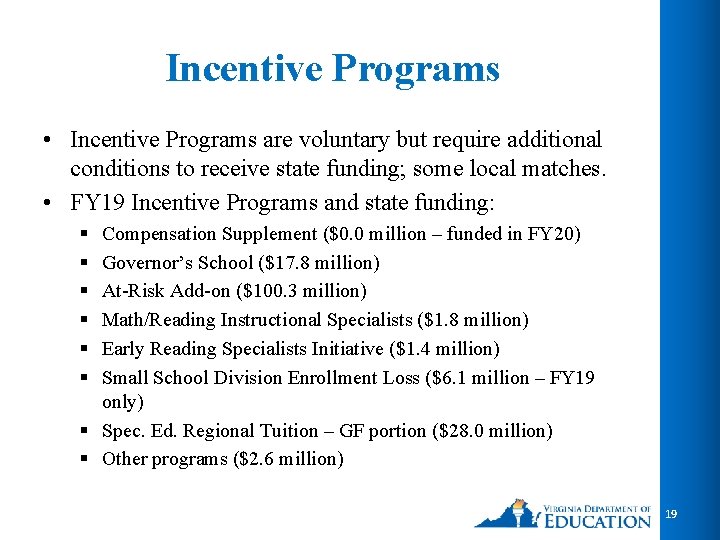
Incentive Programs • Incentive Programs are voluntary but require additional conditions to receive state funding; some local matches. • FY 19 Incentive Programs and state funding: § § § Compensation Supplement ($0. 0 million – funded in FY 20) Governor’s School ($17. 8 million) At-Risk Add-on ($100. 3 million) Math/Reading Instructional Specialists ($1. 8 million) Early Reading Specialists Initiative ($1. 4 million) Small School Division Enrollment Loss ($6. 1 million – FY 19 only) § Spec. Ed. Regional Tuition – GF portion ($28. 0 million) § Other programs ($2. 6 million) 19
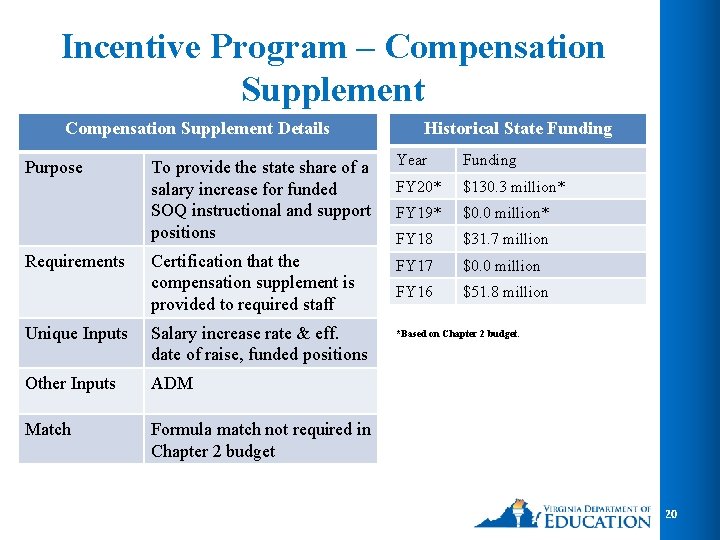
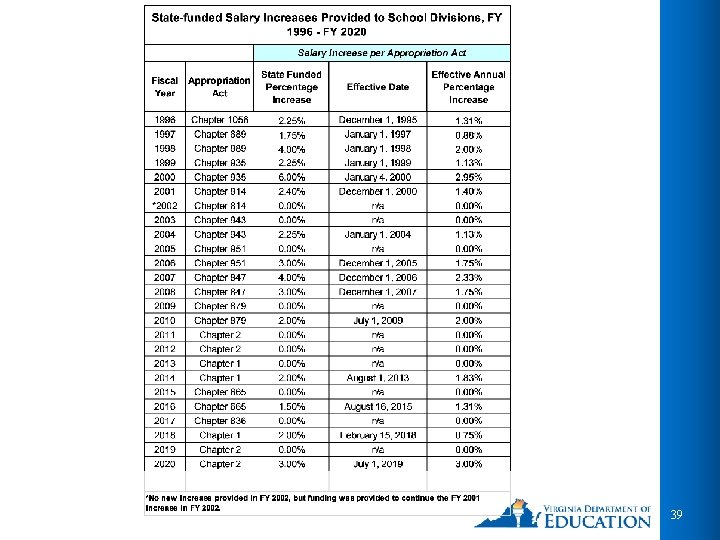
Incentive Program – Compensation Supplement Details Purpose Requirements Historical State Funding To provide the state share of a salary increase for funded SOQ instructional and support positions Year Funding FY 20* $130. 3 million* FY 19* $0. 0 million* FY 18 $31. 7 million Certification that the compensation supplement is provided to required staff FY 17 $0. 0 million FY 16 $51. 8 million Unique Inputs Salary increase rate & eff. date of raise, funded positions Other Inputs ADM Match Formula match not required in Chapter 2 budget *Based on Chapter 2 budget. 20
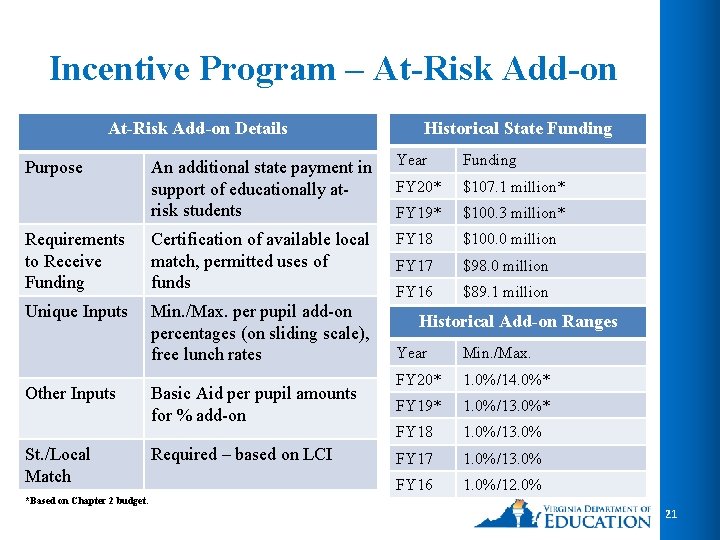
Incentive Program – At-Risk Add-on Details Historical State Funding An additional state payment in support of educationally atrisk students Year Funding FY 20* $107. 1 million* FY 19* $100. 3 million* Requirements to Receive Funding Certification of available local match, permitted uses of funds FY 18 $100. 0 million FY 17 $98. 0 million FY 16 $89. 1 million Unique Inputs Min. /Max. per pupil add-on percentages (on sliding scale), free lunch rates Purpose Other Inputs St. /Local Match Basic Aid per pupil amounts for % add-on Required – based on LCI Historical Add-on Ranges Year Min. /Max. FY 20* 1. 0%/14. 0%* FY 19* 1. 0%/13. 0%* FY 18 1. 0%/13. 0% FY 17 1. 0%/13. 0% FY 16 1. 0%/12. 0% *Based on Chapter 2 budget. 21
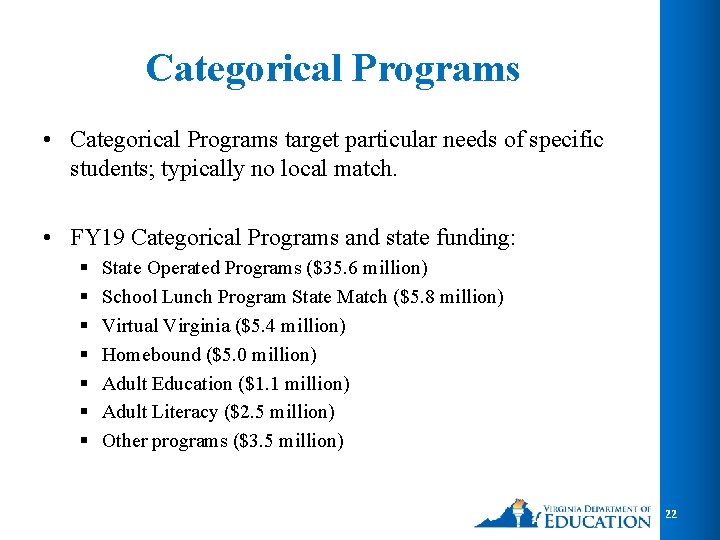
Categorical Programs • Categorical Programs target particular needs of specific students; typically no local match. • FY 19 Categorical Programs and state funding: § § § § State Operated Programs ($35. 6 million) School Lunch Program State Match ($5. 8 million) Virtual Virginia ($5. 4 million) Homebound ($5. 0 million) Adult Education ($1. 1 million) Adult Literacy ($2. 5 million) Other programs ($3. 5 million) 22
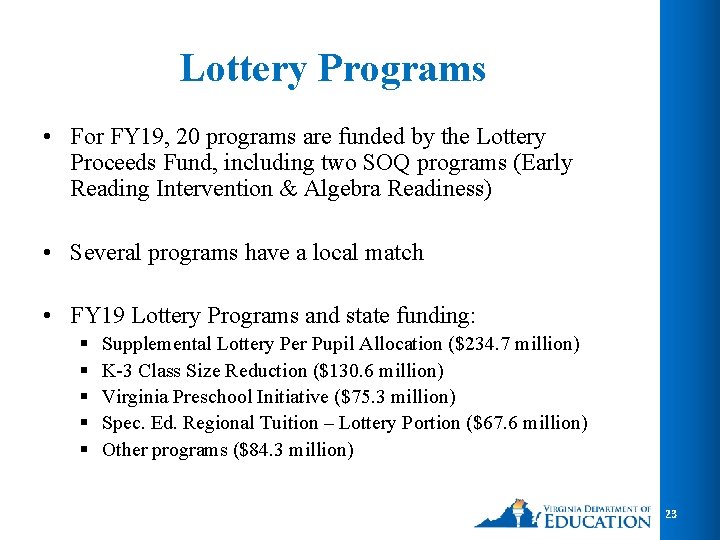
Lottery Programs • For FY 19, 20 programs are funded by the Lottery Proceeds Fund, including two SOQ programs (Early Reading Intervention & Algebra Readiness) • Several programs have a local match • FY 19 Lottery Programs and state funding: § § § Supplemental Lottery Per Pupil Allocation ($234. 7 million) K-3 Class Size Reduction ($130. 6 million) Virginia Preschool Initiative ($75. 3 million) Spec. Ed. Regional Tuition – Lottery Portion ($67. 6 million) Other programs ($84. 3 million) 23
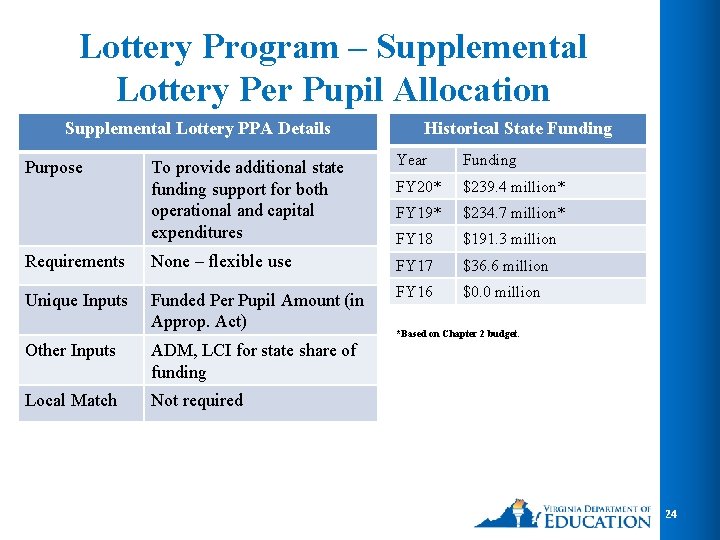
Lottery Program – Supplemental Lottery Per Pupil Allocation Supplemental Lottery PPA Details Historical State Funding To provide additional state funding support for both operational and capital expenditures Year Funding FY 20* $239. 4 million* FY 19* $234. 7 million* FY 18 $191. 3 million Requirements None – flexible use FY 17 $36. 6 million Unique Inputs Funded Per Pupil Amount (in Approp. Act) FY 16 $0. 0 million Purpose Other Inputs ADM, LCI for state share of funding Local Match Not required *Based on Chapter 2 budget. 24
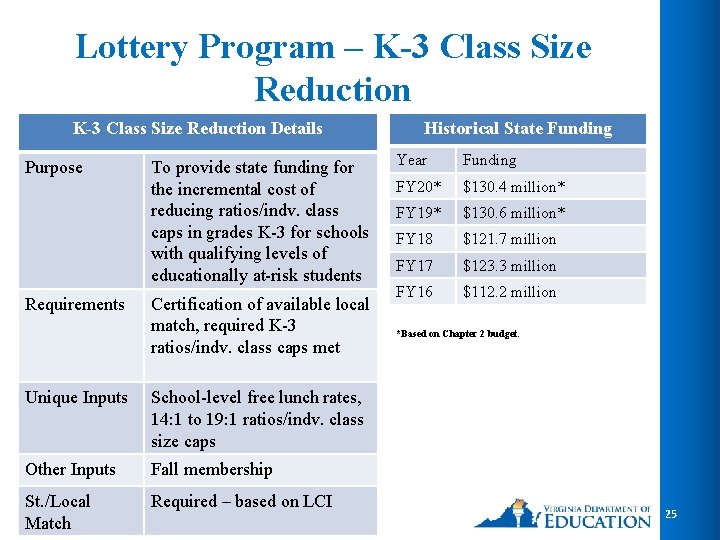
Lottery Program – K-3 Class Size Reduction Details Purpose Requirements To provide state funding for the incremental cost of reducing ratios/indv. class caps in grades K-3 for schools with qualifying levels of educationally at-risk students Certification of available local match, required K-3 ratios/indv. class caps met Unique Inputs School-level free lunch rates, 14: 1 to 19: 1 ratios/indv. class size caps Other Inputs Fall membership St. /Local Match Required – based on LCI Historical State Funding Year Funding FY 20* $130. 4 million* FY 19* $130. 6 million* FY 18 $121. 7 million FY 17 $123. 3 million FY 16 $112. 2 million *Based on Chapter 2 budget. 25
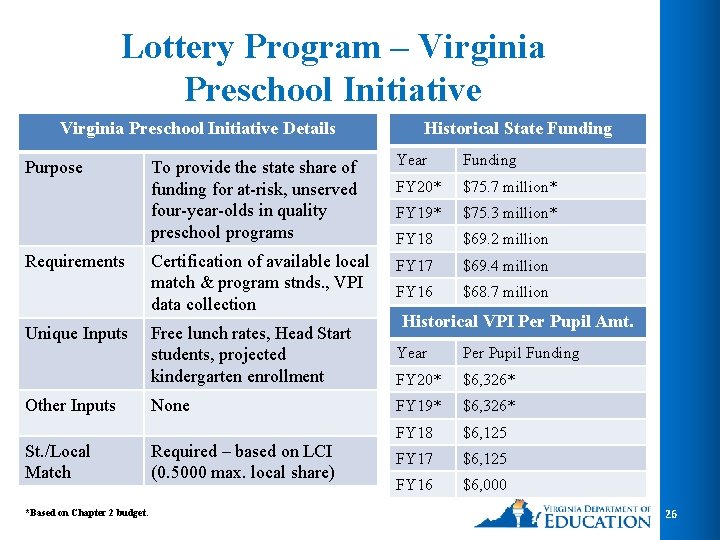
Lottery Program – Virginia Preschool Initiative Details Purpose Requirements Unique Inputs Other Inputs St. /Local Match *Based on Chapter 2 budget. Historical State Funding To provide the state share of funding for at-risk, unserved four-year-olds in quality preschool programs Year Funding FY 20* $75. 7 million* FY 19* $75. 3 million* FY 18 $69. 2 million Certification of available local match & program stnds. , VPI data collection FY 17 $69. 4 million FY 16 $68. 7 million Historical VPI Per Pupil Amt. Free lunch rates, Head Start students, projected kindergarten enrollment Year Per Pupil Funding FY 20* $6, 326* None FY 19* $6, 326* FY 18 $6, 125 FY 17 $6, 125 FY 16 $6, 000 Required – based on LCI (0. 5000 max. local share) 26
State and Local Shares of Funding 27
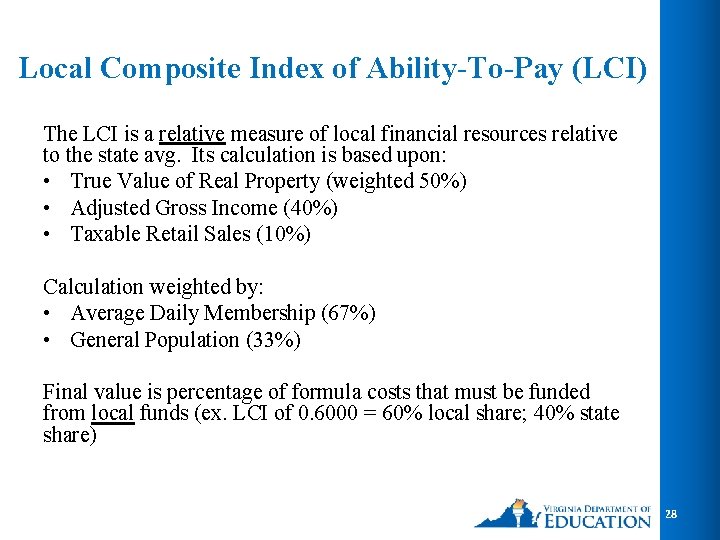
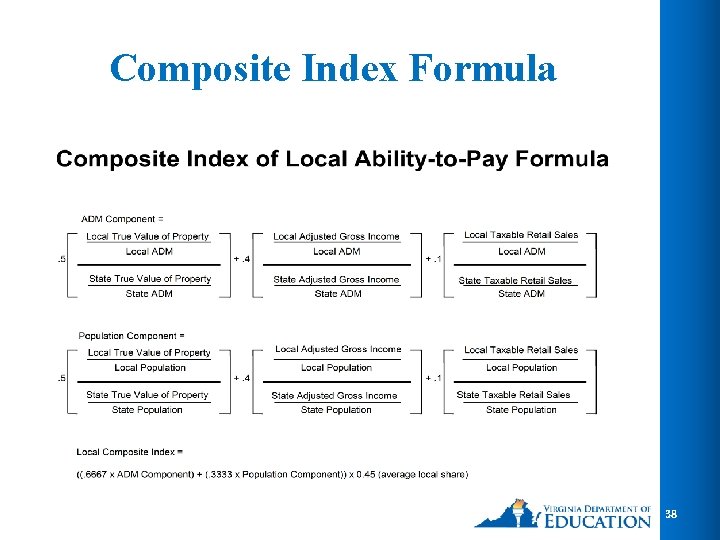
Local Composite Index of Ability-To-Pay (LCI) The LCI is a relative measure of local financial resources relative to the state avg. Its calculation is based upon: • True Value of Real Property (weighted 50%) • Adjusted Gross Income (40%) • Taxable Retail Sales (10%) Calculation weighted by: • Average Daily Membership (67%) • General Population (33%) Final value is percentage of formula costs that must be funded from local funds (ex. LCI of 0. 6000 = 60% local share; 40% state share) 28
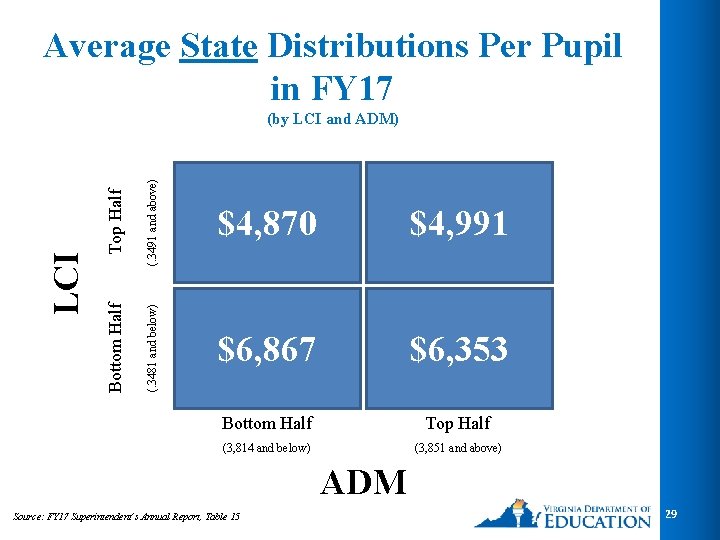
Average State Distributions Per Pupil in FY 17 Top Half (. 3491 and above) $4, 870 Bottom Half (. 3481 and below) LCI (by LCI and ADM) $6, 867 $4, 991 $6, 353 Bottom Half Top Half (3, 814 and below) (3, 851 and above) ADM Source: FY 17 Superintendent’s Annual Report, Table 15 29
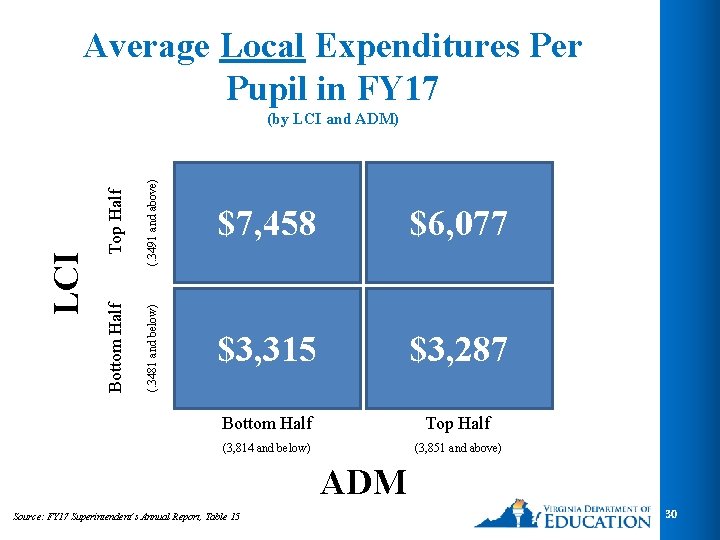
Average Local Expenditures Per Pupil in FY 17 Top Half (. 3491 and above) $7, 458 Bottom Half (. 3481 and below) LCI (by LCI and ADM) $3, 315 $6, 077 $3, 287 Bottom Half Top Half (3, 814 and below) (3, 851 and above) ADM Source: FY 17 Superintendent’s Annual Report, Table 15 30
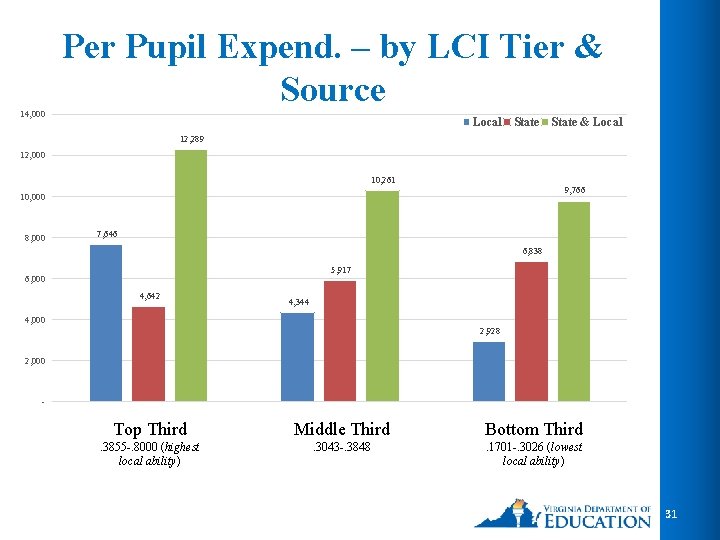
Per Pupil Expend. – by LCI Tier & Source 14, 000 Local State & Local 12, 289 12, 000 10, 261 9, 766 10, 000 8, 000 7, 646 6, 838 5, 917 6, 000 4, 642 4, 344 4, 000 2, 928 2, 000 - Top Third Middle Third Bottom Third . 3855 -. 8000 (highest local ability) . 3043 -. 3848 . 1701 -. 3026 (lowest local ability) 31
Formula Approaches to Recognize Student Need 32
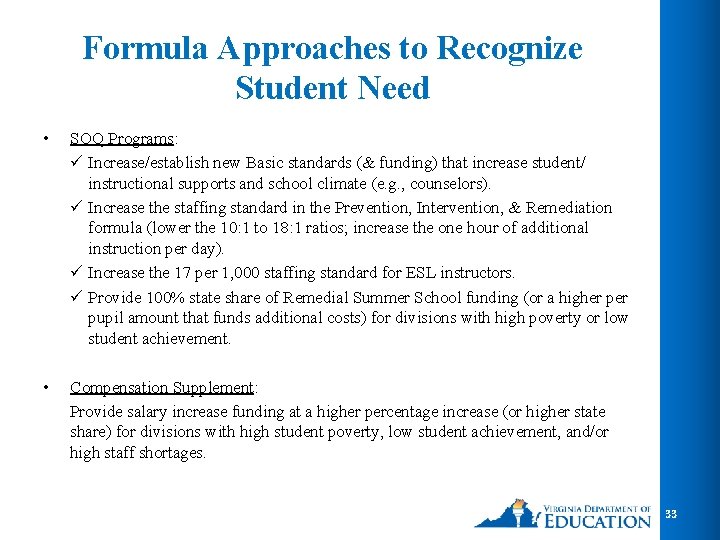
Formula Approaches to Recognize Student Need • SOQ Programs: ü Increase/establish new Basic standards (& funding) that increase student/ instructional supports and school climate (e. g. , counselors). ü Increase the staffing standard in the Prevention, Intervention, & Remediation formula (lower the 10: 1 to 18: 1 ratios; increase the one hour of additional instruction per day). ü Increase the 17 per 1, 000 staffing standard for ESL instructors. ü Provide 100% state share of Remedial Summer School funding (or a higher pupil amount that funds additional costs) for divisions with high poverty or low student achievement. • Compensation Supplement: Provide salary increase funding at a higher percentage increase (or higher state share) for divisions with high student poverty, low student achievement, and/or high staff shortages. 33
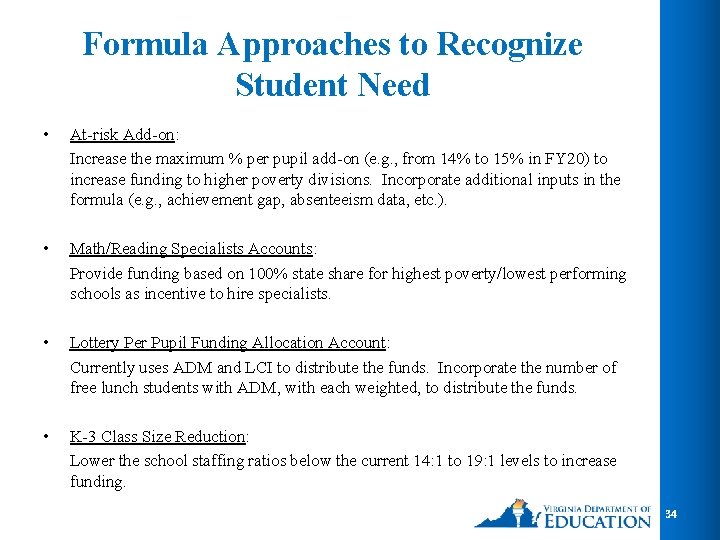
Formula Approaches to Recognize Student Need • At-risk Add-on: Increase the maximum % per pupil add-on (e. g. , from 14% to 15% in FY 20) to increase funding to higher poverty divisions. Incorporate additional inputs in the formula (e. g. , achievement gap, absenteeism data, etc. ). • Math/Reading Specialists Accounts: Provide funding based on 100% state share for highest poverty/lowest performing schools as incentive to hire specialists. • Lottery Per Pupil Funding Allocation Account: Currently uses ADM and LCI to distribute the funds. Incorporate the number of free lunch students with ADM, with each weighted, to distribute the funds. • K-3 Class Size Reduction: Lower the school staffing ratios below the current 14: 1 to 19: 1 levels to increase funding. 34
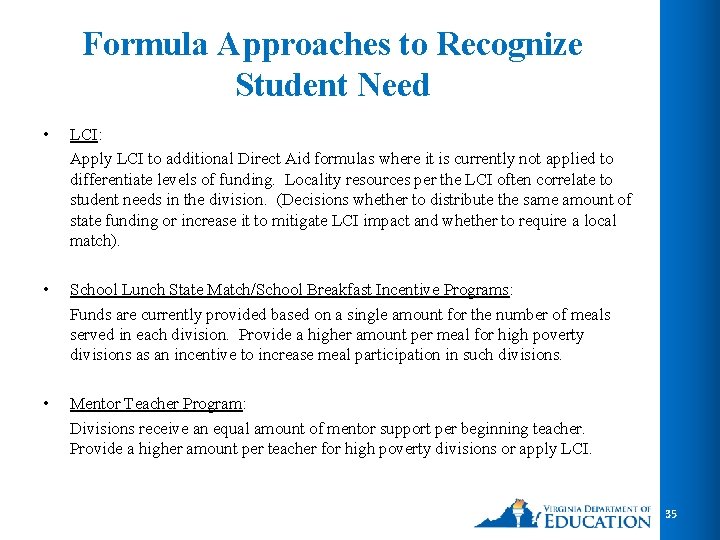
Formula Approaches to Recognize Student Need • LCI: Apply LCI to additional Direct Aid formulas where it is currently not applied to differentiate levels of funding. Locality resources per the LCI often correlate to student needs in the division. (Decisions whether to distribute the same amount of state funding or increase it to mitigate LCI impact and whether to require a local match). • School Lunch State Match/School Breakfast Incentive Programs: Funds are currently provided based on a single amount for the number of meals served in each division. Provide a higher amount per meal for high poverty divisions as an incentive to increase meal participation in such divisions. • Mentor Teacher Program: Divisions receive an equal amount of mentor support per beginning teacher. Provide a higher amount per teacher for high poverty divisions or apply LCI. 35
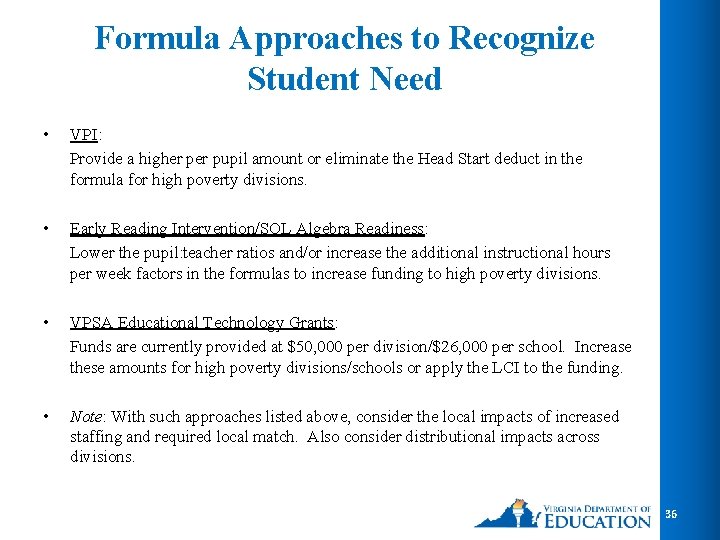
Formula Approaches to Recognize Student Need • VPI: Provide a higher pupil amount or eliminate the Head Start deduct in the formula for high poverty divisions. • Early Reading Intervention/SOL Algebra Readiness: Lower the pupil: teacher ratios and/or increase the additional instructional hours per week factors in the formulas to increase funding to high poverty divisions. • VPSA Educational Technology Grants: Funds are currently provided at $50, 000 per division/$26, 000 per school. Increase these amounts for high poverty divisions/schools or apply the LCI to the funding. • Note: With such approaches listed above, consider the local impacts of increased staffing and required local match. Also consider distributional impacts across divisions. 36
Appendices 37
Composite Index Formula 38
State Funded Salary Increases 39