
Overview of Underground Facility Needs of Gravity Experiments

- Slides: 13
Overview of Underground Facility Needs of Gravity Experiments Tim Kovachy Department of Physics and Astronomy and Center for Fundamental Physics, Northwestern University Snowmass CPM Meeting 2020
Summary • Multiple types of experiments related to gravity that could benefit from underground facilities – Microgravity experiments that benefit from a long free fall distance – Gravitational wave and dark matter detectors with atom and laser interferometry – Tests of GR with precision gyroscopes – Short-distance gravity tests – Dark matter and axion searches using precision experiments • Suggestions encouraged for additional experiments to add to this list
Microgravity Experiments • Leverage long free fall distance to achieve microgravity over many seconds • Underground offers potential for longer free fall distances (hundreds of meters to km scale) • Examples of experiments that can benefit from microgravity – Equivalence principle tests – Studying the interplay between gravity and quantum coherence via matter wave interferometry with macroscopic objects
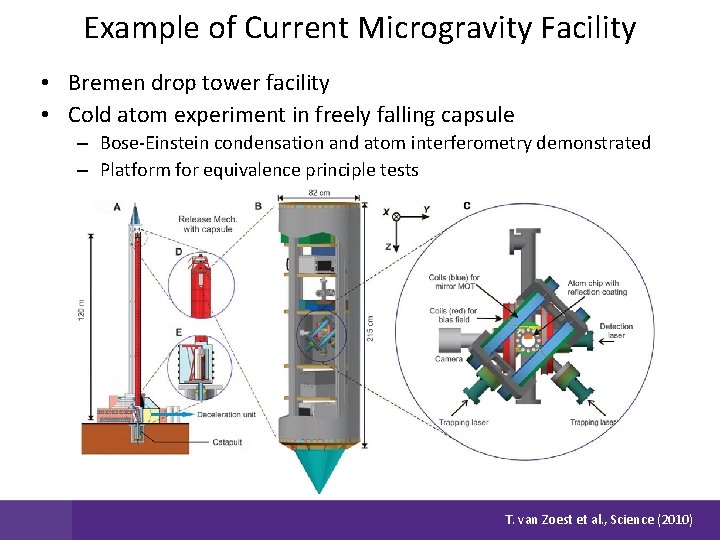
Example of Current Microgravity Facility • Bremen drop tower facility • Cold atom experiment in freely falling capsule – Bose-Einstein condensation and atom interferometry demonstrated – Platform for equivalence principle tests T. van Zoest et al. , Science (2010)
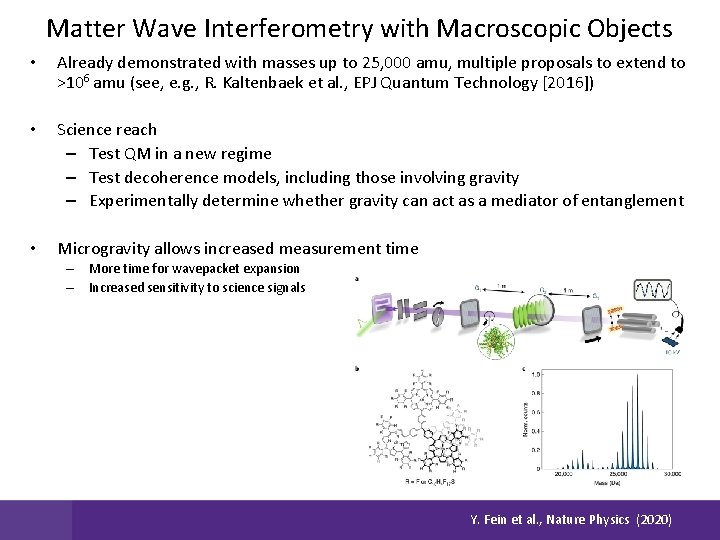
Matter Wave Interferometry with Macroscopic Objects • Already demonstrated with masses up to 25, 000 amu, multiple proposals to extend to >106 amu (see, e. g. , R. Kaltenbaek et al. , EPJ Quantum Technology [2016]) • Science reach – Test QM in a new regime – Test decoherence models, including those involving gravity – Experimentally determine whether gravity can act as a mediator of entanglement • Microgravity allows increased measurement time – More time for wavepacket expansion – Increased sensitivity to science signals Y. Fein et al. , Nature Physics (2020)
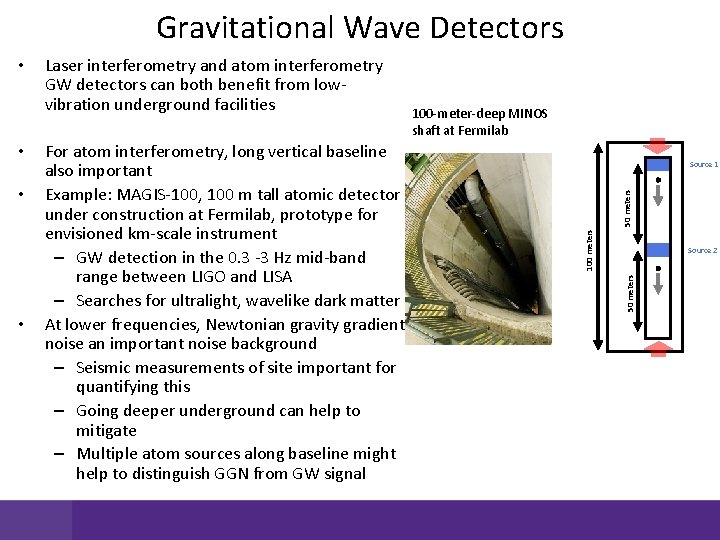
Gravitational Wave Detectors • Source 1 50 meters • For atom interferometry, long vertical baseline also important Example: MAGIS-100, 100 m tall atomic detector under construction at Fermilab, prototype for envisioned km-scale instrument – GW detection in the 0. 3 -3 Hz mid-band range between LIGO and LISA – Searches for ultralight, wavelike dark matter At lower frequencies, Newtonian gravity gradient noise an important noise background – Seismic measurements of site important for quantifying this – Going deeper underground can help to mitigate – Multiple atom sources along baseline might help to distinguish GGN from GW signal 100 -meter-deep MINOS shaft at Fermilab Source 2 50 meters • Laser interferometry and atom interferometry GW detectors can both benefit from lowvibration underground facilities 100 meters •
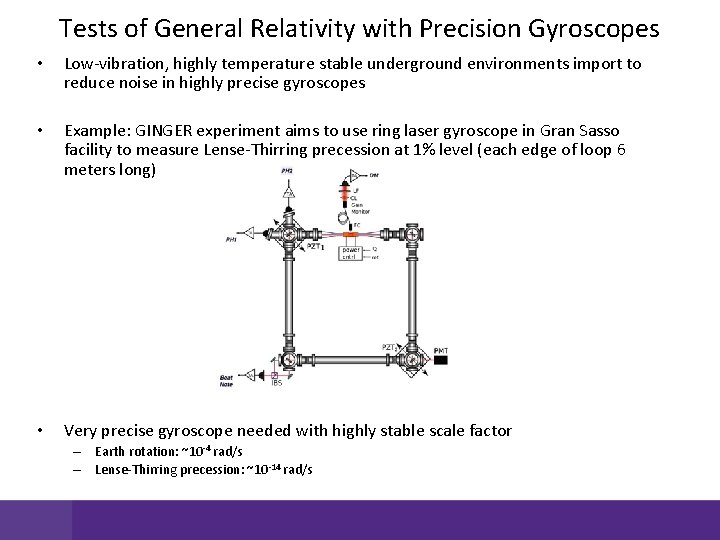
Tests of General Relativity with Precision Gyroscopes • Low-vibration, highly temperature stable underground environments import to reduce noise in highly precise gyroscopes • Example: GINGER experiment aims to use ring laser gyroscope in Gran Sasso facility to measure Lense-Thirring precession at 1% level (each edge of loop 6 meters long) • Very precise gyroscope needed with highly stable scale factor – Earth rotation: ~10 -4 rad/s – Lense-Thirring precession: ~10 -14 rad/s
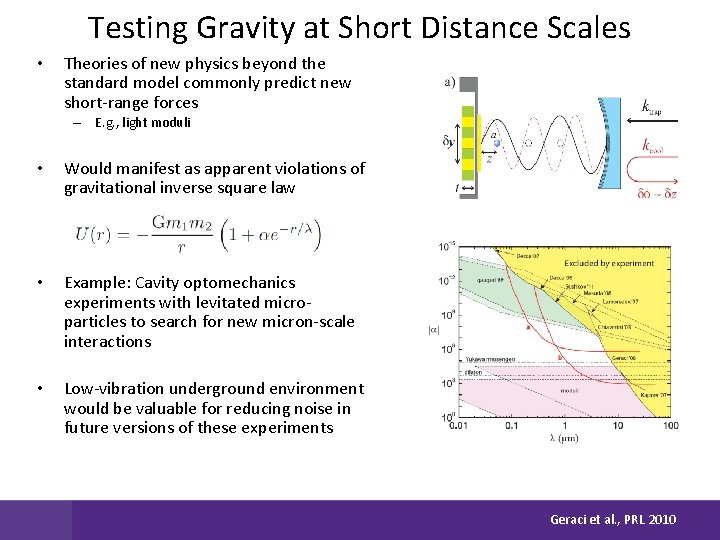
Testing Gravity at Short Distance Scales • Theories of new physics beyond the standard model commonly predict new short-range forces – E. g. , light moduli • Would manifest as apparent violations of gravitational inverse square law • Example: Cavity optomechanics experiments with levitated microparticles to search for new micron-scale interactions • Low-vibration underground environment would be valuable for reducing noise in future versions of these experiments Geraci et al. , PRL 2010
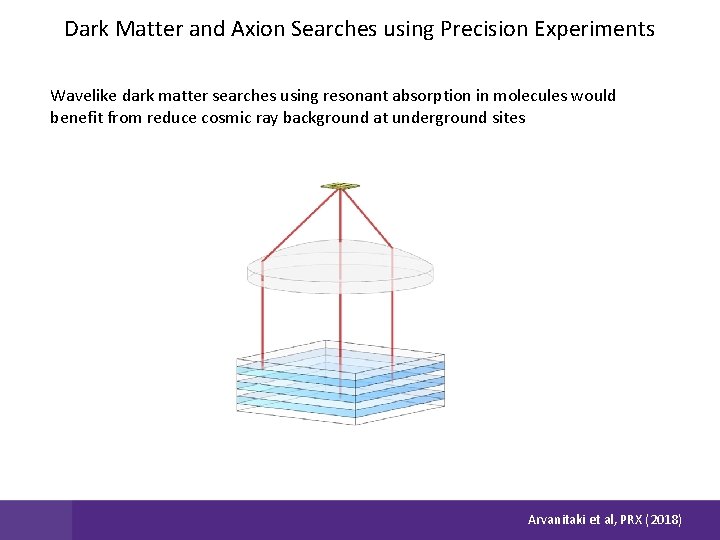
Dark Matter and Axion Searches using Precision Experiments Wavelike dark matter searches using resonant absorption in molecules would benefit from reduce cosmic ray background at underground sites Arvanitaki et al, PRX (2018)
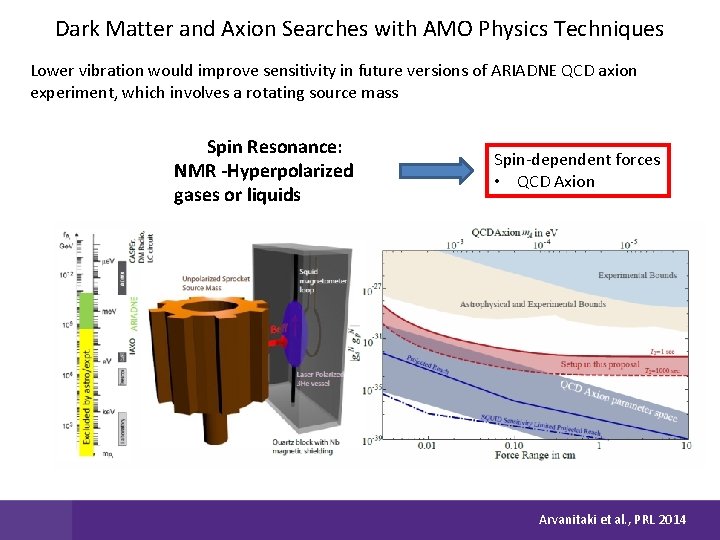
Dark Matter and Axion Searches with AMO Physics Techniques Lower vibration would improve sensitivity in future versions of ARIADNE QCD axion experiment, which involves a rotating source mass Spin Resonance: NMR -Hyperpolarized gases or liquids Spin-dependent forces • QCD Axion Arvanitaki et al. , PRL 2014
Conclusion • Many types of gravitational experiments could benefit from underground facilities • Key needs: – large vertical height (up to km scale), – sites with low vibration and high temperature stability – Experimental infrastructure: electrical power, access for maintenance, ventilation, remote monitoring and control, etc… • Relevant advantages of undergound: – – Opportunity for long vertical baselines/free fall distances Sites with low vibrations Sites with excellent temperature stability Lower cosmic ray background
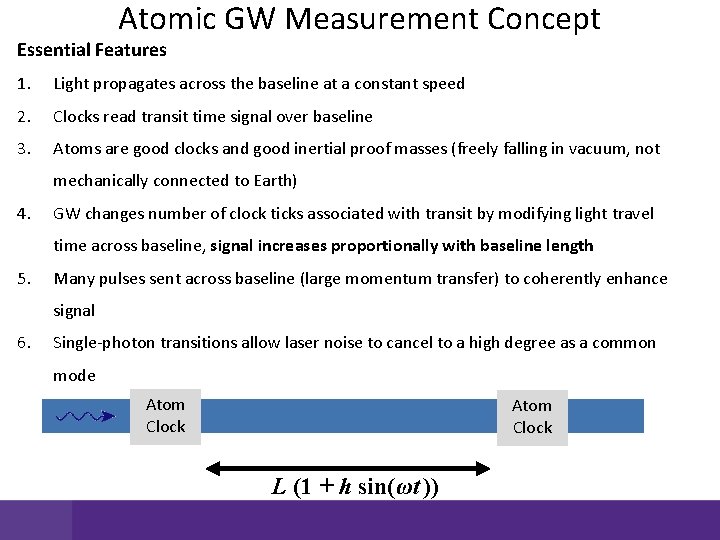
Atomic GW Measurement Concept Essential Features 1. Light propagates across the baseline at a constant speed 2. Clocks read transit time signal over baseline 3. Atoms are good clocks and good inertial proof masses (freely falling in vacuum, not mechanically connected to Earth) 4. GW changes number of clock ticks associated with transit by modifying light travel time across baseline, signal increases proportionally with baseline length 5. Many pulses sent across baseline (large momentum transfer) to coherently enhance signal 6. Single-photon transitions allow laser noise to cancel to a high degree as a common mode Atom Clock L (1 + h sin(ωt ))
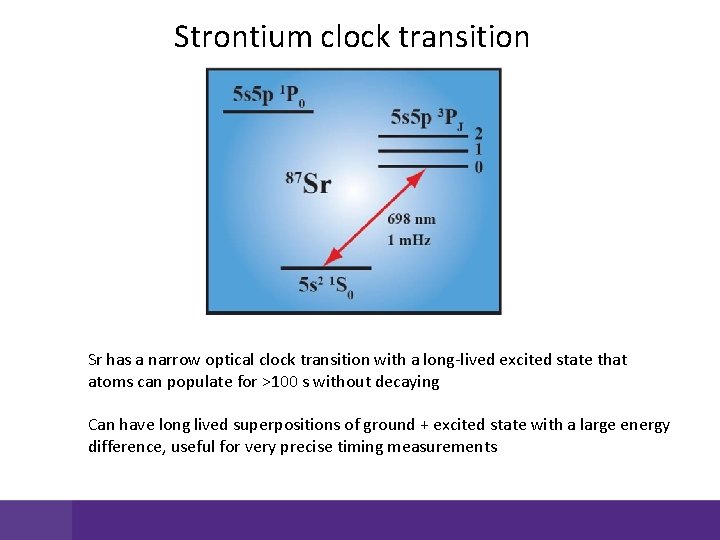
Strontium clock transition Sr has a narrow optical clock transition with a long-lived excited state that atoms can populate for >100 s without decaying Can have long lived superpositions of ground + excited state with a large energy difference, useful for very precise timing measurements