
Overview of the Trans XChange Model Trans XChange


- Slides: 14
Overview of the Trans. XChange Model (Trans. XChange. Schema. Guide-2. 1 -v-44)
Representing a Bus Service in Trans. XChange n 1. 2. 3. 4. 5. 6. 7. The Trans. XChange model has seven basic concepts that it uses to represent a bus service: Service; Registration; Operator; Stop. Point; Route; Journey. Pattern; and Vehicle. Journey.
(1) The Service Model n n A Service brings together the information about a registered bus service, and may contain two types of component service: Standard or Flexible; a mix of both types is allowed within a single Service. A normal bus schedule is described by a Standard. Service. A Flexible. Service describes a bus service that does not have a fixed route, but only a catchment area or a few variable stops with no prescribed pattern of use. Both types of service have a registered Operator, who runs the service. Other associated operator roles can also be specified. A Registration specifies the registration details for a service. It is mandatory in the registration schema.
(2) The Na. PTAN Stop Model n n n Trans. XChange uses the Na. PTAN stop model to define the stops and timing points of routes, and to associate stops with topographical locations in the National Public Transport Gazetteer (NPTG). Normally in Trans. XChange, stops comprise just a reference to an existing Na. PTAN definition using a stop code; all such references are declared as Annotated. Stop. Point. Ref instances. However, full Stop. Point definitions for new bus stops may also be provided locally in a Trans. XChange document (a Na. PTAN identifier must also be allocated for look-ups later).
(2) The Na. PTAN Stop Model n n Stop. Point: Describes a stop, it contains a place, which is used to associate the stop with an Nptg. Locality: localities are defined in the NPTG database and are open to the Local Transport Authority to edit. Stops may be of a number of different types and subtypes, each with different properties. Stop. Area: Used to group stops together. Nptg. Locality: Representing a topographical locality in the country, such as a city, town or village. Localities must exist in the NPTG database. Used to specify where a Stop. Point or Stop. Area is relative to towns and cities. Administrative. Area. All Na. PTAN and NPTG elements are assigned to an administrative area, representing the organisation responsible for maintaining the stop data.
(2) The Na. PTAN Stop Model n n n When importing Trans. XChange schedules, an importing application will normally attempt to look-up the Stop. Point details in the Na. PTAN database using the Na. PTAN identifier, i. e. the Atco. Code. If found, the application will probably use the database’s definition of the stop details in preference to any local definitions. Only if no existing Stop. Point definition is found, will the locally declared definition be used.
(3) The Route Model n n Trans. XChange describes a bus service using a model made up of three distinct layers: 1. A Route describes the physical path taken by buses on the service as a set of ‘route links’. A Route specifies in effect an ordered list of Stop. Points. 2. A Journey. Pattern specifies an ordered list of links between these points, giving relative times between each stop; 3. A Vehicle. Journey follows the same list of stops at specific absolute passing times.
(3) The Route Model n n n 1. A Route; described as a sequence of ‘route links’ connecting individual stops. For Trans. XChange, all stops are defined as being Na. PTAN points, so a route describes a path in Na. PTAN space ; a distinct frame of reference made up of Public Transport Access Nodes (PTANs). Track elements record both the plot of the route at non. Na. PTAN points, and associations with mapping layer identifiers, such as OS TOIDS. The Route. Link instances are grouped using a Route. Section, allowing the reuse of whole sequences of links in different routes.
(3) The Route Model n n 2. A Journey. Pattern: a path over the route made up of a number of journey pattern timing links, each with timing information (and other optional operational data) ascribed to them. All timing information is relative (for example, +5 minutes ). Each end of a Journey. Pattern. Timing. Link can have stop usage information associated with it on a Journey. Pattern. Stop. Usage element, specifying the activity at stop, and other service information.
(3) The Route Model n n n … The timing links are grouped using a Journey. Pattern. Section, allowing the reuse of whole sequences of links in different patterns. The links of a Journey. Pattern must traverse the same stops in the same sequence as the links of any Route associated with the Journey. Pattern. However a Journey. Pattern need not cover the whole Route; it may project onto just a contiguous subset of the links of the route, omitting route links at either or both ends.
(3) The Route Model n n 3. A Vehicle. Journey: a traversal of a specific journey pattern at a specific time: again modelled as a sequence of timing links connecting Na. PTAN stops, using Vehicle. Journey. Timing. Link and Vehicle. Journey. Stop. Usage elements. Each vehicle journey has an absolute start time (e. g. '13: 02') specified: this can be combined with the timing information from each timing link to derive the actual passing times of departure and arrival at each timing point.
(3) The Route Model n n n … The public identifier of a Vehicle. Journey is given by a Line. One or more Line instances may be associated with a service, and a Vehicle. Journey must reference one of its service's lines. The link sequence of a Vehicle. Journey must exactly correspond to the link sequence of the underlying Journey. Pattern; that is, each Vehicle. Journey. Timing. Link must project onto a corresponding Journey. Pattern. Timing. Link.
Other Aspects of the Model n Trans. XChange can also handle: n n Flexibly Routes Services Interchanges Fare Stages Dead runs Days of Operation n For further information on these topics see the Schema Guide. n n n
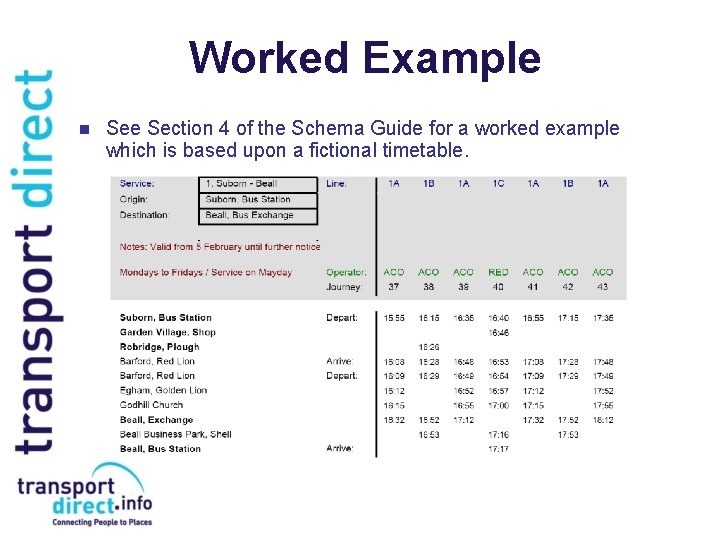
Worked Example n See Section 4 of the Schema Guide for a worked example which is based upon a fictional timetable.