
Overview of the Theory of Self Dual Fields

- Slides: 57
Overview of the Theory of Self -Dual Fields Washington DC, Jan. 8, 2009 Review of work done over the past few years with D. Belov, D. Freed, and G. Segal
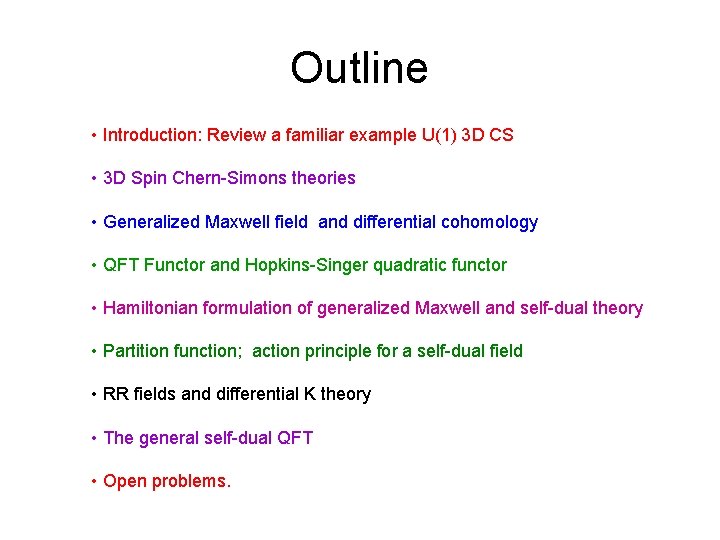
Outline • Introduction: Review a familiar example U(1) 3 D CS • 3 D Spin Chern-Simons theories • Generalized Maxwell field and differential cohomology • QFT Functor and Hopkins-Singer quadratic functor • Hamiltonian formulation of generalized Maxwell and self-dual theory • Partition function; action principle for a self-dual field • RR fields and differential K theory • The general self-dual QFT • Open problems.
Introduction Chiral fields are very familiar to practitioners of 2 d conformal field theory and 3 d Chern-Simons theory I will describe certain generalizations of this mathematical structure, for the case of abelian gauge theories involving differential forms of higher degrees, defined in higher dimensions, and indeed valued in (differential) generalized cohomology theories. These kinds of theories arise naturally in supergravity and superstring theories, and play a key role in theory of D-branes and in the claims of moduli stabilization in string theory that have been made in the past few years.
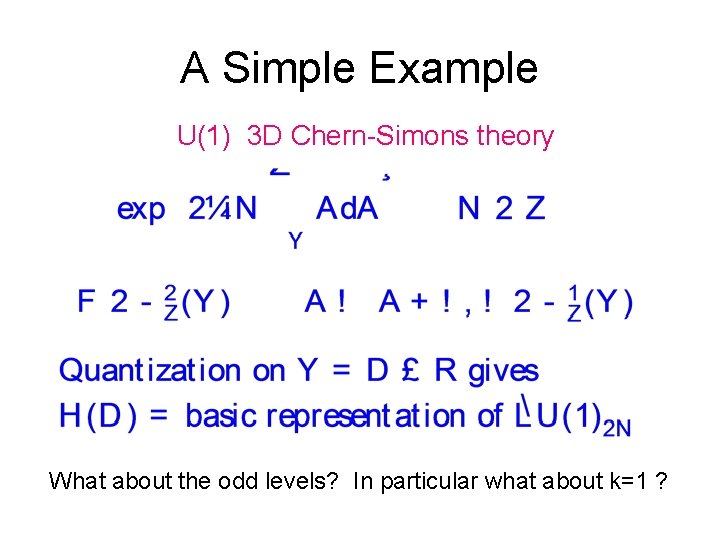
A Simple Example U(1) 3 D Chern-Simons theory What about the odd levels? In particular what about k=1 ?
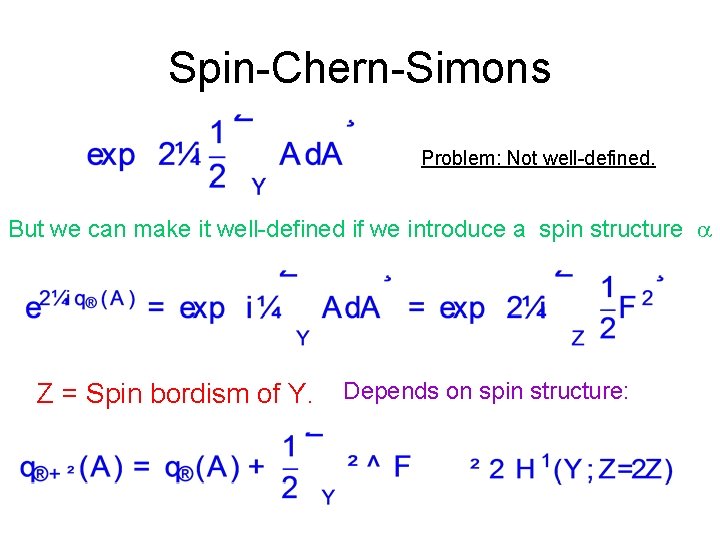
Spin-Chern-Simons Problem: Not well-defined. But we can make it well-defined if we introduce a spin structure a Z = Spin bordism of Y. Depends on spin structure:
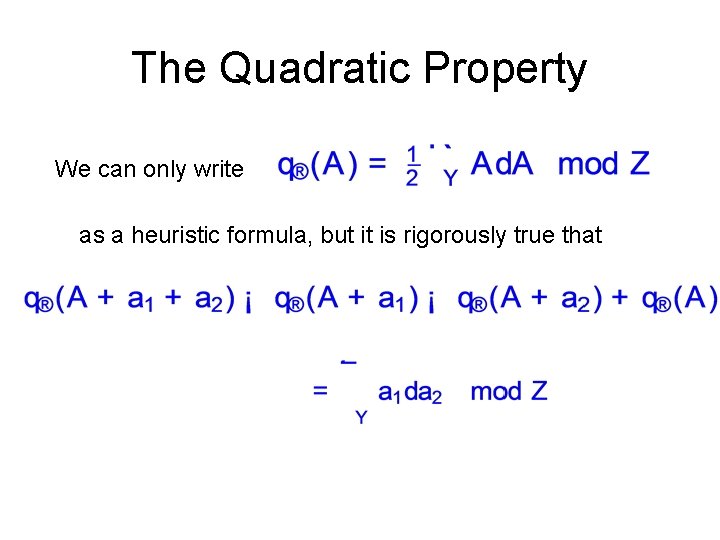
The Quadratic Property We can only write as a heuristic formula, but it is rigorously true that
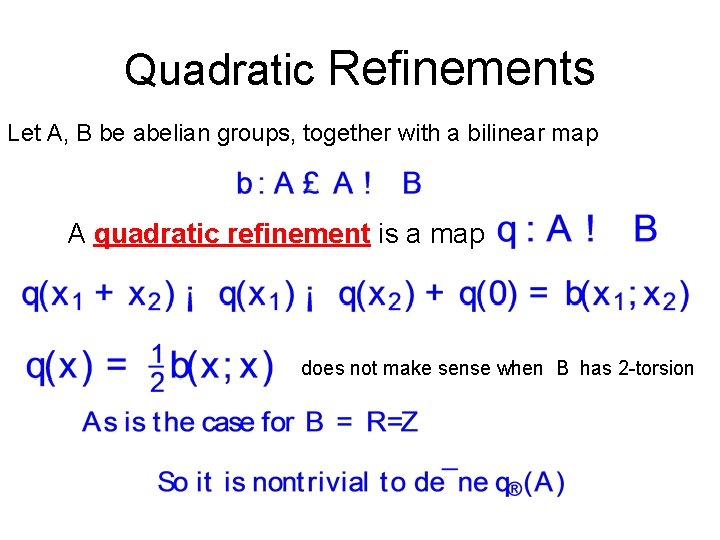
Quadratic Refinements Let A, B be abelian groups, together with a bilinear map A quadratic refinement is a map does not make sense when B has 2 -torsion
General Principle An essential feature in the formulation of self-dual theory always involves a choice of certain quadratic refinements.
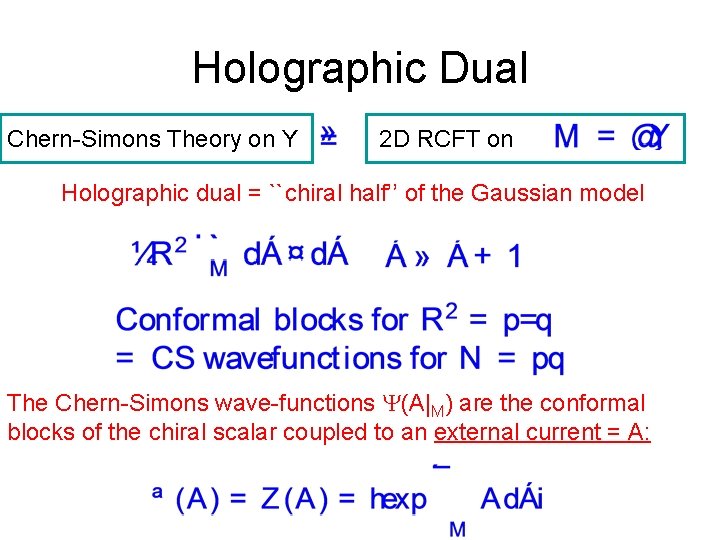
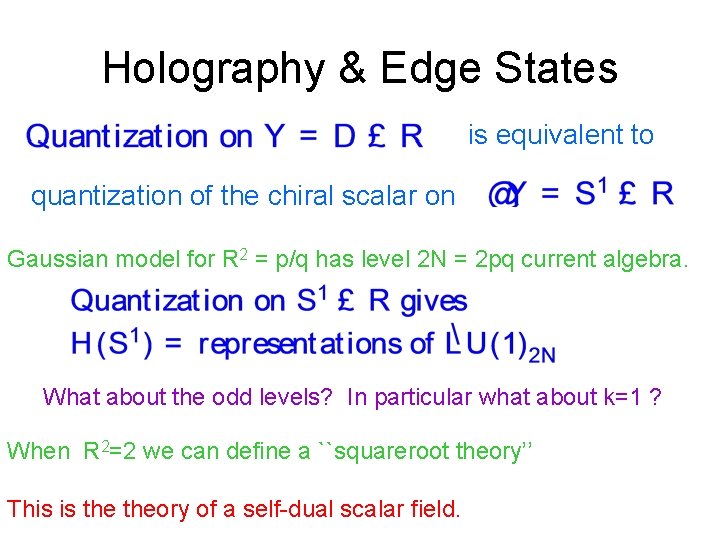
Holographic Dual Chern-Simons Theory on Y 2 D RCFT on Holographic dual = ``chiral half’’ of the Gaussian model The Chern-Simons wave-functions Y(A|M) are the conformal blocks of the chiral scalar coupled to an external current = A:
Holography & Edge States is equivalent to quantization of the chiral scalar on Gaussian model for R 2 = p/q has level 2 N = 2 pq current algebra. What about the odd levels? In particular what about k=1 ? When R 2=2 we can define a ``squareroot theory’’ This is theory of a self-dual scalar field.
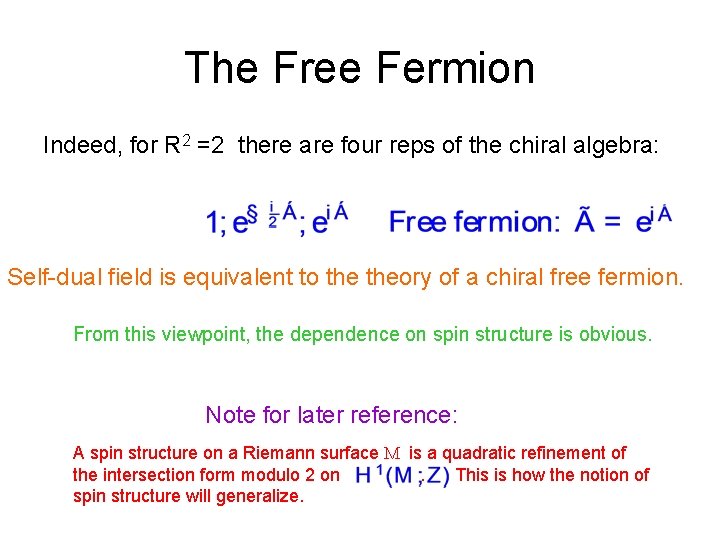
The Free Fermion Indeed, for R 2 =2 there are four reps of the chiral algebra: Self-dual field is equivalent to theory of a chiral free fermion. From this viewpoint, the dependence on spin structure is obvious. Note for later reference: A spin structure on a Riemann surface M is a quadratic refinement of the intersection form modulo 2 on. This is how the notion of spin structure will generalize.
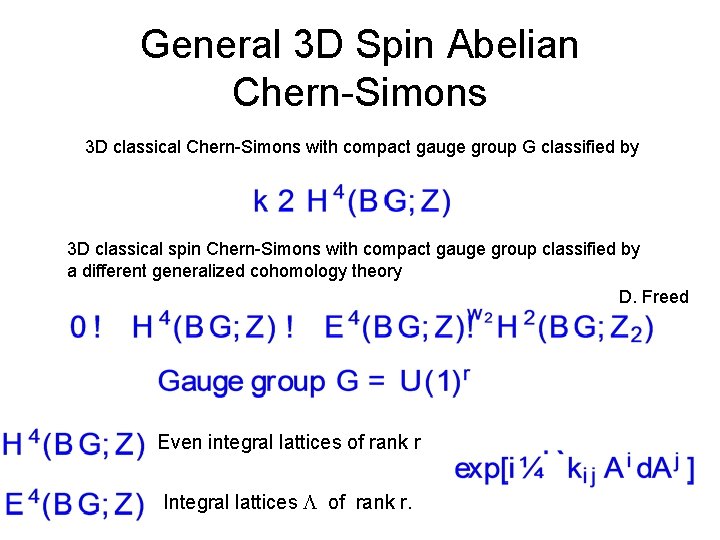
General 3 D Spin Abelian Chern-Simons 3 D classical Chern-Simons with compact gauge group G classified by 3 D classical spin Chern-Simons with compact gauge group classified by a different generalized cohomology theory D. Freed Even integral lattices of rank r Integral lattices L of rank r.
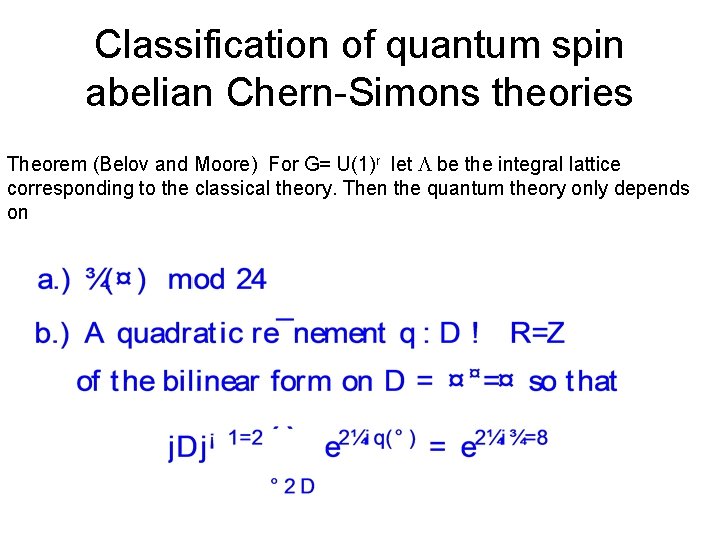
Classification of quantum spin abelian Chern-Simons theories Theorem (Belov and Moore) For G= U(1)r let L be the integral lattice corresponding to the classical theory. Then the quantum theory only depends on
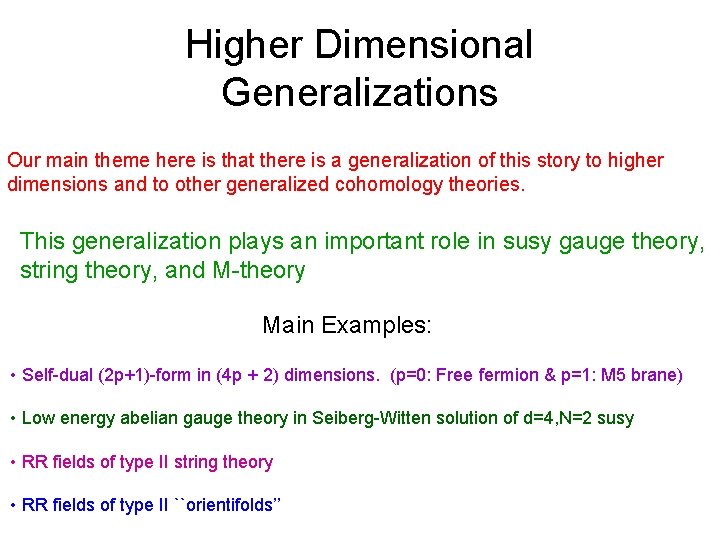
Higher Dimensional Generalizations Our main theme here is that there is a generalization of this story to higher dimensions and to other generalized cohomology theories. This generalization plays an important role in susy gauge theory, string theory, and M-theory Main Examples: • Self-dual (2 p+1)-form in (4 p + 2) dimensions. (p=0: Free fermion & p=1: M 5 brane) • Low energy abelian gauge theory in Seiberg-Witten solution of d=4, N=2 susy • RR fields of type II string theory • RR fields of type II ``orientifolds’’
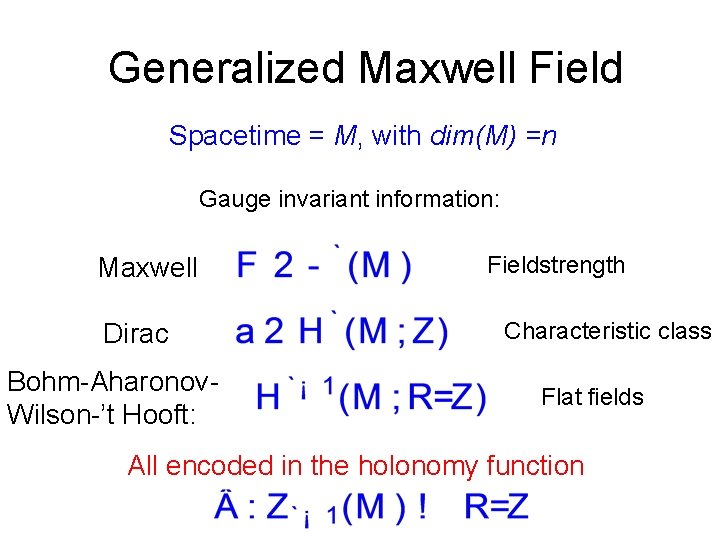
Generalized Maxwell Field Spacetime = M, with dim(M) =n Gauge invariant information: Maxwell Dirac Bohm-Aharonov. Wilson-’t Hooft: Fieldstrength Characteristic class Flat fields All encoded in the holonomy function
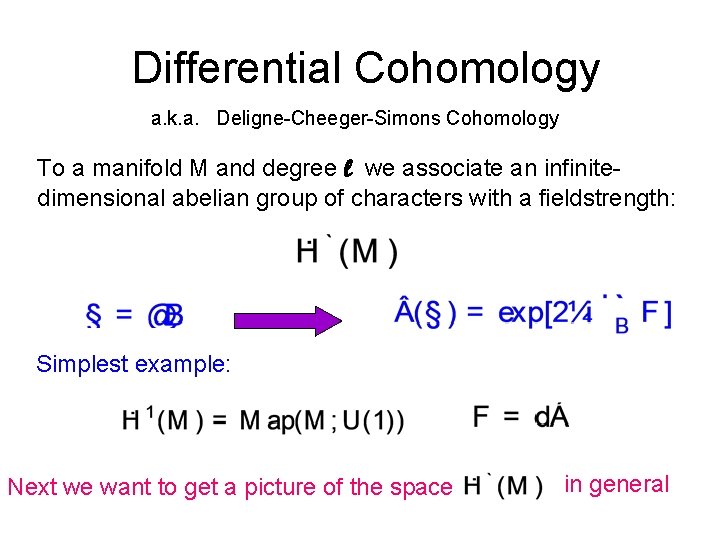
Differential Cohomology a. k. a. Deligne-Cheeger-Simons Cohomology To a manifold M and degree l we associate an infinitedimensional abelian group of characters with a fieldstrength: Simplest example: Next we want to get a picture of the space in general
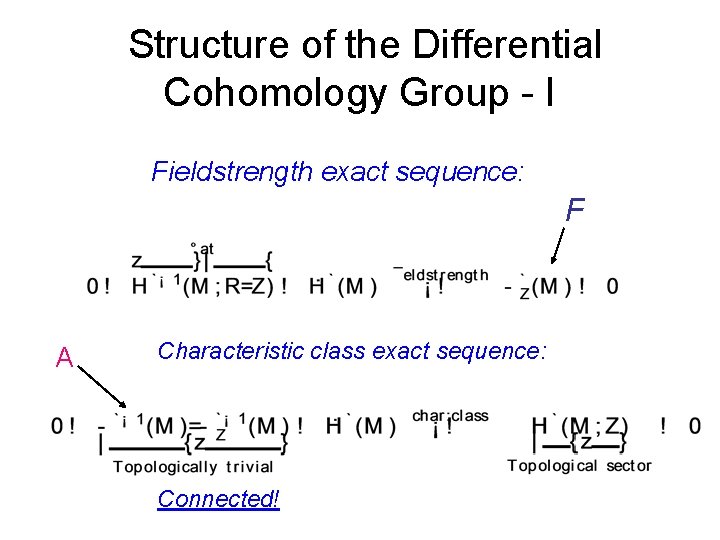
Structure of the Differential Cohomology Group - I Fieldstrength exact sequence: F A Characteristic class exact sequence: Connected!
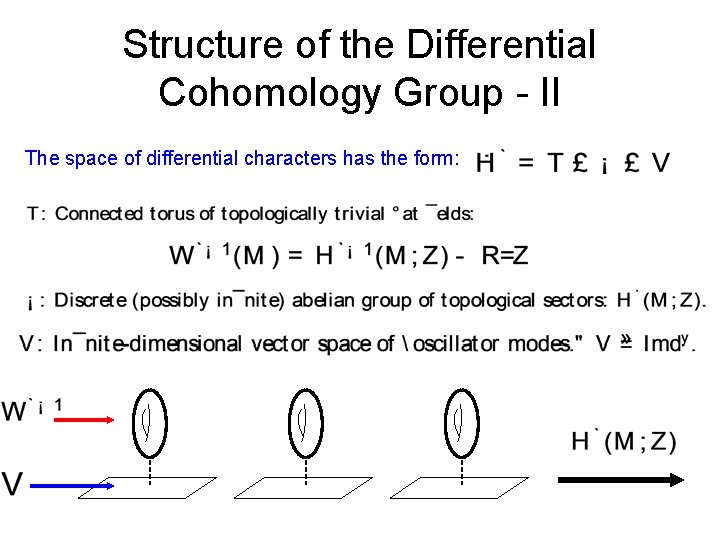
Structure of the Differential Cohomology Group - II The space of differential characters has the form:
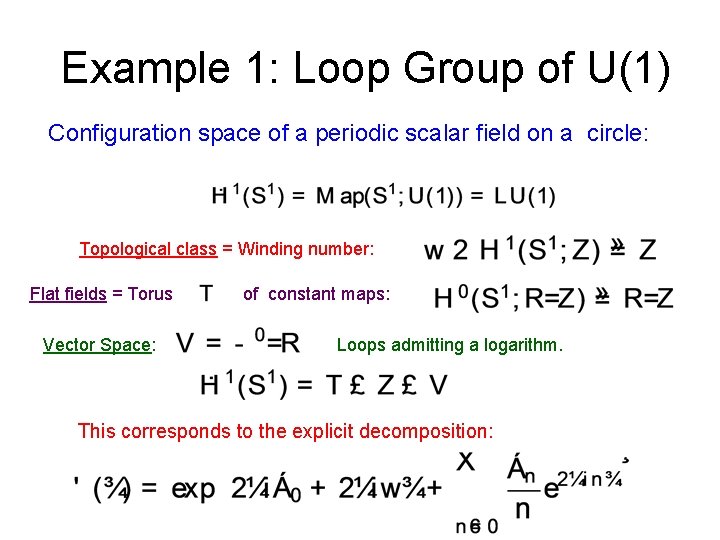
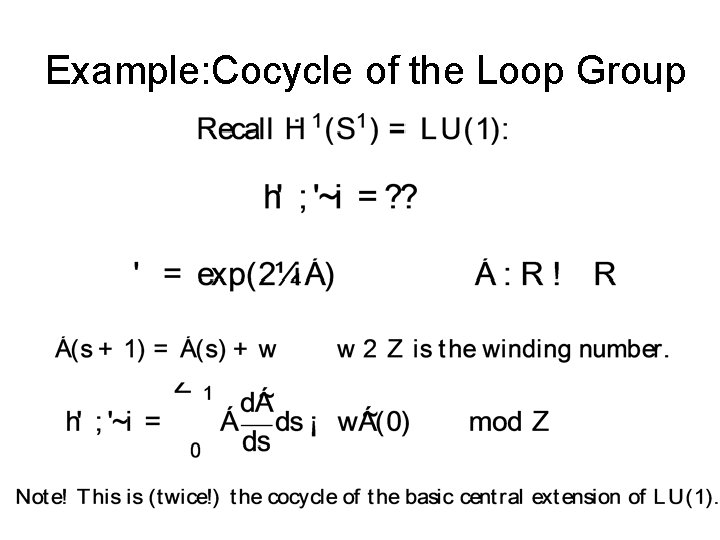
Example 1: Loop Group of U(1) Configuration space of a periodic scalar field on a circle: Topological class = Winding number: Flat fields = Torus Vector Space: of constant maps: Loops admitting a logarithm. This corresponds to the explicit decomposition:
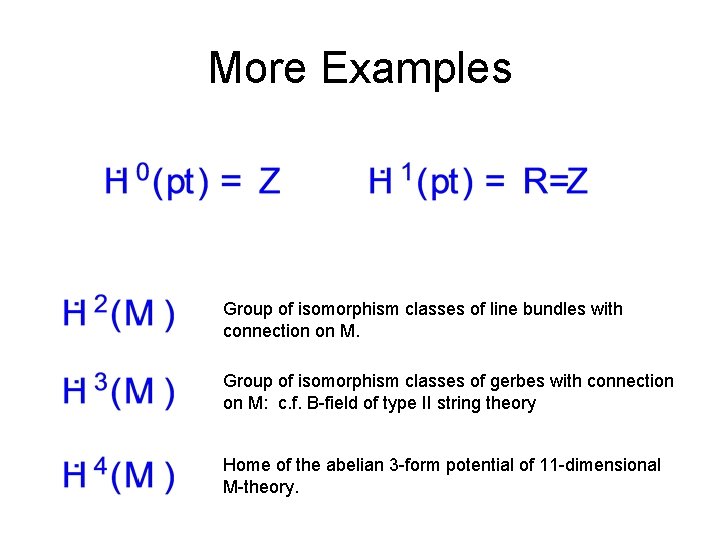
More Examples Group of isomorphism classes of line bundles with connection on M. Group of isomorphism classes of gerbes with connection on M: c. f. B-field of type II string theory Home of the abelian 3 -form potential of 11 -dimensional M-theory.
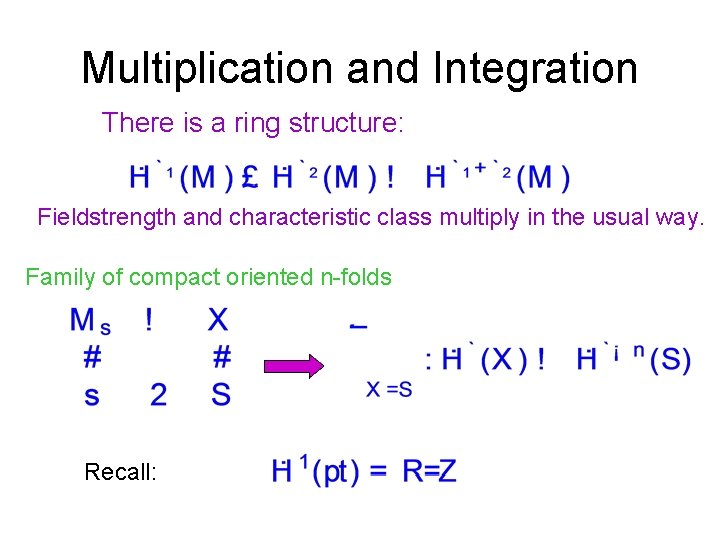
Multiplication and Integration There is a ring structure: Fieldstrength and characteristic class multiply in the usual way. Family of compact oriented n-folds Recall:
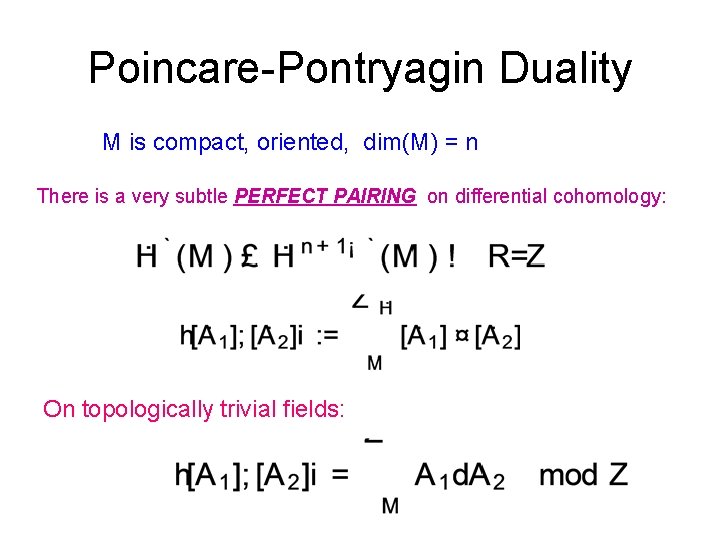
Poincare-Pontryagin Duality M is compact, oriented, dim(M) = n There is a very subtle PERFECT PAIRING on differential cohomology: On topologically trivial fields:
Example: Cocycle of the Loop Group
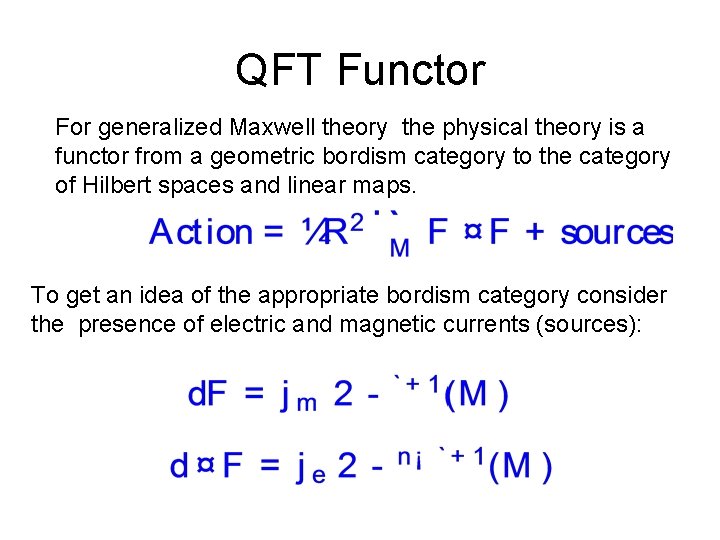
QFT Functor For generalized Maxwell theory the physical theory is a functor from a geometric bordism category to the category of Hilbert spaces and linear maps. To get an idea of the appropriate bordism category consider the presence of electric and magnetic currents (sources):
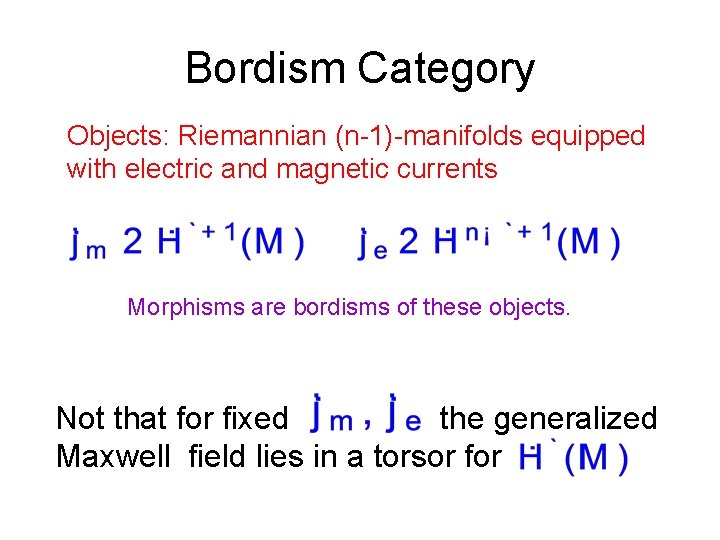
Bordism Category Objects: Riemannian (n-1)-manifolds equipped with electric and magnetic currents Morphisms are bordisms of these objects. Not that for fixed the generalized Maxwell field lies in a torsor for
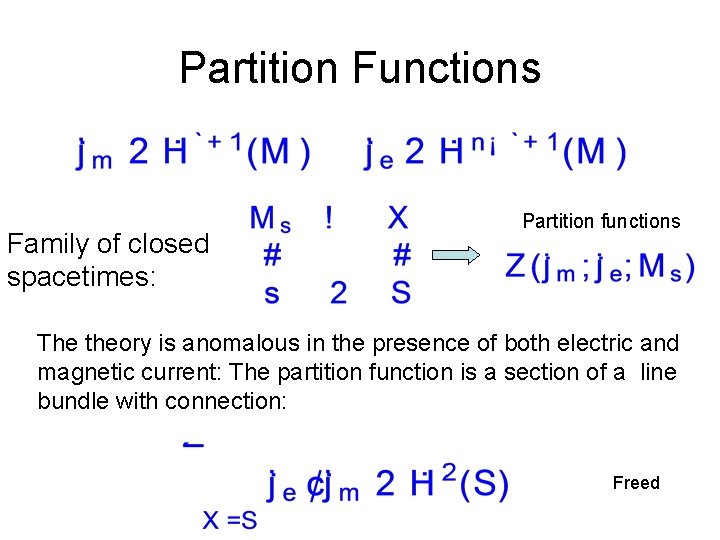
Partition Functions Family of closed spacetimes: Partition functions The theory is anomalous in the presence of both electric and magnetic current: The partition function is a section of a line bundle with connection: Freed
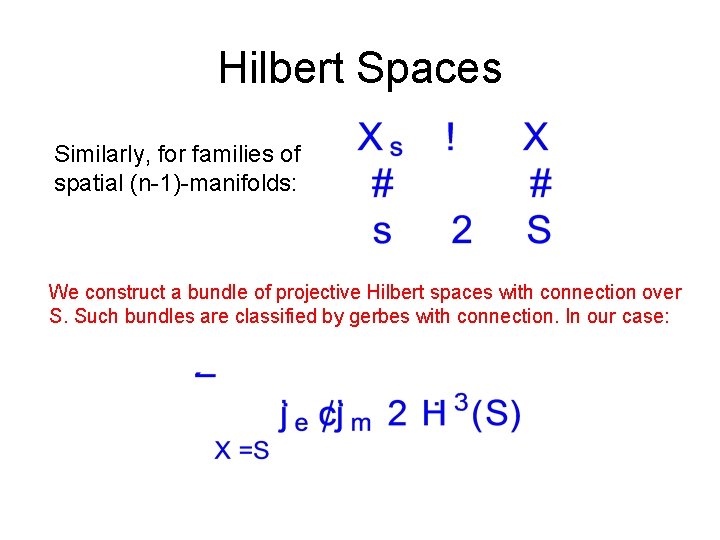
Hilbert Spaces Similarly, for families of spatial (n-1)-manifolds: We construct a bundle of projective Hilbert spaces with connection over S. Such bundles are classified by gerbes with connection. In our case:
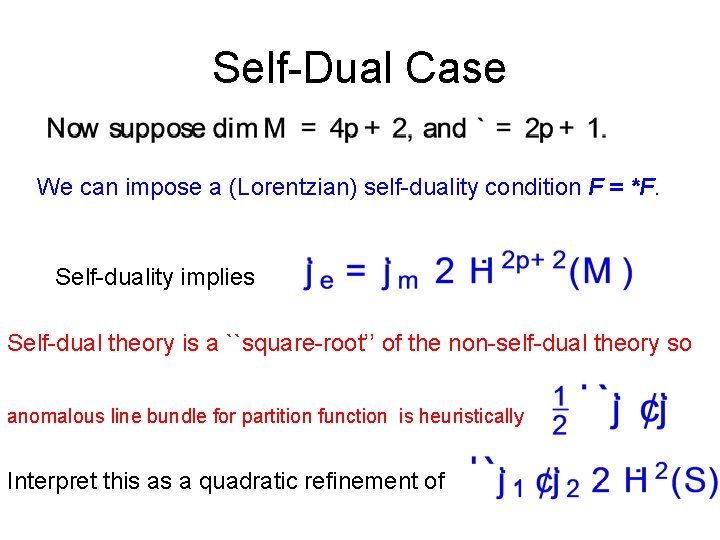
Self-Dual Case We can impose a (Lorentzian) self-duality condition F = *F. Self-duality implies Self-dual theory is a ``square-root’’ of the non-self-dual theory so anomalous line bundle for partition function is heuristically Interpret this as a quadratic refinement of
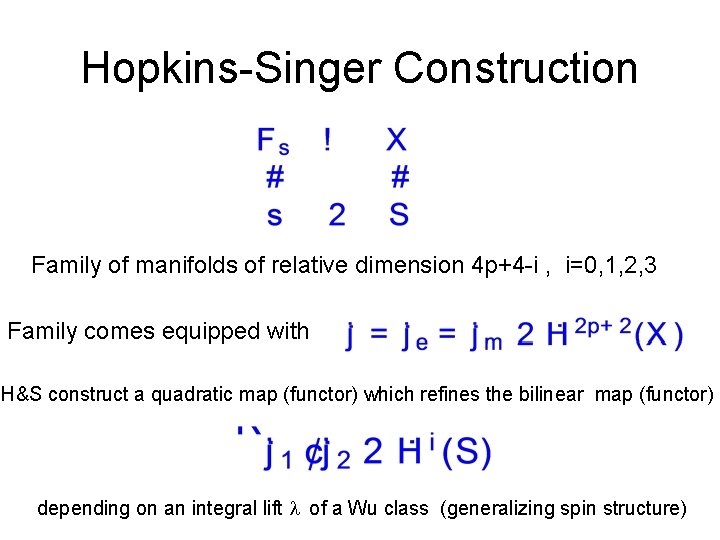
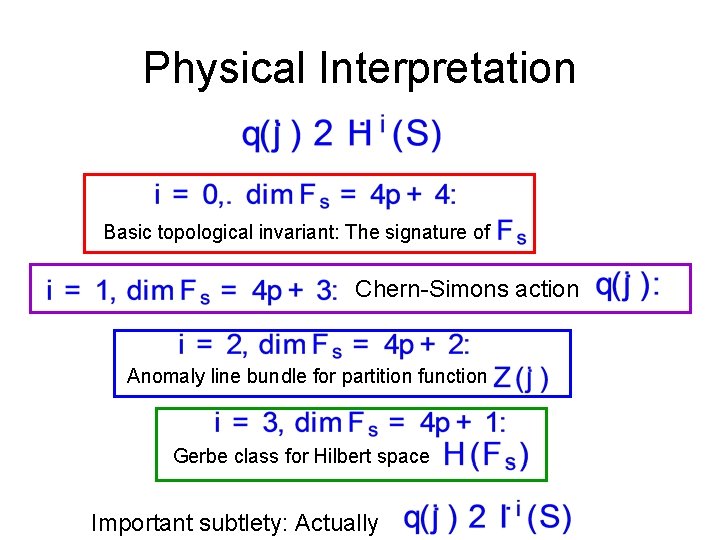
Hopkins-Singer Construction Family of manifolds of relative dimension 4 p+4 -i , i=0, 1, 2, 3 Family comes equipped with H&S construct a quadratic map (functor) which refines the bilinear map (functor) depending on an integral lift l of a Wu class (generalizing spin structure)
Physical Interpretation Basic topological invariant: The signature of Chern-Simons action Anomaly line bundle for partition function Gerbe class for Hilbert space Important subtlety: Actually
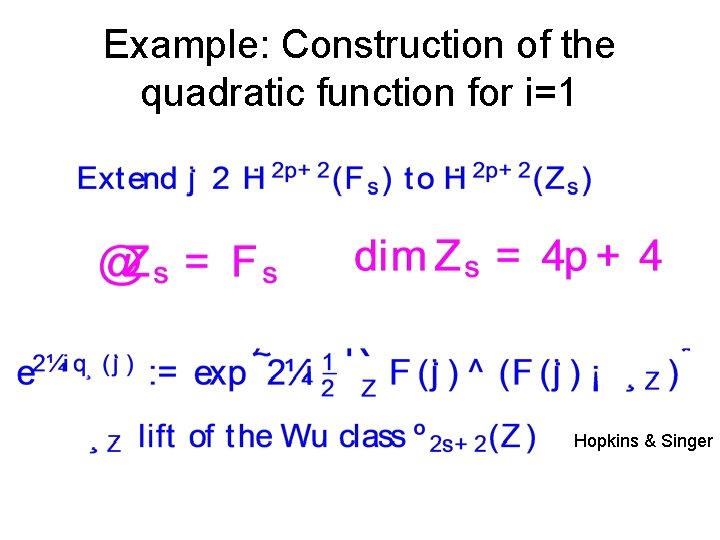
Example: Construction of the quadratic function for i=1 Hopkins & Singer
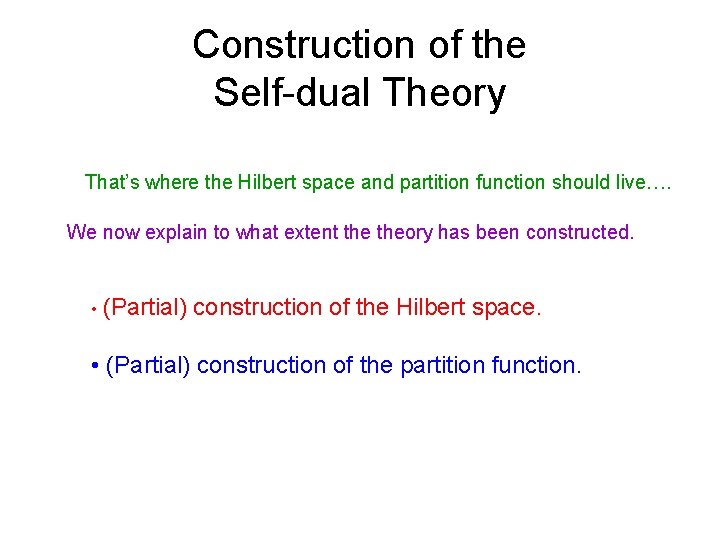
Construction of the Self-dual Theory That’s where the Hilbert space and partition function should live…. We now explain to what extent theory has been constructed. • (Partial) construction of the Hilbert space. • (Partial) construction of the partition function.
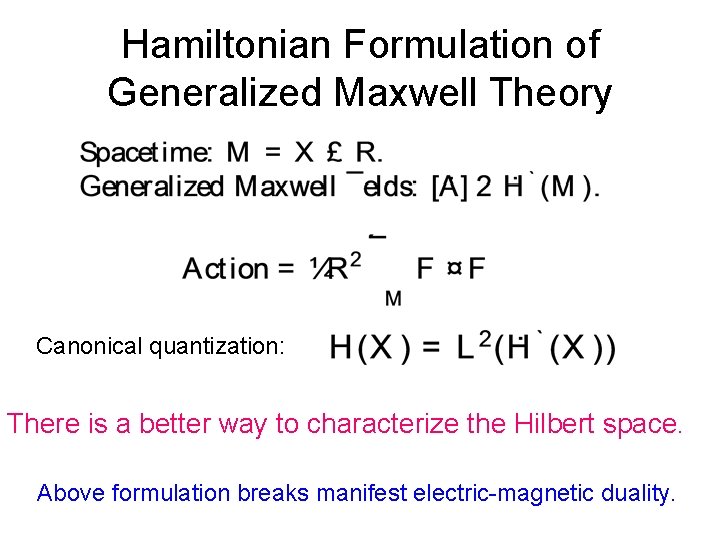
Hamiltonian Formulation of Generalized Maxwell Theory Canonical quantization: There is a better way to characterize the Hilbert space. Above formulation breaks manifest electric-magnetic duality.
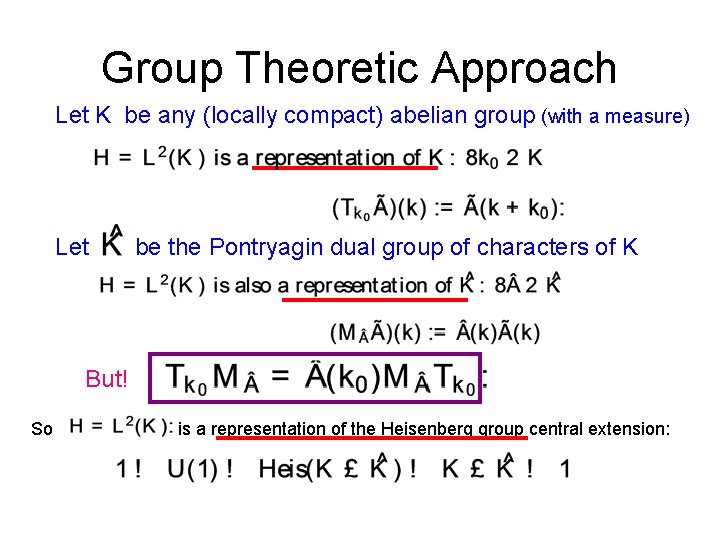
Group Theoretic Approach Let K be any (locally compact) abelian group (with a measure) Let be the Pontryagin dual group of characters of K But! So is a representation of the Heisenberg group central extension:
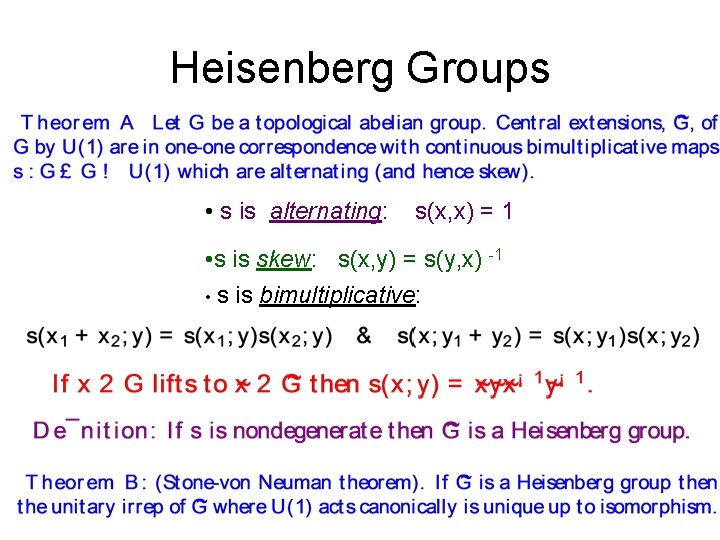
Heisenberg Groups • s is alternating: s(x, x) = 1 • s is skew: s(x, y) = s(y, x) -1 • s is bimultiplicative:
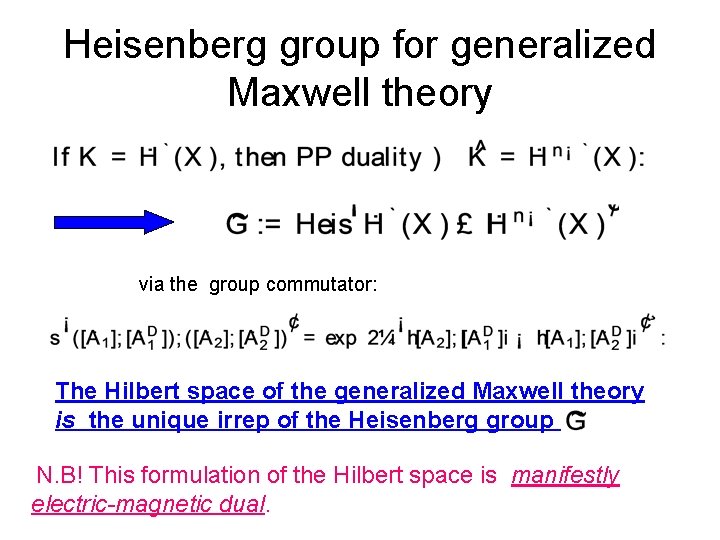
Heisenberg group for generalized Maxwell theory via the group commutator: The Hilbert space of the generalized Maxwell theory is the unique irrep of the Heisenberg group N. B! This formulation of the Hilbert space is manifestly electric-magnetic dual.
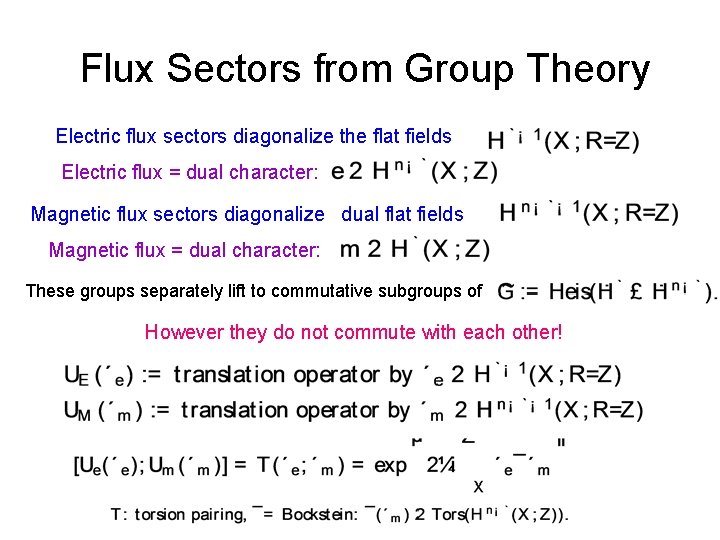
Flux Sectors from Group Theory Electric flux sectors diagonalize the flat fields Electric flux = dual character: Magnetic flux sectors diagonalize dual flat fields Magnetic flux = dual character: These groups separately lift to commutative subgroups of However they do not commute with each other!
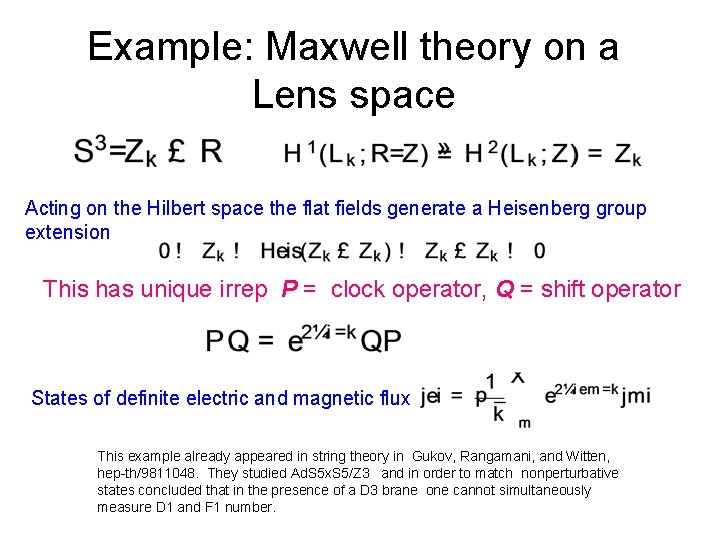
Example: Maxwell theory on a Lens space Acting on the Hilbert space the flat fields generate a Heisenberg group extension This has unique irrep P = clock operator, Q = shift operator States of definite electric and magnetic flux This example already appeared in string theory in Gukov, Rangamani, and Witten, hep-th/9811048. They studied Ad. S 5 x. S 5/Z 3 and in order to match nonperturbative states concluded that in the presence of a D 3 brane one cannot simultaneously measure D 1 and F 1 number.
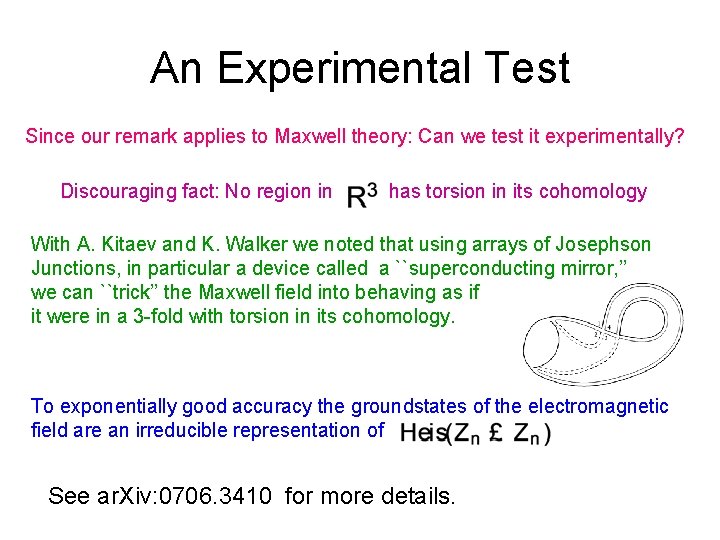
An Experimental Test Since our remark applies to Maxwell theory: Can we test it experimentally? Discouraging fact: No region in has torsion in its cohomology With A. Kitaev and K. Walker we noted that using arrays of Josephson Junctions, in particular a device called a ``superconducting mirror, ’’ we can ``trick’’ the Maxwell field into behaving as if it were in a 3 -fold with torsion in its cohomology. To exponentially good accuracy the groundstates of the electromagnetic field are an irreducible representation of See ar. Xiv: 0706. 3410 for more details.
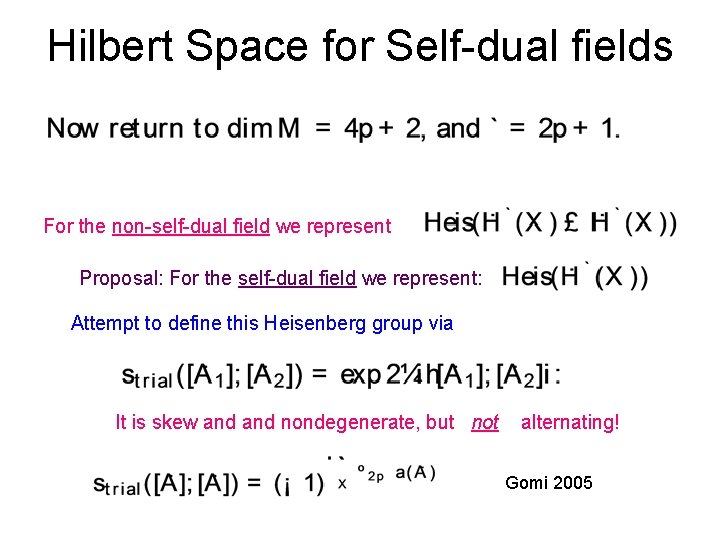
Hilbert Space for Self-dual fields For the non-self-dual field we represent Proposal: For the self-dual field we represent: Attempt to define this Heisenberg group via It is skew and nondegenerate, but not alternating! Gomi 2005
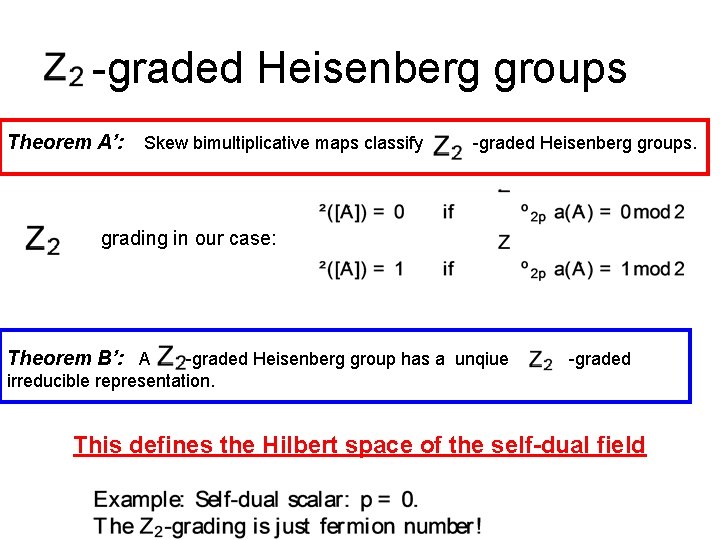
-graded Heisenberg groups Theorem A’: Skew bimultiplicative maps classify -graded Heisenberg groups. grading in our case: Theorem B’: A -graded Heisenberg group has a unqiue irreducible representation. -graded This defines the Hilbert space of the self-dual field
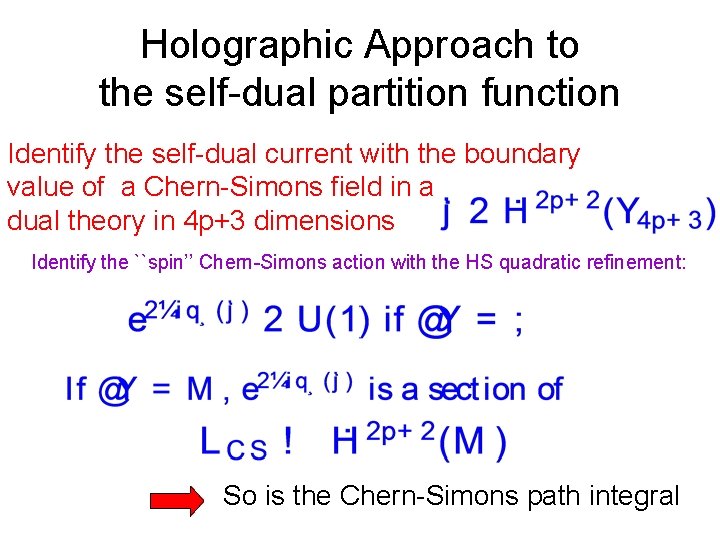
Holographic Approach to the self-dual partition function Identify the self-dual current with the boundary value of a Chern-Simons field in a dual theory in 4 p+3 dimensions Identify the ``spin’’ Chern-Simons action with the HS quadratic refinement: So is the Chern-Simons path integral
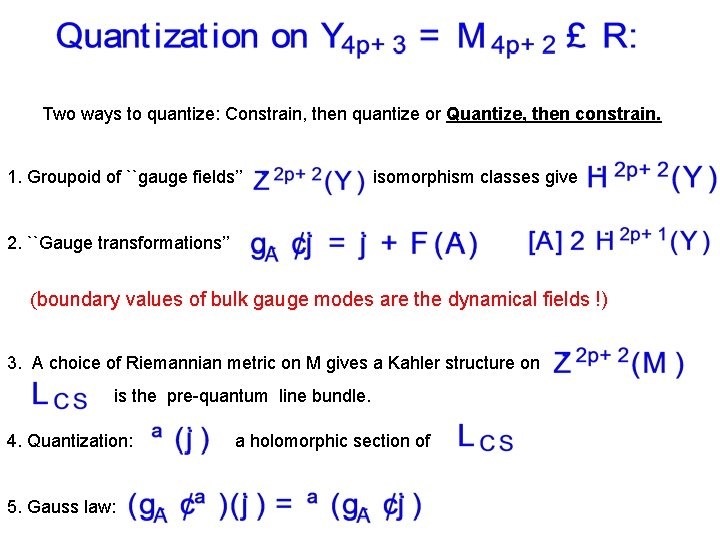
Two ways to quantize: Constrain, then quantize or Quantize, then constrain. 1. Groupoid of ``gauge fields’’ isomorphism classes give 2. ``Gauge transformations’’ (boundary values of bulk gauge modes are the dynamical fields !) 3. A choice of Riemannian metric on M gives a Kahler structure on is the pre-quantum line bundle. 4. Quantization: 5. Gauss law: a holomorphic section of
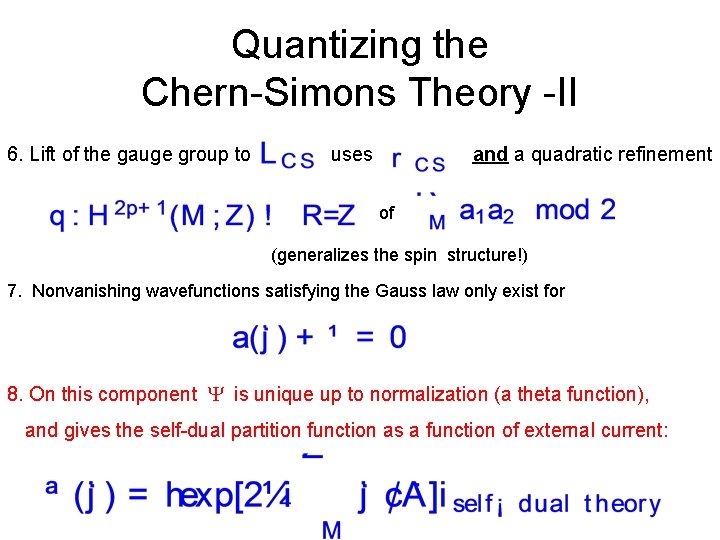
Quantizing the Chern-Simons Theory -II 6. Lift of the gauge group to uses and a quadratic refinement of (generalizes the spin structure!) 7. Nonvanishing wavefunctions satisfying the Gauss law only exist for 8. On this component Y is unique up to normalization (a theta function), and gives the self-dual partition function as a function of external current:
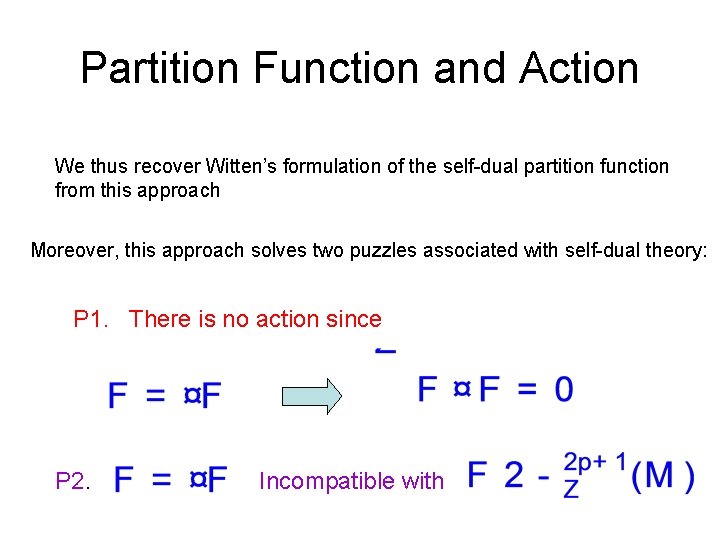
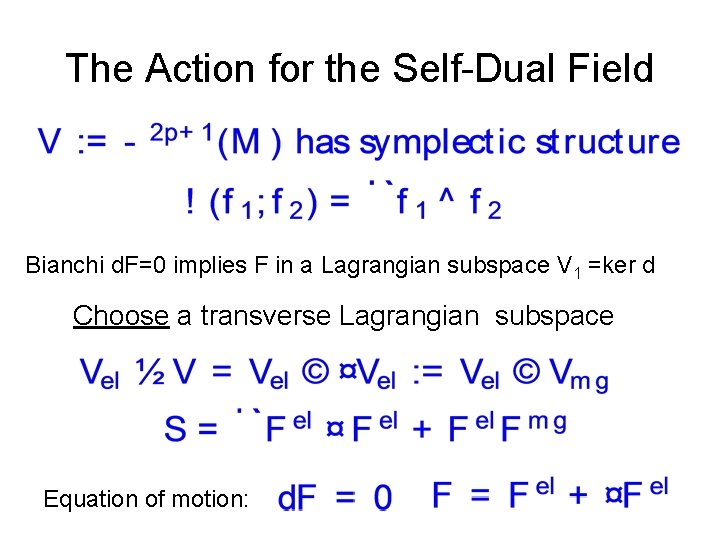
Partition Function and Action We thus recover Witten’s formulation of the self-dual partition function from this approach Moreover, this approach solves two puzzles associated with self-dual theory: P 1. There is no action since P 2. Incompatible with
The Action for the Self-Dual Field Bianchi d. F=0 implies F in a Lagrangian subspace V 1 =ker d Choose a transverse Lagrangian subspace Equation of motion:
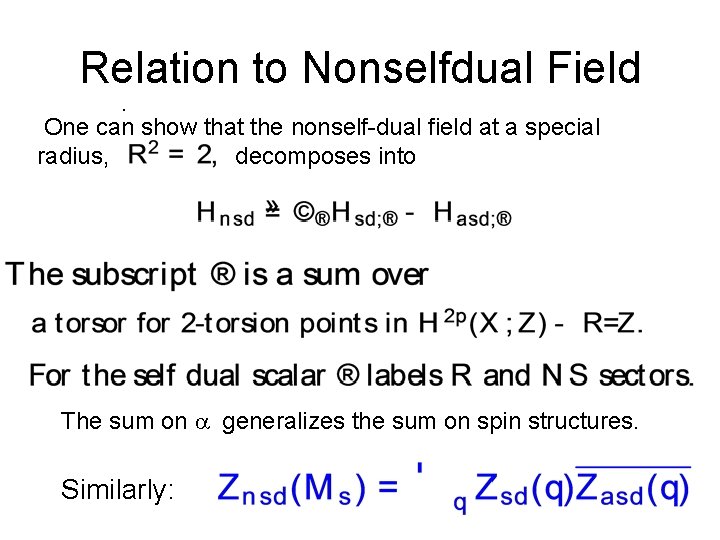
Relation to Nonselfdual Field. One can show that the nonself-dual field at a special radius, decomposes into The sum on a generalizes the sum on spin structures. Similarly:
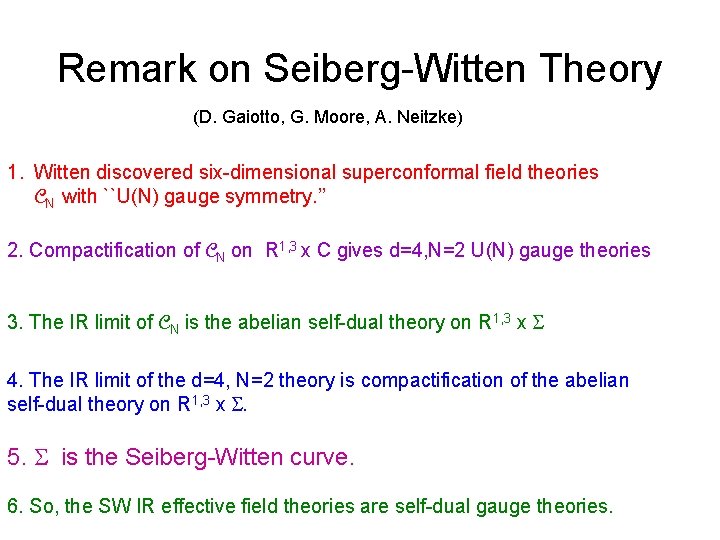
Remark on Seiberg-Witten Theory (D. Gaiotto, G. Moore, A. Neitzke) 1. Witten discovered six-dimensional superconformal field theories CN with ``U(N) gauge symmetry. ’’ 2. Compactification of CN on R 1, 3 x C gives d=4, N=2 U(N) gauge theories 3. The IR limit of CN is the abelian self-dual theory on R 1, 3 x S 4. The IR limit of the d=4, N=2 theory is compactification of the abelian self-dual theory on R 1, 3 x S. 5. S is the Seiberg-Witten curve. 6. So, the SW IR effective field theories are self-dual gauge theories.
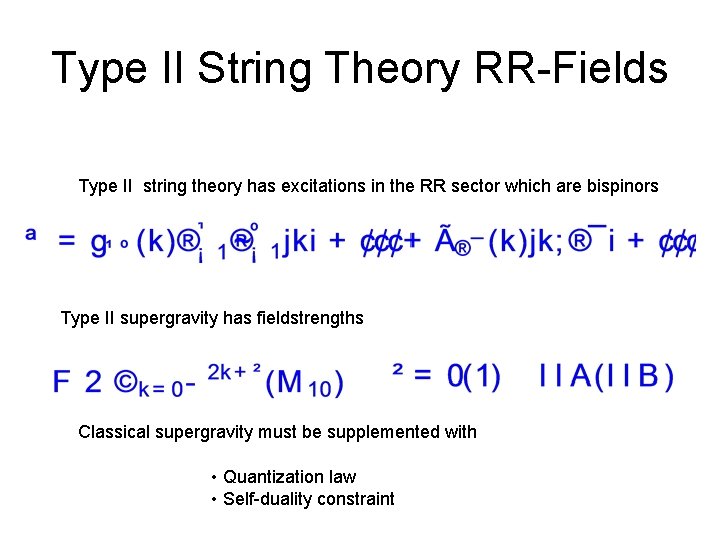
Type II String Theory RR-Fields Type II string theory has excitations in the RR sector which are bispinors Type II supergravity has fieldstrengths Classical supergravity must be supplemented with • Quantization law • Self-duality constraint
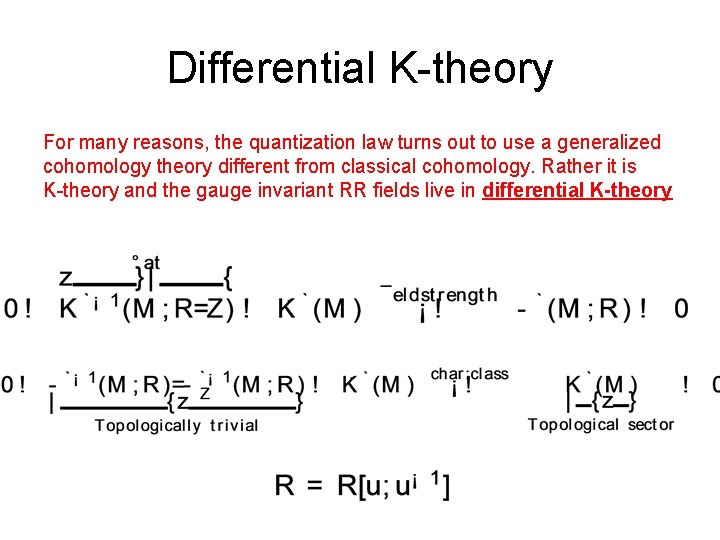
Differential K-theory For many reasons, the quantization law turns out to use a generalized cohomology theory different from classical cohomology. Rather it is K-theory and the gauge invariant RR fields live in differential K-theory
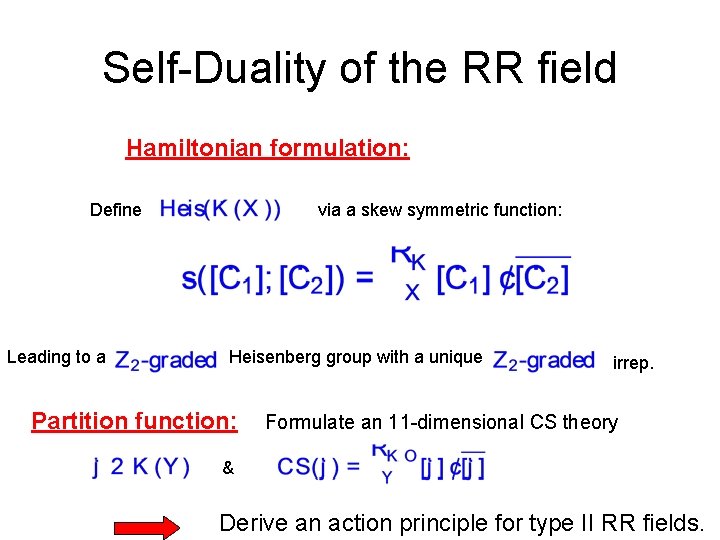
Self-Duality of the RR field Hamiltonian formulation: Define Leading to a via a skew symmetric function: Heisenberg group with a unique Partition function: irrep. Formulate an 11 -dimensional CS theory & Derive an action principle for type II RR fields.
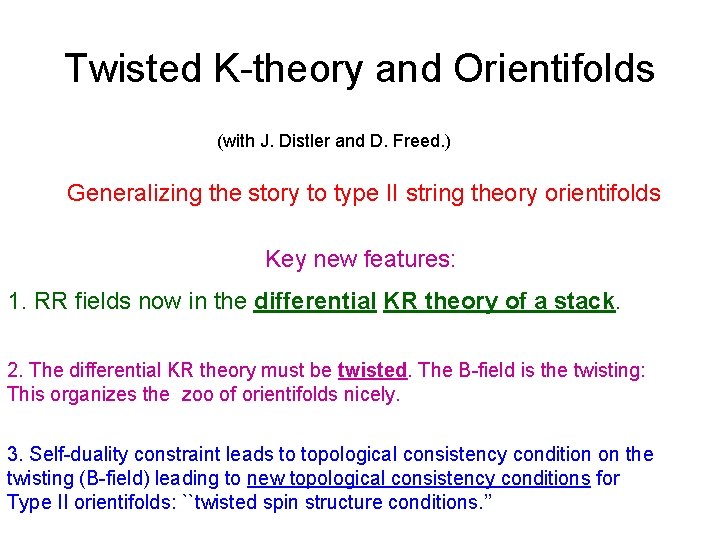
Twisted K-theory and Orientifolds (with J. Distler and D. Freed. ) Generalizing the story to type II string theory orientifolds Key new features: 1. RR fields now in the differential KR theory of a stack. 2. The differential KR theory must be twisted. The B-field is the twisting: This organizes the zoo of orientifolds nicely. 3. Self-duality constraint leads to topological consistency condition on the twisting (B-field) leading to new topological consistency conditions for Type II orientifolds: ``twisted spin structure conditions. ’’
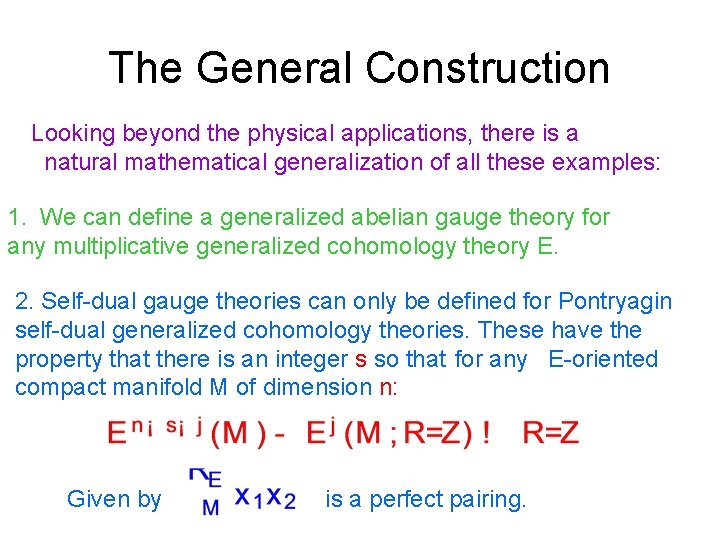
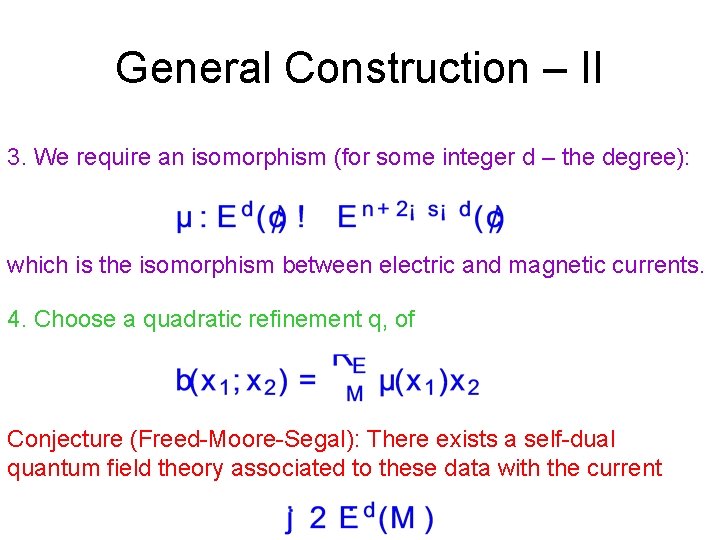
The General Construction Looking beyond the physical applications, there is a natural mathematical generalization of all these examples: 1. We can define a generalized abelian gauge theory for any multiplicative generalized cohomology theory E. 2. Self-dual gauge theories can only be defined for Pontryagin self-dual generalized cohomology theories. These have the property that there is an integer s so that for any E-oriented compact manifold M of dimension n: Given by is a perfect pairing.
General Construction – II 3. We require an isomorphism (for some integer d – the degree): which is the isomorphism between electric and magnetic currents. 4. Choose a quadratic refinement q, of Conjecture (Freed-Moore-Segal): There exists a self-dual quantum field theory associated to these data with the current
Open Problems and Future Directions – I • We have only determined the Hilbert space up to isomorphism. • We have only determined the partition function as a function of external current. We also want the metric dependence. • A lot of work remains to complete the construction of the full theory A second challenging problem is the construction of the nonabelian theories in six dimensions. These are the proper home for understanding the duality symmetries of four-dimensional gauge theories. On their Coulomb branch they are described by the above self-dual theory, which should therefore give hints about the nonabelian theory. For example: Is there an analog of the Frenkel-Kac-Segal construction?
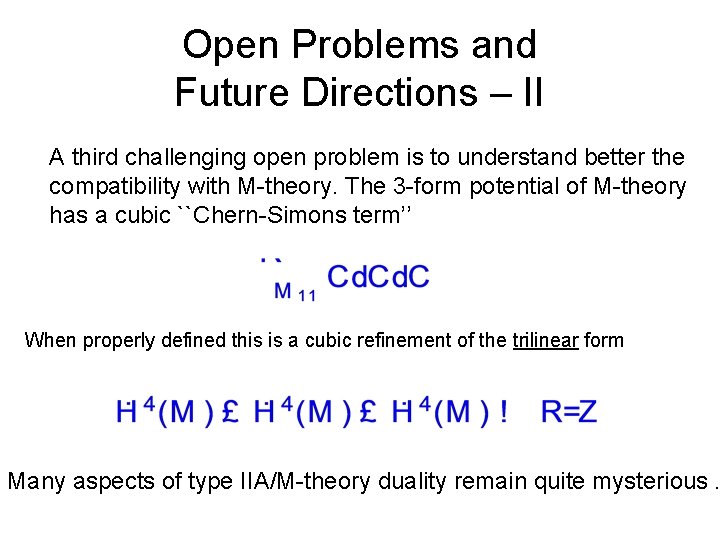
Open Problems and Future Directions – II A third challenging open problem is to understand better the compatibility with M-theory. The 3 -form potential of M-theory has a cubic ``Chern-Simons term’’ When properly defined this is a cubic refinement of the trilinear form Many aspects of type IIA/M-theory duality remain quite mysterious …
References • E. Witten, Five-brane effective action in M-theory, hep-th/9610234 • D. Freed, Dirac Charge Quantization and Generalized Differential Cohomology, hep-th/0011220 • M. Hopkins and I. Singer, Quadratic functions in geometry, topology, and M-theory, math. at/0211216 • D, Belov and G. Moore, Classification of abelian spin CS theories, hep-th. / 0505235 • D. Belov and G. Moore, Holographic action for the self-dual field, hep-th/0605038 • D. Belov and G. Moore, Type II Actions from 11 -Dimensional Chern-Simons theories, hep-th/0611020 • D. Freed, G. Moore, and G. Segal, The Uncertainty of Fluxes, hep-th/0605198 • D. Freed, G. Moore, and G. Segal, Heisenberg Groups and Noncommutative Fluxes, hep-th/0605200