
Overview of the Structure of Physics Overview of
- Slides: 14
Overview of the Structure of Physics
Overview of the Structure of Physics Where does this course fit in? Along the way, some comments on Physics History & trivia.
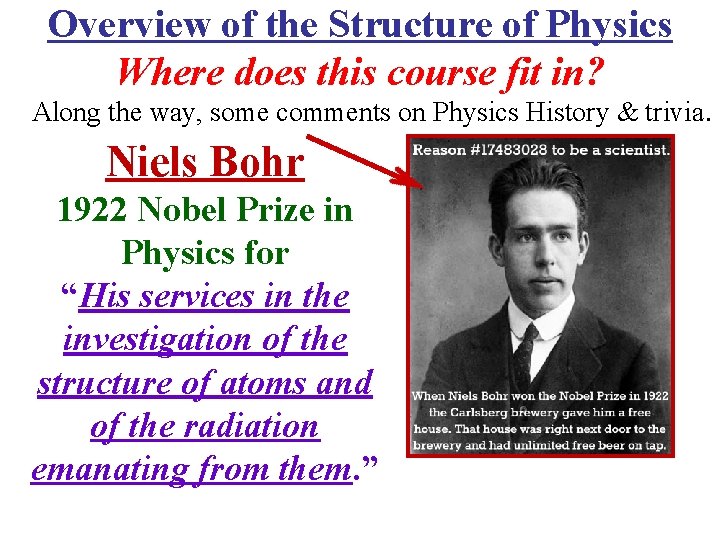
Overview of the Structure of Physics Where does this course fit in? Along the way, some comments on Physics History & trivia. Niels Bohr 1922 Nobel Prize in Physics for “His services in the investigation of the structure of atoms and of the radiation emanating from them. ”
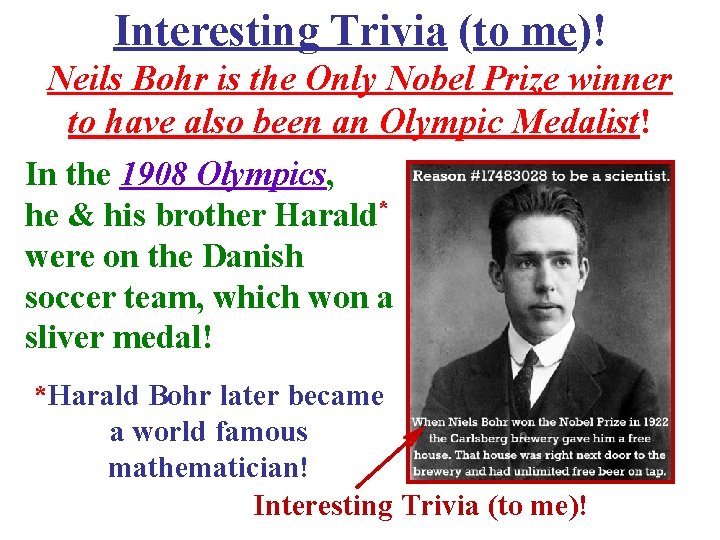
Interesting Trivia (to me)! Neils Bohr is the Only Nobel Prize winner to have also been an Olympic Medalist! In the 1908 Olympics, he & his brother Harald* were on the Danish soccer team, which won a sliver medal! *Harald Bohr later became a world famous mathematician! Interesting Trivia (to me)!
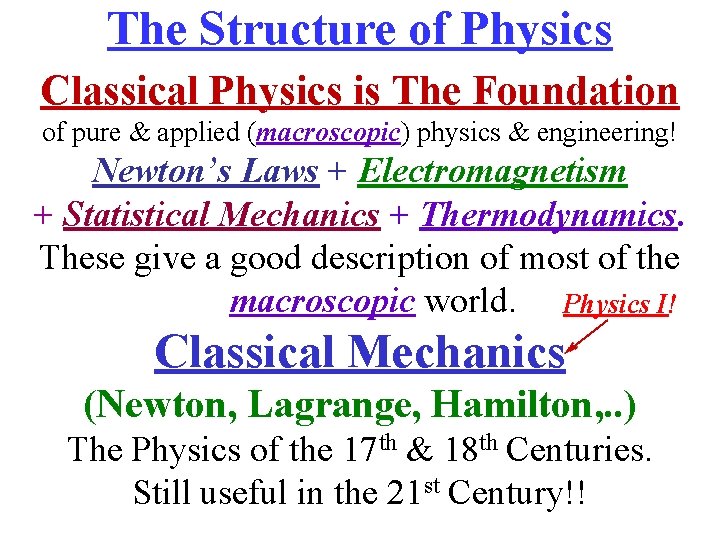
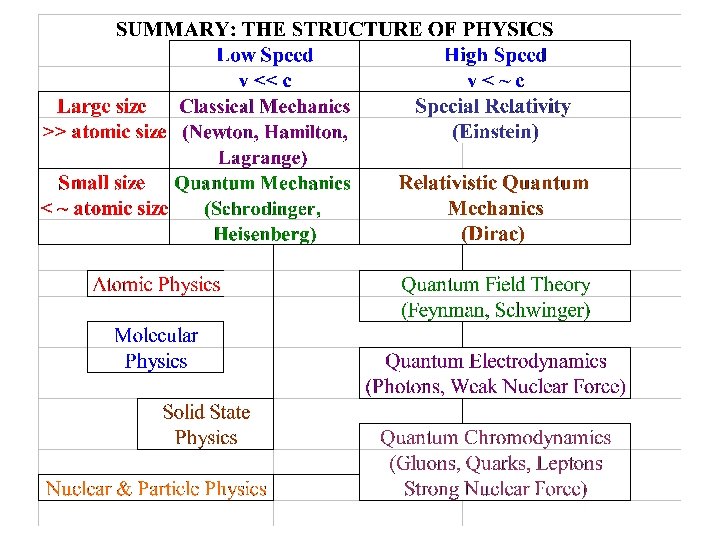
The Structure of Physics Classical Physics is The Foundation of pure & applied (macroscopic) physics & engineering! Newton’s Laws + Electromagnetism + Statistical Mechanics + Thermodynamics. These give a good description of most of the macroscopic world. Physics I! Classical Mechanics (Newton, Lagrange, Hamilton, . . ) The Physics of the 17 th & 18 th Centuries. Still useful in the 21 st Century!!
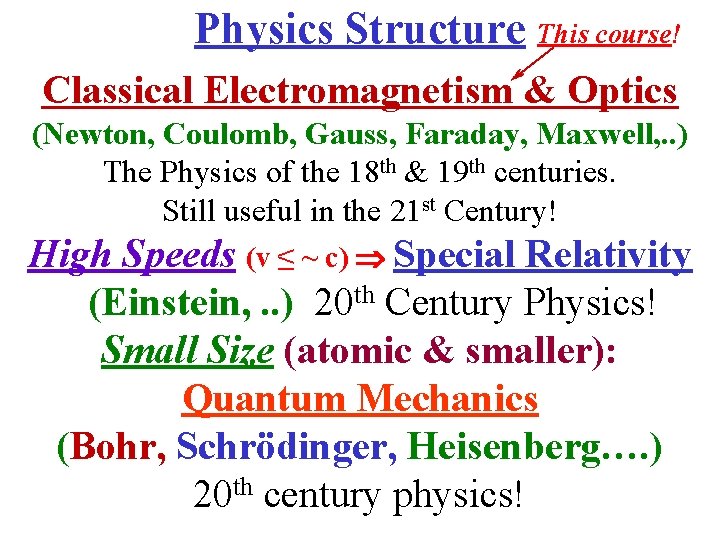
Physics Structure This course! Classical Electromagnetism & Optics (Newton, Coulomb, Gauss, Faraday, Maxwell, . . ) The Physics of the 18 th & 19 th centuries. Still useful in the 21 st Century! High Speeds (v ≤ ~ c) Special Relativity (Einstein, . . ) 20 th Century Physics! Small Size (atomic & smaller): Quantum Mechanics (Bohr, Schrödinger, Heisenberg…. ) 20 th century physics!
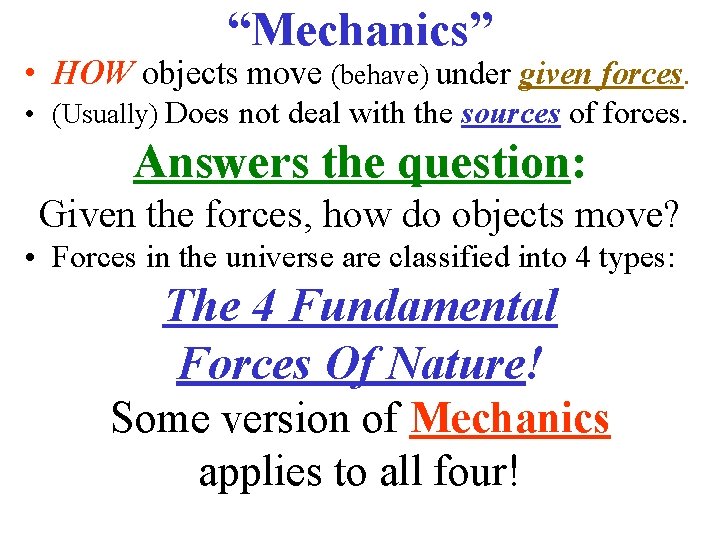
“Mechanics” • HOW objects move (behave) under given forces. • (Usually) Does not deal with the sources of forces. Answers the question: Given the forces, how do objects move? • Forces in the universe are classified into 4 types: The 4 Fundamental Forces Of Nature! Some version of Mechanics applies to all four!
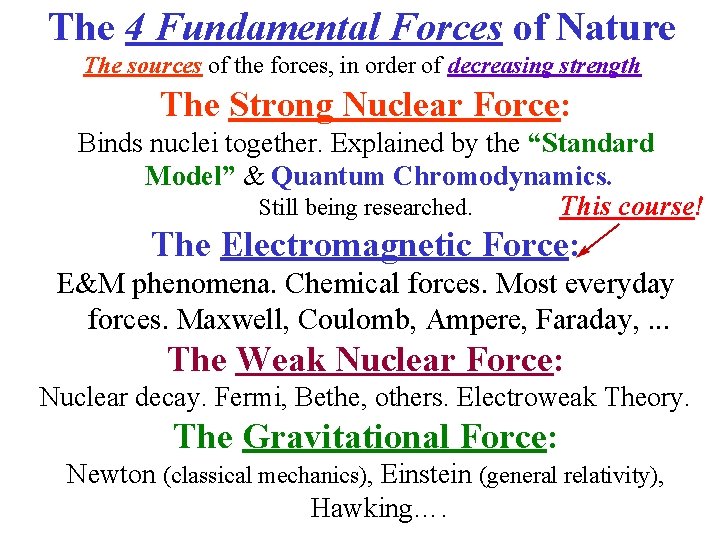
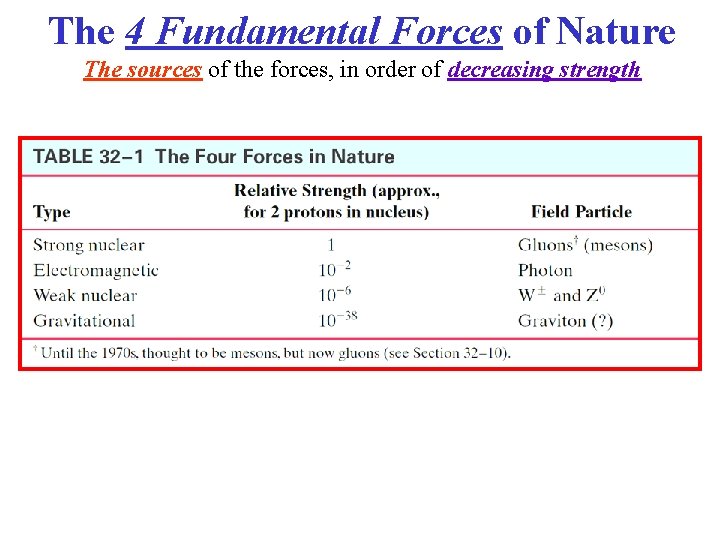
The 4 Fundamental Forces of Nature The sources of the forces, in order of decreasing strength The Strong Nuclear Force: Binds nuclei together. Explained by the “Standard Model” & Quantum Chromodynamics. Still being researched. This course! The Electromagnetic Force: E&M phenomena. Chemical forces. Most everyday forces. Maxwell, Coulomb, Ampere, Faraday, . . . The Weak Nuclear Force: Nuclear decay. Fermi, Bethe, others. Electroweak Theory. The Gravitational Force: Newton (classical mechanics), Einstein (general relativity), Hawking….
The 4 Fundamental Forces of Nature The sources of the forces, in order of decreasing strength
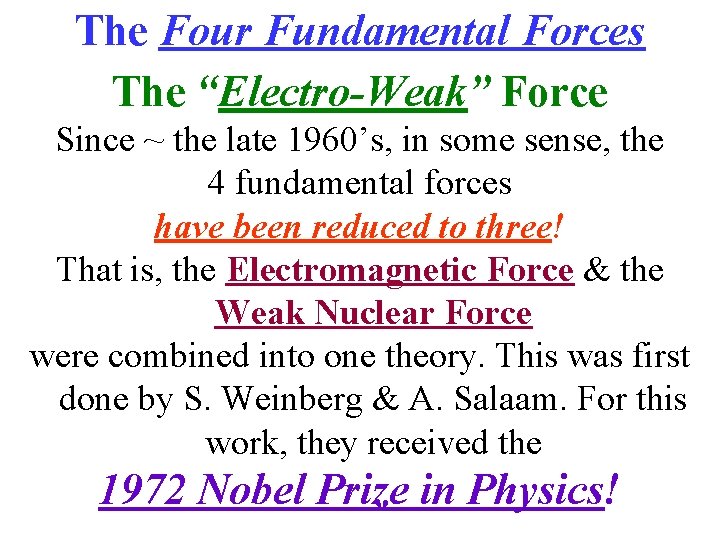
The Four Fundamental Forces The “Electro-Weak” Force Since ~ the late 1960’s, in some sense, the 4 fundamental forces have been reduced to three! That is, the Electromagnetic Force & the Weak Nuclear Force were combined into one theory. This was first done by S. Weinberg & A. Salaam. For this work, they received the 1972 Nobel Prize in Physics!
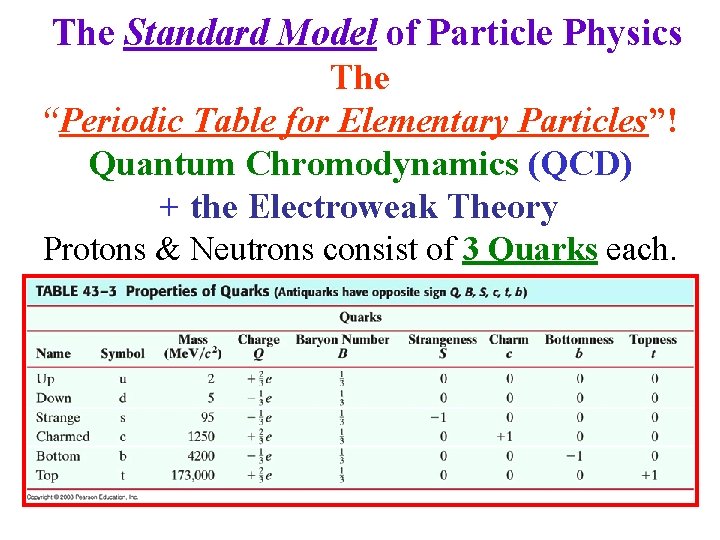
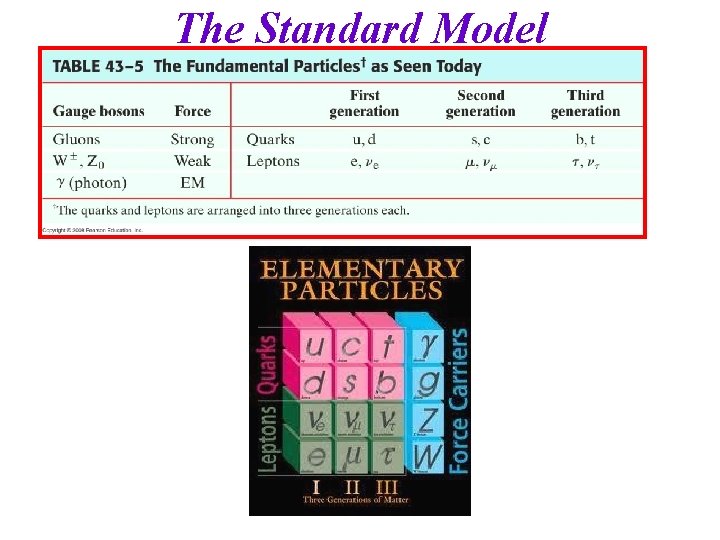
The Standard Model of Particle Physics The “Periodic Table for Elementary Particles”! Quantum Chromodynamics (QCD) + the Electroweak Theory Protons & Neutrons consist of 3 Quarks each.
The Standard Model
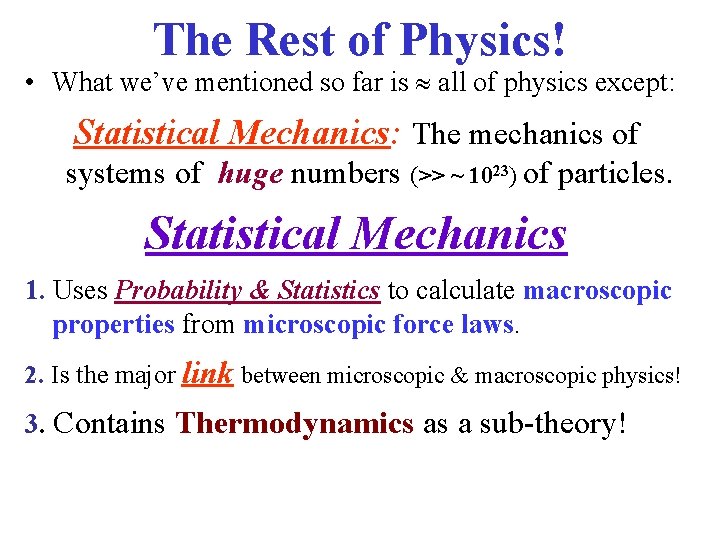
The Rest of Physics! • What we’ve mentioned so far is all of physics except: Statistical Mechanics: The mechanics of systems of huge numbers (>> ~ 1023) of particles. Statistical Mechanics 1. Uses Probability & Statistics to calculate macroscopic properties from microscopic force laws. 2. Is the major link between microscopic & macroscopic physics! 3. Contains Thermodynamics as a sub-theory!