
Overview of the PLC What is a PLC
- Slides: 13
Overview of the PLC
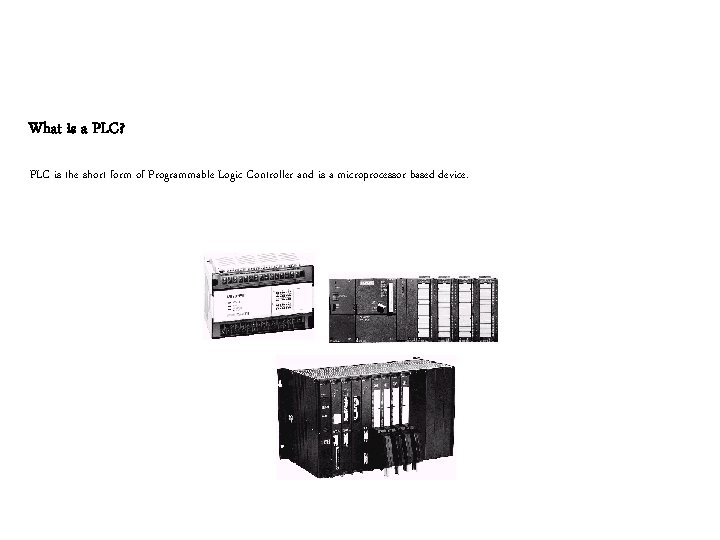
What is a PLC? PLC is the short form of Programmable Logic Controller and is a microprocessor based device.
What is a PLC? It is a programmable memory for storing instructions to implement specific functions such as • Logic • Sequencing • Timing • Counting • Interlocking to control machines and processors • More advanced PLC can also perform arithmetic and data manipulations
History of the PLC were designed to eliminate the high cost and inflexibility of relay control systems. When they designed plcs, they had these design criteria: • Solid-state with computer flexibility • Suited to industrial environment • Easily programmable • Easily maintained
The Early PLC Just relay replacers On/off control only Limited to repetitive operations - transfer lines, grinding machines, boring machines, etc. Improvement over relays • Easily installed • Uses less space and energy • Diagnostic indicators that aid troubleshooting • Reusable
Early Innovations 1970 - 1974 • • Microprocessor technology added greater flexibility and intelligence to PLC Capable of operator interface, arithmetic, data manipulation and computer communications
Early Innovations 1970 - 1974 • • • Cathode ray tube (CRT) programmer allowed relay symbol entry Arithmetic function and improved instruction set allowed numerical input data for instrumentation devices Logic and sequencing tasks enhanced
Later Innovations 1975 - 1979 Greater flexibility with hardware and software enhancements Improvements included: • Larger memory capacity • Remote I/O • Analog and positioning control • Operator communications • Software enhancement • Reduction of wiring and installation costs
Controllers in the 80‘s • • Early 1980 s microprocessor technology brought about many advances Keen competition affected design
Controllers in the 80‘s Hardware enhancements • Faster scan times • Small, low cost and reduced space requirement • More I/O ports • Direct connection to devices • Improved mechanical design • Peripheral equipment improved operator interface and system documentation
Todays PLC • Developments in hardware • Advanced memory • User orientated operator interface • Universal programming device • Communication between different brands of plcs
Todays PLC • • • Developments in software • Iec 61131 -3 Control strategies can be distributed instead of centralised Integration with other control equipment such as robots
PLCs versus Relays • • • I/O units - not directly connected to one another Programmable - need only change program when circuit condition changes Space saving - internal relays, timers, counters, etc. Flexibility in control changes Low power consumption Easy debugging