
Overview of the NSF Directorate for Mathematical and


- Slides: 58
Overview of the NSF Directorate for Mathematical and Physical Sciences (MPS) Kelsey Cook Program Officer Division of Chemistry kcook@nsf. gov www. nsf. gov
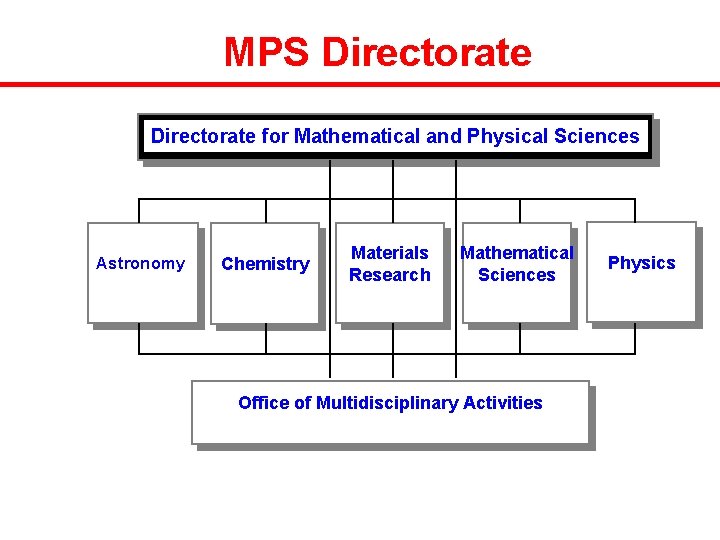
MPS Directorate for Mathematical and Physical Sciences Astronomy Chemistry Materials Research Mathematical Sciences Office of Multidisciplinary Activities Physics
NSF Vision To enable America’s future through discovery, learning and innovation NSF Mission • Promote the progress of science; • Advance the national health, prosperity, and welfare; • Secure the national defense.
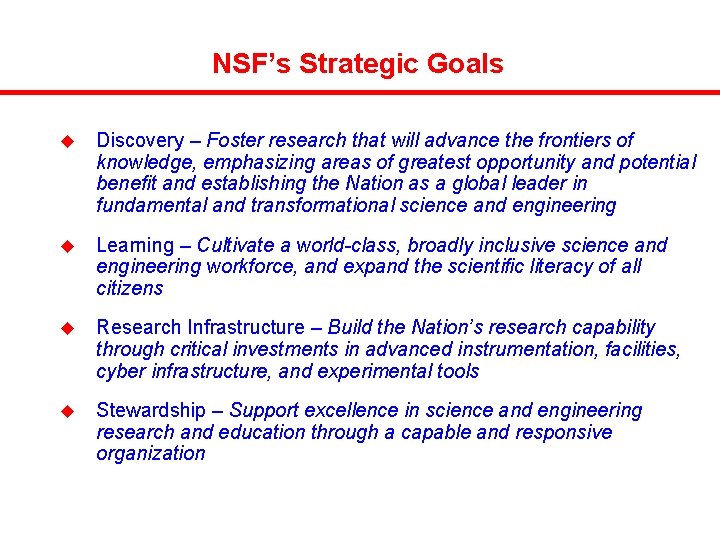
NSF’s Strategic Goals u Discovery – Foster research that will advance the frontiers of knowledge, emphasizing areas of greatest opportunity and potential benefit and establishing the Nation as a global leader in fundamental and transformational science and engineering u Learning – Cultivate a world-class, broadly inclusive science and engineering workforce, and expand the scientific literacy of all citizens u Research Infrastructure – Build the Nation’s research capability through critical investments in advanced instrumentation, facilities, cyber infrastructure, and experimental tools u Stewardship – Support excellence in science and engineering research and education through a capable and responsive organization
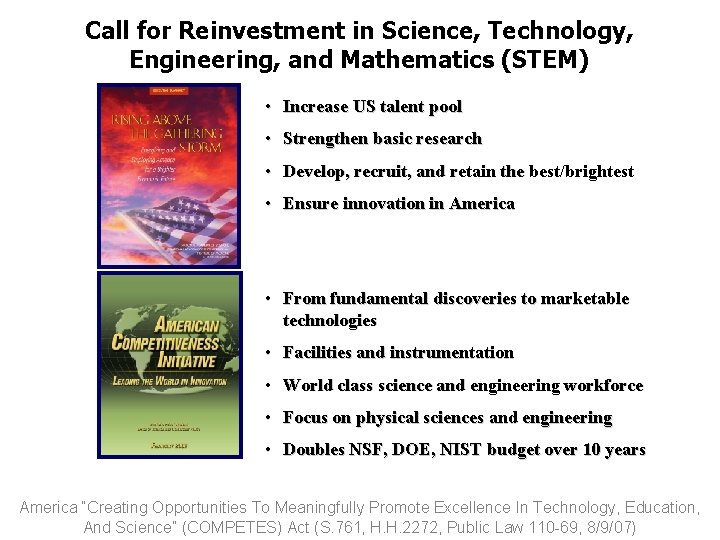
Call for Reinvestment in Science, Technology, Engineering, and Mathematics (STEM) • Increase US talent pool • Strengthen basic research • Develop, recruit, and retain the best/brightest • Ensure innovation in America • From fundamental discoveries to marketable technologies • Facilities and instrumentation • World class science and engineering workforce • Focus on physical sciences and engineering • Doubles NSF, DOE, NIST budget over 10 years America “Creating Opportunities To Meaningfully Promote Excellence In Technology, Education, And Science” (COMPETES) Act (S. 761, H. H. 2272, Public Law 110 -69, 8/9/07)
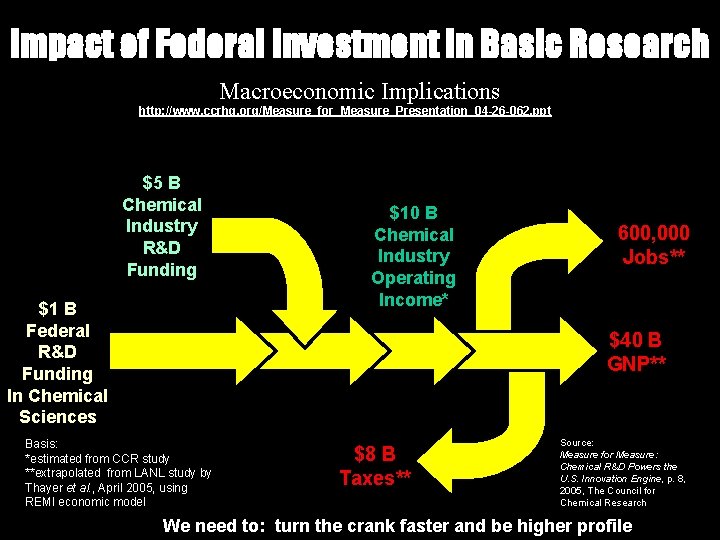
Impact of Federal Investment in Basic Research Macroeconomic Implications http: //www. ccrhq. org/Measure_for_Measure_Presentation_04 -26 -062. ppt $5 B Chemical Industry R&D Funding $1 B Federal R&D Funding In Chemical Sciences $10 B Chemical Industry Operating Income* 600, 000 Jobs** $40 B GNP** Basis: *estimated from CCR study **extrapolated from LANL study by Thayer et al. , April 2005, using REMI economic model $8 B Taxes** Source: Measure for Measure: Chemical R&D Powers the U. S. Innovation Engine, p. 8, 2005, The Council for Chemical Research We need to: turn the crank faster and be higher profile
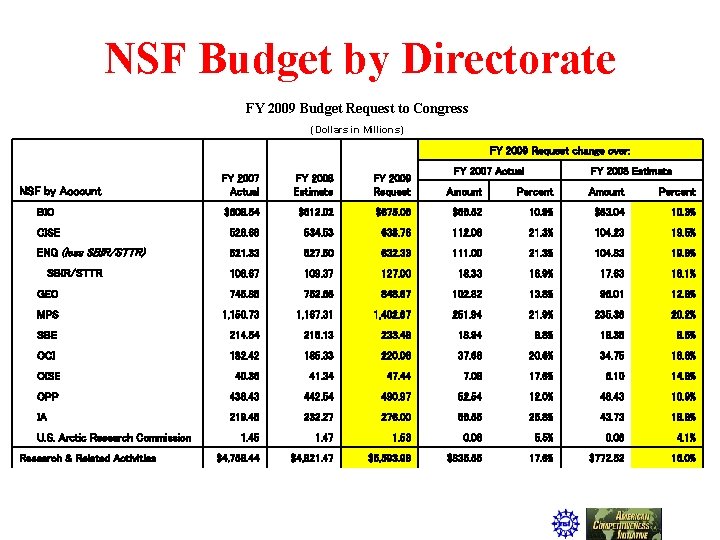
NSF Budget by Directorate FY 2009 Budget Request to Congress (Dollars in Millions) FY 2009 Request change over: FY 2007 Actual FY 2008 Estimate NSF by Account FY 2007 Actual FY 2008 Estimate FY 2009 Request Amount Percent BIO $608. 54 $612. 02 $675. 06 $66. 52 10. 9% $63. 04 10. 3% CISE 526. 68 534. 53 638. 76 112. 08 21. 3% 104. 23 19. 5% ENG (less SBIR/STTR) 521. 33 527. 50 632. 33 111. 00 21. 3% 104. 83 19. 9% 108. 67 109. 37 127. 00 18. 33 16. 9% 17. 63 16. 1% SBIR/STTR GEO 745. 85 752. 66 848. 67 102. 82 13. 8% 96. 01 12. 8% MPS 1, 150. 73 1, 167. 31 1, 402. 67 251. 94 21. 9% 235. 36 20. 2% SBE 214. 54 215. 13 233. 48 18. 94 8. 8% 18. 35 8. 5% OCI 182. 42 185. 33 220. 08 37. 66 20. 6% 34. 75 18. 8% OISE 40. 36 41. 34 47. 44 7. 08 17. 6% 6. 10 14. 8% OPP 438. 43 442. 54 490. 97 52. 54 12. 0% 48. 43 10. 9% IA 219. 45 232. 27 276. 00 56. 55 25. 8% 43. 73 18. 8% U. S. Arctic Research Commission 1. 45 1. 47 1. 53 0. 08 5. 5% 0. 06 4. 1% $4, 758. 44 $4, 821. 47 $5, 593. 99 $835. 55 17. 6% $772. 52 16. 0% Research & Related Activities
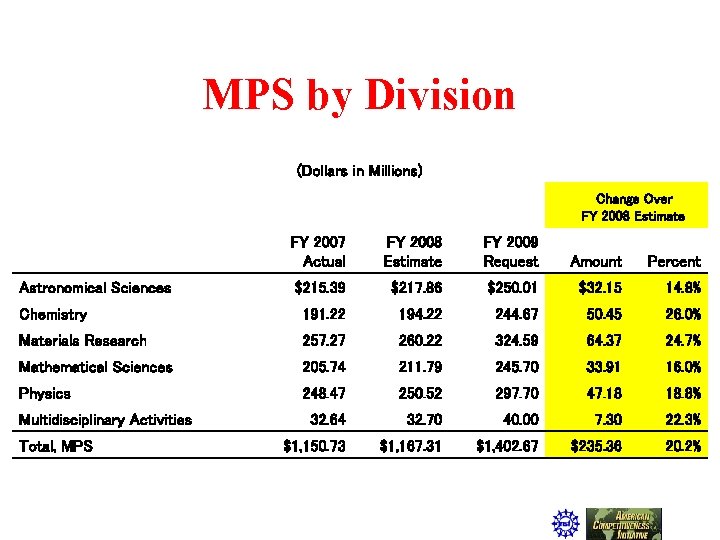
MPS by Division (Dollars in Millions) Change Over FY 2008 Estimate FY 2007 Actual FY 2008 Estimate FY 2009 Request Amount Percent $215. 39 $217. 86 $250. 01 $32. 15 14. 8% Chemistry 191. 22 194. 22 244. 67 50. 45 26. 0% Materials Research 257. 27 260. 22 324. 59 64. 37 24. 7% Mathematical Sciences 205. 74 211. 79 245. 70 33. 91 16. 0% Physics 248. 47 250. 52 297. 70 47. 18 18. 8% 32. 64 32. 70 40. 00 7. 30 22. 3% $1, 150. 73 $1, 167. 31 $1, 402. 67 $235. 36 20. 2% Astronomical Sciences Multidisciplinary Activities Total, MPS
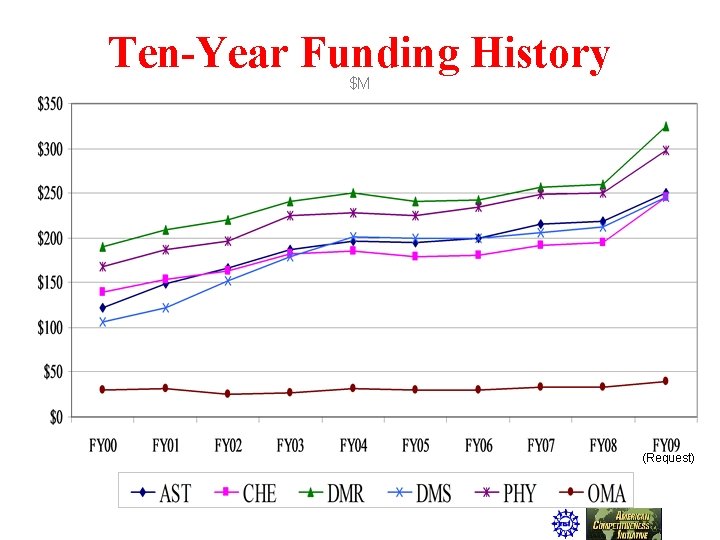
Ten-Year Funding History $M (Request)
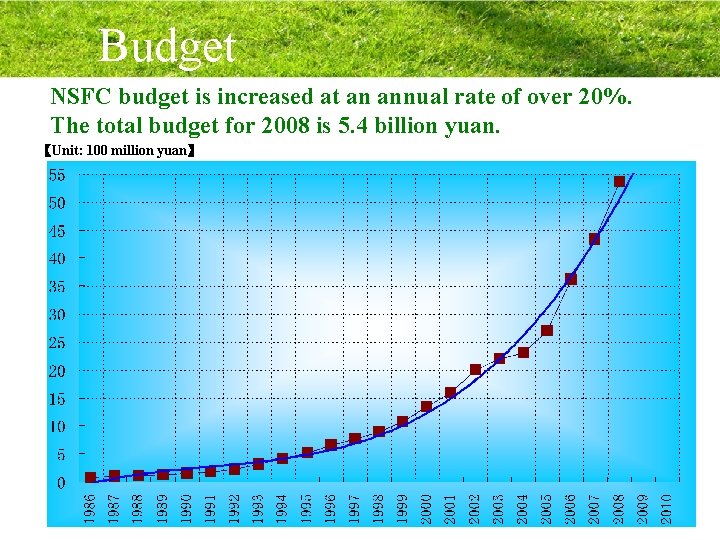
Budget NSFC budget is increased at an annual rate of over 20%. The total budget for 2008 is 5. 4 billion yuan. 【Unit: 100 million yuan】
Top 5 Things to Know About MPS • Most extensive and diverse scientific portfolio • Centered around the American Competitiveness Initiative (ACI): fundamental discovery to marketable technologies • Largest budget: $1. 25 B FY 08 • Develops & supports major facilities • Diverse approaches: smaller individual Principal Investigator (PI) grants to larger centers/institutes
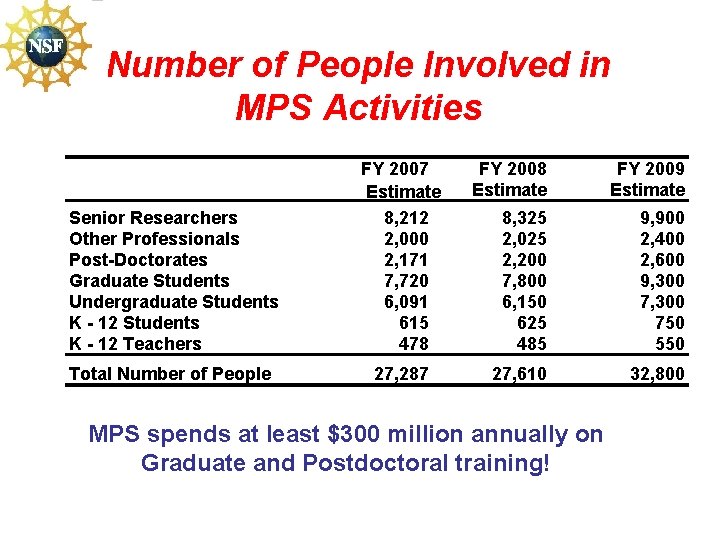
Number of People Involved in MPS Activities Senior Researchers Other Professionals Post-Doctorates Graduate Students Undergraduate Students K - 12 Teachers FY 2007 Estimate 8, 212 2, 000 2, 171 7, 720 6, 091 615 478 Total Number of People 27, 287 FY 2008 Estimate FY 2009 Estimate 8, 325 2, 025 2, 200 7, 800 6, 150 625 485 9, 900 2, 400 2, 600 9, 300 750 550 27, 610 32, 800 MPS spends at least $300 million annually on Graduate and Postdoctoral training!
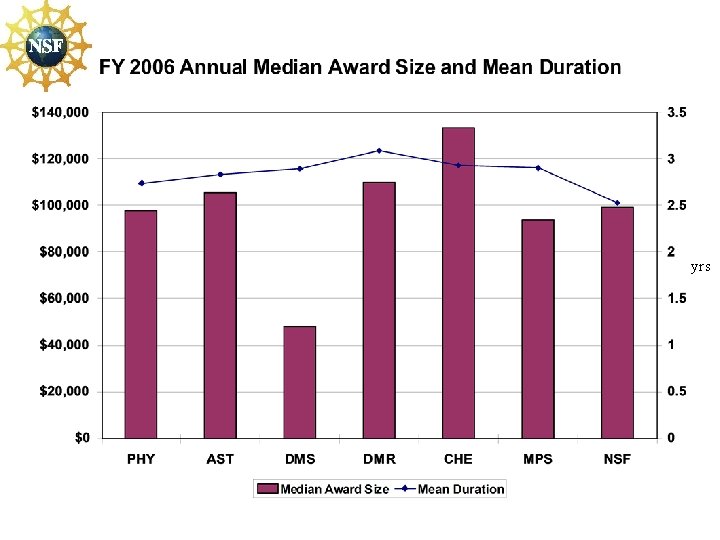
yrs
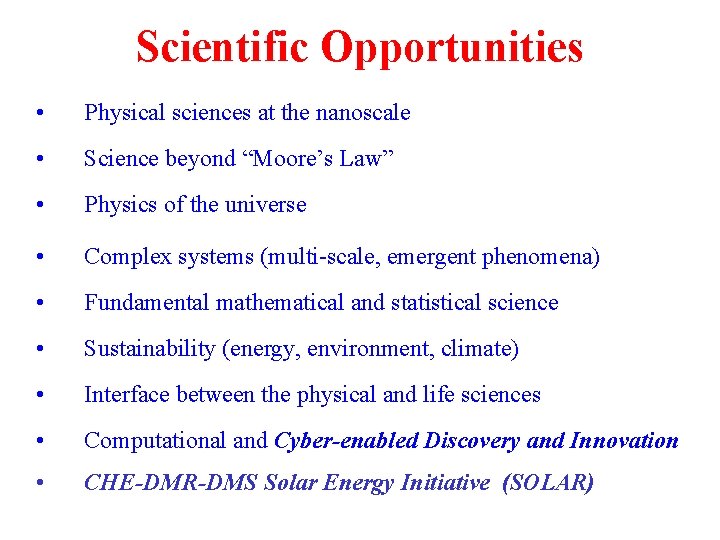
Scientific Opportunities • Physical sciences at the nanoscale • Science beyond “Moore’s Law” • Physics of the universe • Complex systems (multi-scale, emergent phenomena) • Fundamental mathematical and statistical science • Sustainability (energy, environment, climate) • Interface between the physical and life sciences • Computational and Cyber-enabled Discovery and Innovation • CHE-DMR-DMS Solar Energy Initiative (SOLAR)
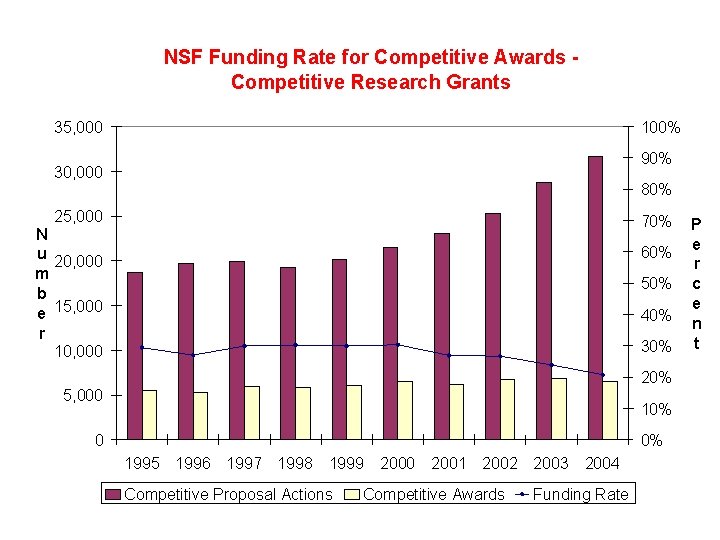
NSF Funding Rate for Competitive Awards Competitive Research Grants 35, 000 100% 90% 30, 000 80% 25, 000 70% N u 20, 000 m b e 15, 000 r 10, 000 60% 50% 40% 30% 20% 5, 000 10% 0 0% 1995 1996 1997 1998 1999 2000 2001 2002 2003 2004 Competitive Proposal Actions Competitive Awards Funding Rate P e r c e n t
MPS Funding Rate for Competitive Awards Competitive Research Grants
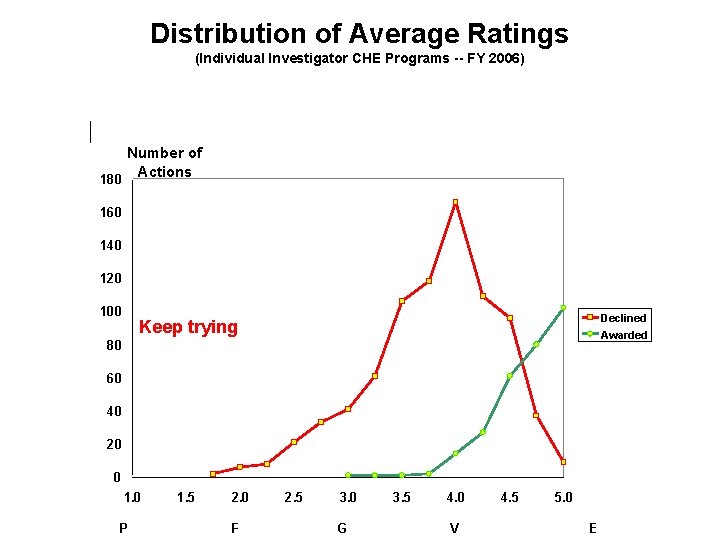
Distribution of Average Ratings (Individual Investigator CHE Programs -- FY 2006) Number of Actions 180 160 140 120 100 Declined Awarded Keep trying 80 60 40 20 0 1. 0 P 1. 5 2. 0 F 2. 5 3. 0 G 3. 5 4. 0 V 4. 5 5. 0 E
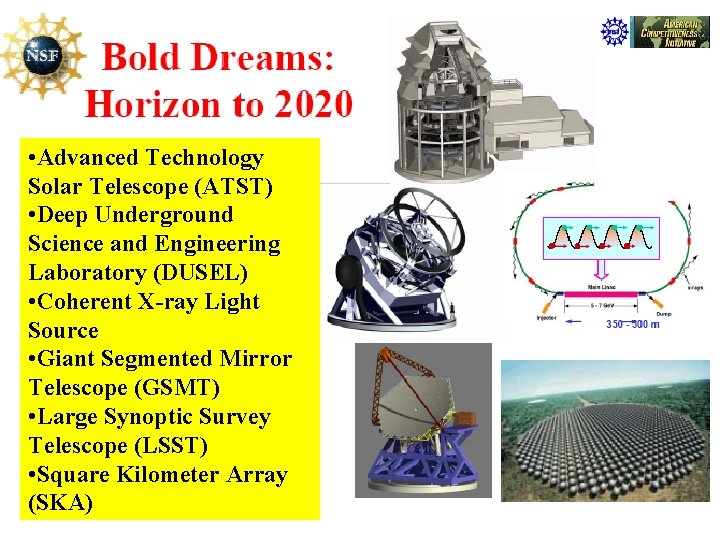
• Advanced Technology Solar Telescope (ATST) • Deep Underground Science and Engineering Laboratory (DUSEL) • Coherent X-ray Light Source • Giant Segmented Mirror Telescope (GSMT) • Large Synoptic Survey Telescope (LSST) • Square Kilometer Array (SKA)
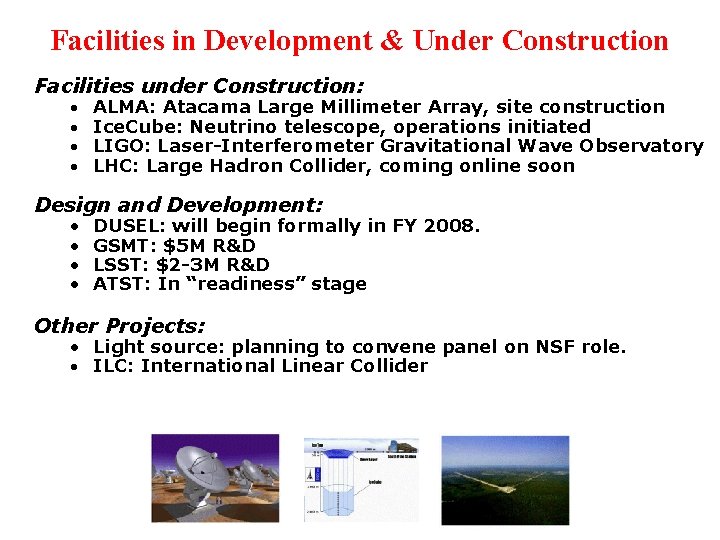
Facilities in Development & Under Construction Facilities under Construction: ALMA: Atacama Large Millimeter Array, site construction Ice. Cube: Neutrino telescope, operations initiated LIGO: Laser-Interferometer Gravitational Wave Observatory LHC: Large Hadron Collider, coming online soon Design and Development: • • DUSEL: will begin formally in FY 2008. GSMT: $5 M R&D LSST: $2 -3 M R&D ATST: In “readiness” stage Other Projects: • Light source: planning to convene panel on NSF role. ILC: International Linear Collider
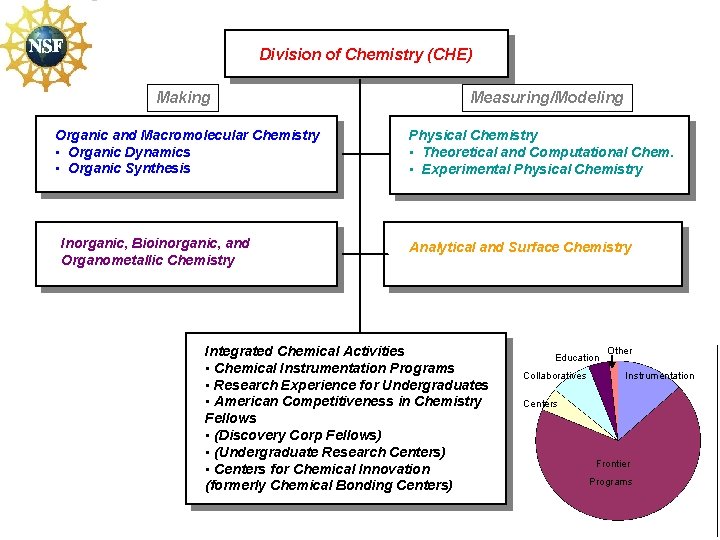
Division of Chemistry (CHE) Making Organic and Macromolecular Chemistry • Inorganic, Organic Dynamics • Organic Synthesis Bioinorganic & Organometallic Chemistry Inorganic, Bioinorganic, and Centers Organometallic Chemistry Measuring/Modeling Physical Chemistry • Theoretical and Computational Chem. Analytical • Experimental Physical&Chemistry Surface Chemistry Analytical and Surface Chemistry Facilities and Integrated Chemical Activities • Chemical Instrumentation Programs • Research Experience for Undergraduates • American Competitiveness in Chemistry Fellows • (Discovery Corp Fellows) • (Undergraduate Research Centers) • Centers for Chemical Innovation (formerly Chemical Bonding Centers) 82 Education Collaboratives Other Instrumentation Centers Frontier Programs 21/48
American Competitiveness in Chemistry Fellowship • Two-year post-doctoral fellowship opportunity that seeks to build ties between academic, industrial, and/or national laboratory, and/or Chemistry Divisionfunded center researchers, and as a vehicle for broadening participation in chemistry. • First four ACC-F grants were awarded August 2008 to post-doctoral students from: • University of California-Irvine • South Dakota State University • University of Arizona • University of Washington
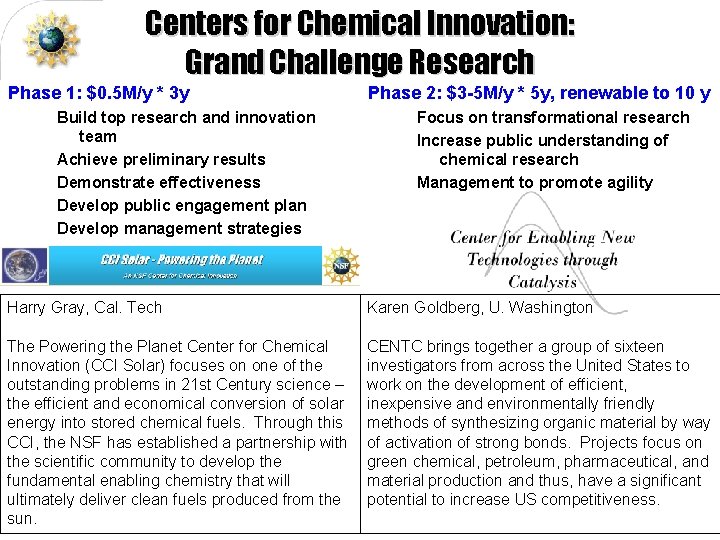
Centers for Chemical Innovation: Grand Challenge Research Phase 1: $0. 5 M/y * 3 y Build top research and innovation team Achieve preliminary results Demonstrate effectiveness Develop public engagement plan Develop management strategies Phase 2: $3 -5 M/y * 5 y, renewable to 10 y Focus on transformational research Increase public understanding of chemical research Management to promote agility Harry Gray, Cal. Tech Karen Goldberg, U. Washington The Powering the Planet Center for Chemical Innovation (CCI Solar) focuses on one of the outstanding problems in 21 st Century science – the efficient and economical conversion of solar energy into stored chemical fuels. Through this CCI, the NSF has established a partnership with the scientific community to develop the fundamental enabling chemistry that will ultimately deliver clean fuels produced from the sun. CENTC brings together a group of sixteen investigators from across the United States to work on the development of efficient, inexpensive and environmentally friendly methods of synthesizing organic material by way of activation of strong bonds. Projects focus on green chemical, petroleum, pharmaceutical, and material production and thus, have a significant potential to increase US competitiveness.
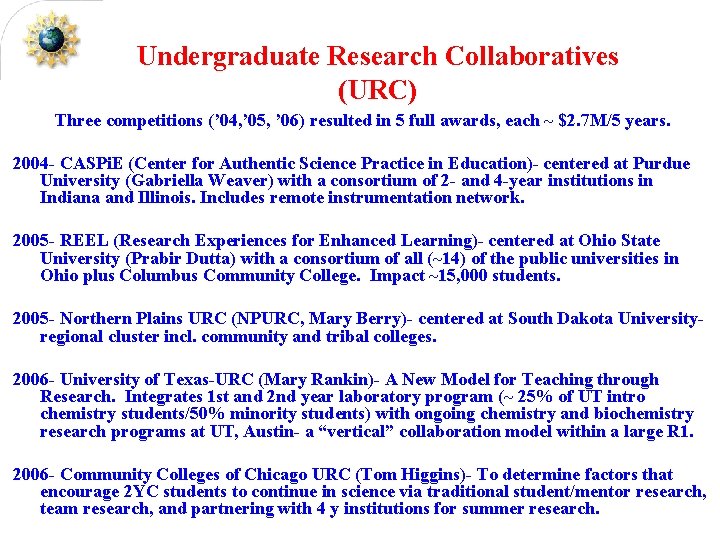
Undergraduate Research Collaboratives (URC) Three competitions (’ 04, ’ 05, ’ 06) resulted in 5 full awards, each ~ $2. 7 M/5 years. 2004 - CASPi. E (Center for Authentic Science Practice in Education)- centered at Purdue University (Gabriella Weaver) with a consortium of 2 - and 4 -year institutions in Indiana and Illinois. Includes remote instrumentation network. 2005 - REEL (Research Experiences for Enhanced Learning)- centered at Ohio State University (Prabir Dutta) with a consortium of all (~14) of the public universities in Ohio plus Columbus Community College. Impact ~15, 000 students. 2005 - Northern Plains URC (NPURC, Mary Berry)- centered at South Dakota Universityregional cluster incl. community and tribal colleges. 2006 - University of Texas-URC (Mary Rankin)- A New Model for Teaching through Research. Integrates 1 st and 2 nd year laboratory program (~ 25% of UT intro chemistry students/50% minority students) with ongoing chemistry and biochemistry research programs at UT, Austin- a “vertical” collaboration model within a large R 1. 2006 - Community Colleges of Chicago URC (Tom Higgins)- To determine factors that encourage 2 YC students to continue in science via traditional student/mentor research, team research, and partnering with 4 y institutions for summer research.
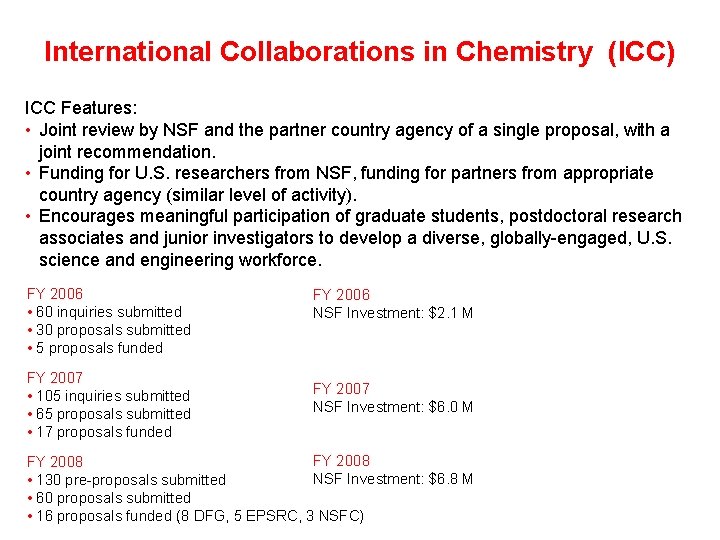
International Collaborations in Chemistry (ICC) ICC Features: • Joint review by NSF and the partner country agency of a single proposal, with a joint recommendation. • Funding for U. S. researchers from NSF, funding for partners from appropriate country agency (similar level of activity). • Encourages meaningful participation of graduate students, postdoctoral research associates and junior investigators to develop a diverse, globally-engaged, U. S. science and engineering workforce. FY 2006 • 60 inquiries submitted • 30 proposals submitted • 5 proposals funded FY 2007 • 105 inquiries submitted • 65 proposals submitted • 17 proposals funded FY 2006 NSF Investment: $2. 1 M FY 2007 NSF Investment: $6. 0 M FY 2008 NSF Investment: $6. 8 M • 130 pre-proposals submitted • 60 proposals submitted • 16 proposals funded (8 DFG, 5 EPSRC, 3 NSFC)
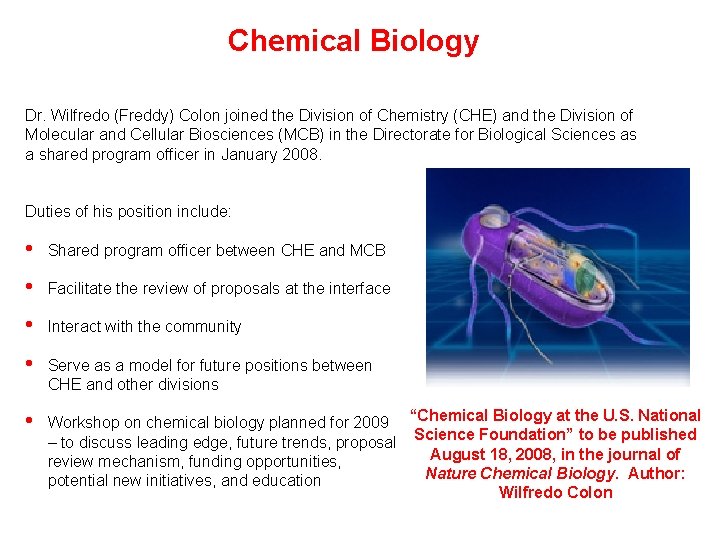
Chemical Biology Dr. Wilfredo (Freddy) Colon joined the Division of Chemistry (CHE) and the Division of Molecular and Cellular Biosciences (MCB) in the Directorate for Biological Sciences as a shared program officer in January 2008. Duties of his position include: • Shared program officer between CHE and MCB • Facilitate the review of proposals at the interface • Interact with the community • Serve as a model for future positions between CHE and other divisions • Workshop on chemical biology planned for 2009 “Chemical Biology at the U. S. National – to discuss leading edge, future trends, proposal Science Foundation” to be published August 18, 2008, in the journal of review mechanism, funding opportunities, Nature Chemical Biology. Author: potential new initiatives, and education Wilfredo Colon
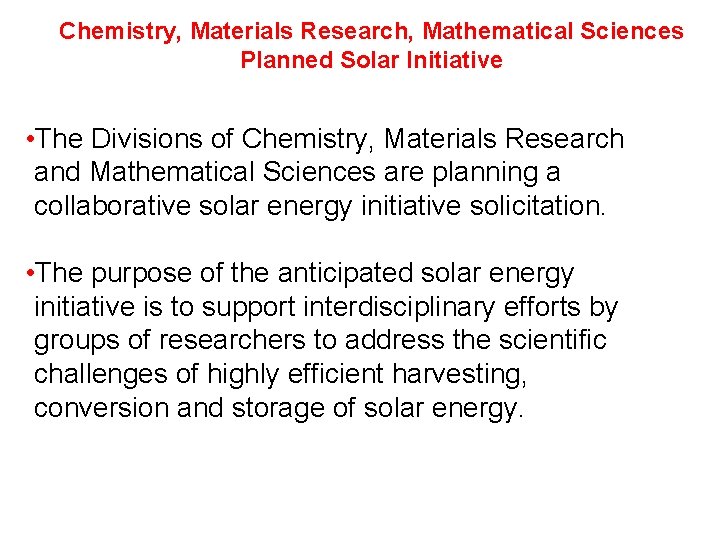
Chemistry, Materials Research, Mathematical Sciences Planned Solar Initiative • The Divisions of Chemistry, Materials Research and Mathematical Sciences are planning a collaborative solar energy initiative solicitation. • The purpose of the anticipated solar energy initiative is to support interdisciplinary efforts by groups of researchers to address the scientific challenges of highly efficient harvesting, conversion and storage of solar energy.
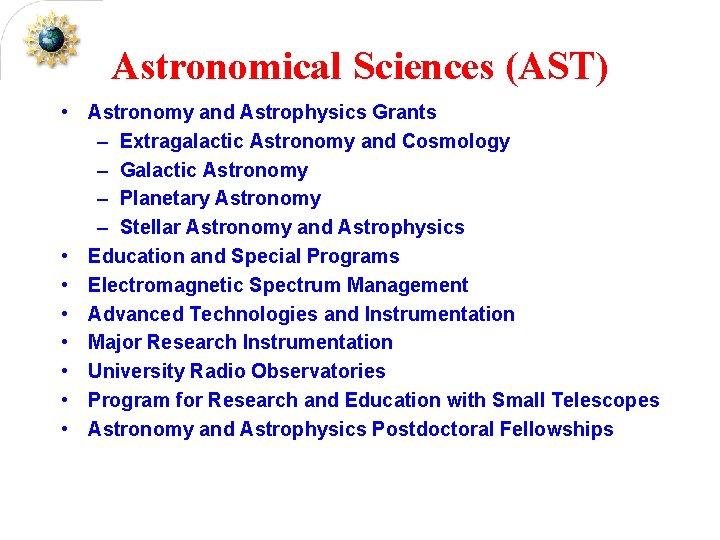
Astronomical Sciences (AST) • Astronomy and Astrophysics Grants – Extragalactic Astronomy and Cosmology – Galactic Astronomy – Planetary Astronomy – Stellar Astronomy and Astrophysics • Education and Special Programs • Electromagnetic Spectrum Management • Advanced Technologies and Instrumentation • Major Research Instrumentation • University Radio Observatories • Program for Research and Education with Small Telescopes • Astronomy and Astrophysics Postdoctoral Fellowships
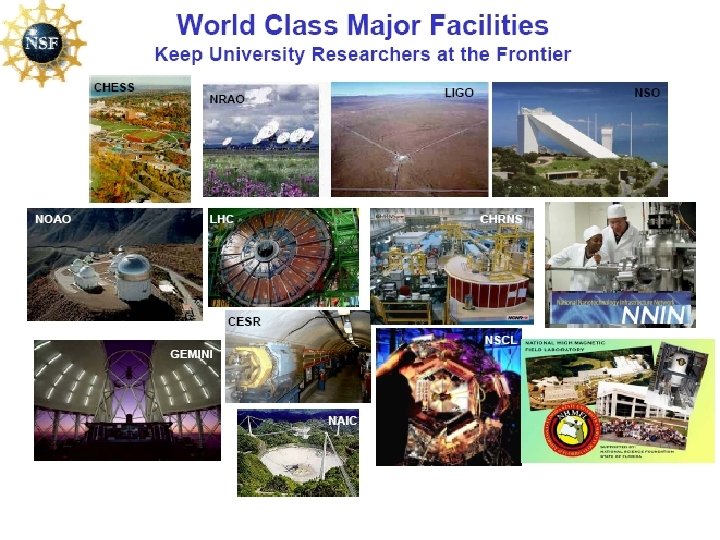
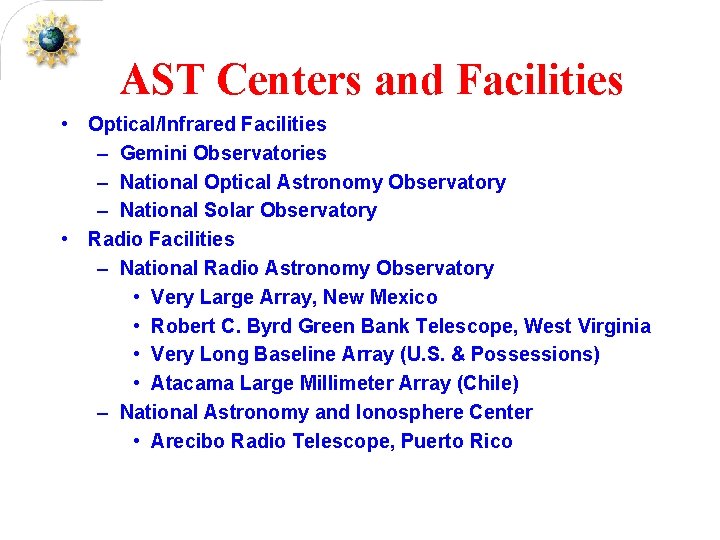
AST Centers and Facilities • Optical/Infrared Facilities – Gemini Observatories – National Optical Astronomy Observatory – National Solar Observatory • Radio Facilities – National Radio Astronomy Observatory • Very Large Array, New Mexico • Robert C. Byrd Green Bank Telescope, West Virginia • Very Long Baseline Array (U. S. & Possessions) • Atacama Large Millimeter Array (Chile) – National Astronomy and Ionosphere Center • Arecibo Radio Telescope, Puerto Rico
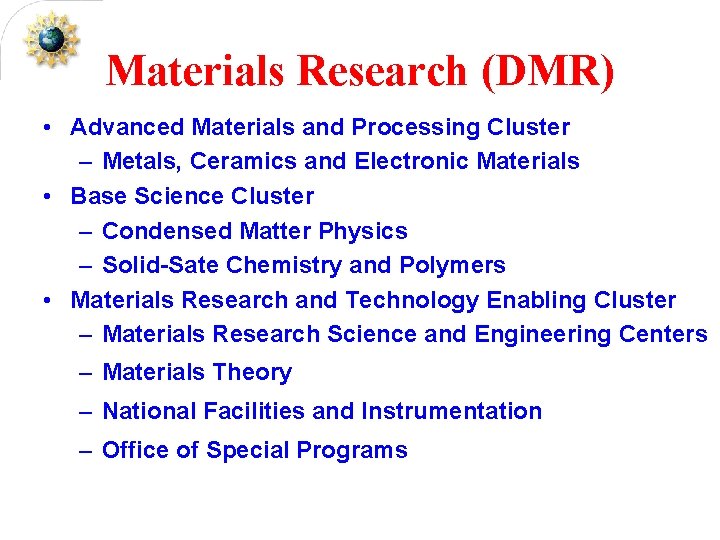
Materials Research (DMR) • Advanced Materials and Processing Cluster – Metals, Ceramics and Electronic Materials • Base Science Cluster – Condensed Matter Physics – Solid-Sate Chemistry and Polymers • Materials Research and Technology Enabling Cluster – Materials Research Science and Engineering Centers – Materials Theory – National Facilities and Instrumentation – Office of Special Programs
Centers and Institutes • Science and Technology Centers • Nanoscale Science and Engineering Centers • Materials Research Science and Engineering Centers • International Materials Institutes • Partnerships for Research and Education in Materials
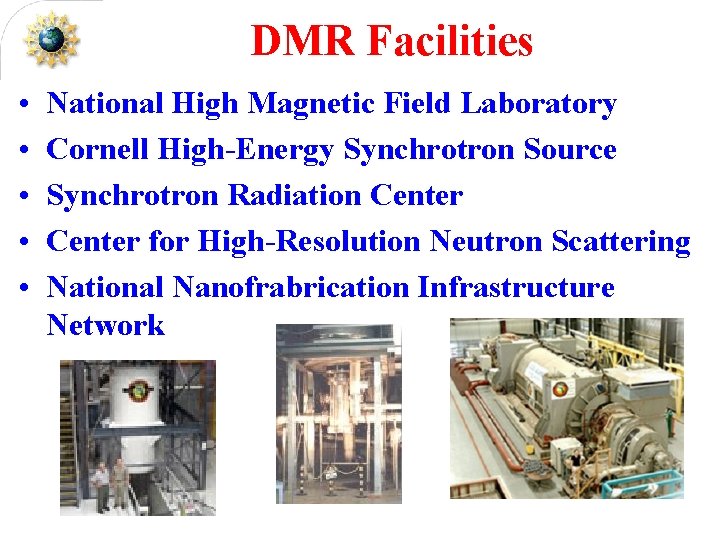
DMR Facilities • • • National High Magnetic Field Laboratory Cornell High-Energy Synchrotron Source Synchrotron Radiation Center for High-Resolution Neutron Scattering National Nanofrabrication Infrastructure Network
Materials World Network • Funds the US researchers in an International Collaboration • Foreign researchers are funded by their respective agencies • Countries and Agencies involved – Algeria, Argentina, Australia, Austria, Brazil, Canada, Chile, China, Colombia, Croatia, Czech Republic, Egypt, Ethiopia, European Commission, European Science Foundation, Finland, France, Germany, Ghana, Greece, Hungary, India, Ireland, Israel, Italy, Jamaica, Japan, Luxembourg, Mexico, Morocco, Namibia, Nigeria, Norway, Poland, Portugal, Russian Federation, Rwanda, Senegal, Singapore, Slovak Republic, South Africa, Spain, Sweden, Switzerland, Taiwan, Trinidad & Tobago, Tunisia, Turkey, Uganda, United Kingdom, Ukraine, and Zimbabwe
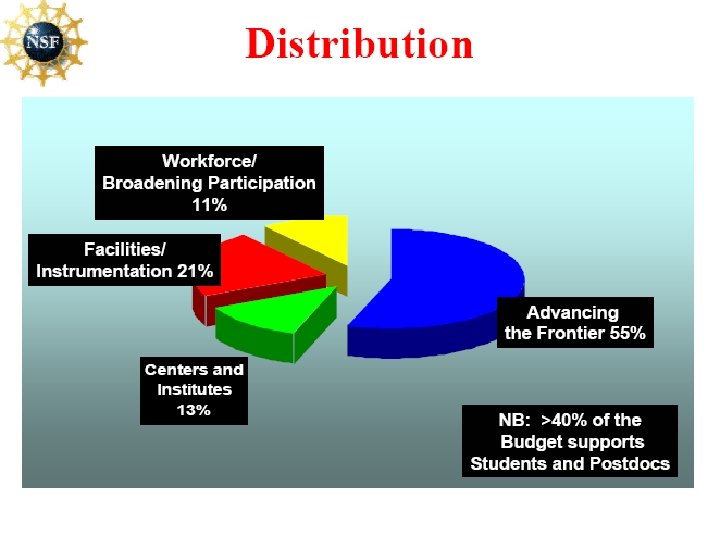
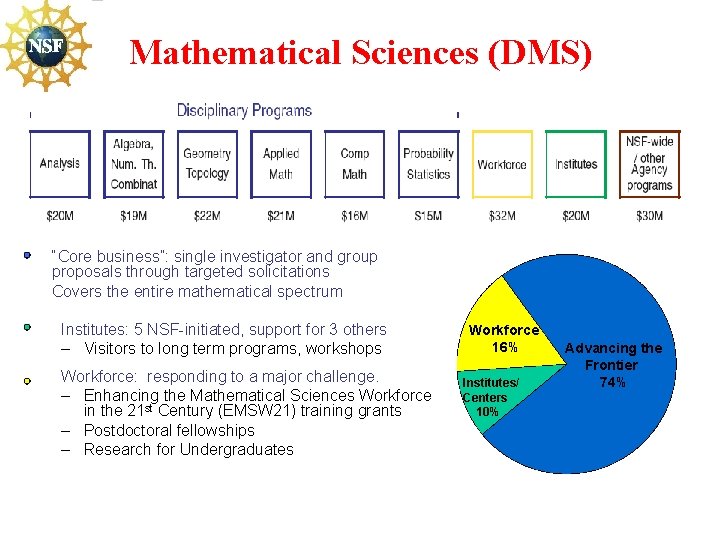
Mathematical Sciences (DMS) • “Core business”: single investigator and group proposals through targeted solicitations Covers the entire mathematical spectrum Institutes: 5 NSF-initiated, support for 3 others – Visitors to long term programs, workshops Workforce: responding to a major challenge. – Enhancing the Mathematical Sciences Workforce in the 21 st Century (EMSW 21) training grants – Postdoctoral fellowships – Research for Undergraduates Workforce 16% Institutes/ Centers 10% Advancing the Frontier 74%
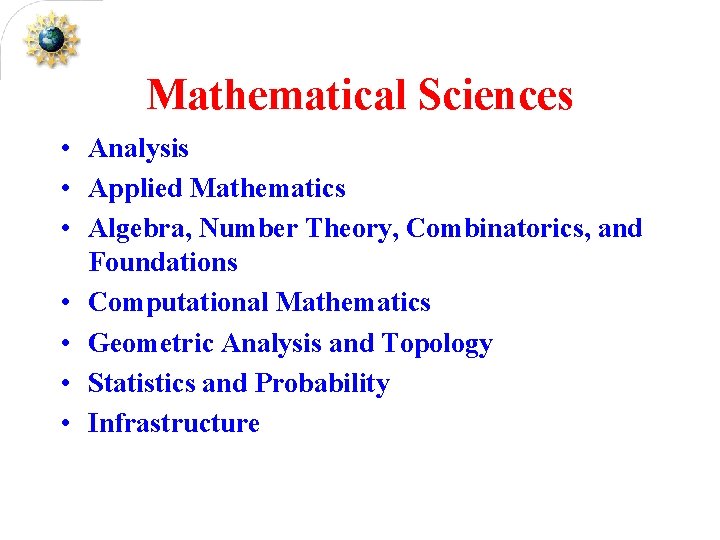
Mathematical Sciences • Analysis • Applied Mathematics • Algebra, Number Theory, Combinatorics, and Foundations • Computational Mathematics • Geometric Analysis and Topology • Statistics and Probability • Infrastructure
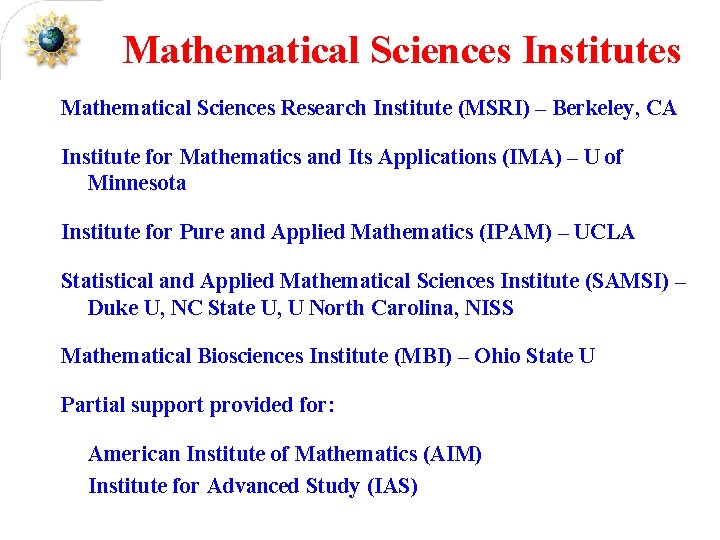
Mathematical Sciences Institutes Mathematical Sciences Research Institute (MSRI) – Berkeley, CA Institute for Mathematics and Its Applications (IMA) – U of Minnesota Institute for Pure and Applied Mathematics (IPAM) – UCLA Statistical and Applied Mathematical Sciences Institute (SAMSI) – Duke U, NC State U, U North Carolina, NISS Mathematical Biosciences Institute (MBI) – Ohio State U Partial support provided for: American Institute of Mathematics (AIM) Institute for Advanced Study (IAS)
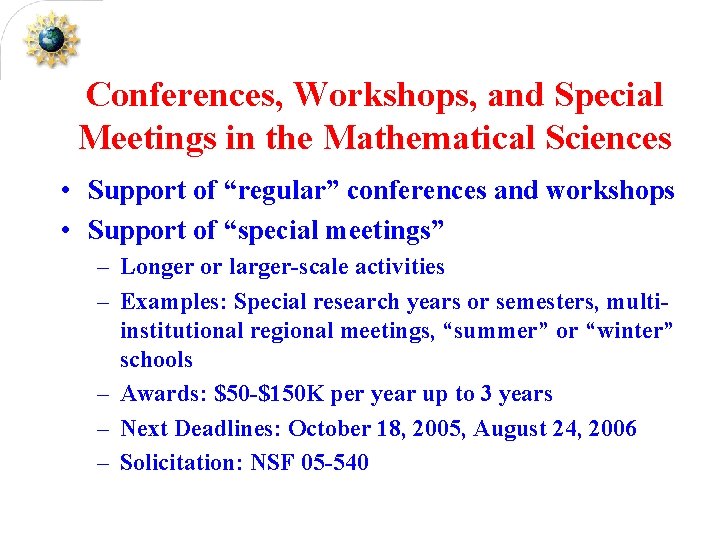
Conferences, Workshops, and Special Meetings in the Mathematical Sciences • Support of “regular” conferences and workshops • Support of “special meetings” – Longer or larger-scale activities – Examples: Special research years or semesters, multiinstitutional regional meetings, “summer” or “winter” schools – Awards: $50 -$150 K per year up to 3 years – Next Deadlines: October 18, 2005, August 24, 2006 – Solicitation: NSF 05 -540
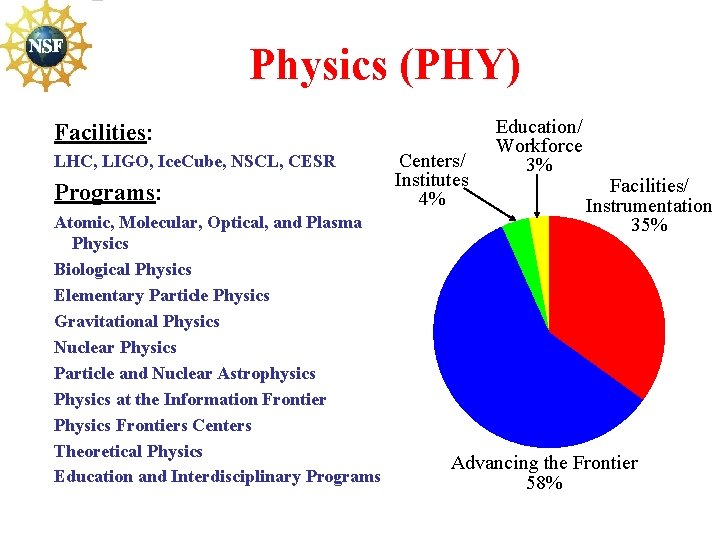
Physics (PHY) Facilities: LHC, LIGO, Ice. Cube, NSCL, CESR Programs: Atomic, Molecular, Optical, and Plasma Physics Biological Physics Elementary Particle Physics Gravitational Physics Nuclear Physics Particle and Nuclear Astrophysics Physics at the Information Frontier Physics Frontiers Centers Theoretical Physics Education and Interdisciplinary Programs Centers/ Institutes 4% Education/ Workforce 3% Facilities/ Instrumentation 35% Advancing the Frontier 58%
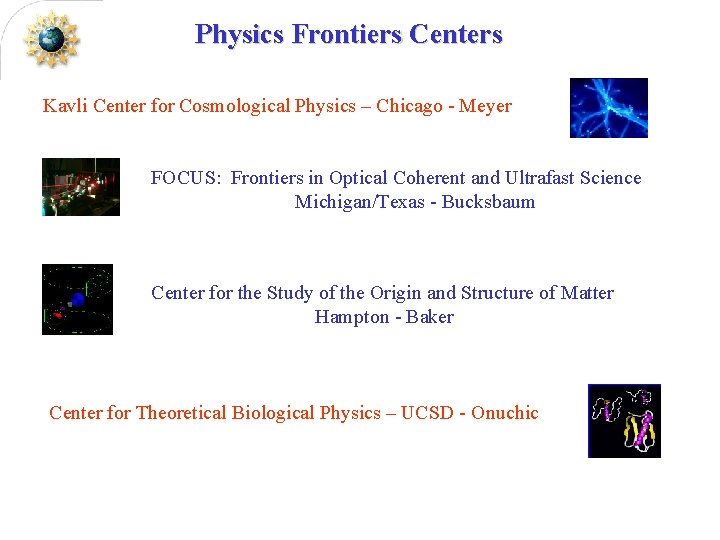
Physics Frontiers Centers Kavli Center for Cosmological Physics – Chicago - Meyer FOCUS: Frontiers in Optical Coherent and Ultrafast Science Michigan/Texas - Bucksbaum Center for the Study of the Origin and Structure of Matter Hampton - Baker Center for Theoretical Biological Physics – UCSD - Onuchic
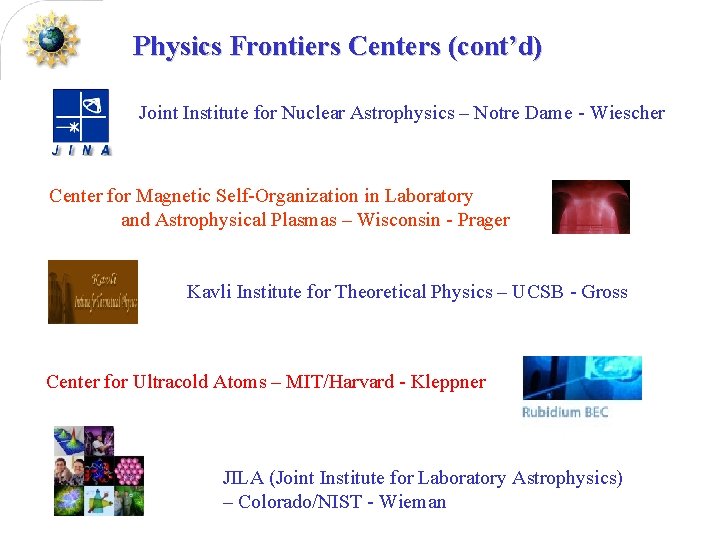
Physics Frontiers Centers (cont’d) Joint Institute for Nuclear Astrophysics – Notre Dame - Wiescher Center for Magnetic Self-Organization in Laboratory and Astrophysical Plasmas – Wisconsin - Prager Kavli Institute for Theoretical Physics – UCSB - Gross Center for Ultracold Atoms – MIT/Harvard - Kleppner JILA (Joint Institute for Laboratory Astrophysics) – Colorado/NIST - Wieman
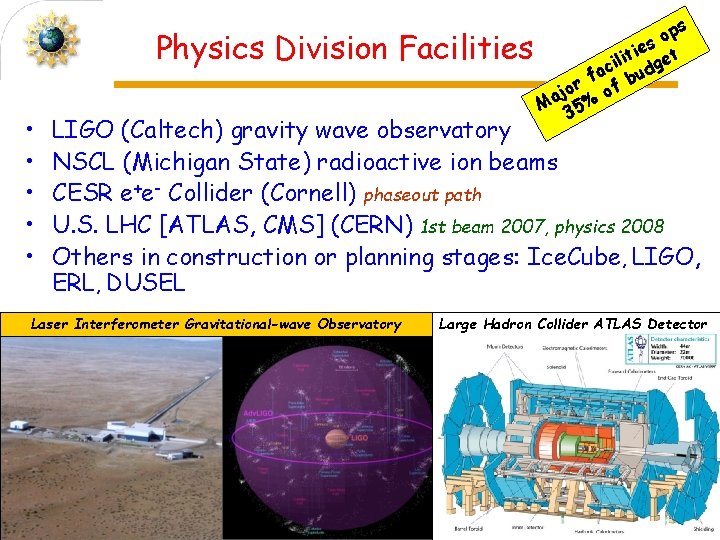
Physics Division Facilities • • • ps o es t i cil udge a f r fb o o j Ma 35% LIGO (Caltech) gravity wave observatory NSCL (Michigan State) radioactive ion beams CESR e+e- Collider (Cornell) phaseout path U. S. LHC [ATLAS, CMS] (CERN) 1 st beam 2007, physics 2008 Others in construction or planning stages: Ice. Cube, LIGO, ERL, DUSEL Laser Interferometer Gravitational-wave Observatory Large Hadron Collider ATLAS Detector
Office of Multidisciplinary Activities • Roles: – Supports excellence and creativity of the MPS community more effectively – Works as an investment capital resource and partner to MPS Divisions to support joint ventures across organizational boundaries – Facilitates support of research and education projects not readily accommodated by existing MPS structures
Office of Multidisciplinary Activities • Characteristics: – Not a traditional ‘program’ function – Does not receive/evaluate external proposals – Co-invests with MPS Divisions, other NSF Directorates, and external partners – Advice/guidance from MPS Division Directors – One year budget basis – no continuing commitments
NSF Merit Review Process • By Mail and/or Panel • Confidential • Anonymous
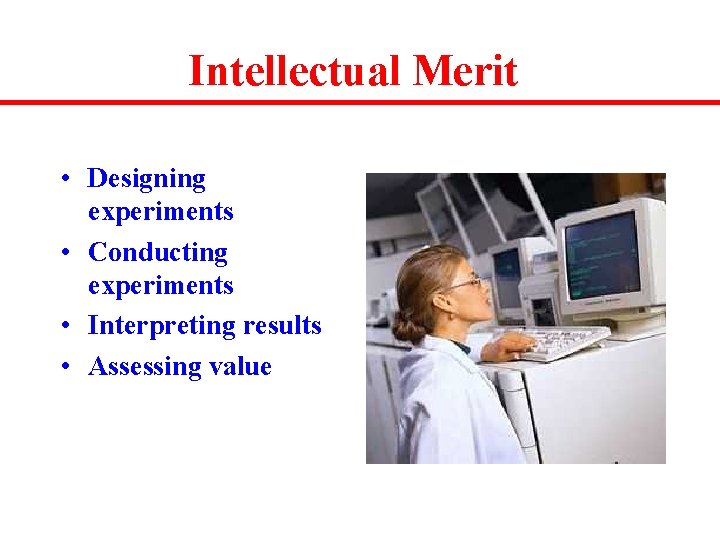
Intellectual Merit • Designing experiments • Conducting experiments • Interpreting results • Assessing value
NSF’s Review Criteria Intellectual Merit • How important is the proposed activity to advancing knowledge and understanding within its own field or across different fields? • How well qualified is the proposer (individual or team) to conduct the project? • To what extent does the proposed activity suggest and explore creative and original concepts? • How well conceived and organized is the proposed activity? • Is there sufficient access to resources?
Broader Impacts • • Communication Education Underrepresented Groups Industry Environment National security Health Quality of life
NSF’s Review Criteria Broader Impact • How well does the activity advance discovery and understanding while promoting teaching, training, and learning? • How well does the proposed activity broaden the participation of underrepresented groups? • To what extent will it enhance the infrastructure for research and education, such as facilities, instrumentation, networks, and partnerships? • Will the results be disseminated broadly to enhance scientific and technological understanding? • What may be the benefits of the proposed activity to society? http: //www. nsf. gov/pubs/2002/nsf 022/bicexamples. pdf
Secrets for Success • • • New and original ideas Sound, succinct, detailed focused plan Preliminary data and/or feasibility calculation Relevant experience Clarity concerning future direction Well-articulated broader impacts
Understanding Grantsmanship • Locate appropriate Program Officer by searching Fastlane for similar awards; note scope of work, range of funding, broader impacts • Talk to Program Officer, send one paragraph on both review criteria (intellectual merit and broader impacts) and get feedback • Read Grant Proposal Guide and abide by rules • Read successful proposals • Have others read your proposal, preferably others like the likely reviewers • Suggest reviewers to use or not to use. OK to request a previous reviewer or ask to not use a previous reviewer. • We strive to complete >70% of the proposals in 6 months • Volunteer as a reviewer, panelist, program officer (www. nsf. gov/chem) • Utilize Graduate Research Fellowship program (Div. Grad. Ed. ) • Pay attention to deadlines, windows • New CHE windows: July and November
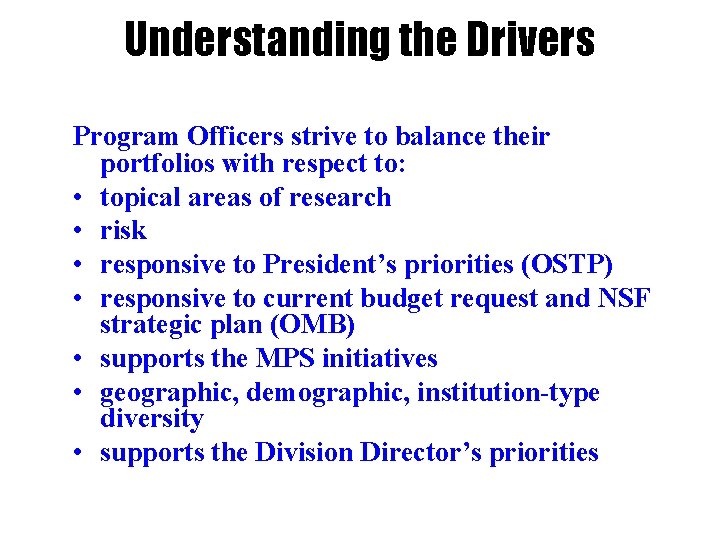
Understanding the Drivers Program Officers strive to balance their portfolios with respect to: • topical areas of research • risk • responsive to President’s priorities (OSTP) • responsive to current budget request and NSF strategic plan (OMB) • supports the MPS initiatives • geographic, demographic, institution-type diversity • supports the Division Director’s priorities
NSF Proposals • Get to know your program officer(s) • Contact the program officer(s) to discuss your project, and learn of relevant, current opportunities • Know and follow the current Grant Proposal Guide (GPG) - it changes! • Know the audience for your proposal’s review - it is a competition! • Explicitly address Intellectual Merit and Broader Impact in both the Project Summary and Project Description!
NSF Proposals • Match and justify the budget to the scope of the proposed work - ask for what you need! • Be familiar with projects that have succeeded - Award Abstracts at http: //www. nsf. gov/awardsearch • Special programs exist which are of interest for Primarily Undergraduate Institutions (PUIs), e. g. , Research at Undergraduate Institutions (RUI) and Research Opportunity Awards (ROA)
Look Us Up For information on a particular division and program, go to the following web address and pick a Division: http: //www. nsf. gov/home/mps/ See “MPS Directory and Staff” on MPS home page