
Overview of the Nigerian Skills Qualifications Framework NSQF






- Slides: 34
Overview of the Nigerian Skills Qualifications Framework (NSQF) BY OLUBODE DANIEL MAJIYAGBE DD (NSQD) NBTE, KADUNA
PRESENTATION TOPICS �Introduction �Brief on NBTE �Challenges of the TVE System �Introduction to the NSQF �National Occupational Standards, NOS �Prospects of the NSQF & progress on Implementation �NSQs, available NSQs, actors delivering, how to acquire �Current Strategies �Conclusion
INTRODUCTION (NSQF) New Initiatives for Repositioning the Technical and Vocational Education TVET Sector for National Development and Global Competitiveness
We are in a race… 4
Brief on NBTE Vision To be a world class regulatory body for the promotion of Technical and Vocational Education and Training in Nigeria Mission To promote the production of skilled technical and professional manpower for the development and sustenance of the National Economy
Our Functions THESE ARE PRINCIPALLY DERIVED FROM OUR ENABLING LAWS: § These functions of the Board are derived in its enabling Act No. 9 of 11 th January, 1977 § Education/National Minimum Standard and Establishment of Institution Act No. 16 of August 1985 and Act No. 9 of 1993.
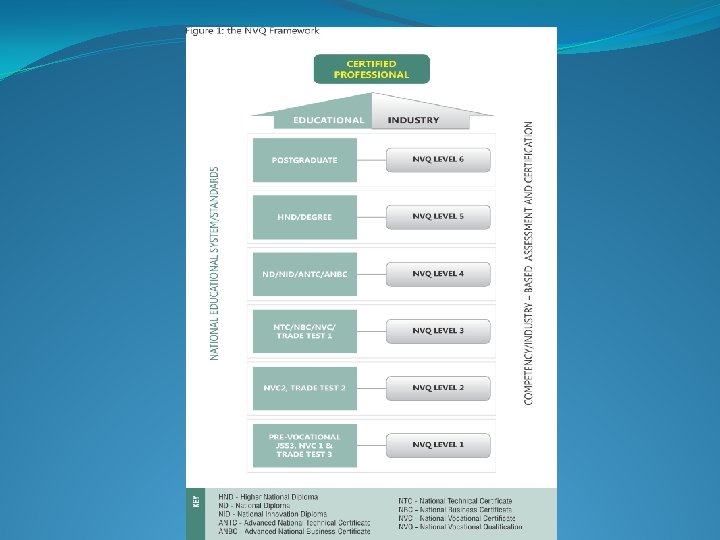
Brief on NBTE q Coordinate all aspect of Technical and Vocational Education and Training falling outside the Universities q Determine, after consultation with such other bodies, the skilled manpower needs of the country in the industrial, commercial and other relevant fields q Quality Assurance: establishment and maintenance of minimum standards in polytechnics and other technical institutions in the Federation q Setting National Minimum Standards on Programmes leading to the award of ND, HND, P HND, NID, NVC, NBC, NTC, ANTC and ANBC q Over 280 curricula q Over 550 technical institutions
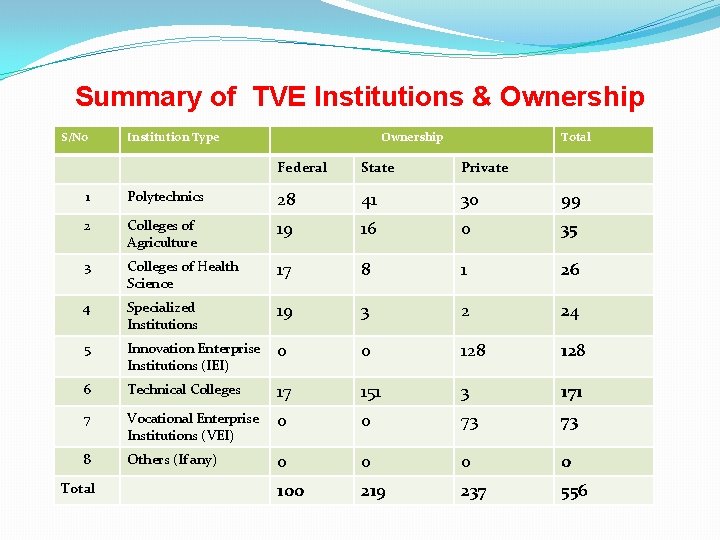
Summary of TVE Institutions & Ownership S/No Institution Type Ownership Total Federal State Private 1 Polytechnics 28 41 30 99 2 Colleges of Agriculture 19 16 0 35 3 Colleges of Health Science 17 8 1 26 4 Specialized Institutions 19 3 2 24 5 Innovation Enterprise Institutions (IEI) 0 0 128 6 Technical Colleges 17 151 3 171 7 Vocational Enterprise Institutions (VEI) 0 0 73 73 8 Others (If any) 0 0 100 219 237 556 Total
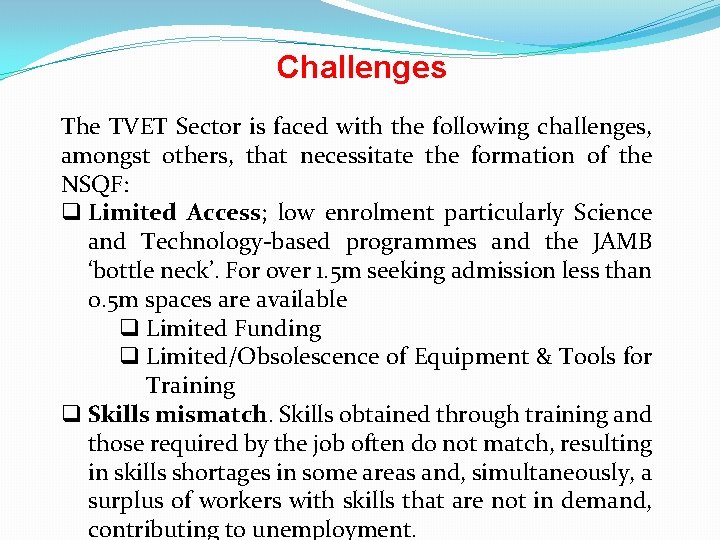
Challenges The TVET Sector is faced with the following challenges, amongst others, that necessitate the formation of the NSQF: q Limited Access; low enrolment particularly Science and Technology based programmes and the JAMB ‘bottle neck’. For over 1. 5 m seeking admission less than 0. 5 m spaces are available q Limited Funding q Limited/Obsolescence of Equipment & Tools for Training q Skills mismatch. Skills obtained through training and those required by the job often do not match, resulting in skills shortages in some areas and, simultaneously, a surplus of workers with skills that are not in demand, contributing to unemployment.
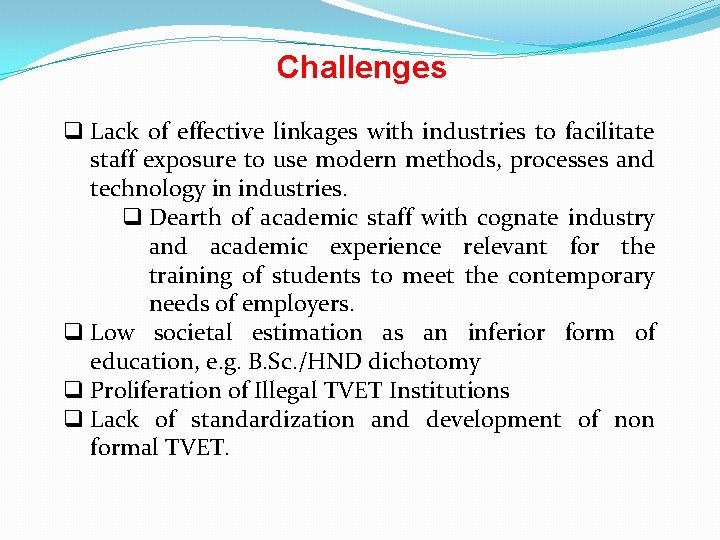
Challenges q Lack of effective linkages with industries to facilitate staff exposure to use modern methods, processes and technology in industries. q Dearth of academic staff with cognate industry and academic experience relevant for the training of students to meet the contemporary needs of employers. q Low societal estimation as an inferior form of education, e. g. B. Sc. /HND dichotomy q Proliferation of Illegal TVET Institutions q Lack of standardization and development of non formal TVET.
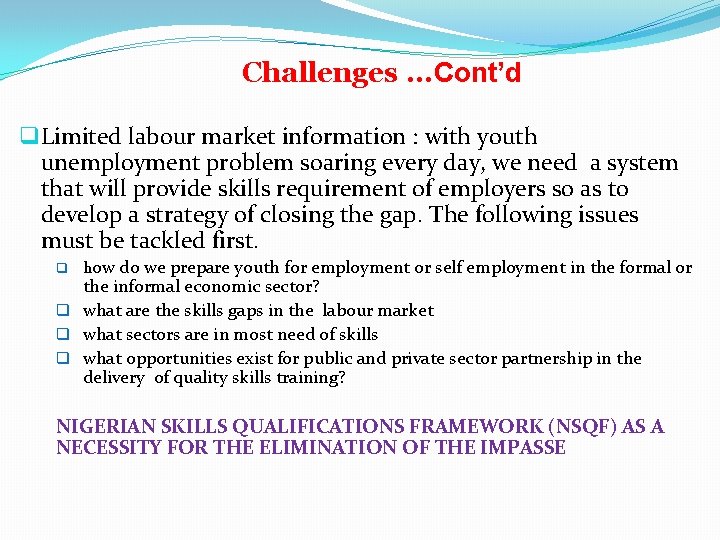
Challenges. . . Cont’d q Limited labour market information : with youth unemployment problem soaring every day, we need a system that will provide skills requirement of employers so as to develop a strategy of closing the gap. The following issues must be tackled first. q how do we prepare youth for employment or self employment in the formal or the informal economic sector? q what are the skills gaps in the labour market q what sectors are in most need of skills q what opportunities exist for public and private sector partnership in the delivery of quality skills training? NIGERIAN SKILLS QUALIFICATIONS FRAMEWORK (NSQF) AS A NECESSITY FOR THE ELIMINATION OF THE IMPASSE
National Skills Qualifications Framework (NSQF) To address the Skill needs of teeming youths and the ever rising challenges of unemployment and under employment, NBTE in partnership with other skills development stakeholders have commenced the institutionalisation of NSQF in Nigeria. § NSQF is an instrument for the development, classification and recognition of skills, knowledge and competencies acquired through a variety of ways by citizens of the country irrespective of the method of training or skill acquisition. § It is a way of structuring existing and new qualifications which are defined by learning outcomes.
Objectives of NSQF… The main objectives of the Framework are: �Ensure the quality, status, relevance and availability of TVET provisions �Reduce the complexity and ambiguity of selecting competent persons to occupational positions by industry �Provide training, assessment and certification opportunities for the formal, non formal and informal TVET �Establish pathways and progression from non-formal and informal short courses provided by various government agencies, NGOs and industry, to formal TVET programmes �Narrow the gaps between what TVET graduates know and can do and the skills and knowledge that employers say they need �Overcome limited progression possibilities and demand for TVET that far exceeds supply
NSQF …. § NSQF is based on National Skills Qualifications (NSQs), which is a 'competence based' qualification. This means that training/learning for such qualification involves a series of practical, work related tasks designed to ensure that trainee develops the skills, knowledge and necessary attitude to do a job effectively. § NSQs are the first national attempt to base vocational qualifications solely on competences or outcomes rather than inputs or processes § They are based on National Occupational Standards (NOS)
NSQF …. NATIONAL OCCUPATIONAL STANDARDS (NOS) § NOS are standards set out by industry bodies or Skills Councils based on occupations or trades and provide the building blocks of NSQs § These NOS spell out precisely what a competent person in a job is expected to do. Learners or trainees are continuously monitored by training guides, master trainers, or internal assessors, at their workplace or place of apprenticeship, § Trainees progress through various levels of increasing complexity in NSQs. § For each level candidates go through series of scheduled job tasks, and when considered ready to be assessed for a particular qualification, they are ‘tested’ by recognised External Assessors.
The Prospects of NSQF in Nigeria The development and institutionalization of NSQF will: �Provide policy guidelines on organizing skills training to improve product quality, productivity and competitiveness in both formal and informal sector �Provide a coherent structure for vocational qualifications, which are based on employment led standards of competence �Increase industry ownership of the traineeship system which enhance stakeholders input to major decisions �Determine the levels of award, which enable clear routes of progression, and appropriate awards, which relate to employment �Determine convenient systems for recognition of prior achievement
The Prospects of NSQF in Nigeria Cont’d �Expand access to education particularly lifelong learning through TVE �Provide system for upskilling, reskilling etc. of Nigerian youths and working adults �Expand training opportunities so that they are more evenly spread across the workforce meeting the needs of all enterprises more equitably �Facilitate access to, and mobility and progression within education, training and career paths �Provide a policy framework for flexible curricula based on National Occupational Standards (NOS) dictated by the industry
Actors Delivering NSQs �The training providers/Assessment Centres �The Awarding Bodies �The Sector Skills Councils �The Regulatory Agency �The Funding Agencies
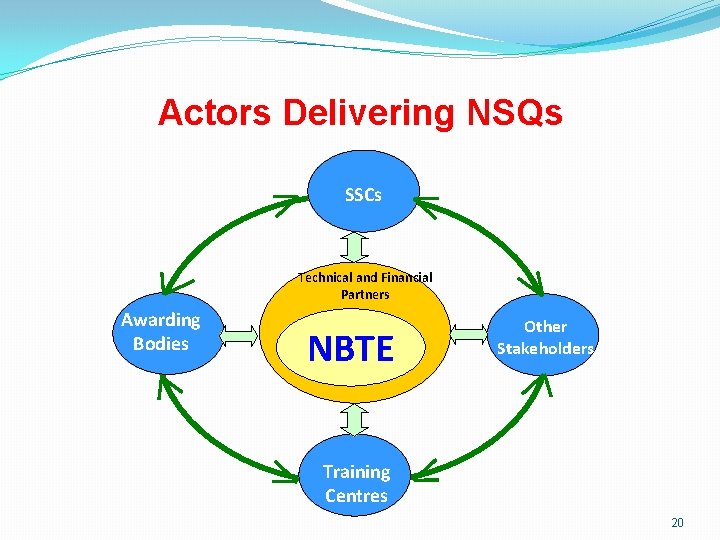
Actors Delivering NSQs SSCs Technical and Financial Partners Awarding Bodies NBTE Other Stakeholders Training Centres 20
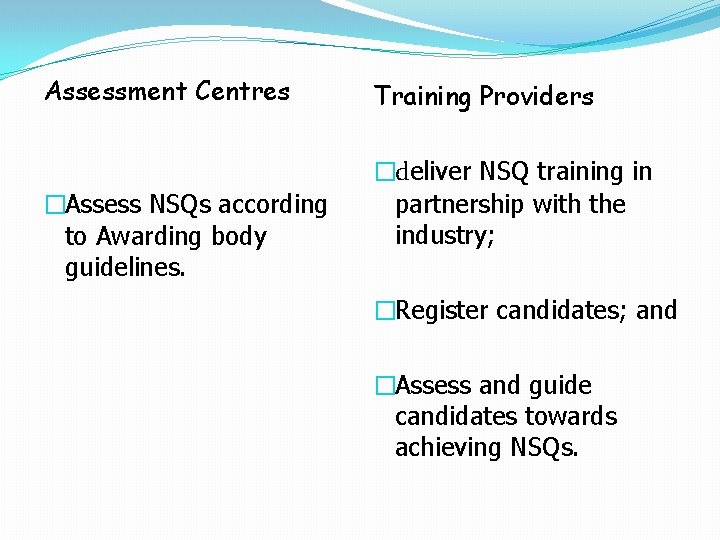
Assessment Centres �Assess NSQs according to Awarding body guidelines. Training Providers �deliver NSQ training in partnership with the industry; �Register candidates; and �Assess and guide candidates towards achieving NSQs.
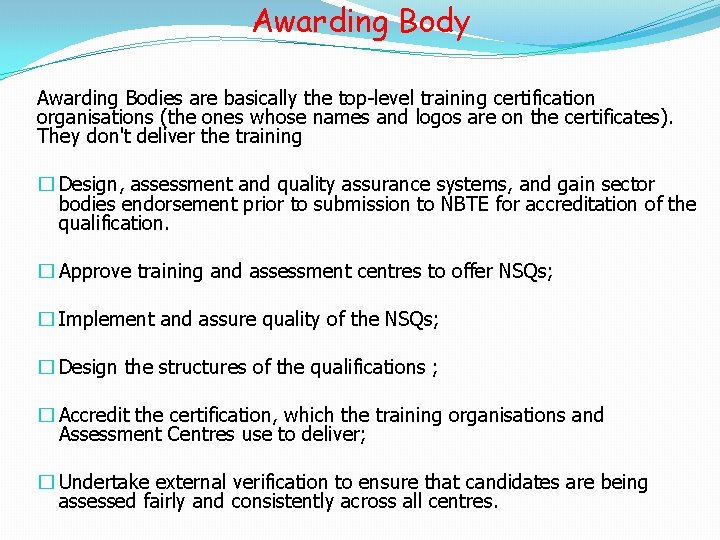
Awarding Body Awarding Bodies are basically the top-level training certification organisations (the ones whose names and logos are on the certificates). They don't deliver the training � Design, assessment and quality assurance systems, and gain sector bodies endorsement prior to submission to NBTE for accreditation of the qualification. � Approve training and assessment centres to offer NSQs; � Implement and assure quality of the NSQs; � Design the structures of the qualifications ; � Accredit the certification, which the training organisations and Assessment Centres use to deliver; � Undertake external verification to ensure that candidates are being assessed fairly and consistently across all centres.
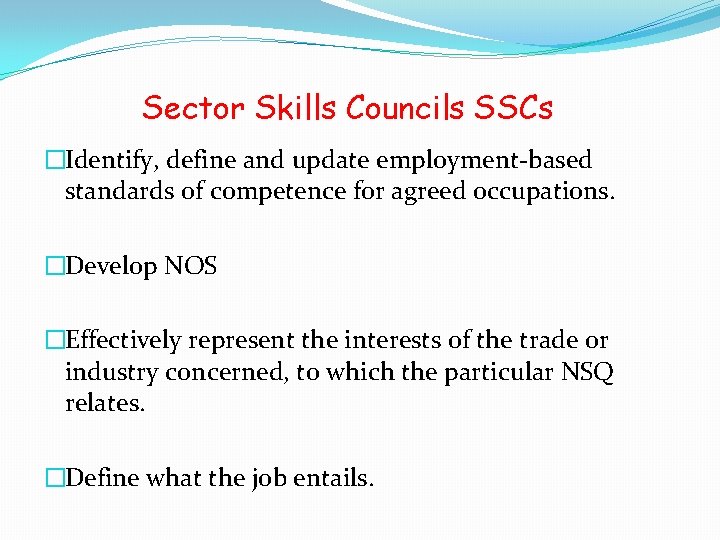
Sector Skills Councils SSCs �Identify, define and update employment based standards of competence for agreed occupations. �Develop NOS �Effectively represent the interests of the trade or industry concerned, to which the particular NSQ relates. �Define what the job entails.
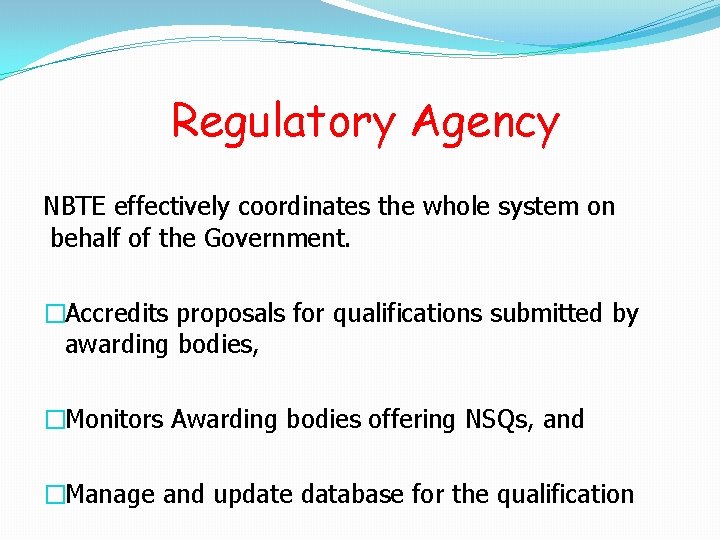
Regulatory Agency NBTE effectively coordinates the whole system on behalf of the Government. �Accredits proposals for qualifications submitted by awarding bodies, �Monitors Awarding bodies offering NSQs, and �Manage and update database for the qualification
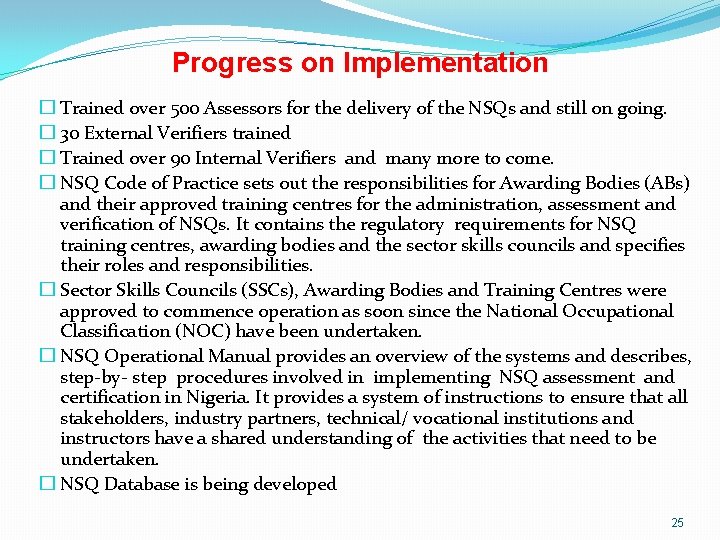
Progress on Implementation � Trained over 500 Assessors for the delivery of the NSQs and still on going. � 30 External Verifiers trained � Trained over 90 Internal Verifiers and many more to come. � NSQ Code of Practice sets out the responsibilities for Awarding Bodies (ABs) and their approved training centres for the administration, assessment and verification of NSQs. It contains the regulatory requirements for NSQ training centres, awarding bodies and the sector skills councils and specifies their roles and responsibilities. � Sector Skills Councils (SSCs), Awarding Bodies and Training Centres were approved to commence operation as soon since the National Occupational Classification (NOC) have been undertaken. � NSQ Operational Manual provides an overview of the systems and describes, step by step procedures involved in implementing NSQ assessment and certification in Nigeria. It provides a system of instructions to ensure that all stakeholders, industry partners, technical/ vocational institutions and instructors have a shared understanding of the activities that need to be undertaken. � NSQ Database is being developed 25
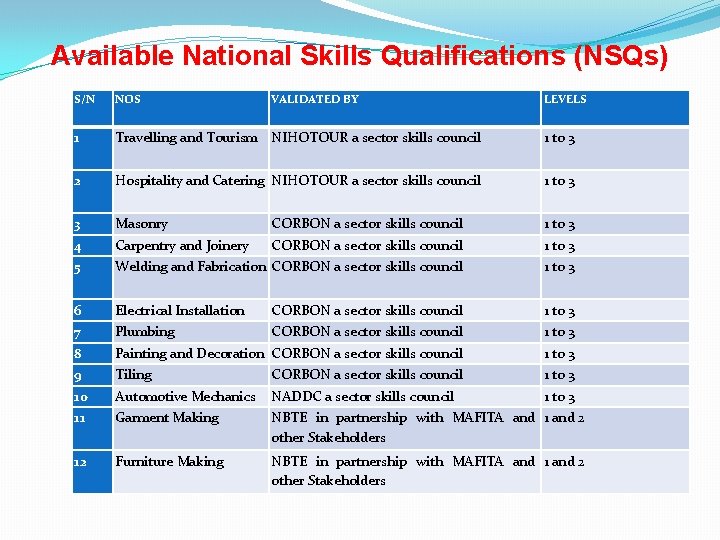
Available National Skills Qualifications (NSQs) S/N NOS VALIDATED BY LEVELS 1 Travelling and Tourism NIHOTOUR a sector skills council 1 to 3 2 Hospitality and Catering NIHOTOUR a sector skills council 1 to 3 3 Masonry CORBON a sector skills council 1 to 3 4 Carpentry and Joinery CORBON a sector skills council 1 to 3 5 Welding and Fabrication CORBON a sector skills council 1 to 3 6 Electrical Installation CORBON a sector skills council 1 to 3 7 Plumbing CORBON a sector skills council 1 to 3 8 Painting and Decoration CORBON a sector skills council 1 to 3 9 Tiling CORBON a sector skills council 1 to 3 10 Automotive Mechanics NADDC a sector skills council 1 to 3 11 Garment Making NBTE in partnership with MAFITA and 1 and 2 other Stakeholders 12 Furniture Making NBTE in partnership with MAFITA and 1 and 2 other Stakeholders
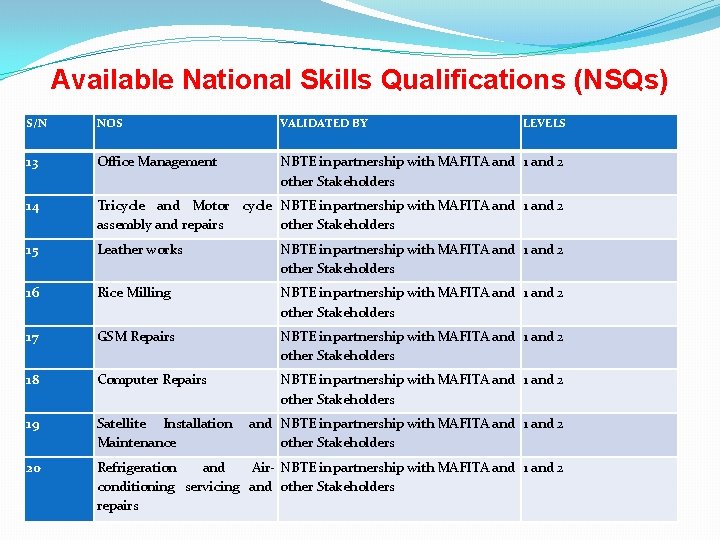
Available National Skills Qualifications (NSQs) S/N NOS VALIDATED BY LEVELS 13 Office Management NBTE in partnership with MAFITA and 1 and 2 other Stakeholders 14 Tricycle and Motor cycle NBTE in partnership with MAFITA and 1 and 2 assembly and repairs other Stakeholders 15 Leather works NBTE in partnership with MAFITA and 1 and 2 other Stakeholders 16 Rice Milling NBTE in partnership with MAFITA and 1 and 2 other Stakeholders 17 GSM Repairs NBTE in partnership with MAFITA and 1 and 2 other Stakeholders 18 Computer Repairs NBTE in partnership with MAFITA and 1 and 2 other Stakeholders 19 Satellite Installation Maintenance 20 Refrigeration and Air NBTE in partnership with MAFITA and 1 and 2 conditioning servicing and other Stakeholders repairs and NBTE in partnership with MAFITA and 1 and 2 other Stakeholders
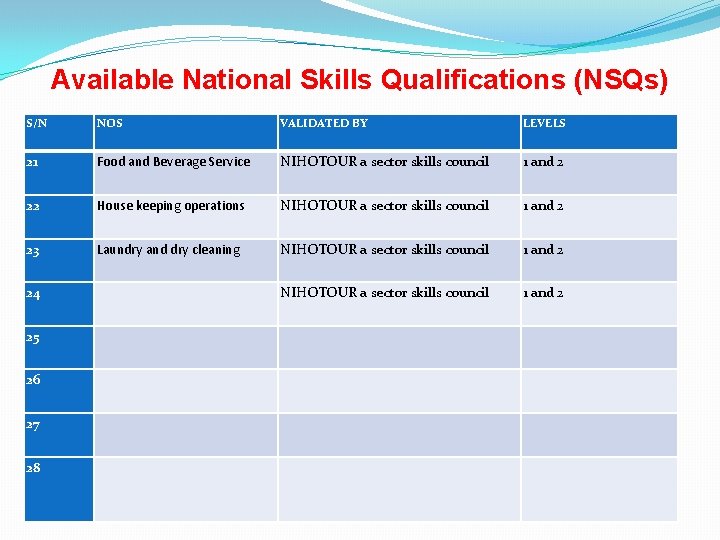
Available National Skills Qualifications (NSQs) S/N NOS VALIDATED BY LEVELS 21 Food and Beverage Service NIHOTOUR a sector skills council 1 and 2 22 House keeping operations NIHOTOUR a sector skills council 1 and 2 23 Laundry and dry cleaning NIHOTOUR a sector skills council 1 and 2 24 25 26 27 28
How to Acquire a NSQ q. Find an appropriate Awarding Body (AB) q. Register with a training provider q. Agree on the Qualification and level to be pursued q. Get an approved Assessor and get inducted q. Agree on Training and Assessment Schedule q. Acquire Training that fits the NOS Units in the NSQ q. Alternatively go for Recognition of Prior Learning (RPL) q. Generate your evidences and build a portfolio q. Submit your portfolio with the AB for
Our Strategies To fast track the institutionalisation of NSQF in Nigeria, there is the need to: �Harmonise training standards: develop additional NOS �Conduct classification of NOS into NSQs �Train Quality Assurance Assessors and Verifiers, and External Verifiers �Approve selected Centres to become assessment Centres �Develop the capacity of the Managers of Skills Centres �Support Sector Skills Councils to conduct skills gap analysis �Produce a functional Skills Development Policy for Nigeria
Our Strategies Cont’d �Establish a funding scheme for the programme(scheme of paying the Trainees and Trainers) �Establishing TVET Consolidation Fund �Develop a data bank on the product of the system �Develop a system of incentives for participating industry/colleges/skills centres �Fast track the placement of holders of NSQs in the National scheme of service �Legislative framework (NBTE’s Act for the take off) �Awarding Bodies �Training Providers (Workplace or College/Skills centre)
Conclusion In order to address the myriad of issues confronting the TVET sector the Ministry and NBTE have, for the last decade, implemented various projects and development initiatives that were aimed at eliminating or reducing the effects of these challenges in TVET. Most of these initiatives are being run in collaboration with National and International development partners such UNESCO, the German GIZ, the British Council and DFID, the World Bank, UNDP, Af. DB, the ECOWAS Commission, FME, NABTEB, NIHOTOUR, NAPTIN etc.
Conclusion q Industry, regulating bodies and other stakeholders should collaborate with the Board in the Implementation of the Framework q Training Providers and ABs should aim to train their Assessors, Internal Verifiers and External Verifiers q To overcome some of the challenges, government should adopt NSQs as a strategy for skills development and q Formulate a National skills development policy/plan for Nigeria. q National Skills Development Council
END OF PRESENTATION THANK YOU FOR LISTENING