
Overview of the NEA Activities Related to Experimental


- Slides: 18
Overview of the NEA Activities Related to Experimental Needs Tatiana Ivanova, Jim Gulliford, Andrew White International Conference on Research Reactors: Safe Management and Effective Utilization Vienna, Austria November 16, 2015 © 2015 Organisation for Economic Co-operation and Development
Outline § Introduction § Experimental Studies for Nuclear Science – Reactor Physics and Criticality Safety – Radiation Shielding – Fuel Performance § Joint Projects for Safety Assessment – Halden Reactor Project – CABRI International Project § Review of Experimental Needs – New NEA Activities Related to Experimental Needs – Reactor and Test Facility Database (RTFDB) International Conference on Research Reactors © 2015 Organisation for Economic Co-operation and Development 2
Introduction § The NEA has been collecting experimental data and evaluated benchmarks in different technical areas: reactor physics, fuel cycle physics and chemistry, criticality safety, material science, radiation shielding, severe accident, fire, common-cause failures, thermochemical data and others § The presentation describes - Current status of the NEA databases, scientific projects and joint projects with a particular focus on experimental information originated from Research Reactors. - On-going work associated with new NEA activity on Experimental Needs International Conference on Research Reactors © 2015 Organisation for Economic Co-operation and Development 3
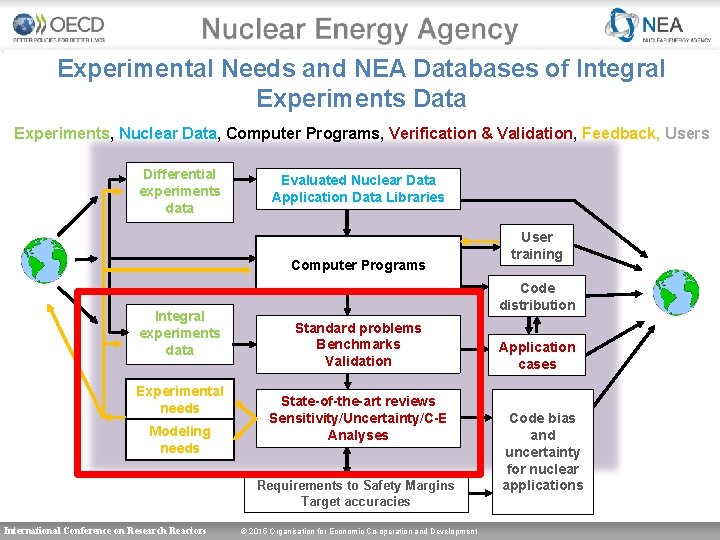
Experimental Needs and NEA Databases of Integral Experiments Data Experiments, Nuclear Data, Computer Programs, Verification & Validation, Feedback, Users Differential experiments data Evaluated Nuclear Data Application Data Libraries Computer Programs Integral experiments data Experimental needs Modeling needs Code distribution Standard problems Benchmarks Validation State-of-the-art reviews Sensitivity/Uncertainty/C-E Analyses Requirements to Safety Margins Target accuracies International Conference on Research Reactors User training © 2015 Organisation for Economic Co-operation and Development Application cases Code bias and uncertainty for nuclear applications
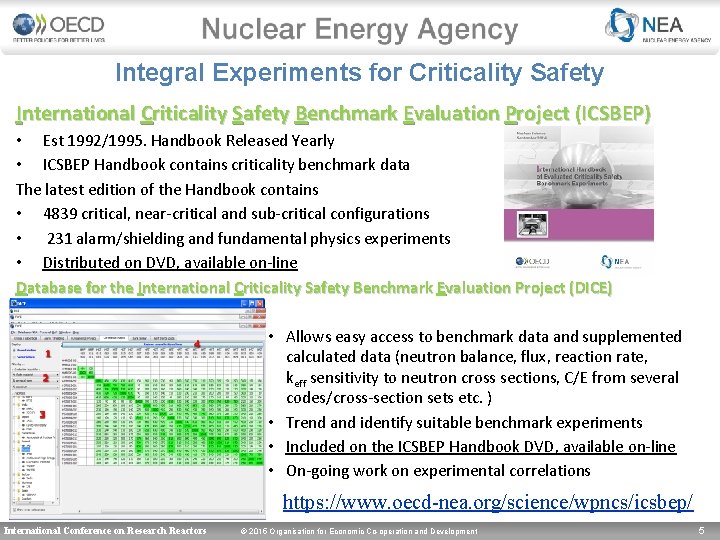
Integral Experiments for Criticality Safety International Criticality Safety Benchmark Evaluation Project (ICSBEP) • Est 1992/1995. Handbook Released Yearly • ICSBEP Handbook contains criticality benchmark data The latest edition of the Handbook contains • 4839 critical, near-critical and sub-critical configurations • 231 alarm/shielding and fundamental physics experiments • Distributed on DVD, available on-line Database for the International Criticality Safety Benchmark Evaluation Project (DICE) • Allows easy access to benchmark data and supplemented calculated data (neutron balance, flux, reaction rate, keff sensitivity to neutron cross sections, C/E from several codes/cross-section sets etc. ) • Trend and identify suitable benchmark experiments • Included on the ICSBEP Handbook DVD, available on-line • On-going work on experimental correlations https: //www. oecd-nea. org/science/wpncs/icsbep/ International Conference on Research Reactors © 2015 Organisation for Economic Co-operation and Development 5
Integral Experiments for Reactor Physics International Reactor Physics Experiment Evaluation (IRPh. E) Project • • Initiated by NEA/NSC in 1999 IRPh. E Handbook contains benchmark data for reactor-type experiments: reactivity effects/coefficients, spectral indices, reaction rates, kinetic parameters, and others The 2015 edition of the Handbook contains • 143 experimental series performed at 50 nuclear facilities 47 series performed at Research Reactors including TRIGA Mark II (Slovenia, USA), ATR (USA), HTTR and JOYO(Japan), HTR-1 (China) and others • Distributed on DVD, available on-line International Reactor Physics Handbook Database and Analysis Tool (IDAT) • Released in 2013 • Allows easy access to benchmark data and supplemented calculated data • Trend and identify suitable benchmark experiments • Included on the IRPh. E Handbook DVD, available on-line https: //www. oecd-nea. org/science/wprs/irphe/ International Conference on Research Reactors © 2015 Organisation for Economic Co-operation and Development 6
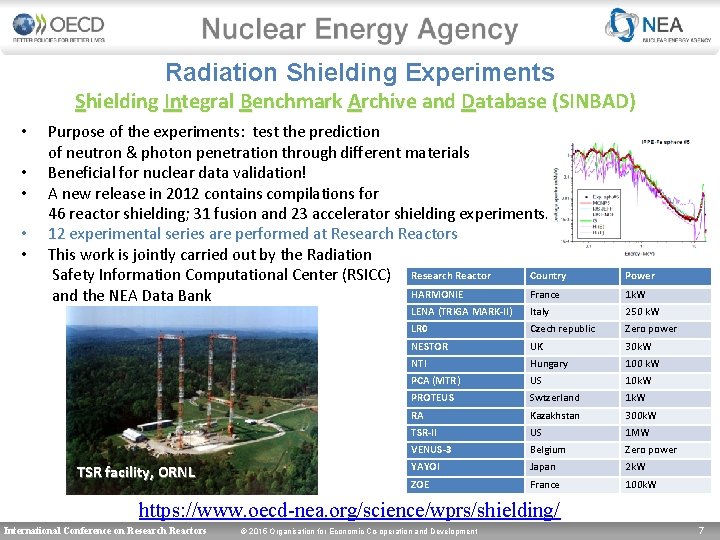
Radiation Shielding Experiments Shielding Integral Benchmark Archive and Database (SINBAD) • • • Purpose of the experiments: test the prediction of neutron & photon penetration through different materials Beneficial for nuclear data validation! A new release in 2012 contains compilations for 46 reactor shielding; 31 fusion and 23 accelerator shielding experiments. 12 experimental series are performed at Research Reactors This work is jointly carried out by the Radiation Country Safety Information Computational Center (RSICC) Research Reactor HARMONIE France and the NEA Data Bank TSR facility, ORNL Power 1 k. W LENA (TRIGA MARK-II) Italy 250 k. W LR 0 Czech republic Zero power NESTOR UK 30 k. W NTI Hungary 100 k. W PCA (MTR) US 10 k. W PROTEUS Swtzerland 1 k. W RA Kazakhstan 300 k. W TSR-II US 1 MW VENUS-3 Belgium Zero power YAYOI Japan 2 k. W ZOE France 100 k. W https: //www. oecd-nea. org/science/wprs/shielding/ International Conference on Research Reactors © 2015 Organisation for Economic Co-operation and Development 7
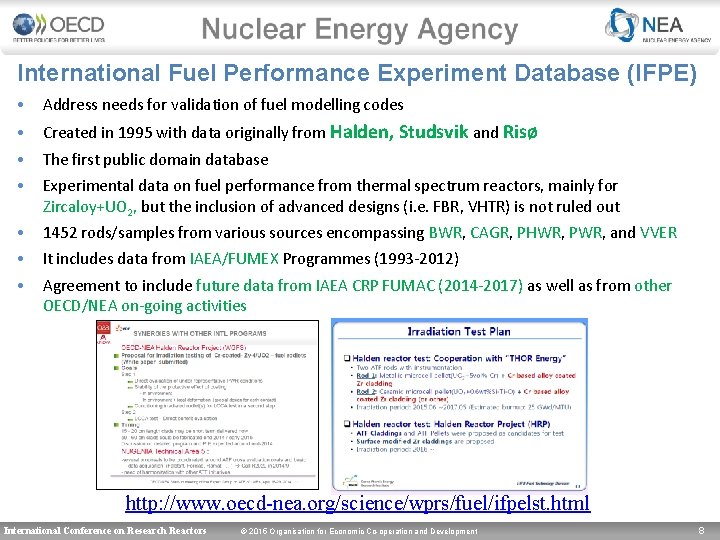
International Fuel Performance Experiment Database (IFPE) • Address needs for validation of fuel modelling codes • Created in 1995 with data originally from Halden, Studsvik and Risø • The first public domain database • Experimental data on fuel performance from thermal spectrum reactors, mainly for Zircaloy+UO 2, but the inclusion of advanced designs (i. e. FBR, VHTR) is not ruled out • 1452 rods/samples from various sources encompassing BWR, CAGR, PHWR, PWR, and VVER • It includes data from IAEA/FUMEX Programmes (1993 -2012) • Agreement to include future data from IAEA CRP FUMAC (2014 -2017) as well as from other OECD/NEA on-going activities http: //www. oecd-nea. org/science/wprs/fuel/ifpelst. html International Conference on Research Reactors © 2015 Organisation for Economic Co-operation and Development 8
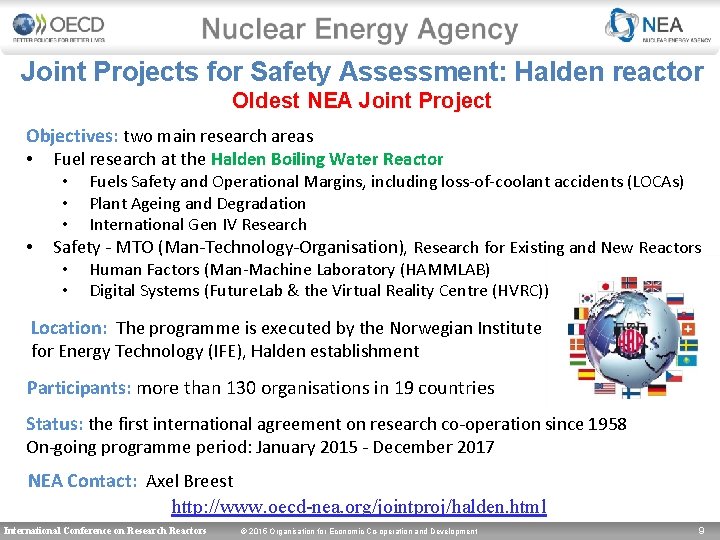
Joint Projects for Safety Assessment: Halden reactor Oldest NEA Joint Project Objectives: two main research areas • Fuel research at the Halden Boiling Water Reactor • • Fuels Safety and Operational Margins, including loss-of-coolant accidents (LOCAs) • Plant Ageing and Degradation • International Gen IV Research Safety - MTO (Man-Technology-Organisation), Research for Existing and New Reactors • Human Factors (Man-Machine Laboratory (HAMMLAB) • Digital Systems (Future. Lab & the Virtual Reality Centre (HVRC)) Location: The programme is executed by the Norwegian Institute for Energy Technology (IFE), Halden establishment Participants: more than 130 organisations in 19 countries Status: the first international agreement on research co-operation since 1958 On-going programme period: January 2015 - December 2017 NEA Contact: Axel Breest http: //www. oecd-nea. org/jointproj/halden. html International Conference on Research Reactors © 2015 Organisation for Economic Co-operation and Development 9
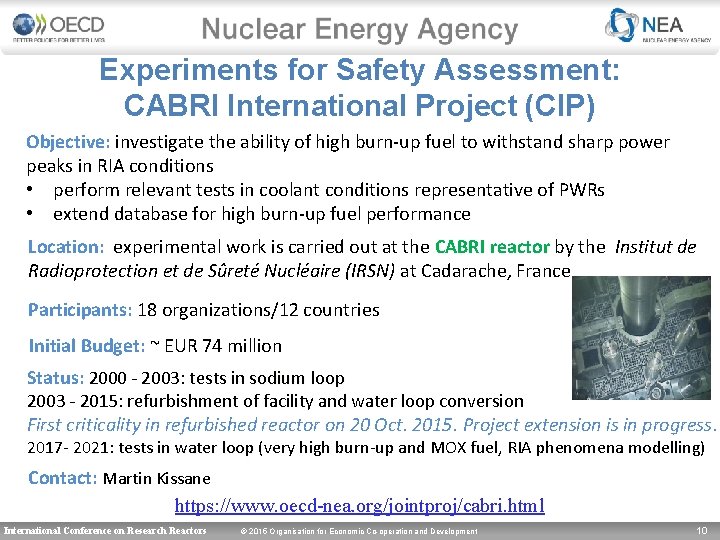
Experiments for Safety Assessment: CABRI International Project (CIP) Objective: investigate the ability of high burn-up fuel to withstand sharp power peaks in RIA conditions • perform relevant tests in coolant conditions representative of PWRs • extend database for high burn-up fuel performance Location: experimental work is carried out at the CABRI reactor by the Institut de Radioprotection et de Sûreté Nucléaire (IRSN) at Cadarache, France Participants: 18 organizations/12 countries Initial Budget: ~ EUR 74 million Status: 2000 - 2003: tests in sodium loop 2003 - 2015: refurbishment of facility and water loop conversion First criticality in refurbished reactor on 20 Oct. 2015. Project extension is in progress. 2017 - 2021: tests in water loop (very high burn-up and MOX fuel, RIA phenomena modelling) Contact: Martin Kissane https: //www. oecd-nea. org/jointproj/cabri. html International Conference on Research Reactors © 2015 Organisation for Economic Co-operation and Development 10
Current Trends – Motivation for the Review of Experimental Needs • Nuclear Reactors Physics and Engineering – Continuing computer technology progress stimulates the development, qualification and application of multi-physics multi-scale coupled methodologies – Thermal-hydraulics models still contain a lot of empirical methods, which puts onerous demands on experimental validation and limits the range of applicability of our computer codes – The growing cost of experimental study and decreasing experimental capabilities • Nuclear Reactor and Fuel Cycle Safety – Move to Best Estimate Plus Uncertainty (BEPU) methods for accident analysis. Increased rigour in uncertainty quantification – Advanced and Innovative Nuclear Reactor Concepts demand the Robust Safety Demonstration based on experimental evidence – Fuel Cycle, Minor Actinides and RW management demand extrapolation beyond the horizon of available experiments requiring minimisation of target uncertainties International Conference on Research Reactors © 2015 Organisation for Economic Co-operation and Development 11
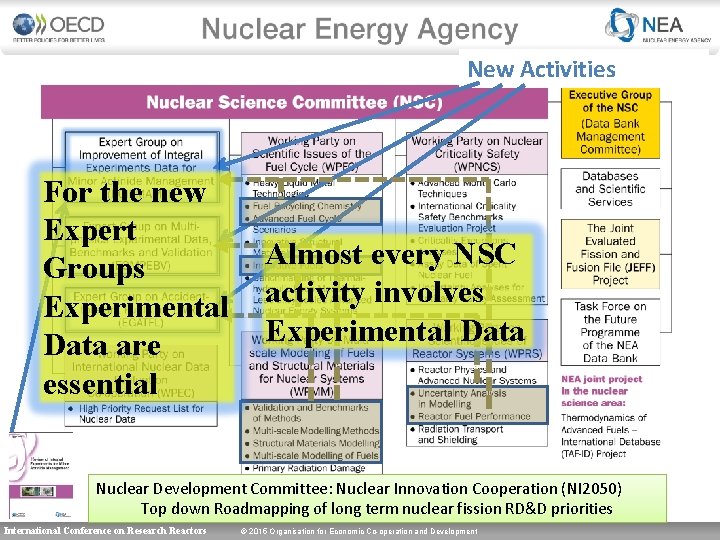
New Activities For the new Expert Groups Experimental Data are essential Almost every NSC activity involves Experimental Data Nuclear Development Committee: Nuclear Innovation Cooperation (NI 2050) Top down Roadmapping of long term nuclear fission RD&D priorities International Conference on Research Reactors © 2015 Organisation for Economic Co-operation and Development
New NEA Activity related to Experimental Needs New activity on review of needs related to experimental data and validation in different areas (neutronics and criticality, thermal-hydraulics, fuel behavior and multi-physics) multi-physics across NEA have been initiated by the Division of Nuclear Science. Objectives: • • Review experimental needs Identify gaps and rank priorities Support experimental design and benchmarking Support coordination of experimental activities to reduce costs and maximize benefits Focus: • Major focus of the activity will be on experimental needs for challenging validation of multi-physics and multi-scale modeling and simulation Organisational Tasks: • Form a framework to gather experts in different areas • Establish cross-division expert group on Experimental Needs • Update the Research and Test Facilities Database (RTFDB) International Conference on Research Reactors © 2015 Organisation for Economic Co-operation and Development 13
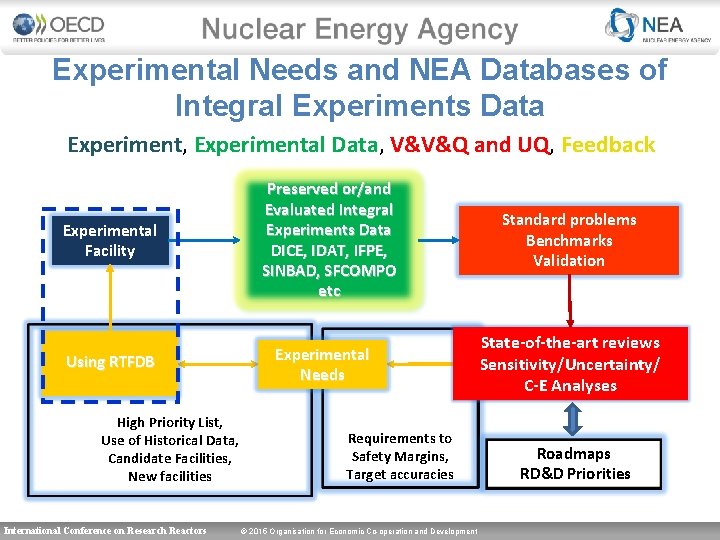
Experimental Needs and NEA Databases of Integral Experiments Data Experiment, Experimental Data, V&V&Q and UQ, Feedback Experimental Facility Using RTFDB High Priority List, Use of Historical Data, Candidate Facilities, New facilities International Conference on Research Reactors Preserved or/and Evaluated Integral Experiments Data DICE, IDAT, IFPE, SINBAD, SFCOMPO etc Experimental Needs Requirements to Safety Margins, Target accuracies © 2015 Organisation for Economic Co-operation and Development Standard problems Benchmarks Validation State-of-the-art reviews Sensitivity/Uncertainty/ C-E Analyses Roadmaps RD&D Priorities
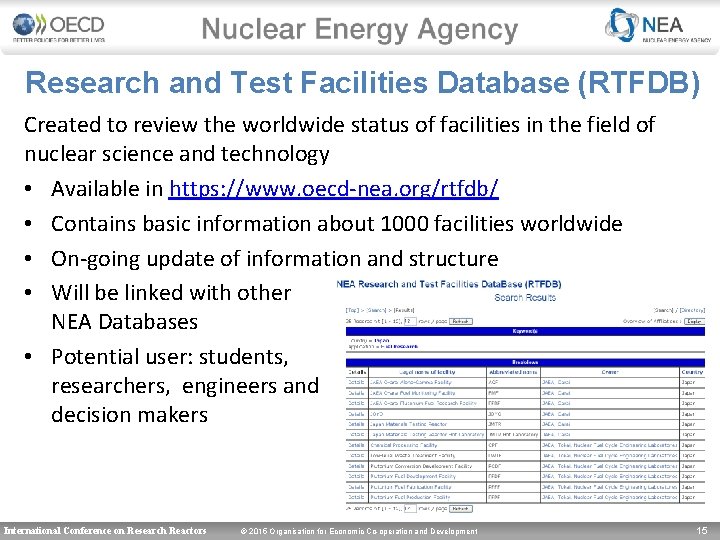
Research and Test Facilities Database (RTFDB) Created to review the worldwide status of facilities in the field of nuclear science and technology • Available in https: //www. oecd-nea. org/rtfdb/ • Contains basic information about 1000 facilities worldwide • On-going update of information and structure • Will be linked with other NEA Databases • Potential user: students, researchers, engineers and decision makers International Conference on Research Reactors © 2015 Organisation for Economic Co-operation and Development 15
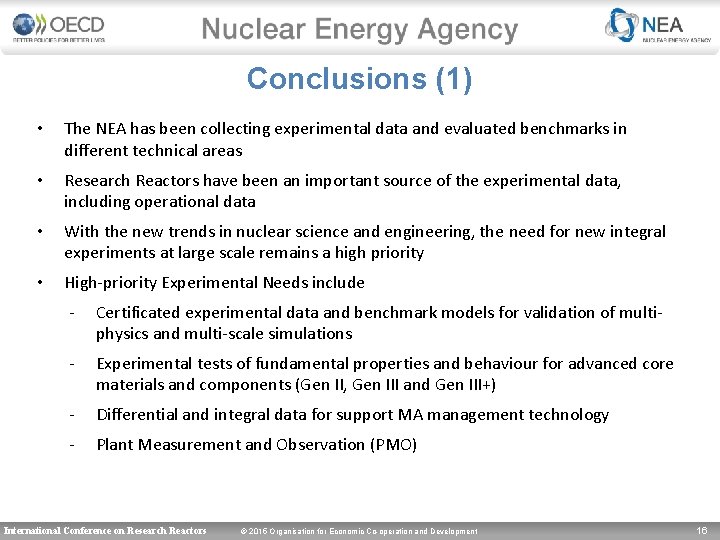
Conclusions (1) • The NEA has been collecting experimental data and evaluated benchmarks in different technical areas • Research Reactors have been an important source of the experimental data, including operational data • With the new trends in nuclear science and engineering, the need for new integral experiments at large scale remains a high priority • High-priority Experimental Needs include - Certificated experimental data and benchmark models for validation of multiphysics and multi-scale simulations - Experimental tests of fundamental properties and behaviour for advanced core materials and components (Gen II, Gen III and Gen III+) - Differential and integral data for support MA management technology - Plant Measurement and Observation (PMO) International Conference on Research Reactors © 2015 Organisation for Economic Co-operation and Development 16
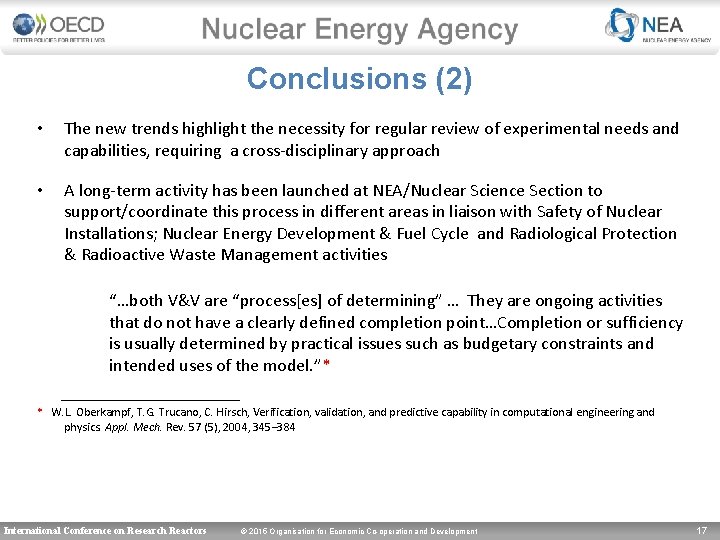
Conclusions (2) • The new trends highlight the necessity for regular review of experimental needs and capabilities, requiring a cross-disciplinary approach • A long-term activity has been launched at NEA/Nuclear Science Section to support/coordinate this process in different areas in liaison with Safety of Nuclear Installations; Nuclear Energy Development & Fuel Cycle and Radiological Protection & Radioactive Waste Management activities “…both V&V are “process[es] of determining” … They are ongoing activities that do not have a clearly defined completion point…Completion or sufficiency is usually determined by practical issues such as budgetary constraints and intended uses of the model. ”* _______________ * W. L. Oberkampf, T. G. Trucano, C. Hirsch, Verification, validation, and predictive capability in computational engineering and physics. Appl. Mech. Rev. 57 (5), 2004, 345– 384 International Conference on Research Reactors © 2015 Organisation for Economic Co-operation and Development 17
Thank you for your attention © 2015 Organisation for Economic Co-operation and Development