
Overview Of The National Health Care Survey NHCS









- Slides: 123
Overview Of The National Health Care Survey (NHCS) American Public Health Association 134 Annual Meeting & Exposition November 4, 2006 William S. Pearson, Ph. D. Division of Health Care Statistics Centers for Disease Control and Prevention National Center for Health Statistics
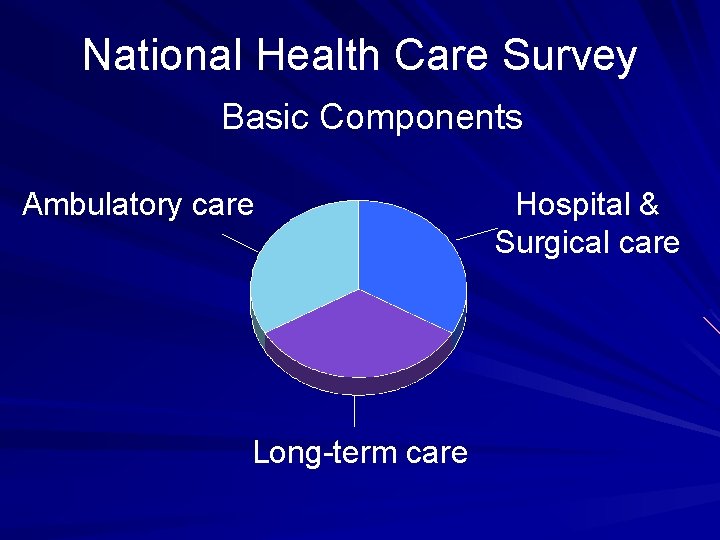
National Health Care Survey Basic Components Ambulatory care Long-term care Hospital & Surgical care
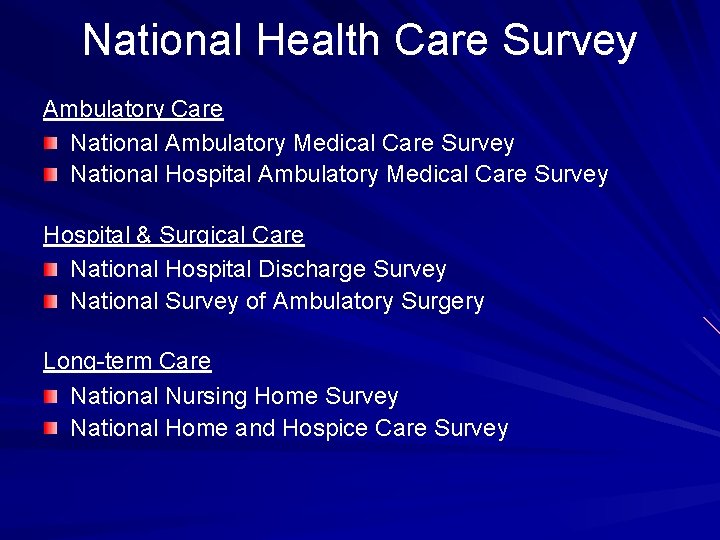
National Health Care Survey Ambulatory Care National Ambulatory Medical Care Survey National Hospital Ambulatory Medical Care Survey Hospital & Surgical Care National Hospital Discharge Survey National Survey of Ambulatory Surgery Long-term Care National Nursing Home Survey National Home and Hospice Care Survey
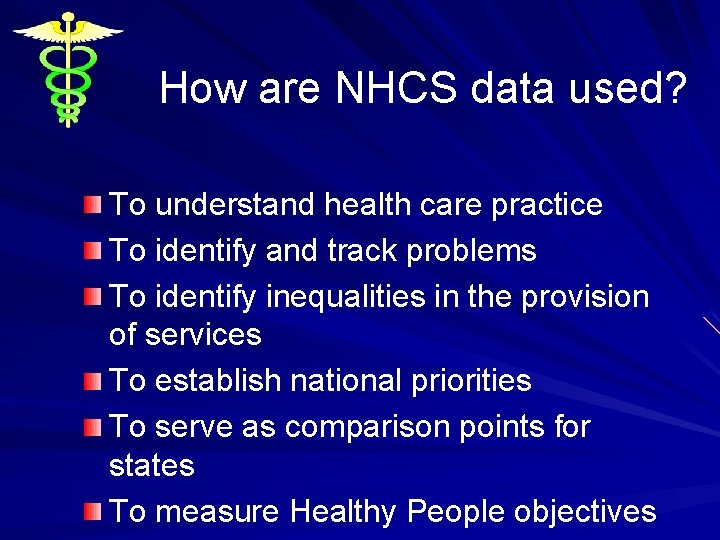
How are NHCS data used? To understand health care practice To identify and track problems To identify inequalities in the provision of services To establish national priorities To serve as comparison points for states To measure Healthy People objectives
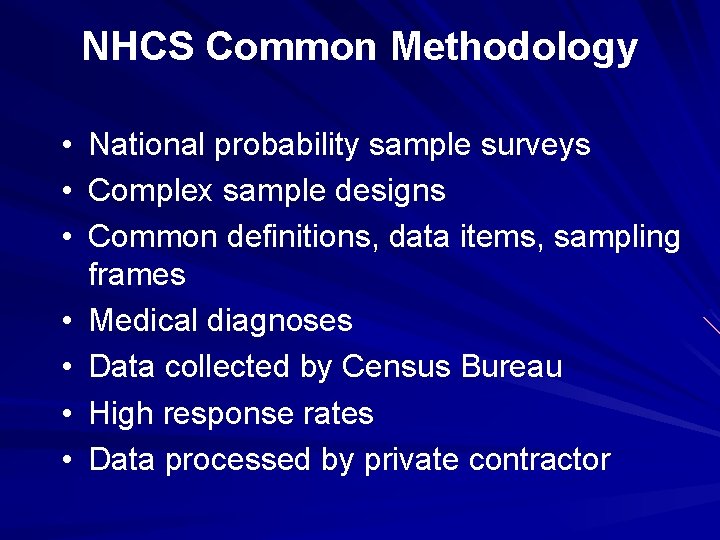
NHCS Common Methodology • • National probability sample surveys Complex sample designs Common definitions, data items, sampling frames Medical diagnoses Data collected by Census Bureau High response rates Data processed by private contractor
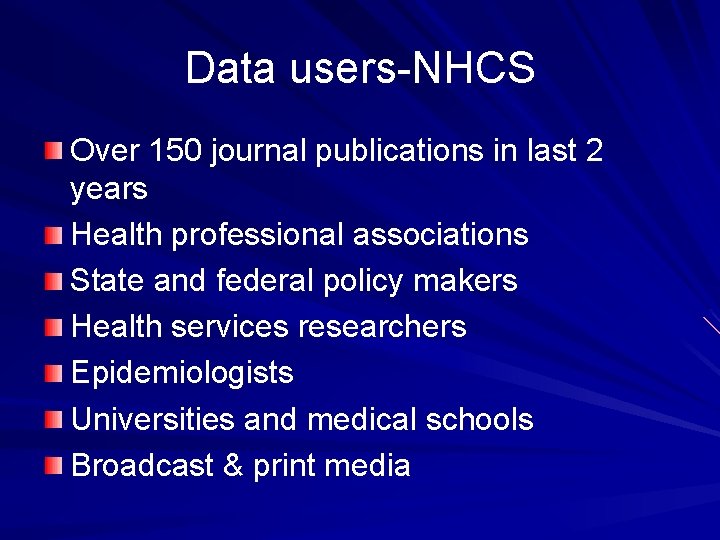
Data users-NHCS Over 150 journal publications in last 2 years Health professional associations State and federal policy makers Health services researchers Epidemiologists Universities and medical schools Broadcast & print media
Where are people going for their health care and has the setting changed over the years?
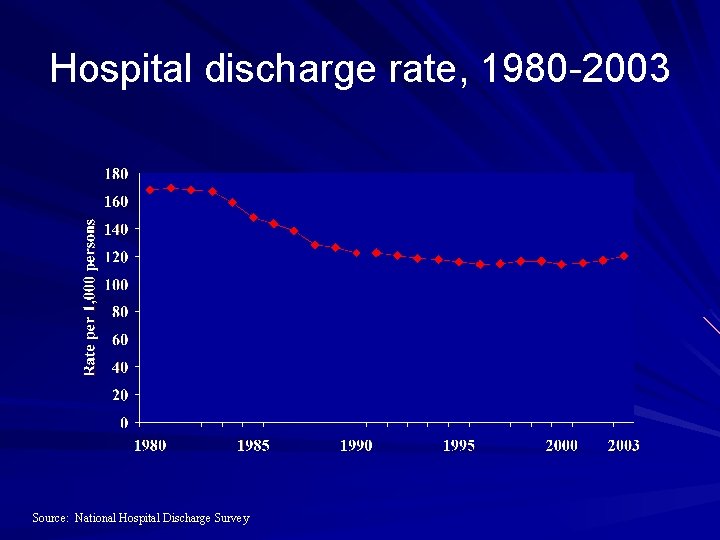
Hospital discharge rate, 1980 -2003 Source: National Hospital Discharge Survey
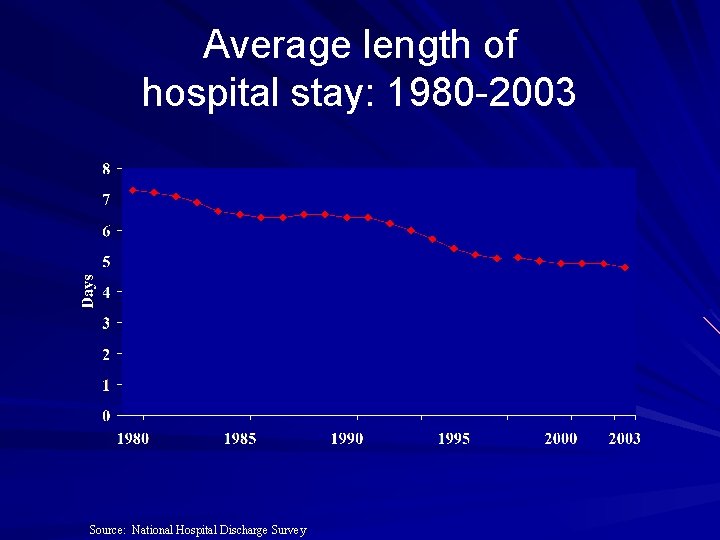
Average length of hospital stay: 1980 -2003 Source: National Hospital Discharge Survey
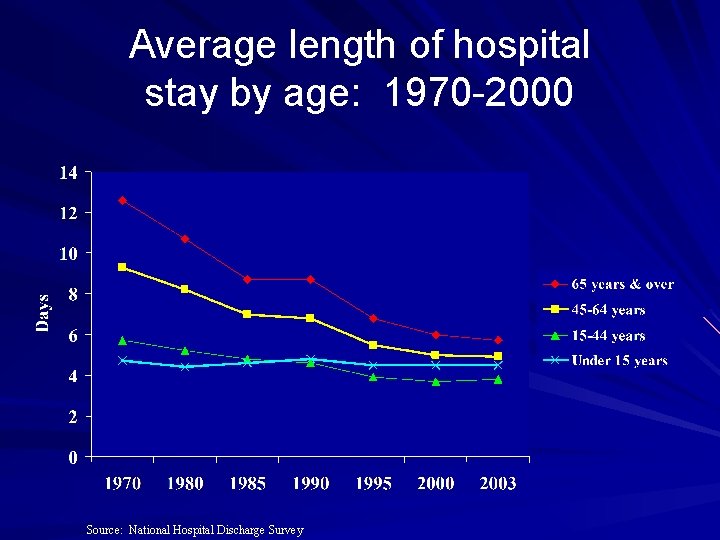
Average length of hospital stay by age: 1970 -2000 Source: National Hospital Discharge Survey
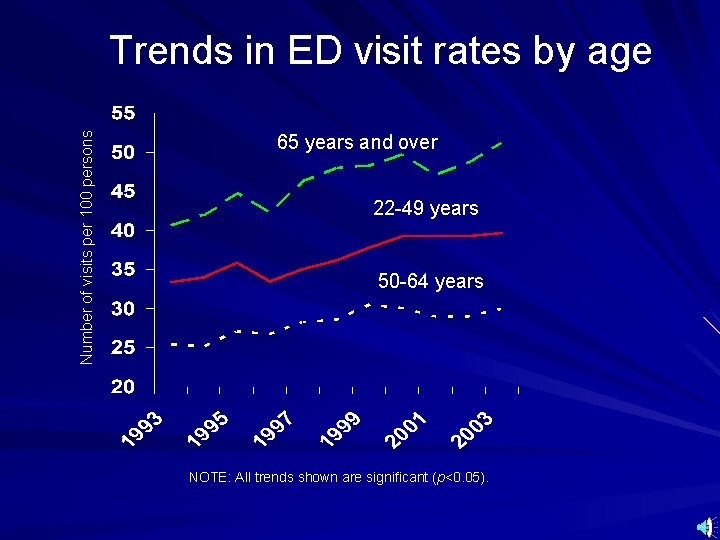
Number of visits per 100 persons Trends in ED visit rates by age 65 years and over 22 -49 years 50 -64 years NOTE: All trends shown are significant (p<0. 05).
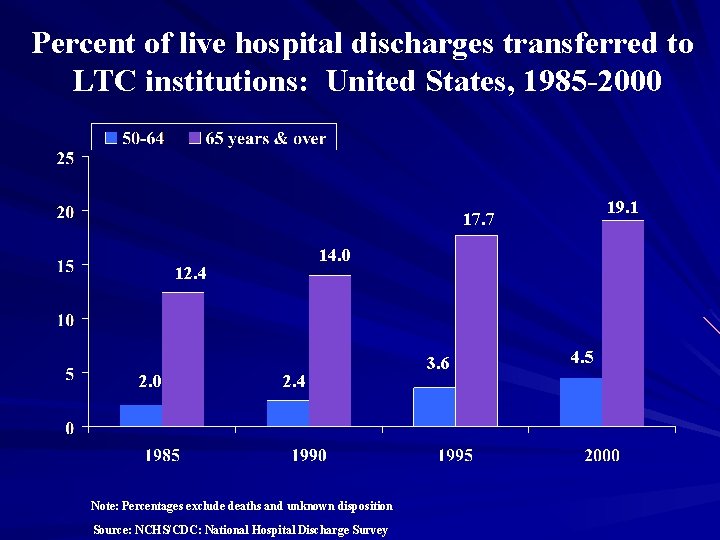
Percent of live hospital discharges transferred to LTC institutions: United States, 1985 -2000 19. 1 17. 7 14. 0 12. 4 2. 0 2. 4 Note: Percentages exclude deaths and unknown disposition Source: NCHS/CDC: National Hospital Discharge Survey 3. 6 4. 5
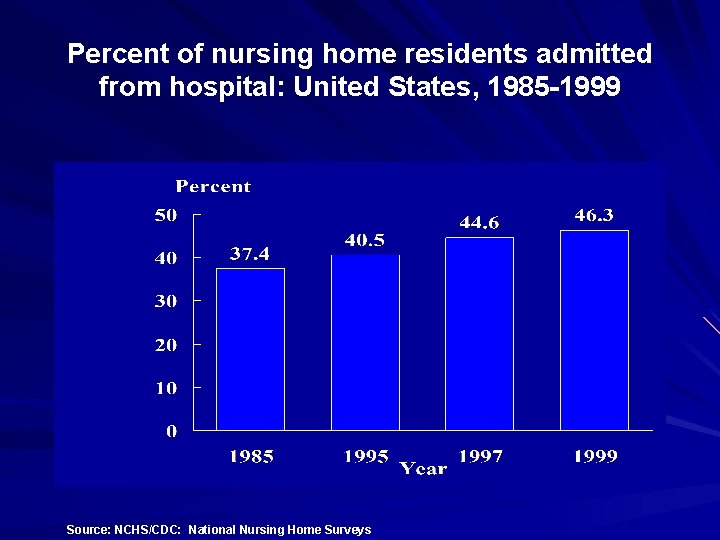
Percent of nursing home residents admitted from hospital: United States, 1985 -1999 Source: NCHS/CDC: National Nursing Home Surveys
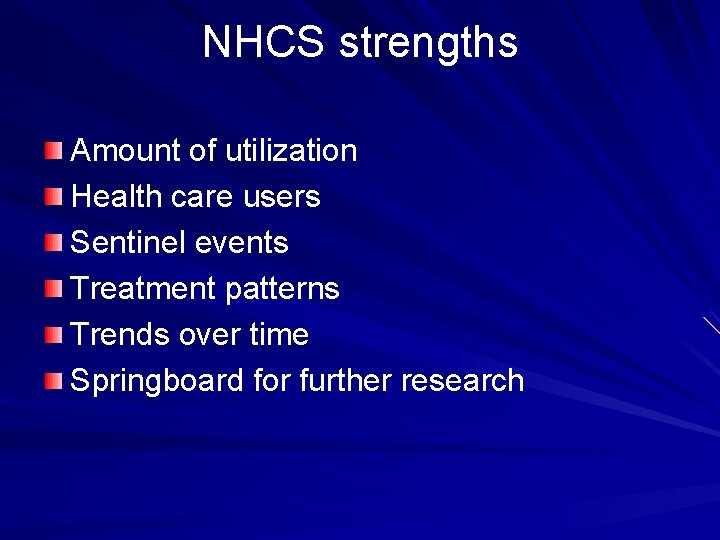
NHCS strengths Amount of utilization Health care users Sentinel events Treatment patterns Trends over time Springboard for further research
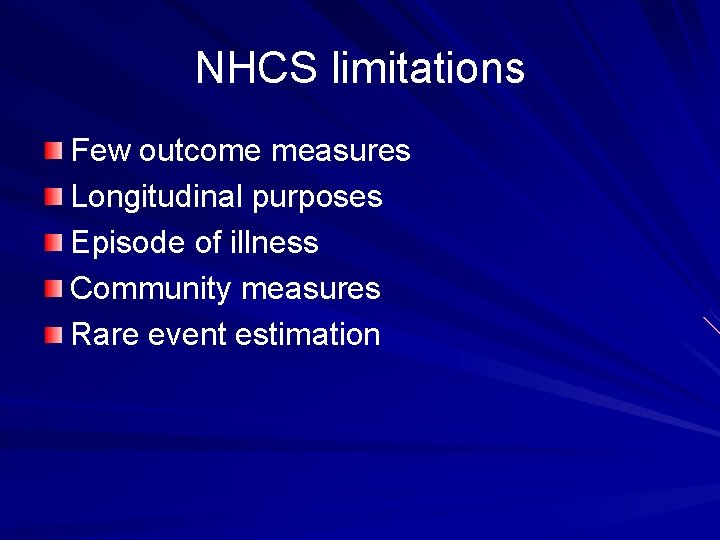
NHCS limitations Few outcome measures Longitudinal purposes Episode of illness Community measures Rare event estimation
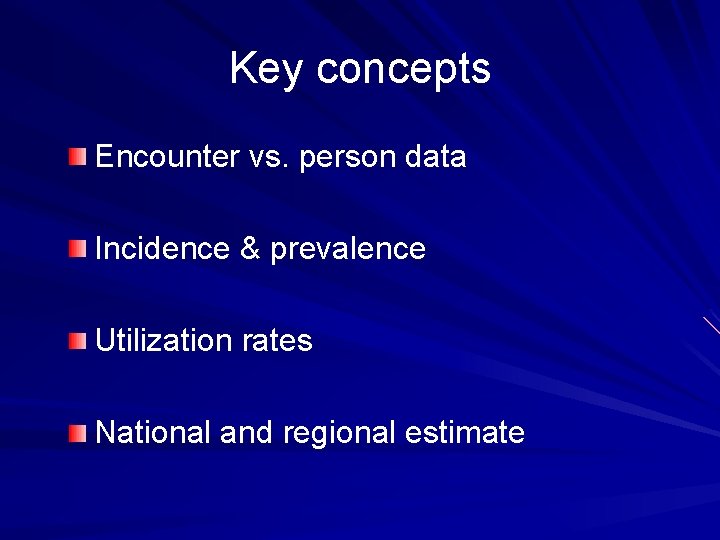
Key concepts Encounter vs. person data Incidence & prevalence Utilization rates National and regional estimate
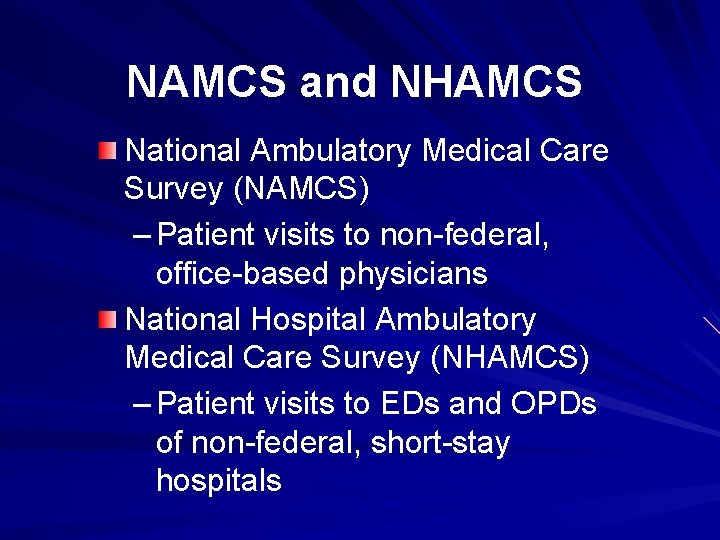
NAMCS and NHAMCS National Ambulatory Medical Care Survey (NAMCS) – Patient visits to non-federal, office-based physicians National Hospital Ambulatory Medical Care Survey (NHAMCS) – Patient visits to EDs and OPDs of non-federal, short-stay hospitals
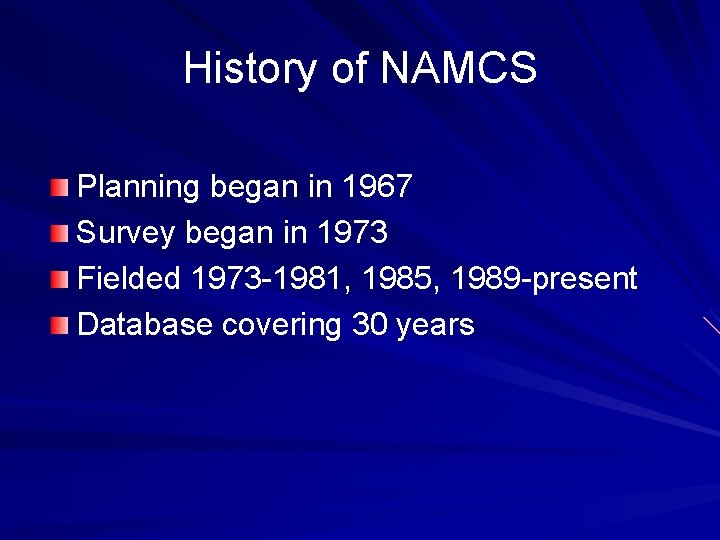
History of NAMCS Planning began in 1967 Survey began in 1973 Fielded 1973 -1981, 1985, 1989 -present Database covering 30 years
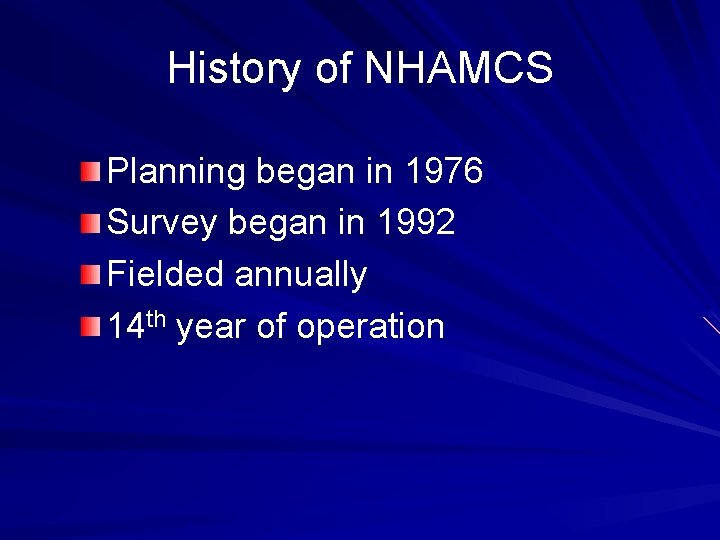
History of NHAMCS Planning began in 1976 Survey began in 1992 Fielded annually 14 th year of operation
NAMCS and NHAMCS Methodology
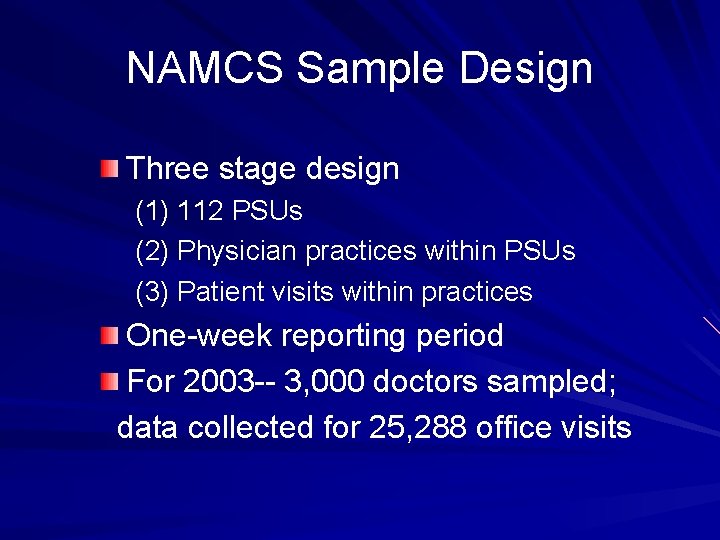
NAMCS Sample Design Three stage design (1) 112 PSUs (2) Physician practices within PSUs (3) Patient visits within practices One-week reporting period For 2003 -- 3, 000 doctors sampled; data collected for 25, 288 office visits
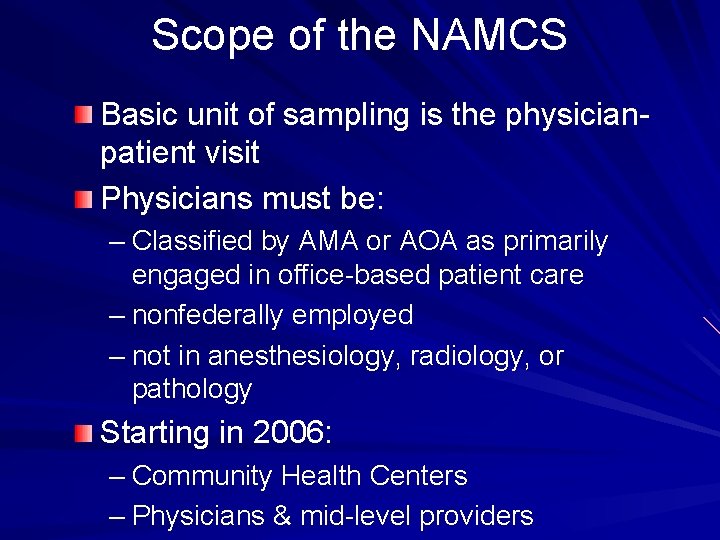
Scope of the NAMCS Basic unit of sampling is the physicianpatient visit Physicians must be: – Classified by AMA or AOA as primarily engaged in office-based patient care – nonfederally employed – not in anesthesiology, radiology, or pathology Starting in 2006: – Community Health Centers – Physicians & mid-level providers
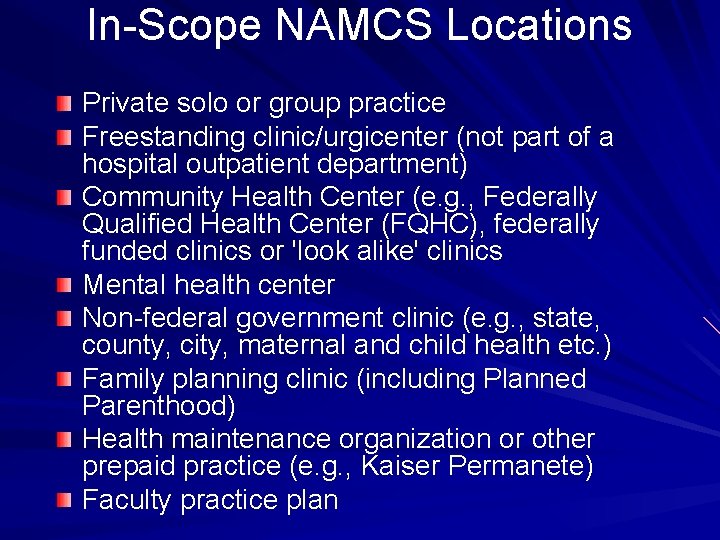
In-Scope NAMCS Locations Private solo or group practice Freestanding clinic/urgicenter (not part of a hospital outpatient department) Community Health Center (e. g. , Federally Qualified Health Center (FQHC), federally funded clinics or 'look alike' clinics Mental health center Non-federal government clinic (e. g. , state, county, city, maternal and child health etc. ) Family planning clinic (including Planned Parenthood) Health maintenance organization or other prepaid practice (e. g. , Kaiser Permanete) Faculty practice plan
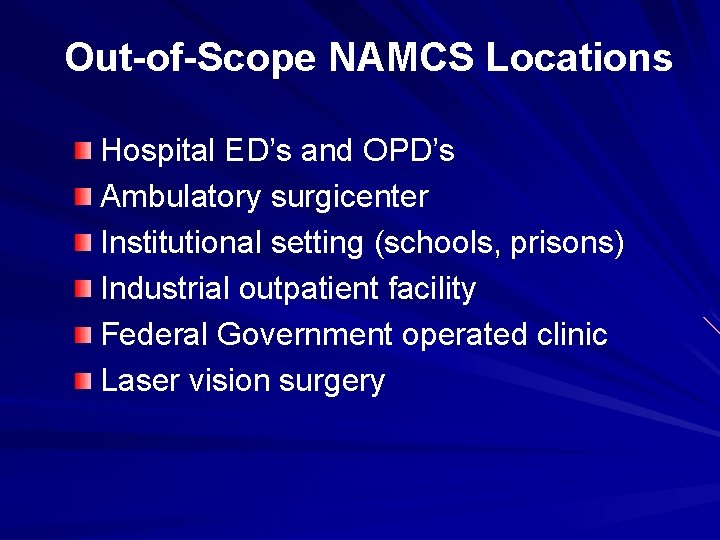
Out-of-Scope NAMCS Locations Hospital ED’s and OPD’s Ambulatory surgicenter Institutional setting (schools, prisons) Industrial outpatient facility Federal Government operated clinic Laser vision surgery
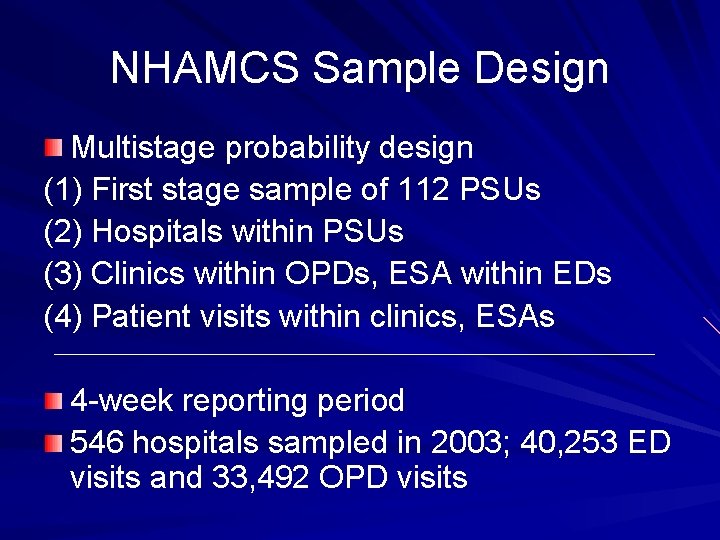
NHAMCS Sample Design Multistage probability design (1) First stage sample of 112 PSUs (2) Hospitals within PSUs (3) Clinics within OPDs, ESA within EDs (4) Patient visits within clinics, ESAs 4 -week reporting period 546 hospitals sampled in 2003; 40, 253 ED visits and 33, 492 OPD visits
Scope of the NHAMCS Basic unit of sampling is patient visit Emergency and outpatient departments of noninstitutional general and short-stay hospitals Not Federal, military, or Veterans Administration facilities Located in 50 states and D. C.
Data Collection Bureau of the Census is our field agent Introductory letter sent 2 -3 months in advance of reporting period Induction interview to train staff, obtain data on practice or facility characteristics Physician’s office/hospital staff is responsible for completion of Patient Record forms Census abstracts as a last resort
Data Items Patient characteristics – Age, sex, race, ethnicity Visit characteristics – Source of payment, continuity of care, reason for visit, diagnosis, treatment Provider characteristics – Physician specialty, hospital ownership… Drug characteristics added in 1980
Coding Systems Used Reason for Visit Classification (NCHS) Drug Classification System (NCHS) National Drug Code Directory ICD-9 -CM – diagnoses – causes of injury – procedures
Drug Data in NAMCS/ NHAMCS Respondents can list up to 8 medications (including Rx and OTC medications, immunizations, allergy shots, anesthetics, and dietary supplements) that were ordered, supplied, administered, or continued during the visit. Each entry is called a drug mention. Visits with one or more drug mentions are called drug visits. Respondents are asked to report trade names or generic names only (not dosage, administration, or regimen). Can’t link drugs with diagnosis.
Drug Characteristics Generic Name (for single ingredient drugs) Prescription Status – Rx or OTC Composition Status – single or multiple ingredient Controlled Substance Status – DEA schedule NDC Therapeutic Class (4 -digit) Up to 5 Ingredients (for multiple ingredient drugs)
Analyzing Drugs NAMCS or NHAMCS drug data can be analyzed – at the visit level (for example, the number of visits at which a particular drug was prescribed) – or at the medication level (for example, the number of “mentions” of a particular drug at ambulatory care visits
Sample Weight Each NAMCS record contains a single weight, which we call Patient Visit Weight Same is true for OPD records and ED records This weight is used for both visits and drug mentions
How to Get the Data
Public Use Micro-data Files Downloadable files NAMCS, 1973 -2003 NHAMCS, 1992 -2003 CD-ROMs NAMCS, 1990 -2002 NHAMCS, 1992 -2002
Enhanced Public Use Files Masked sample design variables – Allow use of SUDAAN, Stata, etc. – Available for 1993 -2003 SAS input statements, label statements, and format statements (1993 -2003) SPSS and Stata code for 2002, 2003
NCHS Research Data Center
Advantages of the Research Data Center Gain access to information not available on public use files – Patient: ZIP code linked income, education, etc. – Provider: physician sex and age, board certification, teaching hospital – Geographic: FIPS state and county codes
Research Data Center – cont. Can merge with contextual variables (e. g. , ARF, NHIS, Census, NHDS) – Health status level – HMO penetration – Physician and specialist supply – Medicaid reimbursement – Air quality – Percent in poverty
Research Data Center E-mail: rdca@cdc. gov Website: www. cdc. gov/nchs/r&d/rdc. htm Call (301) 458 -4277
For more information: NCHS website: www. cdc. gov/nchs/nhcs. htm Call Ambulatory Care Statistics Branch at 301 -458 -4600 Information about the NAMCS: Don Cherry or David Woodwell Information about NHAMCS: Linda Mc. Caig or Kim Middleton
National Hospital Discharge Survey (NHDS) and National Survey of Ambulatory Surgery (NSAS)
Overview of the National Hospital Discharge Survey (NHDS)
NHDS Survey Years Conducted annually 1965 -present: – Latest data available: 2003 – 2004 to be available this Winter
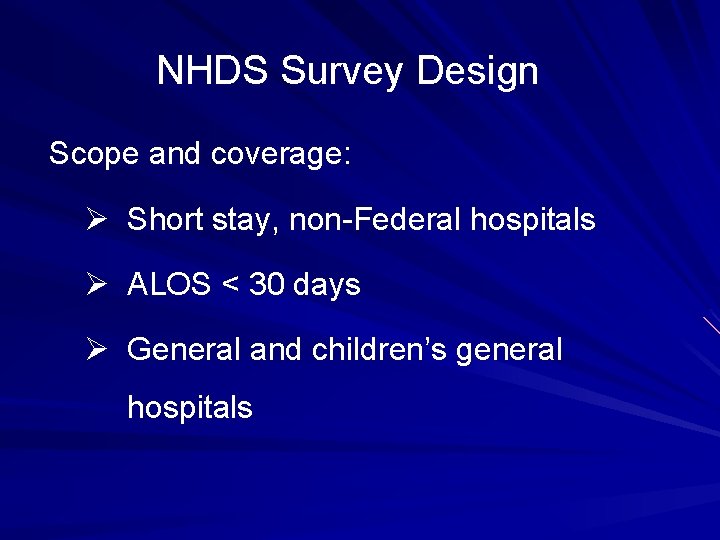
NHDS Survey Design Scope and coverage: Ø Short stay, non-Federal hospitals Ø ALOS < 30 days Ø General and children’s general hospitals
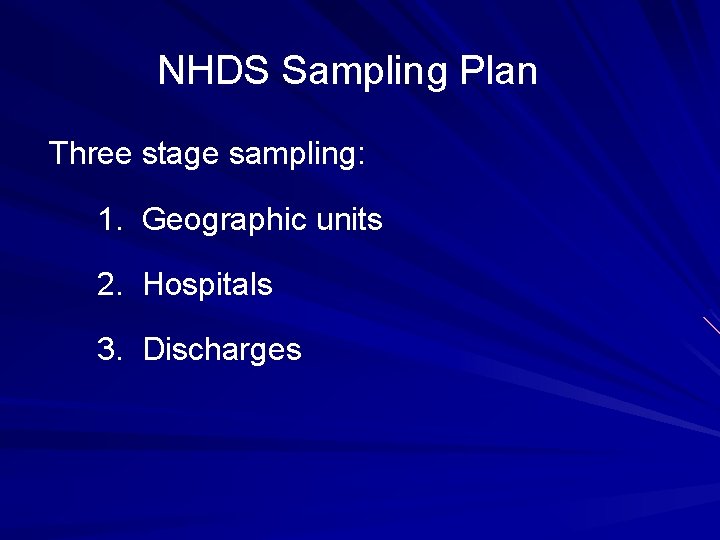
NHDS Sampling Plan Three stage sampling: 1. Geographic units 2. Hospitals 3. Discharges
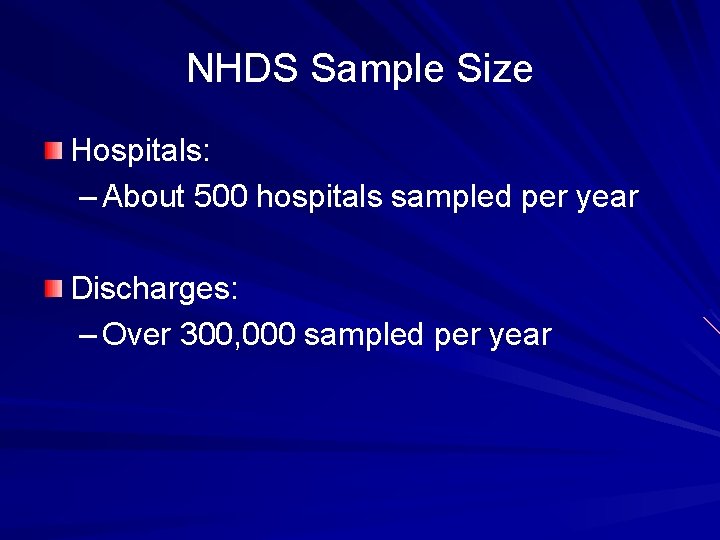
NHDS Sample Size Hospitals: – About 500 hospitals sampled per year Discharges: – Over 300, 000 sampled per year
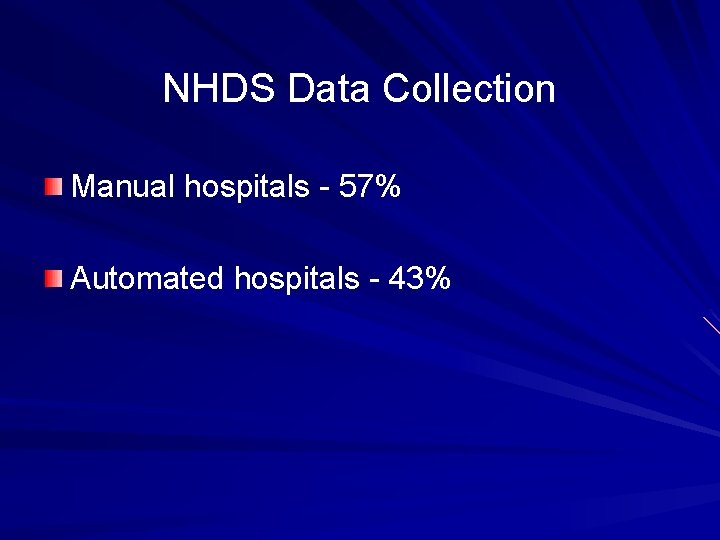
NHDS Data Collection Manual hospitals - 57% Automated hospitals - 43%
NHDS Data Processing NCHS: – Editing – Estimation
Health Insurance Portability and Accountability Act (HIPAA)
Variables on NHDS Public Use Data Files
Patient Data Age Sex Race Expected source of payment Discharge status Marital status
Medical Data Diagnoses (up to 7) Procedures (up to 4) International Classification of Diseases, 9 th Revision, Clinical Modification (ICD-9 -CM)
Hospital Characteristics Geographic region Bed size Ownership
Additional Variables Days of care Month of discharge Diagnosis Related Group (DRG) Analysis weight
Recently-added variables Added in the 2001 NHDS: Source of Admission Type of Admission
NHDS provides data on hospitalizations not people
Diagnoses Disease, injury or other reason for hospitalization Principal diagnosis: chiefly responsible for hospitalization First-listed diagnosis: principal if specified, otherwise first one listed
Diagnoses All-listed: counts the total number of times a diagnosis appears on patient record Any-listed: indicates that a diagnosis appears at least once, in any position, on discharge record
Surgical and Non-Surgical Procedures Surgical (appendectomy) Diagnostic (spinal tap) Therapeutic (chemotherapy)
NHDS provides data on inpatient procedures not total procedures
Reliability RELATIVE STANDARD ERROR (RSE) measures reliability of an estimate Estimates with an RSE greater than 30 % are considered unreliable. Estimates must be based on at least 30 records. Estimates based on 30 -59 records should be used with caution.
Examples of research using the National Hospital Discharge Survey
Diagnoses studied Heart failure Atrial fibrillation Arthritis Diabetes Sepsis Chronic Obstructive Pulmonary Disease (COPD)
Procedures studied Hip replacements Knee replacements Cervical diskectomy Coronary artery revascularization
Other Public Health Issues/ Medical Care Research l Length of hospital stays for ►women giving birth ►newborn infants Surgical treatments for Obesity l Pneumonia among the elderly l Mental disorders in children l
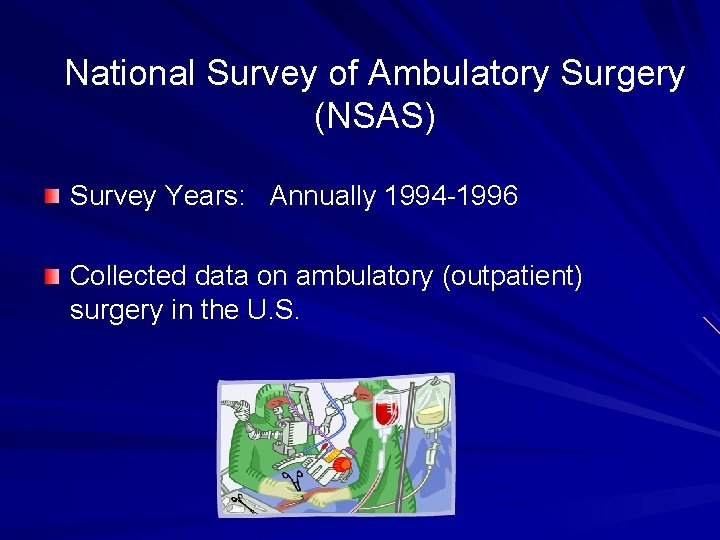
National Survey of Ambulatory Surgery (NSAS) Survey Years: Annually 1994 -1996 Collected data on ambulatory (outpatient) surgery in the U. S.
NSAS Design National probability sample – Short stay non-Federal hospitals (418) – Freestanding ambulatory surgery centers (333) Sample size: – 120, 000 sampled visits per year
Additional variables collected for NSAS Hospital vs. freestanding center Type of anesthesia Anesthesia provider
Accessing Data from the National Hospital Discharge Survey and the National Survey of Ambulatory Surgery
What type of data are available? ØPublications, including annual reports ØData tabulations on selected topics ØPublic-use data files (micro-data)
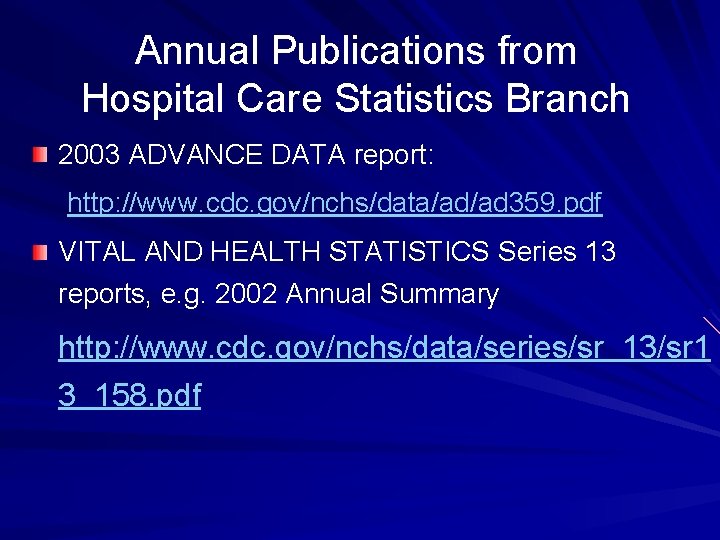
Annual Publications from Hospital Care Statistics Branch 2003 ADVANCE DATA report: http: //www. cdc. gov/nchs/data/ad/ad 359. pdf VITAL AND HEALTH STATISTICS Series 13 reports, e. g. 2002 Annual Summary http: //www. cdc. gov/nchs/data/series/sr_13/sr 1 3_158. pdf
Public-Use Files Available on the Web ØData and documentation available for free from the NCHS website – NHDS: 1996 through 2003 – NSAS: 1994, 1995, 1996 ØFiles are “raw” ASCII data that require the use of standard statistical software packages, such as SAS, SPSS, Stata, etc.
What to Know to Access Data and Publications on the Web ØPublications, data tables, and data file documentation are in Adobe Acrobat PDF format. ØAdobe Acrobat Reader software, available free for download at www. adobe. com
What to Know to Access Public-Use Files on the Web Ø Data files are in ASCII format Ø Must be downloaded via FTP server, then “unzipped” Ø To “Unzip” use: – Win. Zip (www. winzip. com) – PKunzip (www. pkware. com) ØData file documentation is available in PDF format
Multi-year public-use files available on CD-ROM Two separate multi-year files containing Ø 1979 -2003 data years (ICD-9 -CM coding) Ø 1970 -1978 data years (ICD-8 coding) IMPORTANT: DRGs are available on single year files only. Multi-year files do NOT have DRGs.
ICD-9 -CM ØFor full-text, addenda, and conversion tables of ICD-9 -CM, see www. cdc. gov/nchs/icd 9. htm ØFull-text ICD-9 -CM documents are RTF (Rich Text Format) files and can be handled with any word processing package. ØAddenda and conversion tables are PDF documents.
Restricted Data in NHDS HCSB maintains confidential information in files which are not publicly disseminated Restricted data pose disclosure risks to survey respondents Available to researchers through the NCHS Research Data Center (RDC) http: //www. cdc. gov/nchs/r&d/rdc. htm
New Directions National Hospital Discharge Survey ► survey redesign National Survey of Ambulatory Surgery ► re-fielding in 2006
Inpatient clinical data Current limitations on information available in NHDS because data collection is tied to UB 92 Great interest in expanding to collecting more patient and clinical data A study of the feasibility of collecting drug data was performed in 2001 -2003
NHDS Redesign Original survey design implemented in 1965; statistical redesign in 1988 Updating and modernizing methods and measures to keep abreast of rapidly changing hospital use is needed Contract with RAND was let in September to examine options for redesign
Results of Redesign Contract Results will be available in summer of 2007 and will address: ØConceptual framework of NHDS ØProposed, expanded dataset ØFeasibility of implementing new concepts and additional data items
Return of NSAS ØFunding has been approved for NSAS to return to the field in 2006 ØData collection procedures will be updated to reflect changes in the way facilities store data, that is, the greater use of electronic data systems. ØExperts have been consulted to modify and add data items to data collection instruments.
New information collected in the 2006 NSAS ØCredentials of staff ØOwnership of the ambulatory surgery facility ØAccess to care ØUse of electronic medical records ØPatient follow-up after surgery
Timeline for NSAS May 2006 – March 2007 : Data collection April – December 2007 : Coding, keying, editing, and weighting Early 2008 : NSAS 2006 data released Winter 2008 : Public use data file available
NHDS or NSAS Questions? Phone: 301 -458 -4321 Fax: 301 -458 -4032 Email: NHDS@cdc. gov Homepage on the WEB: www. cdc. gov/nchs/about/major/hdasd/nhds. htm
Redesign of the National Long-term Care Surveys American Public Health Association 134 Annual Meeting & Exposition November 4, 2006 Genevieve Strahan Long-term Care Statistics Branch Division of Health Care Statistics National Center for Health Statistics
National Nursing Home Survey (NNHS) Component of the National Health Care Survey (NHCS) Nationally representative sample survey of nursing homes Collects information – Providers – Recipients of care Conducted 7 times since 1973 (1973 -74, 1977, 1985, 1997, 1999 and 2004)
Process 1. Reviewed documents from expert meetings – Future Directions for Residential LTC Health Services Research (October 1999) – Future Directions for Community-based LTC Health Services Research (June 2000) – Institute of Medicine Report from the Committee on Improving Quality in LTC (2001). 2. Policy questions – – Characteristics of nursing homes residents Care and services provided by nursing homes Cost/reimbursement Quality/outcomes
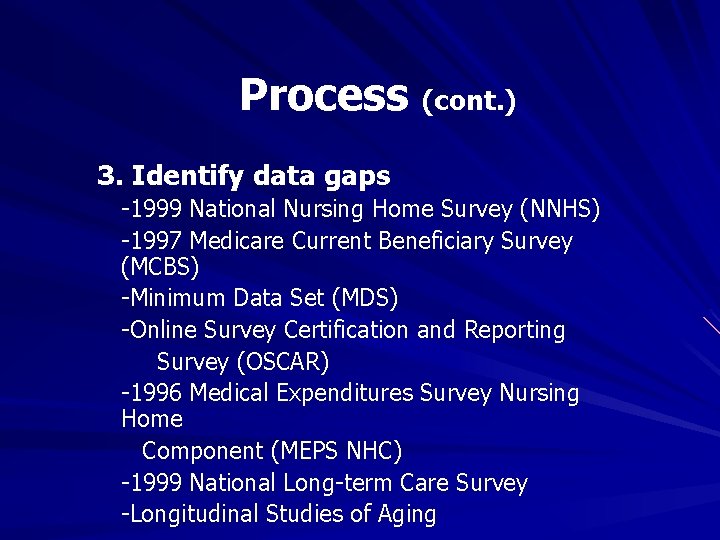
Process (cont. ) 3. Identify data gaps -1999 National Nursing Home Survey (NNHS) -1997 Medicare Current Beneficiary Survey (MCBS) -Minimum Data Set (MDS) -Online Survey Certification and Reporting Survey (OSCAR) -1996 Medical Expenditures Survey Nursing Home Component (MEPS NHC) -1999 National Long-term Care Survey -Longitudinal Studies of Aging
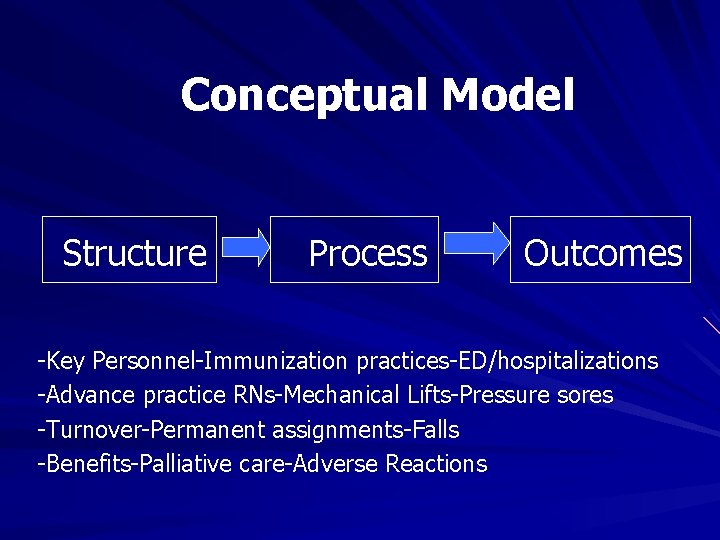
Conceptual Model Structure Process Outcomes -Key Personnel-Immunization practices-ED/hospitalizations -Advance practice RNs-Mechanical Lifts-Pressure sores -Turnover-Permanent assignments-Falls -Benefits-Palliative care-Adverse Reactions
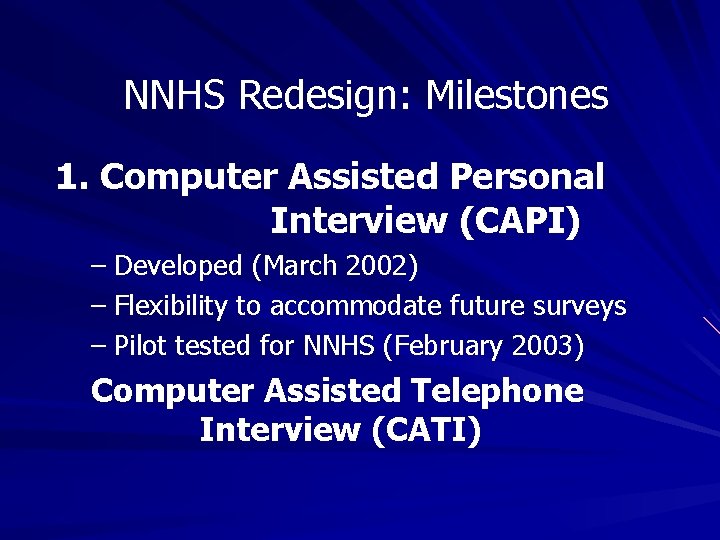
NNHS Redesign: Milestones 1. Computer Assisted Personal Interview (CAPI) – Developed (March 2002) – Flexibility to accommodate future surveys – Pilot tested for NNHS (February 2003) Computer Assisted Telephone Interview (CATI)
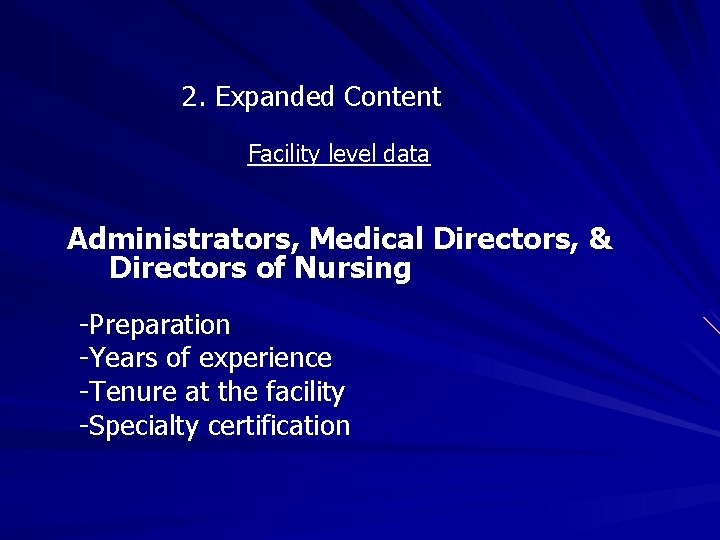
2. Expanded Content Facility level data Administrators, Medical Directors, & Directors of Nursing -Preparation -Years of experience -Tenure at the facility -Specialty certification
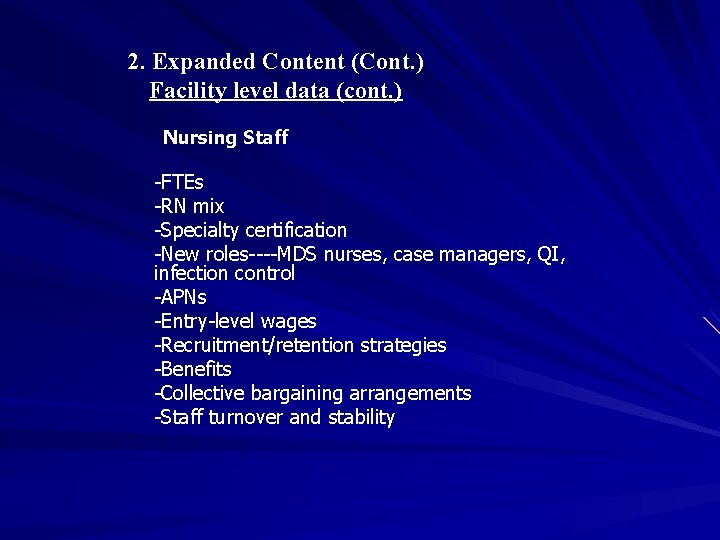
2. Expanded Content (Cont. ) Facility level data (cont. ) Nursing Staff -FTEs -RN mix -Specialty certification -New roles----MDS nurses, case managers, QI, infection control -APNs -Entry-level wages -Recruitment/retention strategies -Benefits -Collective bargaining arrangements -Staff turnover and stability
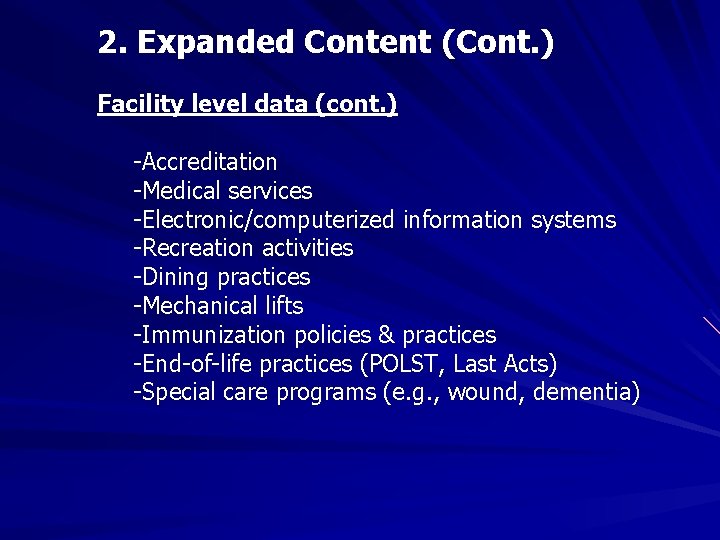
2. Expanded Content (Cont. ) Facility level data (cont. ) -Accreditation -Medical services -Electronic/computerized information systems -Recreation activities -Dining practices -Mechanical lifts -Immunization policies & practices -End-of-life practices (POLST, Last Acts) -Special care programs (e. g. , wound, dementia)
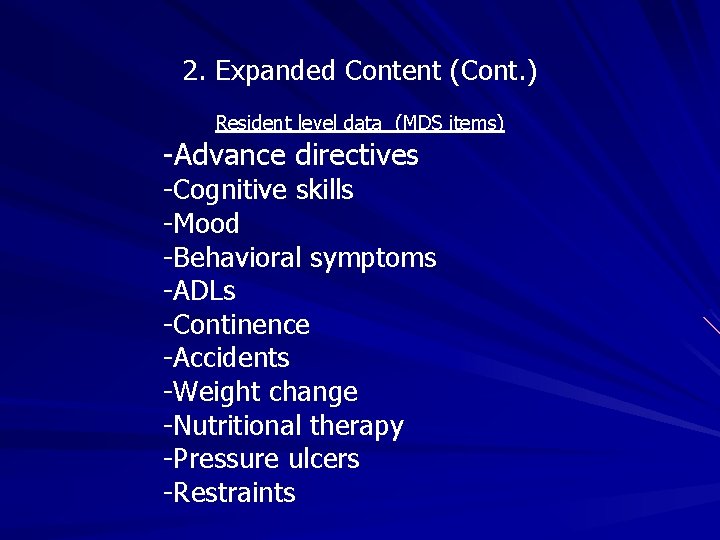
2. Expanded Content (Cont. ) Resident level data (MDS items) -Advance directives -Cognitive skills -Mood -Behavioral symptoms -ADLs -Continence -Accidents -Weight change -Nutritional therapy -Pressure ulcers -Restraints
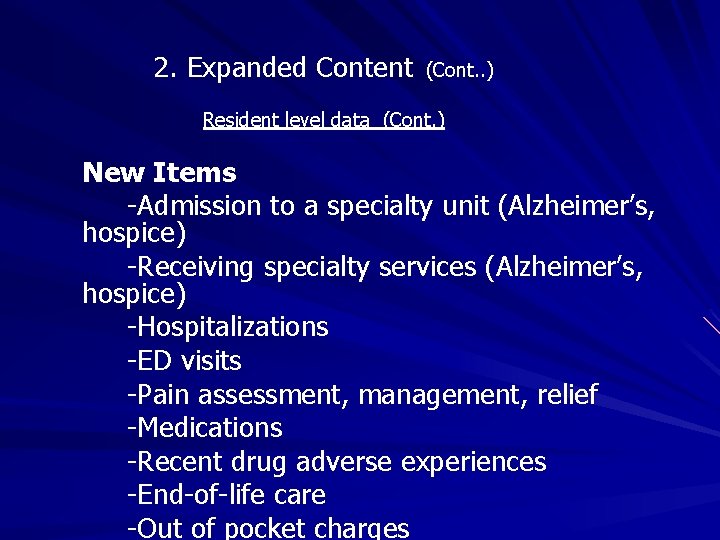
2. Expanded Content (Cont. . ) Resident level data (Cont. ) New Items -Admission to a specialty unit (Alzheimer’s, hospice) -Receiving specialty services (Alzheimer’s, hospice) -Hospitalizations -ED visits -Pain assessment, management, relief -Medications -Recent drug adverse experiences -End-of-life care -Out of pocket charges
NNHS Redesign: Milestones (Cont. ) 3. NNHS pretest (June – July 2003) 4. NNHS national survey (August – December 2004)
Major features Linkage to CMS’ Minimum Data Set – Expanded clinical content – Care episodes New sample design Expanded sample National Nursing Assistant Survey (NNAS)
National Nurse Assistant Survey (NNAS) – Reduces NNAS costs by utilizing a subsample of an existing sample frame and data collection methodology – Enhances response rates and reduces burden – Increases the analytical usefulness of NNAS and NNHS
NNAS Goals Describe characteristics of nurse assistants Explore why workers remain in the field and determine factors that influence retention Understand how these factors affect workers’ attitudes, relationships with managers and nursing home residents, and job satisfaction
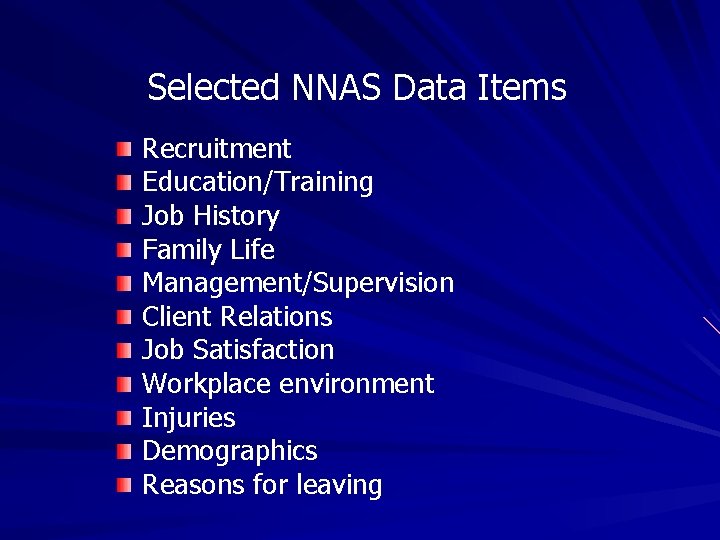
Selected NNAS Data Items Recruitment Education/Training Job History Family Life Management/Supervision Client Relations Job Satisfaction Workplace environment Injuries Demographics Reasons for leaving
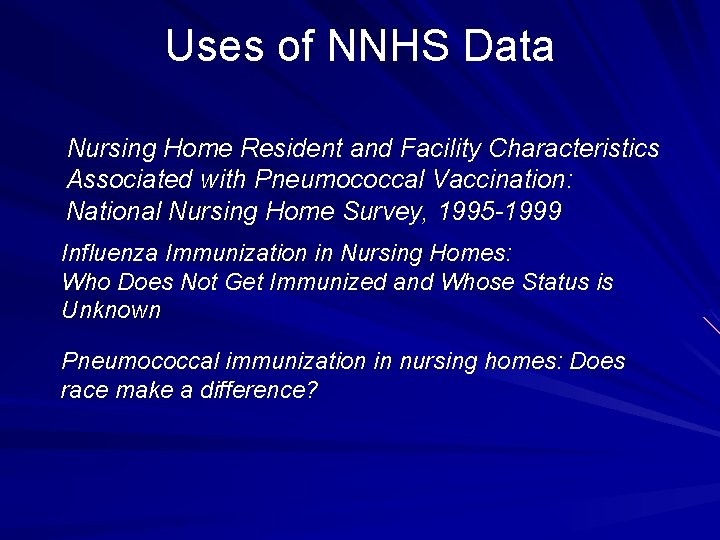
Uses of NNHS Data Nursing Home Resident and Facility Characteristics Associated with Pneumococcal Vaccination: National Nursing Home Survey, 1995 -1999 Influenza Immunization in Nursing Homes: Who Does Not Get Immunized and Whose Status is Unknown Pneumococcal immunization in nursing homes: Does race make a difference?
2007 National Home and Hospice Care Survey Scheduled to be conducted – August-December 2007
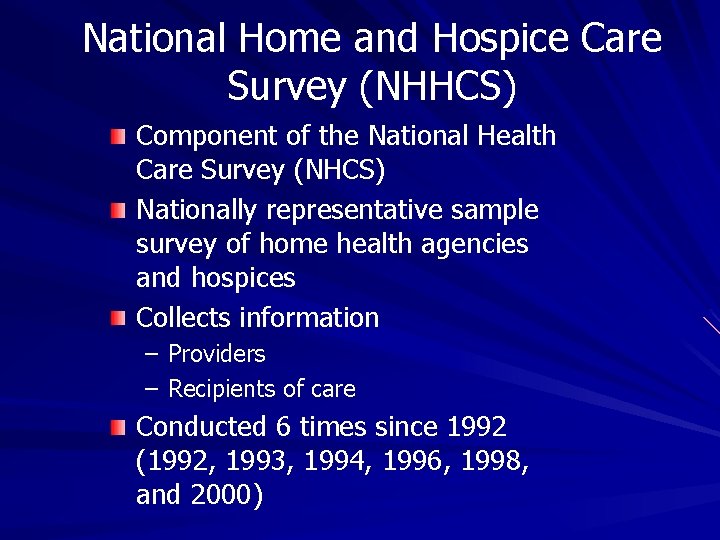
National Home and Hospice Care Survey (NHHCS) Component of the National Health Care Survey (NHCS) Nationally representative sample survey of home health agencies and hospices Collects information – Providers – Recipients of care Conducted 6 times since 1992 (1992, 1993, 1994, 1996, 1998, and 2000)
Process 1. Reviewed documents from expert meetings 2. Policy questions 3. Identified data gaps
NHHCS Redesign: Milestones 1. Computer Assisted Personal Interview (CAPI) and the Computer Assisted Telephone Interview (CATI)
2. Expanded Content Agency level data – – – JCAHO accreditation electronic information systems cultural competency immunization polices and practices end-of-life practices special service programs
2. Expanded Content Patient level data hospitalizations/emergency department admissions pain assessment and pain relief medications Out-of-pocket charges family and caregiver services end-of-life care and advance directives community based waiver program participant pressure ulcers behavior/mood symptoms falls
2. Expanded Content (Cont. ) Staffing level data Contract and agency employees Key personnel (Medical Director, Administrator, and Director of Nursing) educational preparation years of experience tenure at the agency specialty certification
2. Expanded Content (Cont. ) Staffing level data (Cont) RN mix---basic education, Diploma, BS, MS advance practice providers---CNS, NPs, PAs entry level wage for RNs, LPNs, HHAs/CNAs recruitment/retention strategies benefits turnover -- new hires, terminations
3. NHHCS pretest (Oct – Nov 2006) 4. NNHS national survey (August – December 2007)
Major features Linkage to CMS’ OASIS – Expanded clinical content – Care episodes New sample design Expanded sample National Home Health Aide Survey (NHHAS)
National Home Health Aide Survey (NHHAS) – Reduces NHHAS costs by utilizing a subsample of an existing sample frame and data collection methodology – Enhances response rates and reduces burden – Increases the analytical usefulness of NHHAS and NHHCS
Selected NHHAS Data Items – – – – – education/training employment profile family life management/supervision salary, compensation, benefits, reward, and incentives job satisfaction organizational culture Recruitment and training demographics
Uses of NHHCS Data Payment source and length of use among home health agency discharges The 1997 Balanced Budget Act and home services among Medicare patients. Ownership status and patterns of care in hospice
National Survey of Residential Care Facilities First time survey of residential and assisted living facilities Scheduled for fall of 2008 Uses NNHS model CAPI data collection system
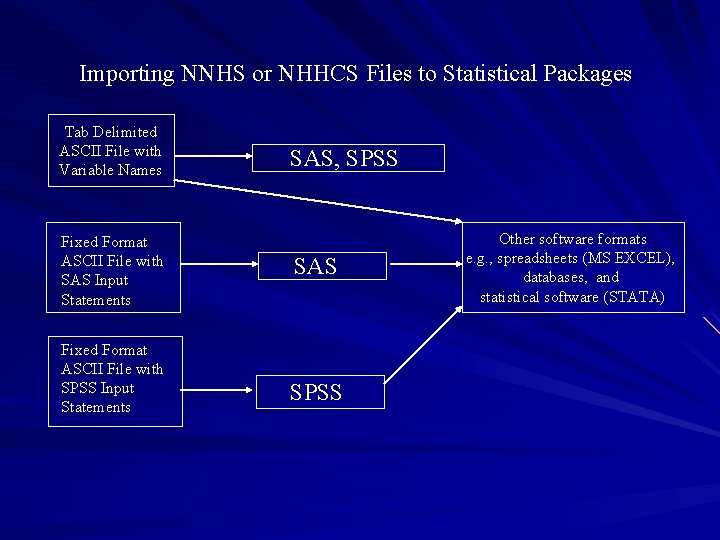
Importing NNHS or NHHCS Files to Statistical Packages Tab Delimited ASCII File with Variable Names Fixed Format ASCII File with SAS Input Statements Fixed Format ASCII File with SPSS Input Statements SAS, SPSS SAS SPSS Other software formats e. g. , spreadsheets (MS EXCEL), databases, and statistical software (STATA)
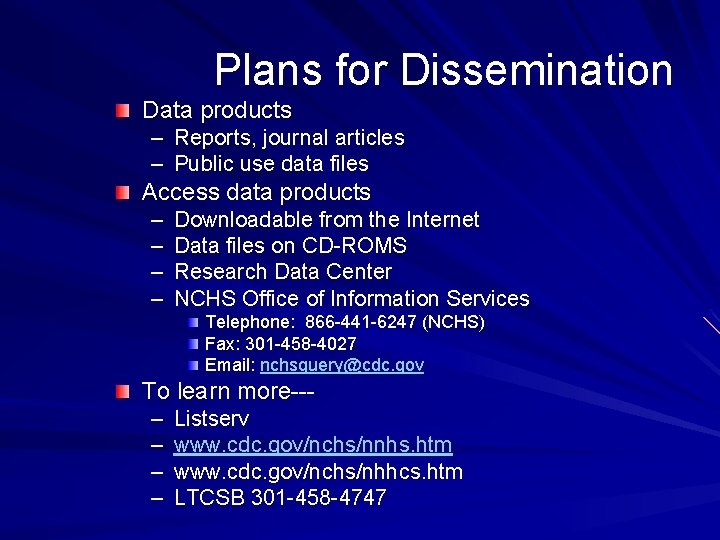
Plans for Dissemination Data products – Reports, journal articles – Public use data files Access data products – – Downloadable from the Internet Data files on CD-ROMS Research Data Center NCHS Office of Information Services Telephone: 866 -441 -6247 (NCHS) Fax: 301 -458 -4027 Email: nchsquery@cdc. gov To learn more--– – Listserv www. cdc. gov/nchs/nnhs. htm www. cdc. gov/nchs/nhhcs. htm LTCSB 301 -458 -4747