
Overview of the MODIS Snow Ice Project Part
![Outline Product Usage Three New & Related Products Re-Launched Website [modis-snow-ice. gsfc. nasa. gov]](https://slidetodoc.com/presentation_image/3a8ad91faf3deed0f6f0eefcf7c2a2cb/image-2.jpg "Outline Product Usage Three New & Related Products Re-Launched Website [modis-snow-ice. gsfc. nasa. gov]")
- Slides: 18
Overview of the MODIS Snow - Ice Project Part 1 Dorothy K. Hall Cryospheric Sciences Branch NASA / Goddard Space Flight Center Greenbelt, Md. dorothy. k. hall@nasa. gov George A. Riggs SSAI and Cryospheric Sciences Branch Nicolo E. Di. Girolamo SSAI and Cryospheric Sciences Branch Jeffrey A. Miller Wyle & Cryospheric Sciences Branch James L. Foster Sujay Kumar Soni Yatheendradas Hydrological Sciences Branch NASA / Goddard Space Flight Center MODIS Science Team Meeting Land Team College Park, Md. 18 May 2011
Outline Product Usage Three New & Related Products Re-Launched Website [modis-snow-ice. gsfc. nasa. gov] Science Results Collection 6 (C 6) Changes – Part 2 - George Riggs
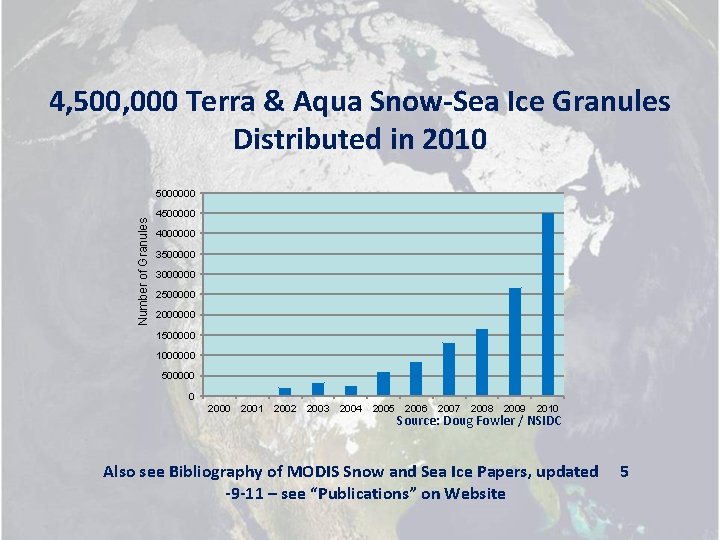
4, 500, 000 Terra & Aqua Snow-Sea Ice Granules Distributed in 2010 Number of Granules 5000000 4500000 4000000 3500000 3000000 2500000 2000000 1500000 1000000 500000 0 2001 2002 2003 2004 2005 2006 2007 2008 2009 2010 Source: Doug Fowler / NSIDC Also see Bibliography of MODIS Snow and Sea Ice Papers, updated -9 -11 – see “Publications” on Website 5
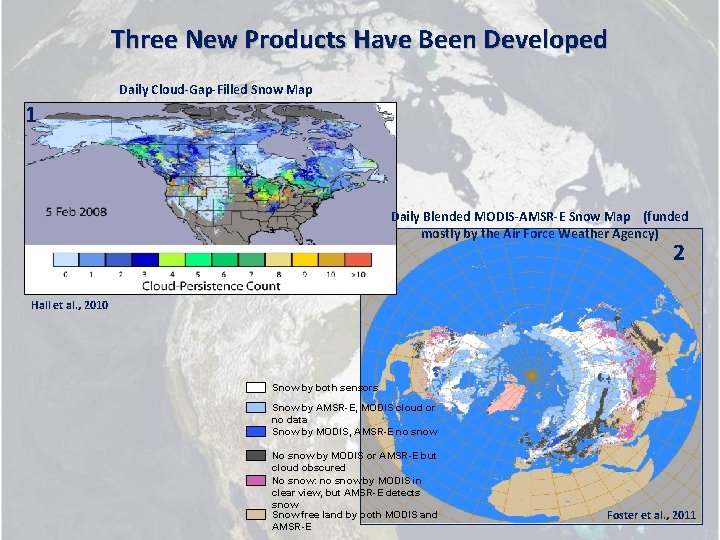
Three New Products Have Been Developed Daily Cloud-Gap-Filled Snow Map 1 Daily Blended MODIS-AMSR-E Snow Map (funded mostly by the Air Force Weather Agency) 2 Hall et al. , 2010 Snow by both sensors Snow by AMSR-E, MODIS cloud or no data Snow by MODIS, AMSR-E no snow No snow by MODIS or AMSR-E but cloud obscured No snow: no snow by MODIS in clear view, but AMSR-E detects snow Snow free land by both MODIS and AMSR-E Foster et al. , 2011
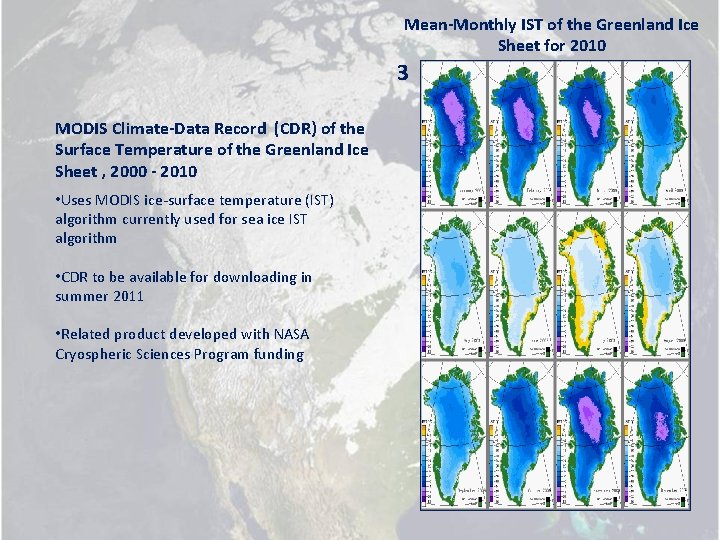
Mean-Monthly IST of the Greenland Ice Sheet for 2010 3 MODIS Climate-Data Record (CDR) of the Surface Temperature of the Greenland Ice Sheet , 2000 - 2010 • Uses MODIS ice-surface temperature (IST) algorithm currently used for sea ice IST algorithm • CDR to be available for downloading in summer 2011 • Related product developed with NASA Cryospheric Sciences Program funding
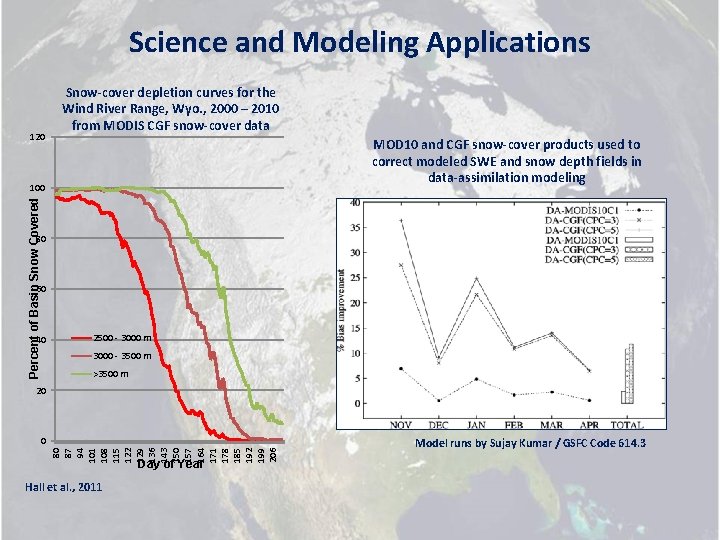
Science and Modeling Applications 120 Snow-cover depletion curves for the Wind River Range, Wyo. , 2000 – 2010 from MODIS CGF snow-cover data MOD 10 and CGF snow-cover products used to correct modeled SWE and snow depth fields in data-assimilation modeling Percent of Basin Snow Covered 100 80 60 40 2500 - 3000 m 3000 - 3500 m >3500 m 20 80 87 94 101 108 115 122 129 136 143 150 157 164 171 178 185 192 199 206 0 Day of Year Hall et al. , 2011 Model runs by Sujay Kumar / GSFC Code 614. 3
Overview of the MODIS Snow - Ice Project Snow Algorithms and Products for C 6 Part II George Riggs MODIS Science Team Meeting 18 – 20 May 2011 College Park, MD
Overview C 6 changes, are response to users’ feed back regarding accuracy and errors reported for various applications of the MODIS snow products , and our evaluation of MODIS snow products. Revised C 6 snow algorithms Adapt to the L 2 G lite storage format New C 6 snow products Two groups affected by C 6 changes production -- down stream products that use MOD 10* products, new products, and NSIDC EOS-DAAC users – applications using primarily MOD 10 A 1 and higher levels
Learned from Users Usage: • • • [listing of papers that use MODIS snow products at modis-snow-ice. gsfc. nasa. gov/] MOD 10 A 1 is most often used in applications, MOD 10 CMG for global scale modeling, e. g. Noah land surface model Though both the snow covered area (SCA) and fractional snow cover (FSC)maps available, the SCA is most often used QA data used infrequently Comparison: • MOD 10 A 1 compared to other snow covered area algorithms/products and surface station data Snow errors: • Snow/cloud confusion at snow cover edge • Snow/cloud confusion in other situations associated with cloud cover, producing snow commission or omission errors • Snow errors in less than ideal viewing conditions • Disappearance of snow cover during summer in mountains
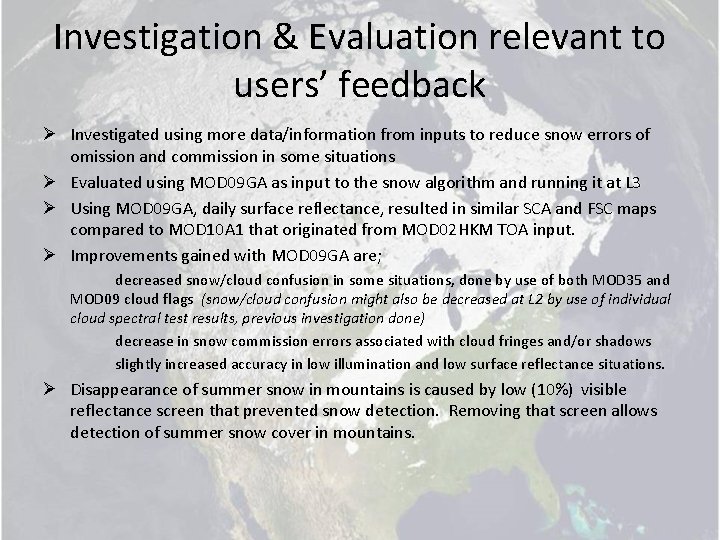
Summary Major C 6 Revisions v. Sequence of snow products will continue in C 6 v. MOD 10_L 2 snow algorithm C 6 revised to improve snow cover detection v. MOD 10 A 1 algorithm revised to use L 2 G lite format v. MOD 10 SR – new independent product to be made using MOD 09 GA input v. Supersede the MOD 10 A 1 v. MOD 10 CGF – new L 3 cloud gap filled (CGF) products added to sequence of products
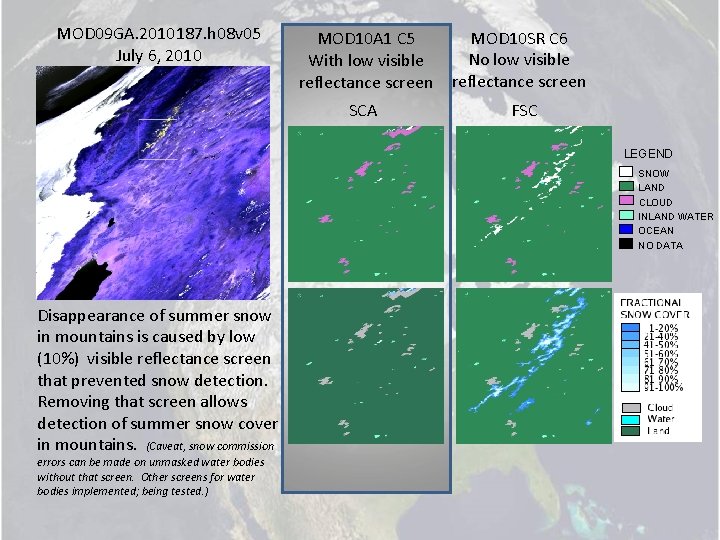
Investigation & Evaluation relevant to users’ feedback Ø Investigated using more data/information from inputs to reduce snow errors of omission and commission in some situations Ø Evaluated using MOD 09 GA as input to the snow algorithm and running it at L 3 Ø Using MOD 09 GA, daily surface reflectance, resulted in similar SCA and FSC maps compared to MOD 10 A 1 that originated from MOD 02 HKM TOA input. Ø Improvements gained with MOD 09 GA are; decreased snow/cloud confusion in some situations, done by use of both MOD 35 and MOD 09 cloud flags (snow/cloud confusion might also be decreased at L 2 by use of individual cloud spectral test results, previous investigation done) decrease in snow commission errors associated with cloud fringes and/or shadows slightly increased accuracy in low illumination and low surface reflectance situations. Ø Disappearance of summer snow in mountains is caused by low (10%) visible reflectance screen that prevented snow detection. Removing that screen allows detection of summer snow cover in mountains.
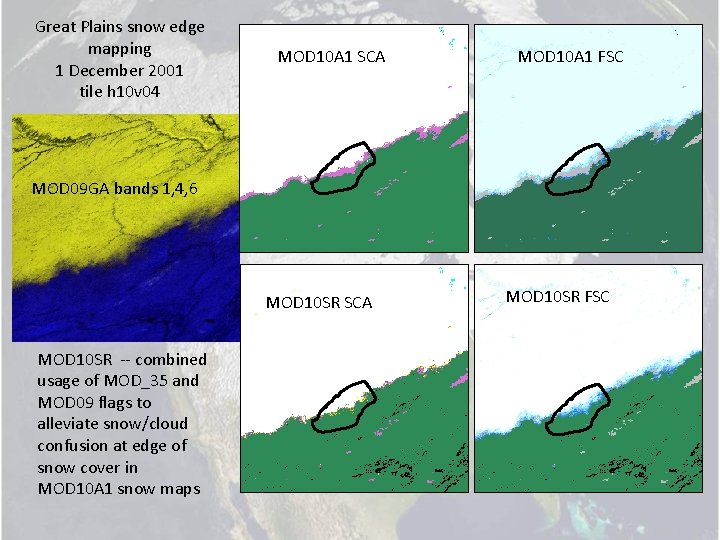
Great Plains snow edge mapping 1 December 2001 tile h 10 v 04 MOD 10 A 1 SCA MOD 10 A 1 FSC MOD 09 GA bands 1, 4, 6 MOD 10 SR SCA MOD 10 SR -- combined usage of MOD_35 and MOD 09 flags to alleviate snow/cloud confusion at edge of snow cover in MOD 10 A 1 snow maps MOD 10 SR FSC
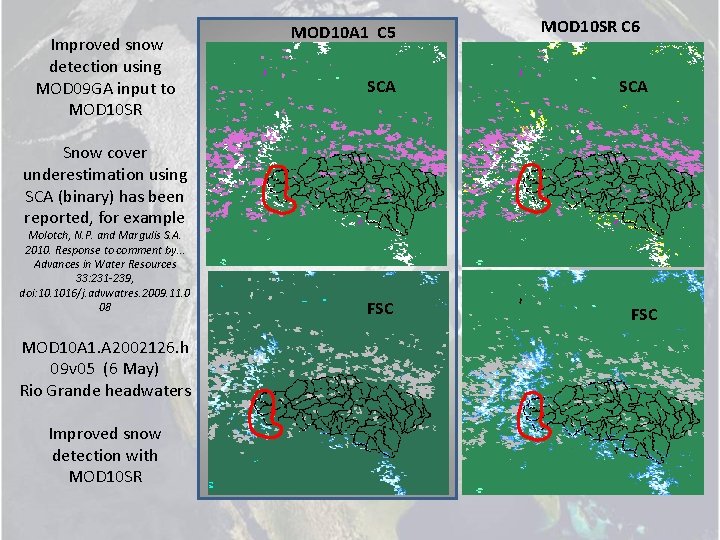
Improved snow detection using MOD 09 GA input to MOD 10 SR MOD 10 A 1 C 5 SCA MOD 10 SR C 6 SCA Snow cover underestimation using SCA (binary) has been reported, for example Molotch, N. P. and Margulis S. A. 2010. Response to comment by… Advances in Water Resources 33: 231 -239, doi: 10. 1016/j. advwatres. 2009. 11. 0 08 MOD 10 A 1. A 2002126. h 09 v 05 (6 May) Rio Grande headwaters Improved snow detection with MOD 10 SR FSC
MOD 09 GA. 2010187. h 08 v 05 July 6, 2010 MOD 10 A 1 C 5 With low visible reflectance screen MOD 10 SR C 6 No low visible reflectance screen SCA FSC LEGEND SNOW LAND CLOUD INLAND WATER OCEAN NO DATA Disappearance of summer snow in mountains is caused by low (10%) visible reflectance screen that prevented snow detection. Removing that screen allows detection of summer snow cover in mountains. (Caveat, snow commission errors can be made on unmasked water bodies without that screen. Other screens for water bodies implemented; being tested. )
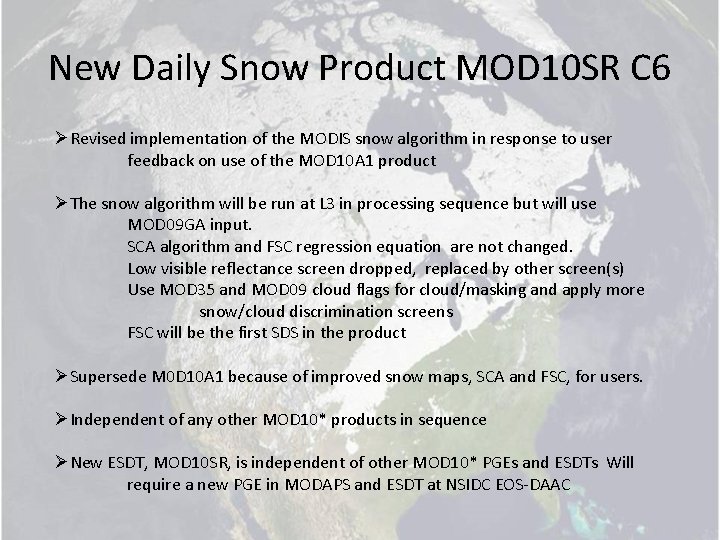
New Daily Snow Product MOD 10 SR C 6 ØRevised implementation of the MODIS snow algorithm in response to user feedback on use of the MOD 10 A 1 product ØThe snow algorithm will be run at L 3 in processing sequence but will use MOD 09 GA input. SCA algorithm and FSC regression equation are not changed. Low visible reflectance screen dropped, replaced by other screen(s) Use MOD 35 and MOD 09 cloud flags for cloud/masking and apply more snow/cloud discrimination screens FSC will be the first SDS in the product ØSupersede M 0 D 10 A 1 because of improved snow maps, SCA and FSC, for users. ØIndependent of any other MOD 10* products in sequence ØNew ESDT, MOD 10 SR, is independent of other MOD 10* PGEs and ESDTs Will require a new PGE in MODAPS and ESDT at NSIDC EOS-DAAC
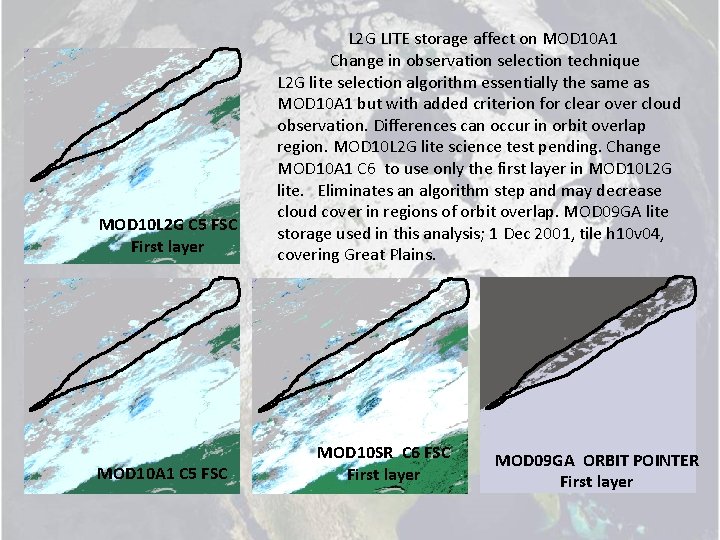
MOD 10 L 2 G C 5 FSC First layer MOD 10 A 1 C 5 FSC L 2 G LITE storage affect on MOD 10 A 1 Change in observation selection technique L 2 G lite selection algorithm essentially the same as MOD 10 A 1 but with added criterion for clear over cloud observation. Differences can occur in orbit overlap region. MOD 10 L 2 G lite science test pending. Change MOD 10 A 1 C 6 to use only the first layer in MOD 10 L 2 G lite. Eliminates an algorithm step and may decrease cloud cover in regions of orbit overlap. MOD 09 GA lite storage used in this analysis; 1 Dec 2001, tile h 10 v 04, covering Great Plains. MOD 10 SR C 6 FSC First layer MOD 09 GA ORBIT POINTER First layer
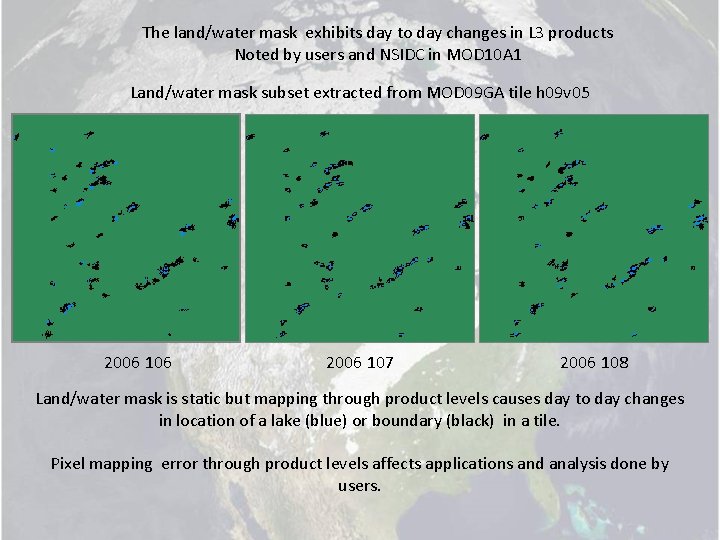
The land/water mask exhibits day to day changes in L 3 products Noted by users and NSIDC in MOD 10 A 1 Land/water mask subset extracted from MOD 09 GA tile h 09 v 05 2006 106 2006 107 2006 108 Land/water mask is static but mapping through product levels causes day to day changes in location of a lake (blue) or boundary (black) in a tile. Pixel mapping error through product levels affects applications and analysis done by users.
Summary Major C 6 Revisions v. Sequence of snow products will continue in C 6 v. MOD 10_L 2 snow algorithm C 6 revised to improve snow cover detection v. MOD 10 A 1 algorithm revised to use L 2 G lite format v. MOD 10 SR – new independent product to be made using MOD 09 GA input v. Supersede the MOD 10 A 1 v. MOD 10 CGF – new L 3 products added to sequence of products