
Overview of the MIDASHU dynamic microsimulation model Tth




- Slides: 12
Overview of the MIDAS_HU dynamic microsimulation model Tóth Krisztián Central Administration of National Pension Insurance European Meeting of the International Microsimulation Association 22 -23 September 2016, Budapest, Hungary.
Motivation Before 2012: Huge administrative data asset BUT unavailable for analytical purposes Important professional issues BUT no model which could answer them Pension reform (2012) Our objectives: Build a data warehouse which: o contains all available administrative data o can be used for analytical purposes Develop a policy model to: o Support the governmental decision-making processes o Analyse the social implications of (past & future) parameter changes
MIDAS_HU Development was launched in 2012 Belongs to the MIDAS model family Support was provided by the Federal Planning Bureau of Belgium The European Commission provided financial from 2013 (VS/2013/0132) Parallel a data warehouse development was launched The first version was completed in 2015
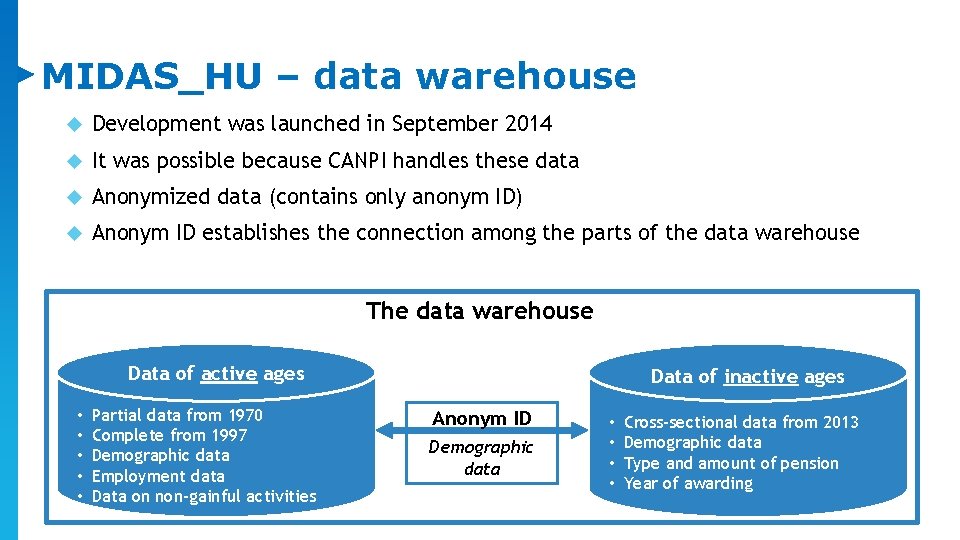
MIDAS_HU – data warehouse Development was launched in September 2014 It was possible because CANPI handles these data Anonymized data (contains only anonym ID) Anonym ID establishes the connection among the parts of the data warehouse The data warehouse Data of active ages • • • Partial data from 1970 Complete from 1997 Demographic data Employment data Data on non-gainful activities Data of inactive ages Anonym ID Demographic data • • Cross-sectional data from 2013 Demographic data Type and amount of pension Year of awarding
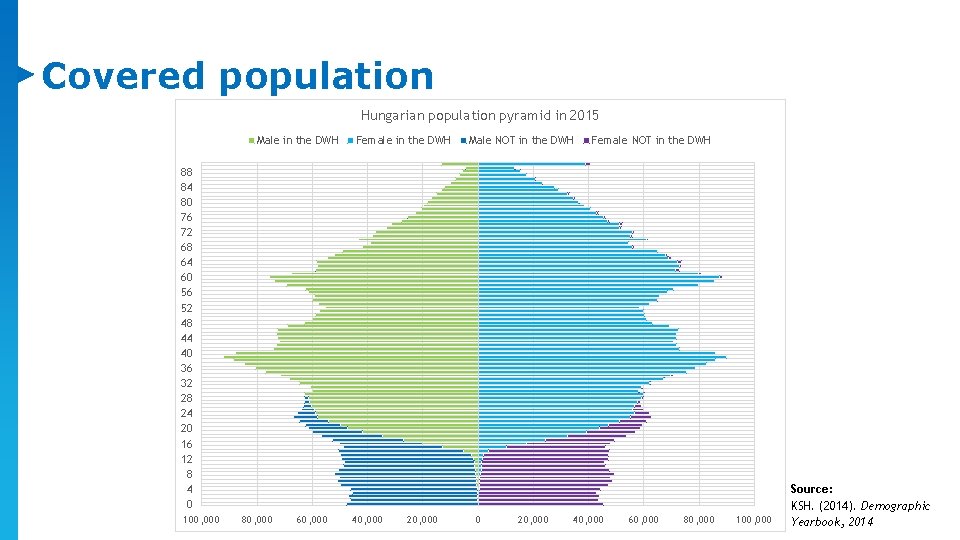
Covered population Hungarian population pyramid in 2015 Male in the DWH 88 84 80 76 72 68 64 60 56 52 48 44 40 36 32 28 24 20 16 12 8 4 0 100, 000 80, 000 60, 000 Female in the DWHMale. Female NOT in the DWH 40, 000 20, 000 Female NOT in the DWH 40, 000 60, 000 80, 000 100, 000 Source: KSH. (2014). Demographic Yearbook, 2014
MIDAS_HU Prospective part of the model Sampling Retrospective module Results Demographic module year = year + 1 Calculation and indexation of pensions Marriage market Labour market module Retirement decision The estimation of the salaries: Results Calculation and indexation pensions Selecting o Data aim cleansing ofemployees: this module is toofand set up the family marriages relationships (logit+alingment): Retirement decision Simulation of: Modelling new marriages common-law (logit+alignment) The results of predefined queries (csv) o Logit+alignment 20% stratified sample from 2012 (~2 million persons) Calculation of the amounts ofexisting contributions paid and the entitlements acquired The start of the prospecitve part of the 1. step: male-female relationships bymodel the length of the relationship Selects the persons meeting all criteria fordaily retirement, i. e. age and service timeduring the Deaths (different mortality old-age pensioners) Modelling the termination offor relationships (divorce) (logit+alignment) o We estimate the natural logarithm of the salary (log continuous regression) o The main explanatory variable is the so called labour market profile given year o Different Stratified by: age, gender, employment status, type family of pension benefit The whole micro database of the simulation (hdf 5) 2. step: parent-child relationships: identification of those who do not immediately take the option(old-age, of retirement o Births (using age-specific fertility rates) Rearranging households in line with the altered relationships equation for employees and entrepreneurs • Worked out on the basis of the persons past contribution frequencies widow(er)s’ pension, orphans allowance) o Educational Calculation the new pension benefits Ad-hoc through the interactive console the retirement age (at least 1 year earlier) • Onlyqueries for of children below 25 Retirement of those not retiring upon reaching o attainment • The model recalculates the employment frequency of the preceding 10 years each year o No family relationships are included o Indexation of pensions • Special cases: and changes the orphans labour market profile if needed
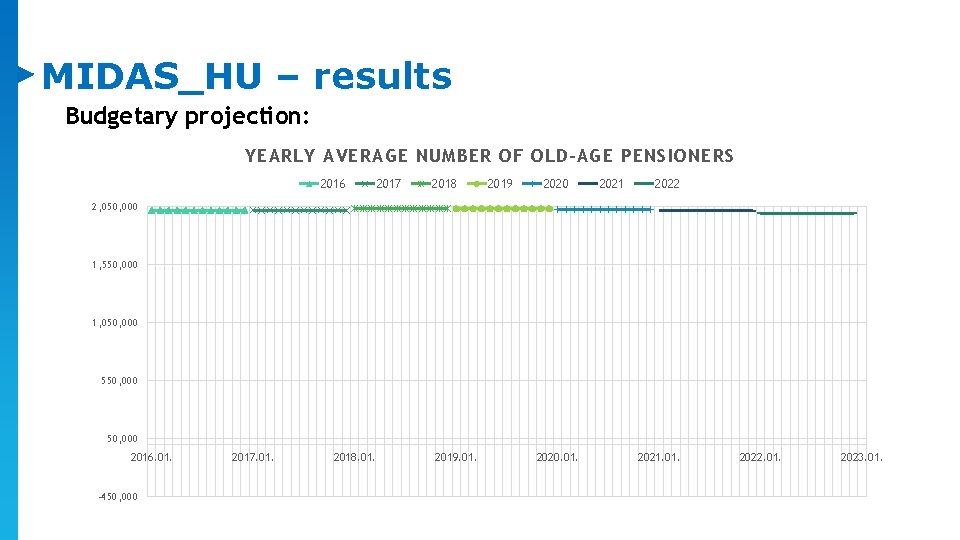
MIDAS_HU – results Budgetary projection: YEARLY AVERAGE NUMBER OF OLD-AGE PENSIONERS 2016 2017 2018 2019 2020 2021 2022 2, 050, 000 1, 550, 000 1, 050, 000 2016. 01. -450, 000 2017. 01. 2018. 01. 2019. 01. 2020. 01. 2021. 01. 2022. 01. 2023. 01.
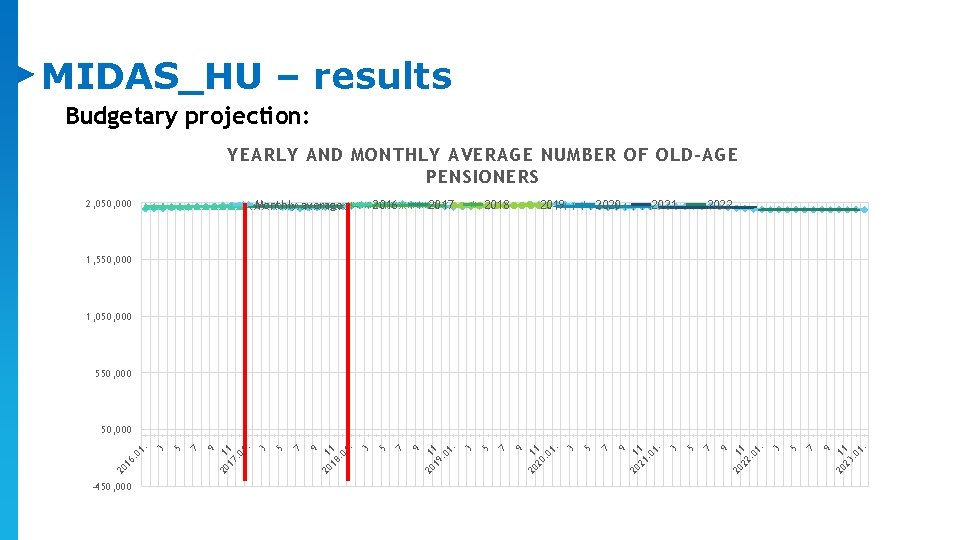
MIDAS_HU – results Budgetary projection: YEARLY AND MONTHLY AVERAGE NUMBER OF OLD-AGE PENSIONERS 2, 050, 000 Monthly average 2016 2017 2018 2019 2020 2021 2022 1, 550, 000 1, 050, 000 550, 000 -450, 000 1. 23. 0 9 11 20 7 5 3 1. 22. 0 9 11 20 7 5 3 9 1 21 1. 0 1. 20 7 5 9 1 20 1. 3 20 7 5 3 1. 19. 0 9 11 20 7 5 3 9 1 18 1. 0 1. 20 7 5 3 9 7 5 3 1 17 1. 0 1. 20 20 16. 0 1. 50, 000
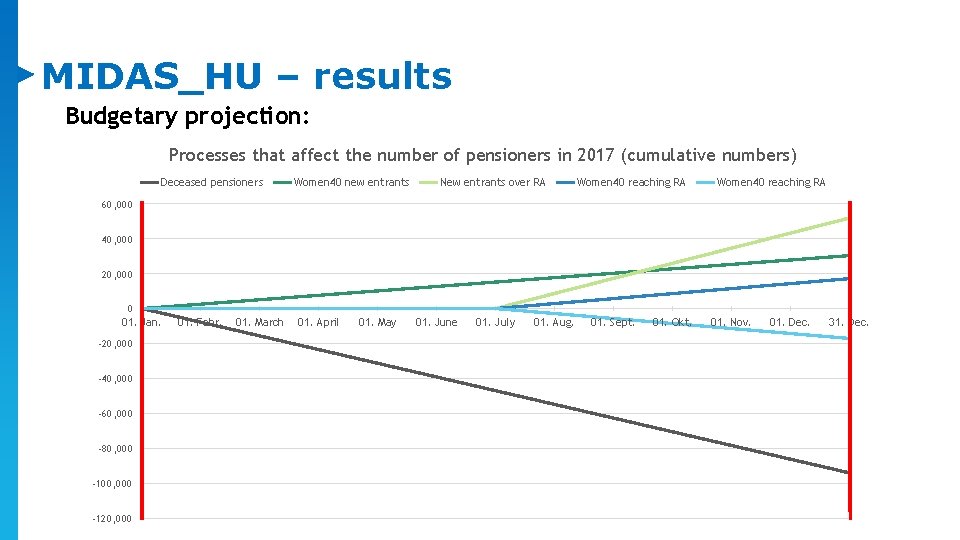
MIDAS_HU – results Budgetary projection: Processes that affect the number of pensioners in 2017 (cumulative numbers) Dedeased Deceasedold-age pensioners. Women 40 new entrants New entrants over RA RA Women 40 nok 40 átlépő reaching RAnők 40 Women 40 korhatárt betöltők reaching RA 60, 000 40, 000 20, 000 0 01. Jan. -20, 000 -40, 000 -60, 000 -80, 000 -100, 000 -120, 000 01. Febr. 01. March 01. April 01. May 01. June 01. July 01. Aug. 01. Sept. 01. Okt. 01. Nov. 01. Dec. 31. Dec.
MIDAS_HU – future plans Further development of the data warehouse and the model: In progress Planned Finished Detailed data of newly awarded benefits Pension benefit data Pension rights accrual data Educational attainment Data about migration ✓ ✓ Data warehouse Information about health status
MIDAS_HU – conclusions MIDAS_HU has proved to be an effective tool to: Support the budget planning Analyse and project pension adequacy Support the governmental decision-making processes Important additional benefits: Accelerated the unification of our micro databases (pension rights and benefits) Better statistical reports using the newly constructed data warehouse
Thank you for your attention!