
Overview of the LHCb Experiment 5 th FOUR
Overview of the LHCb Experiment 5 th FOUR SEAS CONFERENCE IASI, ROMANIA , 29 May - 3 June 2007 Ø Physics motivation Ø Overview and expected performance of detector Ø Prospects for physics performance on selected channels Ø Outlook and conclusion presented by Andreas Schopper (CERN) on behalf of the Collaboration
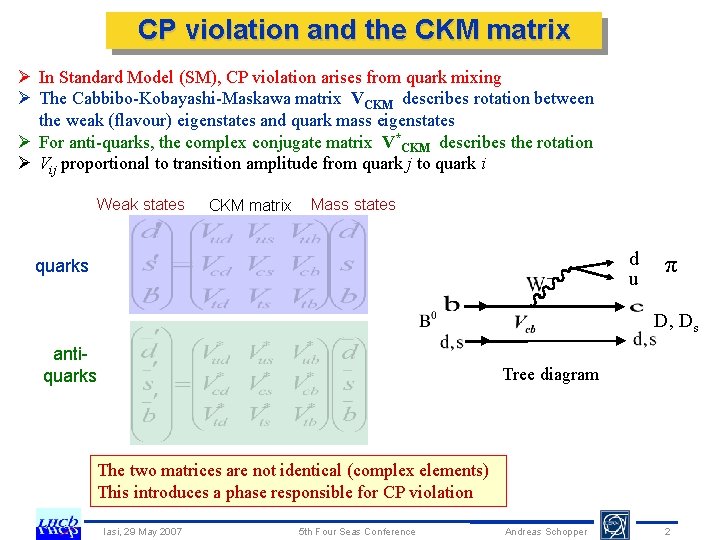
CP violation and the CKM matrix Ø In Standard Model (SM), CP violation arises from quark mixing Ø The Cabbibo-Kobayashi-Maskawa matrix VCKM describes rotation between the weak (flavour) eigenstates and quark mass eigenstates Ø For anti-quarks, the complex conjugate matrix V*CKM describes the rotation Ø Vij proportional to transition amplitude from quark j to quark i Weak states CKM matrix Mass states d u quarks π D, Ds antiquarks Tree diagram The two matrices are not identical (complex elements) This introduces a phase responsible for CP violation Iasi, 29 May 2007 5 th Four Seas Conference Andreas Schopper 2
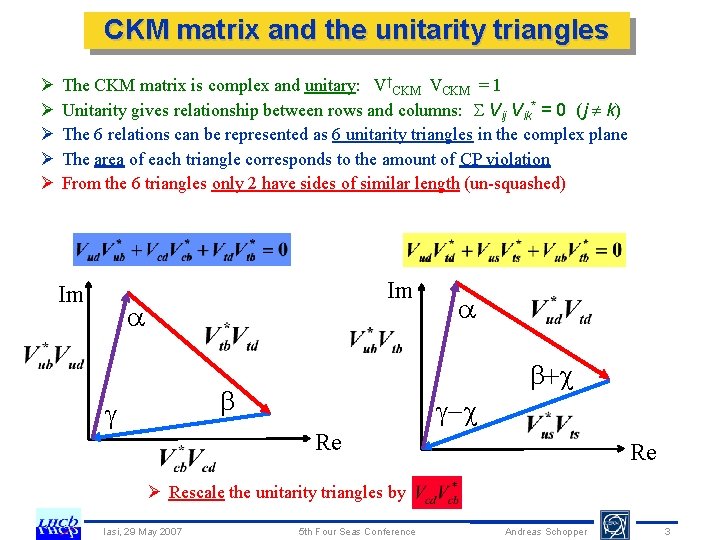
CKM matrix and the unitarity triangles Ø Ø Ø The CKM matrix is complex and unitary: V†CKM VCKM = 1 Unitarity gives relationship between rows and columns: S Vij Vik* = 0 (j k) The 6 relations can be represented as 6 unitarity triangles in the complex plane The area of each triangle corresponds to the amount of CP violation From the 6 triangles only 2 have sides of similar length (un-squashed) Im Im Re Re Ø Rescale the unitarity triangles by Iasi, 29 May 2007 5 th Four Seas Conference Andreas Schopper 3
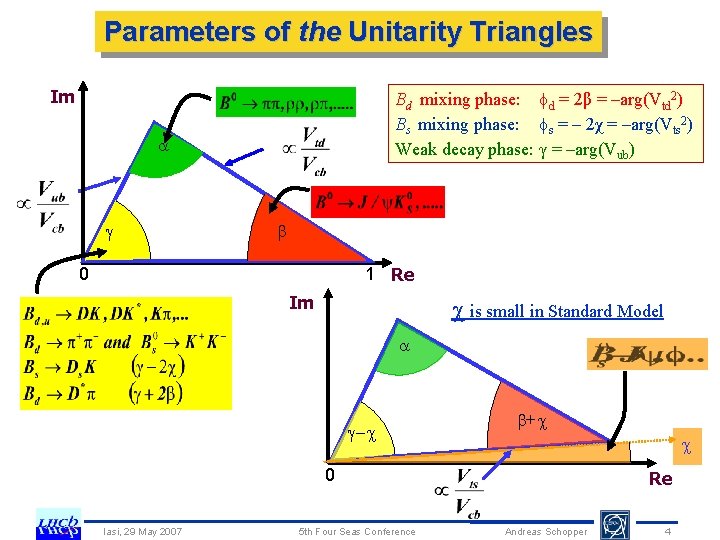
Parameters of the Unitarity Triangles Im Bd mixing phase: d = 2β = –arg(Vtd 2) Bs mixing phase: s = – 2χ = –arg(Vts 2) Weak decay phase: γ = –arg(Vub) 1 Re 0 Im is small in Standard Model + 0 Iasi, 29 May 2007 5 th Four Seas Conference Re Andreas Schopper 4
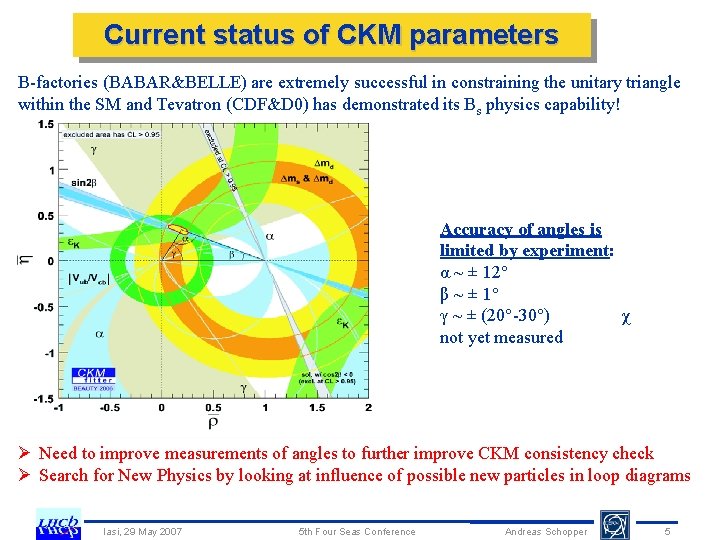
Current status of CKM parameters B-factories (BABAR&BELLE) are extremely successful in constraining the unitary triangle within the SM and Tevatron (CDF&D 0) has demonstrated its Bs physics capability! Accuracy of angles is limited by experiment: α ~ ± 12° β ~ ± 1° γ ~ ± (20°-30°) χ not yet measured Ø Need to improve measurements of angles to further improve CKM consistency check Ø Search for New Physics by looking at influence of possible new particles in loop diagrams Iasi, 29 May 2007 5 th Four Seas Conference Andreas Schopper 5
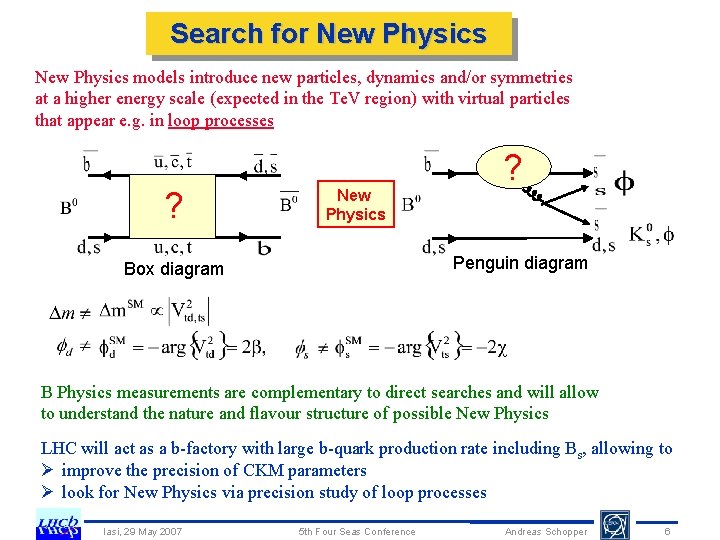
Search for New Physics models introduce new particles, dynamics and/or symmetries at a higher energy scale (expected in the Te. V region) with virtual particles that appear e. g. in loop processes ? New Physics ? Penguin diagram Box diagram B Physics measurements are complementary to direct searches and will allow to understand the nature and flavour structure of possible New Physics LHC will act as a b-factory with large b-quark production rate including Bs, allowing to Ø improve the precision of CKM parameters Ø look for New Physics via precision study of loop processes Iasi, 29 May 2007 5 th Four Seas Conference Andreas Schopper 6
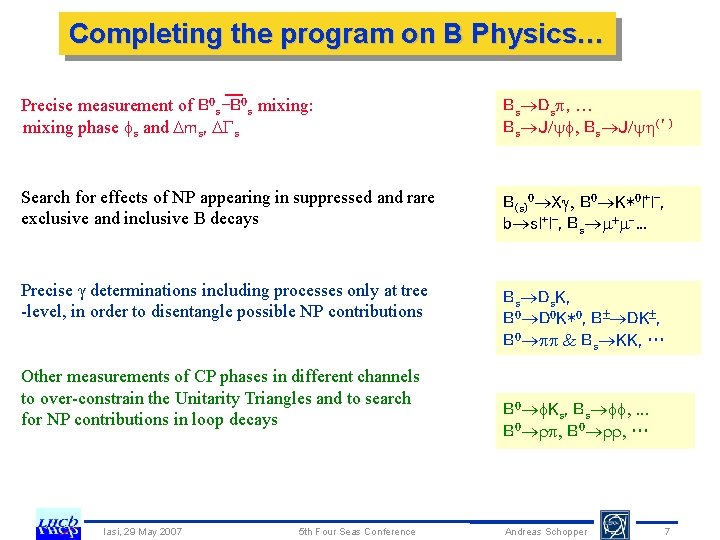
Completing the program on B Physics… Precise measurement of B 0 s-B 0 s mixing: mixing phase s and ms, Gs Bs Ds , … Bs J/ , Bs J/ h(’) Search for effects of NP appearing in suppressed and rare exclusive and inclusive B decays B(s)0 X , B 0 K*0 l+l-, b sl+l-, Bs . . . Precise γ determinations including processes only at tree -level, in order to disentangle possible NP contributions Bs Ds. K, B 0 D 0 K*0, B DK , B 0 & Bs KK, … Other measurements of CP phases in different channels to over-constrain the Unitarity Triangles and to search for NP contributions in loop decays Iasi, 29 May 2007 5 th Four Seas Conference B 0 Ks, Bs , . . . B 0 r , B 0 rr, … Andreas Schopper 7
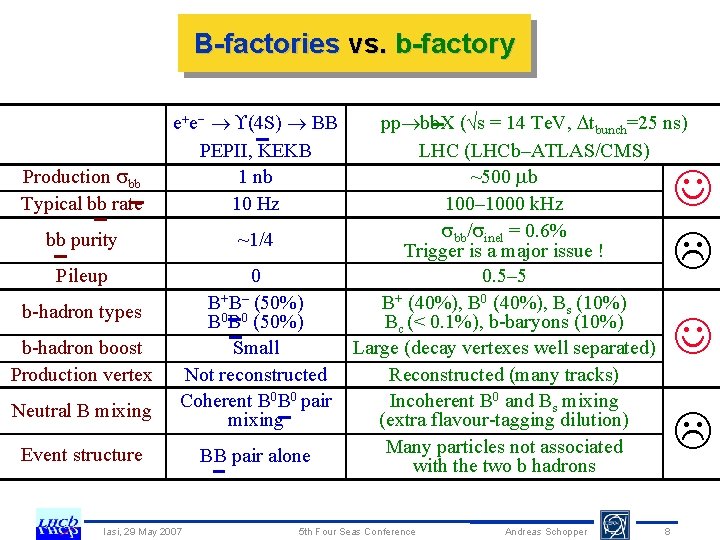
B-factories vs. b-factory Production bb Typical bb rate e e (4 S) BB PEPII, KEKB 1 nb 10 Hz bb purity ~1/4 Pileup Neutral B mixing 0 B+B– (50%) B 0 B 0 (50%) Small Not reconstructed Coherent B 0 B 0 pair mixing Event structure BB pair alone b-hadron types b-hadron boost Production vertex Iasi, 29 May 2007 pp bb. X (√s = 14 Te. V, tbunch=25 ns) LHC (LHCb–ATLAS/CMS) ~500 b 100– 1000 k. Hz bb/ inel = 0. 6% Trigger is a major issue ! 0. 5– 5 B+ (40%), B 0 (40%), Bs (10%) Bc (< 0. 1%), b-baryons (10%) Large (decay vertexes well separated) Reconstructed (many tracks) Incoherent B 0 and Bs mixing (extra flavour-tagging dilution) Many particles not associated with the two b hadrons 5 th Four Seas Conference Andreas Schopper 8
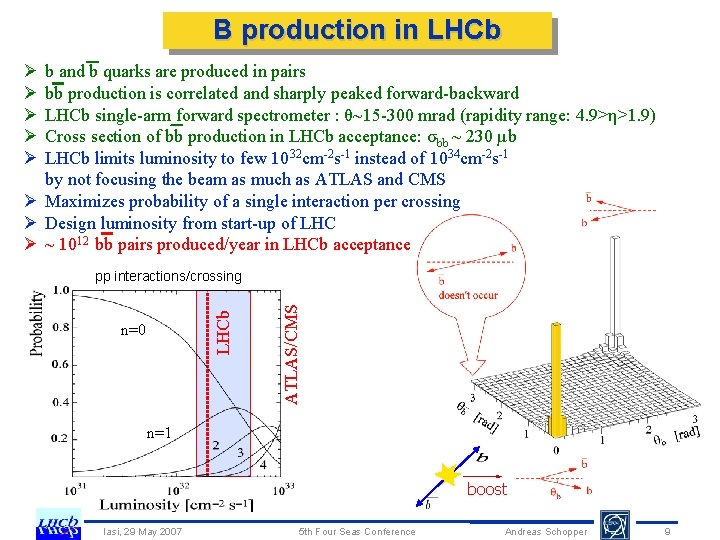
B production in LHCb Ø Ø Ø b and b quarks are produced in pairs bb production is correlated and sharply peaked forward-backward LHCb single-arm forward spectrometer : θ~15 -300 mrad (rapidity range: 4. 9>η>1. 9) Cross section of bb production in LHCb acceptance: σbb ~ 230 µb LHCb limits luminosity to few 1032 cm-2 s-1 instead of 1034 cm-2 s-1 by not focusing the beam as much as ATLAS and CMS Ø Maximizes probability of a single interaction per crossing Ø Design luminosity from start-up of LHC Ø ~ 1012 bb pairs produced/year in LHCb acceptance n=0 ATLAS/CMS LHCb pp interactions/crossing n=1 boost Iasi, 29 May 2007 5 th Four Seas Conference Andreas Schopper 9
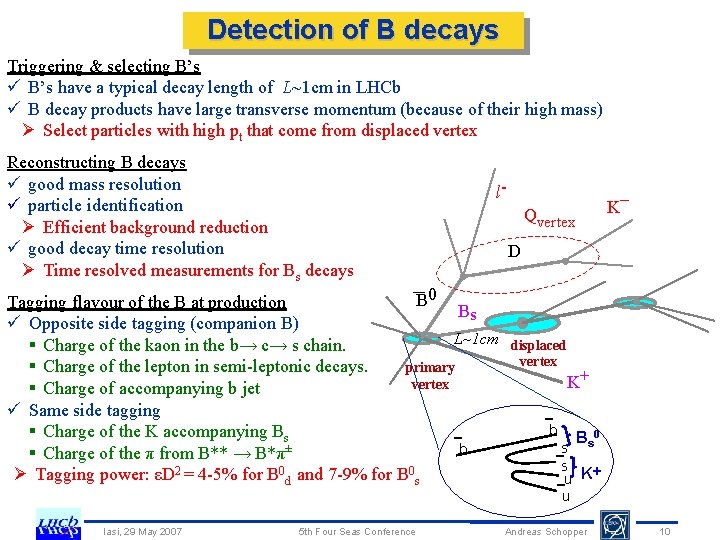
Detection of B decays Triggering & selecting B’s ü B’s have a typical decay length of L~1 cm in LHCb ü B decay products have large transverse momentum (because of their high mass) Ø Select particles with high pt that come from displaced vertex Reconstructing B decays ü good mass resolution ü particle identification Ø Efficient background reduction ü good decay time resolution Ø Time resolved measurements for Bs decays l- B 0 Tagging flavour of the B at production Bs ü Opposite side tagging (companion B) L~1 cm § Charge of the kaon in the b→ c→ s chain. primary § Charge of the lepton in semi-leptonic decays. vertex § Charge of accompanying b jet ü Same side tagging § Charge of the K accompanying Bs b § Charge of the π from B** → B*π± Ø Tagging power: εD 2 = 4 -5% for B 0 d and 7 -9% for B 0 s Iasi, 29 May 2007 5 th Four Seas Conference K– Qvertex D displaced vertex b K+ Bs 0 s s + u K u Andreas Schopper 10
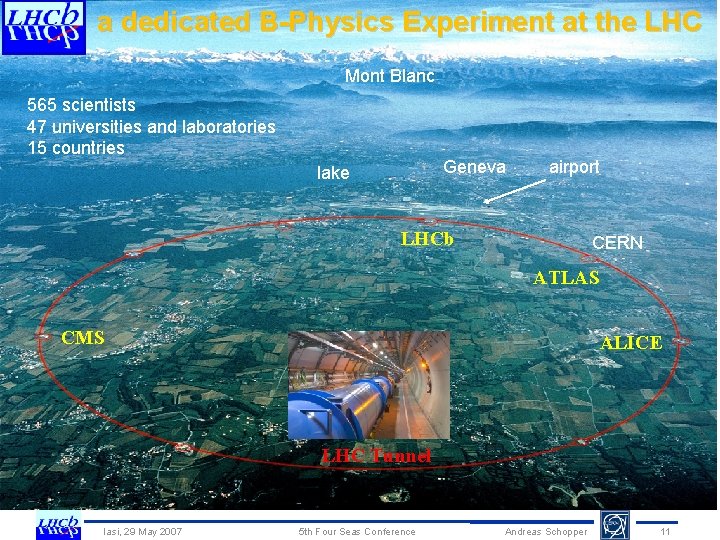
a dedicated B-Physics Experiment at the LHC Mont Blanc 565 scientists 47 universities and laboratories 15 countries Geneva lake airport LHCb CERN ATLAS CMS ALICE LHC Tunnel Iasi, 29 May 2007 5 th Four Seas Conference Andreas Schopper 11
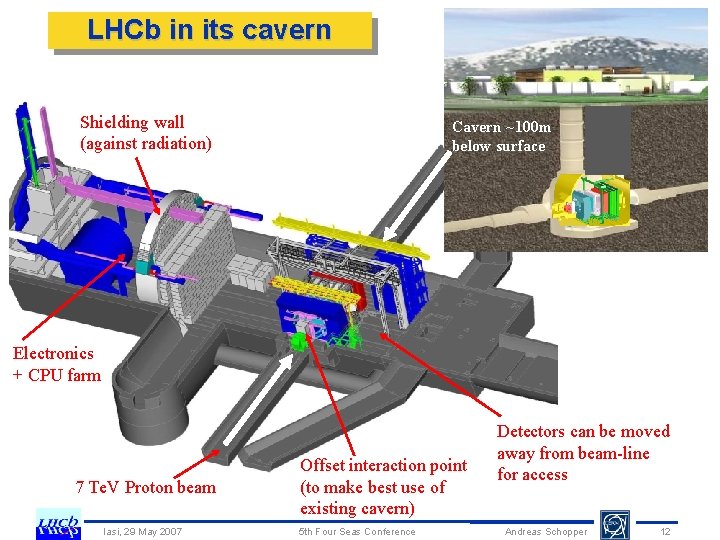
LHCb in its cavern Shielding wall (against radiation) Cavern ~100 m below surface Electronics + CPU farm 7 Te. V Proton beam Iasi, 29 May 2007 Offset interaction point (to make best use of existing cavern) 5 th Four Seas Conference Detectors can be moved away from beam-line for access Andreas Schopper 12
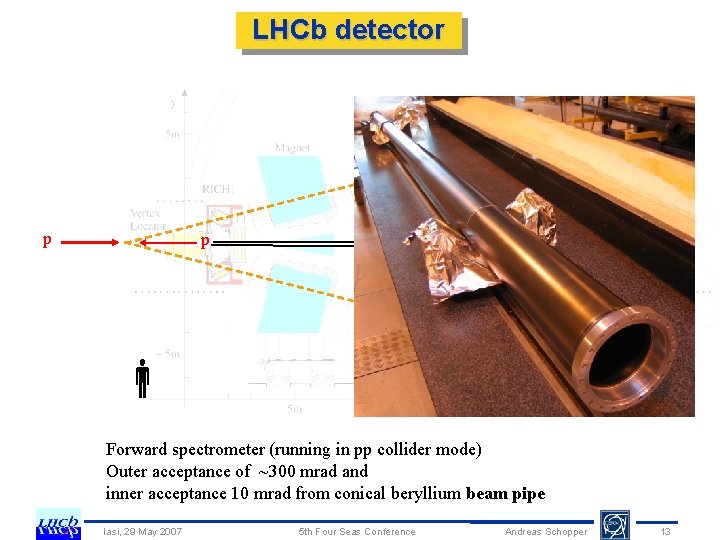
LHCb detector ~ 300 mrad p p 10 mrad Forward spectrometer (running in pp collider mode) Outer acceptance of ~300 mrad and inner acceptance 10 mrad from conical beryllium beam pipe Iasi, 29 May 2007 5 th Four Seas Conference Andreas Schopper 13
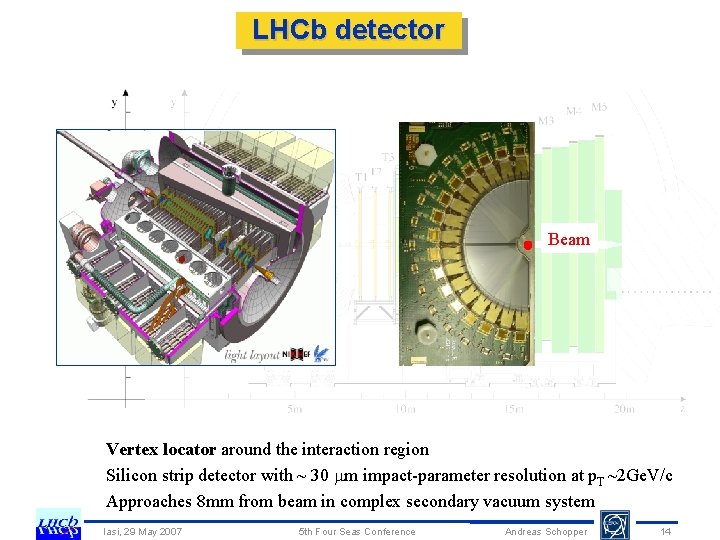
LHCb detector Beam Vertex locator around the interaction region Silicon strip detector with ~ 30 m impact-parameter resolution at p. T ~2 Ge. V/c Approaches 8 mm from beam in complex secondary vacuum system Iasi, 29 May 2007 5 th Four Seas Conference Andreas Schopper 14
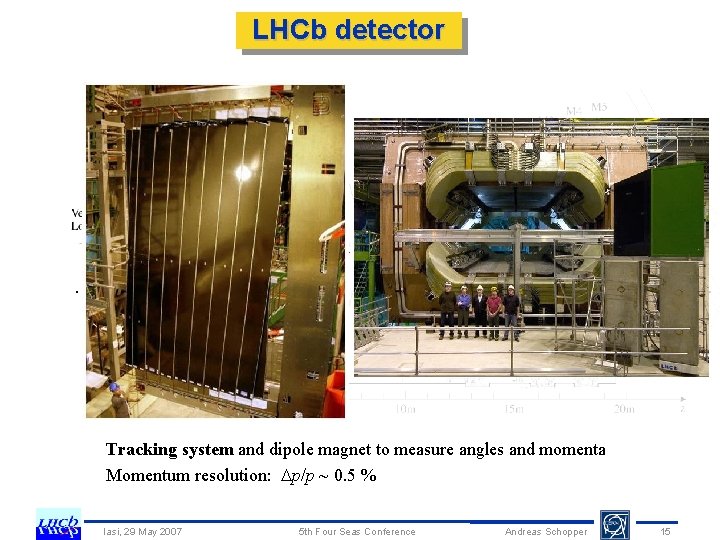
LHCb detector Tracking system and dipole magnet to measure angles and momenta Momentum resolution: p/p ~ 0. 5 % Iasi, 29 May 2007 5 th Four Seas Conference Andreas Schopper 15
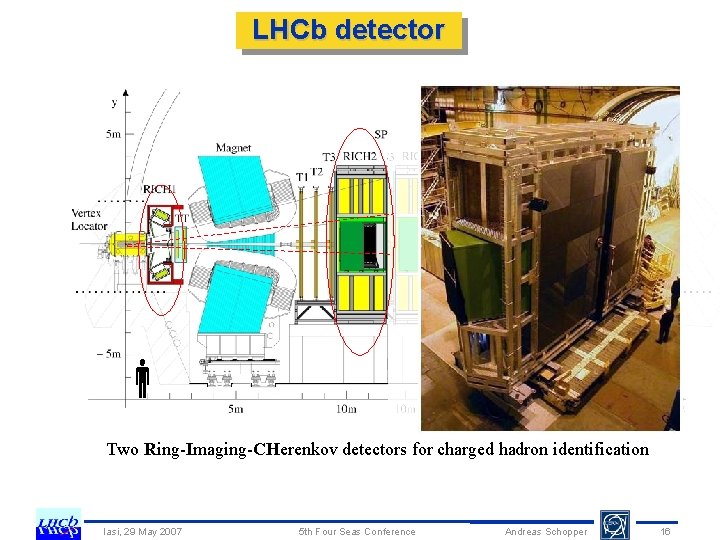
LHCb detector Two Ring-Imaging-CHerenkov detectors for charged hadron identification Iasi, 29 May 2007 5 th Four Seas Conference Andreas Schopper 16
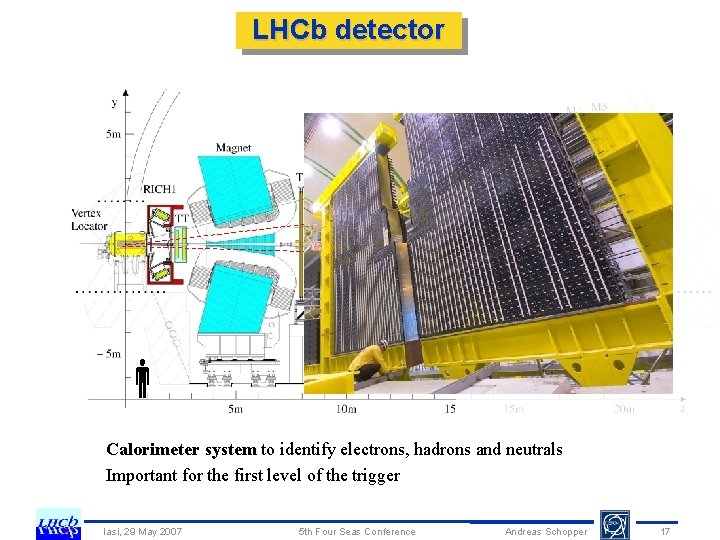
LHCb detector e h Calorimeter system to identify electrons, hadrons and neutrals Important for the first level of the trigger Iasi, 29 May 2007 5 th Four Seas Conference Andreas Schopper 17
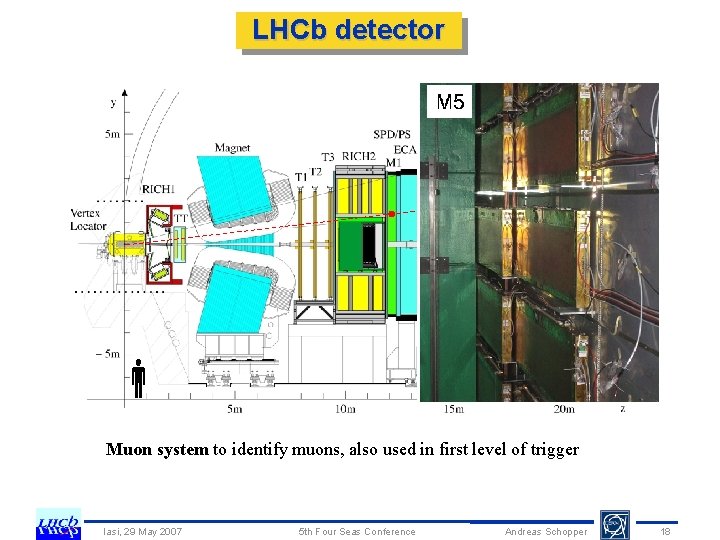
LHCb detector Muon system to identify muons, also used in first level of trigger Iasi, 29 May 2007 5 th Four Seas Conference Andreas Schopper 18
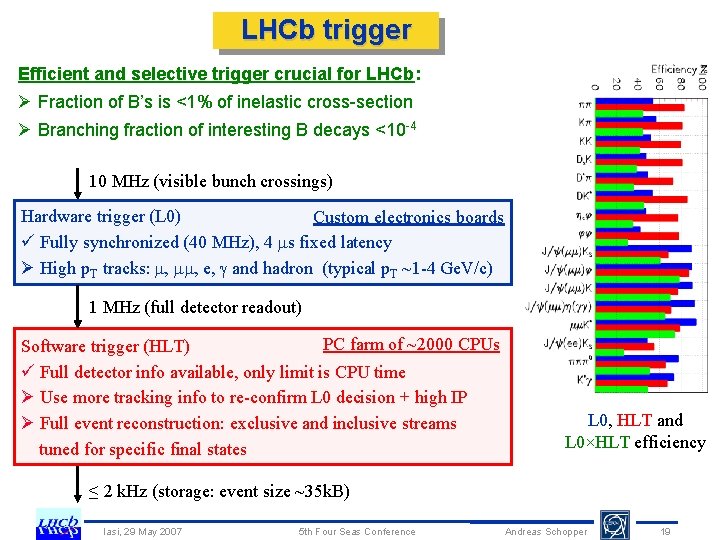
LHCb trigger Efficient and selective trigger crucial for LHCb: Ø Fraction of B’s is <1% of inelastic cross-section Ø Branching fraction of interesting B decays <10 -4 10 MHz (visible bunch crossings) Hardware trigger (L 0) Custom electronics boards ü Fully synchronized (40 MHz), 4 s fixed latency Ø High p. T tracks: , , e, and hadron (typical p. T ~1 -4 Ge. V/c) 1 MHz (full detector readout) PC farm of ~2000 CPUs Software trigger (HLT) ü Full detector info available, only limit is CPU time Ø Use more tracking info to re-confirm L 0 decision + high IP Ø Full event reconstruction: exclusive and inclusive streams tuned for specific final states L 0, HLT and L 0×HLT efficiency ≤ 2 k. Hz (storage: event size ~35 k. B) Iasi, 29 May 2007 5 th Four Seas Conference Andreas Schopper 19
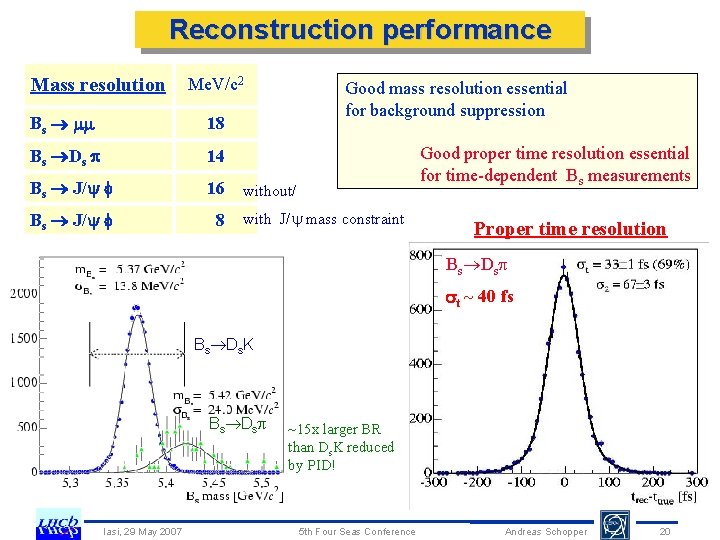
Reconstruction performance Mass resolution Me. V/c 2 Bs 18 Bs Ds 14 Bs J/ 16 Bs J/ 8 Good mass resolution essential for background suppression Good proper time resolution essential for time-dependent Bs measurements without/ with J/ mass constraint Proper time resolution Bs Ds t ~ 40 fs Bs Ds. K Bs Ds Iasi, 29 May 2007 ~15 x larger BR than Ds. K reduced by PID! 5 th Four Seas Conference Andreas Schopper 20
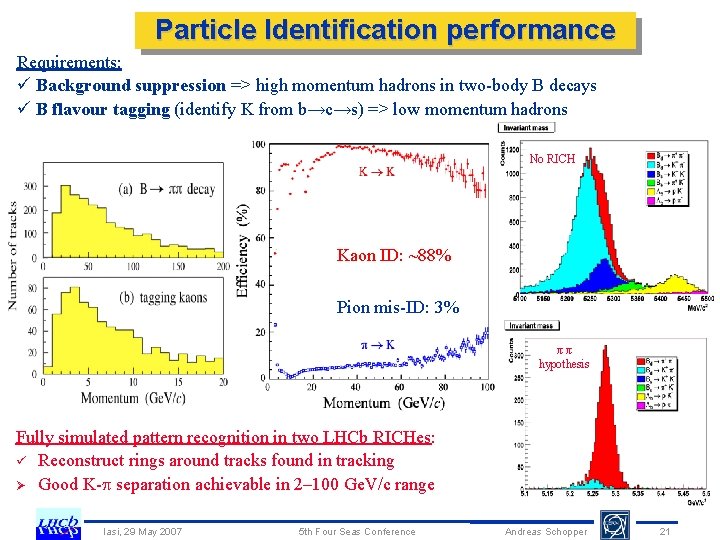
Particle Identification performance Requirements: ü Background suppression => high momentum hadrons in two-body B decays ü B flavour tagging (identify K from b→c→s) => low momentum hadrons No RICH Kaon ID: ~88% Pion mis-ID: 3% ππ hypothesis Fully simulated pattern recognition in two LHCb RICHes: ü Reconstruct rings around tracks found in tracking Ø Good K- separation achievable in 2– 100 Ge. V/c range Iasi, 29 May 2007 5 th Four Seas Conference Andreas Schopper 21
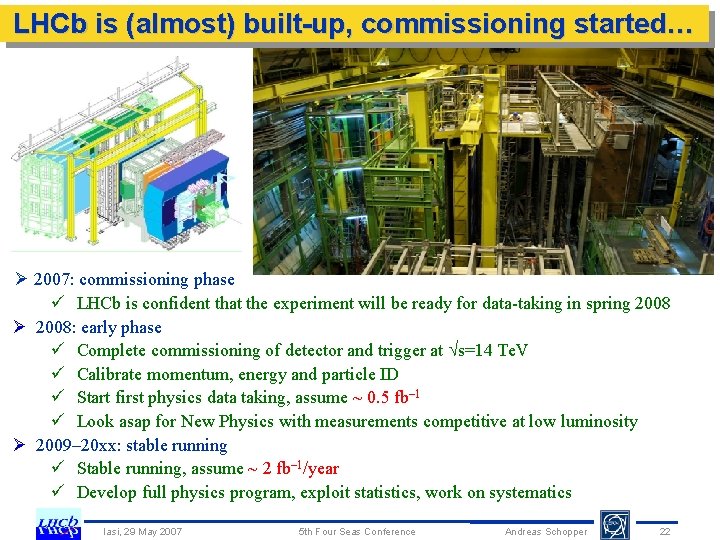
LHCb is (almost) built-up, commissioning started… Ø 2007: commissioning phase ü LHCb is confident that the experiment will be ready for data-taking in spring 2008 Ø 2008: early phase ü Complete commissioning of detector and trigger at s=14 Te. V ü Calibrate momentum, energy and particle ID ü Start first physics data taking, assume ~ 0. 5 fb– 1 ü Look asap for New Physics with measurements competitive at low luminosity Ø 2009– 20 xx: stable running ü Stable running, assume ~ 2 fb– 1/year ü Develop full physics program, exploit statistics, work on systematics Iasi, 29 May 2007 5 th Four Seas Conference Andreas Schopper 22
Expected physics performance (from selected channels) Bs oscillations Ø ms with Bs 0 Ds Bs mixing phase s (=-2 ) Ø from B s J/ (h) Ø from Bs Rare decays Ø B s 0 + Weak decay phase Ø from Bs Ds. K Ø from B D K* (and B± DK±) Ø from B and Bs K K Iasi, 29 May 2007 5 th Four Seas Conference Andreas Schopper 23
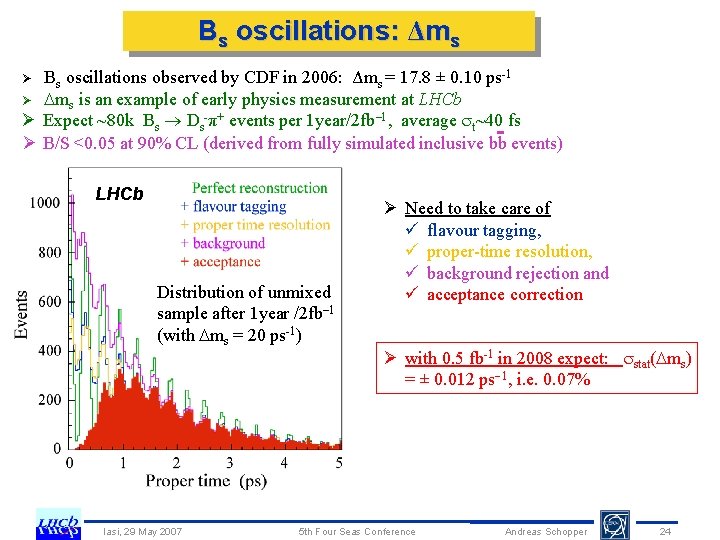
Bs oscillations: Δms Bs oscillations observed by CDF in 2006: Δms = 17. 8 ± 0. 10 ps-1 Ø ms is an example of early physics measurement at LHCb Ø Expect ~80 k Bs Ds-π+ events per 1 year/2 fb– 1, average t~40 fs Ø B/S <0. 05 at 90% CL (derived from fully simulated inclusive bb events) Ø LHCb Distribution of unmixed sample after 1 year /2 fb– 1 (with ms = 20 ps-1) Iasi, 29 May 2007 Ø Need to take care of ü flavour tagging, ü proper-time resolution, ü background rejection and ü acceptance correction Ø with 0. 5 fb-1 in 2008 expect: stat( ms) = ± 0. 012 ps 1, i. e. 0. 07% 5 th Four Seas Conference Andreas Schopper 24
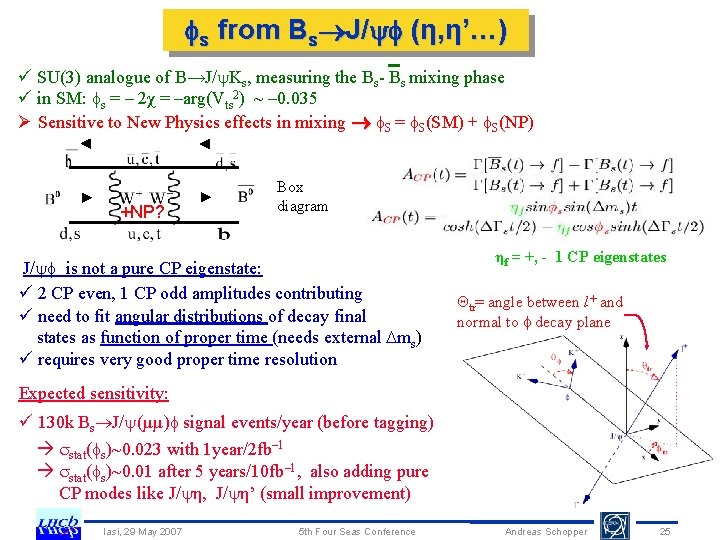
s from Bs J/ (η, η’…) ü SU(3) analogue of B→J/ Ks, measuring the Bs- Bs mixing phase ü in SM: s = – 2χ = –arg(Vts 2) ~ – 0. 035 Ø Sensitive to New Physics effects in mixing S = S(SM) + S(NP) +NP? Box diagram J/ is not a pure CP eigenstate: ü 2 CP even, 1 CP odd amplitudes contributing ü need to fit angular distributions of decay final states as function of proper time (needs external ms) ü requires very good proper time resolution ηf = +, - 1 CP eigenstates Θtr= angle between l+ and normal to decay plane Expected sensitivity: ü 130 k Bs J/ (µµ) signal events/year (before tagging) stat( s)~0. 023 with 1 year/2 fb– 1 stat( s)~0. 01 after 5 years/10 fb– 1, also adding pure CP modes like J/ η, J/ η’ (small improvement) Iasi, 29 May 2007 5 th Four Seas Conference Andreas Schopper 25
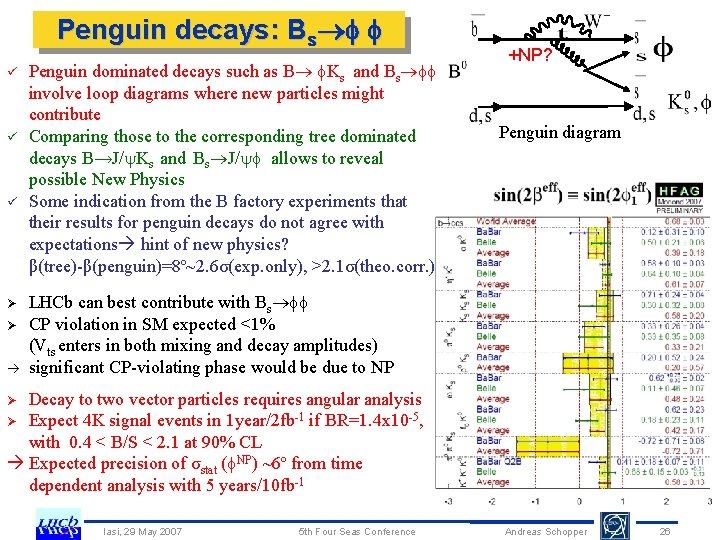
Penguin decays: Bs ü ü ü Ø Ø Penguin dominated decays such as B Ks and Bs involve loop diagrams where new particles might contribute Comparing those to the corresponding tree dominated decays B→J/ Ks and Bs J/ allows to reveal possible New Physics Some indication from the B factory experiments that their results for penguin decays do not agree with expectations hint of new physics? β(tree)-β(penguin)=8º~2. 6σ(exp. only), >2. 1σ(theo. corr. ) +NP? Penguin diagram LHCb can best contribute with Bs CP violation in SM expected <1% (Vts enters in both mixing and decay amplitudes) significant CP-violating phase would be due to NP Decay to two vector particles requires angular analysis Ø Expect 4 K signal events in 1 year/2 fb-1 if BR=1. 4 x 10 -5, with 0. 4 < B/S < 2. 1 at 90% CL Expected precision of σstat ( NP) ~6º from time dependent analysis with 5 years/10 fb-1 Ø Iasi, 29 May 2007 5 th Four Seas Conference Andreas Schopper 26
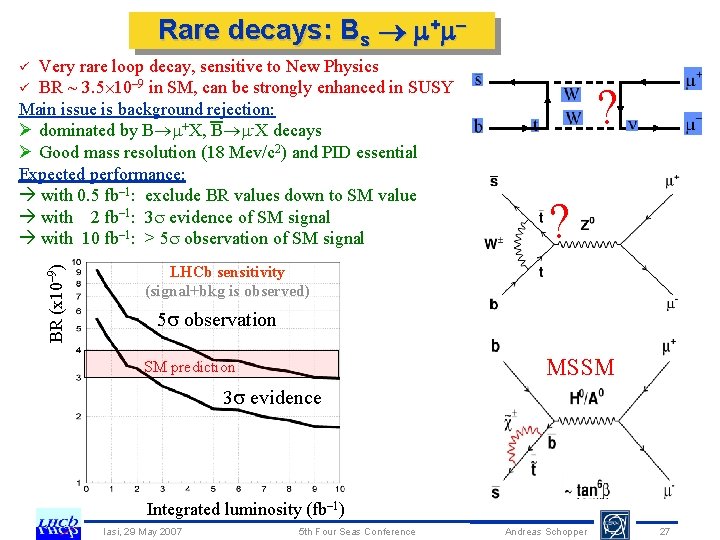
Rare decays: Bs + – Very rare loop decay, sensitive to New Physics ü BR ~ 3. 5 10– 9 in SM, can be strongly enhanced in SUSY Main issue is background rejection: Ø dominated by B +X, B -X decays Ø Good mass resolution (18 Mev/c 2) and PID essential Expected performance: with 0. 5 fb– 1: exclude BR values down to SM value with 2 fb– 1: 3 evidence of SM signal with 10 fb– 1: > 5 observation of SM signal BR (x 10– 9) ü ? ? LHCb sensitivity (signal+bkg is observed) 5 observation MSSM SM prediction 3 evidence Integrated luminosity (fb– 1) Iasi, 29 May 2007 5 th Four Seas Conference Andreas Schopper 27
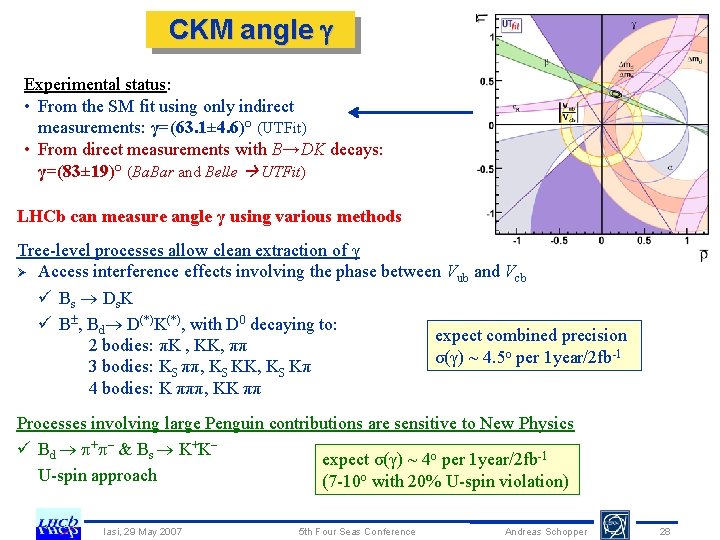
CKM angle Experimental status: • From the SM fit using only indirect measurements: γ=(63. 1± 4. 6)° (UTFit) • From direct measurements with B→DK decays: γ=(83± 19)° (Ba. Bar and Belle UTFit) LHCb can measure angle γ using various methods Tree-level processes allow clean extraction of γ Ø Access interference effects involving the phase between Vub and Vcb ü B s Ds. K ü B , Bd D(*)K(*), with D 0 decaying to: expect combined precision 2 bodies: πK , KK, ππ σ(γ) ~ 4. 5 o per 1 year/2 fb-1 3 bodies: KS ππ, KS KK, KS Kπ 4 bodies: K πππ, KK ππ Processes involving large Penguin contributions are sensitive to New Physics ü B d + – & B s K+ K– expect σ(γ) ~ 4 o per 1 year/2 fb-1 U-spin approach (7 -10 o with 20% U-spin violation) Iasi, 29 May 2007 5 th Four Seas Conference Andreas Schopper 28
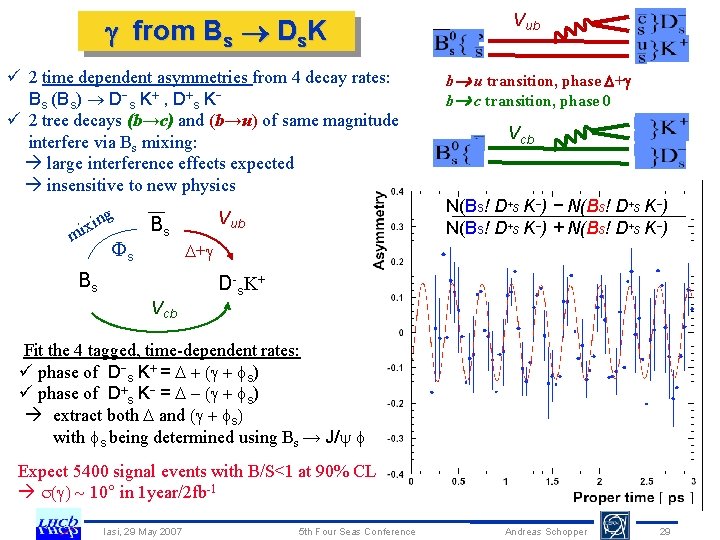
from Bs Ds. K ü 2 time dependent asymmetries from 4 decay rates: Bs (Bs) D s K , D s K ü 2 tree decays (b→c) and (b→u) of same magnitude interfere via Bs mixing: large interference effects expected insensitive to new physics g xin mi Fs b u transition, phase + b c transition, phase 0 Vcb N(Bs! D+s K−) − N(Bs! D+s K−) + N(Bs! D+s K−) Vub Bs Vub + Bs Vcb D-s. K+ Fit the 4 tagged, time-dependent rates: ü phase of D s K = ( s) extract both and ( s) with s being determined using Bs → J/ Expect 5400 signal events with B/S<1 at 90% CL ( ) ~ 10° in 1 year/2 fb-1 Iasi, 29 May 2007 5 th Four Seas Conference Andreas Schopper 29
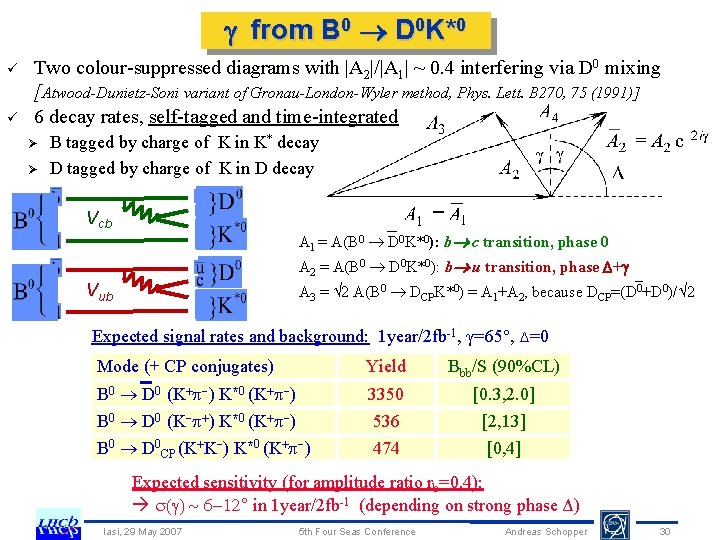
from B 0 D 0 K*0 ü ü Two colour-suppressed diagrams with |A 2|/|A 1| ~ 0. 4 interfering via D 0 mixing [Atwood-Dunietz-Soni variant of Gronau-London-Wyler method, Phys. Lett. B 270, 75 (1991)] 6 decay rates, self-tagged and time-integrated Ø Ø B tagged by charge of K in K* decay D tagged by charge of K in D decay Vcb A 1 = A(B 0 D 0 K*0): b c transition, phase 0 A 2 = A(B 0 D 0 K*0): b u transition, phase + Vub A 3 = 2 A(B 0 DCPK*0) = A 1+A 2, because DCP=(D 0+D 0)/ 2 Expected signal rates and background: 1 year/2 fb-1, γ=65°, Δ=0 Mode (+ CP conjugates) Yield Bbb/S (90%CL) B 0 D 0 (K ) K*0 (K ) 3350 [0. 3, 2. 0] B 0 D 0 (K ) K*0 (K ) B 0 D 0 CP (K K ) K*0 (K ) 536 474 [2, 13] [0, 4] Expected sensitivity (for amplitude ratio rb=0. 4): ( ) ~ 6 12° in 1 year/2 fb-1 (depending on strong phase Δ) Iasi, 29 May 2007 5 th Four Seas Conference Andreas Schopper 30
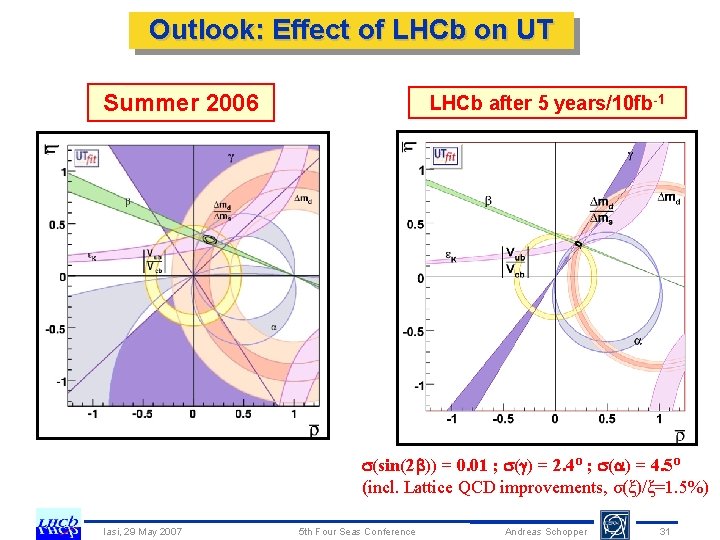
Outlook: Effect of LHCb on UT Summer 2006 LHCb after 5 years/10 fb-1 (sin(2 )) = 0. 01 ; ( ) = 2. 4º ; ( ) = 4. 5º (incl. Lattice QCD improvements, σ(ξ)/ξ=1. 5%) Iasi, 29 May 2007 5 th Four Seas Conference Andreas Schopper 31
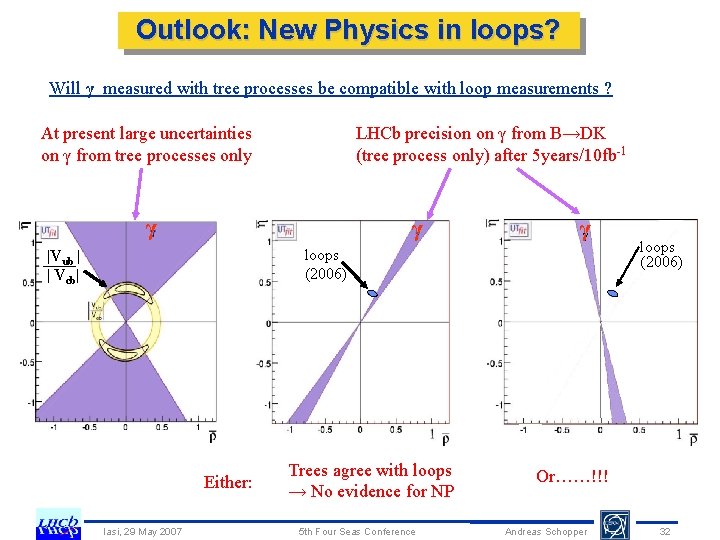
Outlook: New Physics in loops? Will γ measured with tree processes be compatible with loop measurements ? At present large uncertainties on γ from tree processes only LHCb precision on γ from B→DK (tree process only) after 5 years/10 fb-1 γ γ γ loops (2006) |Vub | | Vcb| loops (2006) 32 Either: Iasi, 29 May 2007 Trees agree with loops → No evidence for NP 5 th Four Seas Conference Or……!!! Andreas Schopper 32
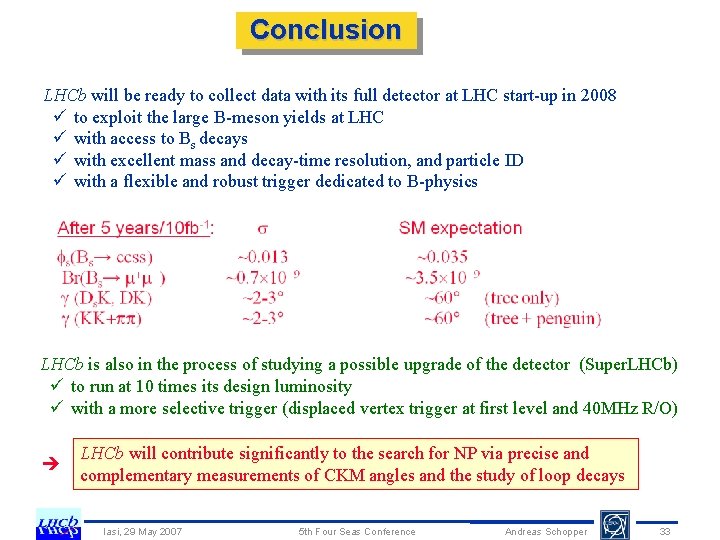
Conclusion LHCb will be ready to collect data with its full detector at LHC start-up in 2008 ü to exploit the large B-meson yields at LHC ü with access to Bs decays ü with excellent mass and decay-time resolution, and particle ID ü with a flexible and robust trigger dedicated to B-physics LHCb is also in the process of studying a possible upgrade of the detector (Super. LHCb) ü to run at 10 times its design luminosity ü with a more selective trigger (displaced vertex trigger at first level and 40 MHz R/O) LHCb will contribute significantly to the search for NP via precise and complementary measurements of CKM angles and the study of loop decays Iasi, 29 May 2007 5 th Four Seas Conference Andreas Schopper 33
- Slides: 33