
Overview of the Instructional Unit Samples Colorados District
- Slides: 35
Overview of the Instructional Unit Samples Colorado’s District Sample Curriculum Project Stephanie Hartman Social Studies Content Specialist, CDE http: //www. cde. state. co. us/standardsandinstruction Office of Standards and Instructional Support
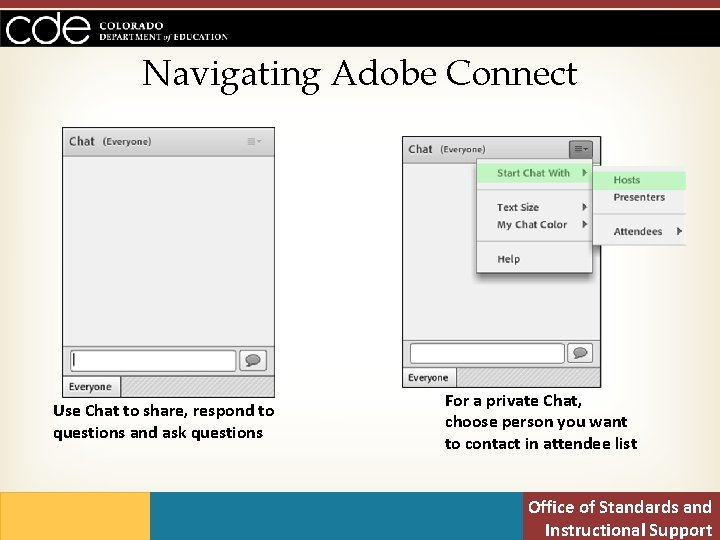
Navigating Adobe Connect Use Chat to share, respond to questions and ask questions For a private Chat, choose person you want to contact in attendee list Office of Standards and Instructional Support
Webinar Goals § During this webinar, we will be using one instructional unit to explore: § § § The processes utilized to create them The components of the units The possible next steps in utilizing these resources § As an introduction to the units, this webinar will not address: § § State summative assessments Educator evaluation § Please feel free to ask questions- I will address them at the end Office of Standards and Instructional Support
Colorado District Sample Curriculum Project Big Picture From its beginning, the District Sample Curriculum Project has had a singular focus: to build the capacity of teachers to use their content expertise and passion for student learning to create samples that support teaching to student mastery of the Colorado Academic Standards. Office of Standards and Instructional Support
Teacher-Authored Samples Curriculum Overviews § 700+ unit overviews- all content areas (k-12) § All samples coded to the Colorado Academic Standards-Ensuring attention to all Evidence Outcomes (indicators of mastery) § Teacher/educator authorship and district affiliation noted at the bottom of every unit overview § Samples available in PDF and Word formats on the Standards and Instructional Support website-by individual content area and grade level § Videos detailing specific aspects of the unit overviews available as a resource § Each sample provides an option for standards-based planning that emphasizes what students should understand, know, and be able to do at the end of a given unit of instruction Office of Standards and Instructional Support
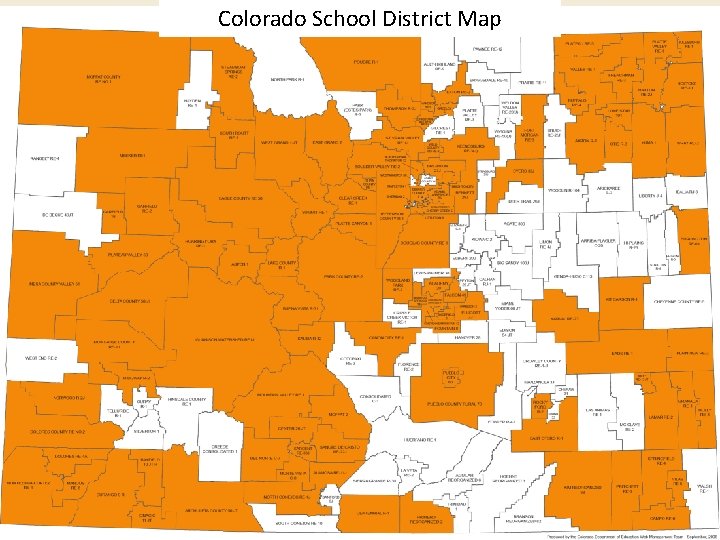
Colorado School District Map
Office of Standards and Instructional Support
Office of Standards and Instructional Support
Office of Standards and Instructional Support
Office of Standards and Instructional Support
Office of Standards and Instructional Support
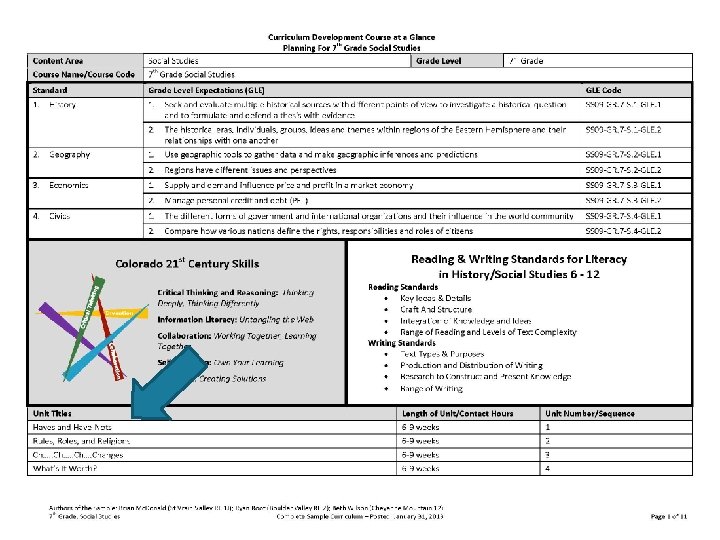
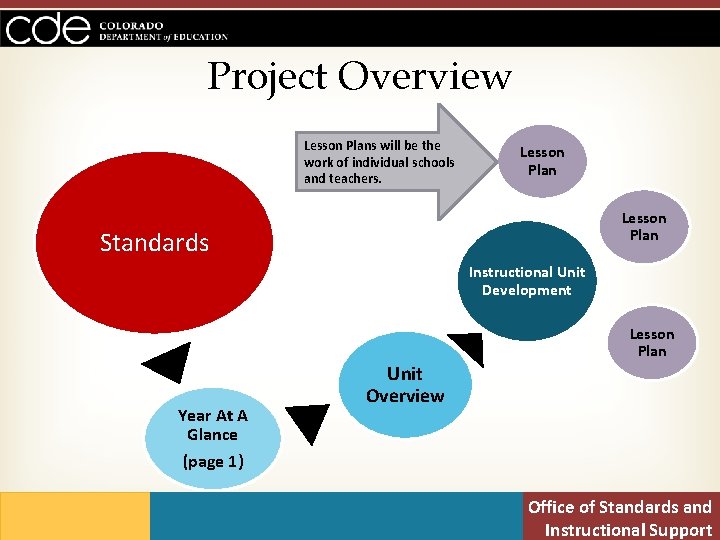
Project Overview Lesson Plans will be the work of individual schools and teachers. Lesson Plan Standards Instructional Unit Development Lesson Plan Year At A Glance Unit Overview (page 1) Office of Standards and Instructional Support
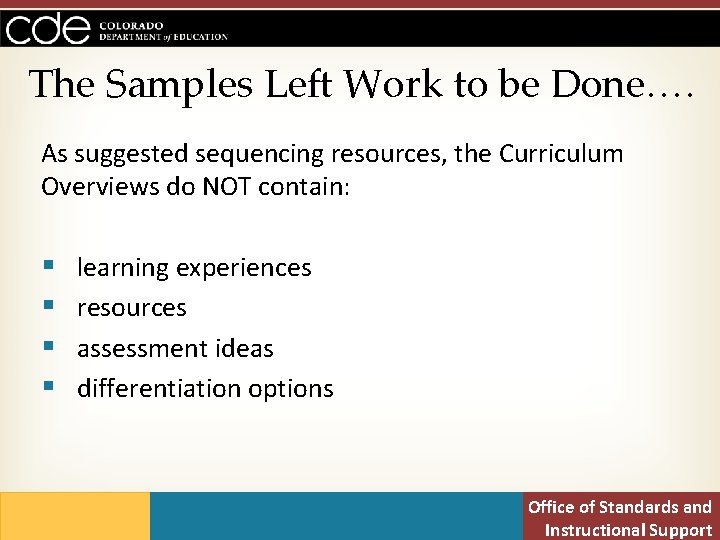
The Samples Left Work to be Done…. As suggested sequencing resources, the Curriculum Overviews do NOT contain: § § learning experiences resources assessment ideas differentiation options Office of Standards and Instructional Support
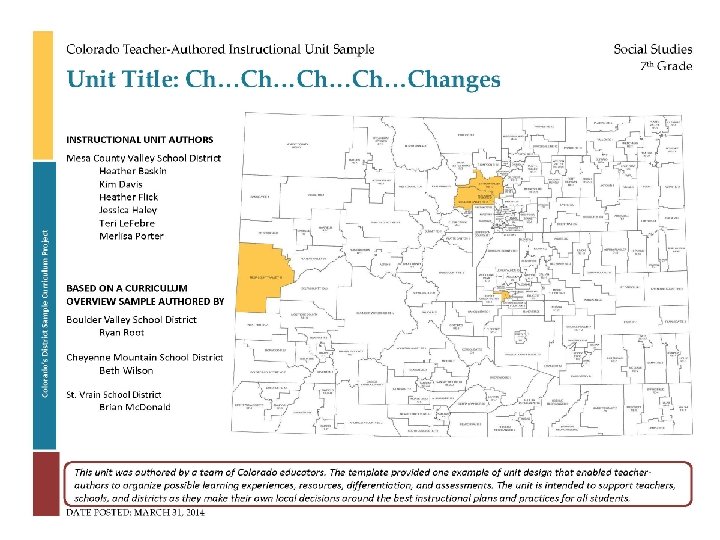
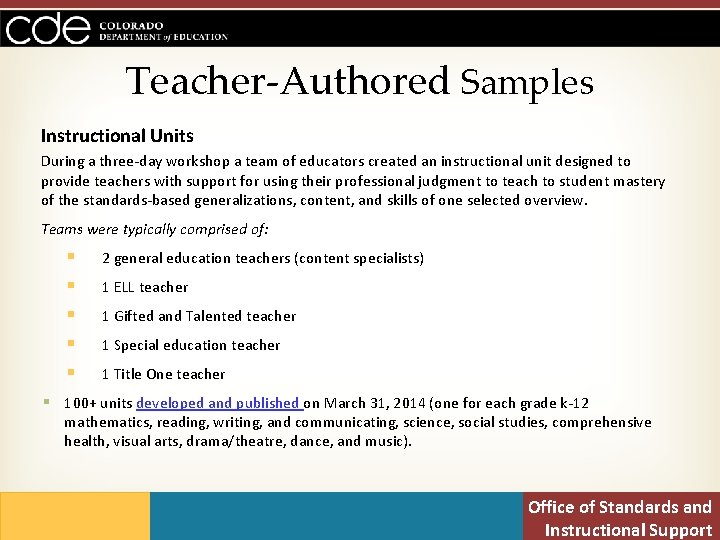
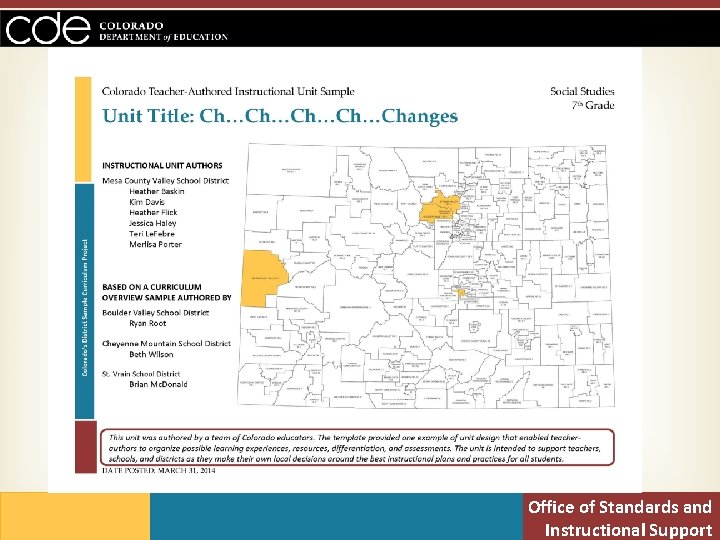
Teacher-Authored Samples Instructional Units During a three-day workshop a team of educators created an instructional unit designed to provide teachers with support for using their professional judgment to teach to student mastery of the standards-based generalizations, content, and skills of one selected overview. Teams were typically comprised of: § § § 2 general education teachers (content specialists) 1 ELL teacher 1 Gifted and Talented teacher 1 Special education teacher 1 Title One teacher § 100+ units developed and published on March 31, 2014 (one for each grade k-12 mathematics, reading, writing, and communicating, science, social studies, comprehensive health, visual arts, drama/theatre, dance, and music). Office of Standards and Instructional Support
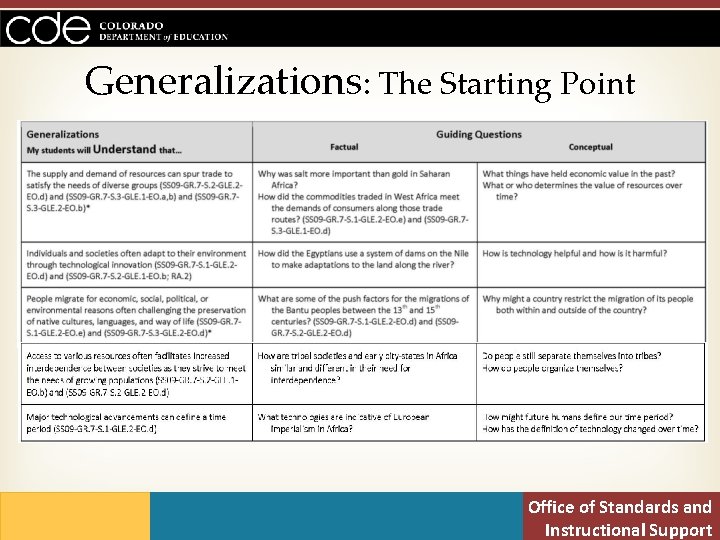
Generalizations: The Starting Point Office of Standards and Instructional Support
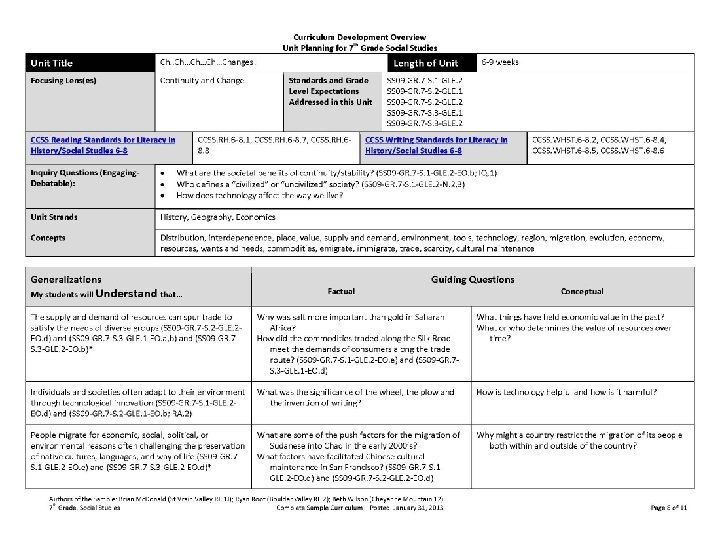
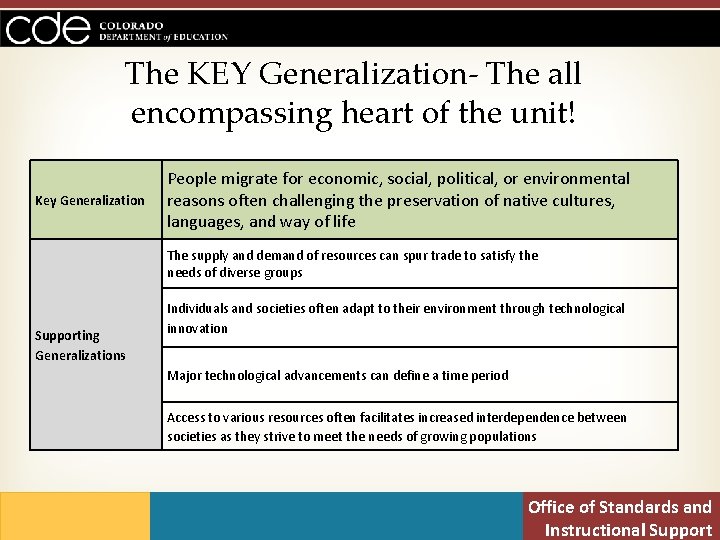
The KEY Generalization- The all encompassing heart of the unit! Key Generalization People migrate for economic, social, political, or environmental reasons often challenging the preservation of native cultures, languages, and way of life The supply and demand of resources can spur trade to satisfy the needs of diverse groups Supporting Generalizations Individuals and societies often adapt to their environment through technological innovation Major technological advancements can define a time period Access to various resources often facilitates increased interdependence between societies as they strive to meet the needs of growing populations Office of Standards and Instructional Support
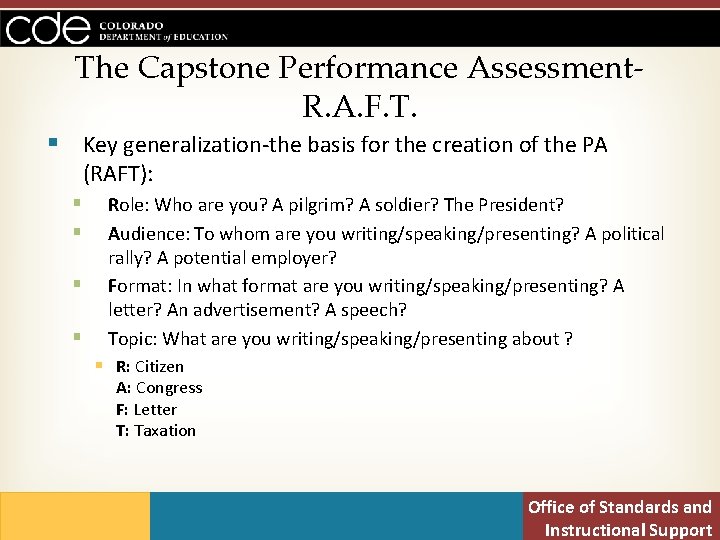
The Capstone Performance Assessment. R. A. F. T. § Key generalization-the basis for the creation of the PA (RAFT): § § Role: Who are you? A pilgrim? A soldier? The President? Audience: To whom are you writing/speaking/presenting? A political rally? A potential employer? Format: In what format are you writing/speaking/presenting? A letter? An advertisement? A speech? Topic: What are you writing/speaking/presenting about ? § R: Citizen A: Congress F: Letter T: Taxation Office of Standards and Instructional Support
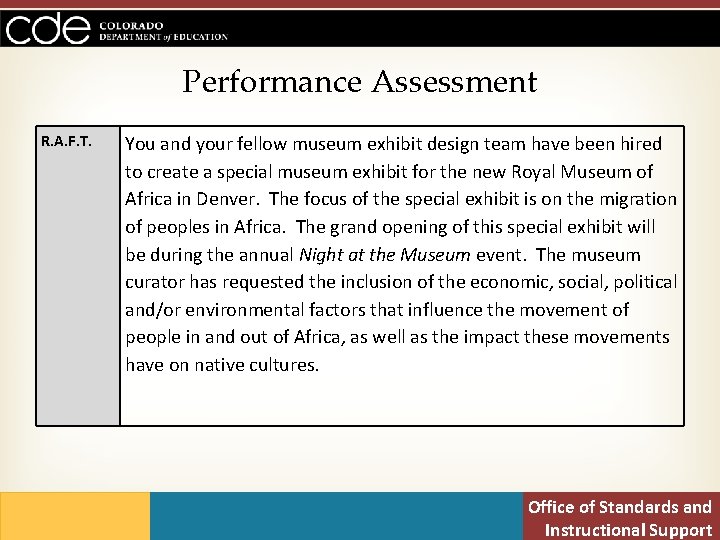
Performance Assessment R. A. F. T. You and your fellow museum exhibit design team have been hired to create a special museum exhibit for the new Royal Museum of Africa in Denver. The focus of the special exhibit is on the migration of peoples in Africa. The grand opening of this special exhibit will be during the annual Night at the Museum event. The museum curator has requested the inclusion of the economic, social, political and/or environmental factors that influence the movement of people in and out of Africa, as well as the impact these movements have on native cultures. Office of Standards and Instructional Support
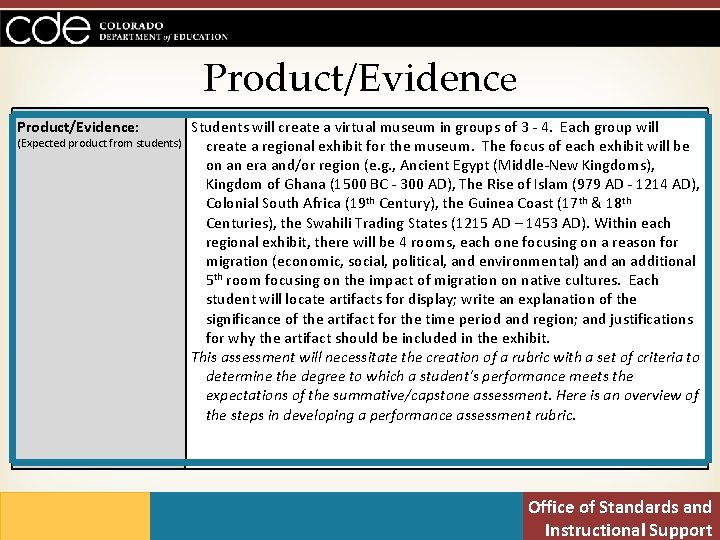
Product/Evidence Performance Assessment: The capstone/summative assessment for this unit. Product/Evidence: Claims: (Expected product from students) (Key generalization(s) to be mastered and demonstrated through the capstone assessment. ) Stimulus Material: (Engaging scenario that includes role, audience, goal/outcome and explicitly connects the key generalization) Product/Evidence: (Expected product from students) Differentiation: (Multiple modes for student expression) Students will create a virtual museum in groups of 3 - 4. Each group will create a regional exhibit for the museum. The focus of each exhibit will be on an era and/or region (e. g. , Ancient Egypt (Middle-New Kingdoms), You and your fellow museum exhibit design team have been hired to create a special museum exhibit for the new Royal Museum of Africa in Denver. The focus of the special exhibit is on the migration of peoples in Africa. The grand opening of this special exhibit will be Kingdom of Ghana (1500 BC - 300 AD), The Rise of Islam (979 AD - 1214 AD), during the annual Night at the Museum event. The museum curator has requested the inclusion of the economic, social, political and/or environmental factors that influence the movement of people in and out of Africa, as well as the impact these movements have on Colonial South Africa (19 th Century), the Guinea Coast (17 th & 18 th native cultures. Centuries), the Swahili Trading States (1215 AD – 1453 AD). Within each Students will create a virtual museum in groups of 3 - 4. Each group will create a regional exhibit, there will be 4 rooms, each one focusing on a reason for exhibit for the museum. The focus of each exhibit will be on an era and/or region (e. g. , migration (economic, social, political, and environmental) and an additional Ancient Egypt (Middle-New Kingdoms), Kingdom of Ghana (1500 BC - 300 AD), The Rise 5 th room focusing on the impact of migration on native cultures. Each of Islam (979 AD - 1214 AD), Colonial South Africa (19 th Century), the Guinea Coast (17 th student will locate artifacts for display; write an explanation of the th Centuries), the Swahili Trading States (1215 AD – 1453 AD). Within each regional & 18 significance of the artifact for the time period and region; and justifications exhibit, there will be 4 rooms, each one focusing on a reason for migration (economic, th room focusing on the impact for why the artifact should be included in the exhibit. social, political, and environmental) and an additional 5 of migration on native cultures. Each student will locate artifacts for display; write an This assessment will necessitate the creation of a rubric with a set of criteria to explanation of the significance of the artifact for the time period and region; and determine the degree to which a student's performance meets the justifications for why the artifact should be included in the exhibit. expectations of the summative/capstone assessment. Here is an overview of Students may develop their own virtual museum template or use one provided by the teacher. Students may the steps in developing a performance assessment rubric. People migrate for economic, social, political, or environmental reasons often challenging the preservation of native cultures, languages, and way of life. choose to create a museum exhibit on poster board. http: //christykeeler. com/Educational. Virtual. Museums. html (How to create Virtual Museums Using Power. Point) http: //www. timemaps. com/history/africa-1453 ad (World History Maps: Africa History Timeline through Maps) Office of Standards and Instructional Support
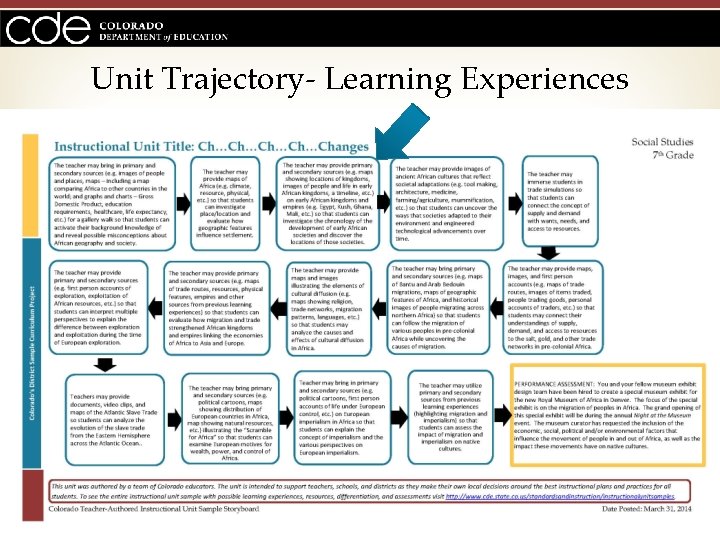
Unit Trajectory- Learning Experiences Office of Standards and Instructional Support
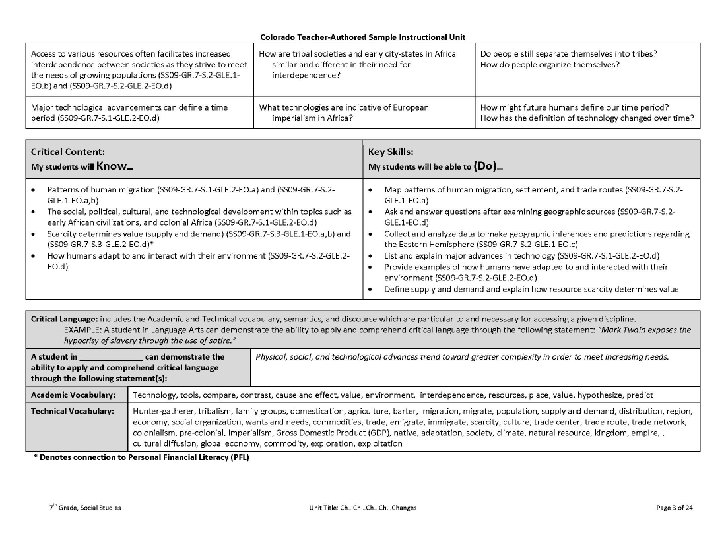
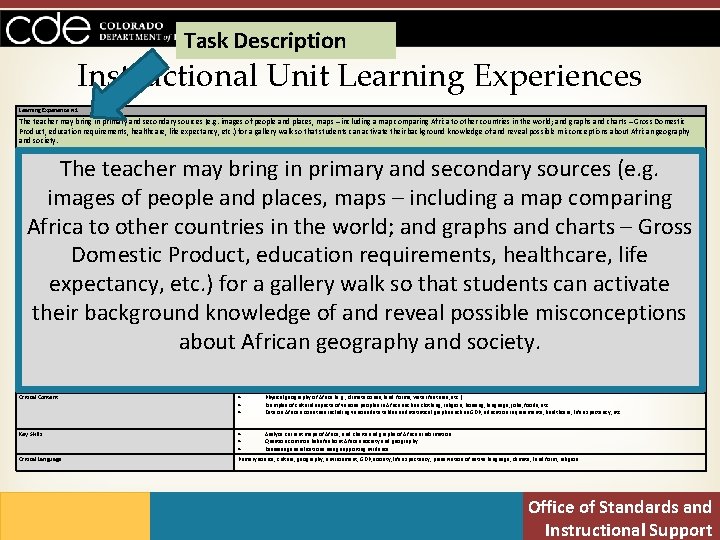
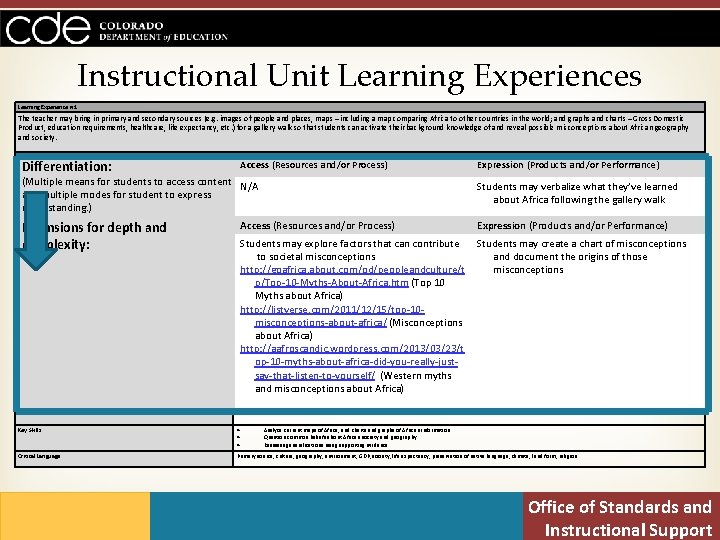
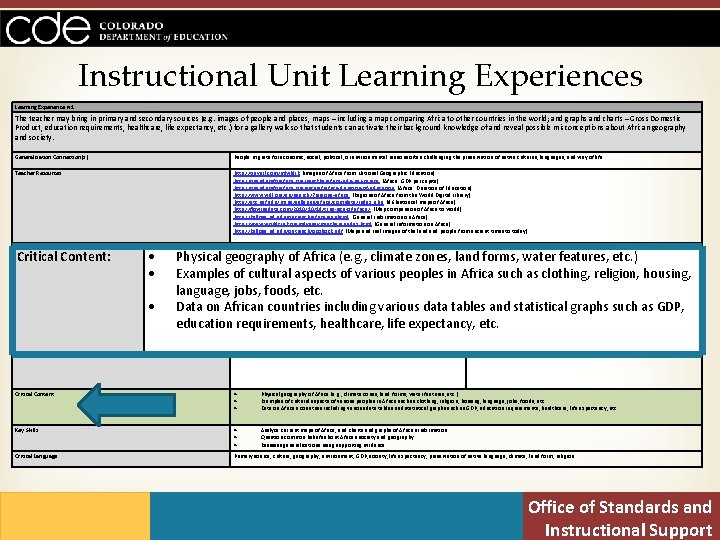
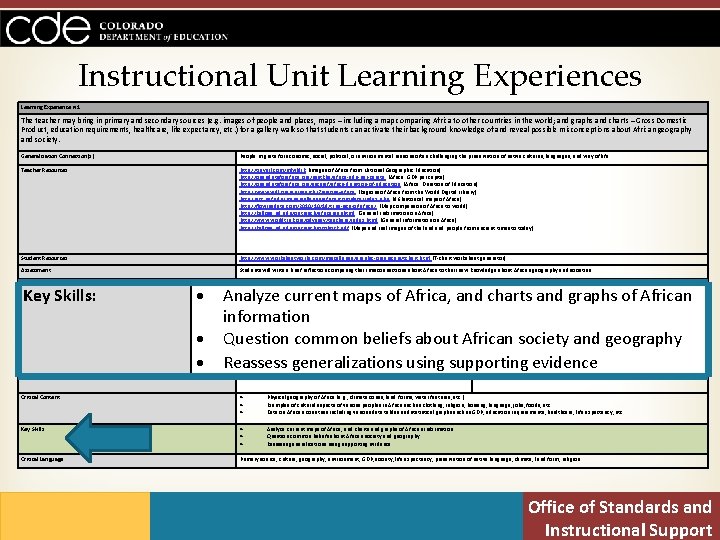
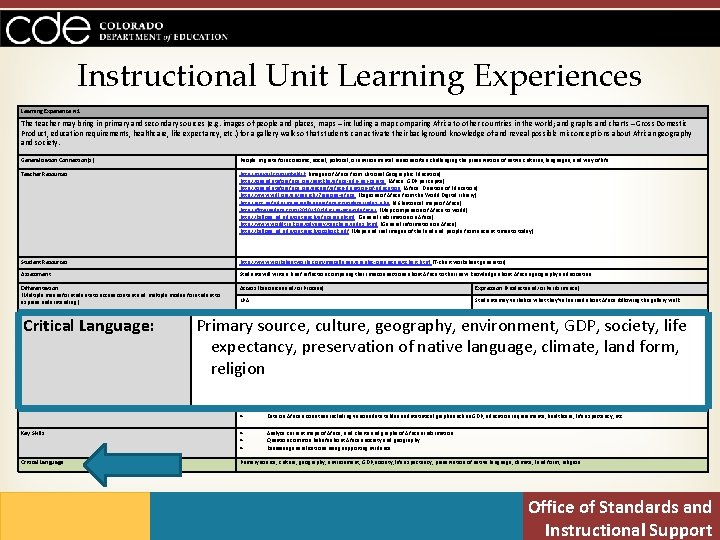
Task Description Instructional Unit Learning Experiences Learning Experience # 1 The teacher may bring in primary and secondary sources (e. g. images of people and places, maps – including a map comparing Africa to other countries in the world; and graphs and charts – Gross Domestic Product, education requirements, healthcare, life expectancy, etc. ) for a gallery walk so that students can activate their background knowledge of and reveal possible misconceptions about African geography and society. The teacher may bring in primary and secondary sources (e. g. images of people and places, maps – including a map comparing Africa to other countries in the world; and graphs and charts – Gross Domestic Product, education requirements, healthcare, life expectancy, etc. ) for a gallery walk so that students can activate their background knowledge of and reveal possible misconceptions about African geography and society. Generalization Connection(s): People migrate for economic, social, political, or environmental reasons often challenging the preservation of native cultures, languages, and way of life Teacher Resources: http: //tinyurl. com/mlwldjk (Images of Africa from National Geographic Education) http: //opendataforafrica. org/ngstkbe/africa-gdp-per-capita (Africa: GDP per capita) http: //opendataforafrica. org/spcesjf/africa-duration-of-education (Africa: Duration of Education) http: //www. wdl. org/en/search/? regions=africa (Regions of Africa from the World Digital Library) http: //etc. usf. edu/maps/galleries/africa/complete/index. php (86 historical maps of Africa) http: //flowingdata. com/2010/10/18/true-size-of-africa/ (Map comparison of Africa to world) http: //kellogg. nd. edu/outreach/africares. shtml (General Information on Africa) http: //www. worldtrek. org/odyssey/teachers/index. html (General Information on Africa) http: //kellogg. nd. edu/outreach/ocobock. pdf (Maps and real images of the land people from ancient times to today) Student Resources: http: //www. worksheetworks. com/miscellanea/graphic-organizers/tchart. html (T-chart worksheet generator) Assessment: Students will write a brief reflection comparing their misconnections about Africa to their new knowledge about African geography and societies. Differentiation: (Multiple means for students to access content and multiple modes for student to express understanding. ) Access (Resources and/or Process) Expression (Products and/or Performance) N/A Students may verbalize what they’ve learned about Africa following the gallery walk Access (Resources and/or Process) Expression (Products and/or Performance) Extensions for depth and complexity: Students may explore factors that can contribute to societal misconceptions Students may create a chart of misconceptions and document the origins of those http: //goafrica. about. com/od/peopleandculture/tp/Top-10 -Myths-About-Africa. htm (Top 10 misconceptions Myths about Africa) http: //listverse. com/2011/12/15/top-10 -misconceptions-about-africa/ (Misconceptions about Africa) http: //aafroscandic. wordpress. com/2013/03/23/top-10 -myths-about-africa-did-you-reallyjust-say-that-listen-to-yourself/ (Western myths and misconceptions about Africa) Critical Content: Physical geography of Africa (e. g. , climate zones, land forms, water features, etc. ) Examples of cultural aspects of various peoples in Africa such as clothing, religion, housing, language, jobs, foods, etc. Data on African countries including various data tables and statistical graphs such as GDP, education requirements, healthcare, life expectancy, etc. Key Skills: Analyze current maps of Africa, and charts and graphs of African information Question common beliefs about African society and geography Reassess generalizations using supporting evidence Critical Language: Primary source, culture, geography, environment, GDP, society, life expectancy, preservation of native language, climate, land form, religion Office of Standards and Instructional Support
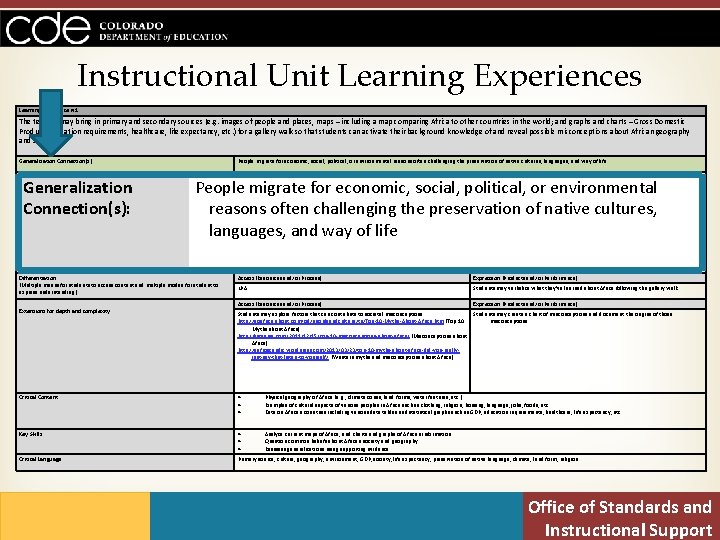
Instructional Unit Learning Experiences Learning Experience # 1 The teacher may bring in primary and secondary sources (e. g. images of people and places, maps – including a map comparing Africa to other countries in the world; and graphs and charts – Gross Domestic Product, education requirements, healthcare, life expectancy, etc. ) for a gallery walk so that students can activate their background knowledge of and reveal possible misconceptions about African geography and society. Generalization Connection(s): People migrate for economic, social, political, or environmental reasons often challenging the preservation of native cultures, languages, and way of life Teacher Resources: http: //tinyurl. com/mlwldjk (Images of Africa from National Geographic Education) http: //opendataforafrica. org/ngstkbe/africa-gdp-per-capita (Africa: GDP per capita) http: //opendataforafrica. org/spcesjf/africa-duration-of-education (Africa: Duration of Education) http: //www. wdl. org/en/search/? regions=africa (Regions of Africa from the World Digital Library) http: //etc. usf. edu/maps/galleries/africa/complete/index. php (86 historical maps of Africa) http: //flowingdata. com/2010/10/18/true-size-of-africa/ (Map comparison of Africa to world) http: //kellogg. nd. edu/outreach/africares. shtml (General Information on Africa) http: //www. worldtrek. org/odyssey/teachers/index. html (General Information on Africa) http: //kellogg. nd. edu/outreach/ocobock. pdf (Maps and real images of the land people from ancient times to today) Generalization Connection(s): People migrate for economic, social, political, or environmental reasons often challenging the preservation of native cultures, languages, and way of life Student Resources: http: //www. worksheetworks. com/miscellanea/graphic-organizers/tchart. html (T-chart worksheet generator) Assessment: Students will write a brief reflection comparing their misconnections about Africa to their new knowledge about African geography and societies. Differentiation: (Multiple means for students to access content and multiple modes for student to express understanding. ) Access (Resources and/or Process) Expression (Products and/or Performance) N/A Students may verbalize what they’ve learned about Africa following the gallery walk Access (Resources and/or Process) Expression (Products and/or Performance) Extensions for depth and complexity: Students may explore factors that can contribute to societal misconceptions Students may create a chart of misconceptions and document the origins of those http: //goafrica. about. com/od/peopleandculture/tp/Top-10 -Myths-About-Africa. htm (Top 10 misconceptions Myths about Africa) http: //listverse. com/2011/12/15/top-10 -misconceptions-about-africa/ (Misconceptions about Africa) http: //aafroscandic. wordpress. com/2013/03/23/top-10 -myths-about-africa-did-you-reallyjust-say-that-listen-to-yourself/ (Western myths and misconceptions about Africa) Critical Content: Physical geography of Africa (e. g. , climate zones, land forms, water features, etc. ) Examples of cultural aspects of various peoples in Africa such as clothing, religion, housing, language, jobs, foods, etc. Data on African countries including various data tables and statistical graphs such as GDP, education requirements, healthcare, life expectancy, etc. Key Skills: Analyze current maps of Africa, and charts and graphs of African information Question common beliefs about African society and geography Reassess generalizations using supporting evidence Critical Language: Primary source, culture, geography, environment, GDP, society, life expectancy, preservation of native language, climate, land form, religion Office of Standards and Instructional Support
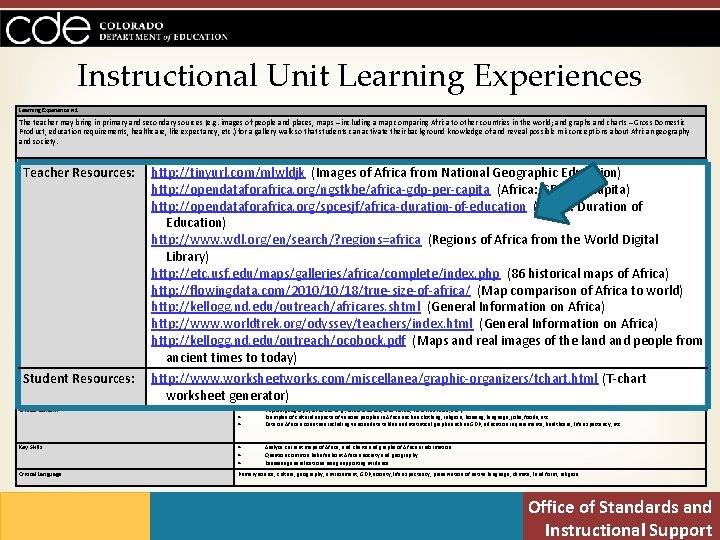
Instructional Unit Learning Experiences Learning Experience # 1 The teacher may bring in primary and secondary sources (e. g. images of people and places, maps – including a map comparing Africa to other countries in the world; and graphs and charts – Gross Domestic Product, education requirements, healthcare, life expectancy, etc. ) for a gallery walk so that students can activate their background knowledge of and reveal possible misconceptions about African geography and society. Generalization Connection(s): Teacher Resources: People migrate for economic, social, political, or environmental reasons often challenging the preservation of native cultures, languages, and way of life http: //tinyurl. com/mlwldjk (Images of Africa from National Geographic Education) http: //opendataforafrica. org/ngstkbe/africa-gdp-per-capita (Africa: GDP per capita) http: //opendataforafrica. org/spcesjf/africa-duration-of-education (Africa: Duration of Education) http: //www. wdl. org/en/search/? regions=africa (Regions of Africa from the World Digital Library) http: //etc. usf. edu/maps/galleries/africa/complete/index. php (86 historical maps of Africa) http: //opendataforafrica. org/spcesjf/africa-duration-of-education (Africa: Duration of http: //flowingdata. com/2010/10/18/true-size-of-africa/ (Map comparison of Africa to world) Education) http: //kellogg. nd. edu/outreach/africares. shtml (General Information on Africa) http: //www. worldtrek. org/odyssey/teachers/index. html (General Information on Africa) http: //kellogg. nd. edu/outreach/ocobock. pdf (Maps and real images of the land people from ancient times to today) http: //www. wdl. org/en/search/? regions=africa (Regions of Africa from the World Digital Student Resources: http: //www. worksheetworks. com/miscellanea/graphic-organizers/tchart. html (T-chart worksheet generator) Library) Assessment: Students will write a brief reflection comparing their misconnections about Africa to their new knowledge about African geography and societies. http: //etc. usf. edu/maps/galleries/africa/complete/index. php (86 historical maps of Africa) Differentiation: Access (Resources and/or Process) Expression (Products and/or Performance) (Multiple means for students to access content and multiple modes for student to http: //flowingdata. com/2010/10/18/true-size-of-africa/ (Map comparison of Africa to world) N/A Students may verbalize what they’ve learned about Africa following the gallery walk express understanding. ) http: //kellogg. nd. edu/outreach/africares. shtml (General Information on Africa) Access (Resources and/or Process) Expression (Products and/or Performance) Extensions for depth and complexity: Students may explore factors that can contribute to societal misconceptions Students may create a chart of misconceptions and document the origins of those http: //www. worldtrek. org/odyssey/teachers/index. html (General Information on Africa) http: //goafrica. about. com/od/peopleandculture/tp/Top-10 -Myths-About-Africa. htm (Top 10 misconceptions Myths about Africa) http: //kellogg. nd. edu/outreach/ocobock. pdf (Maps and real images of the land people from http: //listverse. com/2011/12/15/top-10 -misconceptions-about-africa/ (Misconceptions about Africa) http: //aafroscandic. wordpress. com/2013/03/23/top-10 -myths-about-africa-did-you-reallyancient times to today) just-say-that-listen-to-yourself/ (Western myths and misconceptions about Africa) Student Resources: http: //www. worksheetworks. com/miscellanea/graphic-organizers/tchart. html (T-chart worksheet generator) Critical Content: Physical geography of Africa (e. g. , climate zones, land forms, water features, etc. ) Examples of cultural aspects of various peoples in Africa such as clothing, religion, housing, language, jobs, foods, etc. Data on African countries including various data tables and statistical graphs such as GDP, education requirements, healthcare, life expectancy, etc. Key Skills: Analyze current maps of Africa, and charts and graphs of African information Question common beliefs about African society and geography Reassess generalizations using supporting evidence Critical Language: Primary source, culture, geography, environment, GDP, society, life expectancy, preservation of native language, climate, land form, religion Office of Standards and Instructional Support
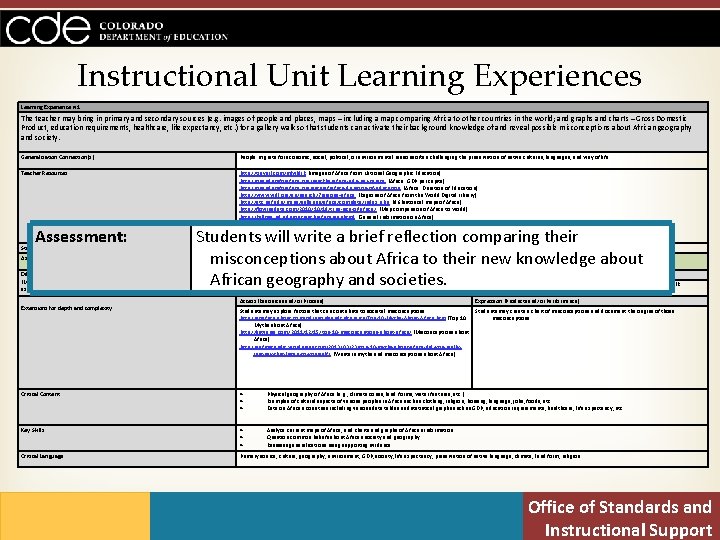
Instructional Unit Learning Experiences Learning Experience # 1 The teacher may bring in primary and secondary sources (e. g. images of people and places, maps – including a map comparing Africa to other countries in the world; and graphs and charts – Gross Domestic Product, education requirements, healthcare, life expectancy, etc. ) for a gallery walk so that students can activate their background knowledge of and reveal possible misconceptions about African geography and society. Generalization Connection(s): People migrate for economic, social, political, or environmental reasons often challenging the preservation of native cultures, languages, and way of life Teacher Resources: http: //tinyurl. com/mlwldjk (Images of Africa from National Geographic Education) http: //opendataforafrica. org/ngstkbe/africa-gdp-per-capita (Africa: GDP per capita) http: //opendataforafrica. org/spcesjf/africa-duration-of-education (Africa: Duration of Education) http: //www. wdl. org/en/search/? regions=africa (Regions of Africa from the World Digital Library) http: //etc. usf. edu/maps/galleries/africa/complete/index. php (86 historical maps of Africa) http: //flowingdata. com/2010/10/18/true-size-of-africa/ (Map comparison of Africa to world) http: //kellogg. nd. edu/outreach/africares. shtml (General Information on Africa) http: //www. worldtrek. org/odyssey/teachers/index. html (General Information on Africa) http: //kellogg. nd. edu/outreach/ocobock. pdf (Maps and real images of the land people from ancient times to today) Assessment: Student Resources: Assessment: Students will write a brief reflection comparing their misconceptions about Africa to their new knowledge about African geography and societies. Differentiation: (Multiple means for students to access content and multiple modes for student to express understanding. ) Extensions for depth and complexity: http: //www. worksheetworks. com/miscellanea/graphic-organizers/tchart. html (T-chart worksheet generator) Students will write a brief reflection comparing their misconnections about Africa to their new knowledge about African geography and societies. Access (Resources and/or Process) Expression (Products and/or Performance) N/A Students may verbalize what they’ve learned about Africa following the gallery walk Access (Resources and/or Process) Expression (Products and/or Performance) Students may explore factors that can contribute to societal misconceptions Students may create a chart of misconceptions and document the origins of those http: //goafrica. about. com/od/peopleandculture/tp/Top-10 -Myths-About-Africa. htm (Top 10 misconceptions Myths about Africa) http: //listverse. com/2011/12/15/top-10 -misconceptions-about-africa/ (Misconceptions about Africa) http: //aafroscandic. wordpress. com/2013/03/23/top-10 -myths-about-africa-did-you-reallyjust-say-that-listen-to-yourself/ (Western myths and misconceptions about Africa) Critical Content: Physical geography of Africa (e. g. , climate zones, land forms, water features, etc. ) Examples of cultural aspects of various peoples in Africa such as clothing, religion, housing, language, jobs, foods, etc. Data on African countries including various data tables and statistical graphs such as GDP, education requirements, healthcare, life expectancy, etc. Key Skills: Analyze current maps of Africa, and charts and graphs of African information Question common beliefs about African society and geography Reassess generalizations using supporting evidence Critical Language: Primary source, culture, geography, environment, GDP, society, life expectancy, preservation of native language, climate, land form, religion Office of Standards and Instructional Support
Instructional Unit Learning Experiences Learning Experience # 1 The teacher may bring in primary and secondary sources (e. g. images of people and places, maps – including a map comparing Africa to other countries in the world; and graphs and charts – Gross Domestic Product, education requirements, healthcare, life expectancy, etc. ) for a gallery walk so that students can activate their background knowledge of and reveal possible misconceptions about African geography and society. Generalization Connection(s): Differentiation: Teacher Resources: People migrate for economic, social, political, or environmental reasons often challenging the preservation of native cultures, languages, and way of life Access (Resources and/or Process) (Multiple means for students to access content N/A and multiple modes for student to express understanding. ) Extensions for depth and complexity: Student Resources: Assessment: Differentiation: (Multiple means for students to access content and multiple modes for student to express understanding. ) Extensions for depth and complexity: Critical Content: Expression (Products and/or Performance) http: //tinyurl. com/mlwldjk (Images of Africa from National Geographic Education) http: //opendataforafrica. org/ngstkbe/africa-gdp-per-capita (Africa: GDP per capita) http: //opendataforafrica. org/spcesjf/africa-duration-of-education (Africa: Duration of Education) http: //www. wdl. org/en/search/? regions=africa (Regions of Africa from the World Digital Library) http: //etc. usf. edu/maps/galleries/africa/complete/index. php (86 historical maps of Africa) http: //flowingdata. com/2010/10/18/true-size-of-africa/ (Map comparison of Africa to world) http: //kellogg. nd. edu/outreach/africares. shtml (General Information on Africa) http: //www. worldtrek. org/odyssey/teachers/index. html (General Information on Africa) http: //kellogg. nd. edu/outreach/ocobock. pdf (Maps and real images of the land people from ancient times to today) Students may verbalize what they’ve learned about Africa following the gallery walk Access (Resources and/or Process) Expression (Products and/or Performance) Students may explore factors that can contribute Students may create a chart of misconceptions to societal misconceptions and document the origins of those Students will write a brief reflection comparing their misconnections about Africa to their new knowledge about African geography and societies. http: //goafrica. about. com/od/peopleandculture/t Expression (Products and/or Performance) misconceptions Access (Resources and/or Process) N/A p/Top-10 -Myths-About-Africa. htm (Top 10 Students may verbalize what they’ve learned about Africa following the gallery walk Myths about Africa) Access (Resources and/or Process) Expression (Products and/or Performance) http: //listverse. com/2011/12/15/top-10 Students may explore factors that can contribute to societal misconceptions Students may create a chart of misconceptions and document the origins of those http: //goafrica. about. com/od/peopleandculture/tp/Top-10 -Myths-About-Africa. htm (Top 10 misconceptions-about-africa/ (Misconceptions Myths about Africa) http: //listverse. com/2011/12/15/top-10 -misconceptions-about-africa/ (Misconceptions about Africa) http: //aafroscandic. wordpress. com/2013/03/23/top-10 -myths-about-africa-did-you-reallyhttp: //aafroscandic. wordpress. com/2013/03/23/t just-say-that-listen-to-yourself/ (Western myths and misconceptions about Africa) op-10 -myths-about-africa-did-you-really-justsay-that-listen-to-yourself/ (Western myths and misconceptions about Africa) Physical geography of Africa (e. g. , climate zones, land forms, water features, etc. ) http: //www. worksheetworks. com/miscellanea/graphic-organizers/tchart. html (T-chart worksheet generator) Examples of cultural aspects of various peoples in Africa such as clothing, religion, housing, language, jobs, foods, etc. Data on African countries including various data tables and statistical graphs such as GDP, education requirements, healthcare, life expectancy, etc. Key Skills: Analyze current maps of Africa, and charts and graphs of African information Question common beliefs about African society and geography Reassess generalizations using supporting evidence Critical Language: Primary source, culture, geography, environment, GDP, society, life expectancy, preservation of native language, climate, land form, religion Office of Standards and Instructional Support
Instructional Unit Learning Experiences Learning Experience # 1 The teacher may bring in primary and secondary sources (e. g. images of people and places, maps – including a map comparing Africa to other countries in the world; and graphs and charts – Gross Domestic Product, education requirements, healthcare, life expectancy, etc. ) for a gallery walk so that students can activate their background knowledge of and reveal possible misconceptions about African geography and society. Generalization Connection(s): People migrate for economic, social, political, or environmental reasons often challenging the preservation of native cultures, languages, and way of life Teacher Resources: http: //tinyurl. com/mlwldjk (Images of Africa from National Geographic Education) http: //opendataforafrica. org/ngstkbe/africa-gdp-per-capita (Africa: GDP per capita) http: //opendataforafrica. org/spcesjf/africa-duration-of-education (Africa: Duration of Education) http: //www. wdl. org/en/search/? regions=africa (Regions of Africa from the World Digital Library) http: //etc. usf. edu/maps/galleries/africa/complete/index. php (86 historical maps of Africa) http: //flowingdata. com/2010/10/18/true-size-of-africa/ (Map comparison of Africa to world) http: //kellogg. nd. edu/outreach/africares. shtml (General Information on Africa) http: //www. worldtrek. org/odyssey/teachers/index. html (General Information on Africa) http: //kellogg. nd. edu/outreach/ocobock. pdf (Maps and real images of the land people from ancient times to today) Student Resources: http: //www. worksheetworks. com/miscellanea/graphic-organizers/tchart. html (T-chart worksheet generator) Students will write a brief reflection comparing their misconnections about Africa to their new knowledge about African geography and societies. Physical geography of Africa (e. g. , climate zones, land forms, water features, etc. ) Differentiation: Access (Resources and/or Process) Expression (Products and/or Performance) Examples of cultural aspects of various peoples in Africa such as clothing, religion, housing, (Multiple means for students to access content and multiple modes for student to N/A Students may verbalize what they’ve learned about Africa following the gallery walk express understanding. ) language, jobs, foods, etc. Access (Resources and/or Process) Expression (Products and/or Performance) Extensions for depth and complexity: Data on African countries including various data tables and statistical graphs such as GDP, Students may explore factors that can contribute to societal misconceptions Students may create a chart of misconceptions and document the origins of those http: //goafrica. about. com/od/peopleandculture/tp/Top-10 -Myths-About-Africa. htm (Top 10 misconceptions Myths about Africa) education requirements, healthcare, life expectancy, etc. http: //listverse. com/2011/12/15/top-10 -misconceptions-about-africa/ (Misconceptions about Critical Content: Assessment: Africa) http: //aafroscandic. wordpress. com/2013/03/23/top-10 -myths-about-africa-did-you-reallyjust-say-that-listen-to-yourself/ (Western myths and misconceptions about Africa) Critical Content: Physical geography of Africa (e. g. , climate zones, land forms, water features, etc. ) Examples of cultural aspects of various peoples in Africa such as clothing, religion, housing, language, jobs, foods, etc. Data on African countries including various data tables and statistical graphs such as GDP, education requirements, healthcare, life expectancy, etc. Key Skills: Analyze current maps of Africa, and charts and graphs of African information Question common beliefs about African society and geography Reassess generalizations using supporting evidence Critical Language: Primary source, culture, geography, environment, GDP, society, life expectancy, preservation of native language, climate, land form, religion Office of Standards and Instructional Support
Instructional Unit Learning Experiences Learning Experience # 1 The teacher may bring in primary and secondary sources (e. g. images of people and places, maps – including a map comparing Africa to other countries in the world; and graphs and charts – Gross Domestic Product, education requirements, healthcare, life expectancy, etc. ) for a gallery walk so that students can activate their background knowledge of and reveal possible misconceptions about African geography and society. Generalization Connection(s): People migrate for economic, social, political, or environmental reasons often challenging the preservation of native cultures, languages, and way of life Teacher Resources: http: //tinyurl. com/mlwldjk (Images of Africa from National Geographic Education) http: //opendataforafrica. org/ngstkbe/africa-gdp-per-capita (Africa: GDP per capita) http: //opendataforafrica. org/spcesjf/africa-duration-of-education (Africa: Duration of Education) http: //www. wdl. org/en/search/? regions=africa (Regions of Africa from the World Digital Library) http: //etc. usf. edu/maps/galleries/africa/complete/index. php (86 historical maps of Africa) http: //flowingdata. com/2010/10/18/true-size-of-africa/ (Map comparison of Africa to world) http: //kellogg. nd. edu/outreach/africares. shtml (General Information on Africa) http: //www. worldtrek. org/odyssey/teachers/index. html (General Information on Africa) http: //kellogg. nd. edu/outreach/ocobock. pdf (Maps and real images of the land people from ancient times to today) Student Resources: http: //www. worksheetworks. com/miscellanea/graphic-organizers/tchart. html (T-chart worksheet generator) Assessment: Students will write a brief reflection comparing their misconnections about Africa to their new knowledge about African geography and societies. Differentiation: (Multiple means for students to access content and multiple modes for student to express understanding. ) Access (Resources and/or Process) Expression (Products and/or Performance) N/A Students may verbalize what they’ve learned about Africa following the gallery walk Access (Resources and/or Process) Expression (Products and/or Performance) Key Skills: Extensions for depth and complexity: Analyze current maps of Africa, and charts and graphs of African information Question common beliefs about African society and geography Reassess generalizations using supporting evidence Students may explore factors that can contribute to societal misconceptions Students may create a chart of misconceptions and document the origins of those http: //goafrica. about. com/od/peopleandculture/tp/Top-10 -Myths-About-Africa. htm (Top 10 misconceptions Myths about Africa) http: //listverse. com/2011/12/15/top-10 -misconceptions-about-africa/ (Misconceptions about Africa) http: //aafroscandic. wordpress. com/2013/03/23/top-10 -myths-about-africa-did-you-reallyjust-say-that-listen-to-yourself/ (Western myths and misconceptions about Africa) Critical Content: Physical geography of Africa (e. g. , climate zones, land forms, water features, etc. ) Examples of cultural aspects of various peoples in Africa such as clothing, religion, housing, language, jobs, foods, etc. Data on African countries including various data tables and statistical graphs such as GDP, education requirements, healthcare, life expectancy, etc. Key Skills: Analyze current maps of Africa, and charts and graphs of African information Question common beliefs about African society and geography Reassess generalizations using supporting evidence Critical Language: Primary source, culture, geography, environment, GDP, society, life expectancy, preservation of native language, climate, land form, religion Office of Standards and Instructional Support
Instructional Unit Learning Experiences Learning Experience # 1 The teacher may bring in primary and secondary sources (e. g. images of people and places, maps – including a map comparing Africa to other countries in the world; and graphs and charts – Gross Domestic Product, education requirements, healthcare, life expectancy, etc. ) for a gallery walk so that students can activate their background knowledge of and reveal possible misconceptions about African geography and society. Generalization Connection(s): People migrate for economic, social, political, or environmental reasons often challenging the preservation of native cultures, languages, and way of life Teacher Resources: http: //tinyurl. com/mlwldjk (Images of Africa from National Geographic Education) http: //opendataforafrica. org/ngstkbe/africa-gdp-per-capita (Africa: GDP per capita) http: //opendataforafrica. org/spcesjf/africa-duration-of-education (Africa: Duration of Education) http: //www. wdl. org/en/search/? regions=africa (Regions of Africa from the World Digital Library) http: //etc. usf. edu/maps/galleries/africa/complete/index. php (86 historical maps of Africa) http: //flowingdata. com/2010/10/18/true-size-of-africa/ (Map comparison of Africa to world) http: //kellogg. nd. edu/outreach/africares. shtml (General Information on Africa) http: //www. worldtrek. org/odyssey/teachers/index. html (General Information on Africa) http: //kellogg. nd. edu/outreach/ocobock. pdf (Maps and real images of the land people from ancient times to today) Student Resources: http: //www. worksheetworks. com/miscellanea/graphic-organizers/tchart. html (T-chart worksheet generator) Assessment: Students will write a brief reflection comparing their misconnections about Africa to their new knowledge about African geography and societies. Differentiation: (Multiple means for students to access content and multiple modes for student to express understanding. ) Access (Resources and/or Process) Expression (Products and/or Performance) N/A Students may verbalize what they’ve learned about Africa following the gallery walk Access (Resources and/or Process) Expression (Products and/or Performance) Critical Language: Extensions for depth and complexity: Primary source, culture, geography, environment, GDP, society, life expectancy, preservation of native language, climate, land form, religion Students may explore factors that can contribute to societal misconceptions Students may create a chart of misconceptions and document the origins of those http: //goafrica. about. com/od/peopleandculture/tp/Top-10 -Myths-About-Africa. htm (Top 10 misconceptions Myths about Africa) http: //listverse. com/2011/12/15/top-10 -misconceptions-about-africa/ (Misconceptions about Africa) http: //aafroscandic. wordpress. com/2013/03/23/top-10 -myths-about-africa-did-you-reallyjust-say-that-listen-to-yourself/ (Western myths and misconceptions about Africa) Critical Content: Physical geography of Africa (e. g. , climate zones, land forms, water features, etc. ) Examples of cultural aspects of various peoples in Africa such as clothing, religion, housing, language, jobs, foods, etc. Data on African countries including various data tables and statistical graphs such as GDP, education requirements, healthcare, life expectancy, etc. Key Skills: Analyze current maps of Africa, and charts and graphs of African information Question common beliefs about African society and geography Reassess generalizations using supporting evidence Critical Language: Primary source, culture, geography, environment, GDP, society, life expectancy, preservation of native language, climate, land form, religion Office of Standards and Instructional Support
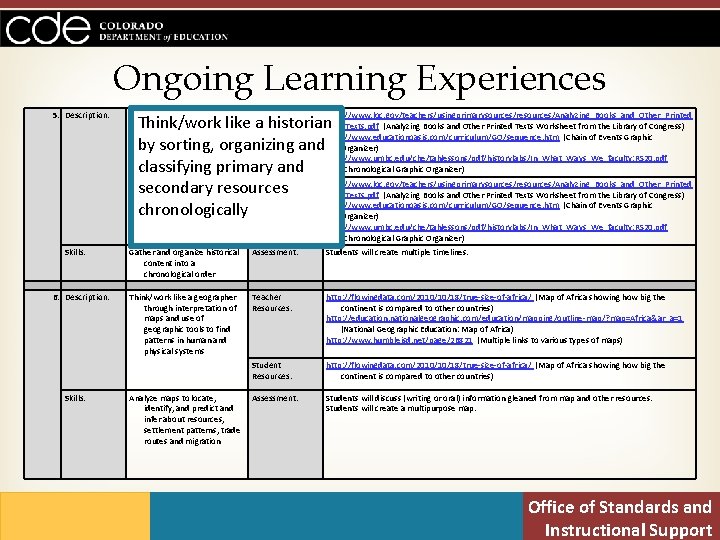
Ongoing Learning Experiences 5. Description: Think/work like a historian by sorting, organizing and classifying primary and secondary resources chronologically Teacher http: //www. loc. gov/teachers/usingprimarysources/resources/Analyzing_Books_and_Other_Printed Think/work like a historian Resources: _Texts. pdf (Analyzing Books and Other Printed Texts Worksheet from the Library of Congress) http: //www. educationoasis. com/curriculum/GO/sequence. htm (Chain of Events Graphic by sorting, organizing and Organizer) http: //www. umbc. edu/che/tahlessons/pdf/historylabs/In_What_Ways_We_faculty: RS 20. pdf classifying primary and (Chronological Graphic Organizer) Student http: //www. loc. gov/teachers/usingprimarysources/resources/Analyzing_Books_and_Other_Printed secondary resources Resources: _Texts. pdf (Analyzing Books and Other Printed Texts Worksheet from the Library of Congress) http: //www. educationoasis. com/curriculum/GO/sequence. htm (Chain of Events Graphic chronologically Organizer) http: //www. umbc. edu/che/tahlessons/pdf/historylabs/In_What_Ways_We_faculty: RS 20. pdf (Chronological Graphic Organizer) Skills: Gather and organize historical content into a chronological order Assessment: Students will create multiple timelines. Think/work like a geographer through interpretation of maps and use of geographic tools to find patterns in human and physical systems Teacher Resources: http: //flowingdata. com/2010/10/18/true-size-of-africa/ (Map of Africa showing how big the continent is compared to other countries) http: //education. nationalgeographic. com/education/mapping/outline-map/? map=Africa&ar_a=1 (National Geographic Education: Map of Africa) http: //www. humbleisd. net/page/26821 (Multiple links to various types of maps) Student Resources: http: //flowingdata. com/2010/10/18/true-size-of-africa/ (Map of Africa showing how big the continent is compared to other countries) 6. Description: Skills: Analyze maps to locate, Assessment: identify, and predict and infer about resources, settlement patterns, trade routes and migration Students will discuss (writing or oral) information gleaned from map and other resources. Students will create a multipurpose map. Office of Standards and Instructional Support
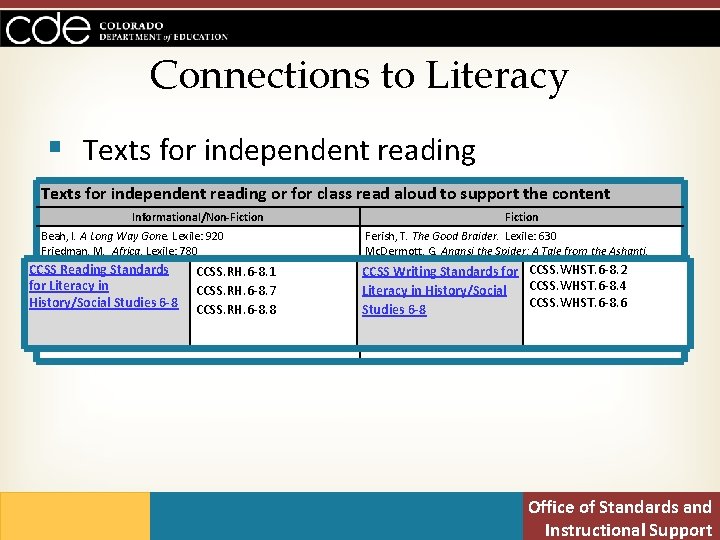
Connections to Literacy § Texts for independent reading or for class read aloud to support the content § Reading & Writing for Literacy in History and Informational/Non-Fiction Social Sciences Fiction Beah, I. A Long Way Gone. Lexile: 920 Ferish, T. The Good Braider. Lexile: 630 Friedman, M. Africa. Lexile: 780 Mc. Dermott, G. Anansi the Spider: A Tale from the Ashanti. Lekuton, J. L. Facing the Lion: Growing Up Maasai on the African Lexile: 290 CCSS Reading Standards CCSS. RH. 6 -8. 1 CCSS Writing Standards for CCSS. WHST. 6 -8. 2 Savanna. Lexile: 720 Park, L. S. A Long Walk to Water. Lexile: 720 for Literacy in CCSS. WHST. 6 -8. 4 CCSS. RH. 6 -8. 7 Literacy in History/Social Macaulay, D. Pyramid. Lexile: 1110 Steptoe, J. Mufaro's Beautiful Daughters. Lexile: 720 History/Social CCSS. WHST. 6 -8. 6 Morley, J. You Studies Wouldn’t 6 -8 Want to be a Pyramid Builder. Lexile: Studies Whelan, G. Listening for Lions. Lexile: 900 CCSS. RH. 6 -8. 8 6 -8 940 Yomtov, N. Ancient Egypt. Lexile: 1110 Office of Standards and Instructional Support
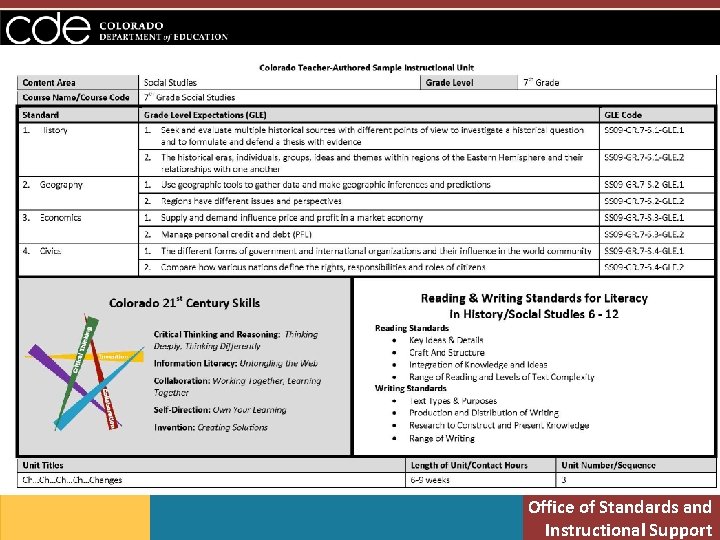
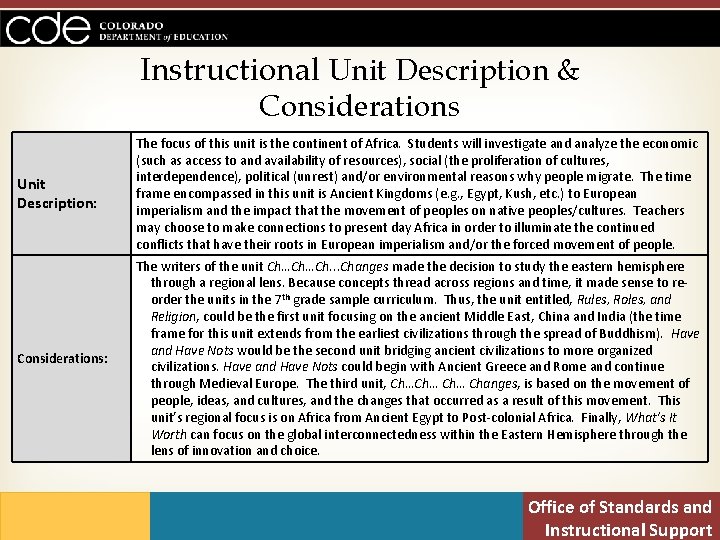
Instructional Unit Description & Considerations Unit Description: The focus of this unit is the continent of Africa. Students will investigate and analyze the economic (such as access to and availability of resources), social (the proliferation of cultures, interdependence), political (unrest) and/or environmental reasons why people migrate. The time frame encompassed in this unit is Ancient Kingdoms (e. g. , Egypt, Kush, etc. ) to European imperialism and the impact that the movement of peoples on native peoples/cultures. Teachers may choose to make connections to present day Africa in order to illuminate the continued conflicts that have their roots in European imperialism and/or the forced movement of people. Considerations: The writers of the unit Ch…Ch…Ch. . . Changes made the decision to study the eastern hemisphere through a regional lens. Because concepts thread across regions and time, it made sense to reorder the units in the 7 th grade sample curriculum. Thus, the unit entitled, Rules, Roles, and Religion, could be the first unit focusing on the ancient Middle East, China and India (the time frame for this unit extends from the earliest civilizations through the spread of Buddhism). Have and Have Nots would be the second unit bridging ancient civilizations to more organized civilizations. Have and Have Nots could begin with Ancient Greece and Rome and continue through Medieval Europe. The third unit, Ch…Ch… Changes, is based on the movement of people, ideas, and cultures, and the changes that occurred as a result of this movement. This unit’s regional focus is on Africa from Ancient Egypt to Post-colonial Africa. Finally, What’s It Worth can focus on the global interconnectedness within the Eastern Hemisphere through the lens of innovation and choice. Office of Standards and Instructional Support
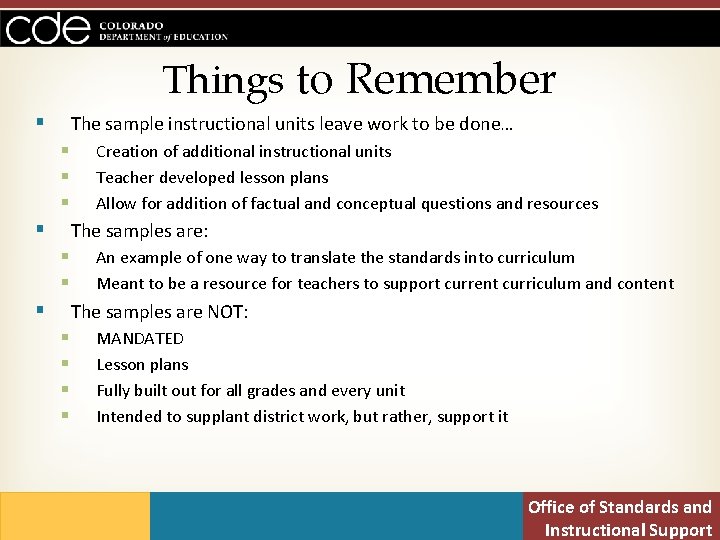
Things to Remember § The sample instructional units leave work to be done… § § Creation of additional instructional units Teacher developed lesson plans Allow for addition of factual and conceptual questions and resources The samples are: § § § An example of one way to translate the standards into curriculum Meant to be a resource for teachers to support current curriculum and content The samples are NOT: § § MANDATED Lesson plans Fully built out for all grades and every unit Intended to supplant district work, but rather, support it Office of Standards and Instructional Support
Office of Standards and Instructional Support
Discussion Time Questions? Office of Standards and Instructional Support
Contact Information Stephanie Hartman, Ph. D Social Studies Content Specialist Colorado Department of Education hartman_s@cde. state. co. us (720) 498 -2084 Instructional Units Webpage: http: //www. cde. state. co. us/standardsandinstruction/instructionalunits-socialstudies Social Studies Webpage: http: //www. cde. state. co. us/cosocialstudies Office of Standards and Instructional Support