
Overview of the Institute for SoftwareIntegrated Systems ISIS
- Slides: 12
Overview of the Institute for Software-Integrated Systems ISIS -2005 Dr. Janos Sztipanovits E. Bronson Ingram Distinguished Professor of EECS Director of ISIS Vanderbilt University Nashville, TN Janos Sztipanovits
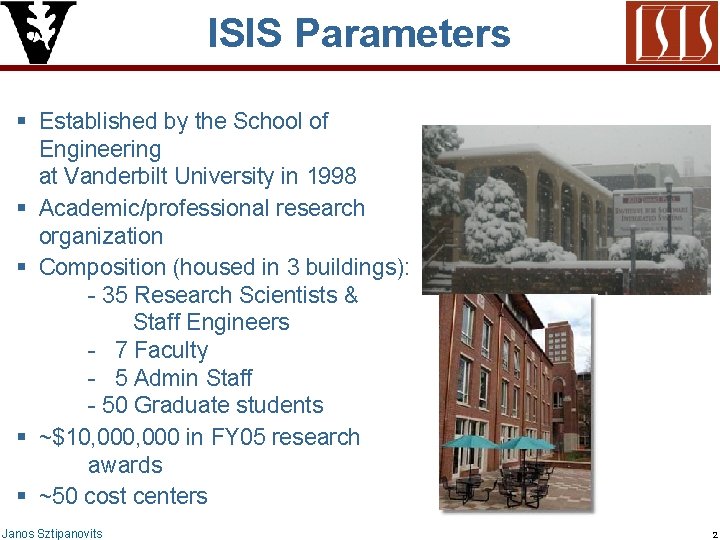
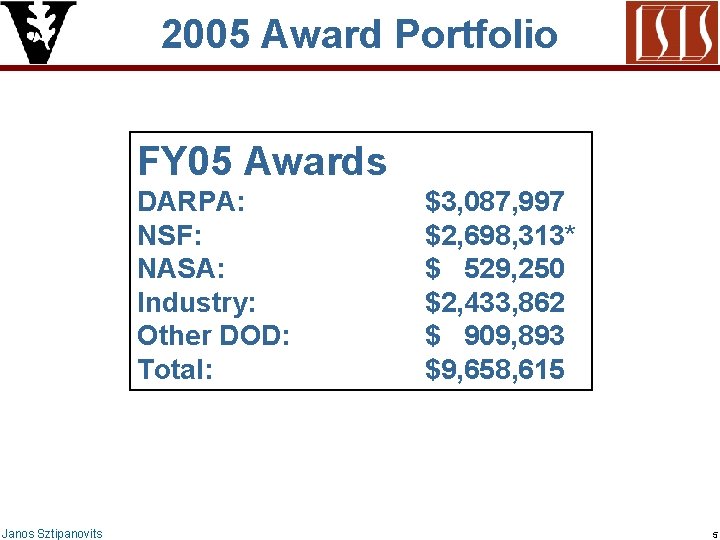
ISIS Parameters § Established by the School of Engineering at Vanderbilt University in 1998 § Academic/professional research organization § Composition (housed in 3 buildings): - 35 Research Scientists & Staff Engineers - 7 Faculty - 5 Admin Staff - 50 Graduate students § ~$10, 000 in FY 05 research awards § ~50 cost centers Janos Sztipanovits 2
Senior Personnel u Dr. Ted Bapty, Senior Research Scientist (VU/ISIS: 16 years) (MIC environments, HW/SW codesign, sensor systems, modeling and simulation) u Dr. Gautam Biswas, Professor (VU/ISIS: 16 years) (Learning theory, fault diagnostics, hybrid systems) u Dr. Larry Howard, Senior Research Scientist (VU/ISIS: 9 years) (SEI system architect until 1997, MIC environments, fault diagnostics training systems) u Dr. Gabor Karsai, Professor (VU/ISIS: 22 years) (model transformation, tool architectures, tool integration, systems) u Dr. Akos Ledeczi, Senior Research Scientist (VU/ISIS: 16 years) (GME, wireless sensor networks) u Dr. Sandeep Neema, Senior Research Scientist (VU/ISIS: 11 years) (networked embedded systems, integrated tool chains, modeling and simulation) u Dr. Douglas C. Schmidt, Professor (VU/ISIS: 4 years) (distributed, real-time, embedded computing, middleware, component models, design patterns; DARPA program manager) u Dr. Janos Sztipanovits, Professor (VU/ISIS: 23 years) (modeling/metamodeling, semantic foundations, metaprogrammable tool architectures; DARPA program manager) Janos Sztipanovits 3
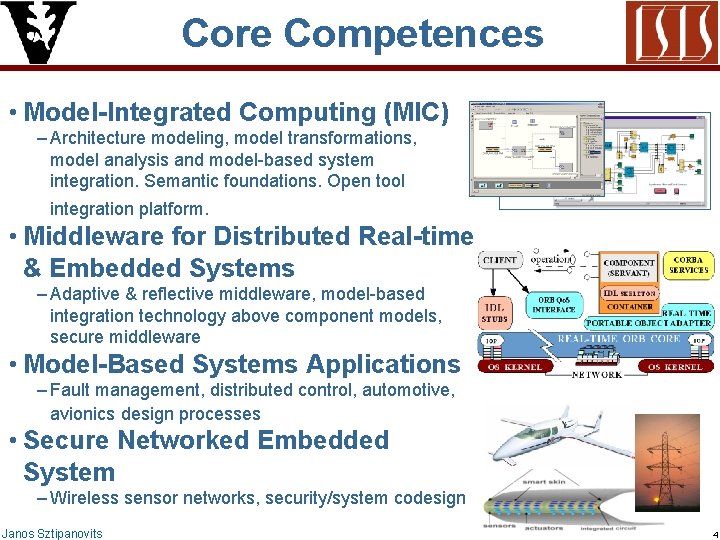
Core Competences • Model-Integrated Computing (MIC) – Architecture modeling, model transformations, model analysis and model-based system integration. Semantic foundations. Open tool integration platform. • Middleware for Distributed Real-time & Embedded Systems – Adaptive & reflective middleware, model-based integration technology above component models, secure middleware • Model-Based Systems Applications – Fault management, distributed control, automotive, avionics design processes • Secure Networked Embedded System – Wireless sensor networks, security/system codesign Janos Sztipanovits 4
2005 Award Portfolio FY 05 Awards DARPA: NSF: NASA: Industry: Other DOD: Total: Janos Sztipanovits $3, 087, 997 $2, 698, 313* $ 529, 250 $2, 433, 862 $ 909, 893 $9, 658, 615 5
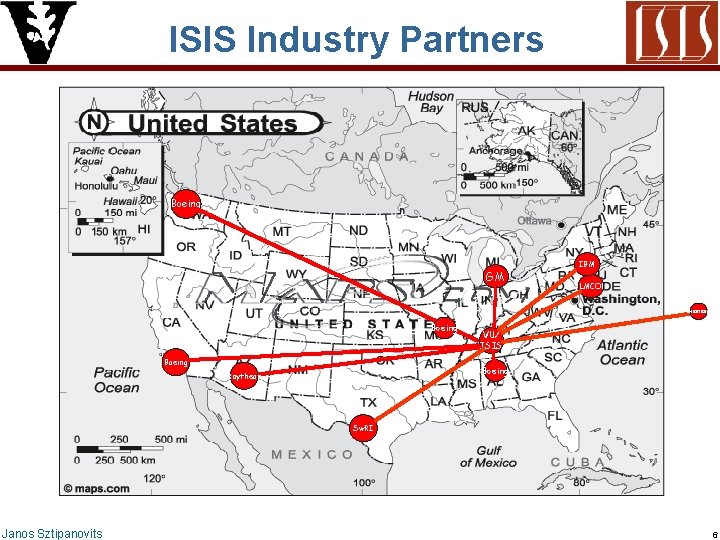
ISIS Industry Partners Boeing GM IBM LMCOl Siemens Boeing VU/ ISIS Boeing Raytheon Sw. RI Janos Sztipanovits 6
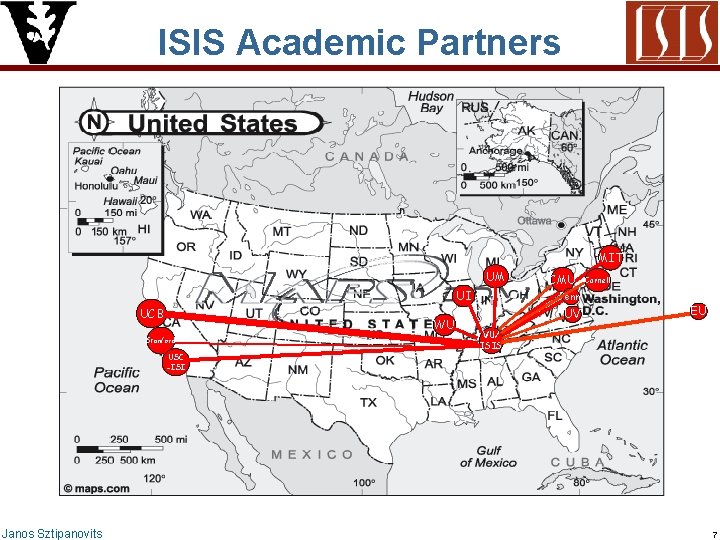
ISIS Academic Partners MIT UM UI UCB WU Stanford USC -ISI Janos Sztipanovits CMU Penn UV Cornell EU VU/ ISIS 7
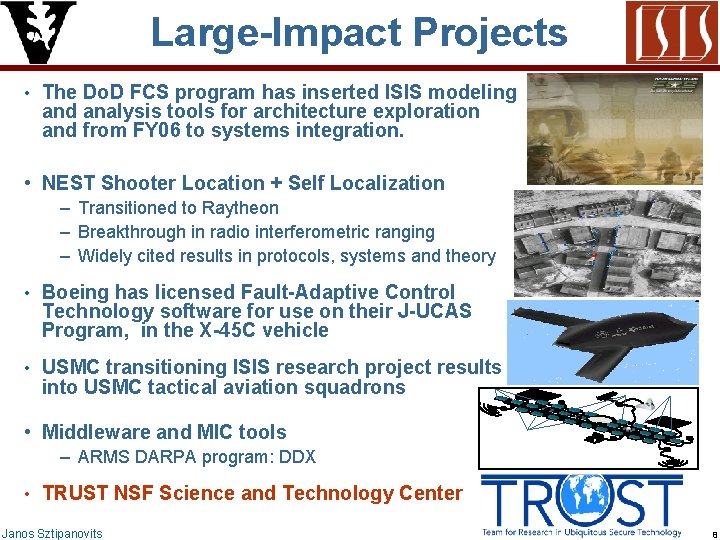
Large-Impact Projects • The Do. D FCS program has inserted ISIS modeling and analysis tools for architecture exploration and from FY 06 to systems integration. • NEST Shooter Location + Self Localization – Transitioned to Raytheon – Breakthrough in radio interferometric ranging – Widely cited results in protocols, systems and theory • Boeing has licensed Fault-Adaptive Control Technology software for use on their J-UCAS Program, in the X-45 C vehicle • USMC transitioning ISIS research project results into USMC tactical aviation squadrons • Middleware and MIC tools – ARMS DARPA program: DDX • TRUST NSF Science and Technology Center Janos Sztipanovits 8
Top 6 *New* Awards in 2005 • TRUST S&TC (NSF) (Partners: UCBerkeley/Cornell/Stanford/CMU) • Mobile Wireless Sensor Network for Acoustic Battlespace Mapping (DARPA) (Partner: Sarnoff 18 month) • Systems Biology Tool Suite (DARPA) • Criticality Sensitive Coordination (DARPA) (Partners: ISI/Kestrel) • Joint Battlespace Infosphere (AFRL) (Partners: Cornell/CMU) • Future Combat Systems (Boeing) Janos Sztipanovits 9
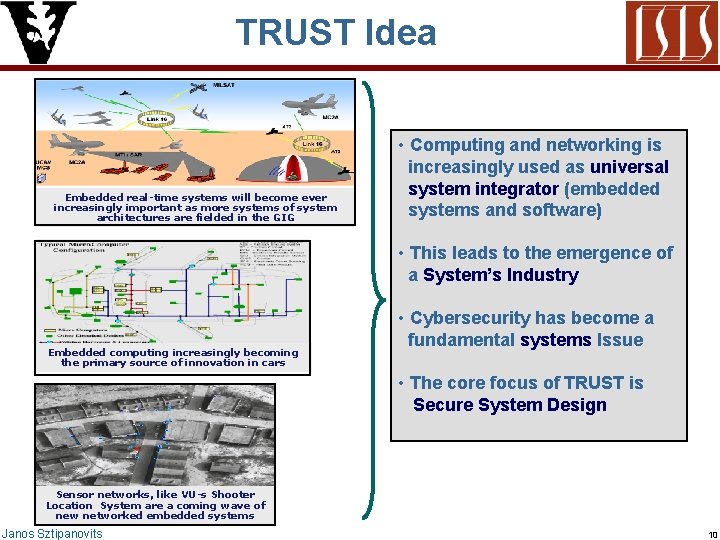
TRUST Idea Embedded real-time systems will become ever increasingly important as more systems of system architectures are fielded in the GIG • Computing and networking is increasingly used as universal system integrator (embedded systems and software) • This leads to the emergence of a System’s Industry Embedded computing increasingly becoming the primary source of innovation in cars • Cybersecurity has become a fundamental systems Issue • The core focus of TRUST is Secure System Design Sensor networks, like VU-s Shooter Location System are a coming wave of new networked embedded systems Janos Sztipanovits 10
Examples for Industry Interactions u IR&D projects done for companies (Boeing, Raytheon, GM, Lockheed and others) u CR&D projects done jointly with companies (Boeing, Raytheon, Co. SYS, Sarnoff, . . ) for Government (DARPA, NASA) u Product support for ISIS tools (Boeing JUCAS/IVHM – Modeling tool + on-board software) u ESCHER Institute (2003) for tool maturation (www. escherinstitute. org) u MIC PSIG at OMG (www. omg. org/mic) Janos Sztipanovits 11
Teaching and Training u Industrial: – Escher Institute; training programs for major end-user companies u Academic: – MIC course (6 th year at VU, 2 nd at Berkeley Students design DSML-s and model-based generators using MIC tools) – Summer program for undergraduates (SIPHER at VU, SUPERB at Berkeley) – Joint Summer School starts in 2006 with Berkeley, Stanford, CMU and Cornell on trusted system design – Migrating MIC to undergraduate level is in progress Janos Sztipanovits 12