
Overview of the IEEE 802 22 Working Group
- Slides: 50
Overview of the IEEE 802. 22 Working Group Activities and the IEEE 802. 22 (Wi-FAR) Standard for Wireless Regional Area Networks Point of Contact Dr. Apurva N. Mody, Chair, IEEE 802. 22 Working Group Chairman, White. Space Alliance® www. ieee 802. org/22 www. White. Space. Alliance. org apurva. mody@ieee. org, +1 -404 -819 -0314 EEE 802 This presentation was compiled by the Participants of the IEEE 802. 22 Working Group as well as the Participants of the White. Space Alliance. Overview off the IEEE 802. 22 Working Group Activities and Standards Page 1
Disclaimer… “At lectures, symposia, seminars, or educational courses, an individual presenting information on IEEE standards shall make it clear that his or her views should be considered the personal views of that individual rather than the formal position, explanation, or interpretation of the IEEE. ” http: //standards. ieee. org/ipr/disclaimers. html This presentation was compiled by the Participants of the IEEE 802. 22 Working Group as well as the Participants of the White. Space Alliance. EEE 802 Overview off the IEEE 802. 22 Working Group Activities and Standards Page 2
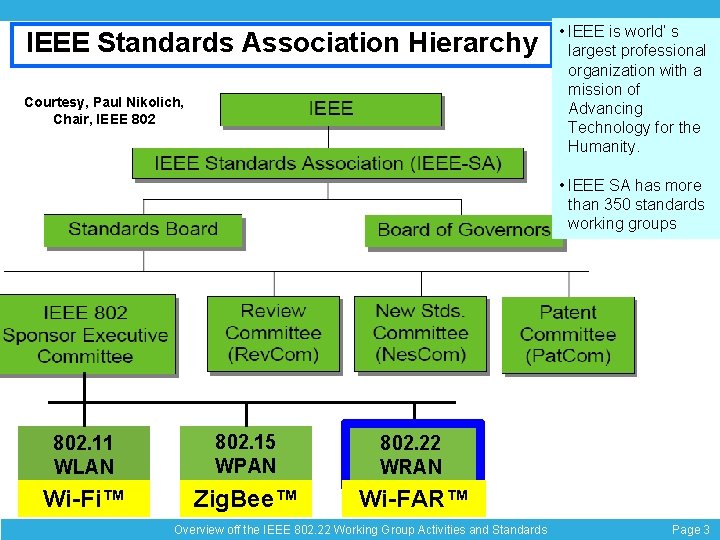
IEEE Standards Association Hierarchy Courtesy, Paul Nikolich, Chair, IEEE 802 • IEEE is world’ s largest professional organization with a mission of Advancing Technology for the Humanity. • IEEE SA has more than 350 standards working groups 802. 11 WLAN EEE 802 Wi-Fi™ 802. 15 WPAN 802. 22 WRAN Zig. Bee™ Wi-FAR™ Overview off the IEEE 802. 22 Working Group Activities and Standards Page 3
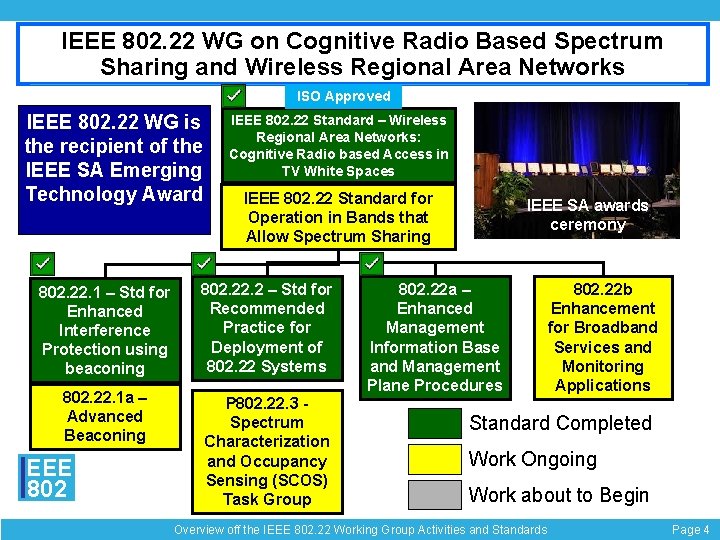
IEEE 802. 22 WG on Cognitive Radio Based Spectrum Sharing and Wireless Regional Area Networks ISO Approved IEEE 802. 22 WG is the recipient of the IEEE SA Emerging Technology Award IEEE 802. 22 Standard – Wireless Regional Area Networks: Cognitive Radio based Access in TV White Spaces IEEE 802. 22 Standard for Operation in Bands that Allow Spectrum Sharing 802. 22. 1 – Std for Enhanced Interference Protection using beaconing 802. 2 – Std for Recommended Practice for Deployment of 802. 22 Systems 802. 22. 1 a – Advanced Beaconing P 802. 22. 3 Spectrum Characterization and Occupancy Sensing (SCOS) Task Group EEE 802 IEEE SA awards ceremony 802. 22 a – Enhanced Management Information Base and Management Plane Procedures 802. 22 b Enhancement for Broadband Services and Monitoring Applications Standard Completed Work Ongoing Work about to Begin Overview off the IEEE 802. 22 Working Group Activities and Standards Page 4
IEEE Std. 802. 22 -2011 Published Standard Title and Scope Title: IEEE Standard for Information Technology— Telecommunications and information exchange between systems - Specific requirements Wireless Regional Area Networks (WRAN) - Part 22: Cognitive Wireless RAN Medium Access Control (MAC) and Physical Layer (PHY) Specifications: Policies and Procedures for Operation in the TV Bands Scope: This standard specifies the air interface, including the cognitive medium access control layer (MAC) and physical layer (PHY), of point-tomultipoint wireless regional area networks comprised of a professional fixed base station with fixed and portable user terminals operating in the VHF/UHF TV broadcast bands between 54 MHz to 862 MHz. EEE 802 The IEEE Std. 802. 22 -2011 was approved by the ISO/ JTC 1 / SC 6. This new standard will be referred to as the ISO/IEC/IEEE Std. 8802 -22: 2015 - Press Release Overview off the IEEE 802. 22 Working Group Activities and Standards Page 5
P 802. 22 b Amendment: Enhancements for Broadband Services and Monitoring Applications Scope: This standard specifies alternate Physical Layer (PHY) and necessary Medium Access Control Layer (MAC) enhancements to IEEE std. 802. 22 -2011 for operation in Very High Frequency (VHF)/ Ultra High Frequency (UHF) TV broadcast bands between 54 MHz and 862 MHz to support enhanced broadband services and monitoring applications. The standard supports aggregate data rates greater than the maximum data rate supported by the IEEE Std. 802. 22 -2011. This standard defines new classes of 802. 22 devices to address these applications and supports more than 512 devices in a network. This standard also specifies techniques to enhance communications among the devices and makes necessary amendments to the cognitive, security & parameters and connection management clauses. This amendment supports mechanisms to enable coexistence with other 802 systems in the same band EEE 802 P 802. 22 b Amendment in its Final Stages of Approval within the IEEE. Planning to Forward this Standard to ISO for Consideration through the PSDO Process Overview off the IEEE 802. 22 Working Group Activities and Standards Page 6
IEEE Std. 802. 22 a-2014 Amendment: Management and Control Plane Interfaces and Procedures and enhancement to the Management Information Base (MIB) Scope: This amendment defines a new clause for Management and Control Plane Interfaces and Procedures to the existing IEEE Std 802. 222011 for operation in VHF/UHF TV broadcast bands between 54 MHz and 862 MHz. The Management Information Base (MIB) structure enhancements include changes to comply with the ASN. 1 format and support for the new clause. Modifications to the existing clause on Primitives for Cognitive Radio Capabilities to align it with the content in the MIB clause and the new clause are also defined. EEE 802 The IEEE Std. 802. 22 a-2014 Approved by the IEEE in 2014. Planning to Forward this Standard to ISO for Consideration through the PSDO Process Overview off the IEEE 802. 22 Working Group Activities and Standards Page 7
IEEE Std. 802. 22. 1 -2010 and the Advanced Beaconing (Revision) Title: IEEE Standard for Information Technology--Telecommunications and information exchange between systems--Local and metropolitan area networks--Specific requirements Part 22. 1: Standard to Enable Spectrum Sharing using Advanced Beaconing Scope: This standard specifies methods for spectrum sharing using advanced beaconing. The beacon specifies a format that facilitates its detection at low Signal to Noise Ratios. It contains information about a system that requires interference protection and is willing to share the spectrum with other systems. The Standard defines Physical Layer (PHY) and Medium Access Control Layer (MAC) for advanced beacon operation in High Frequency (HF), Very High Frequency (VHF), Ultra High Frequency (UHF) (3 MHz to 862 MHz) and the S-Band (2 GHz – 4 GHz). Enhanced security features, spectrum management, self- organizing network and relay capabilities are included in the beacon specification. The beacon supports spectrum sharing with licensed wireless microphones, radars, fixed and transportable space to earth receiver stations and other services. This standard EEE supports 802 mechanisms to enable coexistence Overview off the IEEE 802. 22 Working Group Activities and Standards Page 8
IEEE Std. 802. 2 -2012 – Recommended Practice for Installation and Deployment of 802. 22 Systems Title: IEEE Standard for Information Technology— Telecommunications and information exchange between systems - Specific requirements Wireless Regional Area Networks (WRAN) - Part 22. 2: Recommended Practice for the Installation and Deployment of IEEE 802. 22 Systems Scope: This document recommends best engineering practices for the installation and deployment of IEEE 802. 22 systems to help assure that such systems are correctly installed and deployed. EEE 802 Overview off the IEEE 802. 22 Working Group Activities and Standards Page 9
IEEE P 802. 22. 3 – (New) - Spectrum Characterization and Occupancy Sensing (SCOS) Task Group Title: IEEE Standard for Information Technology— Telecommunications and information exchange between systems - Specific requirements Wireless Regional Area Networks (WRAN) - Part 22. 3: Standard for Spectrum Characterization and Occupancy Sensing Scope: This Standard defines a Spectrum Characterization and Occupancy Sensing (SCOS) System. It specifies measurement parameters and device behaviors. It includes protocols for reporting measurement information that enable coalescing the results from multiple such devices. The standard leverages interfaces and primitives that are derived from IEEE Std. 802. 22 -2011, and uses any on-line transport mechanism available to achieve the control and management of the system. Interfaces and primitives are provided for conveying value added sensing information to various spectrum sharing database services. This standard specifies a device operating in the bands below 1 GHz and a EEE second 802 device operating from 2. 7 GHz to 3. 7 GHz. Overview off the IEEE 802. 22 Working Group Activities and Standards Page 10
Overview of the IEEE 802. 22 Working Group Activities and the IEEE 802. 22 (Wi-FAR) Standard for Wireless Regional Area Networks EEE 802 Overview off the IEEE 802. 22 Working Group Activities and Standards Page 11
Providing cost-effective RURAL broadband is a significant opportunity • Today, 70% of the people in the world (5. 1 Billion people) do not have access to high speed (> 1 Mbps) internet. More than half the population in the world live in rural areas with hardly any access to broadband. • It is expensive to lay fiber / cable in rural and remote areas with low population density. Wireless is the only solution. Backhaul / backbone internet access for rural areas is very expensive (50% of the cost) • Traditional wireless carriers have focused on urban areas with high populations density (faster Return on Investment) using licensed spectrum • EEE This has created a DIGITAL DIVIDE / OPPORTUNITY 802 Overview off the IEEE 802. 22 Working Group Activities and Standards Page 12
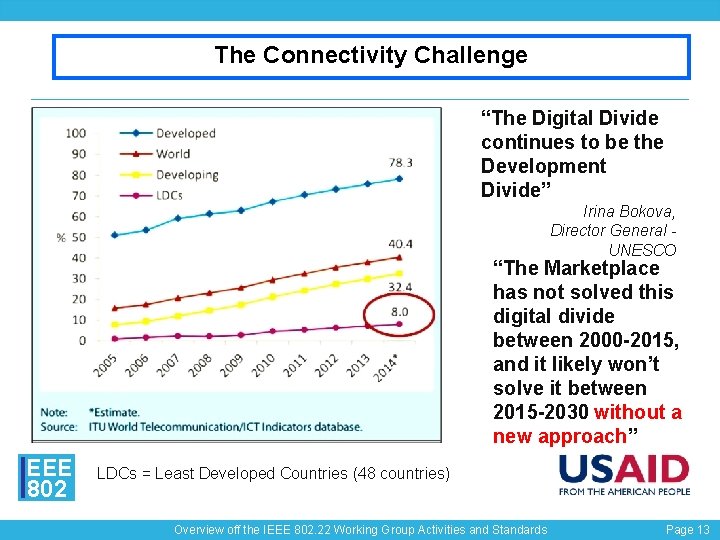
The Connectivity Challenge “The Digital Divide continues to be the Development Divide” Irina Bokova, Director General UNESCO “The Marketplace has not solved this digital divide between 2000 -2015, and it likely won’t solve it between 2015 -2030 without a new approach” EEE 802 LDCs = Least Developed Countries (48 countries) Overview off the IEEE 802. 22 Working Group Activities and Standards Page 13
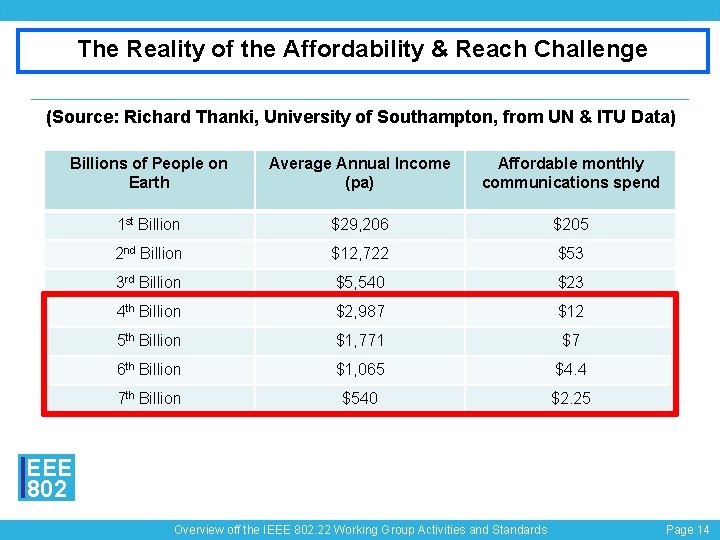
The Reality of the Affordability & Reach Challenge (Source: Richard Thanki, University of Southampton, from UN & ITU Data) Billions of People on Earth Average Annual Income (pa) Affordable monthly communications spend 1 st Billion $29, 206 $205 2 nd Billion $12, 722 $53 3 rd Billion $5, 540 $23 4 th Billion $2, 987 $12 5 th Billion $1, 771 $7 6 th Billion $1, 065 $4. 4 7 th Billion $540 $2. 25 EEE 802 Overview off the IEEE 802. 22 Working Group Activities and Standards Page 14
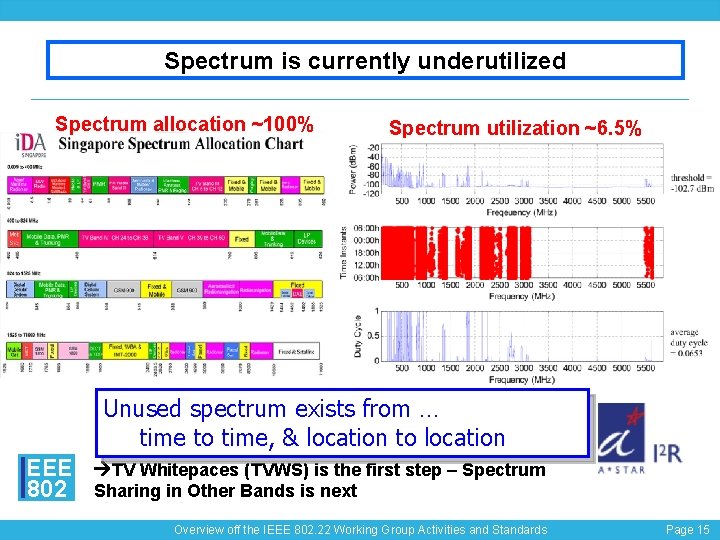
Spectrum is currently underutilized Spectrum allocation ~100% Spectrum utilization ~6. 5% Unused spectrum exists from … time to time, & location to location EEE 802 TV Whitepaces (TVWS) is the first step – Spectrum Sharing in Other Bands is next Overview off the IEEE 802. 22 Working Group Activities and Standards Page 15
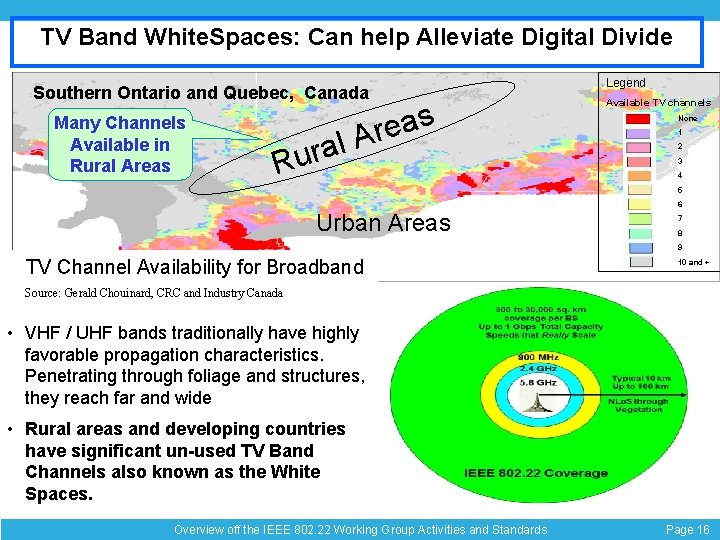
TV Band White. Spaces: Can help Alleviate Digital Divide Southern Ontario and Quebec, Canada Many Channels Available in Rural Areas s a e r l. A a r u R Legend Available TV channels None 1 2 3 4 5 6 Urban Areas 7 8 9 TV Channel Availability for Broadband 10 and + Source: Gerald Chouinard, CRC and Industry Canada • VHF / UHF bands traditionally have highly favorable propagation characteristics. Penetrating through foliage and structures, they reach far and wide • Rural areas and developing countries have significant un-used TV Band EEE Channels also known as the White 802 Spaces. Overview off the IEEE 802. 22 Working Group Activities and Standards Page 16
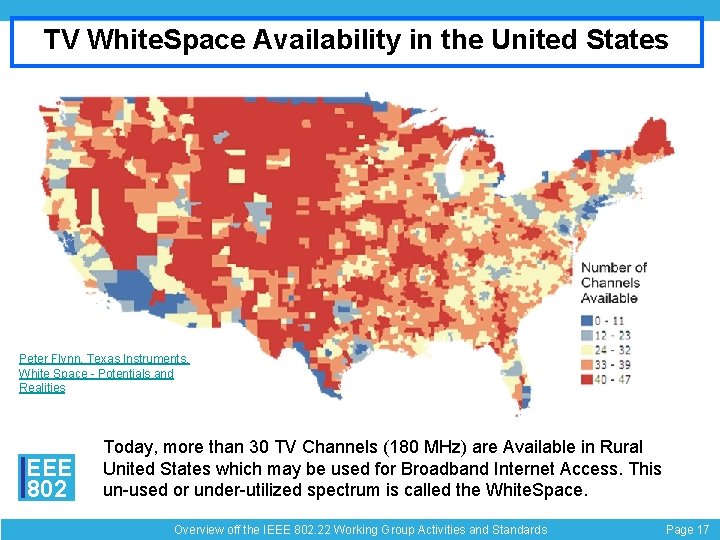
TV White. Space Availability in the United States Peter Flynn, Texas Instruments, White Space - Potentials and Realities EEE 802 Today, more than 30 TV Channels (180 MHz) are Available in Rural United States which may be used for Broadband Internet Access. This un-used or under-utilized spectrum is called the White. Space. Overview off the IEEE 802. 22 Working Group Activities and Standards Page 17
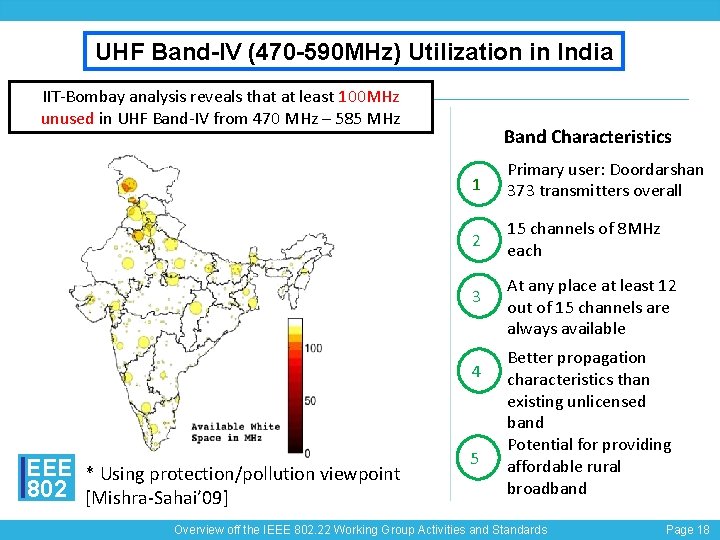
UHF Band-IV (470 -590 MHz) Utilization in India IIT-Bombay analysis reveals that at least 100 MHz unused in UHF Band-IV from 470 MHz – 585 MHz Band Characteristics 1 Primary user: Doordarshan 373 transmitters overall 2 15 channels of 8 MHz each 3 4 EEE * Using protection/pollution viewpoint 802 [Mishra-Sahai’ 09] 5 At any place at least 12 out of 15 channels are always available Better propagation characteristics than existing unlicensed band Potential for providing affordable rural broadband Overview off the IEEE 802. 22 Working Group Activities and Standards Page 18
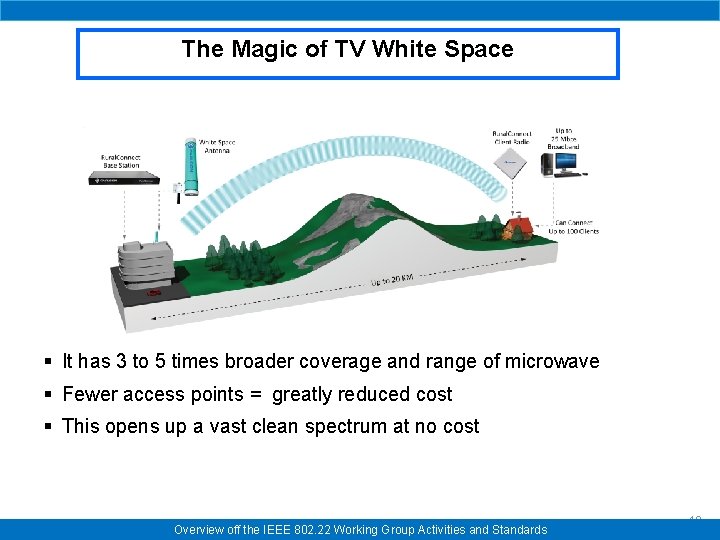
The Magic of TV White Space § It has 3 to 5 times broader coverage and range of microwave § Fewer access points = greatly reduced cost § This opens up a vast clean spectrum at no cost Overview off the IEEE 802. 22 Working Group Activities and Standards 19
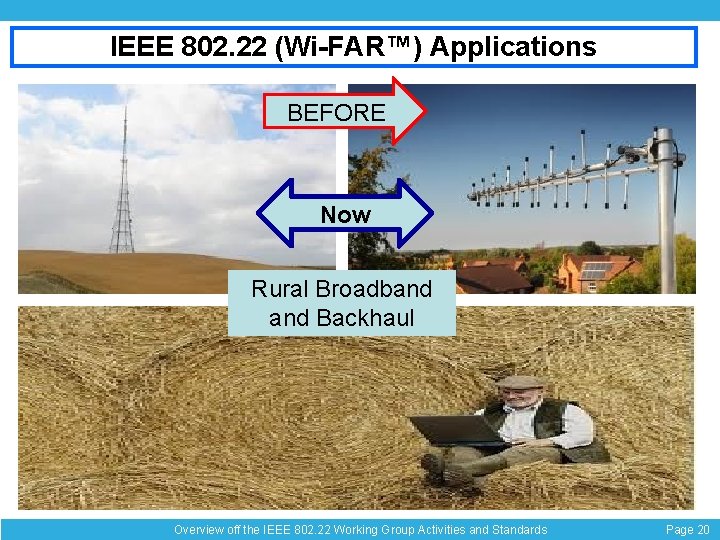
IEEE 802. 22 (Wi-FAR™) Applications BEFORE Now Rural Broadband Backhaul EEE 802 Overview off the IEEE 802. 22 Working Group Activities and Standards Page 20
TVWS Regulations in Various Countries EEE 802 Overview off the IEEE 802. 22 Working Group Activities and Standards Page 21
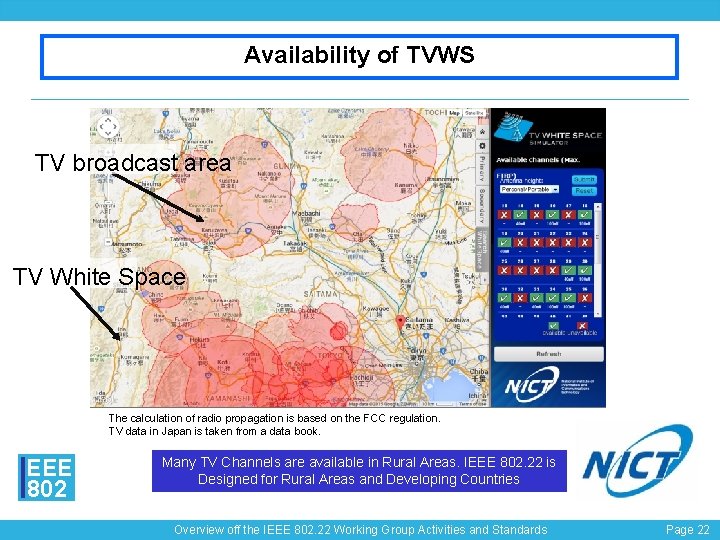
Availability of TVWS TV broadcast area TV White Space The calculation of radio propagation is based on the FCC regulation. TV data in Japan is taken from a data book. EEE 802 Many TV Channels are available in Rural Areas. IEEE 802. 22 is Designed for Rural Areas and Developing Countries Overview off the IEEE 802. 22 Working Group Activities and Standards Page 22
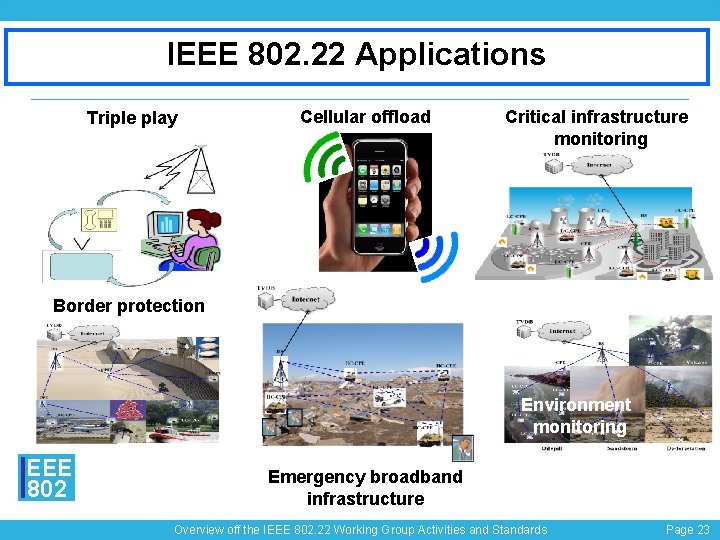
IEEE 802. 22 Applications Triple play Cellular offload Critical infrastructure monitoring Border protection Environment monitoring EEE 802 Emergency broadband infrastructure Overview off the IEEE 802. 22 Working Group Activities and Standards Page 23
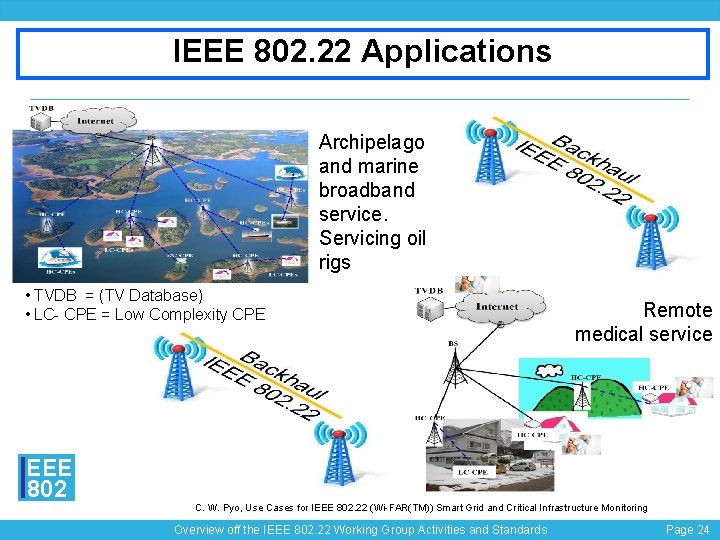
IEEE 802. 22 Applications Archipelago and marine broadband service. Servicing oil rigs • TVDB = (TV Database) • LC- CPE = Low Complexity CPE EEE 802 Remote medical service C. W. Pyo, Use Cases for IEEE 802. 22 (Wi-FAR(TM)) Smart Grid and Critical Infrastructure Monitoring Overview off the IEEE 802. 22 Working Group Activities and Standards Page 24
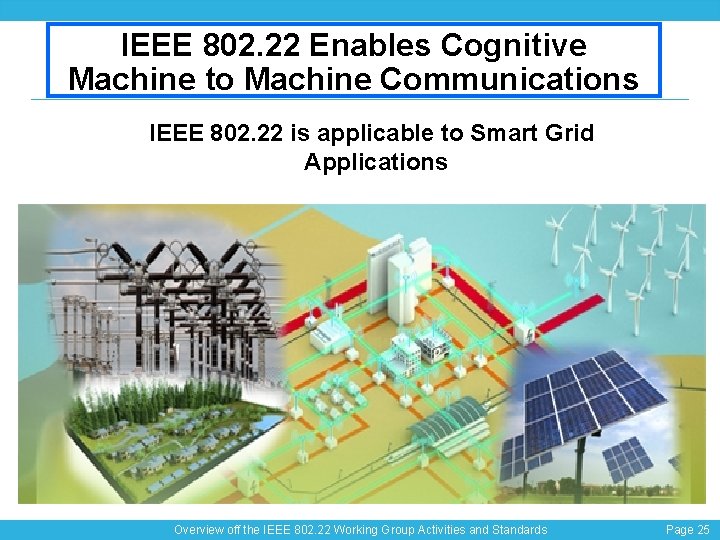
IEEE 802. 22 Enables Cognitive Machine to Machine Communications IEEE 802. 22 is applicable to Smart Grid Applications EEE 802 Overview off the IEEE 802. 22 Working Group Activities and Standards Page 25
IEEE 802. 22 (Wi-FAR™) Summary • First IEEE Standard for operation in Television Whitespaces • First IEEE Standard that is specifically designed for rural and regional area broadband access aimed at removing the digital divide • First IEEE Standard that has all the Cognitive Radio features • IEEE 802. 22 (Wi-FAR™) provides Broadband Wireless Access to Regional, Rural and Remote Areas Under Line of Sight (Lo. S) and Non Line of Sight (NLo. S) Conditions using Cognitive Radio Technology (without causing harmful interference to the incumbents). • Cognitive Radio technology added to a simple and optimized OFDMA waveform (similar to the OFDMA technology used in other broadband standards • Meets all the regulatory requirements such as protection of incumbents, access to the database, accurate geo-location, control of the EIRP etc. • Large EEE regional area foot print can allow placement of the Base Station closer to the area with cheaper internet backhaul / backbone. 802 Overview off the IEEE 802. 22 Working Group Activities and Standards Page 26
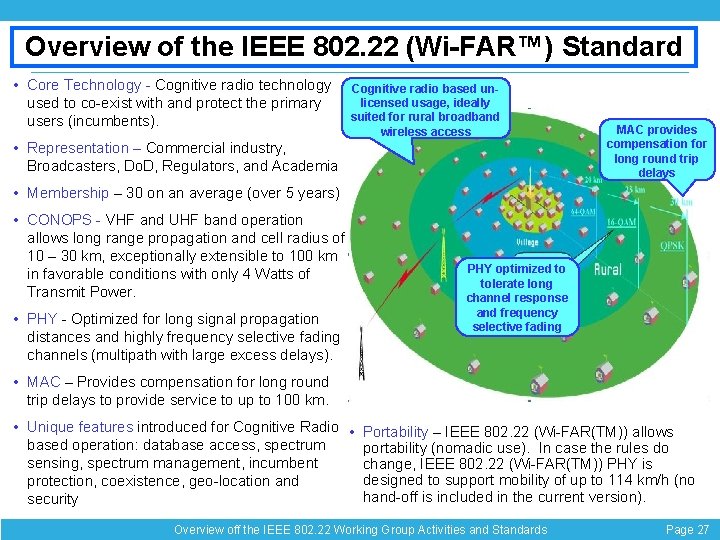
Overview of the IEEE 802. 22 (Wi-FAR™) Standard • Core Technology - Cognitive radio technology used to co-exist with and protect the primary users (incumbents). Cognitive radio based unlicensed usage, ideally suited for rural broadband wireless access • Representation – Commercial industry, Broadcasters, Do. D, Regulators, and Academia MAC provides compensation for long round trip delays • Membership – 30 on an average (over 5 years) • CONOPS - VHF and UHF band operation allows long range propagation and cell radius of 10 – 30 km, exceptionally extensible to 100 km in favorable conditions with only 4 Watts of Transmit Power. • PHY - Optimized for long signal propagation distances and highly frequency selective fading channels (multipath with large excess delays). PHY optimized to tolerate long channel response and frequency selective fading • MAC – Provides compensation for long round trip delays to provide service to up to 100 km. • Unique features introduced for Cognitive Radio • Portability – IEEE 802. 22 (Wi-FAR(TM)) allows based operation: database access, spectrum portability (nomadic use). In case the rules do sensing, spectrum management, incumbent change, IEEE 802. 22 (Wi-FAR(TM)) PHY is EEE designed to support mobility of up to 114 km/h (no protection, coexistence, geo-location and 802 hand-off is included in the current version). security Overview off the IEEE 802. 22 Working Group Activities and Standards Page 27
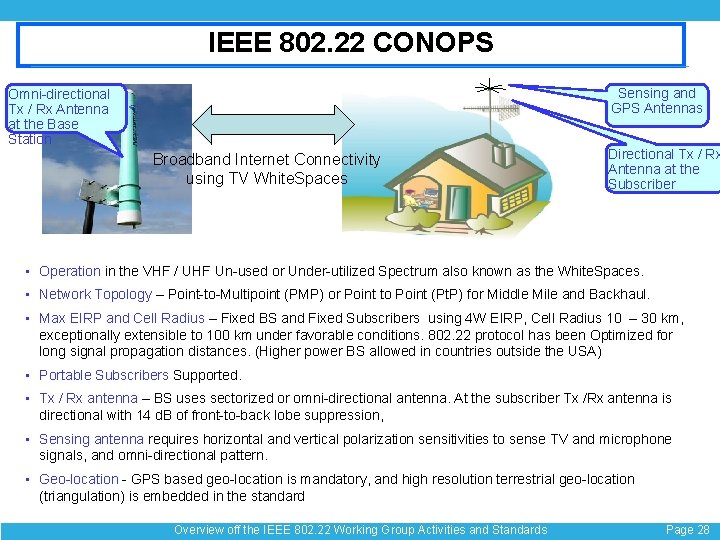
IEEE 802. 22 CONOPS Sensing and GPS Antennas Omni-directional Tx / Rx Antenna at the Base Station Broadband Internet Connectivity using TV White. Spaces Directional Tx / Rx Antenna at the Subscriber • Operation in the VHF / UHF Un-used or Under-utilized Spectrum also known as the White. Spaces. • Network Topology – Point-to-Multipoint (PMP) or Point to Point (Pt. P) for Middle Mile and Backhaul. • Max EIRP and Cell Radius – Fixed BS and Fixed Subscribers using 4 W EIRP, Cell Radius 10 – 30 km, exceptionally extensible to 100 km under favorable conditions. 802. 22 protocol has been Optimized for long signal propagation distances. (Higher power BS allowed in countries outside the USA) • Portable Subscribers Supported. • Tx / Rx antenna – BS uses sectorized or omni-directional antenna. At the subscriber Tx /Rx antenna is directional with 14 d. B of front-to-back lobe suppression, • Sensing antenna requires horizontal and vertical polarization sensitivities to sense TV and microphone signals, and omni-directional pattern. EEE 802 • Geo-location - GPS based geo-location is mandatory, and high resolution terrestrial geo-location (triangulation) is embedded in the standard Overview off the IEEE 802. 22 Working Group Activities and Standards Page 28
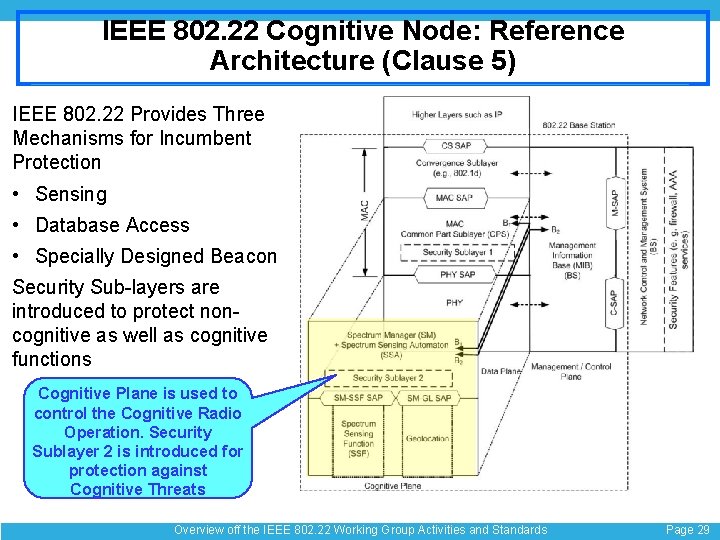
IEEE 802. 22 Cognitive Node: Reference Architecture (Clause 5) IEEE 802. 22 Provides Three Mechanisms for Incumbent Protection • Sensing • Database Access • Specially Designed Beacon Security Sub-layers are introduced to protect noncognitive as well as cognitive functions Cognitive Plane is used to control the Cognitive Radio Operation. Security Sublayer 2 is introduced for EEEprotection against 802 Cognitive Threats Overview off the IEEE 802. 22 Working Group Activities and Standards Page 29
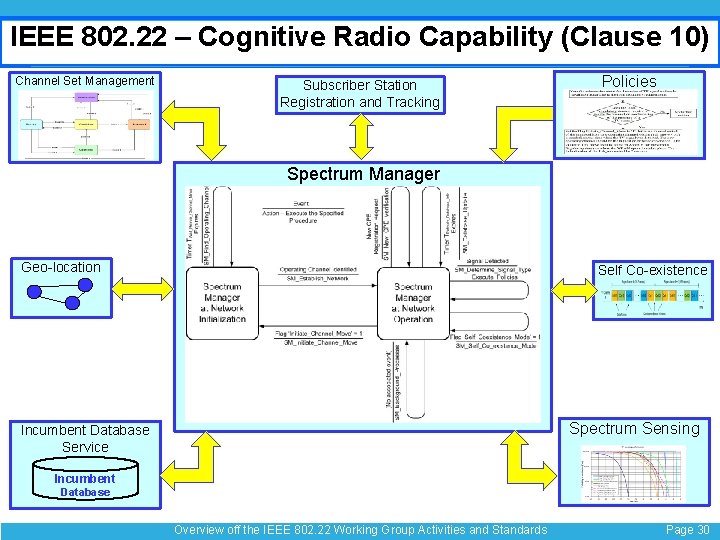
IEEE 802. 22 – Cognitive Radio Capability (Clause 10) Channel Set Management Subscriber Station Registration and Tracking Policies Spectrum Manager Geo-location Self Co-existence Spectrum Sensing Incumbent Database Service EEE Incumbent 802 Database Overview off the IEEE 802. 22 Working Group Activities and Standards Page 30
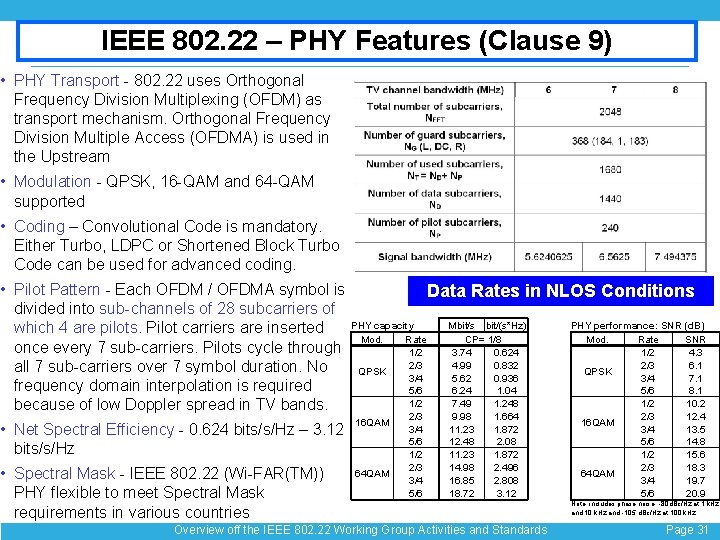
IEEE 802. 22 – PHY Features (Clause 9) • PHY Transport - 802. 22 uses Orthogonal Frequency Division Multiplexing (OFDM) as transport mechanism. Orthogonal Frequency Division Multiple Access (OFDMA) is used in the Upstream • Modulation - QPSK, 16 -QAM and 64 -QAM supported • Coding – Convolutional Code is mandatory. Either Turbo, LDPC or Shortened Block Turbo Code can be used for advanced coding. • Pilot Pattern - Each OFDM / OFDMA symbol is divided into sub-channels of 28 subcarriers of which 4 are pilots. Pilot carriers are inserted once every 7 sub-carriers. Pilots cycle through all 7 sub-carriers over 7 symbol duration. No frequency domain interpolation is required because of low Doppler spread in TV bands. • Net Spectral Efficiency - 0. 624 bits/s/Hz – 3. 12 bits/s/Hz EEE Mask - IEEE 802. 22 (Wi-FAR(TM)) • Spectral 802 PHY flexible to meet Spectral Mask requirements in various countries Data Rates in NLOS Conditions PHY capacity Mod. Rate 1/2 2/3 QPSK 3/4 5/6 1/2 2/3 16 QAM 3/4 5/6 1/2 2/3 64 QAM 3/4 5/6 Mbit/s bit/(s*Hz) CP= 1/8 3. 74 0. 624 4. 99 0. 832 5. 62 0. 936 6. 24 1. 04 7. 49 1. 248 9. 98 1. 664 11. 23 1. 872 12. 48 2. 08 11. 23 1. 872 14. 98 2. 496 16. 85 2. 808 18. 72 3. 12 Overview off the IEEE 802. 22 Working Group Activities and Standards PHY performance: SNR (d. B) Mod. Rate SNR 1/2 4. 3 2/3 6. 1 QPSK 3/4 7. 1 5/6 8. 1 1/2 10. 2 2/3 12. 4 16 QAM 3/4 13. 5 5/6 14. 8 1/2 15. 6 2/3 18. 3 64 QAM 3/4 19. 7 5/6 20. 9 Note: includes phase noise: -80 d. Bc/Hz at 1 k. Hz and 10 k. Hz and -105 d. Bc/Hz at 100 k. Hz Page 31
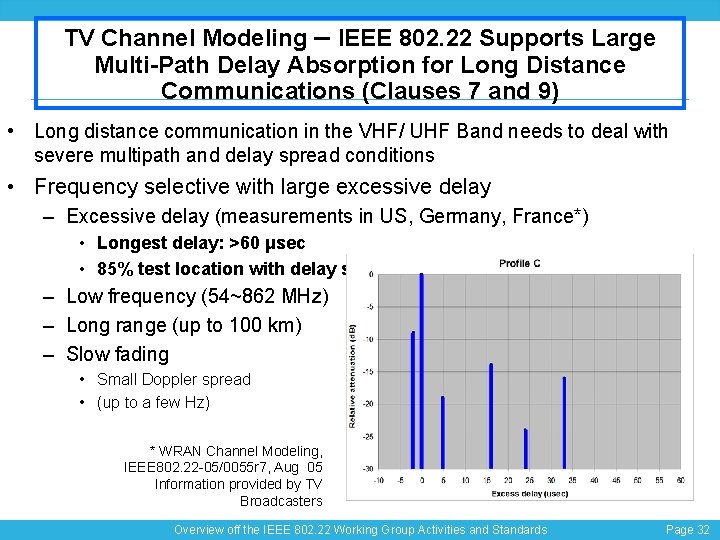
TV Channel Modeling – IEEE 802. 22 Supports Large Multi-Path Delay Absorption for Long Distance Communications (Clauses 7 and 9) • Long distance communication in the VHF/ UHF Band needs to deal with severe multipath and delay spread conditions • Frequency selective with large excessive delay – Excessive delay (measurements in US, Germany, France*) • Longest delay: >60 μsec • 85% test location with delay spread ~35 μsec – Low frequency (54~862 MHz) – Long range (up to 100 km) – Slow fading • Small Doppler spread • (up to a few Hz) EEE 802 * WRAN Channel Modeling, IEEE 802. 22 -05/0055 r 7, Aug 05 Information provided by TV Broadcasters Overview off the IEEE 802. 22 Working Group Activities and Standards Page 32
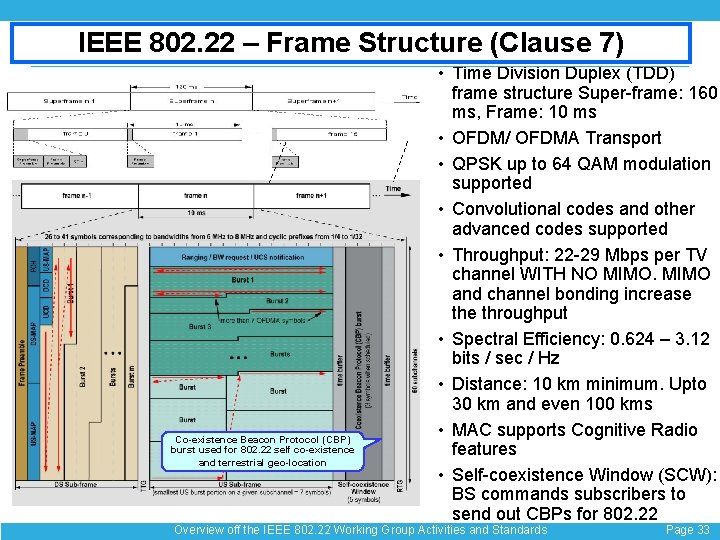
IEEE 802. 22 – Frame Structure (Clause 7) EEE 802 Co-existence Beacon Protocol (CBP) burst used for 802. 22 self co-existence and terrestrial geo-location • Time Division Duplex (TDD) frame structure Super-frame: 160 ms, Frame: 10 ms • OFDM/ OFDMA Transport • QPSK up to 64 QAM modulation supported • Convolutional codes and other advanced codes supported • Throughput: 22 -29 Mbps per TV channel WITH NO MIMO and channel bonding increase throughput • Spectral Efficiency: 0. 624 – 3. 12 bits / sec / Hz • Distance: 10 km minimum. Upto 30 km and even 100 kms • MAC supports Cognitive Radio features • Self-coexistence Window (SCW): BS commands subscribers to send out CBPs for 802. 22 Overview off the IEEE 802. 22 Working Group Activities and Standards Page 33
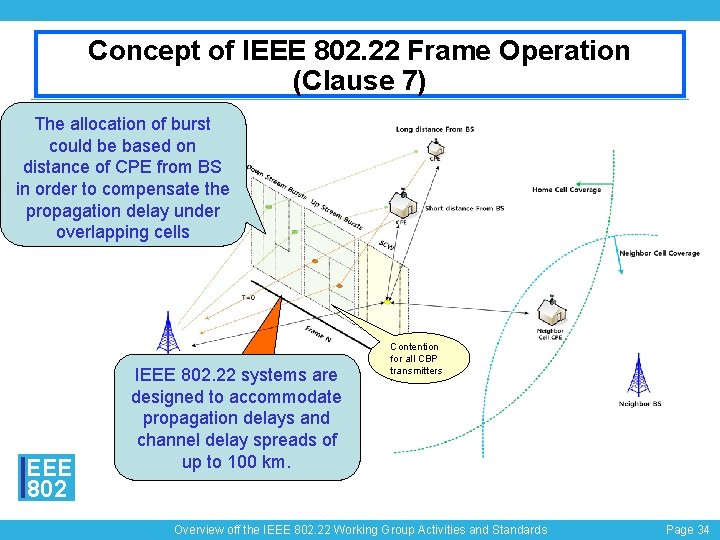
Concept of IEEE 802. 22 Frame Operation (Clause 7) The allocation of burst could be based on distance of CPE from BS in order to compensate the propagation delay under overlapping cells EEE 802 The propagation time for IEEE 802. 22 systems are CPEs beyond 30 km will designed to accommodate be accommodated by scheduling of late propagation delays and upstream bursts channel delay spreads of up to 100 km. Contention for all CBP transmitters Overview off the IEEE 802. 22 Working Group Activities and Standards Page 34
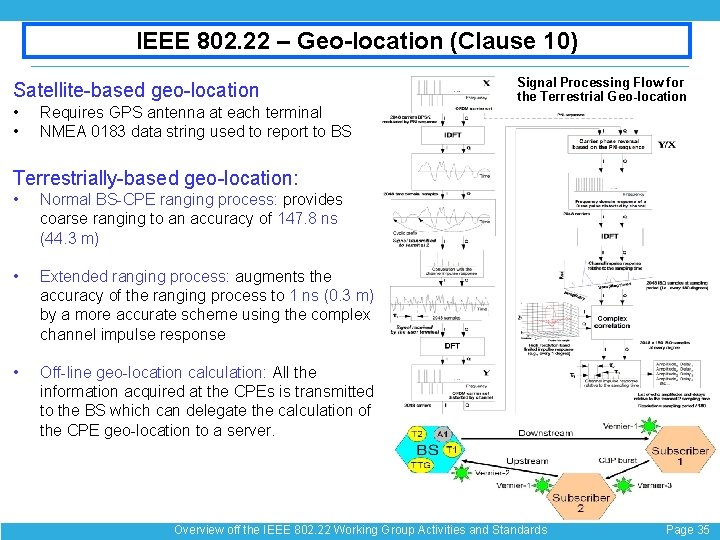
IEEE 802. 22 – Geo-location (Clause 10) Satellite-based geo-location • • Requires GPS antenna at each terminal NMEA 0183 data string used to report to BS Signal Processing Flow for the Terrestrial Geo-location Terrestrially-based geo-location: • Normal BS-CPE ranging process: provides coarse ranging to an accuracy of 147. 8 ns (44. 3 m) • Extended ranging process: augments the accuracy of the ranging process to 1 ns (0. 3 m) by a more accurate scheme using the complex channel impulse response • Off-line geo-location calculation: All the information acquired at the CPEs is transmitted to the BS which can delegate the calculation of the CPE geo-location to a server. EEE 802 Overview off the IEEE 802. 22 Working Group Activities and Standards Page 35
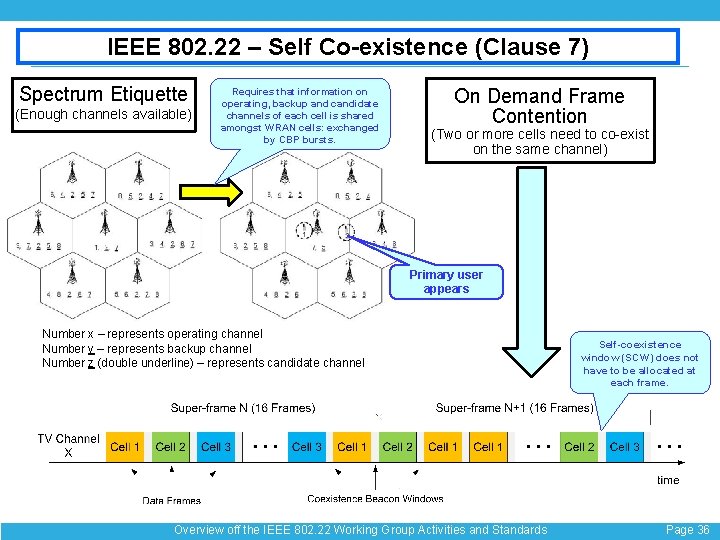
IEEE 802. 22 – Self Co-existence (Clause 7) Spectrum Etiquette (Enough channels available) Requires that information on operating, backup and candidate channels of each cell is shared amongst WRAN cells: exchanged by CBP bursts. On Demand Frame Contention (Two or more cells need to co-exist on the same channel) Primary user appears Number x – represents operating channel Number y – represents backup channel Number z (double underline) – represents candidate channel Self-coexistence window (SCW) does not have to be allocated at each frame. EEE 802 Overview off the IEEE 802. 22 Working Group Activities and Standards Page 36
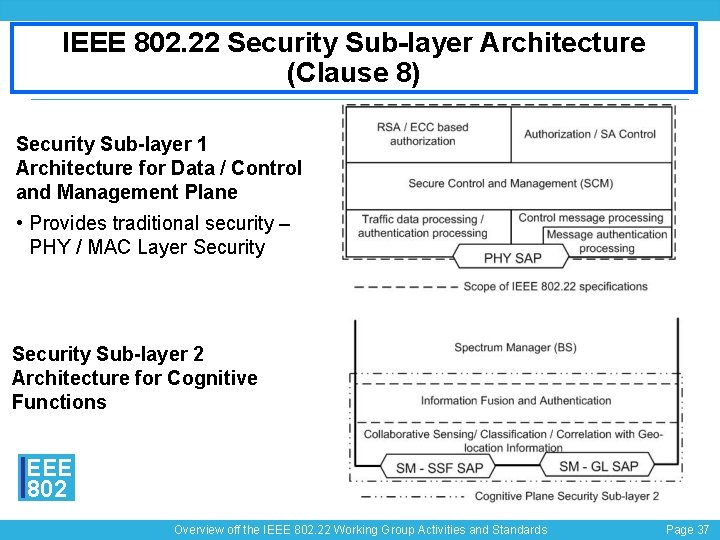
IEEE 802. 22 Security Sub-layer Architecture (Clause 8) Security Sub-layer 1 Architecture for Data / Control and Management Plane • Provides traditional security – PHY / MAC Layer Security Sub-layer 2 Architecture for Cognitive Functions EEE 802 Overview off the IEEE 802. 22 Working Group Activities and Standards Page 37
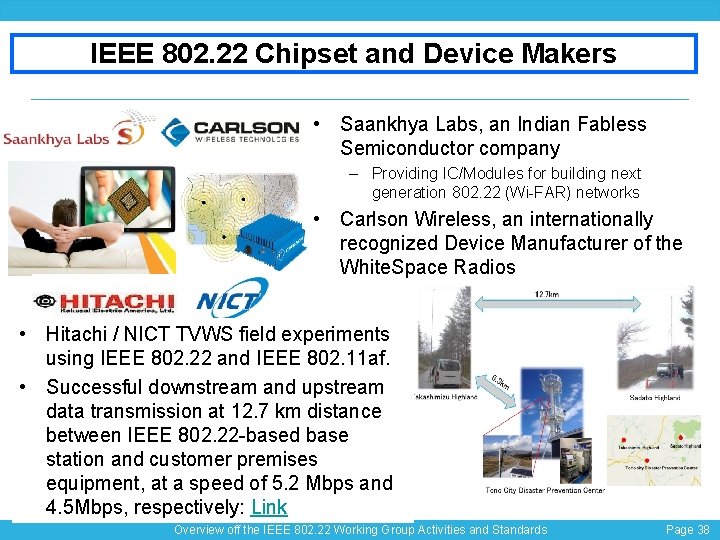
IEEE 802. 22 Chipset and Device Makers • Saankhya Labs, an Indian Fabless Semiconductor company – Providing IC/Modules for building next generation 802. 22 (Wi-FAR) networks • Carlson Wireless, an internationally recognized Device Manufacturer of the White. Space Radios • Hitachi / NICT TVWS field experiments using IEEE 802. 22 and IEEE 802. 11 af. • Successful downstream and upstream data transmission at 12. 7 km distance between IEEE 802. 22 -based base station and customer premises EEE equipment, at a speed of 5. 2 Mbps and 802 4. 5 Mbps, respectively: Link Overview off the IEEE 802. 22 Working Group Activities and Standards Page 38
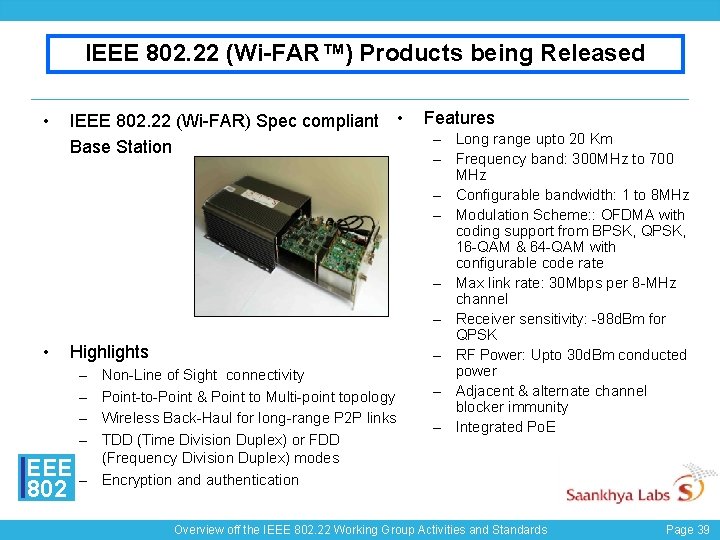
IEEE 802. 22 (Wi-FAR™) Products being Released • IEEE 802. 22 (Wi-FAR) Spec compliant • Base Station • Highlights – – EEE 802 Non-Line of Sight connectivity Point-to-Point & Point to Multi-point topology Wireless Back-Haul for long-range P 2 P links TDD (Time Division Duplex) or FDD (Frequency Division Duplex) modes – Encryption and authentication Features – Long range upto 20 Km – Frequency band: 300 MHz to 700 MHz – Configurable bandwidth: 1 to 8 MHz – Modulation Scheme: : OFDMA with coding support from BPSK, QPSK, 16 -QAM & 64 -QAM with configurable code rate – Max link rate: 30 Mbps per 8 -MHz channel – Receiver sensitivity: -98 d. Bm for QPSK – RF Power: Upto 30 d. Bm conducted power – Adjacent & alternate channel blocker immunity – Integrated Po. E Overview off the IEEE 802. 22 Working Group Activities and Standards Page 39
P 802. 22 b Amendment: Enhancements for Broadband Services and Monitoring Applications EEE 802 Overview off the IEEE 802. 22 Working Group Activities and Standards Page 40
P 802. 22 b Amendment: Enhancements for Broadband Services and Monitoring Applications Scope: This standard specifies alternate Physical Layer (PHY) and necessary Medium Access Control Layer (MAC) enhancements to IEEE std. 802. 22 -2011 for operation in Very High Frequency (VHF)/ Ultra High Frequency (UHF) TV broadcast bands between 54 MHz and 862 MHz to support enhanced broadband services and monitoring applications. The standard supports aggregate data rates greater than the maximum data rate supported by the IEEE Std. 802. 22 -2011. This standard defines new classes of 802. 22 devices to address these applications and supports more than 512 devices in a network. This standard also specifies techniques to enhance communications among the devices and makes necessary amendments to the cognitive, security & parameters and connection management clauses. This amendment supports mechanisms to enable coexistence with other 802 systems in the same band EEE 802 Overview off the IEEE 802. 22 Working Group Activities and Standards Page 41
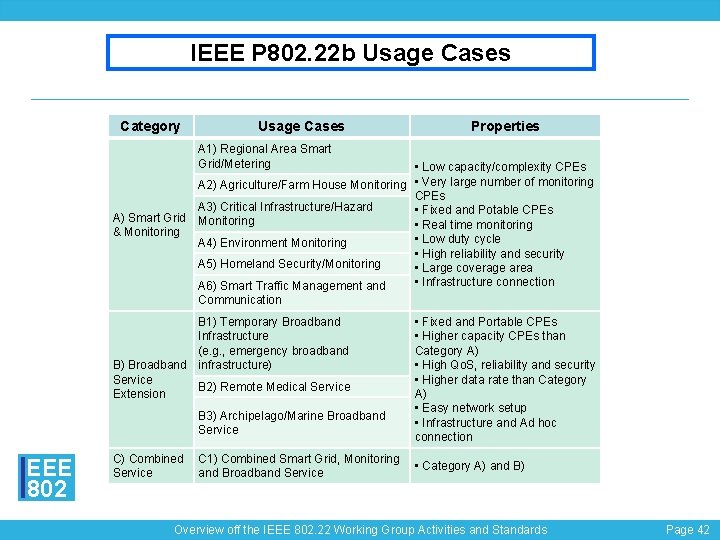
IEEE P 802. 22 b Usage Cases Category Usage Cases Properties A 1) Regional Area Smart Grid/Metering • Low capacity/complexity CPEs A 2) Agriculture/Farm House Monitoring • Very large number of monitoring CPEs A 3) Critical Infrastructure/Hazard • Fixed and Potable CPEs A) Smart Grid Monitoring • Real time monitoring & Monitoring • Low duty cycle A 4) Environment Monitoring • High reliability and security A 5) Homeland Security/Monitoring • Large coverage area • Infrastructure connection A 6) Smart Traffic Management and Communication B 1) Temporary Broadband Infrastructure (e. g. , emergency broadband B) Broadband infrastructure) Service B 2) Remote Medical Service Extension B 3) Archipelago/Marine Broadband Service EEE 802 C) Combined Service C 1) Combined Smart Grid, Monitoring and Broadband Service • Fixed and Portable CPEs • Higher capacity CPEs than Category A) • High Qo. S, reliability and security • Higher data rate than Category A) • Easy network setup • Infrastructure and Ad hoc connection • Category A) and B) Overview off the IEEE 802. 22 Working Group Activities and Standards Page 42
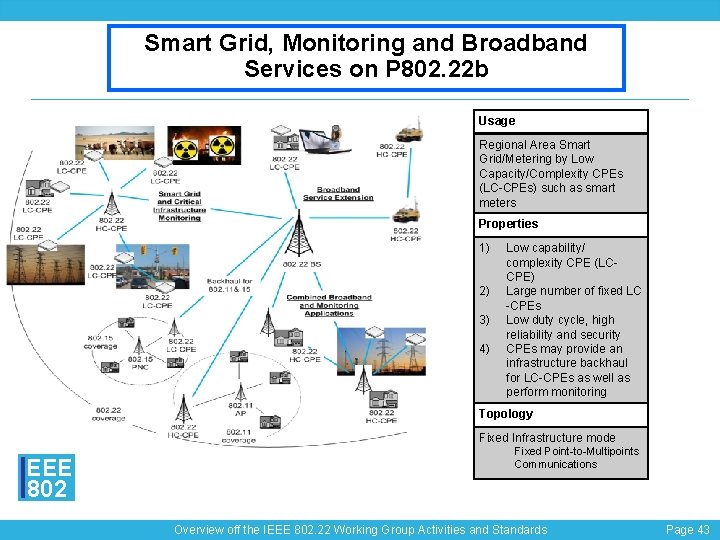
Smart Grid, Monitoring and Broadband Services on P 802. 22 b Usage Regional Area Smart Grid/Metering by Low Capacity/Complexity CPEs (LC-CPEs) such as smart meters Properties 1) 2) 3) 4) Low capability/ complexity CPE (LCCPE) Large number of fixed LC -CPEs Low duty cycle, high reliability and security CPEs may provide an infrastructure backhaul for LC-CPEs as well as perform monitoring Topology Fixed Infrastructure mode EEE 802 Fixed Point-to-Multipoints Communications Overview off the IEEE 802. 22 Working Group Activities and Standards Page 43
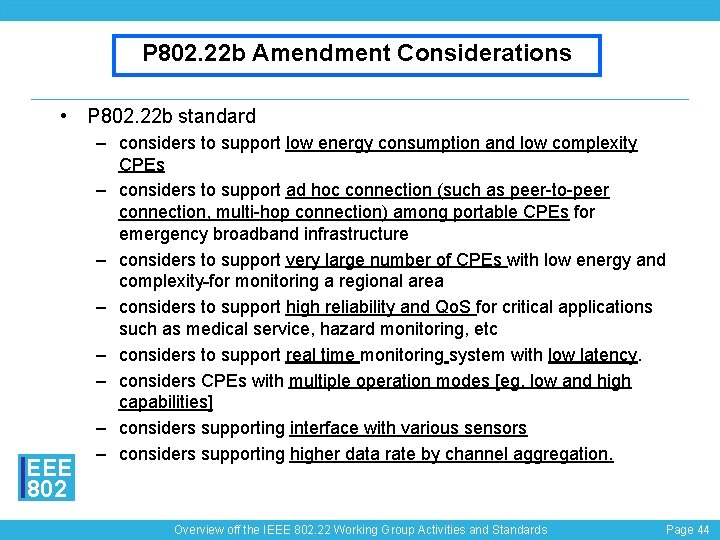
P 802. 22 b Amendment Considerations • P 802. 22 b standard EEE 802 – considers to support low energy consumption and low complexity CPEs – considers to support ad hoc connection (such as peer-to-peer connection, multi-hop connection) among portable CPEs for emergency broadband infrastructure – considers to support very large number of CPEs with low energy and complexity for monitoring a regional area – considers to support high reliability and Qo. S for critical applications such as medical service, hazard monitoring, etc – considers to support real time monitoring system with low latency. – considers CPEs with multiple operation modes [eg. low and high capabilities] – considers supporting interface with various sensors – considers supporting higher data rate by channel aggregation. Overview off the IEEE 802. 22 Working Group Activities and Standards Page 44
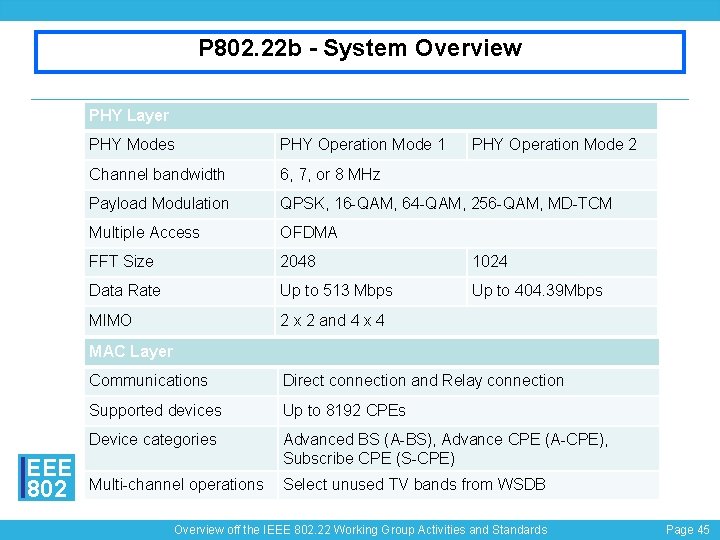
P 802. 22 b - System Overview PHY Layer PHY Modes PHY Operation Mode 1 PHY Operation Mode 2 Channel bandwidth 6, 7, or 8 MHz Payload Modulation QPSK, 16 -QAM, 64 -QAM, 256 -QAM, MD-TCM Multiple Access OFDMA FFT Size 2048 1024 Data Rate Up to 513 Mbps Up to 404. 39 Mbps MIMO 2 x 2 and 4 x 4 MAC Layer EEE 802 Communications Direct connection and Relay connection Supported devices Up to 8192 CPEs Device categories Advanced BS (A-BS), Advance CPE (A-CPE), Subscribe CPE (S-CPE) Multi-channel operations Select unused TV bands from WSDB Overview off the IEEE 802. 22 Working Group Activities and Standards Page 45
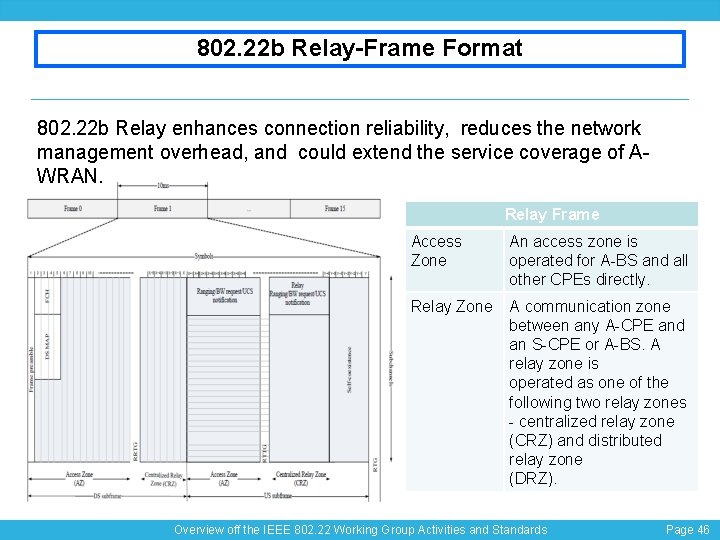
802. 22 b Relay-Frame Format 802. 22 b Relay enhances connection reliability, reduces the network management overhead, and could extend the service coverage of AWRAN. Relay Frame EEE 802 Access Zone An access zone is operated for A-BS and all other CPEs directly. Relay Zone A communication zone between any A-CPE and an S-CPE or A-BS. A relay zone is operated as one of the following two relay zones - centralized relay zone (CRZ) and distributed relay zone (DRZ). Overview off the IEEE 802. 22 Working Group Activities and Standards Page 46
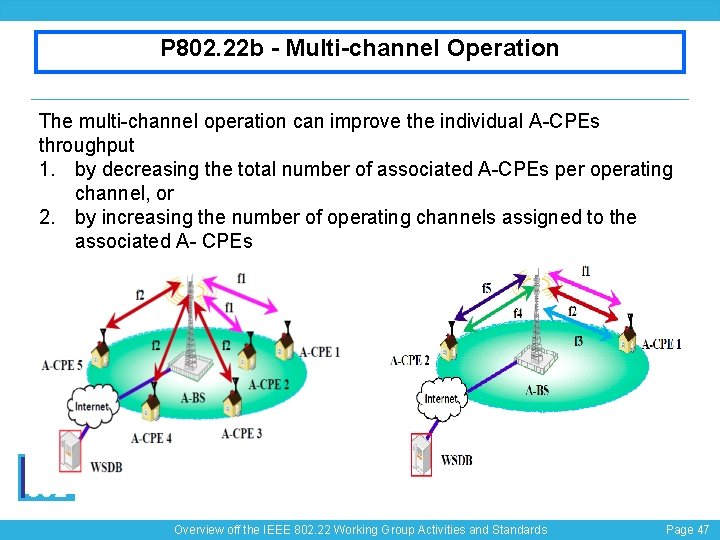
P 802. 22 b - Multi-channel Operation The multi-channel operation can improve the individual A-CPEs throughput 1. by decreasing the total number of associated A-CPEs per operating channel, or 2. by increasing the number of operating channels assigned to the associated A- CPEs EEE 802 Overview off the IEEE 802. 22 Working Group Activities and Standards Page 47
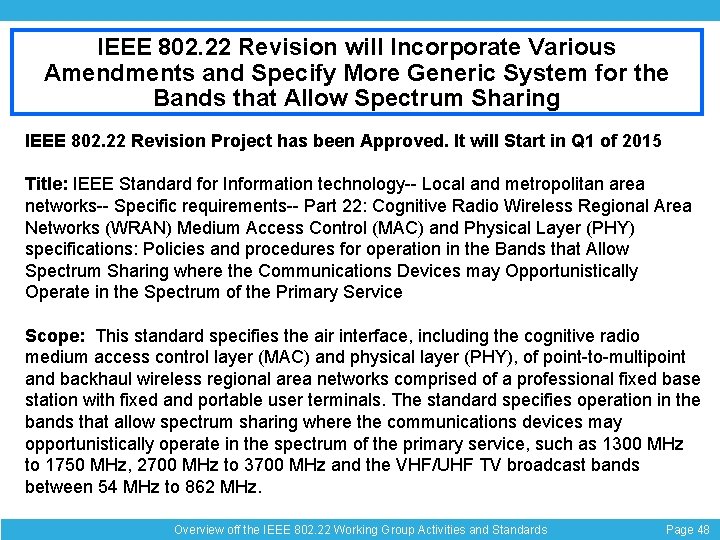
IEEE 802. 22 Revision will Incorporate Various Amendments and Specify More Generic System for the Bands that Allow Spectrum Sharing IEEE 802. 22 Revision Project has been Approved. It will Start in Q 1 of 2015 Title: IEEE Standard for Information technology-- Local and metropolitan area networks-- Specific requirements-- Part 22: Cognitive Radio Wireless Regional Area Networks (WRAN) Medium Access Control (MAC) and Physical Layer (PHY) specifications: Policies and procedures for operation in the Bands that Allow Spectrum Sharing where the Communications Devices may Opportunistically Operate in the Spectrum of the Primary Service Scope: This standard specifies the air interface, including the cognitive radio medium access control layer (MAC) and physical layer (PHY), of point-to-multipoint and backhaul wireless regional area networks comprised of a professional fixed base station with fixed and portable user terminals. The standard specifies operation in the bands that allow spectrum sharing where the communications devices may opportunistically operate in the spectrum of the primary service, such as 1300 MHz to 1750 MHz, 2700 MHz to 3700 MHz and the VHF/UHF TV broadcast bands EEE between 802 54 MHz to 862 MHz. Overview off the IEEE 802. 22 Working Group Activities and Standards Page 48
Conclusions • IEEE 802. 22 Working Group has created Cognitive Radio and Spectrum Sharing Technologies that are applicable to Television Band White Spaces as well as Other (e. g. Radar) Bands • IEEE 802. 22 defines the First IEEE Cognitive Radio Standard for operation in Television Whitespaces • IEEE 802. 22 is the First IEEE Standard that is specifically designed for rural and regional area broadband access aimed at removing the digital divide • IEEE 802. 22 (Wi-FAR™) provides Broadband Wireless Access to Regional, Rural and Remote Areas Under Line of Sight (Lo. S) and Non Line of Sight (NLo. S) conditions without causing harmful interference to the incumbents. • Other IEEE 802. 22 supporting technologies such as the IEEE 802. 22. 1 Advanced Beaconing and new IEEE 802. 22. 3 Spectrum Characterization and Occupancy Sensing (SCOS) Study Group will create enabling technologies for spectrum sharing. • We hope that IEEE 802. 22 Family of Standards will be adopted through the PSDO process by the ISO. EEE 802 Overview off the IEEE 802. 22 Working Group Activities and Standards Page 49
References • IEEE 802. 22 Working Group Website – www. ieee 802. org/22 • Apurva Mody, Gerald Chouinard, “Overview of the IEEE 802. 22 Standard on Wireless Regional Area Networks (WRAN) and Core Technologies” http: //www. ieee 802. org/22/Technology/22 -10 -0073 -03 -0000802 -22 -overview-and-core-technologies. pdf • White. Space Alliance: www. White. Space. Alliance. org • Get Completed IEEE 802. 22 Standards Here: http: //standards. ieee. org/about/get/802. 22. html EEE 802 Overview off the IEEE 802. 22 Working Group Activities and Standards Page 50