
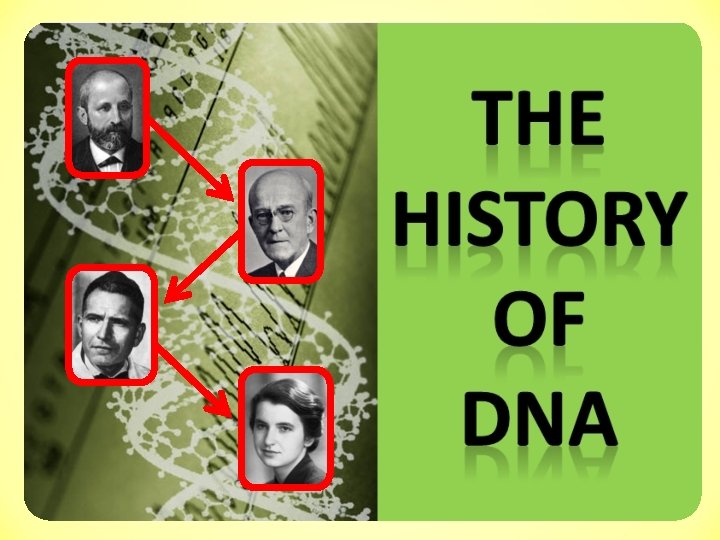
OVERVIEW OF THE HISTORY OF DNA RESEARCH 1869

- Slides: 15
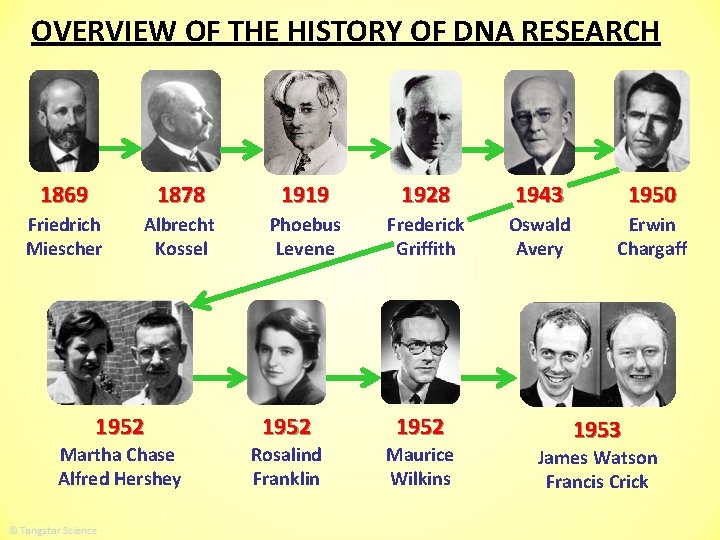
OVERVIEW OF THE HISTORY OF DNA RESEARCH 1869 1878 1919 1928 1943 1950 Friedrich Miescher Albrecht Kossel Phoebus Levene Frederick Griffith Oswald Avery Erwin Chargaff 1952 Martha Chase Alfred Hershey Rosalind Franklin Maurice Wilkins 1953 James Watson Francis Crick
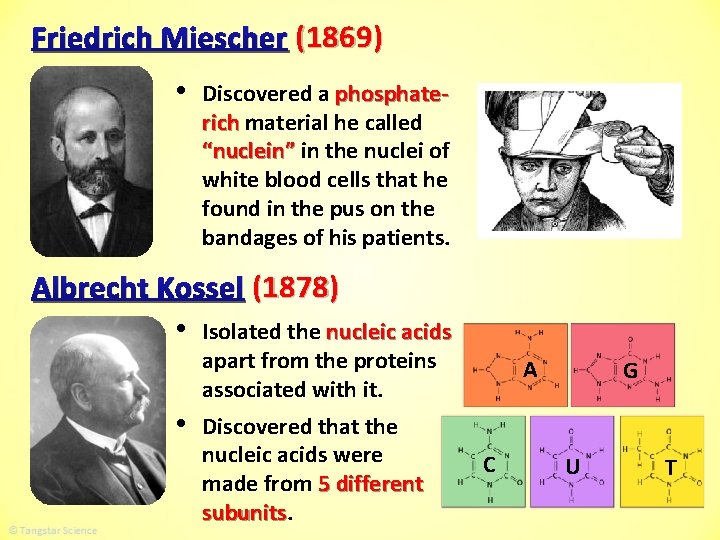
Friedrich Miescher (1869) • Discovered a phosphaterich material he called “nuclein” in the nuclei of white blood cells that he found in the pus on the bandages of his patients. Albrecht Kossel (1878) • Isolated the nucleic acids apart from the proteins associated with it. • Discovered that the nucleic acids were made from 5 different subunits A C G U T
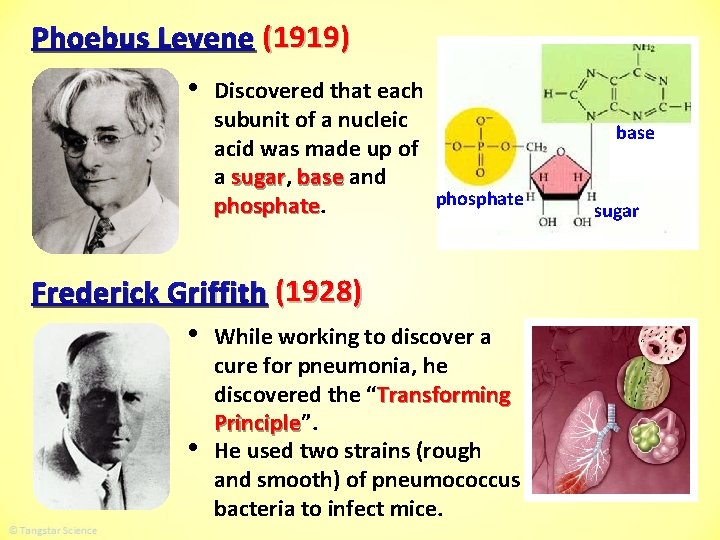
Phoebus Levene (1919) • Discovered that each subunit of a nucleic acid was made up of a sugar, sugar base and phosphate Frederick Griffith (1928) • While working to discover a • cure for pneumonia, he discovered the “Transforming Principle”. Principle He used two strains (rough and smooth) of pneumococcus bacteria to infect mice. base sugar
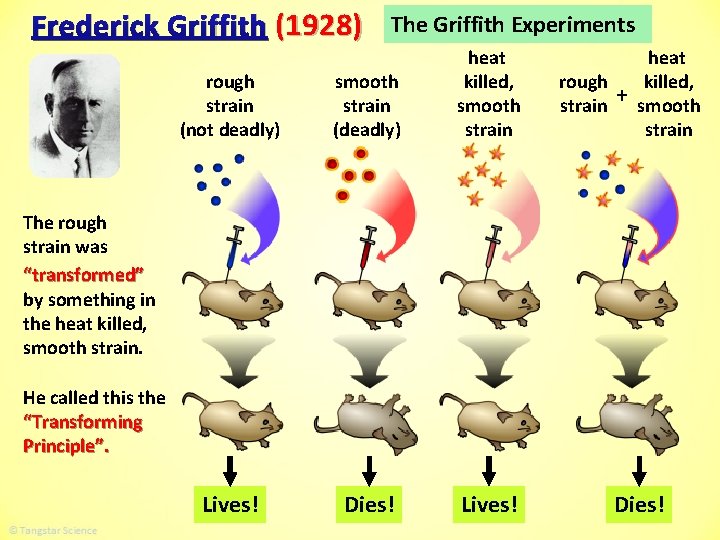
Frederick Griffith (1928) The Griffith Experiments rough strain (not deadly) smooth strain (deadly) heat killed, smooth strain Lives! Dies! Lives! rough strain + heat killed, smooth strain The rough strain was “transformed” by something in the heat killed, smooth strain. He called this the “Transforming Principle”. Dies!
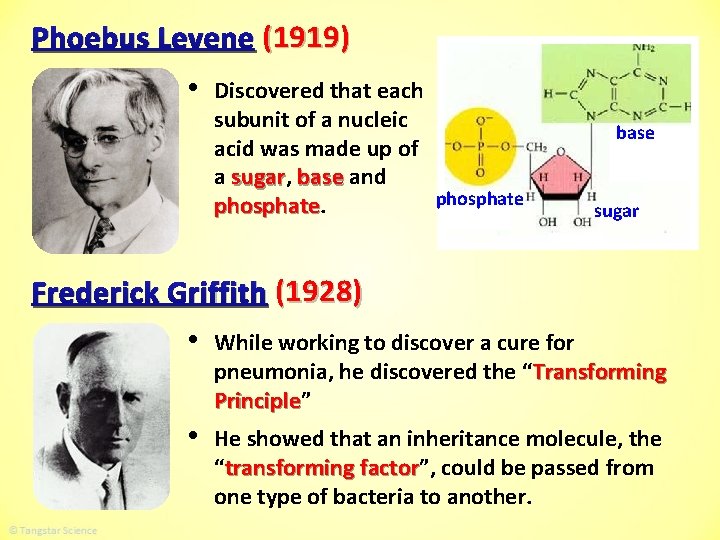
Phoebus Levene (1919) • Discovered that each subunit of a nucleic acid was made up of a sugar, sugar base and phosphate base sugar Frederick Griffith (1928) • While working to discover a cure for pneumonia, he discovered the “Transforming Principle” Principle • He showed that an inheritance molecule, the “transforming factor”, factor could be passed from one type of bacteria to another.
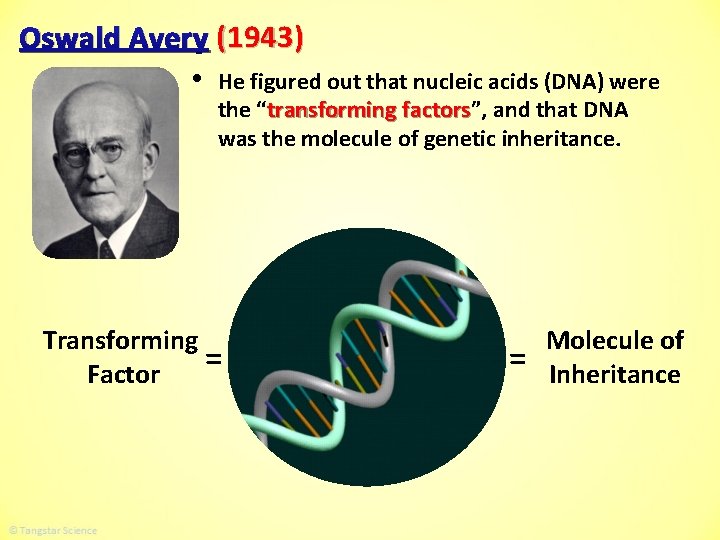
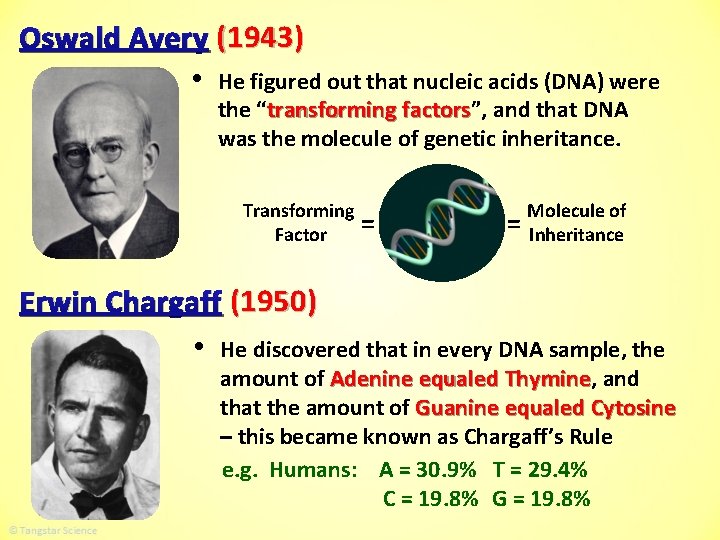
Oswald Avery (1943) • He figured out that nucleic acids (DNA) were the “transforming factors”, factors and that DNA was the molecule of genetic inheritance. Transforming = Factor = Molecule of Inheritance
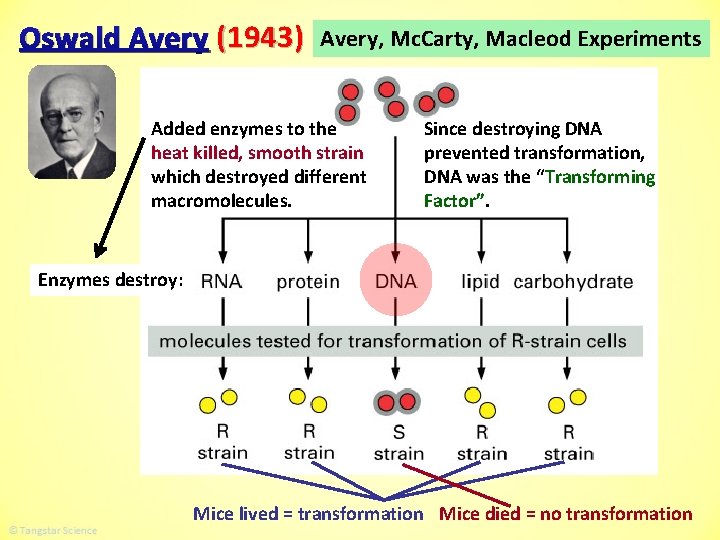
Oswald Avery (1943) Avery, Mc. Carty, Macleod Experiments Added enzymes to the heat killed, smooth strain which destroyed different macromolecules. Since destroying DNA prevented transformation, DNA was the “Transforming Factor”. Enzymes destroy: Mice lived = transformation Mice died = no transformation
Oswald Avery (1943) • He figured out that nucleic acids (DNA) were the “transforming factors”, factors and that DNA was the molecule of genetic inheritance. Transforming Factor = = Molecule of Inheritance Erwin Chargaff (1950) • He discovered that in every DNA sample, the amount of Adenine equaled Thymine, Thymine and that the amount of Guanine equaled Cytosine – this became known as Chargaff’s Rule e. g. Humans: A = 30. 9% T = 29. 4% C = 19. 8% G = 19. 8%
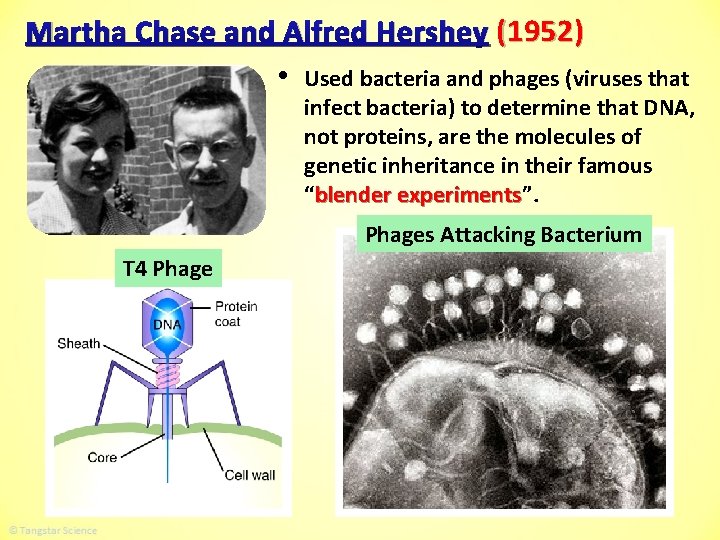
Martha Chase and Alfred Hershey (1952) • Used bacteria and phages (viruses that infect bacteria) to determine that DNA, not proteins, are the molecules of genetic inheritance in their famous “blender experiments”. experiments Phages Attacking Bacterium T 4 Phage
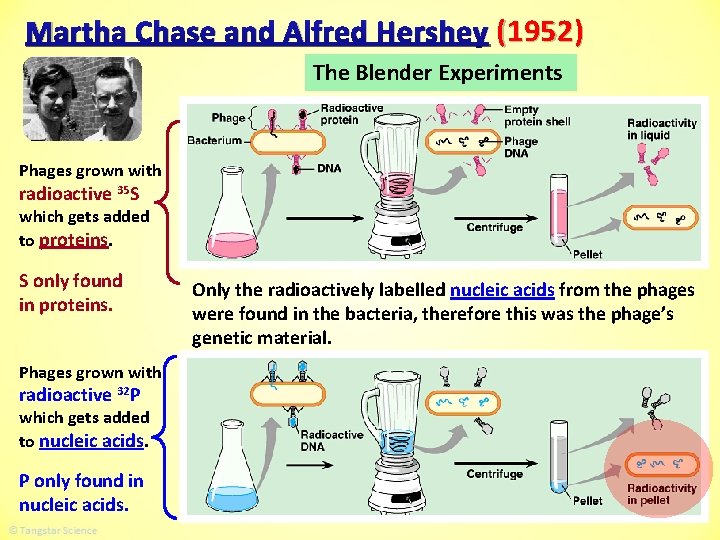
Martha Chase and Alfred Hershey (1952) The Blender Experiments Phages grown with radioactive 35 S which gets added to proteins. S only found in proteins. Phages grown with radioactive 32 P which gets added to nucleic acids. P only found in nucleic acids. Only the radioactively labelled nucleic acids from the phages were found in the bacteria, therefore this was the phage’s genetic material.
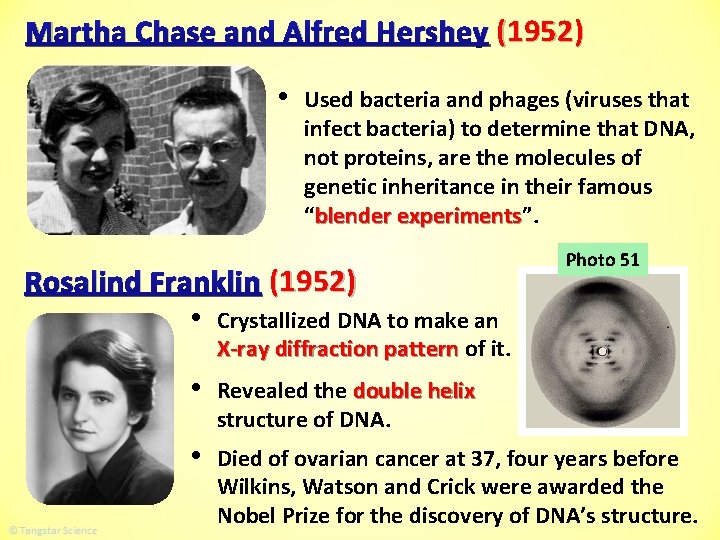
Martha Chase and Alfred Hershey (1952) • Used bacteria and phages (viruses that infect bacteria) to determine that DNA, not proteins, are the molecules of genetic inheritance in their famous “blender experiments”. experiments Rosalind Franklin (1952) • Crystallized DNA to make an Photo 51 X-ray diffraction pattern of it. • Revealed the double helix structure of DNA. • Died of ovarian cancer at 37, four years before Wilkins, Watson and Crick were awarded the Nobel Prize for the discovery of DNA’s structure.
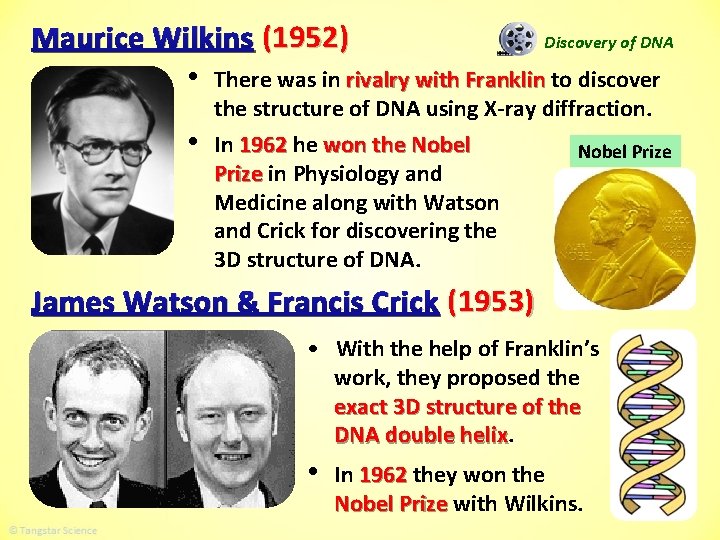
Maurice Wilkins (1952) Discovery of DNA • There was in rivalry with Franklin to discover • the structure of DNA using X-ray diffraction. In 1962 he won the Nobel Prize in Physiology and Medicine along with Watson and Crick for discovering the 3 D structure of DNA. James Watson & Francis Crick (1953) • With the help of Franklin’s work, they proposed the exact 3 D structure of the DNA double helix • In 1962 they won the Nobel Prize with Wilkins.
The End!
Created by Anh-Thi Tang – Tangstar Science Copyright © April 2013 Anh-Thi Tang (a. k. a. Tangstar Science) All rights reserved by author. This document is for personal classroom use only. This entire document, or any parts within, may not be electronically distributed or posted to any website.