
Overview of the GRADE approach selected slides 3


- Slides: 16
Overview of the GRADE approach – selected slides 3 rd European Summer School in Evidence-Based Public Health, Munich, 4 th – 8 th July 2016 Dr. Eva Rehfuess Ludwig-Maximilians-University, Munich, Germany rehfuess@ibe. med. uni-muenchen. de
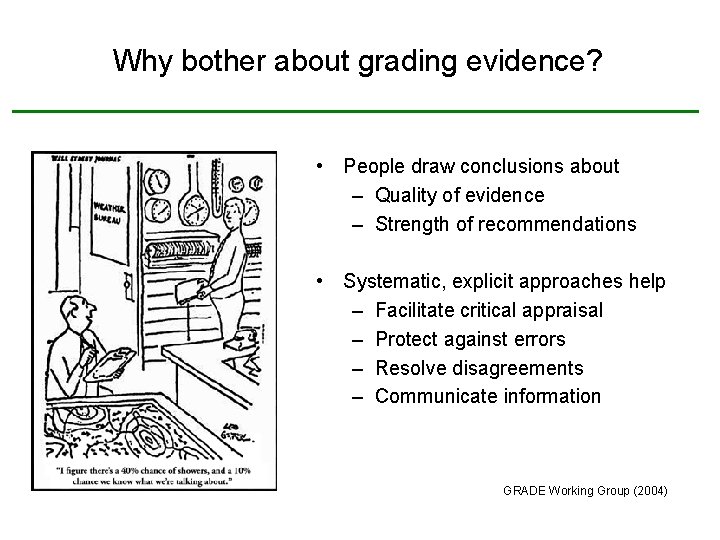
Why bother about grading evidence? • People draw conclusions about – Quality of evidence – Strength of recommendations • Systematic, explicit approaches help – Facilitate critical appraisal – Protect against errors – Resolve disagreements – Communicate information GRADE Working Group (2004)
Grading of Recommendations Assessment, Development and Evaluation • System (and common language) that – was developed and updated by GRADE Working Group – has been endorsed by large number of organisations – expresses degree of confidence one can place in quality of evidence and strength of recommendation • System for assessing quality of evidence of a body of evidence based on – study design – criteria for downgrading/upgrading GRADE Working Group (2004); Guyatt et al (2008)
Rating quality of evidence
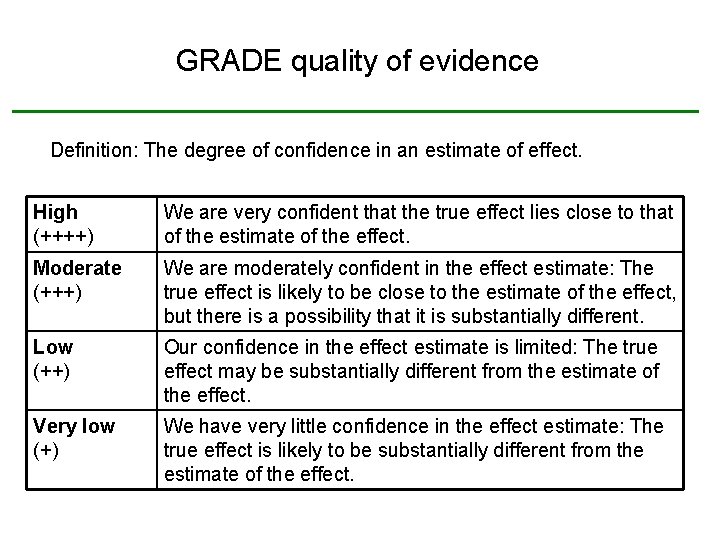
GRADE quality of evidence Definition: The degree of confidence in an estimate of effect. High (++++) We are very confident that the true effect lies close to that of the estimate of the effect. Moderate (+++) We are moderately confident in the effect estimate: The true effect is likely to be close to the estimate of the effect, but there is a possibility that it is substantially different. Low (++) Our confidence in the effect estimate is limited: The true effect may be substantially different from the estimate of the effect. Very low (+) We have very little confidence in the effect estimate: The true effect is likely to be substantially different from the estimate of the effect.
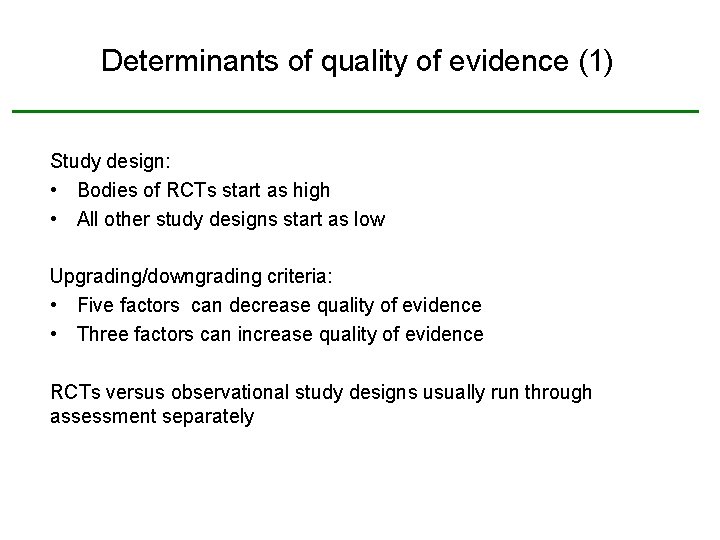
Determinants of quality of evidence (1) Study design: • Bodies of RCTs start as high • All other study designs start as low Upgrading/downgrading criteria: • Five factors can decrease quality of evidence • Three factors can increase quality of evidence RCTs versus observational study designs usually run through assessment separately
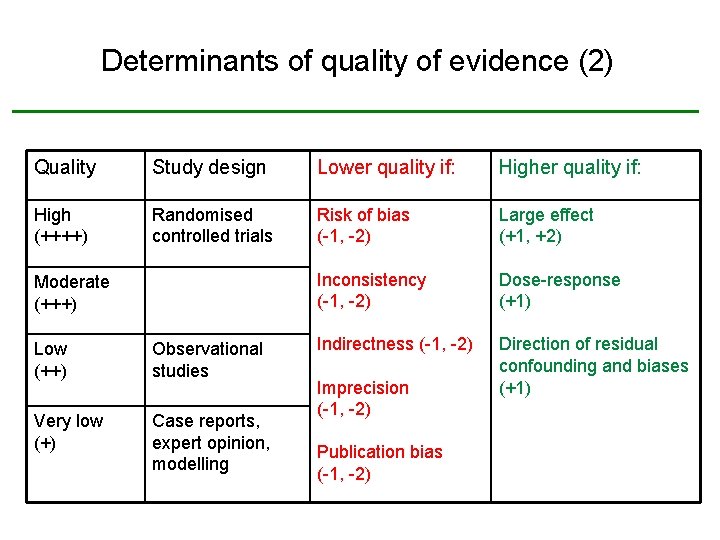
Determinants of quality of evidence (2) Quality Study design Lower quality if: High (++++) Randomised controlled trials Risk of bias (-1, -2) Large effect (+1, +2) Inconsistency (-1, -2) Dose-response (+1) Indirectness (-1, -2) Direction of residual confounding and biases (+1) Moderate (+++) Low (++) Observational studies Very low (+) Case reports, expert opinion, modelling Imprecision (-1, -2) Publication bias (-1, -2)
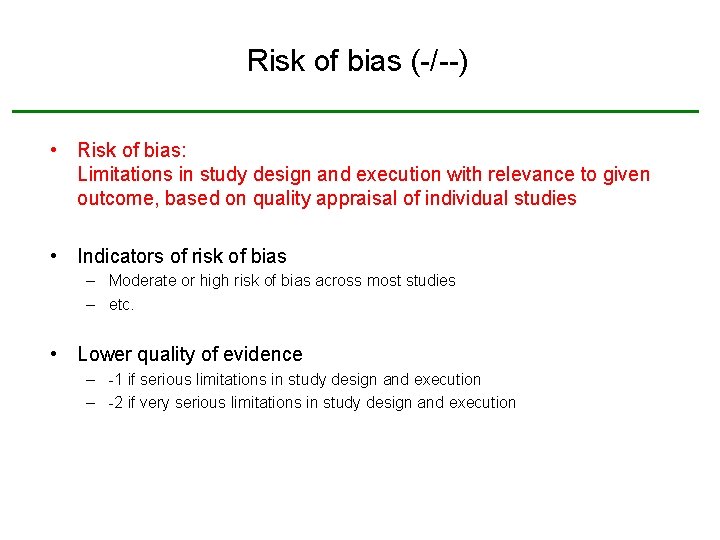
Risk of bias (-/--) • Risk of bias: Limitations in study design and execution with relevance to given outcome, based on quality appraisal of individual studies • Indicators of risk of bias – Moderate or high risk of bias across most studies – etc. • Lower quality of evidence – -1 if serious limitations in study design and execution – -2 if very serious limitations in study design and execution
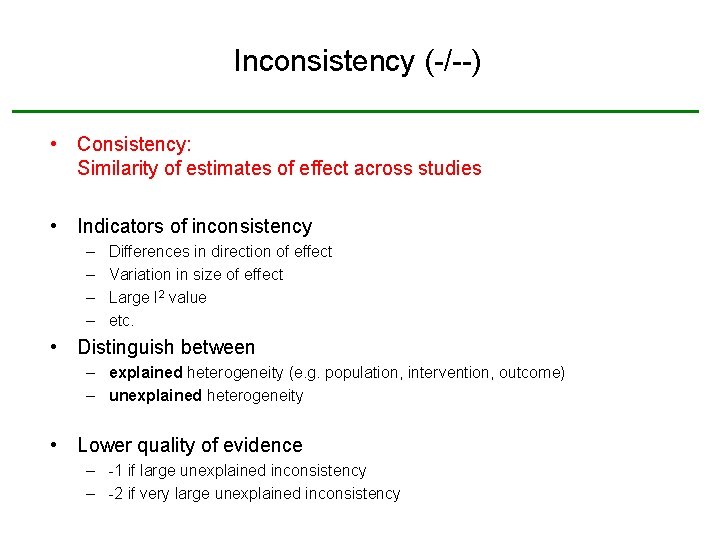
Inconsistency (-/--) • Consistency: Similarity of estimates of effect across studies • Indicators of inconsistency – – Differences in direction of effect Variation in size of effect Large I 2 value etc. • Distinguish between – explained heterogeneity (e. g. population, intervention, outcome) – unexplained heterogeneity • Lower quality of evidence – -1 if large unexplained inconsistency – -2 if very large unexplained inconsistency
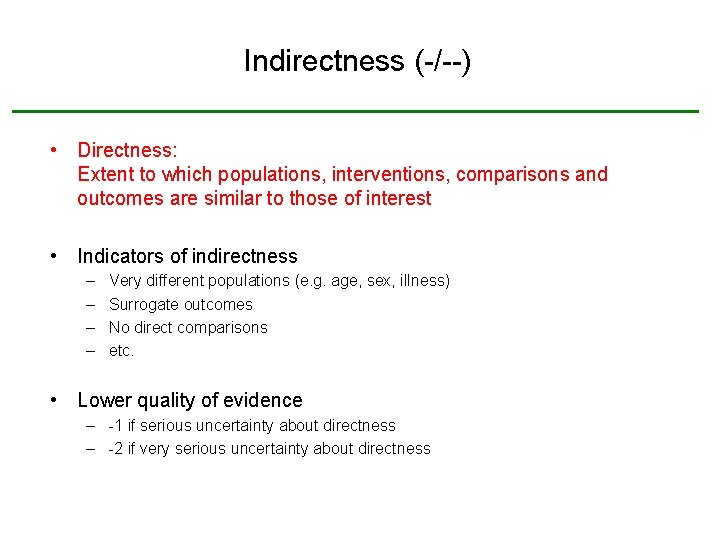
Indirectness (-/--) • Directness: Extent to which populations, interventions, comparisons and outcomes are similar to those of interest • Indicators of indirectness – – Very different populations (e. g. age, sex, illness) Surrogate outcomes No direct comparisons etc. • Lower quality of evidence – -1 if serious uncertainty about directness – -2 if very serious uncertainty about directness
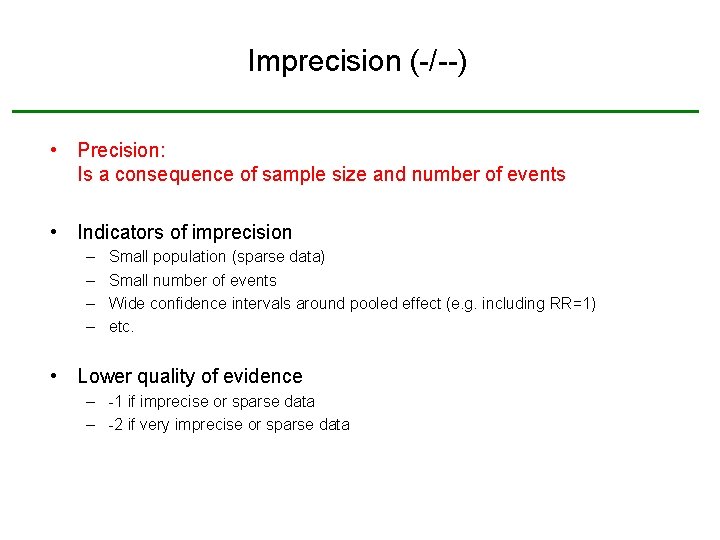
Imprecision (-/--) • Precision: Is a consequence of sample size and number of events • Indicators of imprecision – – Small population (sparse data) Small number of events Wide confidence intervals around pooled effect (e. g. including RR=1) etc. • Lower quality of evidence – -1 if imprecise or sparse data – -2 if very imprecise or sparse data
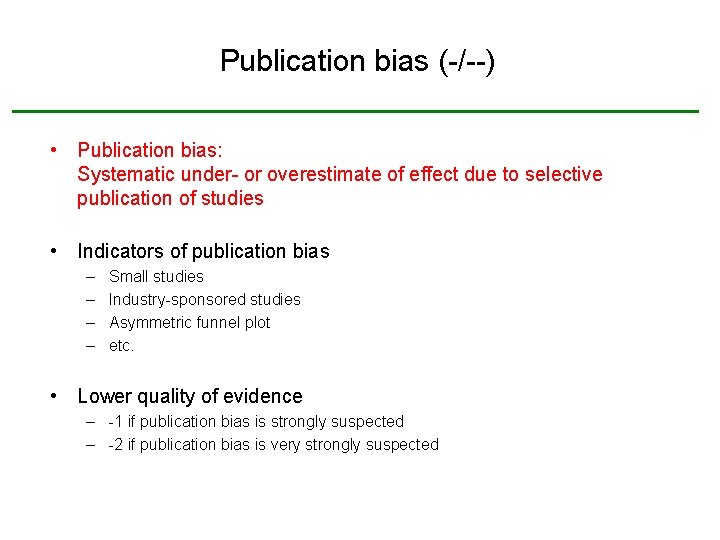
Publication bias (-/--) • Publication bias: Systematic under- or overestimate of effect due to selective publication of studies • Indicators of publication bias – – Small studies Industry-sponsored studies Asymmetric funnel plot etc. • Lower quality of evidence – -1 if publication bias is strongly suspected – -2 if publication bias is very strongly suspected
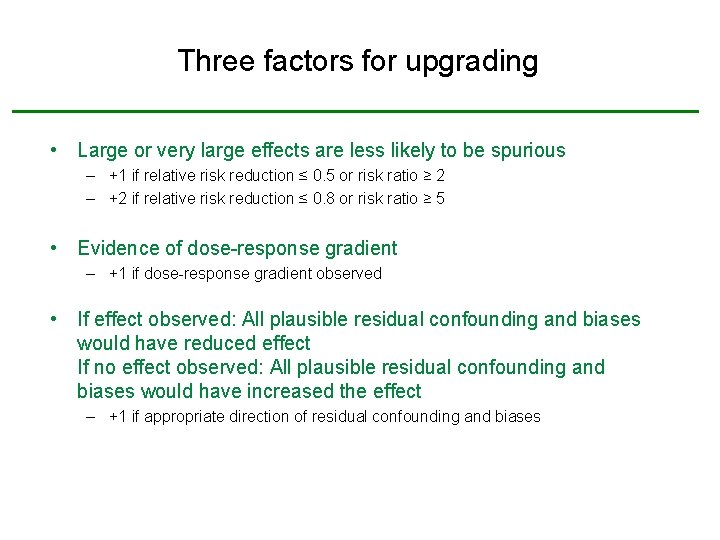
Three factors for upgrading • Large or very large effects are less likely to be spurious – +1 if relative risk reduction ≤ 0. 5 or risk ratio ≥ 2 – +2 if relative risk reduction ≤ 0. 8 or risk ratio ≥ 5 • Evidence of dose-response gradient – +1 if dose-response gradient observed • If effect observed: All plausible residual confounding and biases would have reduced effect If no effect observed: All plausible residual confounding and biases would have increased the effect – +1 if appropriate direction of residual confounding and biases
Grading strength of a recommendation
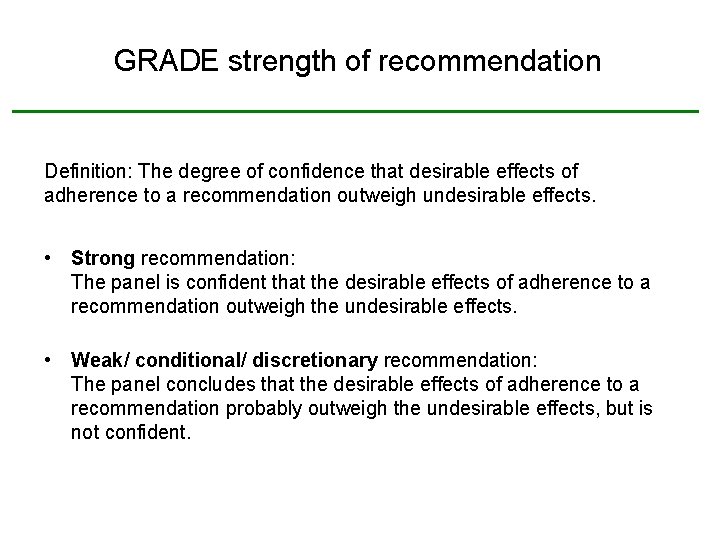
GRADE strength of recommendation Definition: The degree of confidence that desirable effects of adherence to a recommendation outweigh undesirable effects. • Strong recommendation: The panel is confident that the desirable effects of adherence to a recommendation outweigh the undesirable effects. • Weak/ conditional/ discretionary recommendation: The panel concludes that the desirable effects of adherence to a recommendation probably outweigh the undesirable effects, but is not confident.
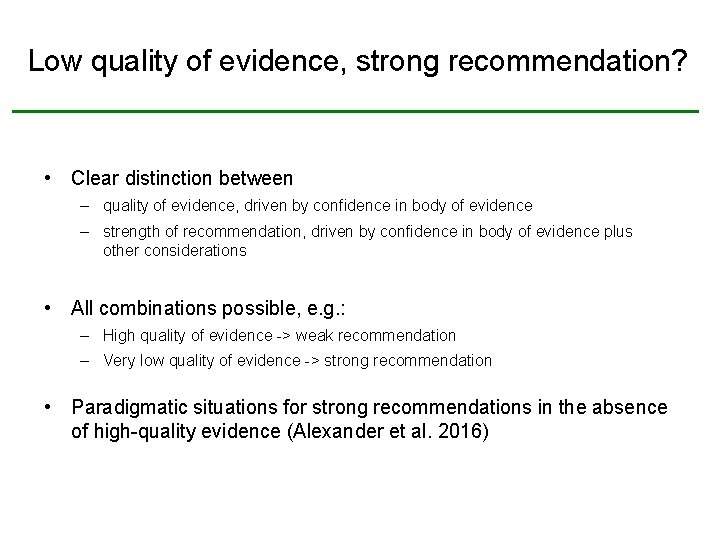
Low quality of evidence, strong recommendation? • Clear distinction between – quality of evidence, driven by confidence in body of evidence – strength of recommendation, driven by confidence in body of evidence plus other considerations • All combinations possible, e. g. : – High quality of evidence -> weak recommendation – Very low quality of evidence -> strong recommendation • Paradigmatic situations for strong recommendations in the absence of high-quality evidence (Alexander et al. 2016)