
Overview of the Geostationary Earth Radiation Budget GERB
Overview of the “Geostationary Earth Radiation Budget (GERB)” Experience. Nicolas Clerbaux Royal Meteorological Institute of Belgium (RMIB) In collaboration with: Imperial College, UK. Rutherford Appleton Laboratory (RAL), UK. GERB International Science Team (GIST).
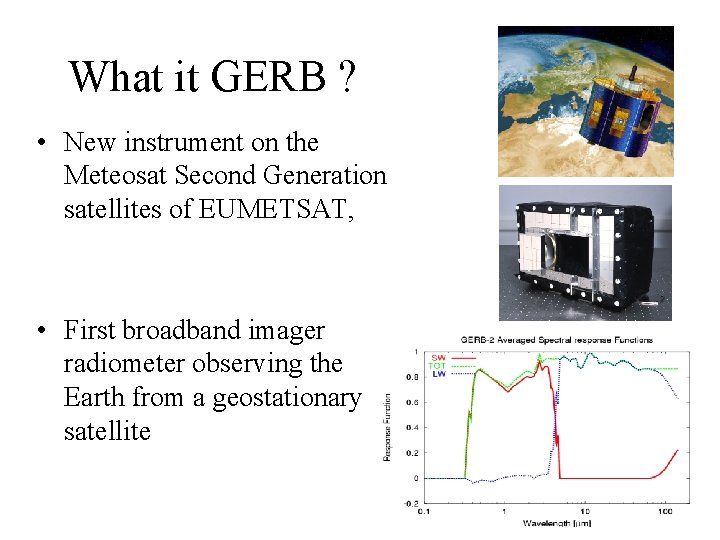
What it GERB ? • New instrument on the Meteosat Second Generation satellites of EUMETSAT, • First broadband imager radiometer observing the Earth from a geostationary satellite
Outline of the talk • The GERB mission/science goals : why we need new measurements of the Earth Radiation Budget (ERB), • Interest of the Meteosat field-of-view, • GERB instrument, data processing, derived products and current status, • Examples of GERB data usage

The Earth Radiation Budget (ERB)
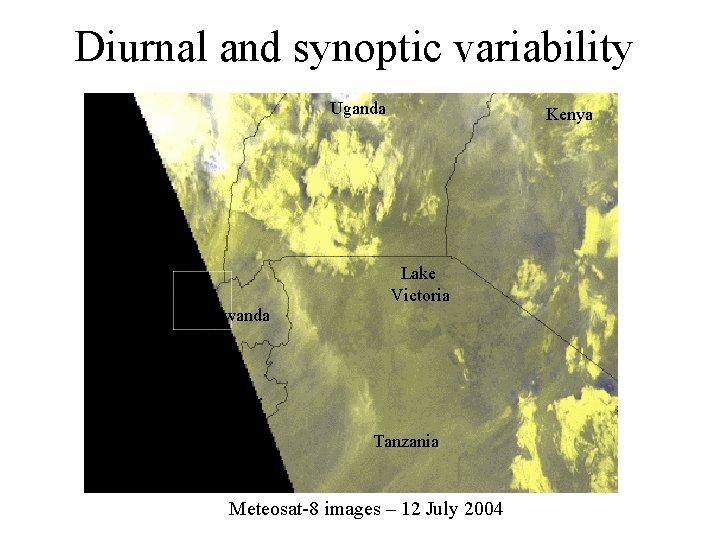
Diurnal and synoptic variability Uganda Kenya Lake Victoria Rwanda Burundi Congo Tanzania Meteosat-8 images – 12 July 2004
GERB Mission • Measurement of the ERB with high temporal sampling thanks to the geostationary orbit. Science goals • Improvement of climate models by better understanding the role of clouds and water vapour in the ERB, • Improvement of Numerical Weather Prediction (NWP) models by data assimilation or near real-time validation, • Synergy with low orbit satellites observations: improvement of the diurnal model, • Climate monitoring in the frame of the EUMETSAT Satellite Application Facility on Climate Monitoring (CMSAF).
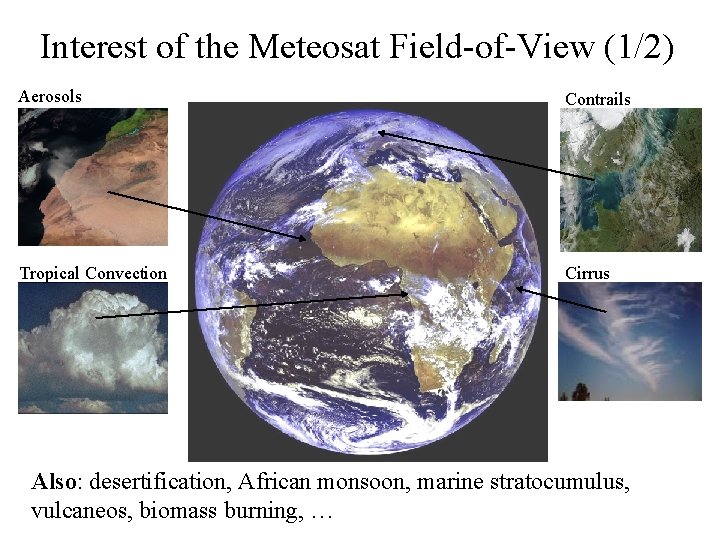
Interest of the Meteosat Field-of-View (1/2) Aerosols Contrails Tropical Convection Cirrus Also: desertification, African monsoon, marine stratocumulus, vulcaneos, biomass burning, …
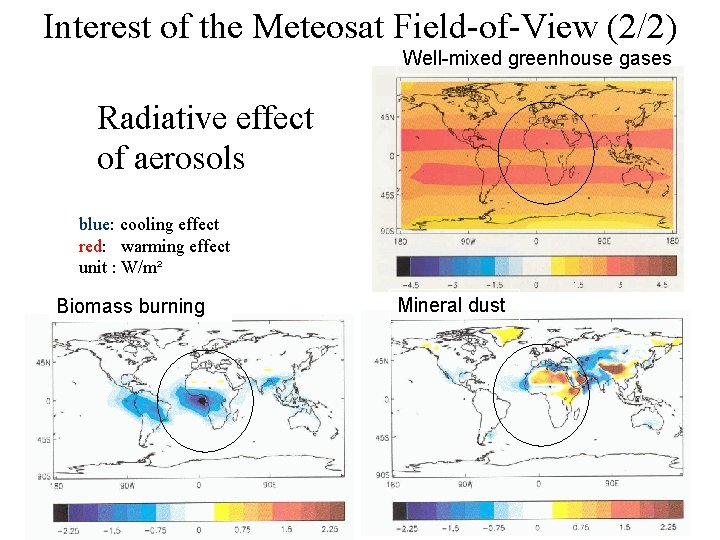
Interest of the Meteosat Field-of-View (2/2) Well-mixed greenhouse gases Radiative effect of aerosols blue: cooling effect red: warming effect unit : W/m² Biomass burning Mineral dust
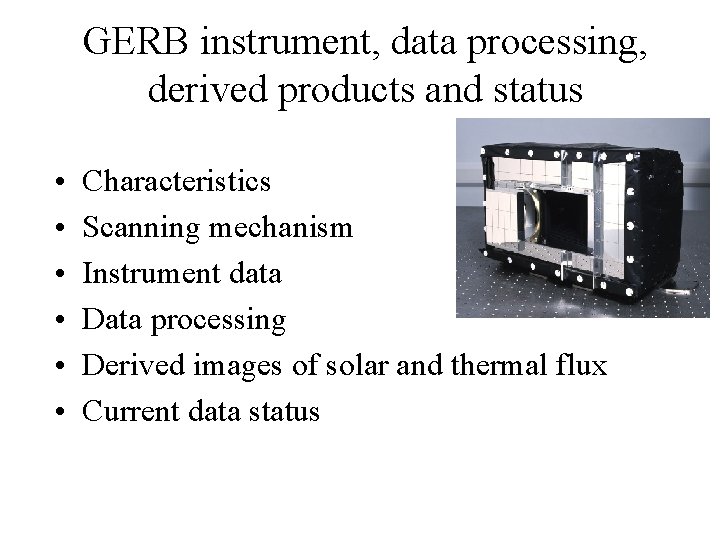
GERB instrument, data processing, derived products and status • • • Characteristics Scanning mechanism Instrument data Data processing Derived images of solar and thermal flux Current data status
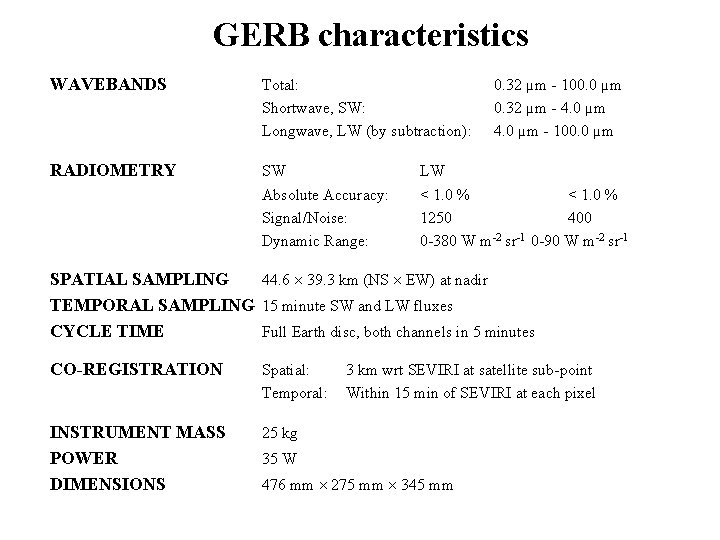
GERB characteristics WAVEBANDS Total: Shortwave, SW: Longwave, LW (by subtraction): RADIOMETRY SW Absolute Accuracy: Signal/Noise: Dynamic Range: 0. 32 µm - 100. 0 µm 0. 32 µm - 4. 0 µm - 100. 0 µm LW < 1. 0 % 1250 400 0 -380 W m-2 sr-1 0 -90 W m-2 sr-1 SPATIAL SAMPLING 44. 6 39. 3 km (NS EW) at nadir TEMPORAL SAMPLING 15 minute SW and LW fluxes CYCLE TIME Full Earth disc, both channels in 5 minutes CO-REGISTRATION Spatial: Temporal: INSTRUMENT MASS POWER DIMENSIONS 25 kg 3 km wrt SEVIRI at satellite sub-point Within 15 min of SEVIRI at each pixel 35 W 476 mm 275 mm 345 mm
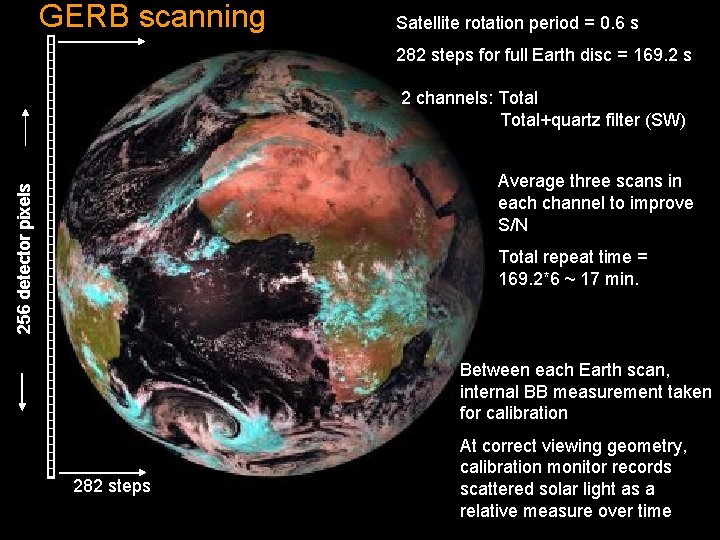
GERB scanning Satellite rotation period = 0. 6 s 282 steps for full Earth disc = 169. 2 s 2 channels: Total+quartz filter (SW) 256 detector pixels Average three scans in each channel to improve S/N Total repeat time = 169. 2*6 ~ 17 min. Between each Earth scan, internal BB measurement taken for calibration 262 282 steps At correct viewing geometry, calibration monitor records scattered solar light as a relative measure over time
![Measured Radiance Images shortwave [W/m²/sr] total [W/m²/sr]](http://slidetodoc.com/presentation_image_h2/889832b0fe19fffb81f14f93f267228b/image-12.jpg "Measured Radiance Images shortwave [W/m²/sr] total [W/m²/sr]")
Measured Radiance Images shortwave [W/m²/sr] total [W/m²/sr]
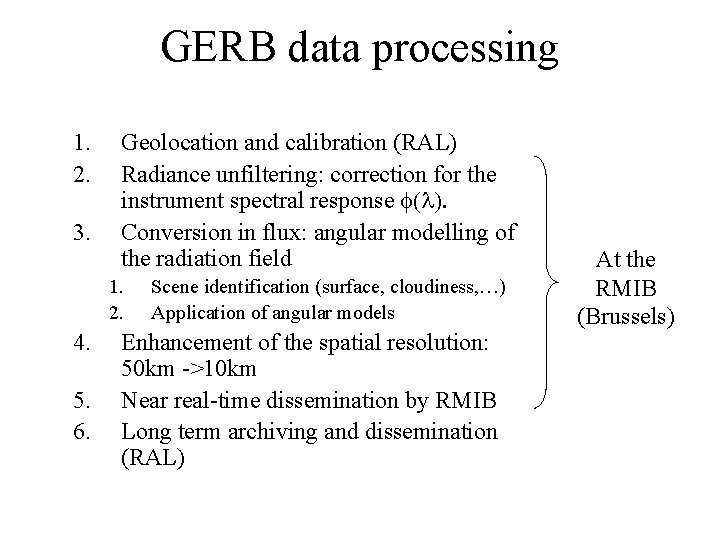
GERB data processing 1. 2. 3. Geolocation and calibration (RAL) Radiance unfiltering: correction for the instrument spectral response f(l). Conversion in flux: angular modelling of the radiation field 1. 2. 4. 5. 6. Scene identification (surface, cloudiness, …) Application of angular models Enhancement of the spatial resolution: 50 km ->10 km Near real-time dissemination by RMIB Long term archiving and dissemination (RAL) At the RMIB (Brussels)
![Derived Fluxes Images (50 km) Solar [W/m²] Thermal [W/m²]](http://slidetodoc.com/presentation_image_h2/889832b0fe19fffb81f14f93f267228b/image-14.jpg "Derived Fluxes Images (50 km) Solar [W/m²] Thermal [W/m²]")
Derived Fluxes Images (50 km) Solar [W/m²] Thermal [W/m²]
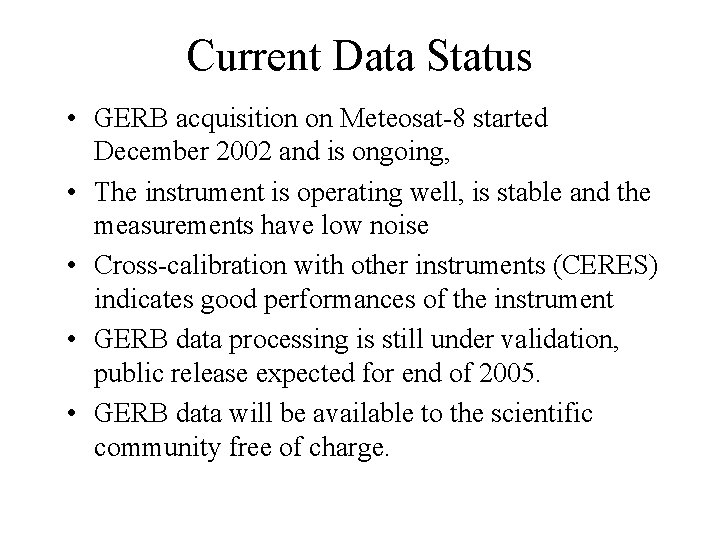
Current Data Status • GERB acquisition on Meteosat-8 started December 2002 and is ongoing, • The instrument is operating well, is stable and the measurements have low noise • Cross-calibration with other instruments (CERES) indicates good performances of the instrument • GERB data processing is still under validation, public release expected for end of 2005. • GERB data will be available to the scientific community free of charge.
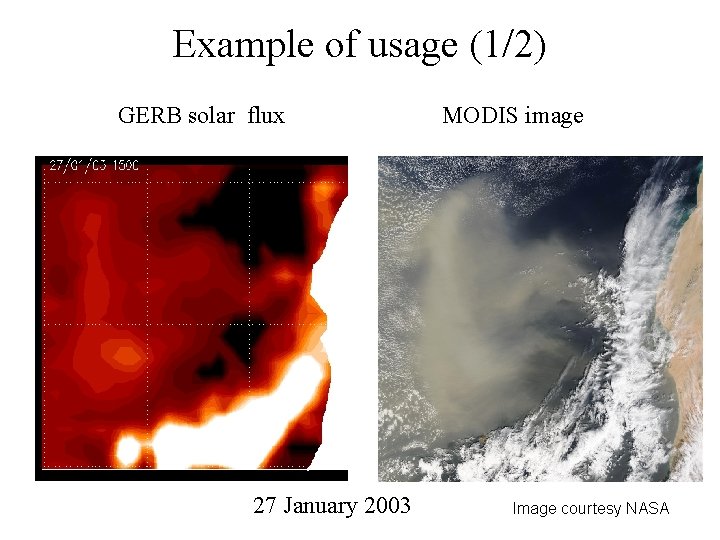
Example of usage (1/2) GERB solar flux 27 January 2003 MODIS image Image courtesy NASA
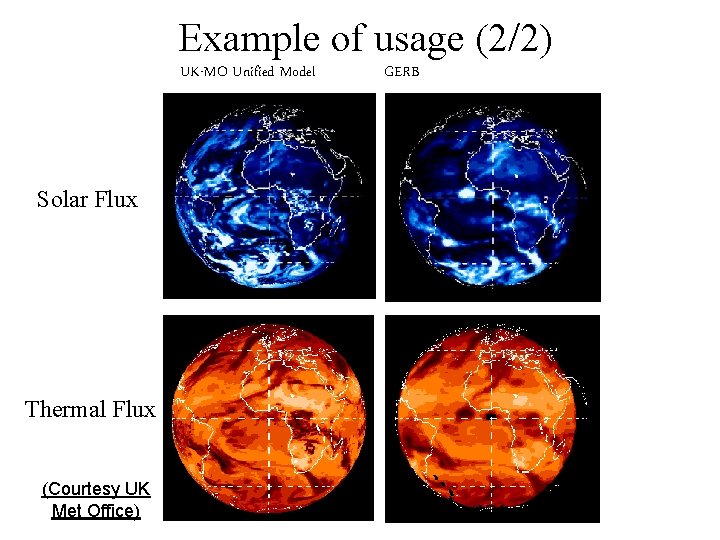
Example of usage (2/2) UK-MO Unified Model Solar Flux Thermal Flux (Courtesy UK Met Office) GERB
Conclusions • The GERB data is unique! • European initiative in operational climate monitoring • Long term mission (+/- 15 years): GERB instrument will fly on Meteosat-9, -10 and -11 • Interest for climate modelling and meteorology • Important contribution of the RMIB. • More info at: http: //gerb. oma. be
- Slides: 18