
Overview of the EvidenceBased Correctional Program Checklist CPC
Overview of the Evidence-Based Correctional Program Checklist (CPC 2. 0) University of Cincinnati Corrections Institute www. uc. edu/corrections
Acknowledgments • The CPC was developed by UCCI in 2005 by Drs. Latessa and Lowenkamp – Version 2. 0 was introduced in September 2015 • Special recognition is provided to Drs. Gendreau and Andrews as the CPC is modeled after the Correctional Program Assessment Inventory (CPAI) Copyright © 2015, University of Cincinnati, Corrections Institute, Ohio. All Rights reserved 2
Purpose of the CPC • To evaluate the extent to which correctional programs adhere to the principles of effective interventions • To assist agencies with developing and improving the services provided to offender populations • To assess funding proposals and external service contracts • To stimulate research on the effectiveness of correctional treatment programs Copyright © 2015, University of Cincinnati, Corrections Institute, Ohio. All Rights reserved 3
Development of the Original CPC • CPC is a checklist of indicators linked with reductions in recidivism • CPAI forms the base of the instrument • Other items were added from: – Meta-analytic reviews – Collective experience of authors • All indicators were then tested via three large outcome studies conducted by UCCI Copyright © 2015, University of Cincinnati, Corrections Institute, Ohio. All Rights reserved 4
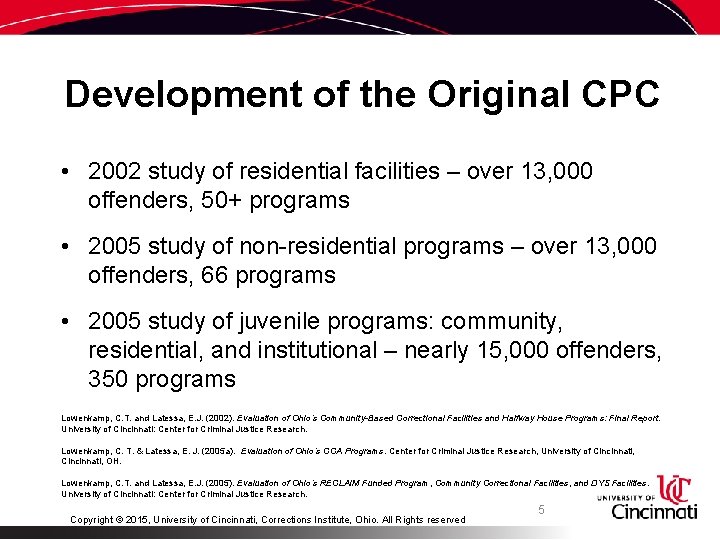
Development of the Original CPC • 2002 study of residential facilities – over 13, 000 offenders, 50+ programs • 2005 study of non-residential programs – over 13, 000 offenders, 66 programs • 2005 study of juvenile programs: community, residential, and institutional – nearly 15, 000 offenders, 350 programs Lowenkamp, C. T. and Latessa, E. J. (2002). Evaluation of Ohio’s Community-Based Correctional Facilities and Halfway House Programs: Final Report. University of Cincinnati: Center for Criminal Justice Research. Lowenkamp, C. T. & Latessa, E. J. (2005 a). Evaluation of Ohio’s CCA Programs. Center for Criminal Justice Research, University of Cincinnati, OH. Lowenkamp, C. T. and Latessa, E. J. (2005). Evaluation of Ohio’s RECLAIM Funded Program, Community Correctional Facilities, and DYS Facilities. University of Cincinnati: Center for Criminal Justice Research. Copyright © 2015, University of Cincinnati, Corrections Institute, Ohio. All Rights reserved 5
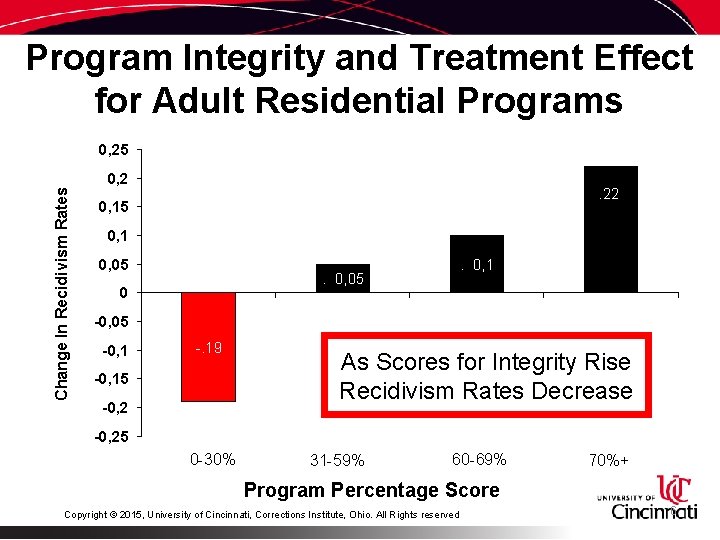
Program Integrity and Treatment Effect for Adult Residential Programs Change In Recidivism Rates 0, 25 0, 2 . 22 0, 15 0, 1 0, 05 . 0, 1 . 0, 05 0 -0, 05 -0, 1 -. 19 -0, 15 -0, 2 As Scores for Integrity Rise Recidivism Rates Decrease -0, 25 0 -30% 31 -59% 60 -69% 70%+ Program Percentage Score Copyright © 2015, University of Cincinnati, Corrections Institute, Ohio. All Rights reserved 6

Program Integrity and Treatment Effect for Adult Non-Residential Programs 0, 2 Change In Recidivism Rates 0, 15 0, 1. 02 0, 05 . 12 . 16 0 -0, 05 -0, 1 -. 15 As Scores for Integrity Rise Recidivism Rates Decrease -0, 15 -0, 2 0 -19% (9) 20 -39%(37) 40 -59% 20 -39% 40 -59% (17) Program Percentage Score Copyright © 2015, University of Cincinnati, Corrections Institute, Ohio. All Rights reserved 60%+(3) 60+% 7
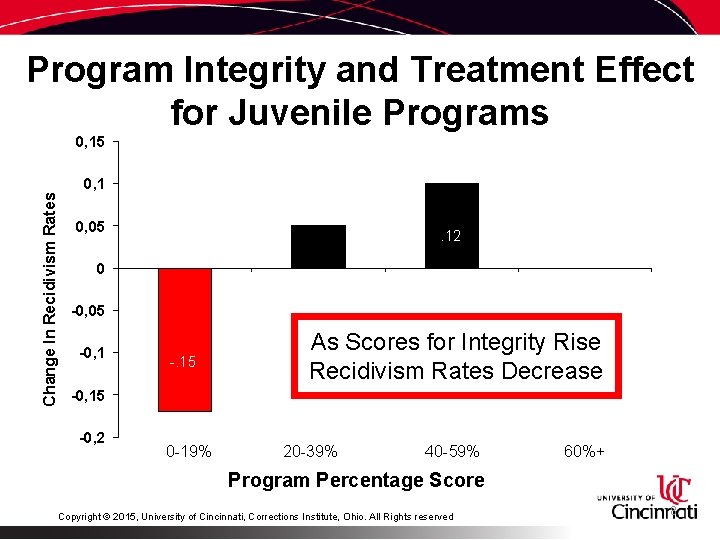
Program Integrity and Treatment Effect for Juvenile Programs Change In Recidivism Rates 0, 15 0, 1 0, 05. 02 . 12 0 -0, 05 -0, 1 -. 15 As Scores for Integrity Rise Recidivism Rates Decrease -0, 15 -0, 2 0 -60% 0 -19% 60 -69% 20 -39% 70% + 40 -59% 60%+ Program Percentage Score Copyright © 2015, University of Cincinnati, Corrections Institute, Ohio. All Rights reserved 8
Development of the Original CPC • The three studies showed that integrity could be measured, that it mattered, and that programs with higher integrity reduced recidivism • Item level analyses conducted to develop the CPC – Items not significant in at least one study were dropped – Items significant in at least one study were retained – Items significant in two or more studies were weighted • Domains and overall instrument correlated with recidivism reduction between a. 38 and. 60 Copyright © 2015, University of Cincinnati, Corrections Institute, Ohio. All Rights reserved 9
Areas of the CPC CAPACITY Evaluates the ability of the program to consistently deliver effective programming CONTENT Assesses the degree to which a program adheres to the principles of effective intervention Copyright © 2015, University of Cincinnati, Corrections Institute, Ohio. All Rights reserved 10

Domains of the CPC CAPACITY 1. Leadership and Development 2. Staff Characteristics 3. Quality Assurance CONTENT 4. Offender Assessment 5. Treatment Characteristics Copyright © 2015, University of Cincinnati, Corrections Institute, Ohio. All Rights reserved 11

Scoring 73 items (some items are weighted; a total of 79 possible points) • To calculate the final score, sum the items and divide by the total number of possible points for each domain • Occasionally some items are not applicable • If n/a is assigned for a particular item, then the total score for that section, and the overall assessment, would exclude that item Copyright © 2015, University of Cincinnati, Corrections Institute, Ohio. All Rights reserved 12

Scoring Categories • Very High Adherence to EBP 65% or more • High Adherence to EBP 55% - 64% • Moderate Adherence to EBP 46% - 54% • Low Adherence to EBP 45% or less *This scale is used for each of the domains as well as the total score. Copyright © 2015, University of Cincinnati, Corrections Institute, Ohio. All Rights reserved 13
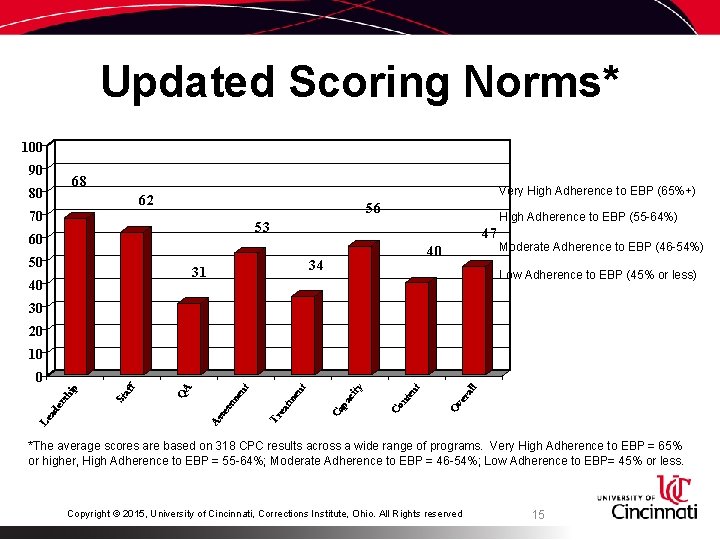
Updated Scoring Norms* 100 90 68 80 Very High Adherence to EBP (65%+) 62 56 70 High Adherence to EBP (55 -64%) 53 60 50 47 34 31 40 40 Moderate Adherence to EBP (46 -54%) Low Adherence to EBP (45% or less) 30 20 10 all er Ov t en nt Co y pa Ca en tm ea Tr cit t t en ss m se QA f af St As Le ad er sh ip 0 *The average scores are based on 318 CPC results across a wide range of programs. Very High Adherence to EBP = 65% or higher, High Adherence to EBP = 55 -64%; Moderate Adherence to EBP = 46 -54%; Low Adherence to EBP= 45% or less. Copyright © 2015, University of Cincinnati, Corrections Institute, Ohio. All Rights reserved 15
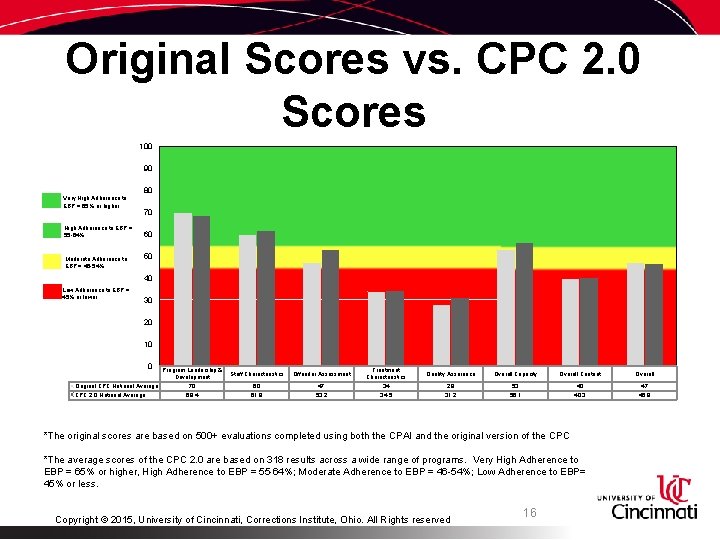
Original Scores vs. CPC 2. 0 Scores 100 90 Very High Adherence to EBP = 65% or higher High Adherence to EBP = 55 -64% Moderate Adherence to EBP = 46 -54% 80 70 60 50 40 Low Adherence to EBP = 45% or lower 30 20 10 0 Program Leadership & Development Original CPC National Average 70 CPC 2. 0 National Average 68, 4 Staff Characteristics Offender Assessment 60 61, 9 47 53, 2 Treatment Characteristics 34 34, 5 Quality Assurance Overall Capacity Overall Content Overall 28 31, 2 53 56, 1 40 40, 3 47 46, 9 *The original scores are based on 500+ evaluations completed using both the CPAI and the original version of the CPC *The average scores of the CPC 2. 0 are based on 318 results across a wide range of programs. Very High Adherence to EBP = 65% or higher, High Adherence to EBP = 55 -64%; Moderate Adherence to EBP = 46 -54%; Low Adherence to EBP= 45% or less. Copyright © 2015, University of Cincinnati, Corrections Institute, Ohio. All Rights reserved 16
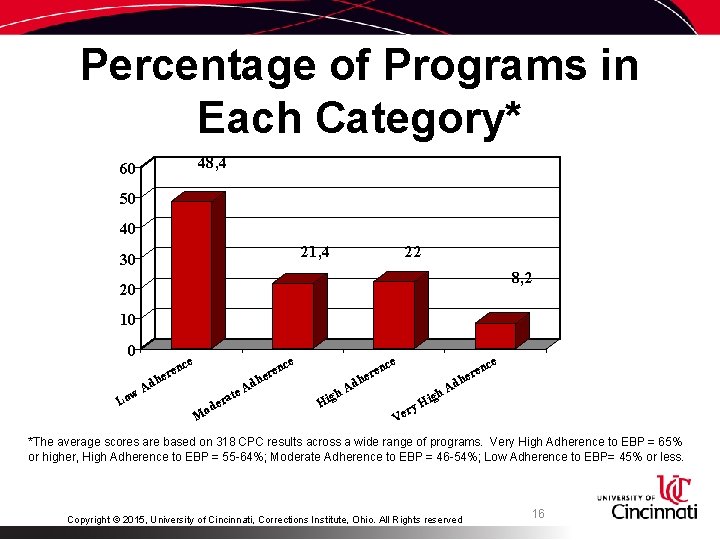
Percentage of Programs in Each Category* 48, 4 60 50 40 21, 4 30 22 8, 2 20 10 0 ce ce en her Ad w o e rat L M e od Ad en her gh Hi nce e r he Ad ce gh Hi y r e en her d A V *The average scores are based on 318 CPC results across a wide range of programs. Very High Adherence to EBP = 65% or higher, High Adherence to EBP = 55 -64%; Moderate Adherence to EBP = 46 -54%; Low Adherence to EBP= 45% or less. Copyright © 2015, University of Cincinnati, Corrections Institute, Ohio. All Rights reserved 16
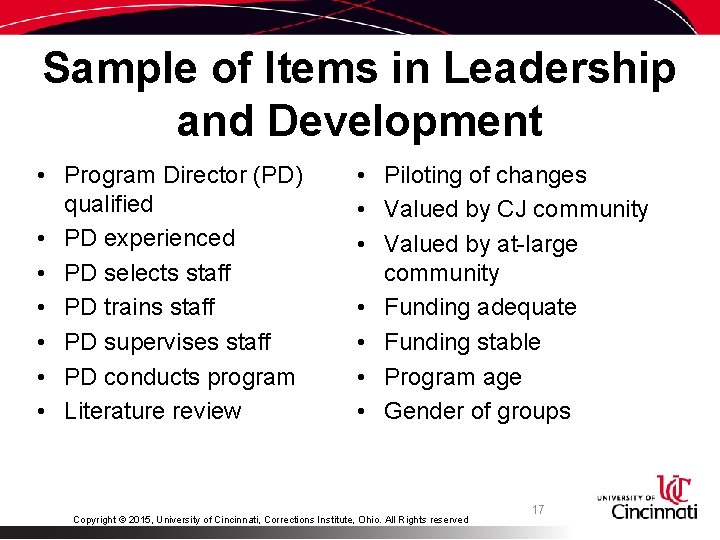
Sample of Items in Leadership and Development • Program Director (PD) qualified • PD experienced • PD selects staff • PD trains staff • PD supervises staff • PD conducts program • Literature review • Piloting of changes • Valued by CJ community • Valued by at-large community • Funding adequate • Funding stable • Program age • Gender of groups Copyright © 2015, University of Cincinnati, Corrections Institute, Ohio. All Rights reserved 17
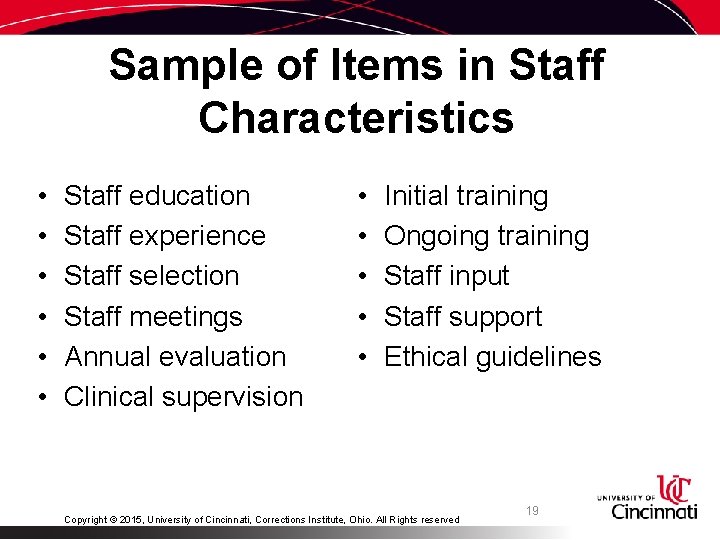
Sample of Items in Staff Characteristics • • • Staff education Staff experience Staff selection Staff meetings Annual evaluation Clinical supervision • • • Initial training Ongoing training Staff input Staff support Ethical guidelines Copyright © 2015, University of Cincinnati, Corrections Institute, Ohio. All Rights reserved 19
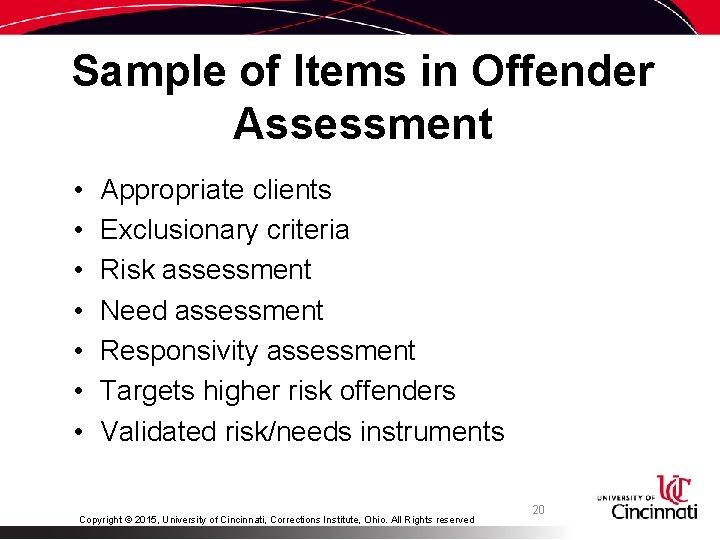
Sample of Items in Offender Assessment • • Appropriate clients Exclusionary criteria Risk assessment Need assessment Responsivity assessment Targets higher risk offenders Validated risk/needs instruments Copyright © 2015, University of Cincinnati, Corrections Institute, Ohio. All Rights reserved 20
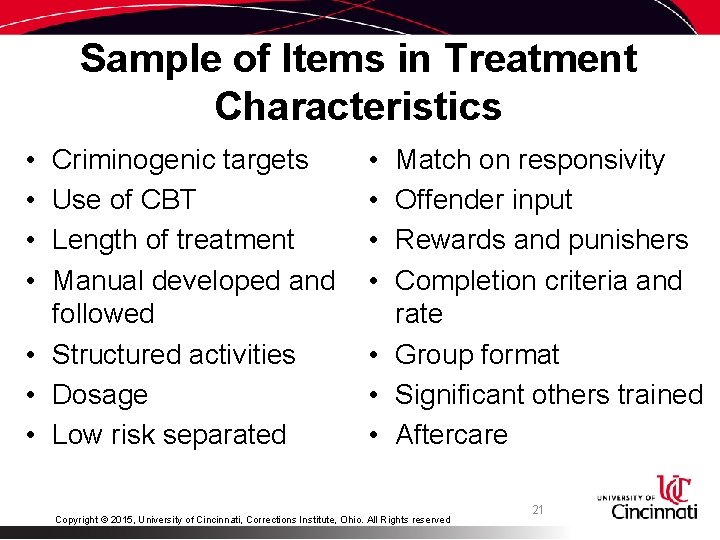
Sample of Items in Treatment Characteristics • • Criminogenic targets Use of CBT Length of treatment Manual developed and followed • Structured activities • Dosage • Low risk separated • • Match on responsivity Offender input Rewards and punishers Completion criteria and rate • Group format • Significant others trained • Aftercare Copyright © 2015, University of Cincinnati, Corrections Institute, Ohio. All Rights reserved 21
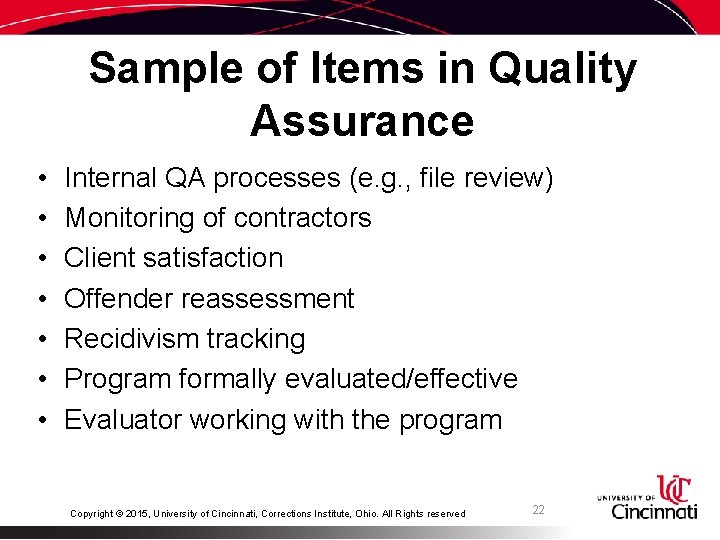
Sample of Items in Quality Assurance • • Internal QA processes (e. g. , file review) Monitoring of contractors Client satisfaction Offender reassessment Recidivism tracking Program formally evaluated/effective Evaluator working with the program Copyright © 2015, University of Cincinnati, Corrections Institute, Ohio. All Rights reserved 22
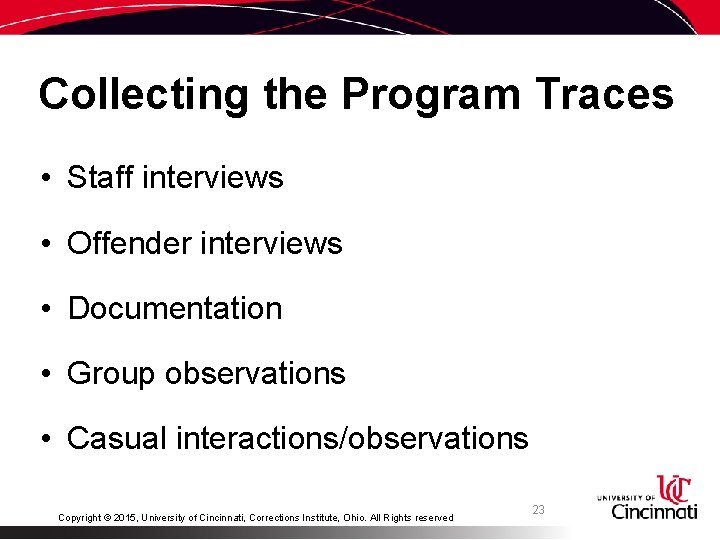
Collecting the Program Traces • Staff interviews • Offender interviews • Documentation • Group observations • Casual interactions/observations Copyright © 2015, University of Cincinnati, Corrections Institute, Ohio. All Rights reserved 23
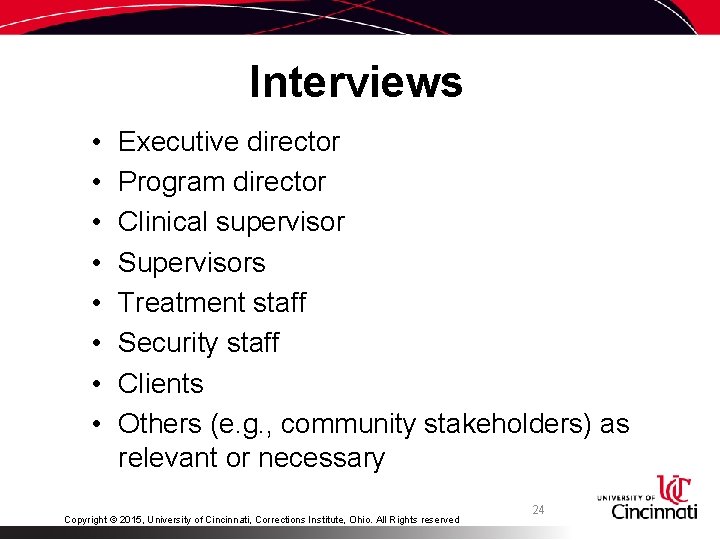
Interviews • • Executive director Program director Clinical supervisor Supervisors Treatment staff Security staff Clients Others (e. g. , community stakeholders) as relevant or necessary Copyright © 2015, University of Cincinnati, Corrections Institute, Ohio. All Rights reserved 24
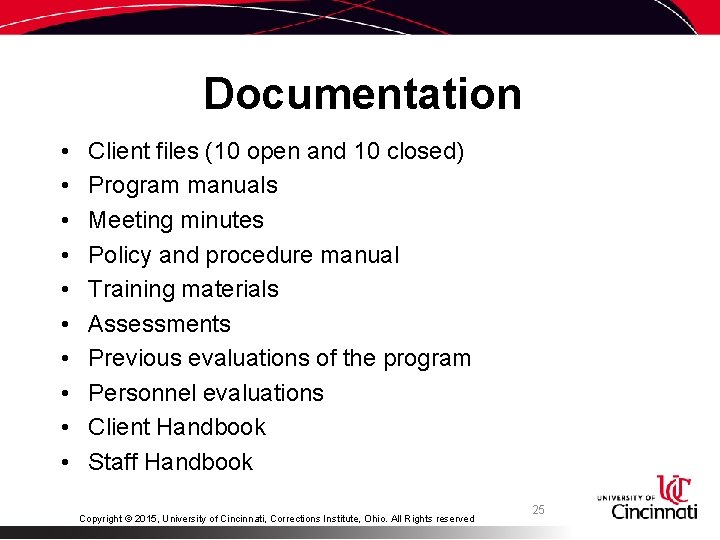
Documentation • • • Client files (10 open and 10 closed) Program manuals Meeting minutes Policy and procedure manual Training materials Assessments Previous evaluations of the program Personnel evaluations Client Handbook Staff Handbook Copyright © 2015, University of Cincinnati, Corrections Institute, Ohio. All Rights reserved 25
Direct Observation • Interventions in progress • Casual contact/communication Copyright © 2015, University of Cincinnati, Corrections Institute, Ohio. All Rights reserved 25
Report Writing • • Background Site visit process Rating for each domain Strengths Areas that need improvement Recommendations Graph with scores for each domain, content and capacity areas, and overall score • Graph with comparison of program’s scores to average CPC scores Copyright © 2015, University of Cincinnati, Corrections Institute, Ohio. All Rights reserved 26
Limitations of the CPC • Easier to administer to a self-contained program • Based on “ideal” type and this is impossible to achieve • Objectivity is critical • Extensive knowledge of correctional treatment is needed • Reliability needs to be considered • Time-specific (i. e. , based on program at the time of assessment) • Does not take into account “system” issues or “why” a problem exists within a program Copyright © 2015, University of Cincinnati, Corrections Institute, Ohio. All Rights reserved 27
Advantages of the CPC • Applicable to a wide range of programs • Based on empirically achieved principles • Provides a measure of program integrity and program quality • Results can be obtained quickly • Identifies strengths and weaknesses of program • Provides recommendations for program improvement • Can be used for “benchmarking” • Serves as a blueprint for program improvement Copyright © 2015, University of Cincinnati, Corrections Institute, Ohio. All Rights reserved 28
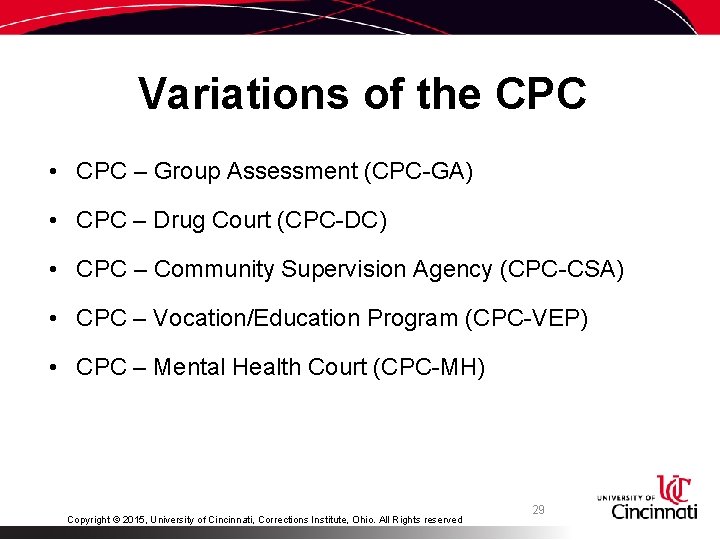
Variations of the CPC • CPC – Group Assessment (CPC-GA) • CPC – Drug Court (CPC-DC) • CPC – Community Supervision Agency (CPC-CSA) • CPC – Vocation/Education Program (CPC-VEP) • CPC – Mental Health Court (CPC-MH) Copyright © 2015, University of Cincinnati, Corrections Institute, Ohio. All Rights reserved 29
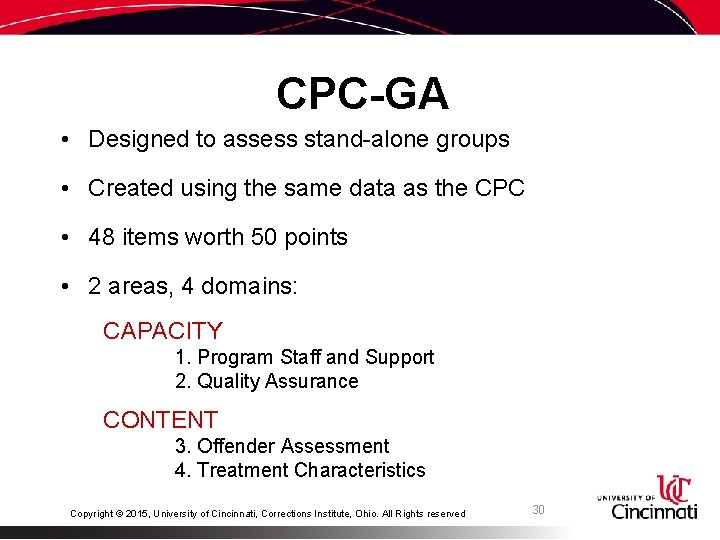
CPC-GA • Designed to assess stand-alone groups • Created using the same data as the CPC • 48 items worth 50 points • 2 areas, 4 domains: CAPACITY 1. Program Staff and Support 2. Quality Assurance CONTENT 3. Offender Assessment 4. Treatment Characteristics Copyright © 2015, University of Cincinnati, Corrections Institute, Ohio. All Rights reserved 30
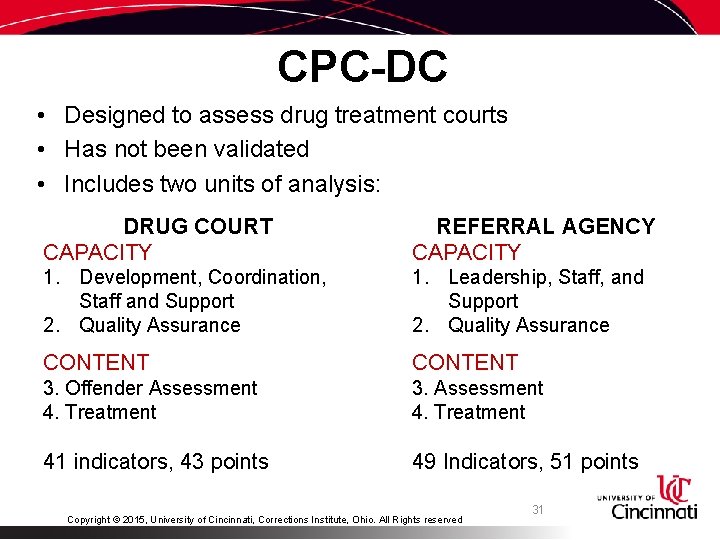
CPC-DC • Designed to assess drug treatment courts • Has not been validated • Includes two units of analysis: DRUG COURT CAPACITY REFERRAL AGENCY CAPACITY 1. Development, Coordination, Staff and Support 2. Quality Assurance 1. Leadership, Staff, and Support 2. Quality Assurance CONTENT 3. Offender Assessment 4. Treatment 3. Assessment 4. Treatment 41 indicators, 43 points 49 Indicators, 51 points Copyright © 2015, University of Cincinnati, Corrections Institute, Ohio. All Rights reserved 31
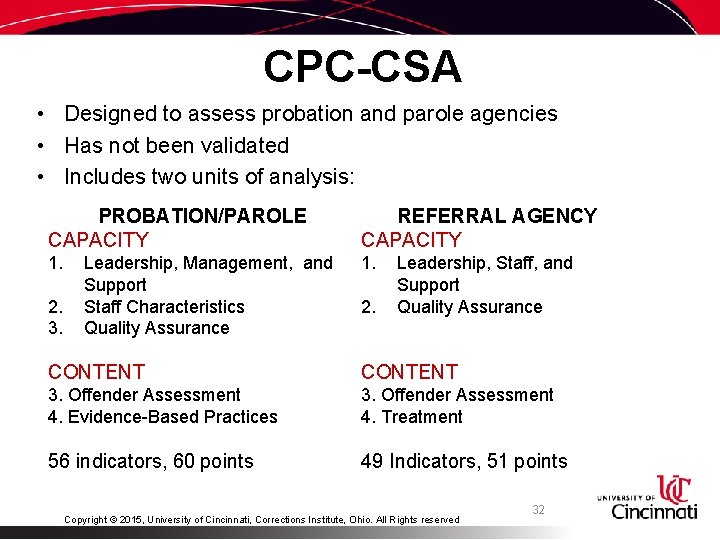
CPC-CSA • Designed to assess probation and parole agencies • Has not been validated • Includes two units of analysis: PROBATION/PAROLE CAPACITY REFERRAL AGENCY CAPACITY 1. 2. 3. Leadership, Management, and Support Staff Characteristics Quality Assurance 2. Leadership, Staff, and Support Quality Assurance CONTENT 3. Offender Assessment 4. Evidence-Based Practices 3. Offender Assessment 4. Treatment 56 indicators, 60 points 49 Indicators, 51 points Copyright © 2015, University of Cincinnati, Corrections Institute, Ohio. All Rights reserved 32
CPC-VEP • Designed to assess correctional vocational and educational programs • Is still in development and is expected to be available in the Fall of 2016 • Focuses on key educational practices Copyright © 2015, University of Cincinnati, Corrections Institute, Ohio. All Rights reserved 33
CPC-MH • Designed to assess mental health courts • The tool has been piloted on two courts in North Carolina • The tool is in early phases of development and we do not have an estimated date for use of the tool Copyright © 2015, University of Cincinnati, Corrections Institute, Ohio. All Rights reserved 34
CPC Availability Two options for CPC Assessments: • UCCI can conduct CPC assessments as needed • UCCI can train governmental agencies to conduct their own assessments Copyright © 2015, University of Cincinnati, Corrections Institute, Ohio. All Rights reserved 35
UCCI Completed Assessments • Across the different CPC variations, UCCI has assessed over 500 different programs across the country and internationally • Examples of recent assessments: – Federal Probation Southern District of Iowa (CPCCSA) – 13 substance abuse programs contracted by Kansas DOC (through JRI initiatives; CPC) – 4 programs used in the Dosage Probation Study for Center for Effective Public Policy in Milwaukee WI (CPC) Copyright © 2015, University of Cincinnati, Corrections Institute, Ohio. All Rights reserved 36
UCCI Trained Agencies • Across the different variations, UCCI trained agencies have assessed another 200 programs across the country and internationally • Examples of trained agencies: – California Bureau of State and Community Corrections (CPC) – Minnesota CPC Collaborative (DOC and 6 partner counties; CPC, CPC-GA, and CPC-CSA) – Singapore Prison Service (CPC and CPC-GA) – Wisconsin DOC (CPC and CPC-GA) – Oregon DOC and Multnomah County (CPC and CPC-DC) – Ohio DRC and DYS (CPC) – San Diego County California Probation Department (CPC) Copyright © 2015, University of Cincinnati, Corrections Institute, Ohio. All Rights reserved 37
CPC Training Process • Staff must be trained and certified in the full CPC before training on other variations can take place • CPC Certification involves: – 4 day training with satisfactory participation during training – Written test with a score of 80% or higher – Conduct an independent evaluation and be rated as satisfactory on program scoring and report writing • Certification in CPC variations involves: – 2. 5 – 3 day training in each variation – Rating as satisfactory on program scoring and report writing • Assistance from UCCI is provided along the way Copyright © 2015, University of Cincinnati, Corrections Institute, Ohio. All Rights reserved 38
UCCI Contact Information Carrie Sullivan Associate Director PO BOX 210389 Cincinnati, OH 45221 Carrie. Sullivan@uc. edu 513 -556 -2036 Copyright © 2015, University of Cincinnati, Corrections Institute, Ohio. All Rights reserved 38
- Slides: 39