
Overview of the Essential Components of Reading Instruction
- Slides: 19
Overview of the Essential Components of Reading Instruction K– 5 Part 3. 1: Introduction Collaboration for Effective Educator Development, Accountability, and Reform H 325 A 120003
Overview of the Essential Components of Reading Instruction K– 5 Part 3. 1: Introduction A special thanks to the Meadows Center for Preventing Education Risk at the University of Texas at Austin for permission to use and adapt material from a module created by the Higher Education Collaborative: Foundations of Reading Instruction. © 2009 University of Texas System/Texas Education Agency www. meadowscenter. org H 325 A 120003
Lean, Look, and Whisper • Find a partner. • Decide who is Partner A and Partner B. • Lean, Look, and Whisper o Introduce yourselves o Discuss for one minute: What should a teacher directly teach a student when teaching reading?
What Should Teachers Teach? • With your partner, write one thing teachers should directly teach students about reading. • Place your responses on the sticky board.
Module Objective Implementation of evidence-based instruction to teach all students including: • Students from poverty. • Students with disabilities. • Students who are English language learners (ELLs). • Students who struggle learning to read.
Big Ideas & Questions 1. What is the idea? Why is it important? What does the research say? 2. What should students know and be able to do at each grade level? 3. How do we assess what students know and the progress they are making?
Big Ideas & Questions 4. How do we effectively and efficiently teach the big idea? 5. How do we develop instructional plans that incorporate standards, assessment data, and evidence-based instructional strategies? 6. What do we do if students are not learning the big idea?
Module Outcomes 1. Design instruction for all students. 2. Differentiate instruction. 3. Use assessment data to inform instruction, form groups, monitor progress. 4. Incorporate standards and evidence-based practices (EBPs).
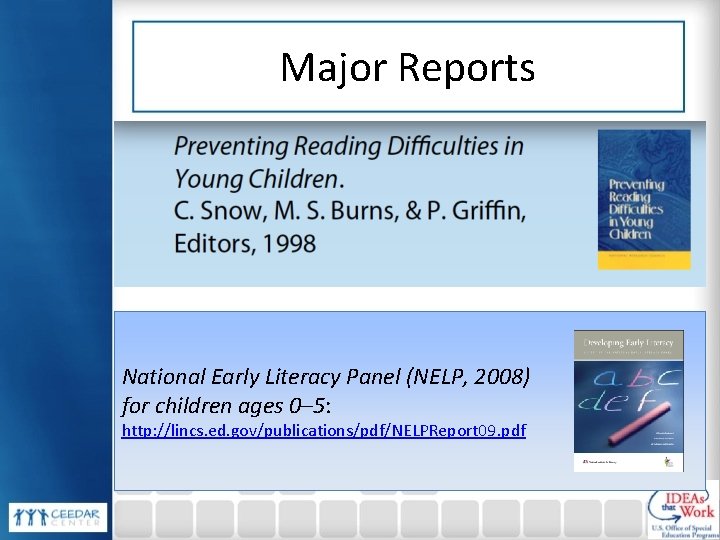
Major Reports National Early Literacy Panel (NELP, 2008) for children ages 0– 5: http: //lincs. ed. gov/publications/pdf/NELPReport 09. pdf
National Reading Panel Elements of Reading Instruction 1. 2. 3. 4. 5. Phonemic Awareness Phonics Fluency Vocabulary Text Comprehension National Reading Panel Report, 2000
Phonemic Awareness • The awareness of the speech sounds in words. • The ability to: o manipulate the sounds o segment phonemes o blend phonemes Phonemes are the smallest units of sound Ehri, 2000; Snow, Burns & Griffin, 1998; National Early Literacy Panel, 2008; National Reading Panel, 2000
Phonics Alphabetic Principle. An awareness of letters and that letters represent sounds. Phonics = graphophonemic relationships or sound-symbol relationships. Ehri, 2002; Honig et al. , 2008
Fluency The ability to read accurately, at an appropriate rate, with prosody and comprehension. Kuhn et al. , 2010; Rasinski et al. , 2011; Hudson et al. , 2005
Vocabulary Word study to increase. . . • Word knowledge • Word consciousness • Words for life • Academic language Necessary for reading comprehension Graves, 2006
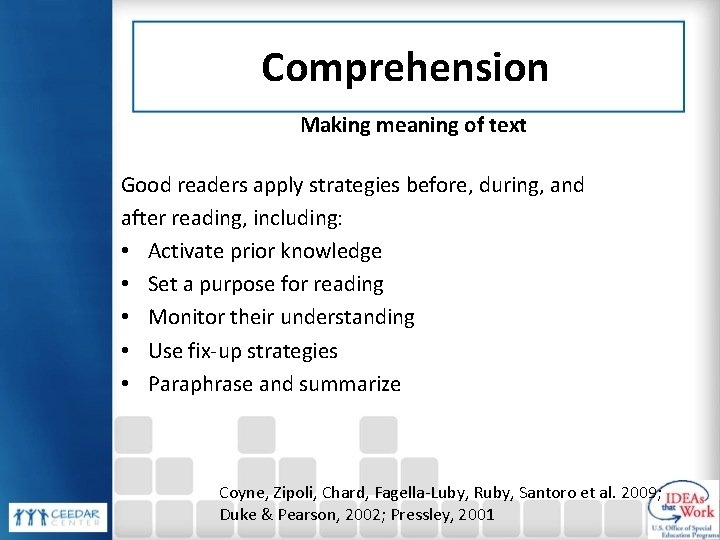
Comprehension Making meaning of text Good readers apply strategies before, during, and after reading, including: • Activate prior knowledge • Set a purpose for reading • Monitor their understanding • Use fix-up strategies • Paraphrase and summarize Coyne, Zipoli, Chard, Fagella-Luby, Ruby, Santoro et al. 2009; Duke & Pearson, 2002; Pressley, 2001
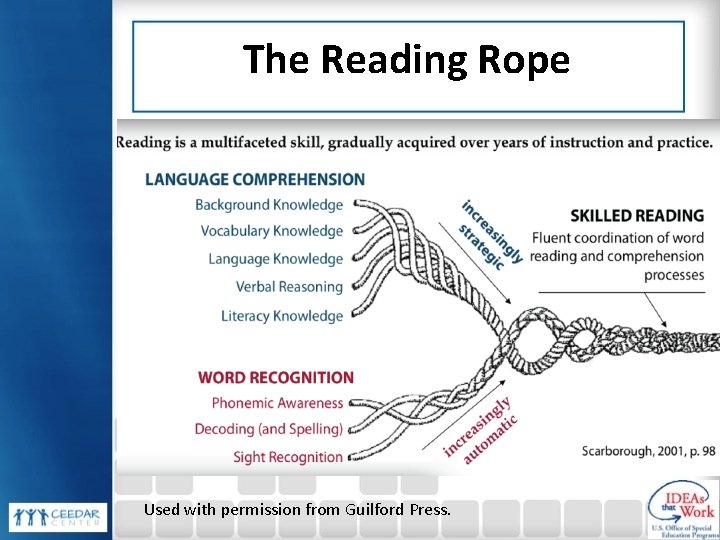
The Reading Rope Used with permission from Guilford Press.
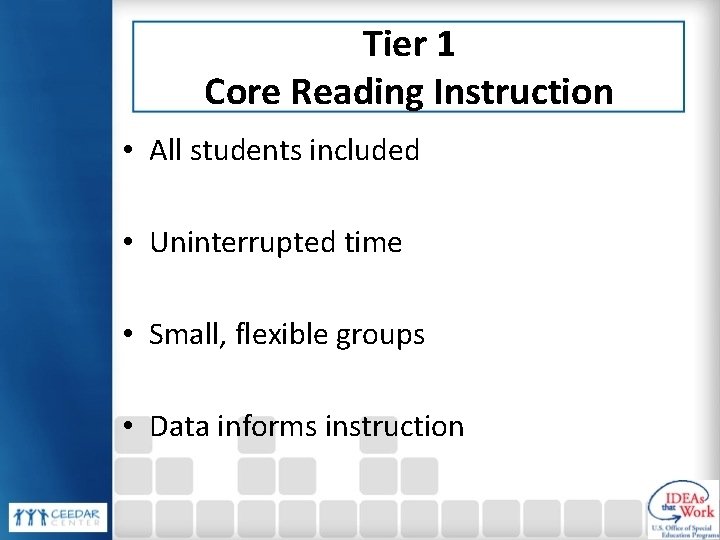
Tier 1 Core Reading Instruction • All students included • Uninterrupted time • Small, flexible groups • Data informs instruction
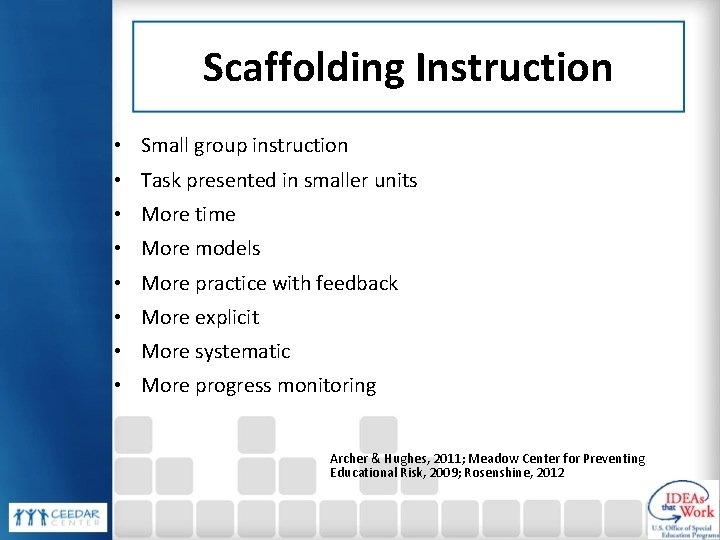
Scaffolding Instruction • Small group instruction • Task presented in smaller units • More time • More models • More practice with feedback • More explicit • More systematic • More progress monitoring Archer & Hughes, 2011; Meadow Center for Preventing Educational Risk, 2009; Rosenshine, 2012
Review & Reflect With your partner…. 1. Explain the five essential components of reading instruction 2. Create questions about each component