
Overview of the Essential Components of Reading Instruction
- Slides: 61
Overview of the Essential Components of Reading Instruction K– 5 Part 3: Phonics & Word Study Collaboration for Effective Educator Development, Accountability, and Reform H 325 A 120003
Big Ideas & Questions 1. What is the idea? Why is it important? What does the research say? 2. What should students know and be able to do at each grade level? 3. How do we assess what students know and the progress they are making?
Big Ideas & Questions 4. How do we teach the big idea effectively and efficiently? 5. How do we develop instructional plans that incorporate standards, assessment data, and evidence-based instructional strategies? 6. What do we do if students aren’t learning the big idea?
Module Outcomes 1. Design instruction for all students. 2. Differentiate instruction. 3. Use assessment data to inform instruction, form groups, monitor progress. 4. Incorporate standards and evidence-based practices (EBPs).
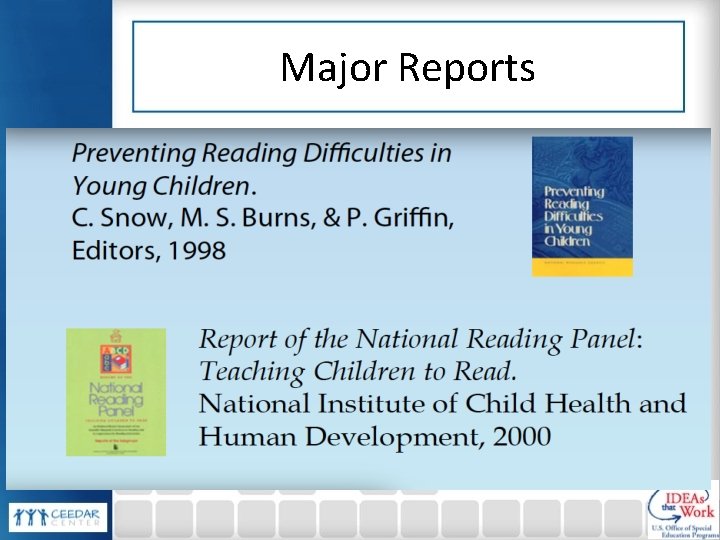
Major Reports
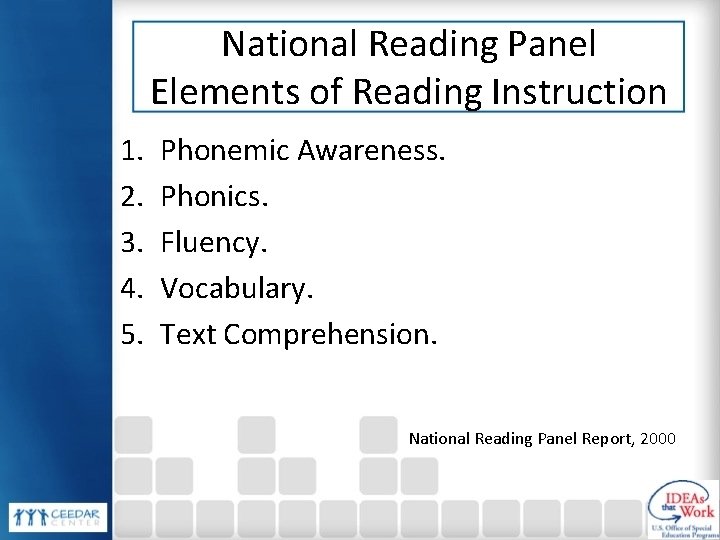
National Reading Panel Elements of Reading Instruction 1. 2. 3. 4. 5. Phonemic Awareness. Phonics. Fluency. Vocabulary. Text Comprehension. National Reading Panel Report, 2000
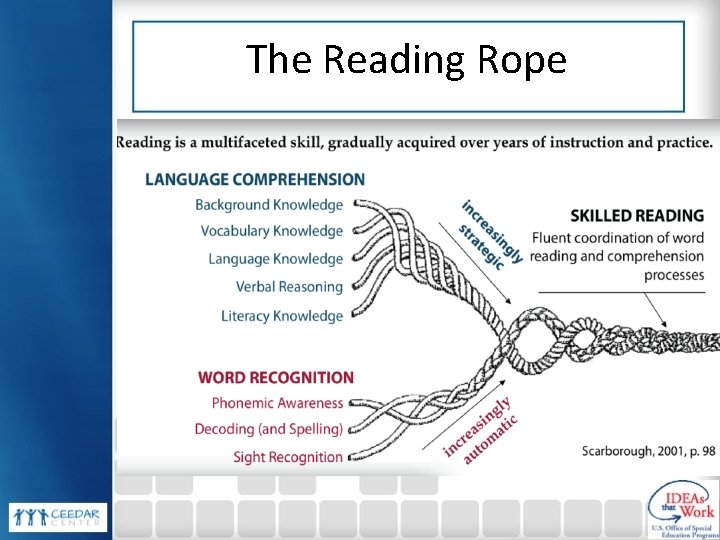
The Reading Rope
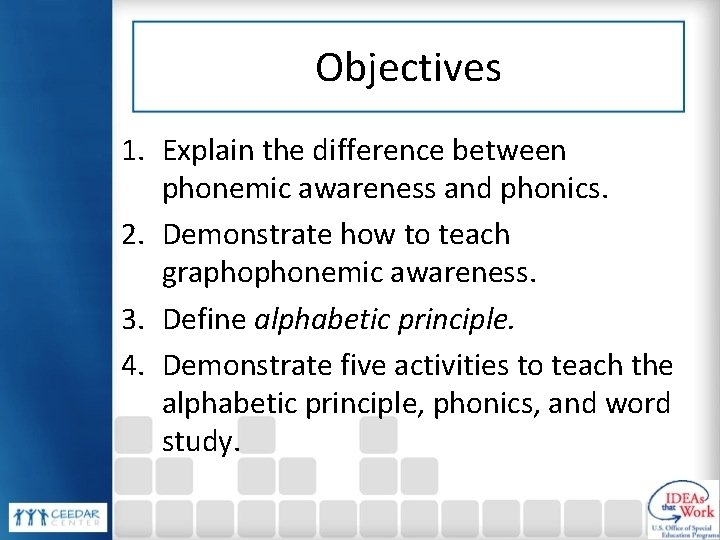
Objectives 1. Explain the difference between phonemic awareness and phonics. 2. Demonstrate how to teach graphophonemic awareness. 3. Define alphabetic principle. 4. Demonstrate five activities to teach the alphabetic principle, phonics, and word study.
What Is Reading? DECODING + COMPREHENDING = READING
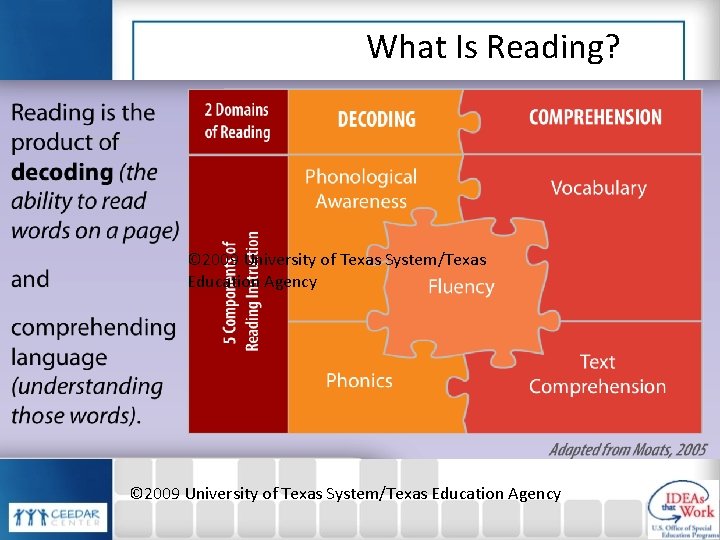
What Is Reading? © 2009 University of Texas System/Texas Education Agency
What Is Phonics? Phonics is the understanding of the letters of written language and the individual sounds of spoken language. Grapheme-Phoneme relationships Ehri, 2002; Honig et al. , 2008
What Do You Know? On your own. . . Complete the matching exercise on Handout 3. 3 A.
What Should K-5 Students Know and Apply? Grade-level phonics and word analysis skills in decoding words. CCSS, foundational skills www. corestandards. org
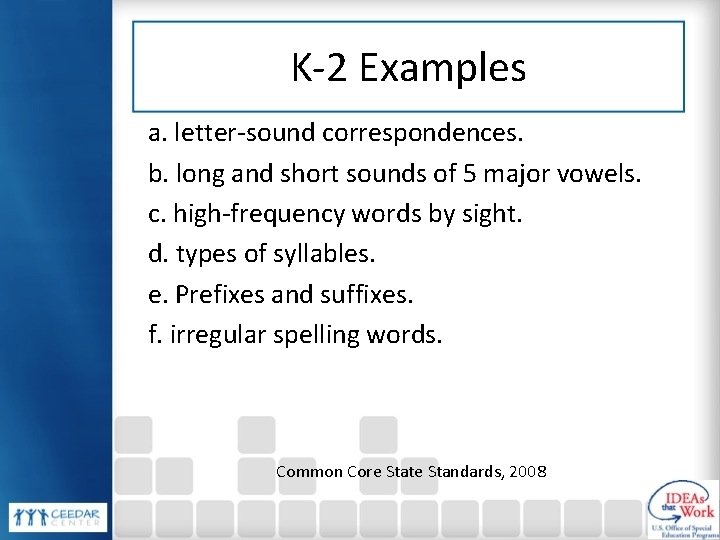
K-2 Examples a. letter-sound correspondences. b. long and short sounds of 5 major vowels. c. high-frequency words by sight. d. types of syllables. e. Prefixes and suffixes. f. irregular spelling words. Common Core State Standards, 2008
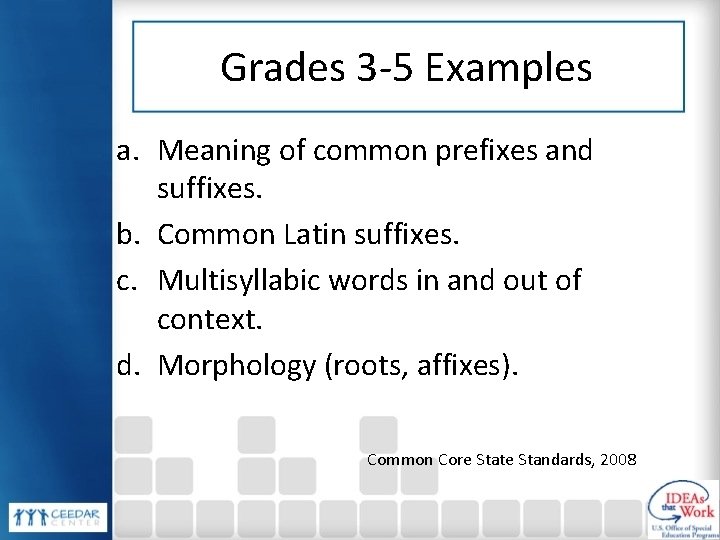
Grades 3 -5 Examples a. Meaning of common prefixes and suffixes. b. Common Latin suffixes. c. Multisyllabic words in and out of context. d. Morphology (roots, affixes). Common Core State Standards, 2008
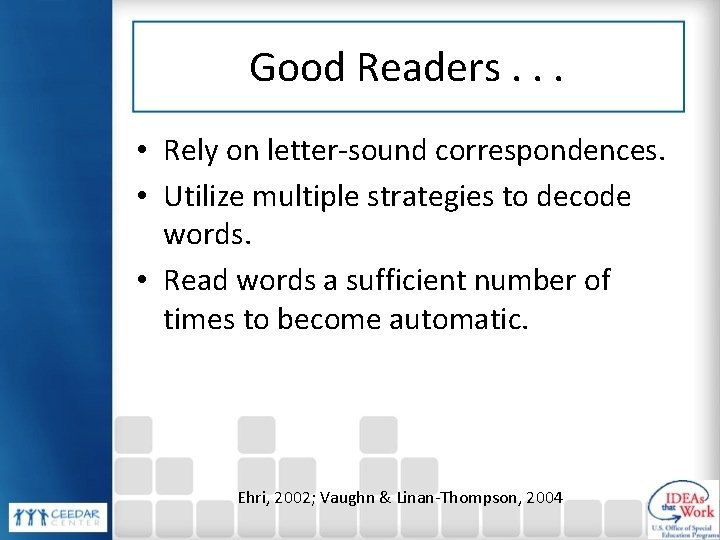
Good Readers. . . • Rely on letter-sound correspondences. • Utilize multiple strategies to decode words. • Read words a sufficient number of times to become automatic. Ehri, 2002; Vaughn & Linan-Thompson, 2004
Poor Readers. . . Rely on context or pictures to identify familiar and unfamiliar words. Look at the first letter and guess.
Alphabetic Principle • The understanding that the sequence of letters in a written word represents the sequence of sounds (phonemes) in the spoken word. • The key to learning to read in many languages, including English & Spanish. Adams, 1990; Moats, 2010; O’Connor, 2014
Letter-Recognition • An early indicator of at-risk students. • Must be taught systematically and explicitly. • Pair letter recognition with writing letters while saying sounds. O’Connor, 2014; Neuhaus & Swank, 2002; Wolf et al. , 2003
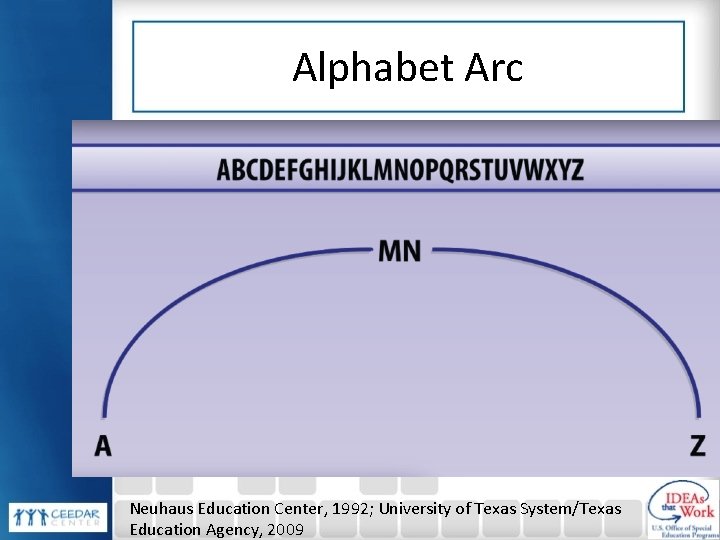
Alphabet Arc Neuhaus Education Center, 1992; University of Texas System/Texas Education Agency, 2009
Video: The Alphabet Arc Partner A: Note how the teacher provides corrective feedback. Partner B: Note the multiple opportunities the teacher provides for students to practice naming the letters. 2009 University of Texas System/Texas Education Agency
Alphabet Activities • Practice saying (not singing) the alphabet, varying the practice (accent every other letter, boys say one letter, girls the next, one letter is said softly and the next one loudly). • Students watch their mouth in a mirror while learning sounds. Neuhaus Education Center, 1992
Screening Assessments • Texas Primary Reading Inventory (TPRI) – Spanish version: Tejas LEE • PALS – PALS español • Dynamic Indicators of Basic Early Literacy Skills) DIBELS – Spanish version: IDEL TPRI: University of Texas Health Science Center at Houston, Center for Academic and Reading Skills, & University of Houston, 2002 tpri@uth. tmc. edu, http: //tejaslee. org— Now published by Brookes PALS: (Invernizzi et al. , 2002); PALS espanol (K. Ford) https: //www. palsmarketplace. com/assessments / DIBELS: (Good & Kaminski, 2002) http: //dibels. uoregon. edu
Letter-Sound Correspondence Effective Instruction. . . • Is explicit and systematic. • Teaches common sounds of letters first. • Provides immediate clarification. • Progresses to blending sounds together to form real words. • © 2009 University of Texas System/Texas Education Agency
In Action. . . • • • Maintain attention and engagement. Opportunities to practice. Modeling. Explicit and systematic. What else?
Orthographic Mapping • Orthographic Mapping (OM): letter-sound connections. • Bonds the spellings, pronunciations, and meaning of words in memory. Ehri, 2014, 2005; Moats, 2010
Sight Words • All words read from memory. • OM forms connections between written units and spoken units. • Connections are retained in memory. Cunningham, 2014; Ehri, 2014
Word Reading Strategies 1. Decoding. 2. Analogy. 3. Prediction. Ehri, 2014
Phases of Reading 1. Pre-alphabetic phase. 2. Partial alphabetic phase. 3. Full alphabetic phase. 4. Consolidated alphabetic phase. Ehri, 2005
Letter-Sound Teaching 1. Teach frequently used letters and sounds. 2. Teach letters that will enable reading words quickly. 3. Do NOT teach letters that sound alike together—separate the introductions. 4. Teach continuous sounds, then stop sounds. 5. Provide practice opportunities! Vaughn, 2004; O’Connor, 2014
Guidelines Handout 3. 3 D: Guidelines for Teaching Letter-Sound Correspondences. Highlight important points to remember. Be prepared to discuss why you chose these points.
Sequence for Teaching Handout 3. 3 E: Example Sequence for Introducing Letter-Sound Correspondences. Letters that sound and look similar. Object permanency and letters.
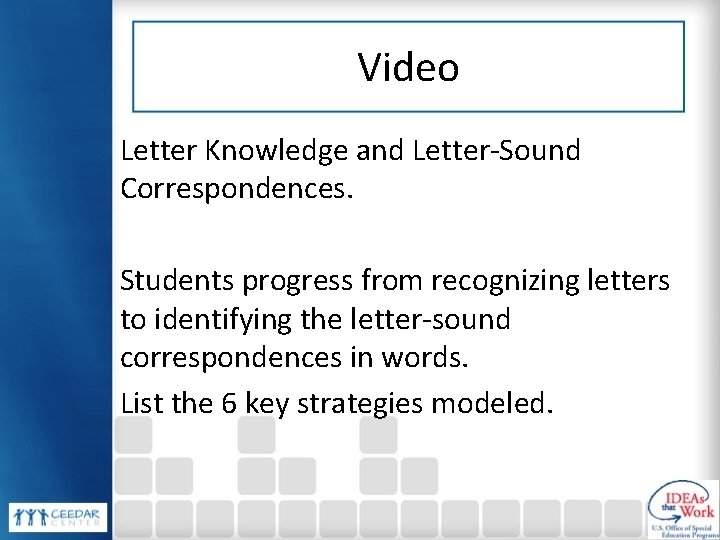
Video Letter Knowledge and Letter-Sound Correspondences. Students progress from recognizing letters to identifying the letter-sound correspondences in words. List the 6 key strategies modeled.
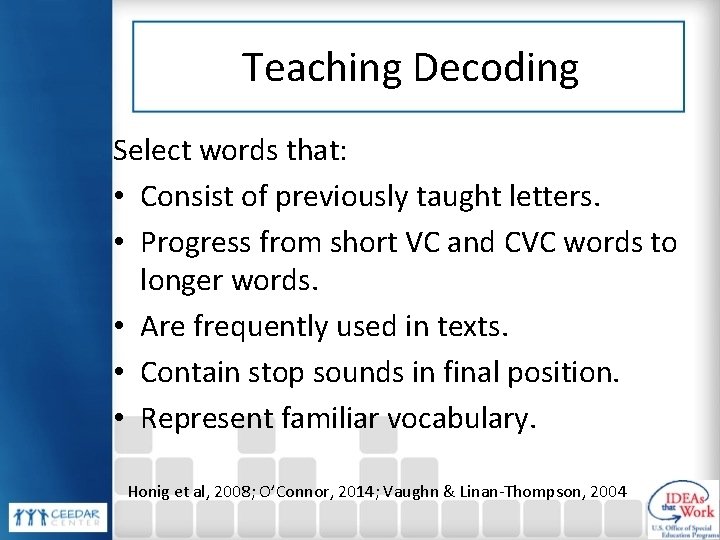
Teaching Decoding Select words that: • Consist of previously taught letters. • Progress from short VC and CVC words to longer words. • Are frequently used in texts. • Contain stop sounds in final position. • Represent familiar vocabulary. Honig et al, 2008; O’Connor, 2014; Vaughn & Linan-Thompson, 2004
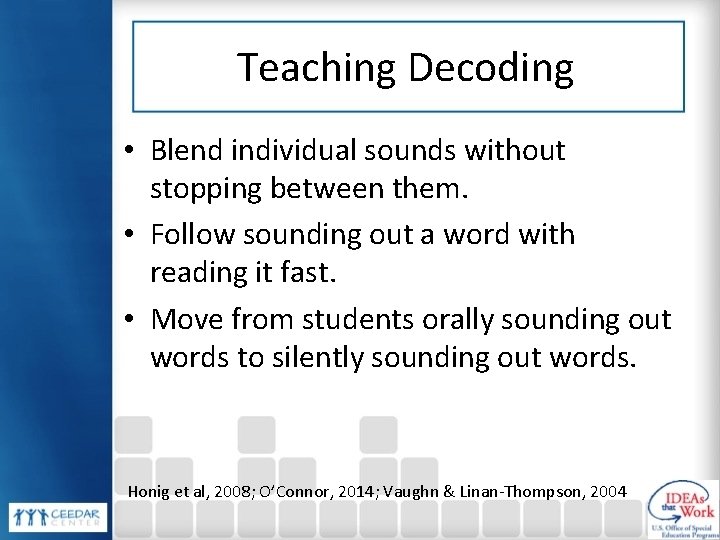
Teaching Decoding • Blend individual sounds without stopping between them. • Follow sounding out a word with reading it fast. • Move from students orally sounding out words to silently sounding out words. Honig et al, 2008; O’Connor, 2014; Vaughn & Linan-Thompson, 2004
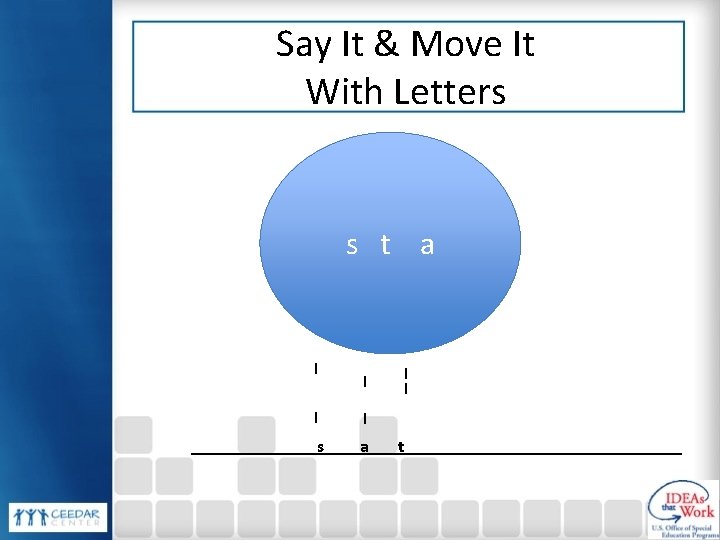
Say It & Move It With Letters s t a I I _______s I I a t________________
Teaching Irregular Words that do not follow predictable patterns: • Teach frequently occurring words. • Teach words before students read them in stories. • Limit the number introduced in one lesson. • Separate visually similar words. • Review previously taught words. © 2009 University of Texas System/Texas Education Agency; Birsh, 2011; Hougen, 2012; O’Connor, 2014
Let’s Try It! Handout 3. 3 F: Guidelines for Teaching Irregular Words. B: teach said. A: teach was.
Quick Review • What is the alphabetic principle? • What is one way to teach letter-sound relationships? • What challenges do you anticipate?
Challenges? With your partner, discuss challenges some students may have learning letter-sound correspondences and reading words.
Phonics Continuum Handout 3. 3 G: Phonics Continuum. Think of a student who is stuck on the continuum. Plan skills you can teach to help the student progress.
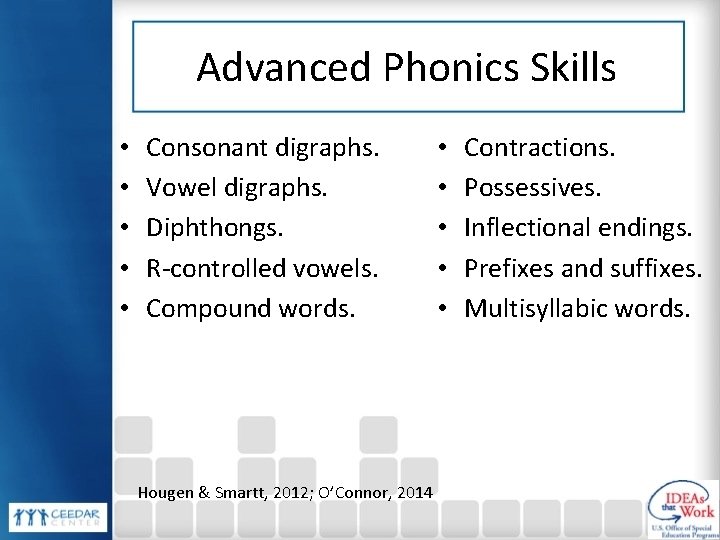
Advanced Phonics Skills • • • Consonant digraphs. Vowel digraphs. Diphthongs. R-controlled vowels. Compound words. Hougen & Smartt, 2012; O’Connor, 2014 • • • Contractions. Possessives. Inflectional endings. Prefixes and suffixes. Multisyllabic words.
In Action • Partner A: Note the decoding strategies taught. • Partner B: Note how the teacher corrects and reinforces the learning.
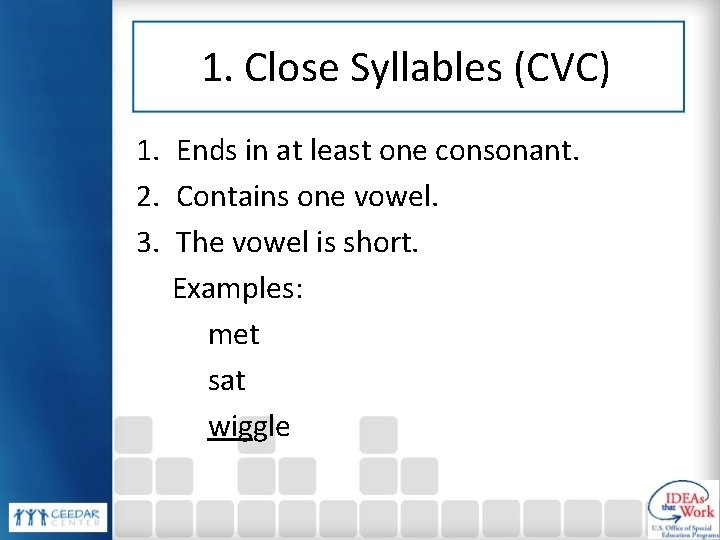
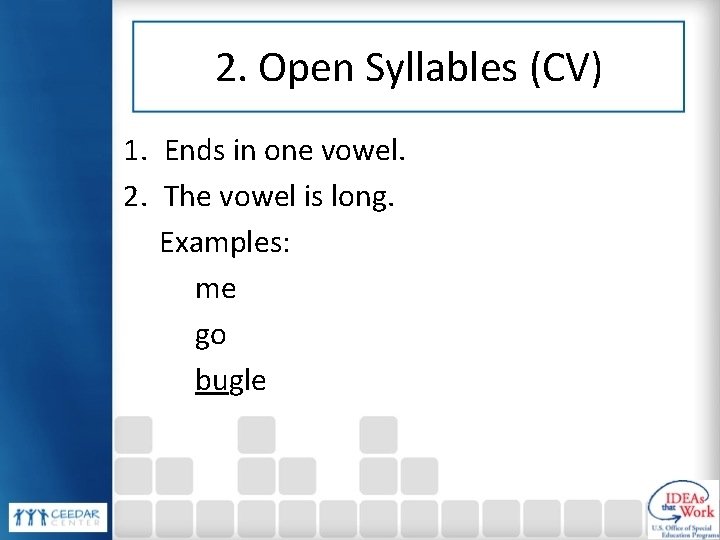
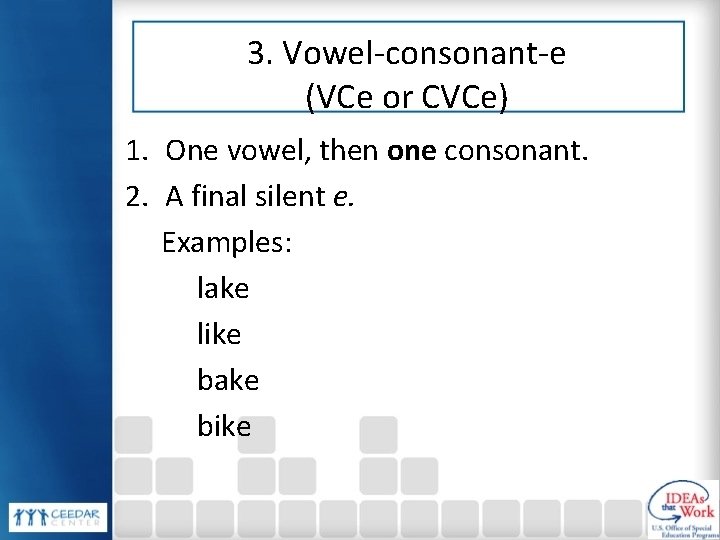
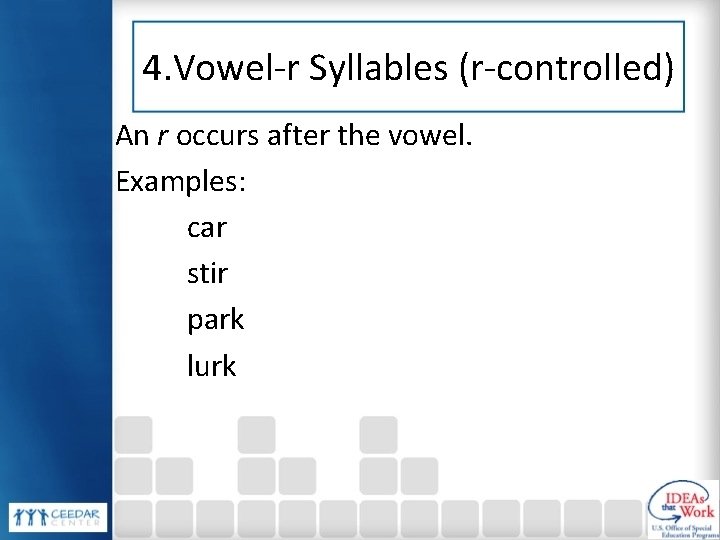
Types of Syllables Knowing the types of syllables helps students to: • Determine the vowel sounds in one-syllable words. • Decode multi-syllable words. Birsh, 2011; Hougen & Smartt, 2012
1. Close Syllables (CVC) 1. Ends in at least one consonant. 2. Contains one vowel. 3. The vowel is short. Examples: met sat wiggle
2. Open Syllables (CV) 1. Ends in one vowel. 2. The vowel is long. Examples: me go bugle
3. Vowel-consonant-e (VCe or CVCe) 1. One vowel, then one consonant. 2. A final silent e. Examples: lake like bake bike
4. Vowel-r Syllables (r-controlled) An r occurs after the vowel. Examples: car stir park lurk
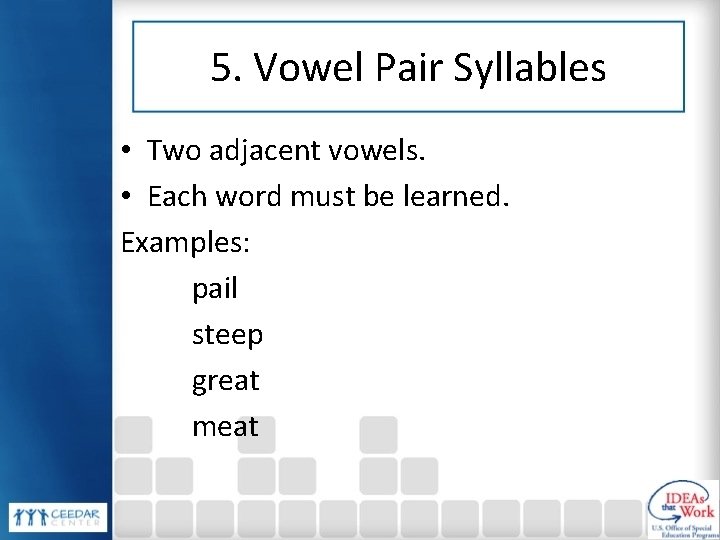
5. Vowel Pair Syllables • Two adjacent vowels. • Each word must be learned. Examples: pail steep great meat
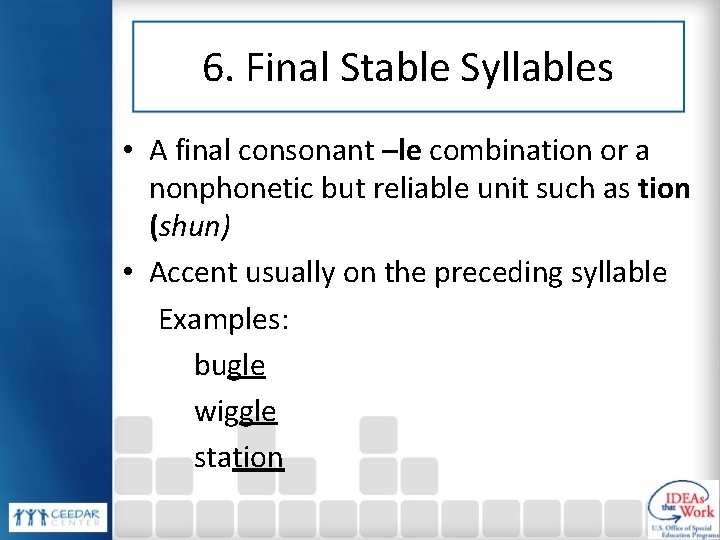
6. Final Stable Syllables • A final consonant –le combination or a nonphonetic but reliable unit such as tion (shun) • Accent usually on the preceding syllable Examples: bugle wiggle station
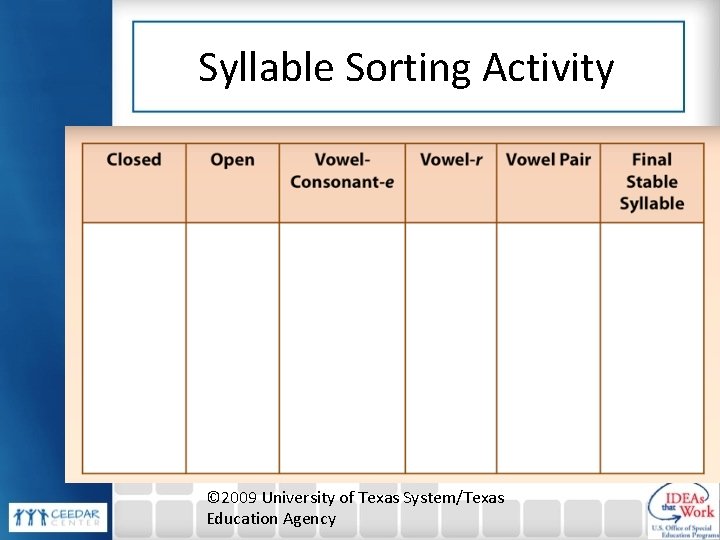
Syllable Sorting Activity © 2009 University of Texas System/Texas Education Agency
Think, Pair, Share • What challenges do you anticipate some students having learning about syllables? • How will knowing the types of syllables help students learn to read?
Struggling Students Need More: • explicit instruction – one syllable type at a time • manipulation – plastic letters, sorting activities • modeling – by teacher, other students • practice time – small group, centers, computer programs • reading real words
Morphemes are the smallest units of meaning in a language. Ebbers & Hougen, 2014; O’Connor, 2014
Unbound Morphemes Unbound (or free) morphemes can stand alone: – smile – book – cute Moats, 2010
Bound Morphemes • Bound morphemes must be attached to other morphemes. • They change the meaning of the word. – un –s – est Moats, 2010
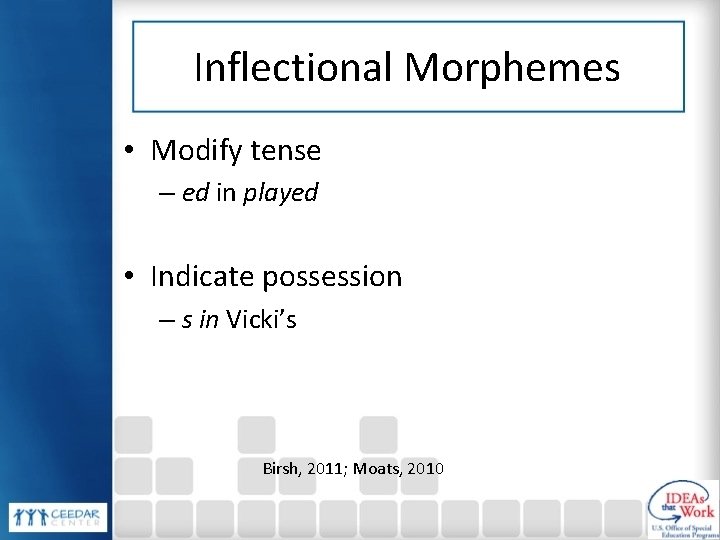
Inflectional Morphemes • Modify tense – ed in played • Indicate possession – s in Vicki’s Birsh, 2011; Moats, 2010
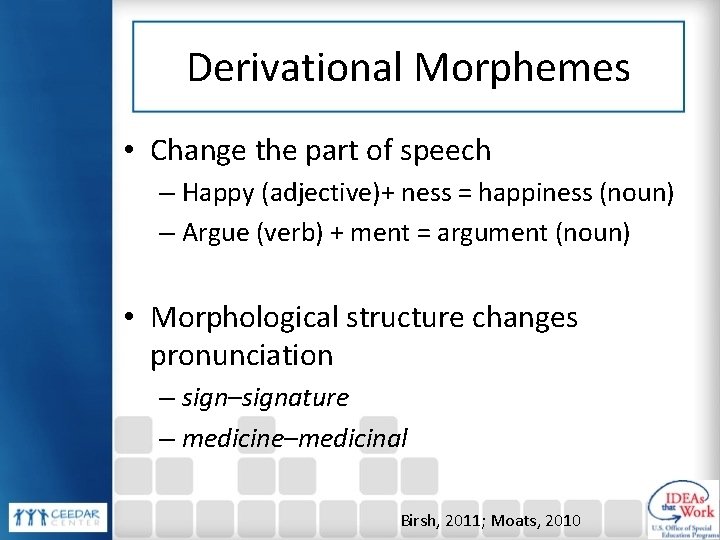
Derivational Morphemes • Change the part of speech – Happy (adjective)+ ness = happiness (noun) – Argue (verb) + ment = argument (noun) • Morphological structure changes pronunciation – sign–signature – medicine–medicinal Birsh, 2011; Moats, 2010
Check Your Learning With your partner: 1. Review your answers to the definitions on Handout 3. 3 A. 2. Discuss and reach a consensus on each item.
Application Assignment Review the materials at: www. fcrr. org Grades 1 & 2: Phonics. Select one activity to teach to your partner. Before the next session, teach the activity to a young student.
Homework: Content Review • Complete the quiz on syllable types Handout 3. 3 H. • Be prepared to discuss: o challenges students may have applying knowledge of syllable types to decoding words. o how you would address those challenges.