
Overview of the Colorado River Basin Water Supply
Overview of the Colorado River Basin Water Supply and Demand Study Urban Water Institute 19 th Annual Water Policy Conference August 22 -24, 2012 San Diego CA
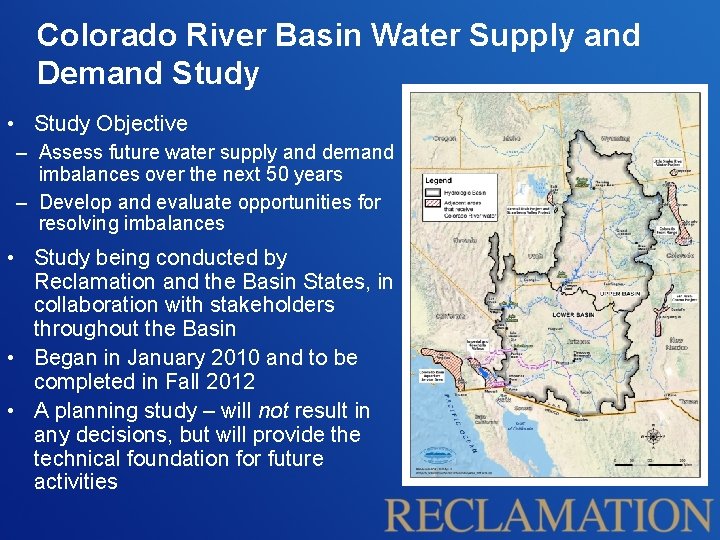
Colorado River Basin Water Supply and Demand Study • Study Objective – Assess future water supply and demand imbalances over the next 50 years – Develop and evaluate opportunities for resolving imbalances • Study being conducted by Reclamation and the Basin States, in collaboration with stakeholders throughout the Basin • Began in January 2010 and to be completed in Fall 2012 • A planning study – will not result in any decisions, but will provide the technical foundation for future activities
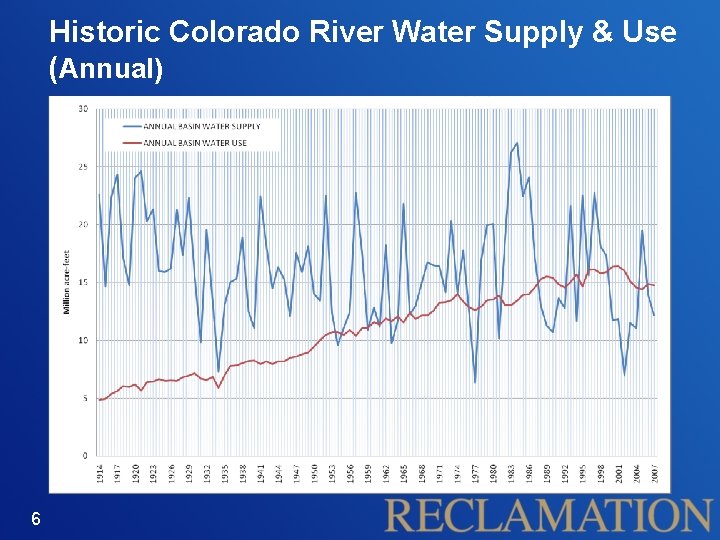
Historic Colorado River Water Supply & Use (Annual) 6
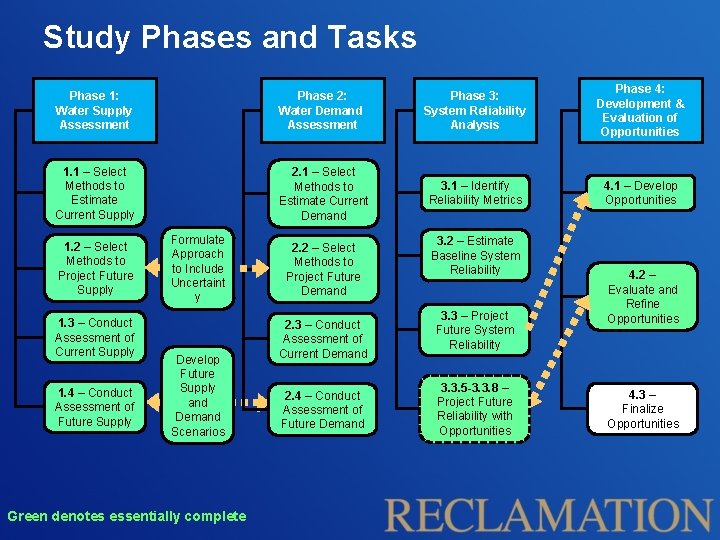
Study Phases and Tasks Phase 1: Water Supply Assessment Phase 2: Water Demand Assessment Phase 3: System Reliability Analysis Phase 4: Development & Evaluation of Opportunities 1. 1 – Select Methods to Estimate Current Supply 2. 1 – Select Methods to Estimate Current Demand 3. 1 – Identify Reliability Metrics 4. 1 – Develop Opportunities 1. 2 – Select Methods to Project Future Supply 1. 3 – Conduct Assessment of Current Supply 1. 4 – Conduct Assessment of Future Supply Formulate Approach to Include Uncertaint y Develop Future Supply and Demand Scenarios Green denotes essentially complete 2. 2 – Select Methods to Project Future Demand 2. 3 – Conduct Assessment of Current Demand 2. 4 – Conduct Assessment of Future Demand 3. 2 – Estimate Baseline System Reliability 3. 3 – Project Future System Reliability 3. 3. 5 -3. 3. 8 – Project Future Reliability with Opportunities 4. 2 – Evaluate and Refine Opportunities 4. 3 – Finalize Opportunities
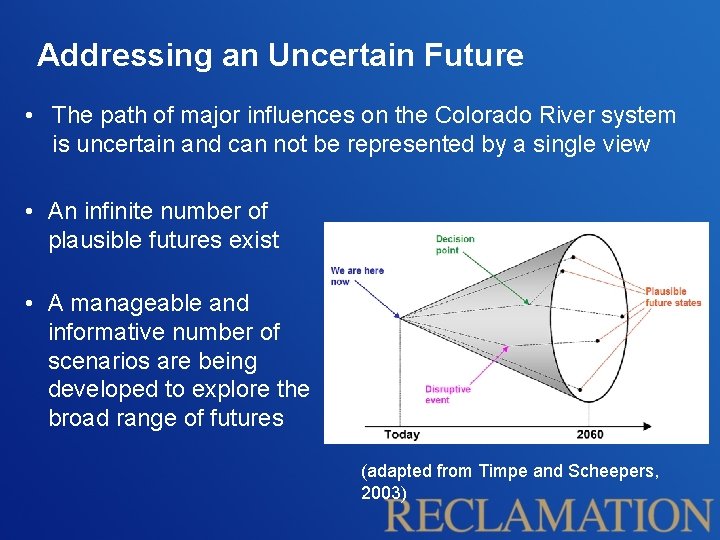
Addressing an Uncertain Future • The path of major influences on the Colorado River system is uncertain and can not be represented by a single view • An infinite number of plausible futures exist • A manageable and informative number of scenarios are being developed to explore the broad range of futures (adapted from Timpe and Scheepers, 2003)

Water Supply Scenarios Water Demand Scenarios Observed Resampled: Current Projected (A): Ø future hydrologic trends and variability will be similar to the past 100 years Ø growth, development patterns, and institutions continue along recent trends Paleo Resampled: Slow Growth (B): Ø future hydrologic trends and variability are represented by the distant past (approximately 1250 years) Ø low growth with emphasis on economic efficiency Paleo Conditioned: Ø economic resurgence (population and energy) and current preferences toward human and environmental values Ø future hydrologic trends and variability are represented by a blend of the wet dry states of the paleo-climate record but magnitudes are more similar to the observed period Downscaled GCM Projected: Ø future climate will continue to warm with regional precipitation trends represented through an ensemble of future GCM projections Rapid Growth (C 1 and C 2): Ø C 1 – slower technology adoption Ø C 2 – rapid technology adoption Enhanced Environment (D 1 and D 2): Ø expanded environmental awareness and stewardship with growing economy Ø D 1 – with moderate population growth Ø D 2 – with rapid population growth
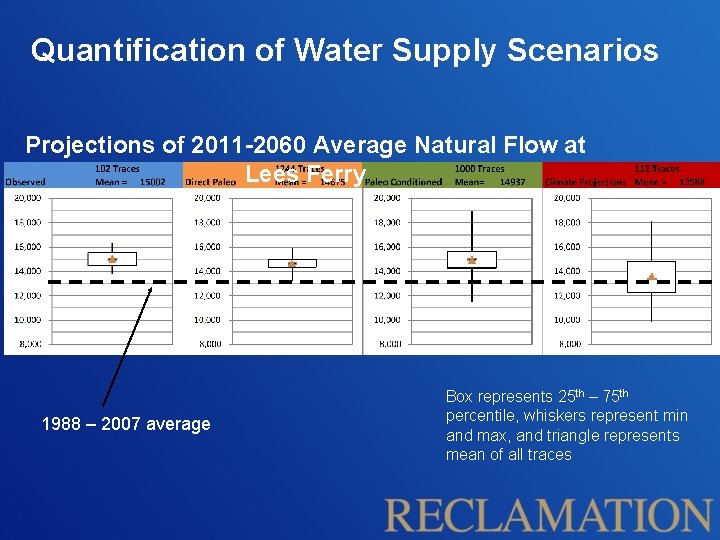
Quantification of Water Supply Scenarios Projections of 2011 -2060 Average Natural Flow at Lees Ferry 1988 – 2007 average Box represents 25 th – 75 th percentile, whiskers represent min and max, and triangle represents mean of all traces
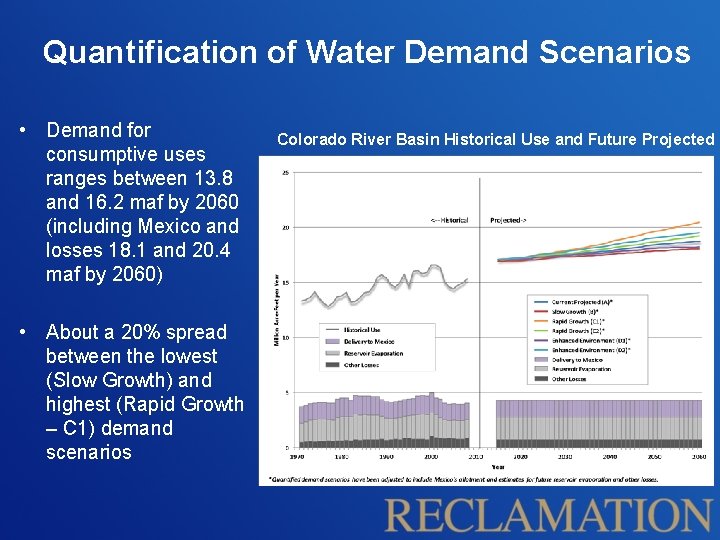
Quantification of Water Demand Scenarios • Demand for consumptive uses ranges between 13. 8 and 16. 2 maf by 2060 (including Mexico and losses 18. 1 and 20. 4 maf by 2060) • About a 20% spread between the lowest (Slow Growth) and highest (Rapid Growth – C 1) demand scenarios Colorado River Basin Historical Use and Future Projected D
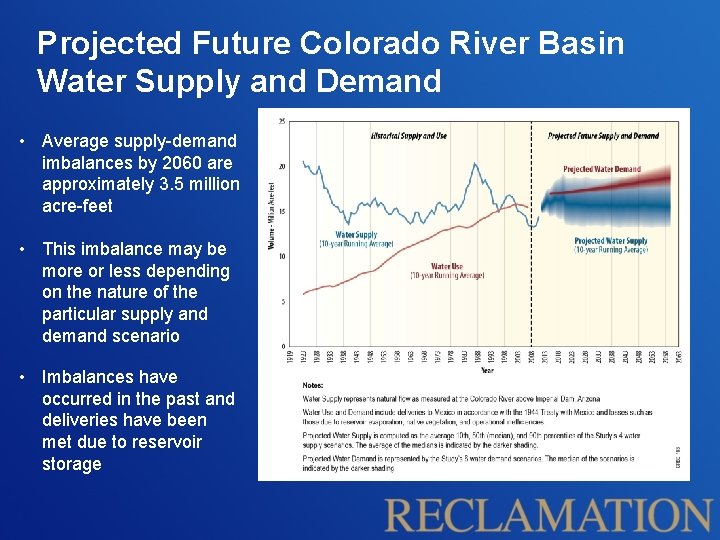
Projected Future Colorado River Basin Water Supply and Demand • Average supply-demand imbalances by 2060 are approximately 3. 5 million acre-feet • This imbalance may be more or less depending on the nature of the particular supply and demand scenario • Imbalances have occurred in the past and deliveries have been met due to reservoir storage
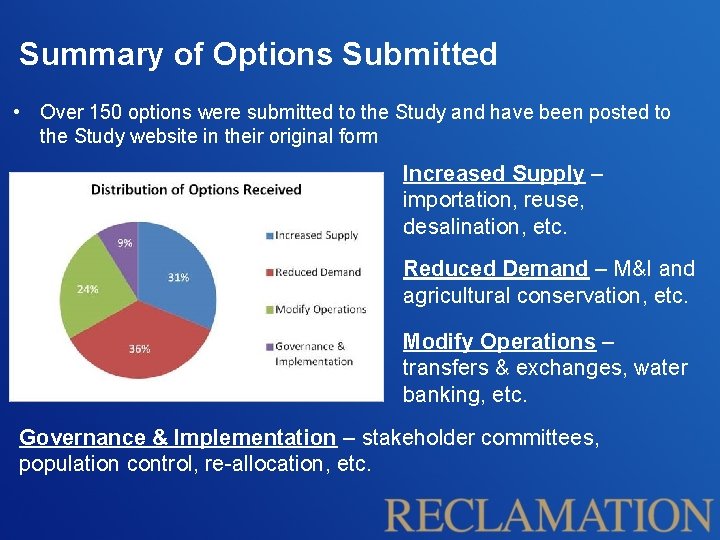
Summary of Options Submitted • Over 150 options were submitted to the Study and have been posted to the Study website in their original form Increased Supply – importation, reuse, desalination, etc. Reduced Demand – M&I and agricultural conservation, etc. Modify Operations – transfers & exchanges, water banking, etc. Governance & Implementation – stakeholder committees, population control, re-allocation, etc.
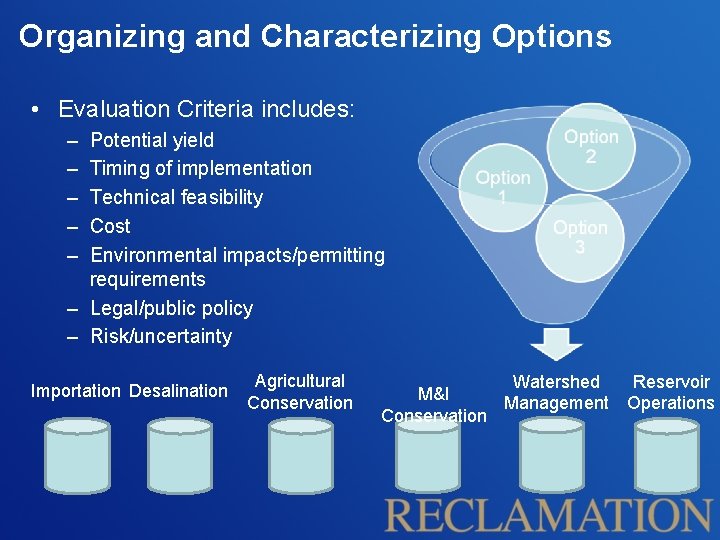
Organizing and Characterizing Options • Evaluation Criteria includes: – – – Potential yield Timing of implementation Technical feasibility Cost Environmental impacts/permitting requirements – Legal/public policy – Risk/uncertainty Importation Desalination Agricultural Conservation Watershed M&I Management Conservation Reservoir Operations
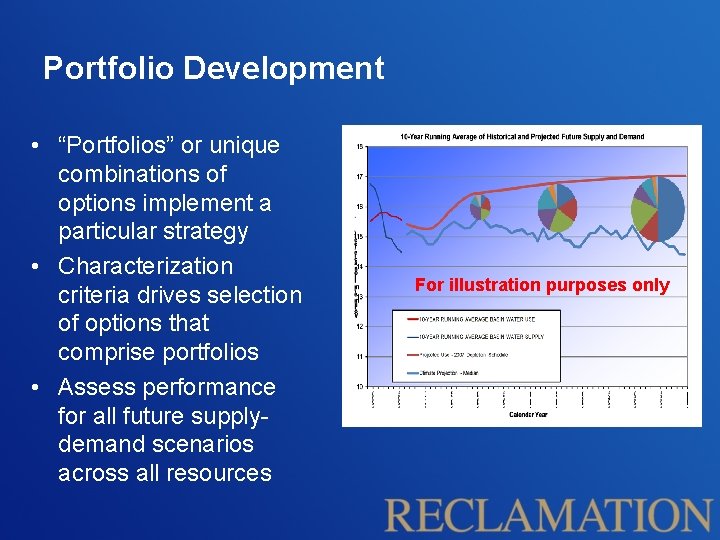
Portfolio Development • “Portfolios” or unique combinations of options implement a particular strategy • Characterization criteria drives selection of options that comprise portfolios • Assess performance for all future supplydemand scenarios across all resources For illustration purposes only
Colorado River Basin Water Supply and Demand Study Contact Information • Website: http: //www. usbr. gov/lc/region/programs/crbstudy. html • Email: Colorado. River. Basin. Study@usbr. gov • Telephone: 702 -293 -8500; Fax: 702 -293 -8418
- Slides: 13