
Overview of the CERTCC and the Survivable Systems
Overview of the CERT/CC and the Survivable Systems Initiative Andrew P. Moore apm@cert. org CERT Coordination Center Software Engineering Institute Carnegie Mellon University Pittsburgh, PA 15213 Sponsored by the U. S. Department of Defense 1 2002 Carnegie Mellon University

*FFRDC - Federally Funded Research and Development Center 2 2002 Carnegie Mellon University
Talk Overview • CERT Coordination Center • Survivable Systems Initiative • Intrusion-Aware Design and Analysis 3 2002 Carnegie Mellon University
CERT Coordination Center 4 2002 Carnegie Mellon University

The Beginning of the CERT/CC

CERT/CC Mission • Respond to security emergencies on the Internet • Serve as a focal point for reporting security vulnerabilities and incidents • Raise awareness of security issues • Serve as a model to help others establish incident response teams 6 2002 Carnegie Mellon University
CERT/CC Principles Princip • Provide valued services - proactive as well as reactive • Ensure confidentiality and impartiality - we do not identify victims but can pass information anonymously and describe activity without attribution - unbiased source of trusted information • Coordinate with other organisations and experts - academic, government, corporate - distributed model for incident response teams (coordination and cooperation, not control) 7 2002 Carnegie Mellon University
CERT Coordination Center Teams 8 2002 Carnegie Mellon University
CERT Vulnerability Handling & Analysis • Receives vulnerability reports - forms, email, phone calls • Verifies and analyzes reports/artifacts - veracity, scope, magnitude, exploitation • Works with vulnerability reporters, vendors, experts - understanding and countermeasures • Publicizes information about vulnerabilities and countermeasures - vulnerability notes, advisories 9 2002 Carnegie Mellon University
CERT Incident Handling & Response • Receives reports related to computer security from Internet sites - break-ins, service denial, probes, attempts • Provides 24 -hr. emergency incident response • Analyses report and provides feedback to reporting sites involved - attack method, scope, magnitude, correlation, response • Informs Internet community - incident notes, summaries, advisories - assist formation and development of CSIRTs 10 2002 Carnegie Mellon University
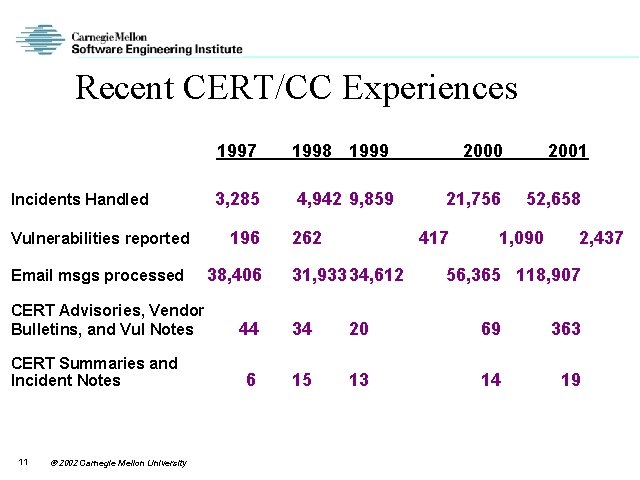
Recent CERT/CC Experiences Incidents Handled Vulnerabilities reported Email msgs processed CERT Advisories, Vendor Bulletins, and Vul Notes CERT Summaries and Incident Notes 11 2002 Carnegie Mellon University 1997 1998 1999 3, 285 4, 942 9, 859 196 38, 406 262 2000 21, 756 417 31, 933 34, 612 2001 52, 658 1, 090 2, 437 56, 365 118, 907 44 34 20 69 363 6 15 13 14 19
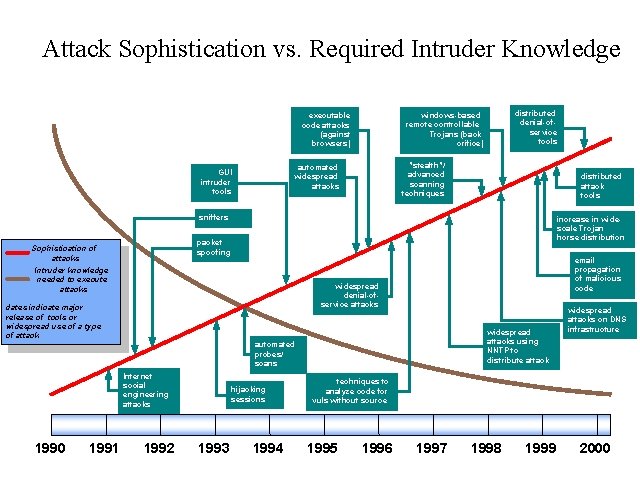
Attack Sophistication vs. Required Intruder Knowledge "stealth"/ advanced scanning techniques automated widespread attacks GUI intruder tools distributed denial-ofservice tools windows-based remote controllable Trojans (back orifice) executable code attacks (against browsers) distributed attack tools sniffers increase in widescale Trojan horse distribution packet spoofing Sophistication of attacks Intruder knowledge needed to execute attacks widespread denial-ofservice attacks dates indicate major release of tools or widespread use of a type of attack 1991 widespread attacks using NNTP to distribute attack automated probes/ scans Internet social engineering attacks 1990 email propagation of malicious code 1992 hijacking sessions 1993 1994 widespread attacks on DNS infrastructure techniques to analyze code for vuls without source 1995 1996 1997 1998 1999 2000

Major Event Response Time Declining March 1999 May 2000 13 2002 Carnegie Mellon University
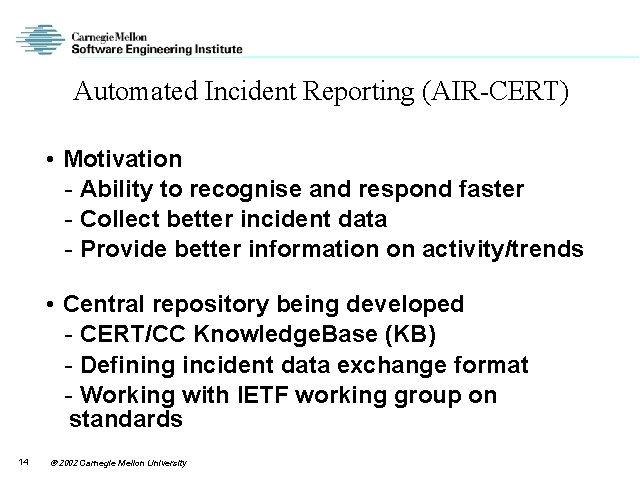
Automated Incident Reporting (AIR-CERT) • Motivation - Ability to recognise and respond faster - Collect better incident data - Provide better information on activity/trends • Central repository being developed - CERT/CC Knowledge. Base (KB) - Defining incident data exchange format - Working with IETF working group on standards 14 2002 Carnegie Mellon University
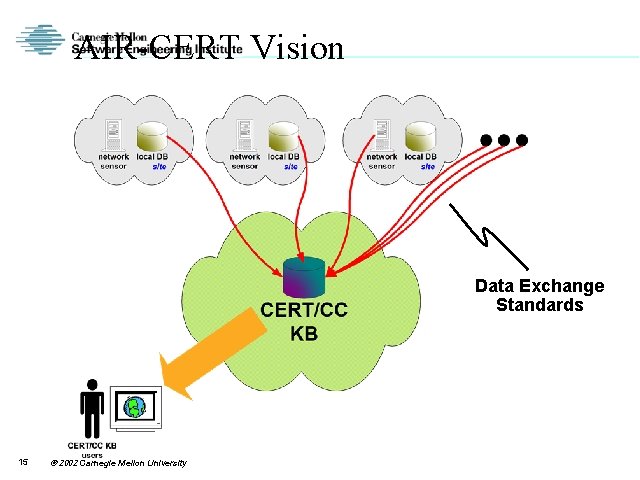
AIR-CERT Vision Data Exchange Standards 15 2002 Carnegie Mellon University

Survivable Systems Initiative 16 2002 Carnegie Mellon University
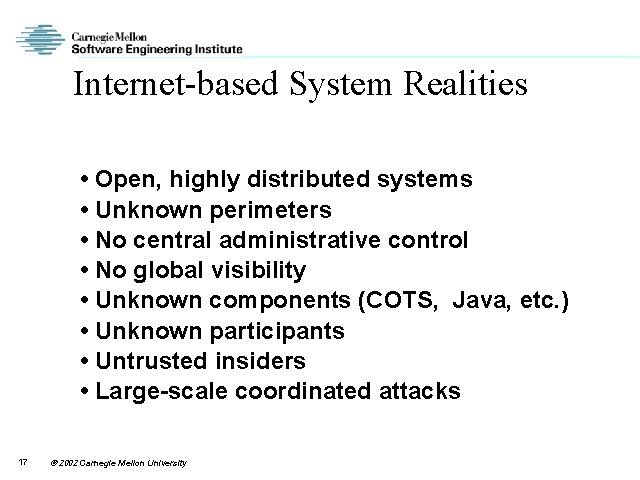
Internet-based System Realities • Open, highly distributed systems • Unknown perimeters • No central administrative control • No global visibility • Unknown components (COTS, Java, etc. ) • Unknown participants • Untrusted insiders • Large-scale coordinated attacks 17 2002 Carnegie Mellon University

Survivable Systems Initiative 18 2002 Carnegie Mellon University
Initiative Goal Ensure that appropriate technology, systems management practices, and supporting infrastructures are used to limit damage and to ensure continuity of critical services in the presence of attacks, accidents, and failures 19 2002 Carnegie Mellon University

Survivability Definition: The ability of a system to fulfill its mission, in a timely manner, in the presence of attacks, accidents, and failures Assumption: No individual component of a system is immune to all attacks, accidents, and failures. Goal: The mission must survive. 20 2002 Carnegie Mellon University
3 R’s of Survivability Resistance — ability of a system to deter attacks Recognition — ability to recognize attacks and the extent of damage Recovery — ability to restore services in a timely manner 21 2002 Carnegie Mellon University
Survivability Methods • Conventional security techniques (access control, encryption, authentication) • Diversity, redundancy • Deception • Trust validation • Rapid Recovery and Adaptation • Mission-specific risk management • Contingency (disaster) planning • Success criterion: graceful degradation & essential services maintained 22 2002 Carnegie Mellon University
Intrusion-Aware Design (IAD) 23 2002 Carnegie Mellon University
IAD Problem Addressed Sophisticated intruders can and do • Share tools and knowledge to amplify capability • Escalate attack with intensity of political conflicts • Target people (perceptions), resources, workflows • Hide their tracks, fly under the radar of existing IDS Engineers not using security failure data • Same security mistakes continually repeated • Properties must emerge from architectural interaction • Survivability considered too late, if at all 24 2002 Carnegie Mellon University
Objective Develop cost-effective methods for using our understanding of known and hypothesized patterns of attack to build more survivable systems. 25 2002 Carnegie Mellon University
Definitions intrusion scenario • description of people, systems interacting • characterizes malicious behavior • causes harm to enterprise survivability scenario • description of people, systems interacting • in way that resists, recognizes, recovers from attacks on enterprise 26 2002 Carnegie Mellon University
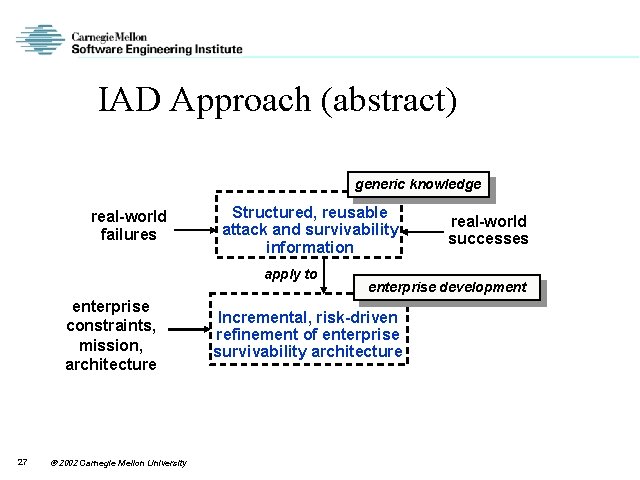
IAD Approach (abstract) generic knowledge real-world failures Structured, reusable attack and survivability information apply to enterprise constraints, mission, architecture 27 2002 Carnegie Mellon University real-world successes enterprise development Incremental, risk-driven refinement of enterprise survivability architecture

IAD Approach (expanded) generic knowledge real-world failures Intrusion Scenarios Survivability Scenarios abstraction, parameterization Survivability Strategies Attack Patterns instantiation, composition enterprise development enterprise constraints, mission, architecture Attack Weighted threat/impact analysis Tree 28 2002 Carnegie Mellon University mitigation analysis Attack Tree Enterprise Survivability Architecture real-world successes
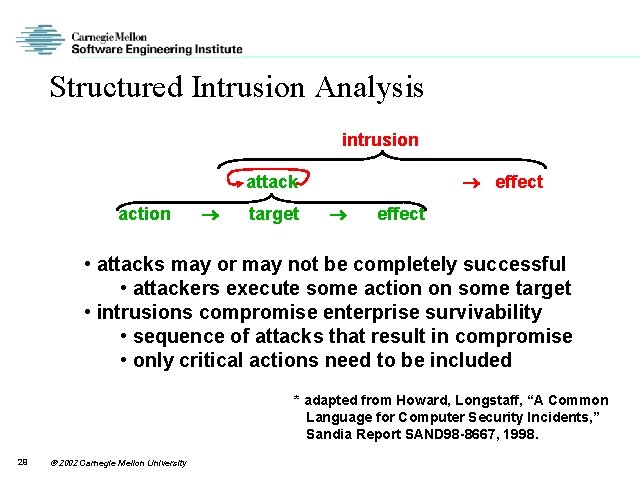
Structured Intrusion Analysis intrusion effect attack action target effect • attacks may or may not be completely successful • attackers execute some action on some target • intrusions compromise enterprise survivability • sequence of attacks that result in compromise • only critical actions need to be included * adapted from Howard, Longstaff, “A Common Language for Computer Security Incidents, ” Sandia Report SAND 98 -8667, 1998. 29 2002 Carnegie Mellon University
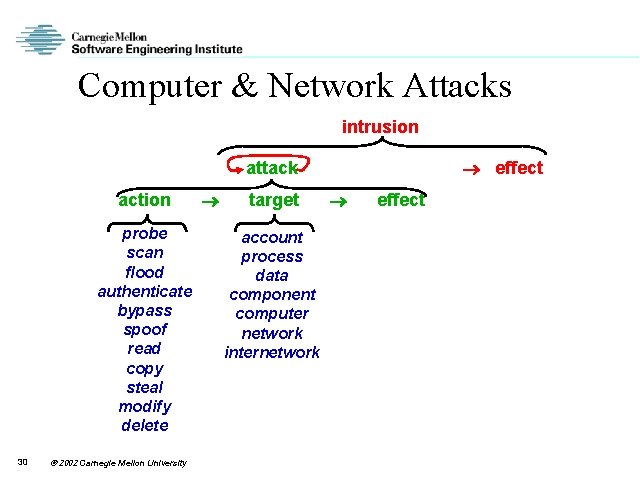
Computer & Network Attacks intrusion effect attack action probe scan flood authenticate bypass spoof read copy steal modify delete 30 2002 Carnegie Mellon University target account process data component computer network internetwork effect
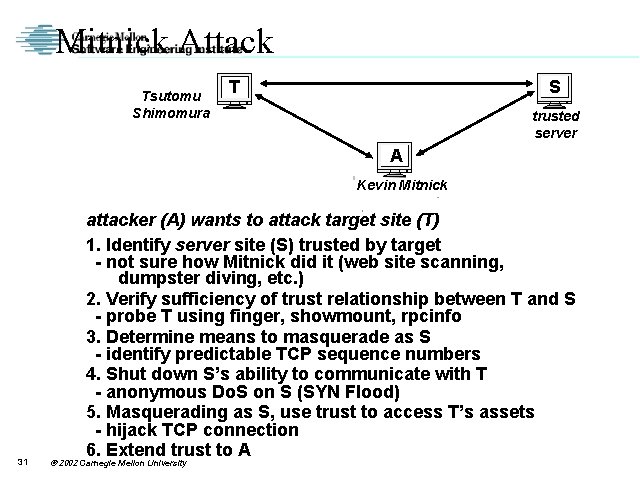
Mitnick Attack Tsutomu Shimomura S T trusted server A Kevin Mitnick 31 attacker (A) wants to attack target site (T) 1. Identify server site (S) trusted by target - not sure how Mitnick did it (web site scanning, dumpster diving, etc. ) 2. Verify sufficiency of trust relationship between T and S - probe T using finger, showmount, rpcinfo 3. Determine means to masquerade as S - identify predictable TCP sequence numbers 4. Shut down S’s ability to communicate with T - anonymous Do. S on S (SYN Flood) 5. Masquerading as S, use trust to access T’s assets - hijack TCP connection 6. Extend trust to A 2002 Carnegie Mellon University
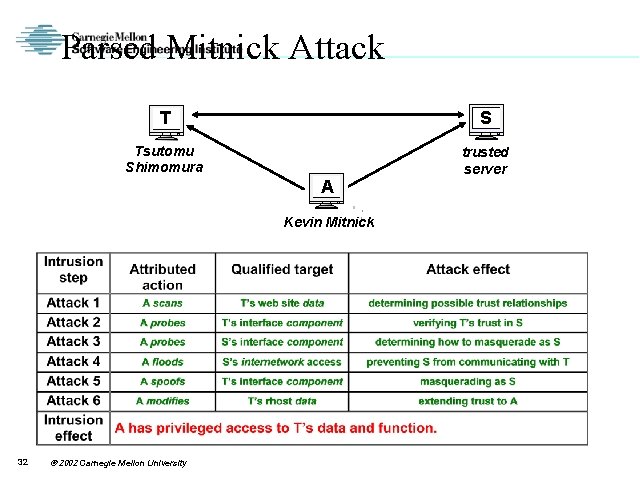
Parsed Mitnick Attack T S Tsutomu Shimomura trusted server A Kevin Mitnick 32 2002 Carnegie Mellon University
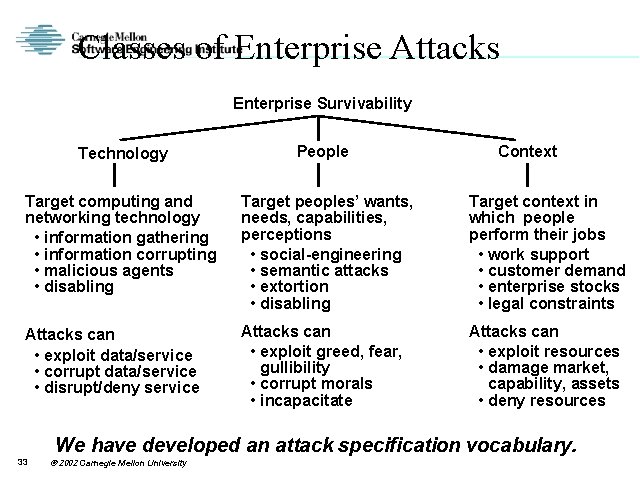
Classes of Enterprise Attacks Enterprise Survivability Technology People Context Target computing and networking technology • information gathering • information corrupting • malicious agents • disabling Target peoples’ wants, needs, capabilities, perceptions • social-engineering • semantic attacks • extortion • disabling Target context in which people perform their jobs • work support • customer demand • enterprise stocks • legal constraints Attacks can • exploit data/service • corrupt data/service • disrupt/deny service Attacks can • exploit greed, fear, gullibility • corrupt morals • incapacitate Attacks can • exploit resources • damage market, capability, assets • deny resources We have developed an attack specification vocabulary. 33 2002 Carnegie Mellon University
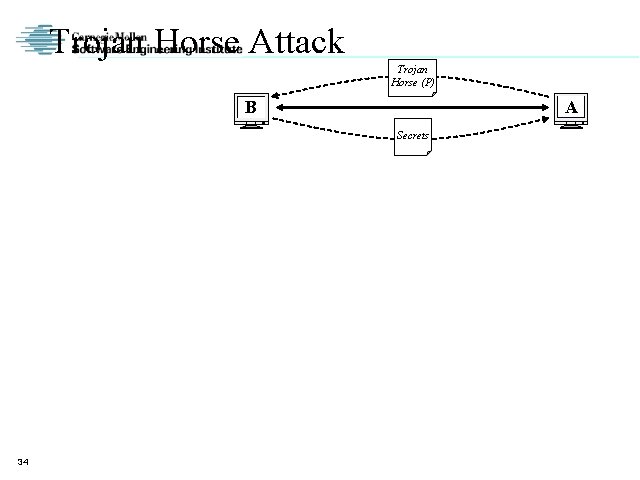
Trojan Horse Attack Trojan Horse (P) A B Secrets 34 2002 Carnegie Mellon University
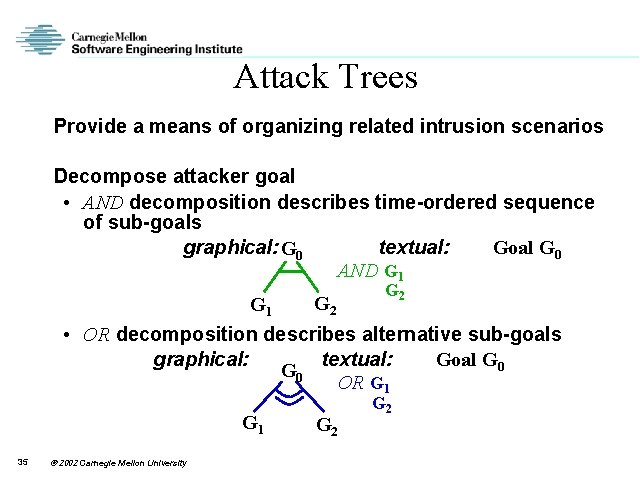
Attack Trees Provide a means of organizing related intrusion scenarios Decompose attacker goal • AND decomposition describes time-ordered sequence of sub-goals graphical: G 0 textual: Goal G 0 AND G 1 G 2 G 1 • OR decomposition describes alternative sub-goals graphical: textual: Goal G 0 OR G 1 35 2002 Carnegie Mellon University G 2
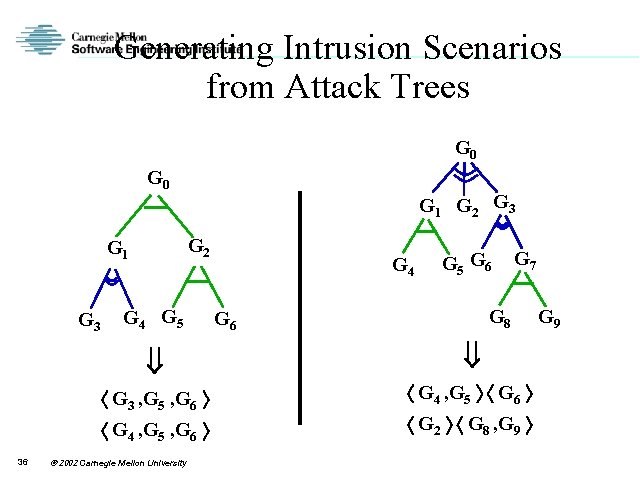
Generating Intrusion Scenarios from Attack Trees G 0 G 2 G 1 G 3 G 1 G 2 G 3 G 4 G 5 G 4 , G 5 , G 6 36 2002 Carnegie Mellon University G 6 G 5 G 6 G 7 G 8 G 3 , G 5 , G 6 G 4 , G 5 G 6 G 2 G 8 , G 9
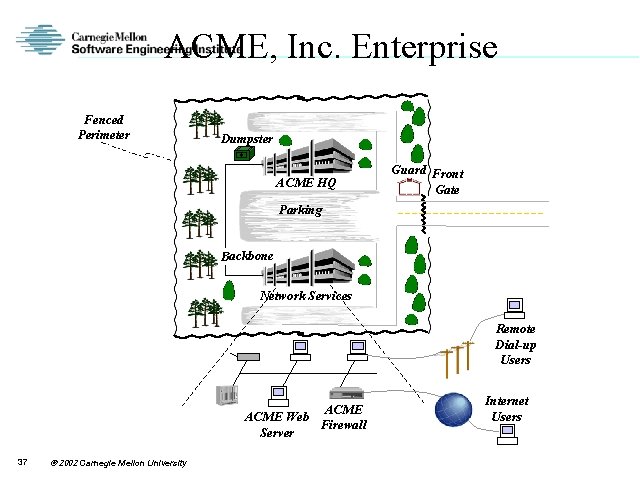
ACME, Inc. Enterprise Fenced Perimeter Dumpster ACME HQ Guard Front Gate Parking Backbone Network Services Remote Dial-up Users ACME Web Firewall Server 37 2002 Carnegie Mellon University Internet Users
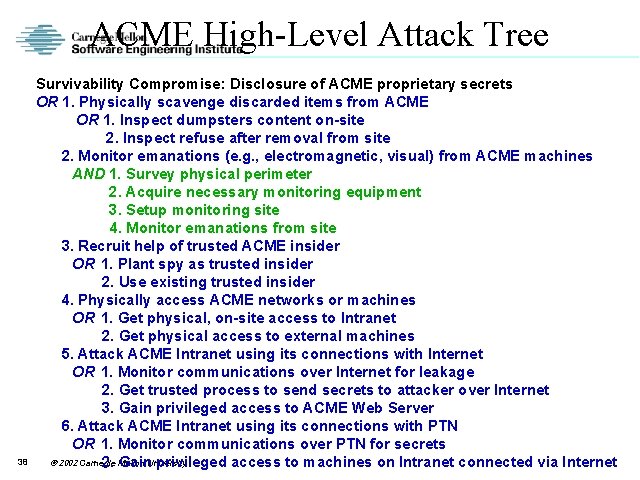
ACME High-Level Attack Tree 38 Survivability Compromise: Disclosure of ACME proprietary secrets OR 1. Physically scavenge discarded items from ACME OR 1. Inspect dumpsters content on-site 2. Inspect refuse after removal from site 2. Monitor emanations (e. g. , electromagnetic, visual) from ACME machines AND 1. Survey physical perimeter 2. Acquire necessary monitoring equipment 3. Setup monitoring site 4. Monitor emanations from site 3. Recruit help of trusted ACME insider OR 1. Plant spy as trusted insider 2. Use existing trusted insider 4. Physically access ACME networks or machines OR 1. Get physical, on-site access to Intranet 2. Get physical access to external machines 5. Attack ACME Intranet using its connections with Internet OR 1. Monitor communications over Internet for leakage 2. Get trusted process to send secrets to attacker over Internet 3. Gain privileged access to ACME Web Server 6. Attack ACME Intranet using its connections with PTN OR 1. Monitor communications over PTN for secrets 2002 Carnegie 2. Mellon Gain. University privileged access to machines on Intranet connected via Internet
Additional Information CERT/CC and Survivable Systems Initiative - General: http: //www. cert. org/ - Incident/vulnerability trends – http: //www. cert. org/present/cert-overview-trends/ Intrusion-Aware Design - General: http: //www. cert. org/sna/ - Attack pattern specification, reuse, composition: – http: //www. cert. org/archive/pdf/01 tn 001. pdf - Attack Tree analysis – http: //www. cert. org/archive/pdf/intrusion-aware. pdf 39 2002 Carnegie Mellon University
CERT® Contact Information CERT Coordination Center Software Engineering Institute Carnegie Mellon University 4500 Fifth Avenue Pittsburgh PA 15213 -3890 USA Hotline: +1 412 268 7090 CERT personnel answer 8: 00 a. m. — 8: 00 p. m. EST(GMT-5) / EDT(GMT-4), and are on call for emergencies during other hours. Fax: +1 412 268 6989 Web: http: //www. cert. org/ Email: cert@cert. org 40 2002 Carnegie Mellon University
- Slides: 40