
Overview of The Autism Curriculum Encyclopedia ACE Rethink
- Slides: 45
+ Overview of The Autism Curriculum Encyclopedia (ACE®), Rethink Autism, and Autism Apps Lauren Anderson, B. S. University of Utah School Psychology Program July 6 th, 2016 Superheroes Social Skills Training, Rethink Autism Internet Intervention, Parent Training, Evidencebased Practices Classroom Training, Functional Behavior Assessment: An Autism Spectrum Disorder, Evidence-based Practices Training Track for School Psychologists US Office of Education Personnel Preparation Grant H 325 K 12306 William Jenson, Ph. D. , Elaine Clark Ph. D. , Julia Hood, Ph. D. , & John Davis, Ph. D.
+ Overview n The Autism Encyclopedia Curriculum (ACE®) n System description n Cost n Effectiveness n Rethink Autism n Brief system description n Parental Involvement n Cost n Effectiveness n Autism Apps n Background n Categories
+ The ACE®: Mission n “Our mission is to provide you with the very best in online ABA software and curriculum. We want to ensure you have the latest tools to help you maximize the effectiveness of your programs for learners with autism. ” (http: //www. acenecc. org/history-mission/)
+ The ACE®: Background n Developed by staff at The New England Center for Children (NECC) n Serving individuals with ASD since 1975 n Non-profit organization devoted to helping children with ASD n NECC Highlights: n Serves 450+ students n Given 1818 presentations n Published 241 research articles n 1100+ employees n Emphasis on using ABA methodologies (http: //www. acenecc. org/about-the-ace/)
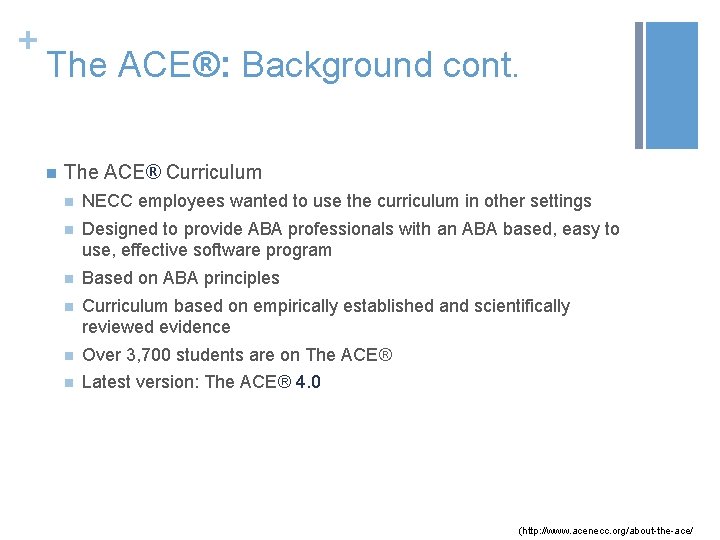
+ The ACE®: Background cont. n The ACE® Curriculum n NECC employees wanted to use the curriculum in other settings n Designed to provide ABA professionals with an ABA based, easy to use, effective software program n Based on ABA principles n Curriculum based on empirically established and scientifically reviewed evidence n Over 3, 700 students are on The ACE® n Latest version: The ACE® 4. 0 (http: //www. acenecc. org/about-the-ace/
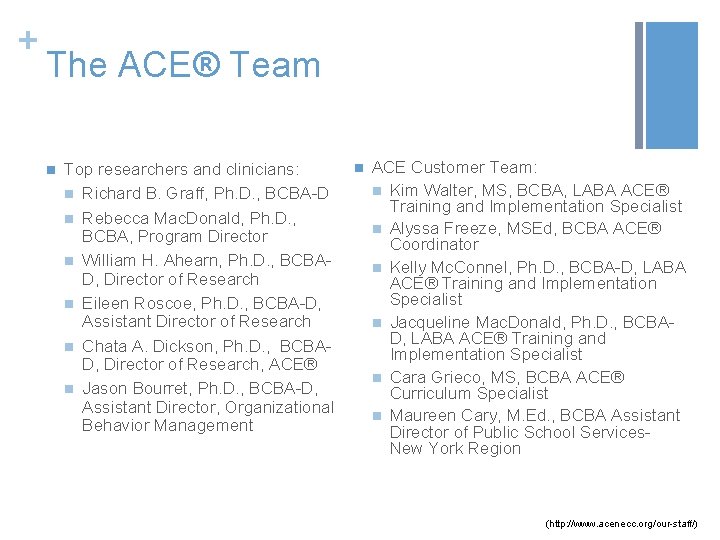
+ The ACE® Team n Top researchers and clinicians: n Richard B. Graff, Ph. D. , BCBA-D n Rebecca Mac. Donald, Ph. D. , BCBA, Program Director n William H. Ahearn, Ph. D. , BCBAD, Director of Research n Eileen Roscoe, Ph. D. , BCBA-D, Assistant Director of Research n Chata A. Dickson, Ph. D. , BCBAD, Director of Research, ACE® n Jason Bourret, Ph. D. , BCBA-D, Assistant Director, Organizational Behavior Management n ACE Customer Team: n Kim Walter, MS, BCBA, LABA ACE® Training and Implementation Specialist n Alyssa Freeze, MSEd, BCBA ACE® Coordinator n Kelly Mc. Connel, Ph. D. , BCBA-D, LABA ACE® Training and Implementation Specialist n Jacqueline Mac. Donald, Ph. D. , BCBAD, LABA ACE® Training and Implementation Specialist n Cara Grieco, MS, BCBA ACE® Curriculum Specialist n Maureen Cary, M. Ed. , BCBA Assistant Director of Public School Services- New York Region (http: //www. acenecc. org/our-staff/)
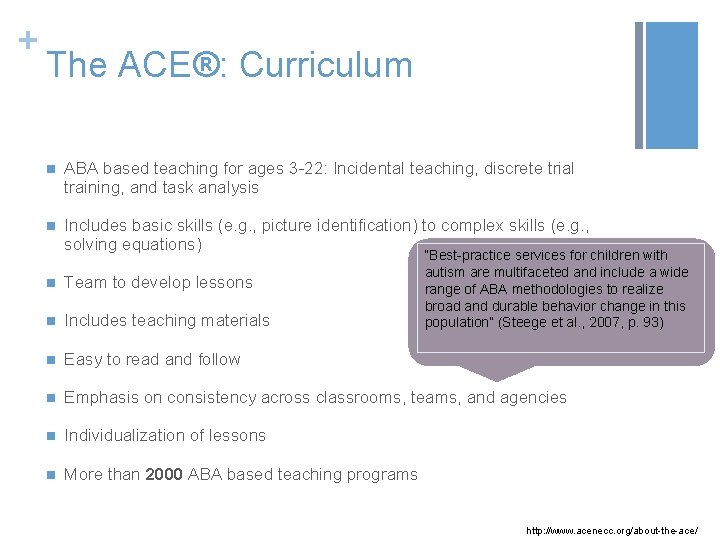
+ The ACE®: Curriculum n ABA based teaching for ages 3 -22: Incidental teaching, discrete trial training, and task analysis n Includes basic skills (e. g. , picture identification) to complex skills (e. g. , solving equations) “Best-practice services for children with autism are multifaceted and include a wide range of ABA methodologies to realize broad and durable behavior change in this population” (Steege et al. , 2007, p. 93) n Team to develop lessons n Includes teaching materials n Easy to read and follow n Emphasis on consistency across classrooms, teams, and agencies n Individualization of lessons n More than 2000 ABA based teaching programs http: //www. acenecc. org/about-the-ace/
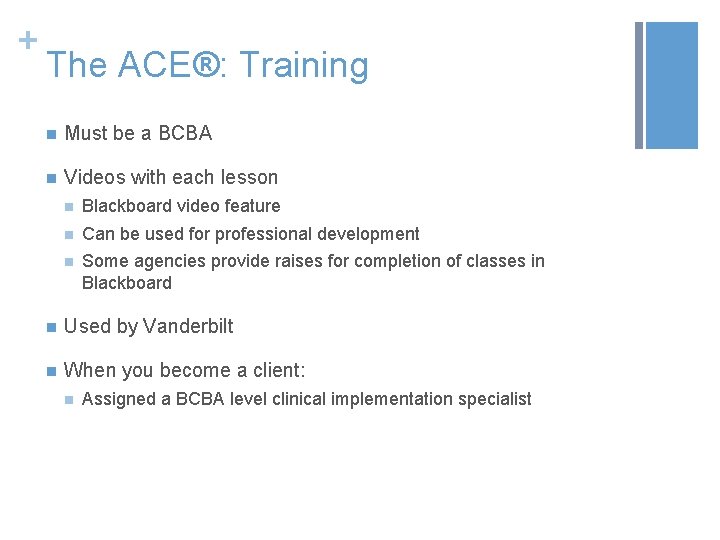
+ The ACE®: Training n Must be a BCBA n Videos with each lesson n Blackboard video feature n Can be used for professional development n Some agencies provide raises for completion of classes in Blackboard n Used by Vanderbilt n When you become a client: n Assigned a BCBA level clinical implementation specialist
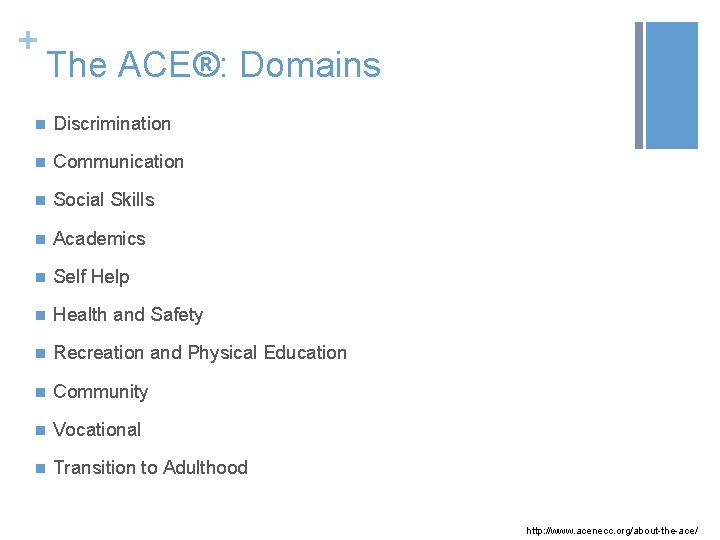
+ The ACE®: Domains n Discrimination n Communication n Social Skills n Academics n Self Help n Health and Safety n Recreation and Physical Education n Community n Vocational n Transition to Adulthood http: //www. acenecc. org/about-the-ace/
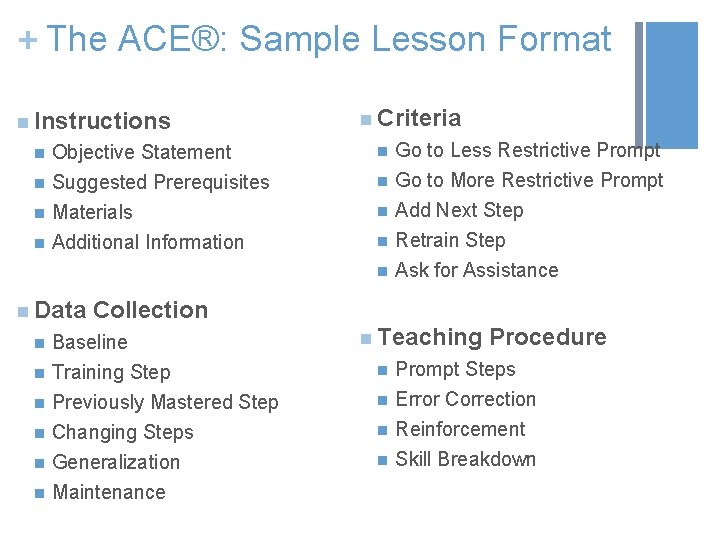
+ The ACE®: Sample Lesson Format n Instructions n n Objective Statement Suggested Prerequisites Materials Additional Information n Criteria n n n Data n n n Go to Less Restrictive Prompt Go to More Restrictive Prompt Add Next Step Retrain Step Ask for Assistance Collection Baseline Training Step Previously Mastered Step Changing Steps Generalization Maintenance n Teaching n n Procedure Prompt Steps Error Correction Reinforcement Skill Breakdown
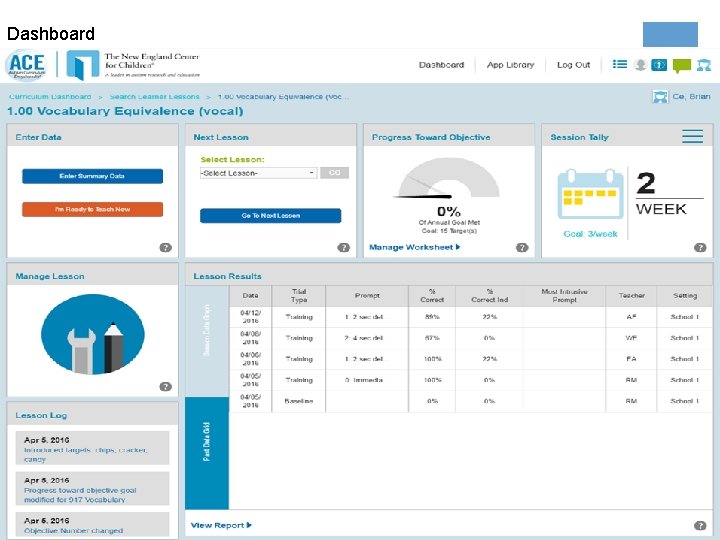
Dashboard
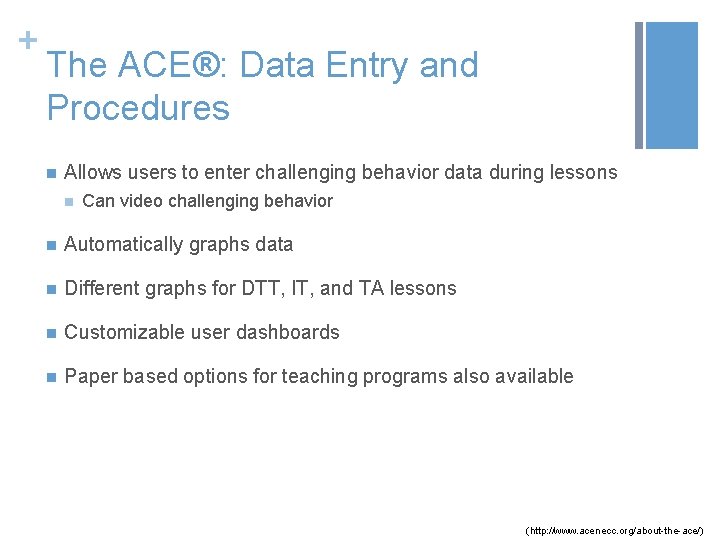
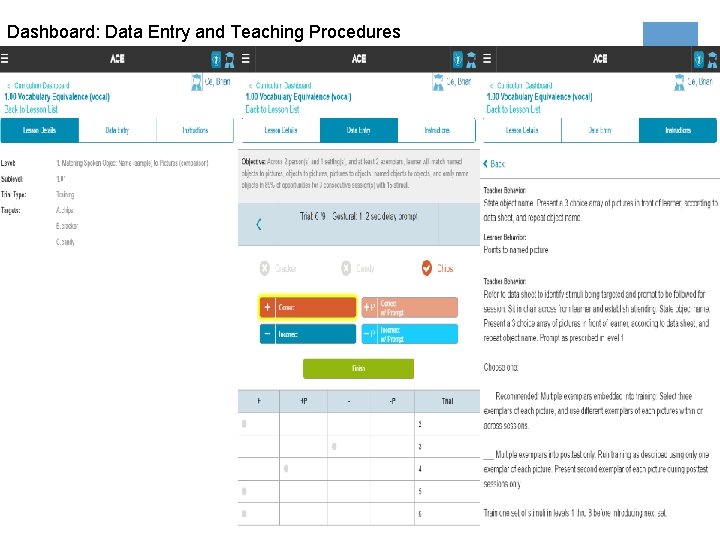
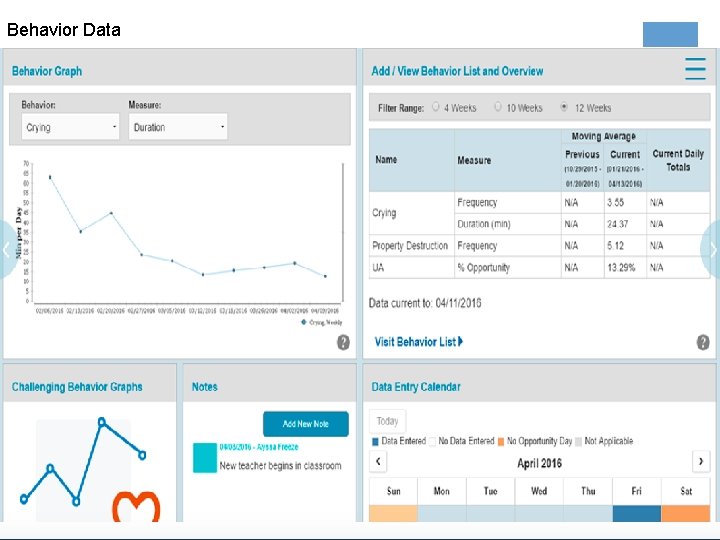
+ The ACE®: Data Entry and Procedures n Allows users to enter challenging behavior data during lessons n Can video challenging behavior n Automatically graphs data n Different graphs for DTT, IT, and TA lessons n Customizable user dashboards n Paper based options for teaching programs also available (http: //www. acenecc. org/about-the-ace/)
Dashboard: Data Entry and Teaching Procedures
Behavior Data
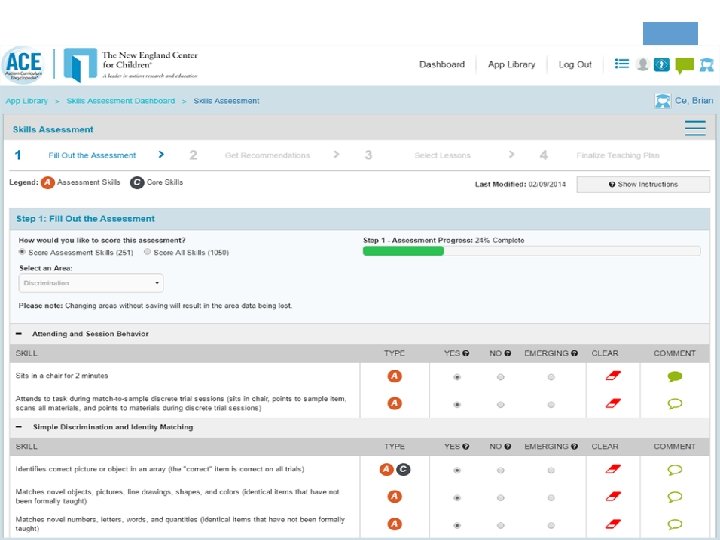
+ The ACE®: Assessments n The Core Skills Assessment n n n Direct assessment Targets 52 skills necessary for higher-level learning and independent functioning Materials provided Administered yearly The ACE® Skills Assessment n n Indirect assessment Assesses skills from the entire curriculum Helps identify skill deficits and lesson plans to teach skills Recommends lessons based on assessment results (http: //www. acenecc. org/about-the-ace/)
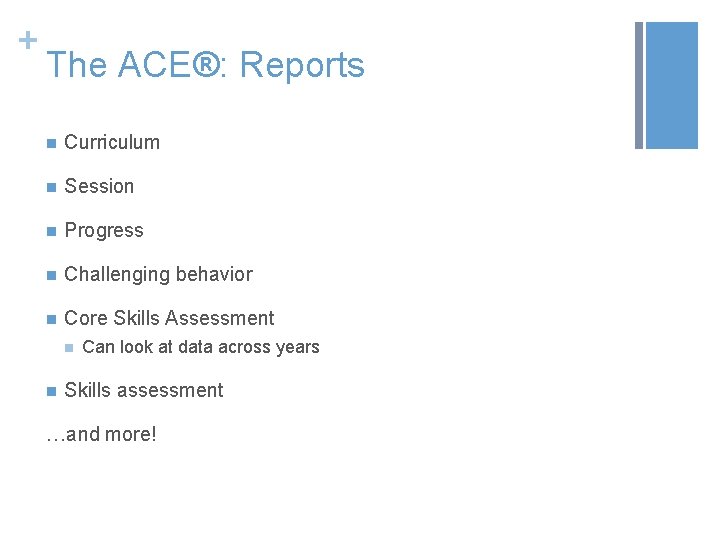
+ The ACE®: Reports n Curriculum n Session n Progress n Challenging behavior n Core Skills Assessment n n Can look at data across years Skills assessment …and more!
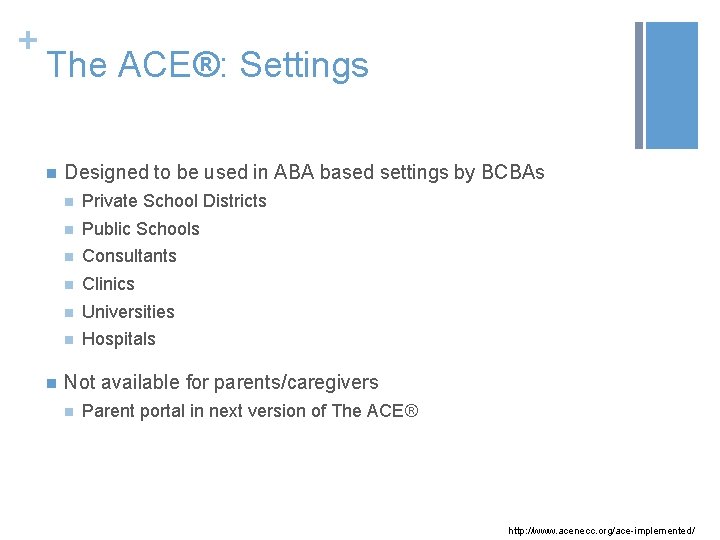
+ The ACE®: Settings n n Designed to be used in ABA based settings by BCBAs n Private School Districts n Public Schools n Consultants n Clinics n Universities n Hospitals Not available for parents/caregivers n Parent portal in next version of The ACE® http: //www. acenecc. org/ace-implemented/
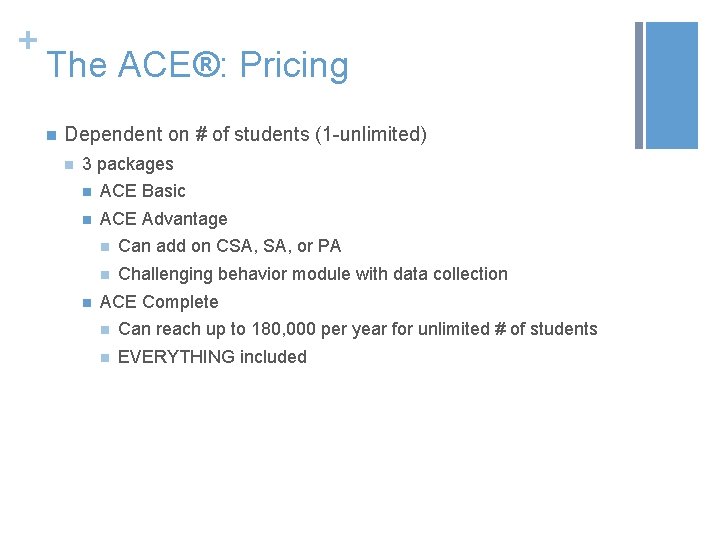
+ The ACE®: Pricing n Dependent on # of students (1 -unlimited) n 3 packages n ACE Basic n ACE Advantage n n Can add on CSA, or PA n Challenging behavior module with data collection ACE Complete n Can reach up to 180, 000 per year for unlimited # of students n EVERYTHING included
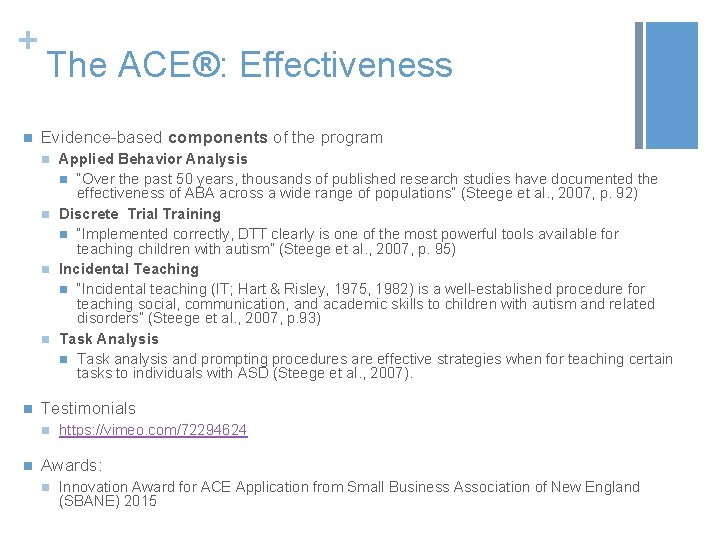
+ n The ACE®: Effectiveness Evidence-based components of the program n n n Testimonials n n Applied Behavior Analysis n “Over the past 50 years, thousands of published research studies have documented the effectiveness of ABA across a wide range of populations” (Steege et al. , 2007, p. 92) Discrete Trial Training n “Implemented correctly, DTT clearly is one of the most powerful tools available for teaching children with autism” (Steege et al. , 2007, p. 95) Incidental Teaching n “Incidental teaching (IT; Hart & Risley, 1975, 1982) is a well-established procedure for teaching social, communication, and academic skills to children with autism and related disorders” (Steege et al. , 2007, p. 93) Task Analysis n Task analysis and prompting procedures are effective strategies when for teaching certain tasks to individuals with ASD (Steege et al. , 2007). https: //vimeo. com/72294624 Awards: n Innovation Award for ACE Application from Small Business Association of New England (SBANE) 2015
+ What is Rethink Autism? n “Rethink aims to place evidence-based treatment solutions in the hands of every educator, clinician or parent working with a child with special needs. We are unique in our footprint, leveraging the power of technology to provide clinical support, best-practice tools, and research-based content to all market segments, reaching more children with special needs than any other solution. ”
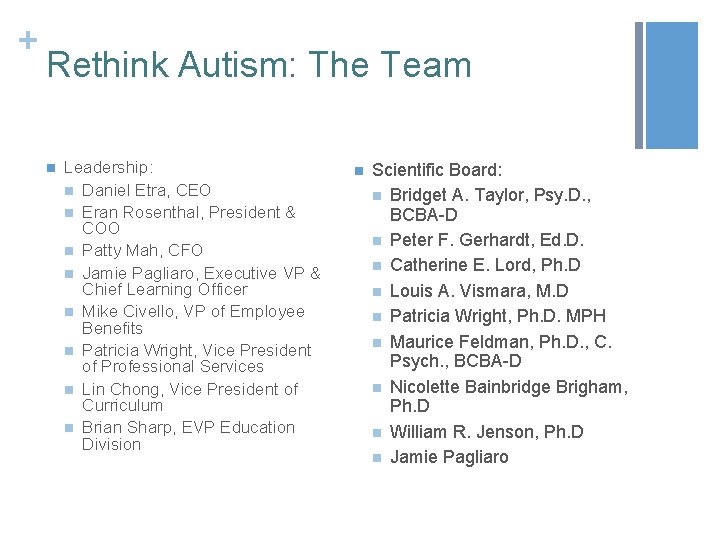
+ Rethink Autism: The Team n Leadership: n Daniel Etra, CEO n Eran Rosenthal, President & COO n Patty Mah, CFO n Jamie Pagliaro, Executive VP & Chief Learning Officer n Mike Civello, VP of Employee Benefits n Patricia Wright, Vice President of Professional Services n Lin Chong, Vice President of Curriculum n Brian Sharp, EVP Education Division n Scientific Board: n Bridget A. Taylor, Psy. D. , BCBA-D n Peter F. Gerhardt, Ed. D. n Catherine E. Lord, Ph. D n Louis A. Vismara, M. D n Patricia Wright, Ph. D. MPH n Maurice Feldman, Ph. D. , C. Psych. , BCBA-D n Nicolette Bainbridge Brigham, Ph. D n William R. Jenson, Ph. D n Jamie Pagliaro
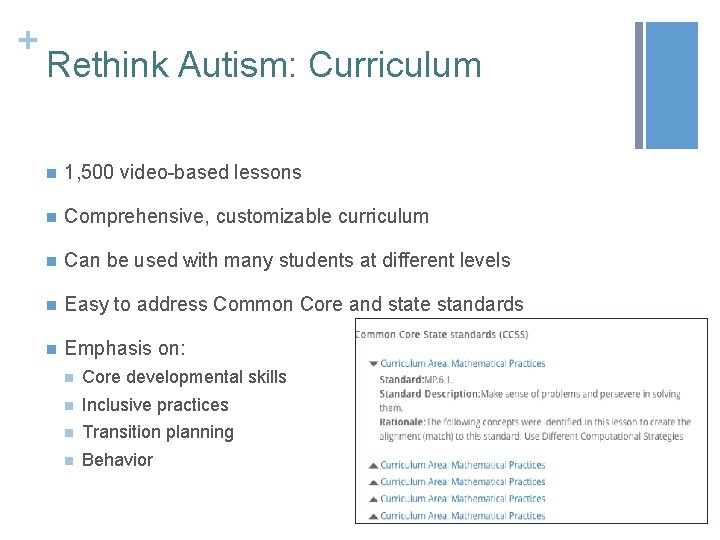
+ Rethink Autism: Curriculum n 1, 500 video-based lessons n Comprehensive, customizable curriculum n Can be used with many students at different levels n Easy to address Common Core and state standards n Emphasis on: n Core developmental skills n Inclusive practices n Transition planning n Behavior
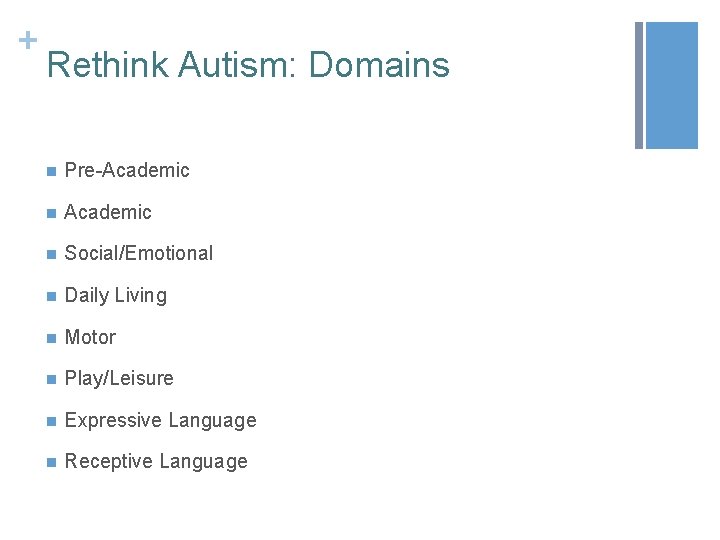
+ Rethink Autism: Domains n Pre-Academic n Social/Emotional n Daily Living n Motor n Play/Leisure n Expressive Language n Receptive Language
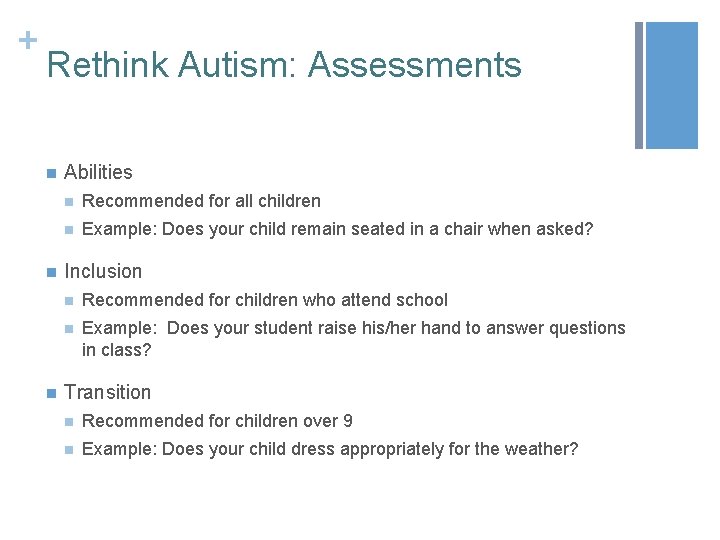
+ Rethink Autism: Assessments n n n Abilities n Recommended for all children n Example: Does your child remain seated in a chair when asked? Inclusion n Recommended for children who attend school n Example: Does your student raise his/her hand to answer questions in class? Transition n Recommended for children over 9 n Example: Does your child dress appropriately for the weather?
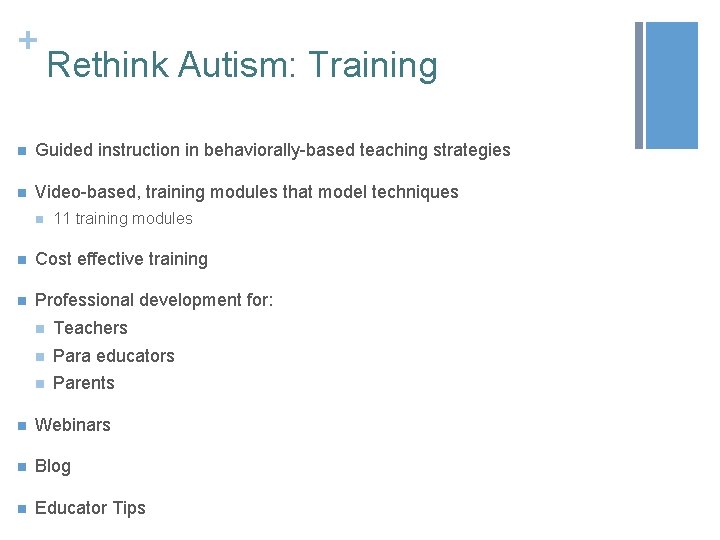
+ Rethink Autism: Training n Guided instruction in behaviorally-based teaching strategies n Video-based, training modules that model techniques n 11 training modules n Cost effective training n Professional development for: n Teachers n Para educators n Parents n Webinars n Blog n Educator Tips
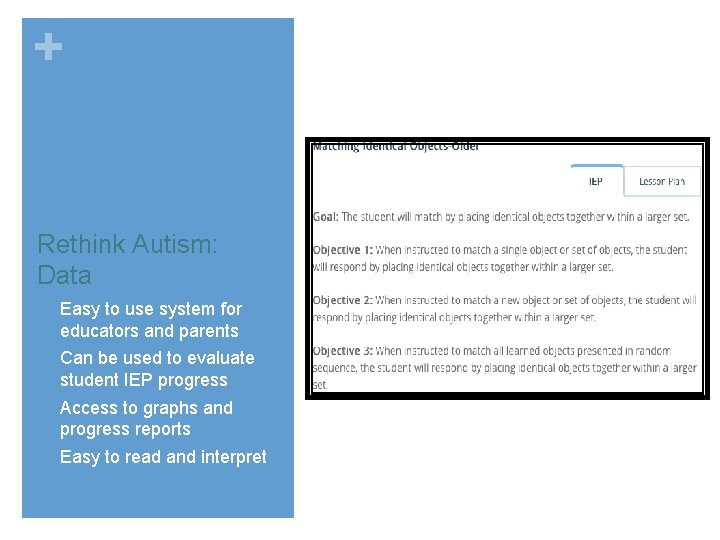
+ Rethink Autism: Data q Easy to use system for educators and parents q Can be used to evaluate student IEP progress q Access to graphs and progress reports q Easy to read and interpret
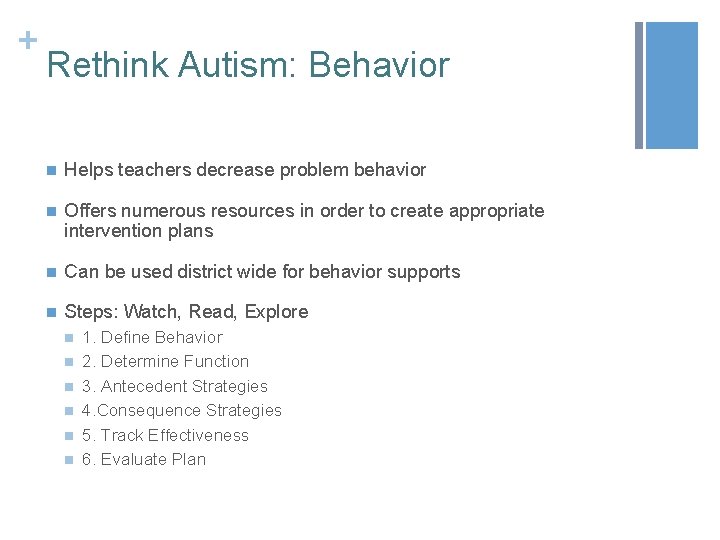
+ Rethink Autism: Behavior n Helps teachers decrease problem behavior n Offers numerous resources in order to create appropriate intervention plans n Can be used district wide for behavior supports n Steps: Watch, Read, Explore n n n 1. Define Behavior 2. Determine Function 3. Antecedent Strategies 4. Consequence Strategies 5. Track Effectiveness 6. Evaluate Plan
+ n Rethink Autism: Parents can use Rethink at home n n n n Access to entire curriculum Problem behavior strategies Data collection procedures Web-based training Activities Teleconsultation Email Rethink therapists Prior to signing up: n n Videos about lessons, ABA, Scientific Advisory Board How it works Time saving and problem behavior strategies, lesson plans Access to sample lessons n Free trial available n Affordable annual, quarterly, and monthly plans n Access to Rethink Peer Support
+ Rethink Autism: Activity Center n Can be accessed by teachers, students, and parents n Customizable activities n Built-in prompts and feedback n Student activity is tracked and graphed
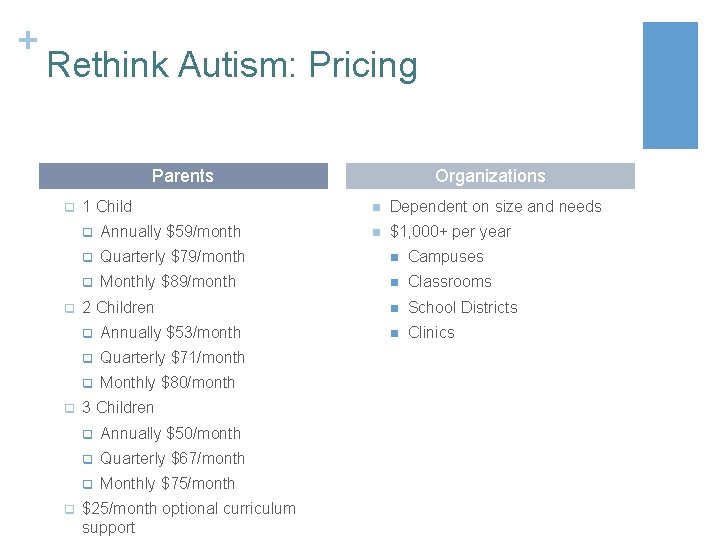
+ Rethink Autism: Pricing Parents q q 1 Child Organizations n Dependent on size and needs n $1, 000+ per year q Annually $59/month q Quarterly $79/month n Campuses q Monthly $89/month n Classrooms n School Districts n Clinics 2 Children q Annually $53/month q Quarterly $71/month q Monthly $80/month 3 Children q Annually $50/month q Quarterly $67/month q Monthly $75/month $25/month optional curriculum support
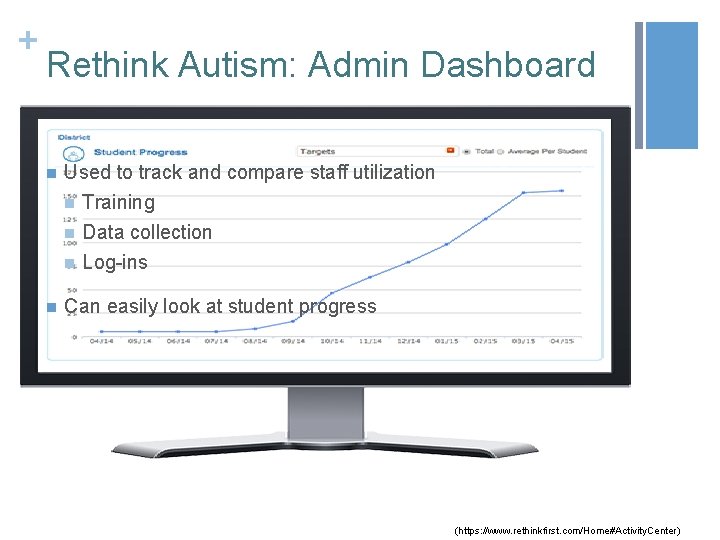
+ Rethink Autism: Admin Dashboard n Used to track and compare staff utilization n Training n n n Data collection Log-ins Can easily look at student progress (https: //www. rethinkfirst. com/Home#Activity. Center)
+ Rethink Autism: Effectiveness n Research based components of Rethink n n n n Testimonials n n The effectiveness of ABA-based intervention in Autism Spectrum Disorders has been well documented through five decades of research. ” (American Academy of Pediatrics, 2007) PBIS Inclusion Video modeling Discrete Trial Training Task Analysis Reinforcement strategies “His family is actually looking to move him back into his home because of the awesome progress he has made using these tools. It’s pretty cool. ”- Jennifer Harris “Staff are thrilled with the program. It gives them an opportunity to see the progress made and the fruits of their labor as they are working with the children. ” –Meryl Gill 98% of administrators recommend Rethink Awards
+ Rethink Autism: Dissertation by Jennifer Cardinal Rethink Autism: Effectiveness of web-based applied behavior video modeling program on the performance of para-educators and students with autism spectrum disorder (2011) n n Purpose n Examined the effectiveness of Rethink Autism with paraeducators and children with ASD n Effectiveness of video modeling on para-educators ABA teaching n Skills acquisition and student response of Rethink n Generalization of skills to other curriculums Method n Multiple baseline with generalization probes n Public midsized charter school with 4 paraeducators matched with a student with ASD n Baseline was collected by teaching Rethink lessons with existing skill set/materials/and pretest administered to student n Intervention: Staggered, 3 -phase using Rethink lessons (12 teaching sessions)
+ Rethink Autism: Dissertation cont. n Results n Effective in increasing para-educator DTT skill level Increased student performance n High acceptability and treatment integrity n Cost effective Limitations n Wide range in quality of the videos teaching specific skills n Lack of maintenance probes n n Lack of collaboration Small number of participants
+ What the research is telling us: n Effective interventions for children with ASD include: n Early intervention n Intensive instructional programming n Systematic instruction (DTT, Incidental teaching) n One-to-one and small-group instruction n Instructional domains n Social n Communication n Adaptive living n Recreation-leisure n Cognitive n Academic skills n Monitoring interventions n Generalization n Interaction with typically developing students n Intervention in multiple settings (Steege et al. , 2007; The National Research Council, 2001)
+ What the research is telling us cont. : n “Comprehensive ABA programs use a wide range of assessments and interventions that are aimed at developing a broad range of cognitive, social, academic, leisure, and functional living skills needed for success at school, at home, and in the community” (Steege et al. , 2007, p. 98)
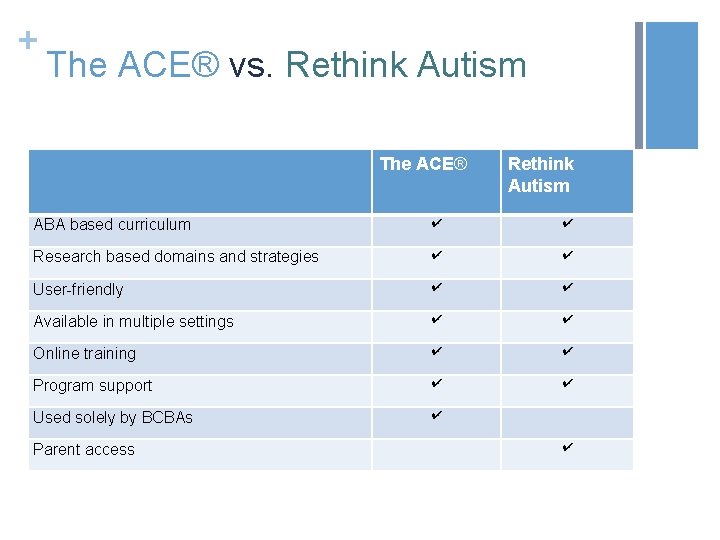
+ The ACE® vs. Rethink Autism The ACE® Rethink Autism ABA based curriculum ✔ ✔ Research based domains and strategies ✔ ✔ User-friendly ✔ ✔ Available in multiple settings ✔ ✔ Online training ✔ ✔ Program support ✔ ✔ Used solely by BCBAs ✔ ✔ Parent access
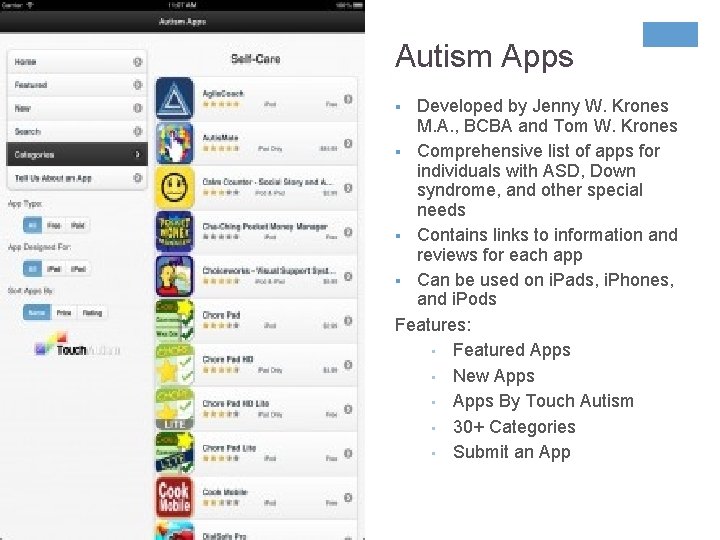
Autism Apps Developed by Jenny W. Krones M. A. , BCBA and Tom W. Krones § Comprehensive list of apps for individuals with ASD, Down syndrome, and other special needs § Contains links to information and reviews for each app § Can be used on i. Pads, i. Phones, and i. Pods Features: • Featured Apps • New Apps • Apps By Touch Autism • 30+ Categories • Submit an App § +
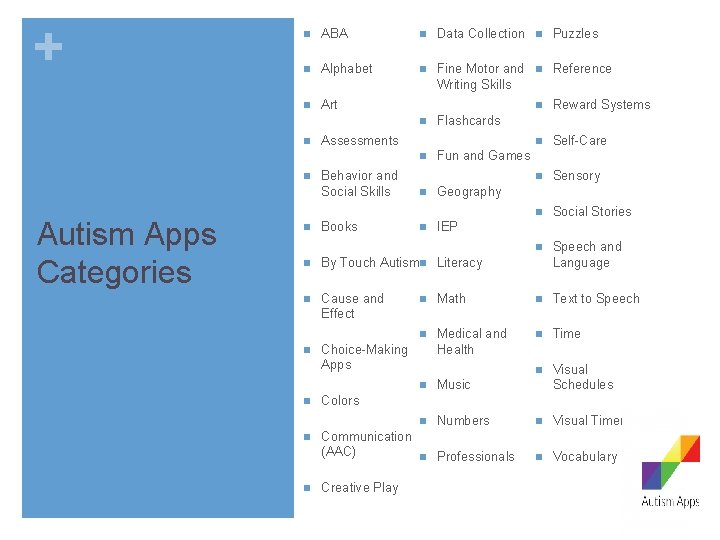
+ n ABA n Data Collection n Puzzles n Alphabet n Fine Motor and Writing Skills n Reference n Art n Reward Systems n Self-Care n Sensory n Social Stories n Speech and Language n n n Autism Apps Categories n Flashcards Assessments Behavior and Social Skills Books n Fun and Games n Geography n IEP n By Touch Autismn Literacy n Cause and Effect n n n Math n Text to Speech n Medical and Health n Time n Visual Schedules n Visual Timers n Vocabulary Choice-Making Apps n Music n Numbers Colors Communication (AAC) n Professionals Creative Play
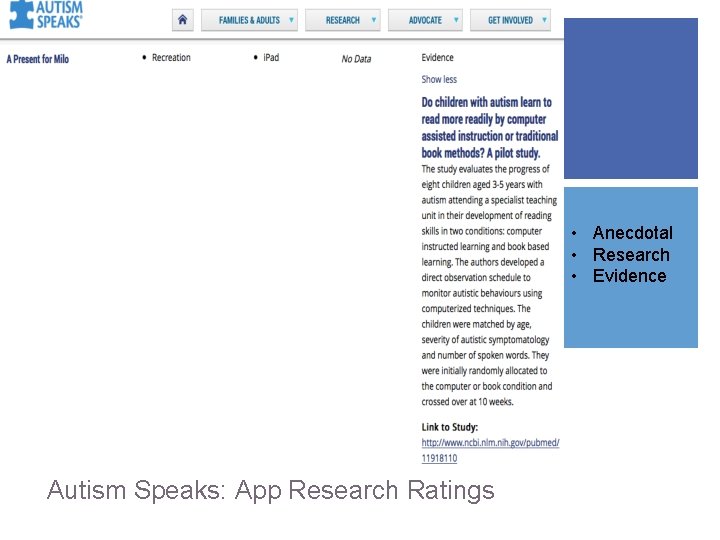
• Anecdotal • Research • Evidence + Autism Speaks: App Research Ratings
+ Summary n The ACE® and Rethink Autism are both comprehensive, ABA-based, web programs developed for individuals with ASD ages 3 -22. n The ACE® can only be used by BCBAs. n Rethink Autism can be used by a variety of individuals, including parents. n Both programs include a wide range of evidence based teaching strategies. n Autism Apps includes many categories of apps that can be downloaded from the App store. n Autism Speaks includes research ratings for apps listed on their website. n More research needs to be conducted to determine the effectiveness of these programs as a whole.
+ THANK YOU!
+ References n Autism Apps - Touch Autism. (n. d. ). Retrieved from http: //touchautism. com/app/autismapps/ n A. (2012). Autism Curriculum Encyclopedia® (ACE®) - Assessment. Retrieved from https: //www. youtube. com/watch? v=4 cu. Alm 8 Vj 58 n A. (2015). ACE Minute - Task Analysis Lesson Plans. Retrieved from https: //www. youtube. com/watch? v=k. PYs. C 7 Vn. HQg n ACE NECC - ABA Software System. (n. d. ). Retrieved from http: //acenecc. org/ n Autism Speaks. (n. d. ). Retrieved from https: //www. autismspeaks. org/autism-apps n Cardinal, J. (2011). Rethink Autism: Effectiveness of web- based applied behavior video modeling program on the performance of para-educators and students with autism spectrum disorder. Dissertation submitted to the Department of Educational Psychology, School Psychology. n Contemporary Applied Behavior Analysis Approaches. (2012). Retrieved from http: //autismnow. org/articles/contemporary-applied-behavior-analysis-approaches/ n Discrete Trial Training. (n. d. ). Retrieved from https: //www. autismspeaks. org/blog/2012/12/14/discrete-trial-training
+ References n Steege, M. W. , Mace, F. C. , Perry, L. , & Longenecker, H. (2007). Applied behavior analysis: Beyond discrete trial teaching. Psychol. Schs. Psychology in the Schools, 44(1), 9199. doi: 10. 1002/pits. 20208 n Szidon, K. , & Franzone, E. (2009). Task Analysis. Madison, WI: National Professional Development Center on Autism Spectrum Disorders, Waisman Center, University of Wisconsin. Retrieved from http: //autismpdc. fpg. unc. edu/sites/autismpdc. fpg. unc. edu/files/ Task. Analyis_Steps_0. pdf n The tools every district needs to design, deliver and monitor evidence-based practices in special education. (n. d. ). Retrieved from http: //www. rethinkfirst. com/