
Overview of the Atmospheric Radiation Measurement ARM Programs


- Slides: 25
Overview of the Atmospheric Radiation Measurement (ARM) Program’s Mobile Facility (AMF) Dave Turner University of Wisconsin – Madison COPS Workshop 10 -11 April 2006 Hohenheim, Germany
The Real People Behind the AMF l Head Scientist: Mark Miller l Team Members: Mary Jane Bartholomew, Larry Jones, Kim Nitschke, Doug Sisterson l Chief Engineer: Kevin Widener l Program Manager: Wanda Ferrell
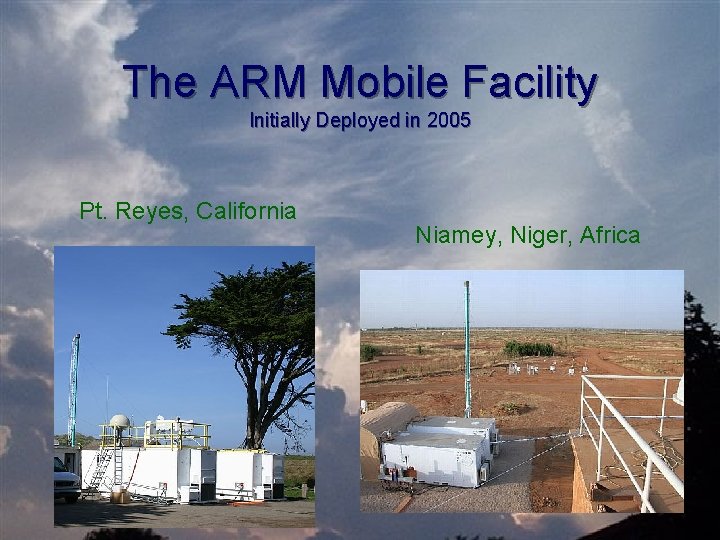
The ARM Mobile Facility Initially Deployed in 2005 Pt. Reyes, California Niamey, Niger, Africa
Charter l Detailed measurements of the cloudy atmospheric column – in regions of the climate system that are generally undersampled – in association with the international atmospheric science community l Subset of instruments located at ARM’s fixed sites – Active and passive sensors – Enhanced surface aerosol system l Deployment duration is 6 -12 months
Site Selection Process l International Proposal Competition – ARM Climate Research User Facility (ACRF) Board selects winning proposal Composed of 40% ARM Scientists and 60% external scientists l Final decision is made by the ARM Program Manager l Proposals rated on scientific merit, facility leverage, and logistical feasibility l
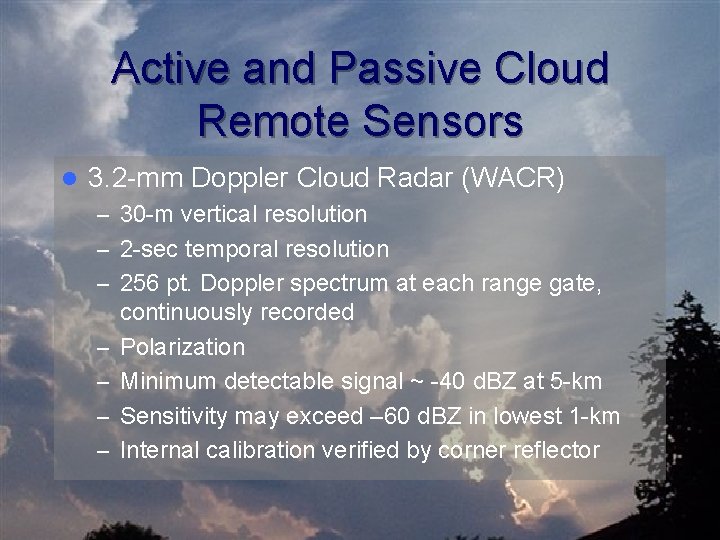
Active and Passive Cloud Remote Sensors l 3. 2 -mm Doppler Cloud Radar (WACR) – 30 -m vertical resolution – 2 -sec temporal resolution – 256 pt. Doppler spectrum at each range gate, – – continuously recorded Polarization Minimum detectable signal ~ -40 d. BZ at 5 -km Sensitivity may exceed – 60 d. BZ in lowest 1 -km Internal calibration verified by corner reflector
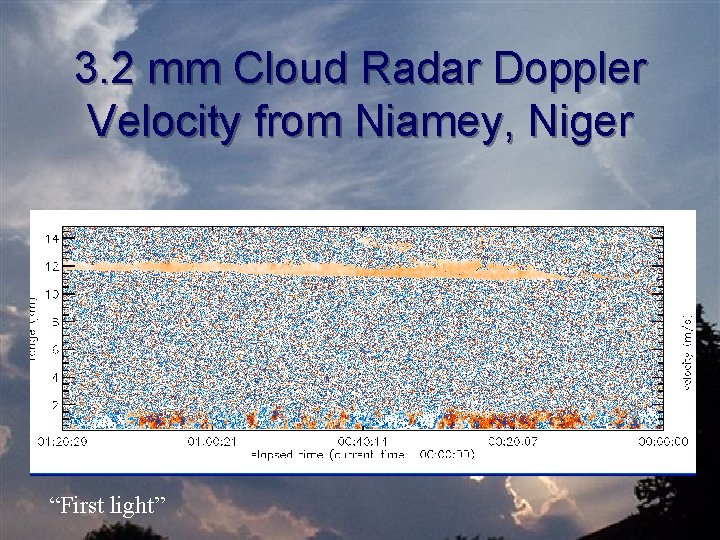
3. 2 mm Cloud Radar Doppler Velocity from Niamey, Niger “First light”
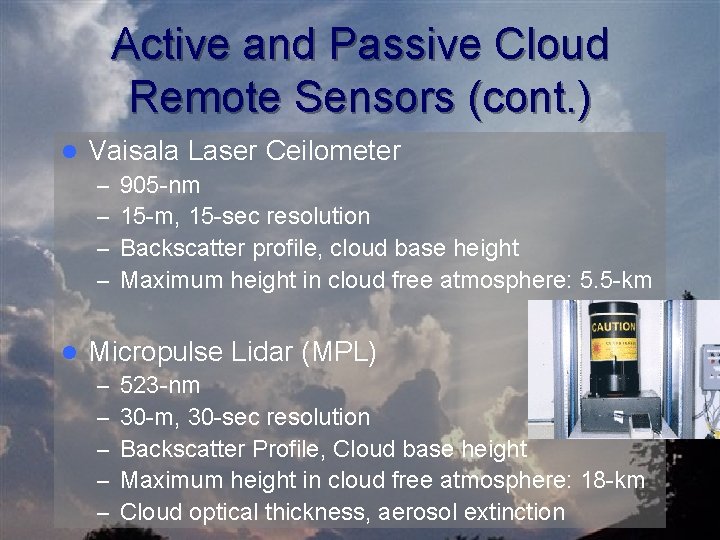
Active and Passive Cloud Remote Sensors (cont. ) l Vaisala Laser Ceilometer – – l 905 -nm 15 -m, 15 -sec resolution Backscatter profile, cloud base height Maximum height in cloud free atmosphere: 5. 5 -km Micropulse Lidar (MPL) – – – 523 -nm 30 -m, 30 -sec resolution Backscatter Profile, Cloud base height Maximum height in cloud free atmosphere: 18 -km Cloud optical thickness, aerosol extinction
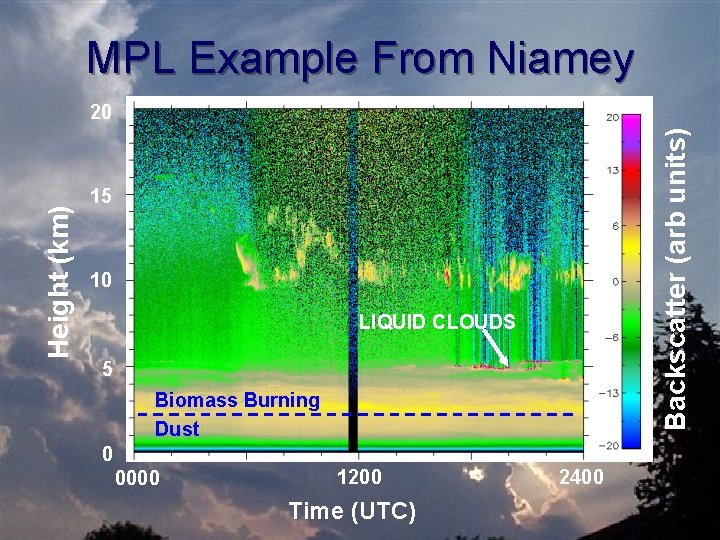
MPL Example From Niamey Backscatter (arb units) Height (km) 20 15 10 LIQUID CLOUDS 5 Biomass Burning Dust 0 0000 1200 Time (UTC) 2400
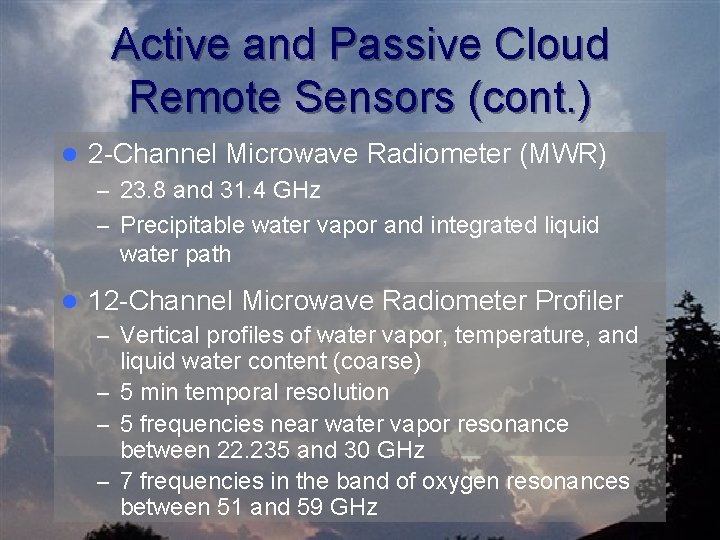
Active and Passive Cloud Remote Sensors (cont. ) l 2 -Channel Microwave Radiometer (MWR) – 23. 8 and 31. 4 GHz – Precipitable water vapor and integrated liquid water path l 12 -Channel Microwave Radiometer Profiler – Vertical profiles of water vapor, temperature, and liquid water content (coarse) – 5 min temporal resolution – 5 frequencies near water vapor resonance between 22. 235 and 30 GHz – 7 frequencies in the band of oxygen resonances between 51 and 59 GHz
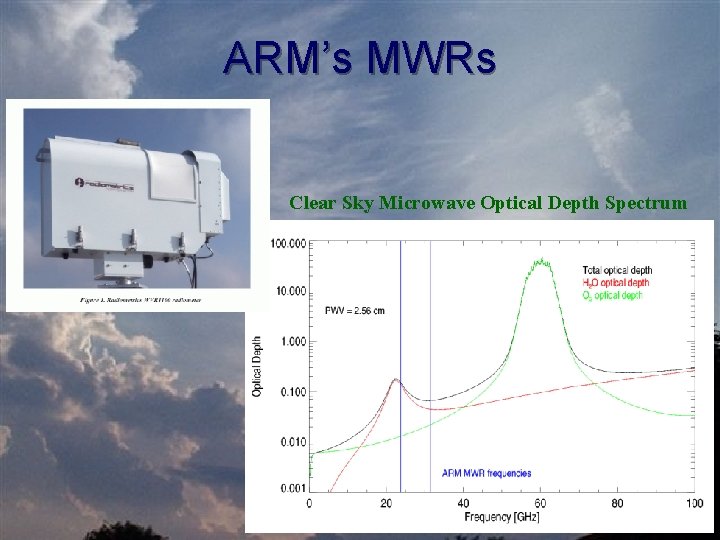
ARM’s MWRs Clear Sky Microwave Optical Depth Spectrum
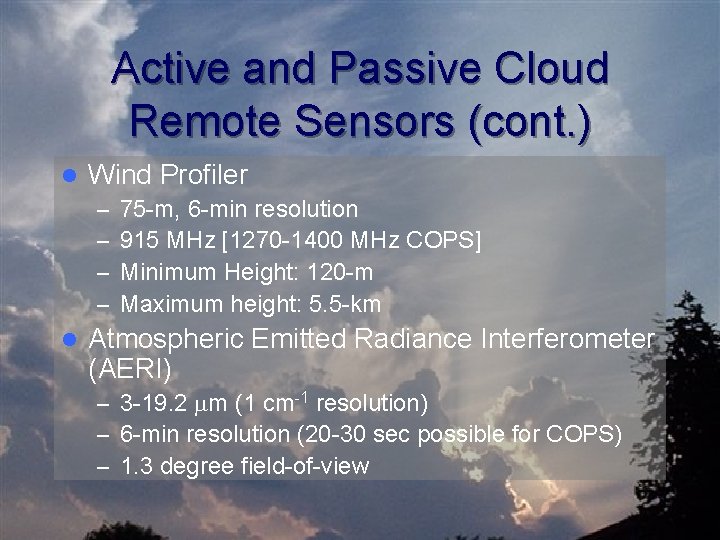
Active and Passive Cloud Remote Sensors (cont. ) l Wind Profiler – – l 75 -m, 6 -min resolution 915 MHz [1270 -1400 MHz COPS] Minimum Height: 120 -m Maximum height: 5. 5 -km Atmospheric Emitted Radiance Interferometer (AERI) – 3 -19. 2 mm (1 cm-1 resolution) – 6 -min resolution (20 -30 sec possible for COPS) – 1. 3 degree field-of-view
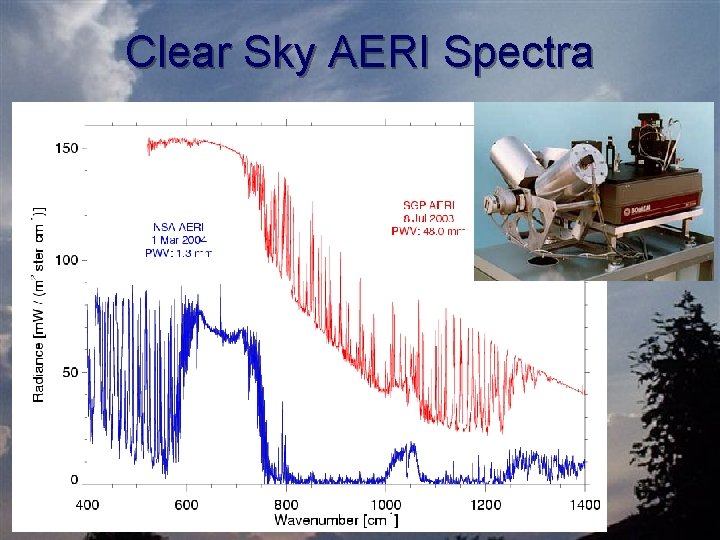
Clear Sky AERI Spectra
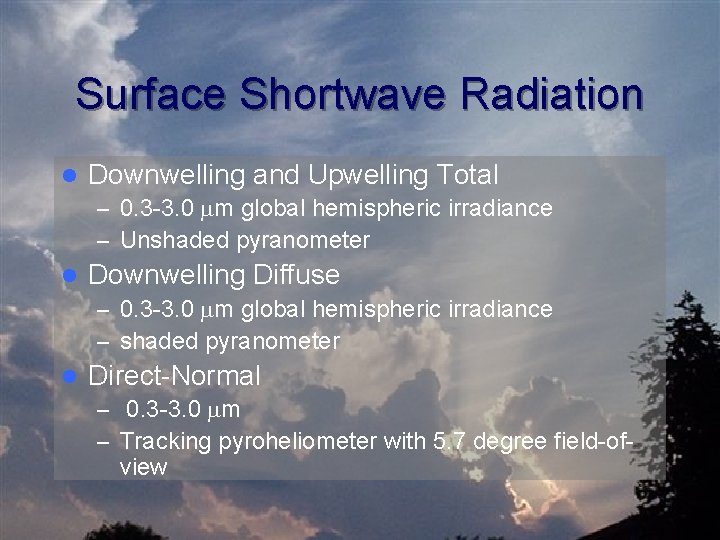
Surface Shortwave Radiation l Downwelling and Upwelling Total – 0. 3 -3. 0 mm global hemispheric irradiance – Unshaded pyranometer l Downwelling Diffuse – 0. 3 -3. 0 mm global hemispheric irradiance – shaded pyranometer l Direct-Normal – 0. 3 -3. 0 mm – Tracking pyroheliometer with 5. 7 degree field-of- view
Surface Shortwave Radiation l Multi-filter rotating shadowband radiometer (MFRSR) – Total, Diffuse, and Direct-Normal – 6 channels @ 10 -nm width Wavelength (nm) Application 415 aerosol 500 aerosol, ozone 615 aerosol, ozone 673 aerosol, ozone 870 aerosol 940 water vapor
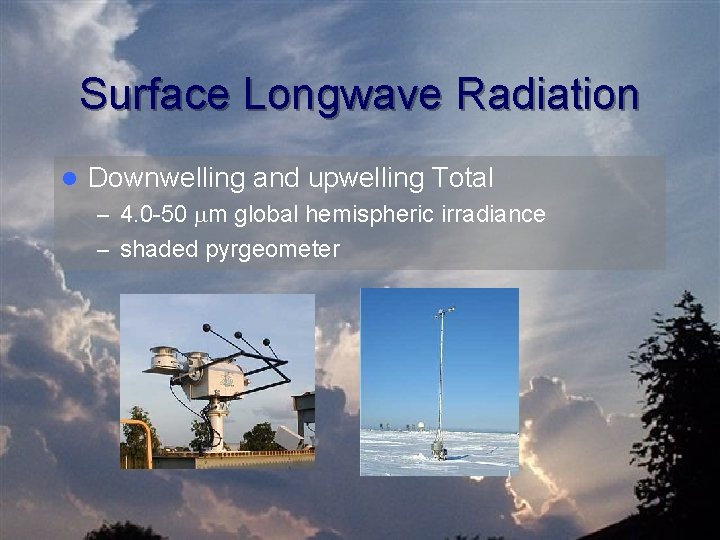
Surface Longwave Radiation l Downwelling and upwelling Total – 4. 0 -50 mm global hemispheric irradiance – shaded pyrgeometer
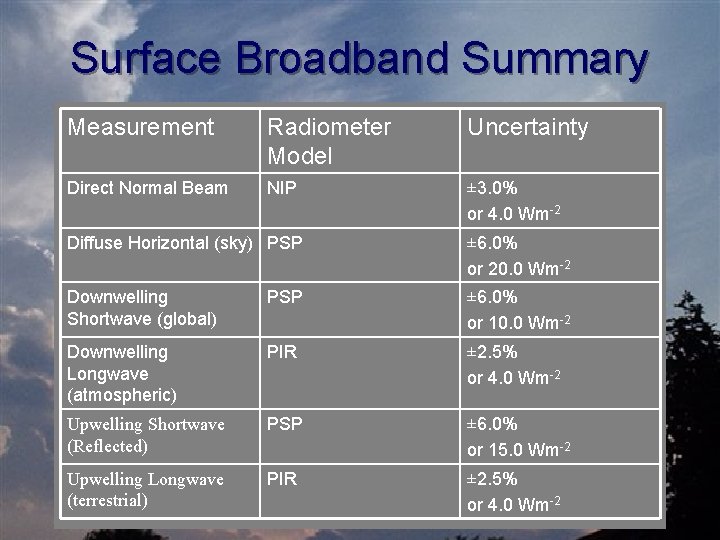
Surface Broadband Summary Measurement Radiometer Model Uncertainty Direct Normal Beam NIP ± 3. 0% or 4. 0 Wm-2 Diffuse Horizontal (sky) PSP ± 6. 0% or 20. 0 Wm-2 Downwelling Shortwave (global) PSP ± 6. 0% or 10. 0 Wm-2 Downwelling Longwave (atmospheric) PIR ± 2. 5% or 4. 0 Wm-2 Upwelling Shortwave (Reflected) PSP ± 6. 0% or 15. 0 Wm-2 Upwelling Longwave (terrestrial) PIR ± 2. 5% or 4. 0 Wm-2
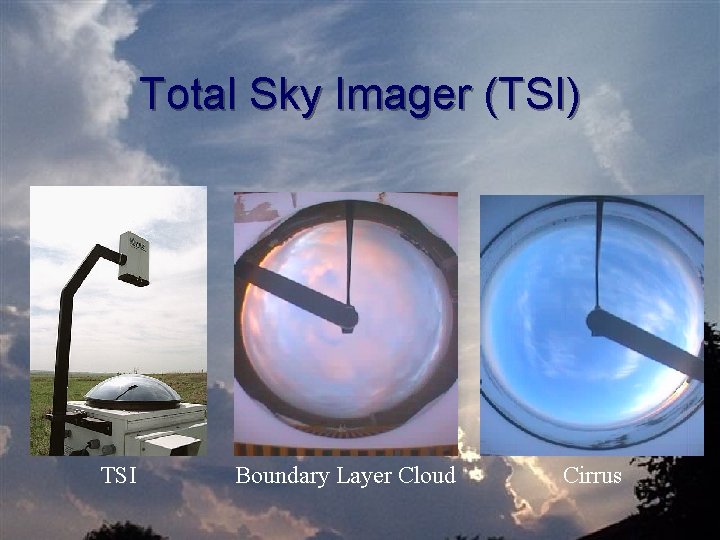
Total Sky Imager (TSI) TSI Boundary Layer Cloud Cirrus
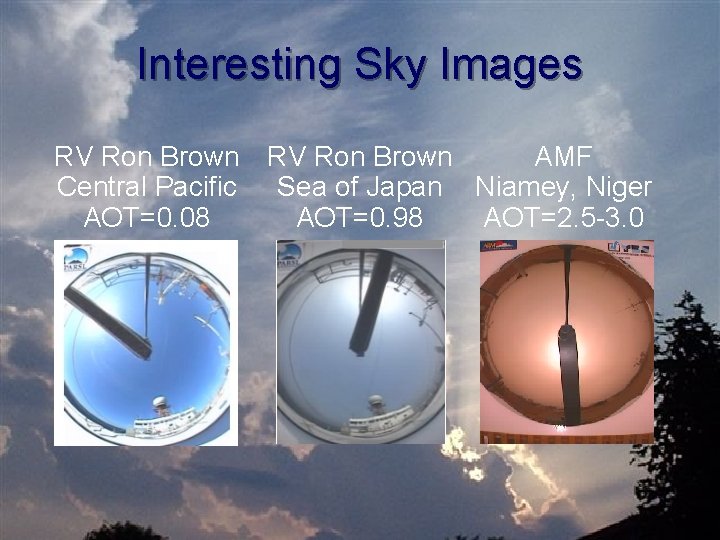
Interesting Sky Images RV Ron Brown AMF Central Pacific Sea of Japan Niamey, Niger AOT=0. 08 AOT=0. 98 AOT=2. 5 -3. 0
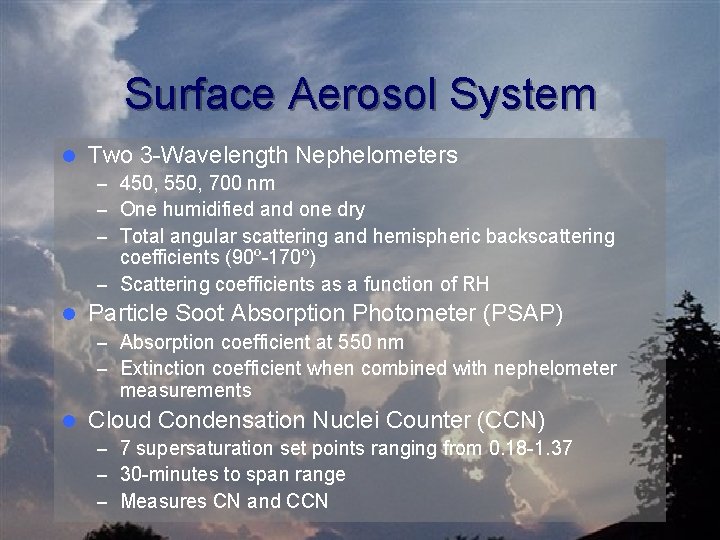
Surface Aerosol System l Two 3 -Wavelength Nephelometers – 450, 550, 700 nm – One humidified and one dry – Total angular scattering and hemispheric backscattering coefficients (90º-170º) – Scattering coefficients as a function of RH l Particle Soot Absorption Photometer (PSAP) – Absorption coefficient at 550 nm – Extinction coefficient when combined with nephelometer measurements l Cloud Condensation Nuclei Counter (CCN) – 7 supersaturation set points ranging from 0. 18 -1. 37 – 30 -minutes to span range – Measures CN and CCN
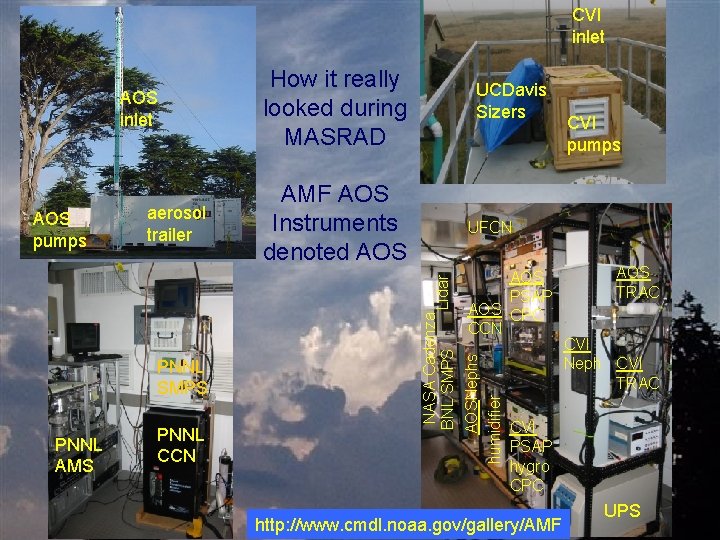
CVI inlet aerosol trailer PNNL SMPS PNNL AMS PNNL CCN AMF AOS Instruments denoted AOS CVI pumps UFCN AOS PSAP AOS CPC CCN AOSNephs humidifier AOS pumps UCDavis Sizers NASA Cadenza Lidar BNL SMPS AOS inlet How it really looked during MASRAD AOS TRAC CVI Neph CVI TRAC CVI PSAP hygro CPC http: //www. cmdl. noaa. gov/gallery/AMF UPS
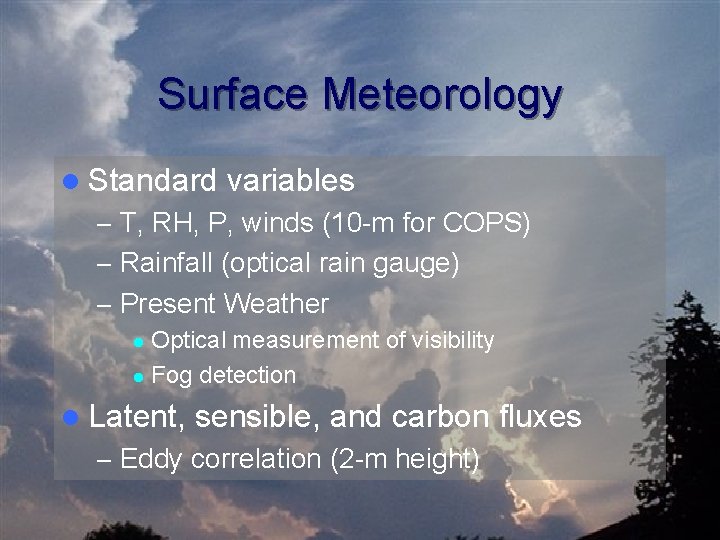
Surface Meteorology l Standard variables – T, RH, P, winds (10 -m for COPS) – Rainfall (optical rain gauge) – Present Weather Optical measurement of visibility l Fog detection l l Latent, sensible, and carbon fluxes – Eddy correlation (2 -m height)
New Additions to AMF l CIMEL Sun Photometer – Before COPS l Possibly ARM’s new 90 / 150 GHz microwave radiometer
Data, Data l AMF data are generally available within a day or two from the ARM data archive (www. archive. arm. gov) – True for all ARM data – Data quality documented afterwards – Reprocessing is occasionally required Data are open to all investigators l Some data streams can be accessed in real-time, if needed (i. e. , radiosonde profiles) l Recommendation: talk with Mark Miller and/or the “instrumentors” when you start using various ARM datastreams… l ARM tracks data users (# of requests, # of different datastreams, etc. ) – this is an important metric l
Summary l AMF has most of the instrumentation used at the various ARM fixed sites l Supplements the instrumentation provided by our European colleagues l Excited about COPS, and looking forward to a fruitful experiment!