
Overview of Teaching Methods in Nursing Education Lubica
Overview of Teaching Methods in Nursing Education Lubica Rybarova
Traditional → Inovative Traditional approach – Objectives with closely managed learning experiences; teacher controlled Inovative approach - Competencies and outcomes; focus on „end product”; teacher-student collaborative learning process
Student Learning Styles Characteristics of the learner Diversity of learners Learning style preferences
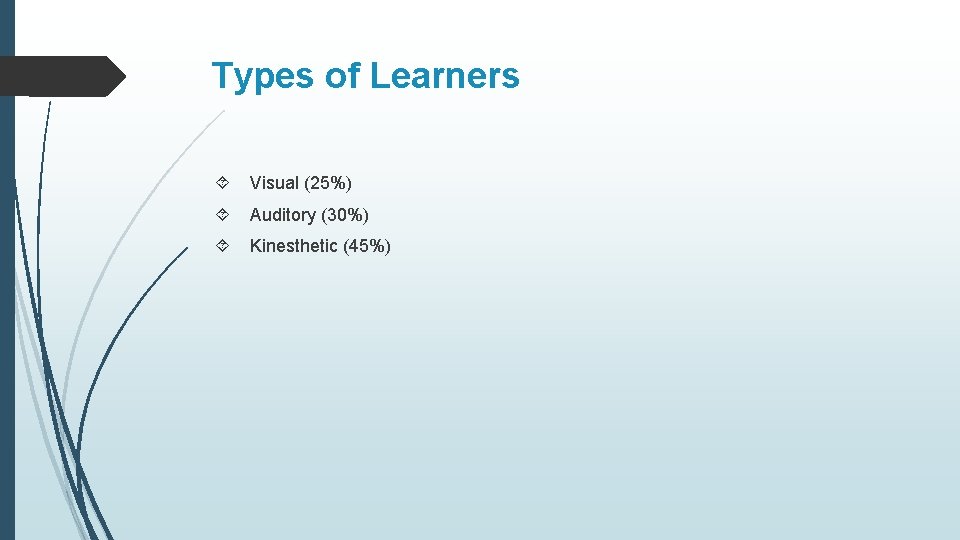
Types of Learners Visual (25%) Auditory (30%) Kinesthetic (45%)
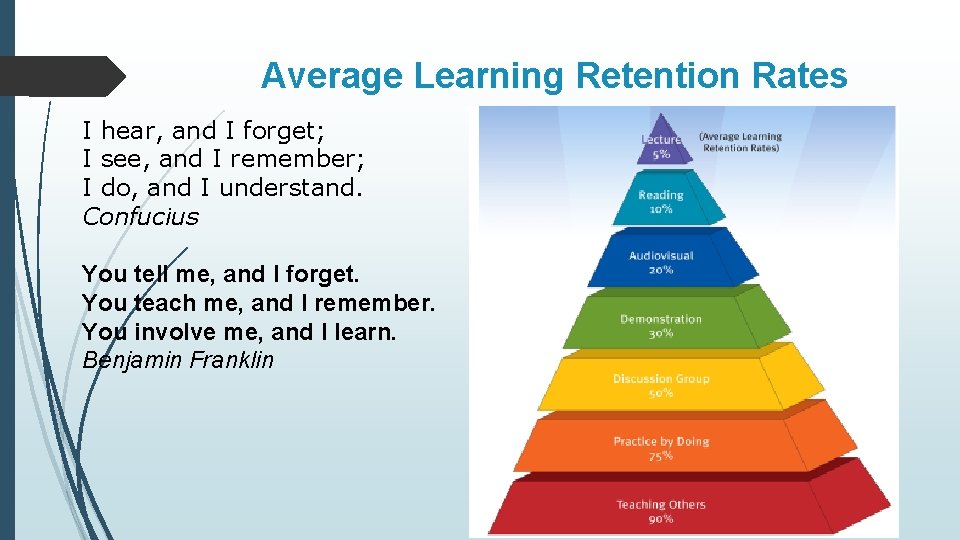
Average Learning Retention Rates I hear, and I forget; I see, and I remember; I do, and I understand. Confucius You tell me, and I forget. You teach me, and I remember. You involve me, and I learn. Benjamin Franklin

Lecture advantages Allows maximum teacher control Presents minimal threats to students or teacher Able to enliven facts and ideas that seem tedious in the text Able to clarify issues relating to confusing/intricate points Teacher knows what has been taught Lecture material can become basis of publication Able to accommodate larger numbers of students Cost effective Economy of time Teacher controls pace of presentation Teacher becomes known as an expert in a specific area or topic Encourages and allows deductive reasoning disadvantages Attempt to cover too much material in given time An easy teaching method but a far less effective learning strategy 80% of lecture information forgotten one day later and 80% of remainder fades in one month Presumes that all students are learning at the same pace Not suited to higher levels of learning
Group Teaching/Learning Strategies Killen (2007) identifies the key characteristic of small group learning as being the students´ engagement with learning activities without direct intervention by the teacher, at least for some of the time. Small groups can be run in parallel with a traditional lecture -based program, as a part of traditional tutorial classes or as the primary mode of learning with supplementation from more traditional sources such as lectures and self-directed learning.
The Tutor Role/Activities Creating an effective learning environment Starting and closing discussion Focused listening Conversation tracking Questioning Providing feedback Reinforcing Summarising Responding to group dynamics (the nature and extent of this will vary according to the level of overall responsibility that is required of the group members)
The Group Development Tuckman (1965), Mulholland (1994) and Walton (1997) have identified four stages of group development: 1. Forming – group members get to know one another; 2. Norming – members negotiate the ground rules for the group's operations; 3. Storming – members explore the role(s) each person feels most comfortable with; 4. Performing – ideally, the group dynamics have settled and it is able to function productively.
Group Strategy: Think, pair, share This is a very simple but often highly effective strategy for involving students who normally might not contribute to group discussion: Step 1 Think – Each student thinks about their own response to a question, case or other discussion focus; Step 2 Pair – Each student then chats to a classmate about their thinking; Step 3 Share – One member of each pair then reports the content of their discussion to the other group members.
Group Strategy: Snowballing commences with each group member thinking about a question or other stimulus and then moves to students sharing their thoughts in pairs. After a reasonable discussion time two pairs join together and continue the discussion. This process can continue at the tutor's discretion.
Group Strategy: Cooperative learning roles This strategy involves the tutor (or group) assigning functional roles to the group members. Not all group members need have a role in every session, but the roles need to rotated around the group over time. Roles could include: Chair – convenes the group and generally keeps the group on task; Scribe – records the group’s discussions; Ideas Tracker – keeps a diagrammatic record of the group’s discussions; Researcher(s) – sources the information required by the group; Reporter(s) – prepare verbal and/or written reports of the group’s work; Gofer(s) – collect resources in equipment-based activities.
Group Strategy: Jigsaw Strategy
Each Expert group should now be provided an activity unique to their group. This means planning four activities in advance that relate to the session's topic. For example, if the topic is asthma Expert group 1 could investigate the pathophysiological aspects Expert group 2 could research causes and triggers of asthmatic events Expert group 3 could investigate nursing diagnoses, nursing outcomes, nursing interventions Expert group 4 could prepare a summary of treatment and nursing plan.
On completion of their activity each Expert group must ensure its members have a shared understanding of the group's findings/discussion/conclusions/results. The students return to their Home groups and take turns reporting back on their Expert group's outcomes to the other Home group members.
Group Discusion advantages disadvantages Meets principles of adult learning Teacher may not feel in control Excellent vehicle for affective content Sometimes difficult to keep on track Allows less experienced learners to benefit from more experienced nurses’ knowledge May be difficult to deal with emotions that arise Can stimulate critical thinking Challenging to prevent some students from monopolizing the discussion Takes a great deal of preparation if done correctly Must be able to establish a climate of trust and respect
Problem-Based Learning (PBL) This technique is similar to the focused, case-based discussions, but encourages increased learner independence. As part of a small group (ideally 4 -6 members), students are first presented with a clinical problem that unfolds over 2 to 3 sessions with progressive disclosure of historical information, physical exam, laboratory data, etc. Students define the facts, develop hypotheses based on these facts, and then develop their own learning objectives and plan for solving the clinical problem. At the beginning of each session, students self assign their roles in the session, as Leader (moderator), Reader, Scribe, or Participant. These roles will rotate with subsequent sessions, ensuring maximum active participation from all members in the group. Learning objectives are researched between sessions by students and presented back to the group for discussion. This type of small group fosters self-directed learning and teamwork among participants. The teacher’s role in PBL is to facilitate this process, rather than to direct and lead it.
PBL advantages Students are more focused on the clinical usefulness of the information they look up and report to the group Students also learn to work more independently, and there is a greater focus on self-directed learning Teamwork is encouraged disadvantages PBL takes more in-class time than other methods Teacher have less control over the learning environment than in focused discussions because they function as facilitators of the process and not discussion leaders
Student-led Seminars In these seminars, the student is charged with presenting a topic to the rest of the group. The nature of the topics is usually negotiated within the small group. A topic may be chosen to complement a previous discussion or clinical experience, or a new topic may be presented. The presentation is usually followed by a focused discussion. Expectations for length of presentation, use of handouts, or audio-visual material should be clearly stated in advance.
Student-led Seminars advantages The topic discussed is relevant to the learning needs of the small group and is taught at the level of the learners This strategy provides an opportunity for students to teach other disadvantages Student–led seminars rely on the student teacher’s knowledge of the topic and application of effective teaching methodology Discussions may not be well presented or facilitated, and there is a danger that the clinical relevance and applicability will not be clear.
Role-Play Role-play is an excellent technique for building clinical skills in the safety of the small group setting. It is particularly effective for practicing communication skills. Role-plays can be based on previously scripted written scenarios or on a real case that may have been presented to the group. Clear instructions must to be given regarding the nature of the roles, timing, and specific objectives. The role-play may be enacted in groups of two, with one student playing the “nurse” and another playing the “patient. ” Role-play can also take place in groups of three, with an observer added to the group. The observer should be given a checklist to facilitate observation and feedback. The role-play should always be followed by a debriefing and an opportunity for self-assessment and feedback.
Role Play advantages The role-play method allows learners to practice clinical skills, particularly communication skills, in a safe environment without the expense of paying for a Standardized Patient. The teacher can directly observe the skills of multiple students during a single session. By playing the role of the patient, the student can get a better understanding of the patient’s point of view. disadvantages The biggest limitation of role-play is the almost universal hesitance of students (and sometimes teacher) to role-play.
Simulation has been defined by Mc. Gaghie (1999) as: “a person, device, or set of conditions which attempts to present [education and] evaluation problems authentically. The student or trainee is required to respond to the problems as he or she would under natural circumstances” (p. 198). This style of teaching and learning is highly interactive, allowing multiple learning objectives in a realistic simulated environment whilst mirroring the clinical setting. Examples: Nursing skills simulator Human Patient Simulator is “a computer-controlled mannequin that mimics interaction with students in a controlled simulated clinical setting. ” These mannequins are programmed to respond to a variety of clinical interventions, for example, O 2 therapy, and medication administration. ECG simulator http: //skillstat. com/tools/ecg-simulator
Problem/Concept Mapping makes use of graphics and designs to understand complex relationships and the possible outcomes of these relationships. In a nursing environment, it can help students connect conditions with treatments and potential side effects. Concept and problem mapping can develop the ability to see problems in their mind’s eye and improve creative thinking ability of students. Nursing practice often calls for innovative thinking from practitioners and concept mapping can train students to meet this requirement. Mapping can be applied with equal effectiveness to both individuals and groups.
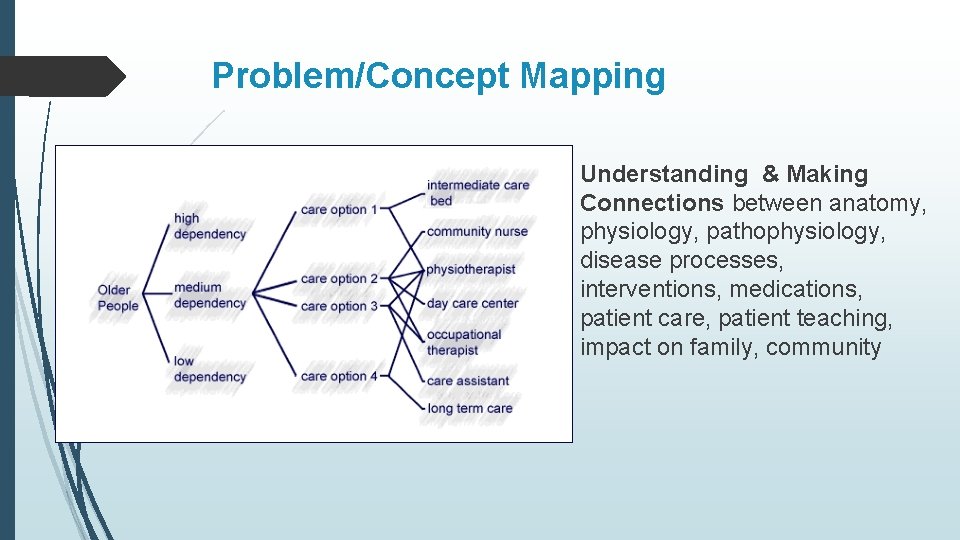
Problem/Concept Mapping Understanding & Making Connections between anatomy, physiology, pathophysiology, disease processes, interventions, medications, patient care, patient teaching, impact on family, community
Distance Learning E-learning Videoconferencing Computer–Assisted Instruction Discusion Groups and Chat Rooms

- Slides: 27