
Overview of SRHR Situation in East Africa Presented

- Slides: 31
Overview of SRHR Situation in East Africa Presented to EALA Committee on GP in Bujumbura: 24 th -25 th Jan, 2020 Kenneth Juma, MPH, MSc.
What is Sexual and Reproductive Health and Rights (SRHR)?
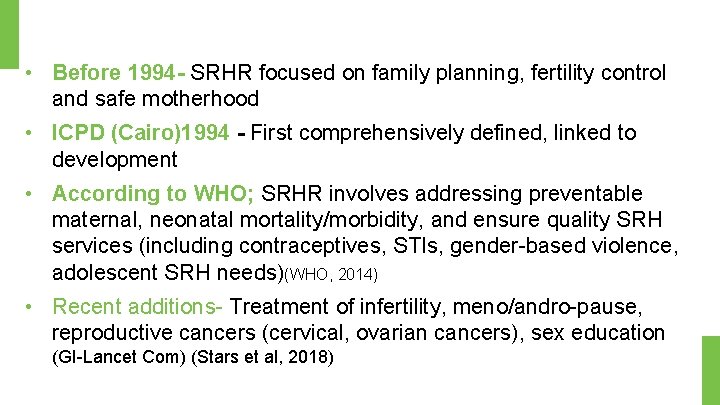
• Before 1994 - SRHR focused on family planning, fertility control and safe motherhood • ICPD (Cairo)1994 - First comprehensively defined, linked to development • According to WHO; SRHR involves addressing preventable maternal, neonatal mortality/morbidity, and ensure quality SRH services (including contraceptives, STIs, gender-based violence, adolescent SRH needs)(WHO, 2014) • Recent additions- Treatment of infertility, meno/andro-pause, reproductive cancers (cervical, ovarian cancers), sex education (GI-Lancet Com) (Stars et al, 2018)
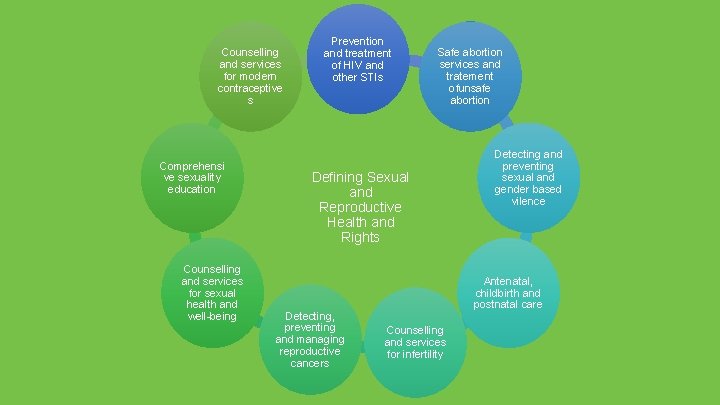
Counselling and services for modern contraceptive s Comprehensi ve sexuality education Counselling and services for sexual health and well-being Prevention and treatment of HIV and other STIs Safe abortion services and tratement ofunsafe abortion Defining Sexual and Reproductive Health and Rights Detecting, preventing and managing reproductive cancers Detecting and preventing sexual and gender based vilence Antenatal, childbirth and postnatal care Counselling and services for infertility
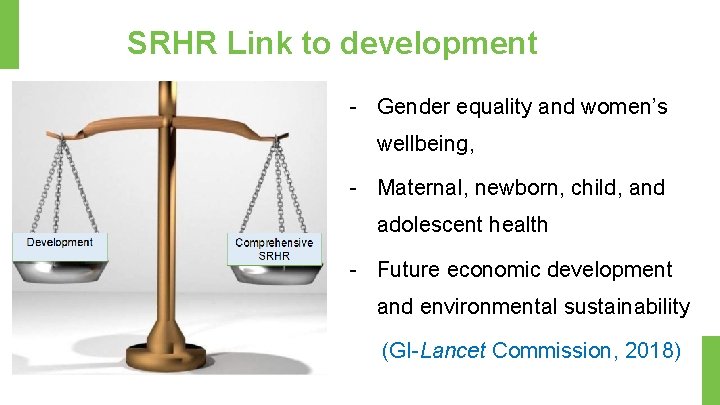
SRHR Link to development - Gender equality and women’s wellbeing, - Maternal, newborn, child, and adolescent health - Future economic development and environmental sustainability (GI-Lancet Commission, 2018)
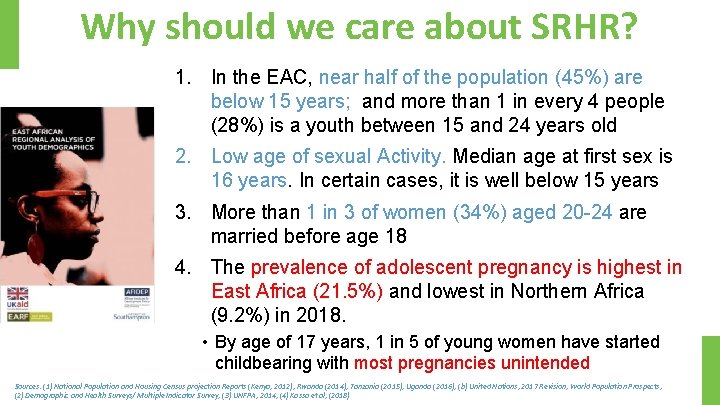
Why should we care about SRHR? 1. In the EAC, near half of the population (45%) are below 15 years; and more than 1 in every 4 people (28%) is a youth between 15 and 24 years old 2. Low age of sexual Activity. Median age at first sex is 16 years. In certain cases, it is well below 15 years 3. More than 1 in 3 of women (34%) aged 20 -24 are married before age 18 4. The prevalence of adolescent pregnancy is highest in East Africa (21. 5%) and lowest in Northern Africa (9. 2%) in 2018. • By age of 17 years, 1 in 5 of young women have started childbearing with most pregnancies unintended Sources: (1) National Population and Housing Census projection Reports (Kenya, 2012), Rwanda (2014), Tanzania (2015), Uganda (2016); (b) United Nations, 2017 Revision, World Population Prospects; (2) Demographic and Health Surveys/ Multiple Indicator Survey; (3) UNFPA, 2014; (4) Kassa et al, (2018)
5. Unsafe abortions are common in the region, In Kenya, 464, 000 women had abortions in 2013; leading to severe illnesses (70% had severe complications), high costs of care, and deaths (13% of maternal deaths) 6. Sexual and gender-based violence (SGBV) is common. In Uganda, more than 6 in 10 women (63%) had experienced physical/sexual violence or both in their lives. 7. High number of Maternal Mortalities – low quality of in-facility deliveries 8. HIV prevalence (1%BU, 2. 5%S. S, 2. 5%RW, 4. 7%KE, 4. 6%TZ, 5. 7%UG) Sources: (5) APHRC & Guttmacher Institute, 2013; (6)UDHS, 2011, (8) UNAIDS, 2018;
I will describe the following in details 1. Early sexual Debut 2. , Harmful practices (Early/forced child marriage), Female Genital Mutilation, Transactional sex, 3. SGBV 4. Teenage Pregnancy 5. Unsafe abortion 6. Safe motherhood - causes of maternal morbidity, mortality, effects of mortality 7. HIV/AIDS (90 -90 -90) and STIs - incidence, population and key pops; 8. Contraception-need for spacing (FP)
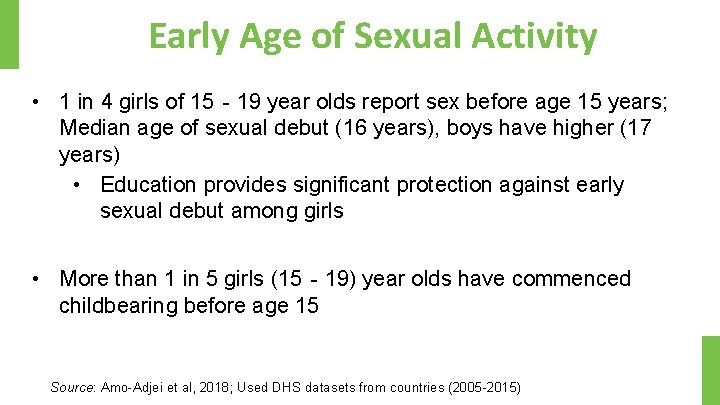
Early Age of Sexual Activity • 1 in 4 girls of 15‐ 19 year olds report sex before age 15 years; Median age of sexual debut (16 years), boys have higher (17 years) • Education provides significant protection against early sexual debut among girls • More than 1 in 5 girls (15‐ 19) year olds have commenced childbearing before age 15 Source: Amo-Adjei et al, 2018; Used DHS datasets from countries (2005 -2015)
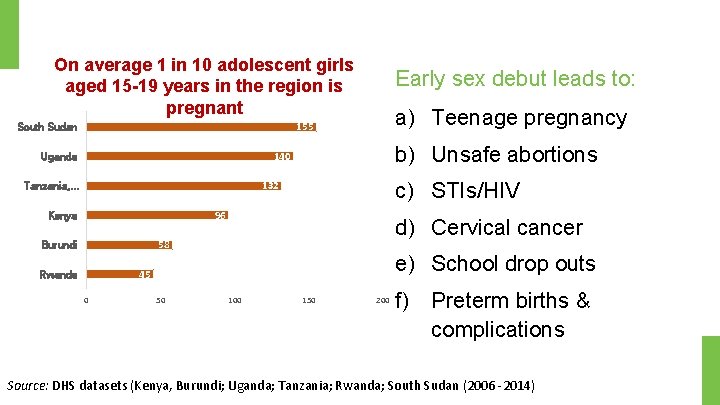
On average 1 in 10 adolescent girls aged 15 -19 years in the region is pregnant Early sex debut leads to: a) Teenage pregnancy 155 South Sudan b) Unsafe abortions 140 Uganda c) STIs/HIV 132 Tanzania, . . . 96 Kenya d) Cervical cancer 58 Burundi e) School drop outs 45 Rwanda 0 50 100 150 200 f) Preterm births & complications Source: DHS datasets (Kenya, Burundi; Uganda; Tanzania; Rwanda; South Sudan (2006 -2014)
So what is the way forward? Much of the power and leadership is in the hands of law makers
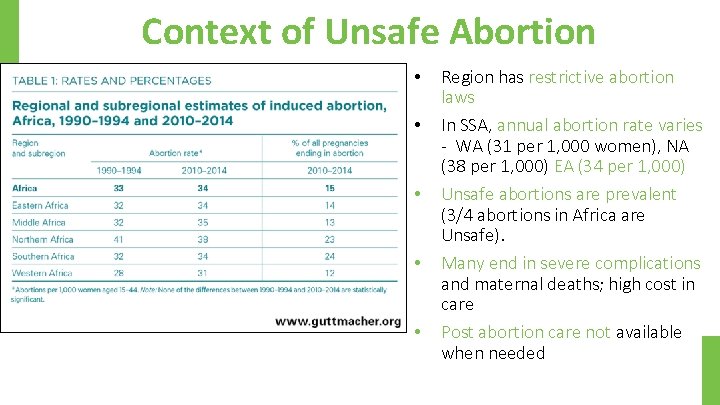
Context of Unsafe Abortion • • • Region has restrictive abortion laws In SSA, annual abortion rate varies - WA (31 per 1, 000 women), NA (38 per 1, 000) EA (34 per 1, 000) Unsafe abortions are prevalent (3/4 abortions in Africa are Unsafe). Many end in severe complications and maternal deaths; high cost in care Post abortion care not available when needed
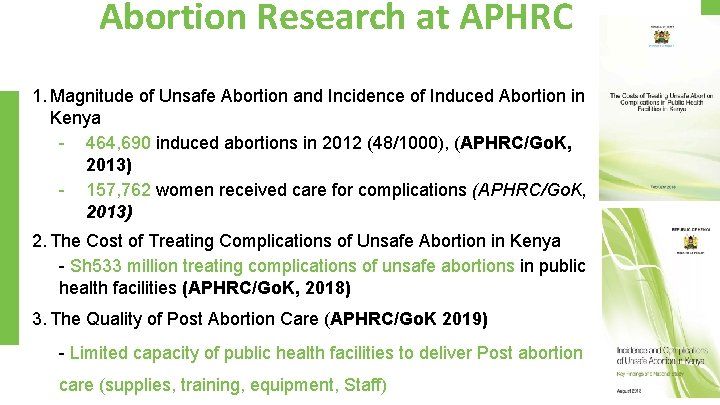
Abortion Research at APHRC 1. Magnitude of Unsafe Abortion and Incidence of Induced Abortion in Kenya - 464, 690 induced abortions in 2012 (48/1000), (APHRC/Go. K, 2013) - 157, 762 women received care for complications (APHRC/Go. K, 2013) 2. The Cost of Treating Complications of Unsafe Abortion in Kenya - Sh 533 million treating complications of unsafe abortions in public health facilities (APHRC/Go. K, 2018) 3. The Quality of Post Abortion Care (APHRC/Go. K 2019) - Limited capacity of public health facilities to deliver Post abortion care (supplies, training, equipment, Staff)
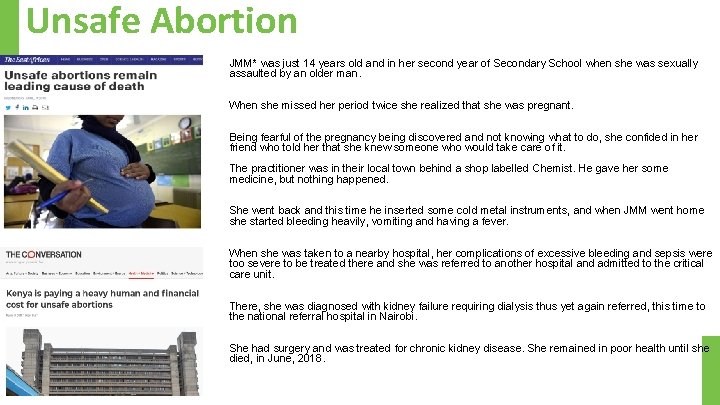
Unsafe Abortion JMM* was just 14 years old and in her second year of Secondary School when she was sexually assaulted by an older man. When she missed her period twice she realized that she was pregnant. Being fearful of the pregnancy being discovered and not knowing what to do, she confided in her friend who told her that she knew someone who would take care of it. The practitioner was in their local town behind a shop labelled Chemist. He gave her some medicine, but nothing happened. She went back and this time he inserted some cold metal instruments, and when JMM went home she started bleeding heavily, vomiting and having a fever. When she was taken to a nearby hospital, her complications of excessive bleeding and sepsis were too severe to be treated there and she was referred to another hospital and admitted to the critical care unit. There, she was diagnosed with kidney failure requiring dialysis thus yet again referred, this time to the national referral hospital in Nairobi. She had surgery and was treated for chronic kidney disease. She remained in poor health until she died, in June, 2018.
What can you do to prevent unsafe abortions?
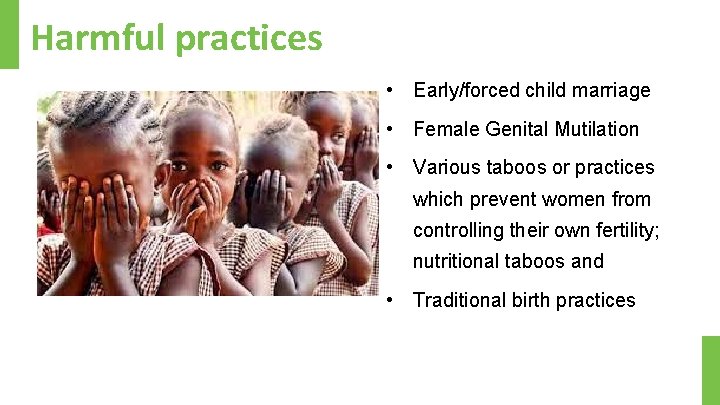
Harmful practices • Early/forced child marriage • Female Genital Mutilation • Various taboos or practices which prevent women from controlling their own fertility; nutritional taboos and • Traditional birth practices
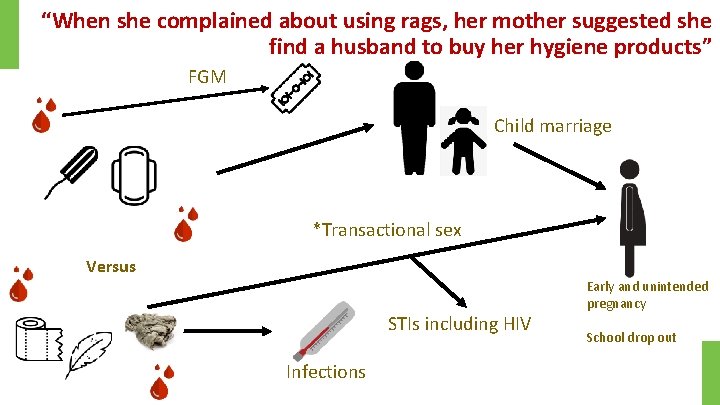
“When she complained about using rags, her mother suggested she find a husband to buy her hygiene products” FGM Child marriage *Transactional sex Versus STIs including HIV Infections Early and unintended pregnancy School drop out .
Violence, abuse and exploitation: • Up to 45% of adolescent girls report that their first sexual experience was forced(UNAIDS, 2014, 2016) • Increasing risk and vulnerability to infections and other outcomes • Persons with disabilities most likely to be abused • Young women who experience intimate partner violence are 50% more likely to acquire HIV than women who have not (UNAIDS, 2019)
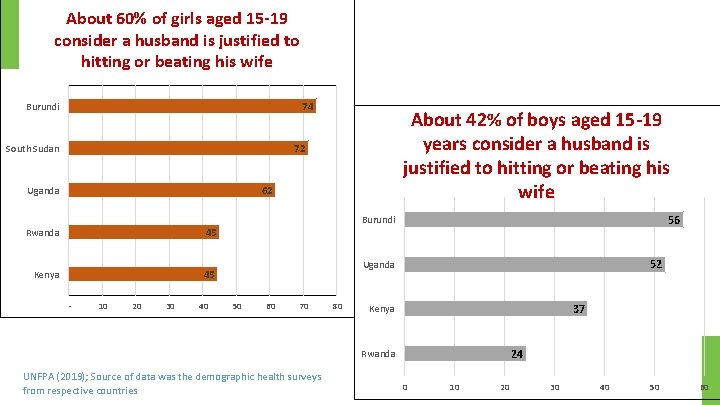
About 60% of girls aged 15 -19 consider a husband is justified to hitting or beating his wife 74 Burundi About 42% of boys aged 15 -19 years consider a husband is justified to hitting or beating his wife 72 South Sudan 62 Uganda Rwanda 45 Kenya 45 - 10 20 30 40 56 Burundi 52 Uganda 50 60 70 80 37 Kenya 24 Rwanda UNFPA (2019); Source of data was the demographic health surveys from respective countries 0 10 20 30 40 50 60
Gender and Sexual violence leads to; • Mental health issues, Infections such as HIV, Suicide, and Rape • Challenges accessing justice • New forms of violence continue to emerge - revenge pornography
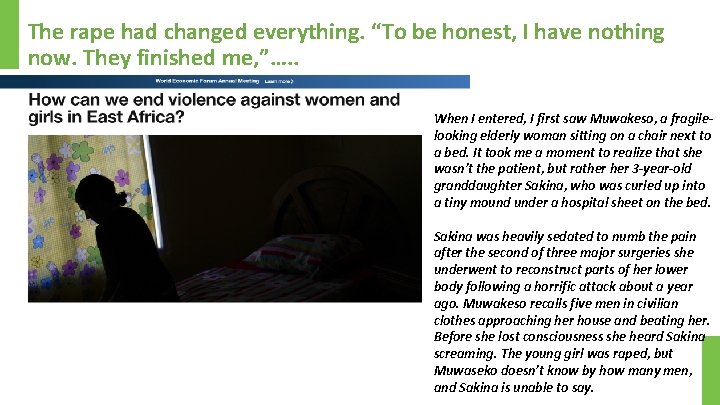
The rape had changed everything. “To be honest, I have nothing now. They finished me, ”…. . When I entered, I first saw Muwakeso, a fragilelooking elderly woman sitting on a chair next to a bed. It took me a moment to realize that she wasn’t the patient, but rather 3 -year-old granddaughter Sakina, who was curled up into a tiny mound under a hospital sheet on the bed. Sakina was heavily sedated to numb the pain after the second of three major surgeries she underwent to reconstruct parts of her lower body following a horrific attack about a year ago. Muwakeso recalls five men in civilian clothes approaching her house and beating her. Before she lost consciousness she heard Sakina screaming. The young girl was raped, but Muwaseko doesn’t know by how many men, and Sakina is unable to say.
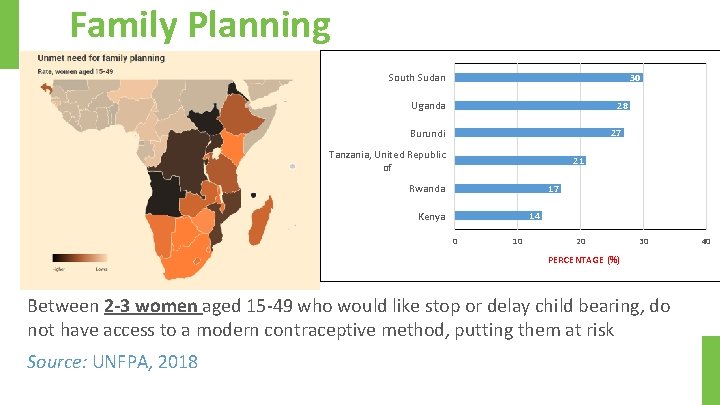
Family Planning South Sudan 30 Uganda 28 Burundi 27 Tanzania, United Republic of 21 Rwanda 17 Kenya 14 0 10 20 30 PERCENTAGE (%) Between 2 -3 women aged 15 -49 who would like stop or delay child bearing, do not have access to a modern contraceptive method, putting them at risk Source: UNFPA, 2018 40
Lack of access to FP/contraceptives leads to; • Unintended pregnancies • Unsafe abortion • Maternal and Child morbidity and mortality • Poverty
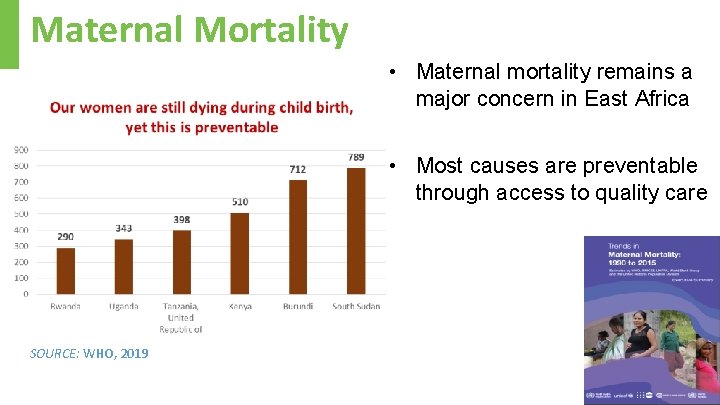
Maternal Mortality • Maternal mortality remains a major concern in East Africa • Most causes are preventable through access to quality care SOURCE: WHO, 2019
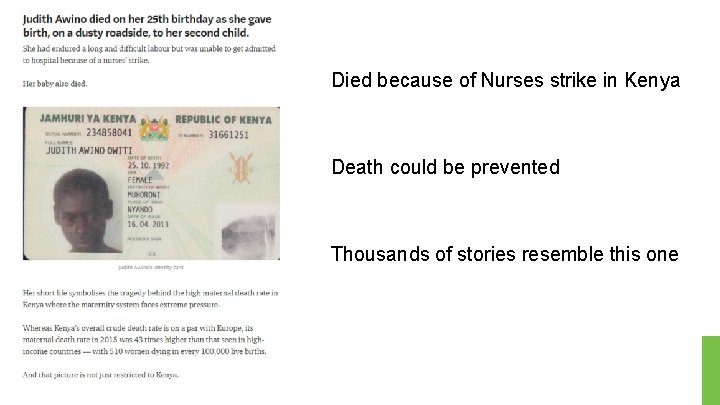
- Died because of Nurses strike in Kenya - Death could be prevented - Thousands of stories resemble this one
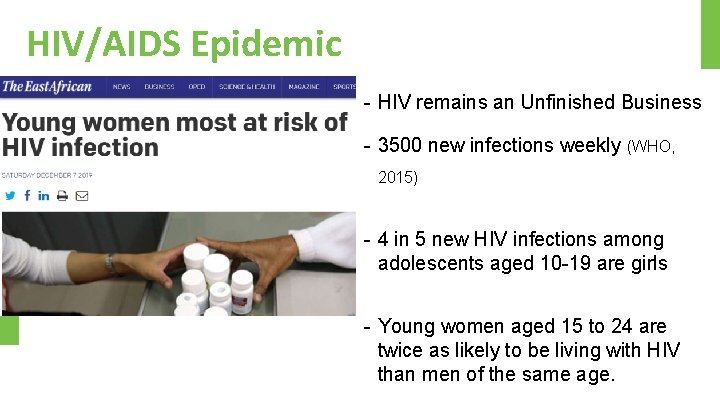
HIV/AIDS Epidemic - HIV remains an Unfinished Business - 3500 new infections weekly (WHO, 2015) - 4 in 5 new HIV infections among adolescents aged 10 -19 are girls - Young women aged 15 to 24 are twice as likely to be living with HIV than men of the same age.
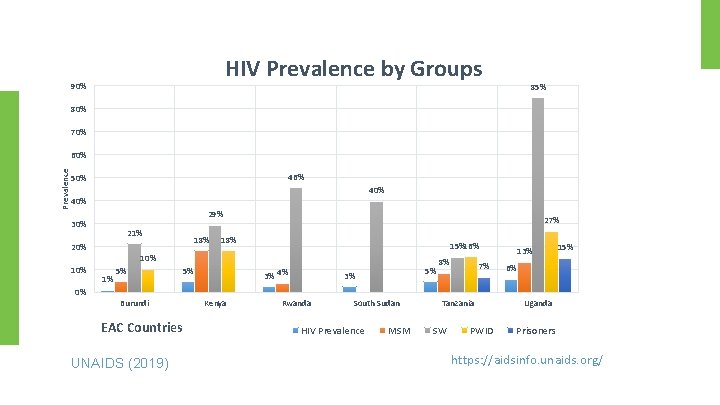
Groups most affected by HIV epidemic • Sex workers • People with Injectable drugs • Vulnerable populations • Clients of sex workers and other sexual partners of key populations
HIV Prevalence by Groups 90% 85% 80% 70% Prevalence 60% 46% 50% 40% 29% 30% 21% 18% 20% 27% 18% 15%16% 10% 0% 1% 5% Burundi EAC Countries UNAIDS (2019) 5% 3% 4% Kenya 5% 3% Rwanda South Sudan HIV Prevalence MSM 8% 7% Tanzania SW PWID 13% 15% 6% Uganda Prisoners https: //aidsinfo. unaids. org/
CONTACTS Kenneth Juma +254 726 902 835 kjuma@aphrc. org @kennethjuma
THANK YOU @APHRC www. aphrc. org