
Overview of SHAllow WAter Initiative HAWAI JIP Shallow
- Slides: 29
Overview of SHAllow WAter Initiative (HAWAI JIP) Shallow Water Hydrodynamics Seminar, Trondheim, Dec 19, 2005 Radboud van Dijk and Bas Buchner, MARIN
History HAWAI JIP – – April 21, 2004: Feb 1 -2, 2005: May 5, 2005: Oct 25, 2005: Birth of initiative (SBM model tests) Shallow Water Seminar @ MARIN Informative mtg Houston Kick-off mtg Cambridge (UK) 2
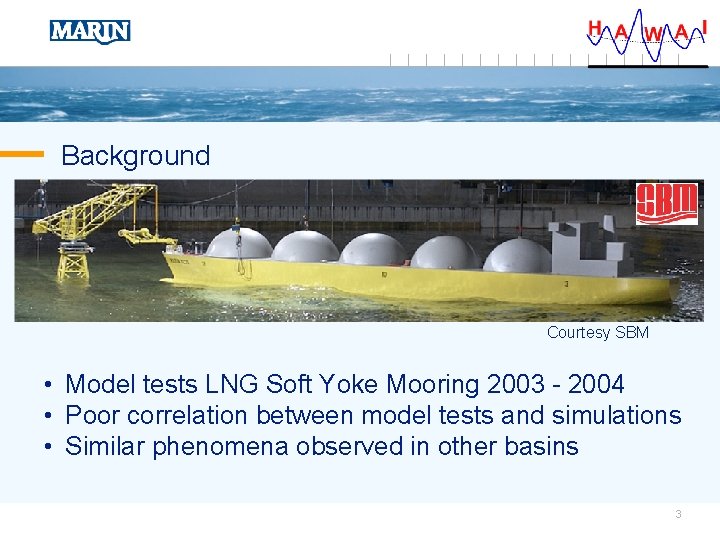
Background Courtesy SBM • Model tests LNG Soft Yoke Mooring 2003 - 2004 • Poor correlation between model tests and simulations • Similar phenomena observed in other basins 3
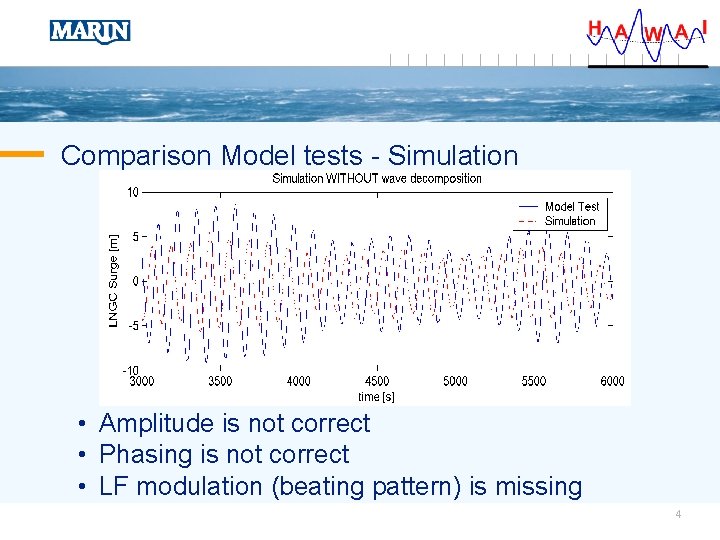
Comparison Model tests - Simulation • Amplitude is not correct • Phasing is not correct • LF modulation (beating pattern) is missing 4
Cause of Differences ? – Extensive study and model test program to determine cause of these differences – Causes: – – – Low damped surge of LNG carrier hull (<1%) Low frequency waves in basin Shallow water 5
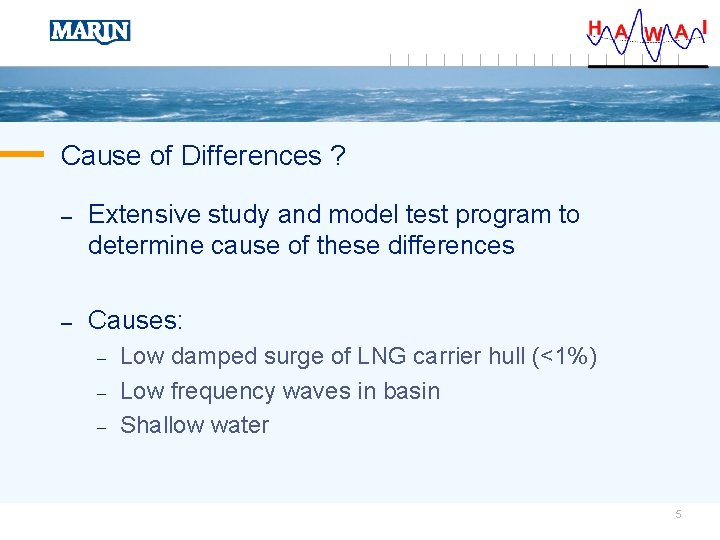
Solution – – – Determine wave content in basin Take into account low frequency waves in basin Split measured LF wave signal into: – – – LF bound wave (setdown) LF free incident waves LF free reflected waves 6
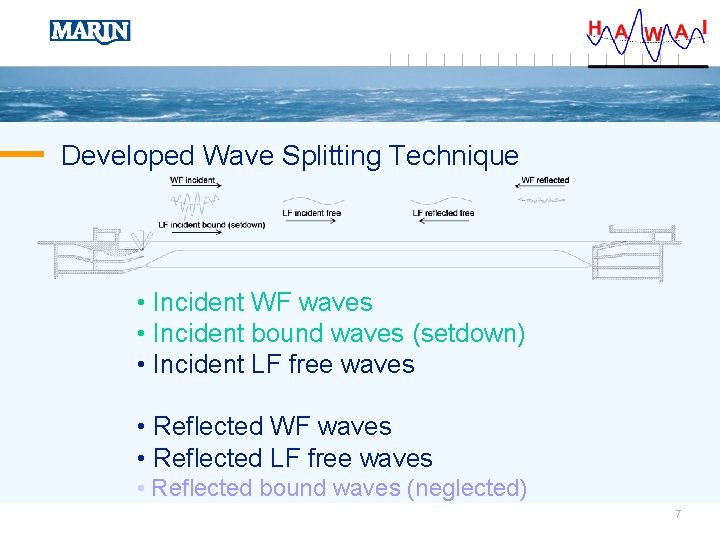
Developed Wave Splitting Technique • Incident WF waves • Incident bound waves (setdown) • Incident LF free waves • Reflected WF waves • Reflected LF free waves • Reflected bound waves (neglected) 7
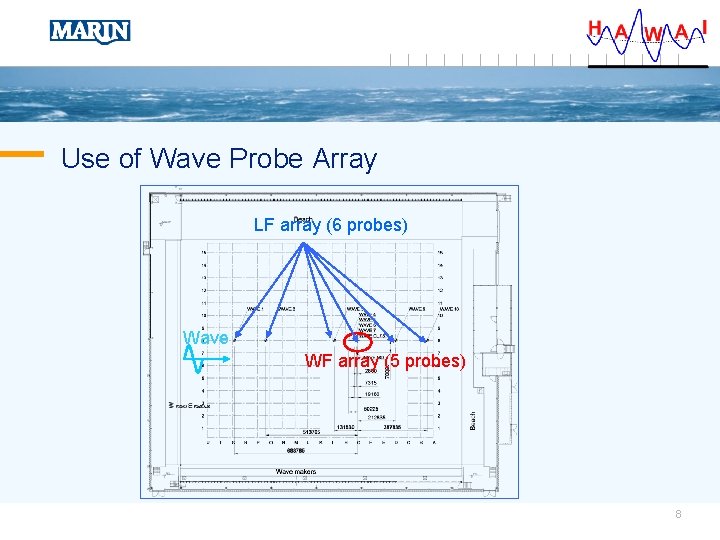
Use of Wave Probe Array LF array (6 probes) Wave WF array (5 probes) 8
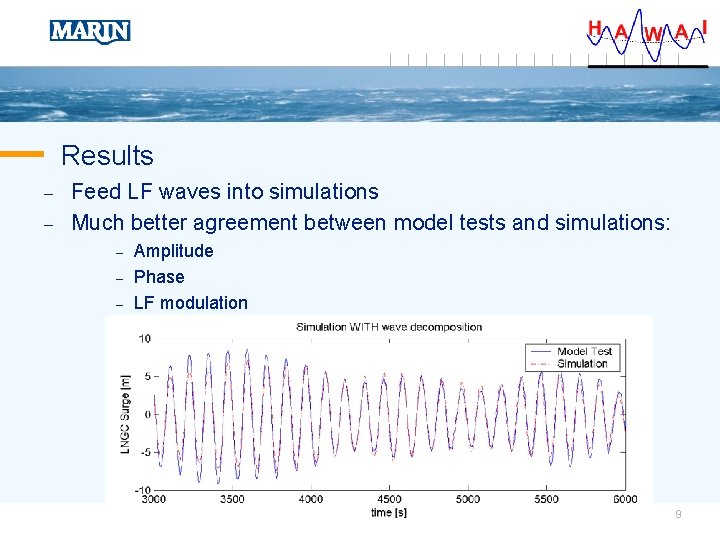
Results – – Feed LF waves into simulations Much better agreement between model tests and simulations: – – – Amplitude Phase LF modulation 9
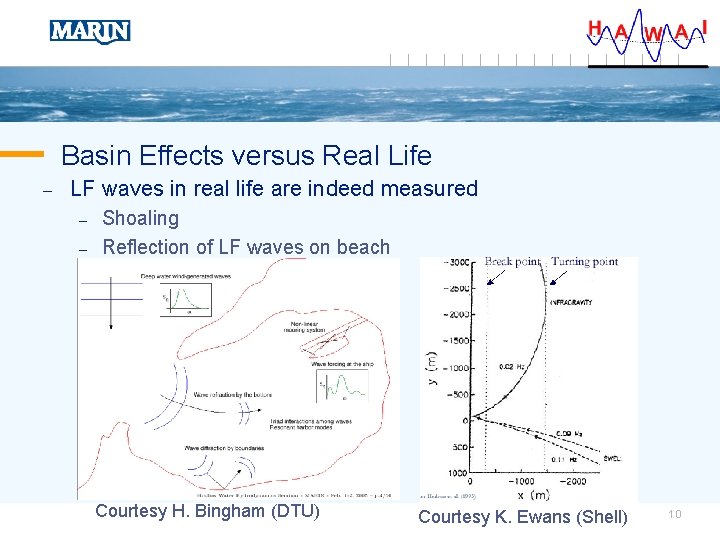
Basin Effects versus Real Life – LF waves in real life are indeed measured – – Shoaling Reflection of LF waves on beach Courtesy H. Bingham (DTU) Courtesy K. Ewans (Shell) 10
Numerical Investigation on LF Waves – Shoaling – – FE method (HUBRIS) Wave generated by modeling of wave flap Transient of wave spectrum from deep to shallow water Shallow water effects and reflection – – Boussinesq type wave model (TRITON) Takes into account: – – – Bottom friction Wave breaking Reflection on beach 11
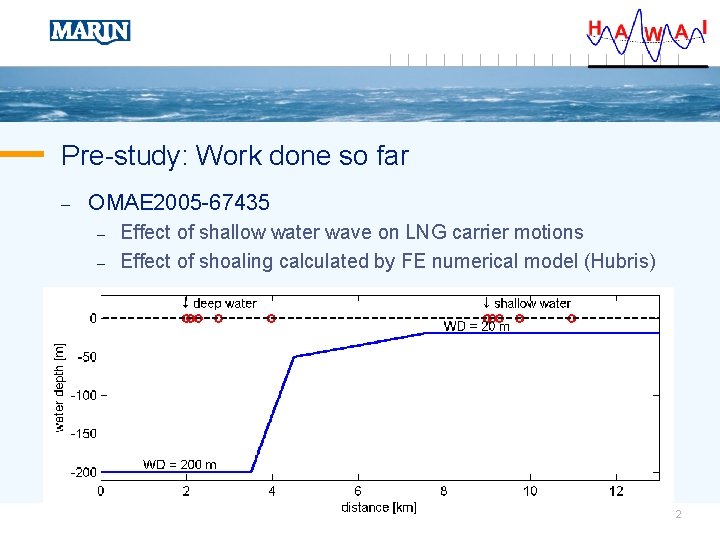
Pre-study: Work done so far – OMAE 2005 -67435 – – Effect of shallow water wave on LNG carrier motions Effect of shoaling calculated by FE numerical model (Hubris) 12
Pre-study: Work done so far – Effect of shoaling on waves: – 1) 1 st order wave and LF component (movie Pre. Study 1. AVI) – 2) Bound wave & free LF wave (movie Pre. Study 2. AVI) 13
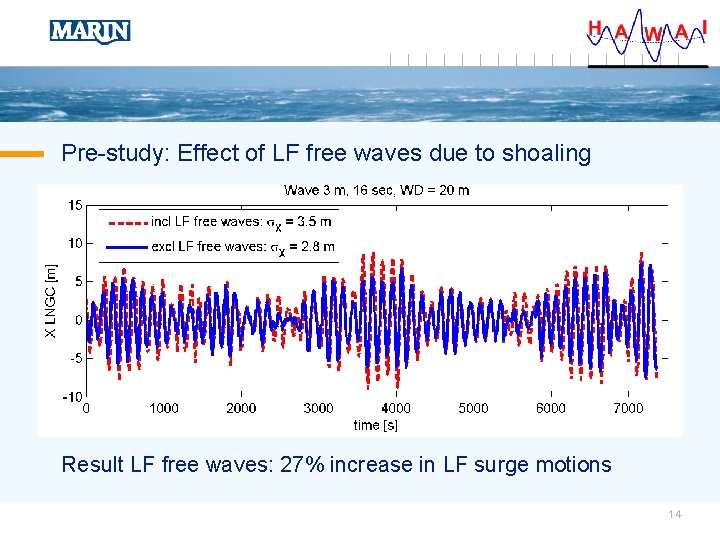
Pre-study: Effect of LF free waves due to shoaling Result LF free waves: 27% increase in LF surge motions 14
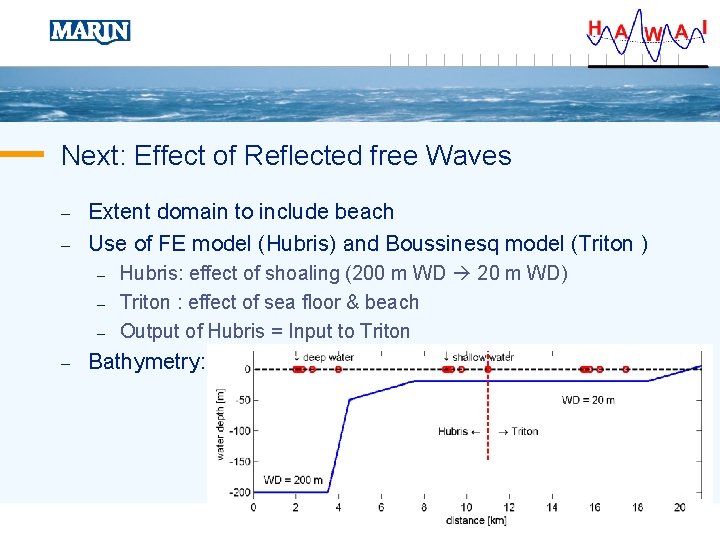
Next: Effect of Reflected free Waves – – Extent domain to include beach Use of FE model (Hubris) and Boussinesq model (Triton ) – – Hubris: effect of shoaling (200 m WD 20 m WD) Triton : effect of sea floor & beach Output of Hubris = Input to Triton Bathymetry: 15
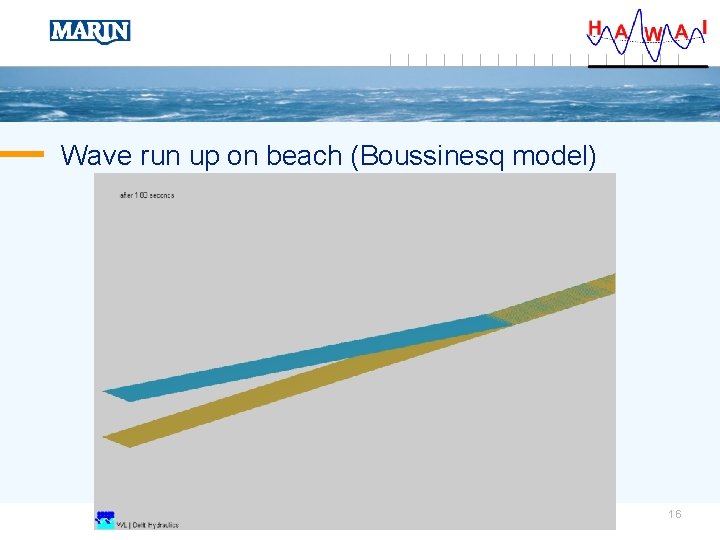
Wave run up on beach (Boussinesq model) 16
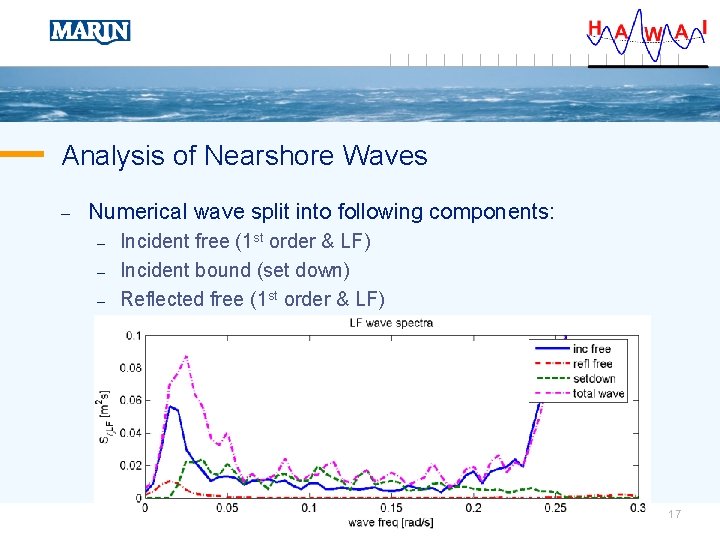
Analysis of Nearshore Waves – Numerical wave split into following components: – – – Incident free (1 st order & LF) Incident bound (set down) Reflected free (1 st order & LF) 17
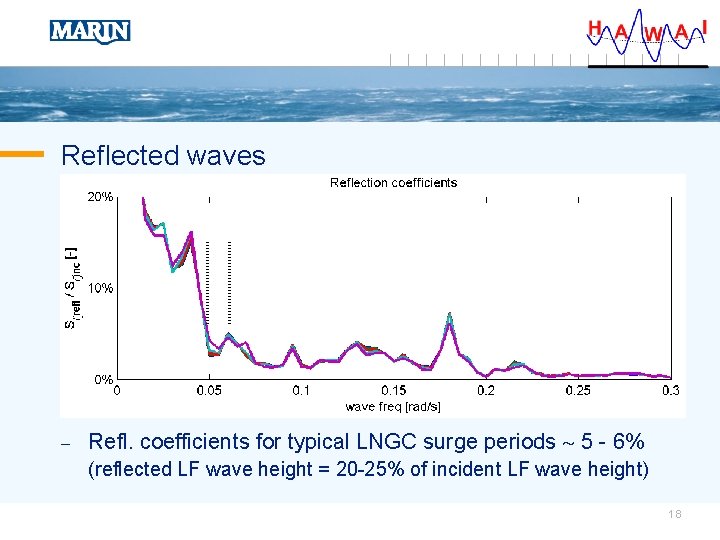
Reflected waves – Refl. coefficients for typical LNGC surge periods 5 - 6% (reflected LF wave height = 20 -25% of incident LF wave height) 18
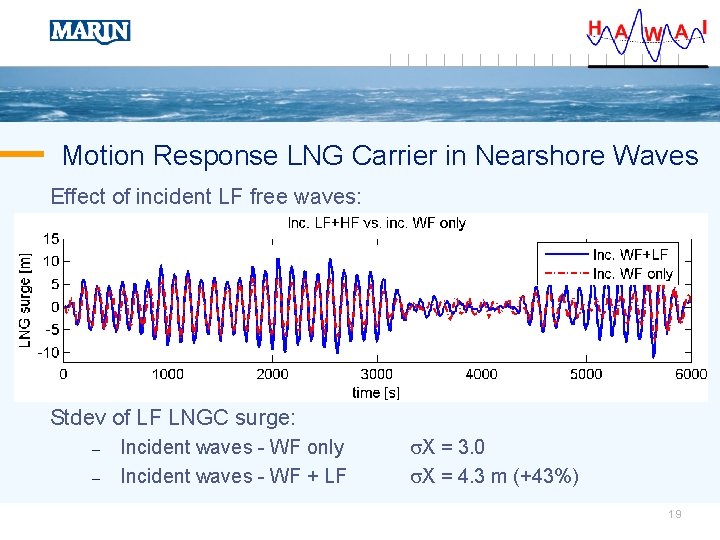
Motion Response LNG Carrier in Nearshore Waves Effect of incident LF free waves: Stdev of LF LNGC surge: – – Incident waves - WF only Incident waves - WF + LF X = 3. 0 X = 4. 3 m (+43%) 19
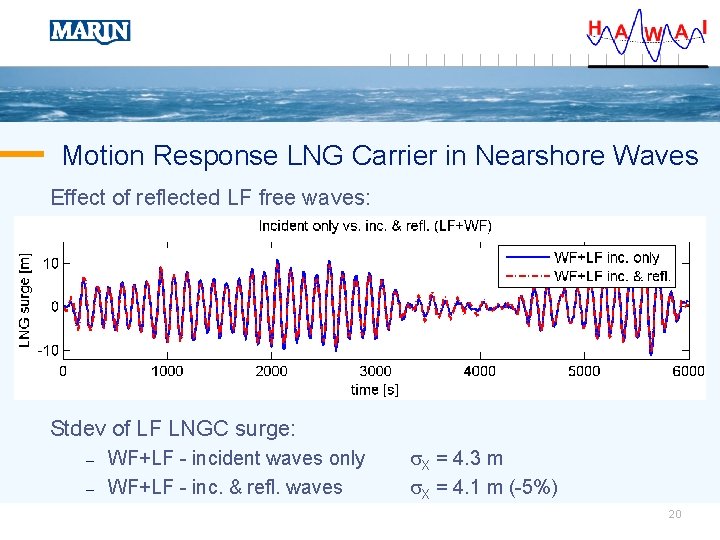
Motion Response LNG Carrier in Nearshore Waves Effect of reflected LF free waves: Stdev of LF LNGC surge: – – WF+LF - incident waves only WF+LF - inc. & refl. waves X = 4. 3 m X = 4. 1 m (-5%) 20
Results of Numerical Prestudy – – – Effect of LF free waves on LF vessel motions is significant Pre-study shows small amount of reflected free waves in wave model ( 5% of incident free LF wave energy) Effect of these LF reflected waves on LF vessel motions is small (decrease in motions observed) What is actual LF free wave content (inc. & refl. ) ? Analysis of Duck data 21
Objective HAWAI JIP To improve the reliability of offshore (LNG) terminals in shallow water by using the combined expertise of offshore hydrodynamics and coastal engineering to better address key issues regarding motion and mooring prediction methods in shallow water 22
Scope of Work HAWAI JIP – Case study “LNG carrier in a nearshore wave field” – WP 1: Nearshore Wave Modelling – WP 2: Model Testing for Shallow Water – WP 3: Hydrodynamic Wave Loading – WP 4: Validation and Guidelines 23
Case study: “LNG carrier in a nearshore wave field” – – – Assess importance of nearshore wave data Use of state-of-the-art mooring tools Focus on the effect of – LF wave energy – Directional waves Input: realistic wave data (including LF content) Two different methods: 1) Classical approach: wave spectrum & diffraction calculations 2) Boussinesq-type wave model & diffraction analysis 24
WP 1: Nearshore Wave Modelling – – – WP leader: Delft Hydraulics Co-operation with Bingham Deliverables: a. b. c. d. State-of-the-art overview of nearshore wave modelling Identify the relevant aspects of nearshore wave behaviour Analysis of available nearshore wave data Evaluation of short-crested/directional waves modelling by means of shallow water (Boussinesq-type) wave models 25
WP 2: Model Testing – – – WP leader: MARIN Co-operation with Pinkster, MARINTEK & Oceanic Deliverables: a. b. c. d. Systematic database of current coefficients Develop a wave splitting / separation technique & tool Model tests for validation of hydrodynamic issues Cross-bi-spectral method to determine the full QTF matrix from model tests e. Recommendations for shallow water testing 26
WP 3: Hydrodynamic Wave Loading – – WP leader: Bureau Veritas Deliverables: a. b. c. d. e. f. Wave-current interaction in shallow water Effects of sea bed bathymetry Evaluation of QTFs in multi-directional waves Inventory of various methods to compute QTF matrices New formulations of second-order wave loads Optimisation of wave drift force time-series reconstruction 27
WP 4: Validation and Guidelines – – WP leader: SBM Deliverables: a. b. c. d. e. f. Compare results of different diffraction codes Investigate QTF approximations and limits Methodology to include the free LF wave in time domain Effect of wave directionality Validation model tests and simulations Summary report with detailed guidelines 28
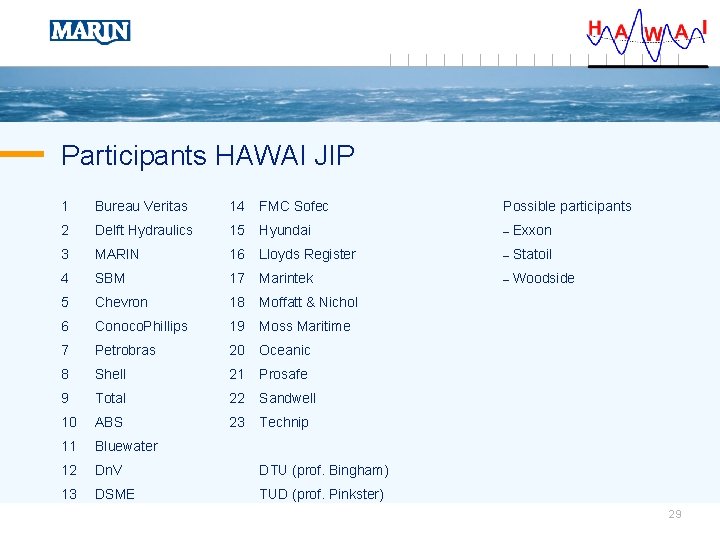
Participants HAWAI JIP 1 Bureau Veritas 14 FMC Sofec Possible participants 2 Delft Hydraulics 15 Hyundai – Exxon 3 MARIN 16 Lloyds Register – Statoil 4 SBM 17 Marintek – Woodside 5 Chevron 18 Moffatt & Nichol 6 Conoco. Phillips 19 Moss Maritime 7 Petrobras 20 Oceanic 8 Shell 21 Prosafe 9 Total 22 Sandwell 10 ABS 23 Technip 11 Bluewater 12 Dn. V DTU (prof. Bingham) 13 DSME TUD (prof. Pinkster) 29